Books by Irving Singer
George Santayana, Literary Philosopher
Reality Transformed: Film as Meaning and Technique
Meaning in Life
The Creation of Value
The Pursuit of Love
The Harmony of Nature and Spirit
The Nature of Love
Plato to Luther
Courtly and Romantic
The Modern World
Mozart and Beethoven: The Concept of Love in Their Operas
The Goals of Human Sexuality
Santayana’s Aesthetics
Essays in Literary Criticism by George Santayana (editor)
The Nature and Pursuit of Love: The Philosophy
George Santayana, Literary Philosopher
Irving Singer
Copyright © by Irving Singer. All rights reserved.
This book may not be reproduced, in whole or in part, including illustrations, in any form (beyond that copying permitted by Sections and of the
U.S. Copyright Law and except by reviewers for the public press), without written permission from the publishers.
Designed by Rebecca Gibb.
Set in Bembo type by The Composing Room of Michigan, Inc. Printed in the United States of America
by Vail-Ballou Press, Binghamton, New York.
Library of Congress Cataloging-in-Publication Data
Singer, Irving.
George Santayana, literary philosopher / Irving Singer. p. cm.
Includes bibliographical references (p. ) and index. ISBN ---(cloth : alk. paper)
. Santayana, George,‒. I. Title. B.SS
—dc -
A catalogue record for this book is available from the British Library.
The paper in this book meets the guidelines for permanence and durability of the Committee on Production Guidelines for Book Longevity of the Council
on Library Resources.
Contents
Preface ix
A Pilgrimage to Santayana
His Host the World
The Last Puritan
Idealization: Santayana versus Freud
Santayana’s Philosophy of Love
Santayana as a Literary Critic
Greatness in Art
The Basis of Aesthetic and Moral Criticism
Epilogue
Notes
Preface
,the American philosopher who meant the most to me was John Dewey. During my early years, which co-incided with the Depression and World War II, Dewey represented most of what I believed in at the time: naturalism, humanism, dem-ocratic pluralism, pragmatism as the clue to knowledge. I felt that he, better than any other philosopher I had read, understood the goodness of a healthy-minded life that combines the best in science and in art. My undergraduate honors thesis on Dewey’s theory of
value was a sympathetic, though somewhat critical, attempt to ex-tend his fundamental orientation beyond the limits he had set. I never thought of myself as a disciple, and Dewey’s impoverished lit-erary style often made me cringe. Nevertheless, I saw him as a model of how an intellectual could also be an active force in society, e
ffi-cacious through his writing as well as through his devotion to lib-eral causes that mattered greatly to me.
As the years went by, I gravitated more and more toward the work of George Santayana. I wrote my graduate dissertation on his aesthetics, which seemed to me more challenging and possibly more fertile than Dewey’s. I later realized that, among philosophers trained in the Anglo-Saxon traditions of the nineteenth and twen-tieth centuries, only Santayana had exhaustively investigated the questions about love that increasingly interested me—questions about love as a topic in philosophy as well as a theme in literature and all the other arts. From the start, I considered Santayana’s Neo-platonism a serious impediment in his official outlook. But since I had always loved the dialogues of Plato as supreme examples of lit-erature no less than philosophy, I was fascinated by Santayana’s merging of a twentieth-century version of Platonism with an up-to-date materialism to which he gave equal importance.
Relying on Dewey as my touchstone for a wholesome, balanced, and defensible alternative to both Platonistic idealism and reduc-tivist materialism, I found myself in the anomalous position of re-pudiating Santayana’s doctrine while also relishing his resplendent construction of it. Though I concluded that his attempt to unify Platonism and naturalism fails as philosophy, I felt then, and always have, that it succeeds as an exciting and uniquely inspirational ex-pression of humanistic imagination. Santayana was what the Span-ish call a pensador,a thinker in the broadest sense, whose books were
filled with rich aperçus and wise inventiveness. I found his think-ing closer to actual experience than any other contemporary
losophy in the English language. His prose glittered and was bur-nished in a manner that invited emulation at whatever level I my-self might someday attain.
I was additionally attracted to Santayana’s approach by the fact that it encompasses persistent modes of alienation recurrent in his own experience but characteristic of the world as I knew it too. Santayana was both an insider and an outsider in American life. Al-though he resided in the United States for more than forty years, he remained until he died a European man of letters and a Spanish citizen.Throughout his life he was a Catholic and an atheist,a scholar and an author addressing the intelligent public at large, a man who saw the world as many other Spaniards did but one whose works were written in English, a technical philosopher as well as a poet, critic, novelist, and cultural historian, a product of his time yet never at home in it. He was all these as they enacted a permanent coun-terpoint of divisions within himself. I was not divided in the same way as he, but his example helped me to see the extent to which I was alienated as well. If the benign and consummate activism of Dewey proferred an ideal that I might contemplate at a distance, study of the problematics of Santayana’s philosophy showed me the residual rifts that my kind of person would have to face up to sooner or later. Dewey could never have elicited that awareness in me.
A few years ago I was asked to participate in a documentary about Santayana’s life and work, to be directed toward teen-age Hispanics in America. At first I thought that the project was utterly unrealistic. How many young people nowadays, regardless of their ethnic origin, would even have heard of Santayana? How many of them would want to know about anything he had published? But then it occurred to me that this venture could serve a useful pur-pose. Most of the students who would watch the video were also alienated from their American surroundings. Not entirely but to a large degree, they experienced many of the inner divisions that
Santayana underwent. The young Hispanics might never read much of what he wrote, but they could easily appreciate the na-ture of his situation as a human being. Learning that he survived, even flourished, through faith in his capacity to surmount his alien-ated condition, to transform it creatively by works of individual talent that his imagination made available to him, they might in-tuit a comparable solution for themselves. Whether or not the video would actually attain this goal, I was happy to participate in it after all.1
This book may be taken as a similar attempt. It is an introduc-tion to the part of Santayana’s philosophy that has meant the most to me. Though it begins with an account of my first acquaintance with his thought, and my visit to him in Rome, it is a portrayal of his lasting achievement from the perspective of its humanistic rel-evance. It concentrates on problems about the nature of art, criti-cism, love, and the good life as Santayana formulated them in his books. Over the years my own writing as a literary philosopher was frequently inspired by developments in Santayana’s approach, even when I did not agree with them. The present book is a study of those developments, together with my reaction and running com-mentary.
I have considerably revised or rewritten most of the material in the text that originally appeared on other occasions. The sources are documented in the endnotes, but here I wish to remark that my discussion of Daniel Cory’s biography in Chapter had a different title when its earlier version was published in The New
York Review of Books. Without my foreknowledge, the editors of
that journal attached a heading that I consider pejorative to San-tayana’s genius. They entitled the piece “Marble Faun.”While this allusion to Hawthorne’s novel about American expatriates in Eu-rope is accurate and suggestive in various ways, it intimates a type of feckless, even effete, aestheticism that is grossly untrue to the
mature wisdom that Santayana acquired and expressed in his later years.
In retaining its focus upon Santayana’s humanistic philosophy, the book cites but scarcely discusses many important publications by other Santayana specialists. Since the Santayana Society came into existence twenty years ago, much has been written that is wor-thy of detailed attention. I hope such promising research will get the professional recognition it deserves. Though my work is de-signed for a more general audience,it also seeks to find a niche within that vital area of scholarship.
Among the many people who have aided and abetted the comple-tion of this book, in one way or another, I am particularly grateful to the following persons: James Engell, Cayetano Estébanez, Cán-dido Pérez Gállego, Carmen García-Trevijano, Manuel Garrido, Morris Grossman, Felipe Guardiola, José Antonio Gurpegui, Henry Hardy, Larisa Heimert, Angus Kerr-Lawson, Paul Grimley Kuntz, Richard A. Macksey, Timothy J. Madigan, Frederick Mor-gan, Joel Porte, Manuel Villar Raso, José M. Ruiz Ruiz, Herman J. Saatkamp, Jr., Michael Shinagel, Jo Singer, David Wapinsky, and David F. Wheeler.
A Pilgrimage to Santayana
in the twenty-first century assess the na-ture of twentieth-century philosophy from their own perspective, they may have some difficulty in placing the mind and works of George Santayana.There are two ways in which we might appraise his contribution. We could take him as a writer about the human condition who also did philosophy; or else as a theorist in various branches of philosophy who wrote essays, literary criticism, history of ideas, social commentary, volumes of poetry, a best-selling novel,
and so on. Both approaches to his talent must be employed, and interwoven, in order to attain a clear idea of what Santayana ac-complished in his books.
More than any other great philosopher in the English language, Santayana not only harmonized the two types of writing—the lit-erary and the philosophical—but also made harmonization of this sort a fundamental resource in his doctrinal outlook. In the preface to Scepticism and Animal Faithhe writes that if the reader is tempted to smile at the idea that he is offering “one more system of philos-ophy,”he smiles as well.1Despite its systematic structure, Santayana’s philosophy was intended to be an expression of the author’s per-sonal experience and imaginative interpretation of his life as he lived it. Neither in his works nor in anyone else’s, he thought, could a reader find the certitude and objectivity that so many oth-ers promised.
In taking this attitude, Santayana believed that philosophical speculation was inherently a literary pursuit and therefore a branch of the humanities rather than of the sciences. Santayana sought to further humanistic acuities that would permeate philosophy as they also permeate fine arts and the various forms of criticism that in-terpret and evaluate them. He denied that these different facets of human inspiration could be reduced or rendered subservient to technical procedures that science (correctly) employs for its own expertise. He recognized that the life of the mind, above all in the humanities, becomes stunted when artificial barriers are reared be-tween philosophy and literature or bebe-tween philosophy and history or, in a different dimension, between creative and critical insights. Ideally these would not be separated from one another. To the ex-tent that they establish a harmonious interpenetration, they enrich each other.
Above all in the United States, but now in most other countries, intellectual and academic fields have become increasingly
tered in the twentieth century, even split into hermetically distinct compartments. The long humanistic tradition that linked the early Renaissance to the art and history of the ancient world, and then continued to evolve for the next five hundred years, has suffered disabilities from which it may never recover. In the past few decades, the danger to the humanistic spirit has accelerated greatly. As a re-minder of what we have had, and as a model for what we may yet regain as a supplement to the new achievements on which we can rightly pride ourselves, Santayana’s books merit the renewed study that some scholars are now giving them. Though far from com-pleted, the new critical edition of his works has already encouraged this return to Santayana and what he represents as a philosopher.2 In a book published in , Somerset Maugham laments the fact that it was in the service of philosophy that Santayana used his “great gifts, gifts of imagery, of metaphor, of apt simile and of bril-liant illustration.” Maugham doubts that philosophy needs “the decoration of a luxuriance so lush.” He regretfully concludes: “It was a loss to American literature when Santayana decided to be-come a philosopher rather than a novelist.”3
In saying this, Maugham fails to recognize that Santayana’s liter-ary gifts were not employed for mere decoration, even when his prose was lush and luxuriant, but rather as the means by which he could express his view of the world in a way that transcends any pre-conceptions about what either literature or philosophy “ought” to be. Santayana’s fusion of the two disciplines was an enrichment, not a loss, to both American philosophy and American literature.
Writing in , John Crowe Ransom said: “Among philo-sophical personalities probably the most urbane and humanistic since Socrates is Mr. Santayana.”4In one of his letters Santayana remarks: “In my old-fashioned terminology, a Humanist means a person saturated by the humanities: Humanism is something cul-tural: an accomplishment, not a doctrine.”5 In renouncing
manism as a doctrine, Santayana was asserting his usual belief that the imagination must never be constrained by any fixed or codi-fied tenets. By serving as an accomplishment, humanism would il-lustrate the fact that virtually all areas of learning can find a home within the mentality of a person who is truly cultivated and radi-cally enlightened. Santayana’s writings themselves embody the highest aspirations of this humanistic faith, and throughout its sub-tle modulations his thought serves to buttress even the most di-versified types of humanism.
Nevertheless, Santayana’s philosophical novel The Last Puritan was generally neglected by professionals in literature as well as philosophy for almost sixty years after it was first published, and dur-ing most of that time there existed no inexpensive edition that English-language readers could readily acquire. For the most part Santayana’s other works were ignored not only by the prevailing tendencies in contemporary thought but also by the popular cul-ture. His ideas survived mainly in a few well-turned epigrams, such as the famous line (often misquoted) from Reason in Common Sense: “Those who cannot remember the past are condemned to repeat it.”6These words were traced in large letters on a placard just be-hind the altar in Jonestown, Guyana. After the massacre they were visible in photographs of the site that appeared in newspapers.They were, in fact, the only text to be seen—like holy script wrenched out of context.
This desecration of Santayana’s perceptiveness, and the unfriend-liness toward his philosophy in academic circles, may yet be rectified. My hope is partly based on healthy changes that are now occurring. More than at any time since Santayana’s death in , work is being done in the kind of humanistic approach that Santayana fa-vored. In various ways, though not massively as yet, American phi-losophy is returning to questions about the nature and quality of human experience, of living the good life, of creating or
ing values and expressing them in action as well as works of art. In Santayana’s day the subject matter would have been called morals. The French still use the word moralitéin this fashion, though the practice itself seems to be almost as imperiled with them as it is in the United States. The study of morals includes what philosophers currently categorize as “normative ethics.” It is best investigated by thinkers who are at home in all the areas of the humanities—in his-tory, literature, and the other arts, as well as in the broadest spec-trum of philosophical speculation.
In this realm of the intellect Santayana’s contribution is, I believe, superior to the efforts of any other American philosopher. I do not minimize the importance of his work in more technical branches of philosophy—in ontology, epistemology, aesthetics proper—but Santayana’s achievement as a humanistic thinker is what I admire most of all.
Concentrating on that aspect of Santayana’s productivity, my chap-ters cluster about his insight into the nature of imagination. In book after book, beginning with The Sense of Beautyin and contin-uing throughout his career as a philosopher, Santayana charted the ever-present functioning of what he called “the constructive imagination” in human existence.7 “The systematic relations in time and space,”he wrote,“and their dependence upon one another are the work of our imagination. . . . Unless human nature suffers an inconceivable change, the chief intellectual and aesthetic value of our ideas will always come from the creative action of the imag-ination.”8The work he did in this area primarily interested the two persons to whom my book is dedicated. From these mentors at Har-vard, I first learned how to appreciate Santayana’s thought. Their enthusiasm eventuated in my pilgrimage to the man himself, and
that propelled me into the explorations embodied in later pages of this book.
When I studied at Harvard shortly after the Second World War, Henry David Aiken was the most dynamic teacher in philosophy there at the time, and virtually the only one whose interests ranged through all the fields of the humanities. He was the resident aes-thetician and a former student of David W. Prall and Ralph Barton Perry. Prall had taught courses similar to Santayana’s, and Perry had been a disciple of William James.Through this derivation one could feel that Aiken, at his best, exemplified the spirit and many of the ideals of the Golden Age of Harvard philosophy to which San-tayana belonged.
As an undergraduate I had the good fortune to meet Walter Jackson Bate and to become one of the students he befriended. His specialty was English literature of the late eighteenth and early nineteenth century, but he saw in Santayana’s belletristic style a liv-ing proof that philosophy could still express itself in vibrant and graceful writing. For Bate as for Aiken, philosophy remained a hu-manistic activity rather than a conglomeration of inquiries into logic, linguistics, or the foundations of science. They revered San-tayana as one of the last humanists in this sense of the word. Aiken and Bate were both convinced that liberal education attains its greatest sustenance in writing such as his.
Neither Aiken nor Bate found Santayana’s beliefs wholly tenable. At different times in his career, Aiken preferred the philosophy of Hume, the pragmatists, English and American logical analysis, and (for a while) Continental existentialism. At an early age, Bate had fallen under the influence of Alfred North Whitehead, whom he knew in the Society of Fellows at Harvard. Whitehead’s idealistic organicism plays a substantive role in Bate’s work, whereas San-tayana’s combination of Platonism and materialism does not.
of what could be attained by literary philosophy and philosophical literary criticism. Aiken detailed Santayana’s comprehensive im-portance in an essay entitled “George Santayana: Natural Historian of Symbolic Forms,”and Bate chose him as the only twentieth-cen-tury philosopher writing in English who was worth including in his anthology of the history of criticism.9Whitehead himself, when asked which living philosopher was “most likely to be read in the future,” is reported to have answered: Santayana.10
When I began to read Santayana, in one of Aiken’s courses, books like Reason in Art, The Sense of Beauty,and Interpretations of
Poetry and Religion initially seemed to me somewhat archaic and
very unequal in quality. Much of their contents I could not under-stand, and long stretches appeared precious and overblown. I could see the many evidences of a brilliant mind, but I was not able to perceive the coherent structure that unifies Santayana’s statements in even these early works. During a year that I spent at Oxford do-ing graduate study, I read The Last Puritanas an antidote to the phi-losophy of ordinary language that was practiced there in those days (–). The novel left me unsatisfied, however, and it was al-most out of determination to discover what I had been missing that I decided to look for Santayana himself when I would be in Italy the following summer.
I had no idea where he was living, but someone suggested that the authorities at San Giovanni in Laterano—the Mother Church of Rome—would surely know. I went there and talked to a priest who became very indignant when I referred to Santayana as an Ameri-can philosopher.“He is notan American,”he said.“He is a Spaniard.” I muttered something about Santayana’s having lived in America for forty years, but the priest continued to glower and so I turned
away. But then an inner voice must have moderated his anger at my obvious ignorance. He called me back and told me that Santayana was living in the sanatorium of the English Blue Nuns adjacent to the Church of Santo Stefano Rotondo.
I was surprised at how easy it was to meet Santayana. Having learned that I was a graduate student at Harvard, he sent word that he would welcome a visit the following afternoon. I hardly knew what to expect. The only great philosopher I had ever met was Alfred North Whitehead. In December , when I was still an undergraduate, Bate had pushed me into a telephone booth and insisted that I call the Whitehead residence. Mrs. Whitehead an-swered the phone and arranged for me to see her husband imme-diately. I had an hour’s conversation with him two weeks before he died. Dressed in a dark suit and wearing a bright blue cravat, the eighty-year-old Whitehead looked cherubic. Having tea with him was like chatting with a modest and extremely gentle parson who had somehow been transplanted from Cambridge, England, to Cambridge, Massachusetts. He was reluctant to talk about himself or his ideas. He remarked that he no longer read the books and ar-ticles on his philosophy that were sent to him—“I just turn the pages occasionally,” he said—but he was eager to know what was going on in the world of philosophy in general. He kept asking what the young people at Harvard were interested in nowadays.
My visit with Santayana was totally different. Since it was a hot day in August and my wife and I were bicycling through the coun-tryside, I arrived dressed in scanty Italian shorts. When Santayana opened the door to his room in the sanatorium, his first words were: “I am so glad that you are dressed informally. For I am always, as you see, in my pajamas.”For about three hours Santayana regaled us with reflections about everything that came to mind. He seemed to want to talk only about the world as he experienced it, about himself and his ideas. He asked very few questions that might encourage a
sponse to his monologue. I later learned that in this period of his life (he was then eighty-six) Santayana was having difficulties with his hearing. Like many people who are afraid that they will not be able to catch what is being said, he doubtless spoke more continu-ously than he would have in earlier days. When Gore Vidal paid a visit in , Santayana told him: “I shall talk and you shall listen. . . . You can ask questions, of course. But remember I am verydeaf.”11
But possibly that was not the only explanation.Years later Isaiah Berlin told me something relevant that he had heard, in what I as-sume was the late s, from Mary Berenson, the wife of Bernard Berenson. She mentioned that Santayana had been their houseguest for some time at the Villa I Tatti outside Florence.When Santayana returned to Rome, he wrote her a routine thank-you note. In it he said how much he enjoyed conversing with her husband, whom he knew as a fellow student at Harvard, and he added words to the effect that he had not realized that Bernard was such a good talker. According to Berlin, Mrs. Berenson then exclaimed:“Good talker! How would he know? He wouldn’t let anyone else get a word in edgewise. He did all the talking himself and never stopped.”
For our part, my wife and I were so thoroughly captivated by Santayana’s discourse that we had no desire to interrupt. We felt honored that he was willing to lavish upon us this flow of animated language that issued so effortlessly from him. At his ease in an arm-chair close to his narrow bed in the small room that he inhabited, he treated us like friends or grandchildren to whom he could speak freely. He learned very little about us to justify his friendliness, but possibly the link to Harvard was sufficient. He showed hardly any curiosity about what was happening there, and the Wittgensteinian philosophy that I had been studying at Oxford intrigued him not at all. He seemed rather scornful of Sartre’s kind of existentialism. He referred to Daniel Cory, who was his closest disciple and who
later became his literary executor and biographer, as a “half-edu-cated man.”
Among the students Santayana had at Harvard, he named only two who were now famous:T. S. Eliot and Walter Lippmann. He was very much concerned about world affairs.The Korean War was at its height, and he was worried about the possibility of an American de-feat. He continually used the first person plural in referring to things American—“our forces in Korea,”“the war we are in”—and I won-dered what the priest would think of his blatant Americanism.
The English that Santayana spoke seemed clearly American in its accent, but with a slight English articulation that sounded very beautiful to me. The Colombian philosopher Mario Laserna recently informed me that when he met Santayana in they talked in Spanish. I asked Laserna what kind of Spanish accent San-tayana had.To which he replied, with some amusement:“An Amer-icanaccent!”
At one point I said something about The Sense of Beauty. San-tayana answered that he wrote the book only because he was com-ing up for tenure at Harvard and his friends had warned him that in order to keep his job he would have to publish a scholarly work. “But what can I write about?” he had asked them. “There’s that course of lectures you’ve been giving on aesthetics,” someone sug-gested. “Why not that?” Santayana laughed as he added that he fol-lowed this advice just to stay on at Harvard.Then he remarked:“But I hadn’t seenanything.” Either at that point or later in the conversa-tion, he leaped up and threw open his casement window in order to show us the view of Rome—although he himself was partly blind.
After a couple of hours had elapsed, a sister entered with San-tayana’s sparse dinner on a tray. My wife and I quickly rose to leave. Santayana got up too, but talked on for another forty-five minutes. Although his food was getting cold, as we pointed out, he refused
to take any notice of it. Standing awkwardly, I allowed my eyes to wander through the room. They lighted on two travel-weary suit-cases tucked under a table. Santayana followed my gaze. “I know they’re old and battered,” he said, “but they’ve been all over Europe with me.” It was as if he felt a need to justify possessing such un-sightly articles. His caring about this diminished slightly my admi-ration. It was fully restored, however, when I mentioned that we hoped to return to Rome in a year or so and would like to see him again. A meager smile appeared on his lips and a look of serene in-difference shone in his eyes as he replied, “I may be here.”
The following day our friends David Wheeler and his future wife Bronia also visited Santayana. They talked with him about Proust and Kafka, and reported that he listened attentively to their ideas. He said to them, half quizzically, something he had also said to us: “I don’t suppose anyone still believes in immortality.” When Bro-nia insisted that she did, Santayana brushed this aside and asserted that the only kind of immortality he could believe in was the eter-nal and immutable fact that he had lived in time exactly as he had. Nothing else made sense to him.This comports with what he wrote about life and death in The Realm of Essence:“Our distinction and glory, as well as our sorrow, will have lain in being something in par-ticular, and in knowing what it is.”12
I left Santayana with the feeling that he was a lonely man, an old philosopher who would soon be dying by himself in Rome. The brilliance of his conversation was largely lost on me. It was only afterward, when I had studied his major works, that I realized how profound a thinker he was. By then I had forgotten almost every-thing he had said during our visit.What remained, however, and has been strengthened throughout the passing decades, is my convic-tion that Santayana was—in Henry James’s characterizaconvic-tion of what every would-be writer should be—“one of the people on whom nothing is lost.”13
His Host the World
ofPersons and Places,Santayana’s autobiogra-phy, is entitled My Host the World. Like the other two segments, it was originally published as a separate volume. It appeared posthu-mously, in accordance with Santayana’s wishes. Completed ten years before his death, it actually antedates The Idea of Christ in the Gospelsand Dominations and Powers. Santayana’s last decade was not an eventful one, however, and could well be omitted from the his-tory of his experiences with persons as well as places. Living in a
single room of the sanatorium in Rome, Santayana spent his last years in greater seclusion than before, allowing himself even fewer contacts with persons and even fewer opportunities for direct ob-servation of where and how they lived.
The word evenis significant here because, as the autobiography shows, Santayana never sought a wide range of involvement with either human beings or their habitations. In a long life, the last forty years of which were blessed with financial and occupational free-dom, Santayana knew many individuals and lived in or visited several countries. But the individuals were generally academic ac-quaintances or school friends or relatives, and in none of the coun-tries did Santayana make much attempt to share the petty but inescapable problems of ordinary people pursuing the everyday ac-tivities of political, social, and economic routine. Like Socrates, Santayana was, and wanted to be, a gadfly; but unlike Socrates, he refused to become a gadabout. His place was in the enclosed gar-den, not the open agora.
Santayana was not possessive: he had no desire to accumulate an enormous wealth of indiscriminate observation and behavior. Like Plato, Pater, Spinoza, and Schopenhauer (a strange assortment no doubt, but all of them greatly influenced him) Santayana cultivated not experience but its efflorescence, not exemplifications of life but its values and recurrent patterns of existence. He wished, above all, to combine the inventiveness of a poet with the integrity of a philoso-pher. For this kind of occupation he did not need the agora; indeed, the flora and fauna that he would find there might only confuse and arrest.
At the same time, Santayana was neither bigoted nor absolutis-tic. He knew that his imagination, if not his actual experience, must be stocked, like Noah’s ark, with something of each kind. Life was multifarious, and he had no intention, in his re-creation of it, to squeeze everything into one constraining category. He wanted to
view the things of this world from the unity of his own personal-ity, and in terms of his own creative interests; but he realized that all things, from their own point of view, had inherent variations that could not be reduced away.“The full-grown human soul should re-spect all traditions and understand all passions; at the same time it should possess and embody a particular culture, without any un-manly relaxation or mystical neutrality.”1Out of these two strands the autobiography is woven: the detached sympathy with all per-sons and places contrasting, sometimes painfully, with the necessity to live as a particular person in a particular place.
As far as Santayana’s philosophical ideas are concerned,Persons and Placesadds little that is new. Instead, it places his philosophy in a vital context and indicates the underlying problems that motivate so much of his thinking. An author’s world outlook is as much a function of the questions that he asks of the world as it is of the an-swers he happens to provide. The anan-swers can be neatly presented in a technical work, such as Scepticism and Animal Faithor Realms of
Being;but the adequate exposition of fundamental questions
re-quires something like The Last Puritanor the Platonizing sonnets or the Soliloquiesor, specifically, this autobiography.
From Persons and Placesit becomes wholly clear that the prob-lems that were personally most significant to Santayana were the problems neither of action nor of feeling, but rather of belief. Prob-lems of action are concerned with humanity’s practical relations within itself and to its environment;they spring from the inescapable need to make moral choices and defensible decisions. Those who, like Hamlet, cannot act in a consecutive and meaningful manner tend to interpret life’s problems as a search for purposive behavior and freedom of the will. It is in these terms that most American au-thors of the nineteenth and early twentieth century saw the world. Writers as different as Henry James and Theodore Dreiser portray men and women who are happy or fulfilled only to the extent that
they are able to dosomething, to impose whatever talents and sen-sitivities they may have upon circumstances that require decisive-ness and moral vigor.The mainstream of pragmatism, behaviorism, scientific naturalism, and even their more recent derivatives stems from a similar source.
Problems of feeling originate in a different impulse. They arise from the typically human desire to commune directly with things and people other than oneself. This craving for felt immediacy, for spontaneous understanding and appreciation, for intuition in short, underlies the efforts of writers as disparate as Augustine, on the one hand, and Pascal, Bergson, and Proust on the other.
For Santayana, however, these types of problem were not preeminent. He generally envisaged freedom less as the ability to act than as the ability notto act. He did not recognize any supreme achievement in the mere effort to change the world; and he pre-supposed that the good life depended upon moral resolution—for him there was no burning issue there. Likewise, he took it for granted that one must learn how to cultivate one’s feelings ade-quately and with imagination. From the beginning of the autobi-ography to the end, one does not get the impression that Santayana’s powers of sensitive awareness developed greatly.In his life as a whole they seem to have remained constant: refined and impeccable, no doubt, but static, not dynamic. One does not sense that he had any-thing like the growth of feeling that is recorded in The Remembrance of Things Pastor Pascal’s Pensées.
To say all this is only to indicate that questions about action and feeling were, for Santayana, less pressing than questions about be-lief. If he had “a white marble mind,” as William James remarked, it was true only with respect to the matters that touched him more remotely. For him, the most urgent aspects of life centered about our need to seek the truth and hold fast to it regardless of the con-sequences to oneself or others. Unlike James, Santayana wanted to
articulate beliefs that were warranted not because they worked or served as a personal convenience but simply because, in some ulti-mate and irreducible manner, they were true. Santayana was con-vinced that the need to act and to feel are secondary to the need to distinguish appearance from reality or sophistry from logic. In many important ways his philosophy closely resembled both pragmatism and intuitionism, but always in the context of a more pervasive scholasticism and rationalism.
Because Santayana sought the truth as something sacrosanct and independent, he insisted upon the skepticism to which his think-ing led him. Pragmatism repelled him in that regard. Although its project was based on doubts as extreme as his, he felt that it slurred over this part of philosophy for fear of undermining an oppor-tunism that Santayana considered both facile and futile. He believed that pragmatism was not completely honest: it was too quick in get-ting people to do something. It was willing to wink complacently over the inveterate limitations of the human situation. Santayana wished to take a long look at the fragility and the pettiness of our species before he came round to the need for active engagement, for ethical and political choice. Intuitionism, on the other hand, lacked the interest in reflection that pragmatism at least retained. Intuitionism besotted itself with faith in unreliable feelings, he thought; it absurdly expected emotion to succeed where thought had failed. Santayana was willing to tolerate Romantic excursions into the unknown, but he denied that they were likely to lead to the truth.
As the basis of his concern about authentic belief and what is true, Santayana distinguished between two elements of the human mind: reason and spirit. The former was part of the animal organism that acts and feels and is located in space and time—the “psyche,”as San-tayana called it. Reason was responsible for the intelligent adapta-tion of the psyche to its environment. Reason was practical and
could help establish a working harmony with nature. Spirit, how-ever, was an outsider to the purposive necessities of our being. It was both detached and immaterial, a disinterested observer that could as easily sympathize with entities remote in space and time as with those that were near. In fact, it could refuse to serve the needs of the very psyche from which it sprang; and even when it cooperated, it did so only as a spectator, not as an agent.
On Santayana’s conception, spirit has the capacity to intuit the essences of things—their defining character or “whatness.” This comes to us through the qualitative aspect of experience. But spirit could not hold commerce with the substance of things—their brute presentness, factuality, or “thatness.”Spirit was alien to the dy-namic workings of a material world in flux. As something nonma-terial, spirit was inevitably doomed, like Cassandra or Tiresias, to see all yet act on nothing. While reason might enable an organism to survive and be happy, spirit could only make it dispassionately aware of what is true, good, and beautiful. Without reason one could not live well; without spirit one could not attain clarity, in-sight, or fundamental integrity.Without spirit one could not believe as one should and regardless of what it costs.
How then is the problem of belief crucial to all of Santayana’s thinking? In the last pages of Persons and Places,he speaks of “the double conflict, the social opposition and the moral agony, that spirit suffers by being incarnate.” Still, he goes on to say, “if it were not incarnate it could not be individual, with a situation in space and time, a language and special perspectives over nature and his-tory: indeed, if not incarnate, spirit could not existat all. . . . [It is] the fate of all spirit to live in a special body and a special age, and yet, for its vocation and proper life, to be addressed from that cen-tre to all life and to all being.”2
This reveals the radical dilemma that pervaded Santayana’s sense of reality. We can believe properly, and as a result act and feel
erly, only when spirit is able to wander freely. But spirit cannot ex-ist without the prisonlike shelter of some particular body, some par-ticular set of habits, some parpar-ticular culture or tradition. How then can spirit ever be free; how can we know with any assurance that we are approximating the truth; how in other words can the “full-grown human soul” understand and correctly respect all other per-sons or traditions at the same time as it embodies a specific culture of its own?
In his search for an answer to these questions, Santayana begins as a skeptic and ends as a person who understands the importance of what he calls “animal faith.” On the one hand, he denies that we can avoid error except by restraining all interpretation of the world as it impinges upon us. One way of living in the spirit would be to strip our consciousness to the sheer apprehension of sensory essences, eliminating the cognitive elements of life that make knowl-edge possible. We would then encounter reality without actually knowing anything about it, much as an idiot might. On the other hand, skepticism is for Santayana mainly a “heuristic pose”; and he effectively employs it as a midstation on the way to faith in our be-ing as conscious emanations of material nature.
Far from being limited to the vacuous certainty of immediate sensation, the level of spirit that Santayana finally recommends en-compasses the plenitude and qualitative richness of experience. It belongs to an individual who lives in the ordinary world and yet manages to go beyond its mundane and moral necessities.To do this is to see things as they are in their essential being, in terms of their uniqueness as well as their historical locus in reality.This is the office of the saint, who exists as an animal organism but achieves con-templative detachment that enables him or her to find the truth and to rise above mere animal interest.
In advocating this kind of saintliness, Santayana did not want to identify his view with that of traditional religion. The churchly
saints had too often been ascetics; and all supernatural dogmas that claim to be literal truth Santayana rejected as either superstition or fallacious physics. But though he considered the existence of God dubious in principle, Santayana was not justan atheist. From child-hood on, he retained a strong attachment to Catholicism as the cul-ture within which he had macul-tured and to which, willy-nilly, he was emotionally attached. He would no sooner renounce Catholicism than he would renounce his parents or the animal side of his na-ture. But as his parents’ views were not his, and as the search for sal-vation required the subordination of one’s animal nature, so too did he refuse to distort his naturalistic beliefs for the sake of the Catholic feelings that he had grown up with.
During the conversation described in the previous chapter, San-tayana told my wife and me that upon entering Santo Stefano he had informed the authorities that he was a nonpracticing Catholic. And then he continued:“They sent me priests to try to convert me, and I argued with them. They went away baffled: the old professor knew more about it than they did! But the Mother Superior and some of the nuns are nice, and I let them leave a Bible in my room. Now I’m worried that at the end I may have a protracted illness, or be in a coma for some time, and they’ll be standing around waiting for a last-minute conversion. It can be awfully embarrassing.”
The struggle between Catholicism and naturalism that disturbed the youthful Santayana, recorded and dramatized in his early son-nets, closely paralleled the conflict between religion and science that troubled many reflective persons of the time. In this respect, as in others, Santayana was a representative product of the nineteenth century. Still, not everyone resolved the conflict in the way that he did. His student T. S. Eliot is an interesting example of one who did
not. Like Santayana, Eliot considered the subordination of feelings to beliefs to be the main problem of life; but whereas Santayana’s feelings were religious and his beliefs naturalistic, Eliot’s feelings were naturalistic or skeptical and his beliefs religious. The main thoroughfare of Eliot’s writing is one long consecration to his Christian beliefs, and the documentation of his attempt to subdue whatever sentiments or emotions might distract him from those be-liefs. Even about religious feelings, Eliot agreed with T. E. Hulme when Hulme said one ought not to “put up with the dogma for the sake of the sentiment, but . . . possibly swallow the sentiment for the sake of the dogma.”3
Eliot’s leading problem being similar to Santayana’s, it would be interesting to know just how the teacher influenced the student. The evidence is unclear. In some matters, Santayana surely had some effect upon Eliot: the latter’s doctrine of the “objective cor-relative,” for instance, is a virtual restatement of Santayana’s views about “correlative objects” which had appeared in Interpretations of Poetry and Religionalmost twenty years earlier.4In questions about religious faith, Santayana’s approach was clearly abhorrent to Eliot. Unlike him and Hulme, Santayana believed that the dogmas of all supernatural religions can be justified only as imaginative portray-als of human aspiration. For him religion is, and of a right ought to be, nothing more than poetry supervening upon life. As a kind of aesthetic metaphysics or mythmaking, religion elicits the most elevated feelings and it provides affective reassurance of a sort that science cannot give. But according to Santayana, religion has no authority to contradict science. In its valid function religion can only depict ideal (and therefore nonexistent) essences. Only science describes the realm of material substance, which includes all exis-tence but nothing that is perfect and much that is quite the oppo-site. At the same time, religion conveys essences of perfection, which can delight and possibly give us something to live for even
though they do not actually exist. It was this duality that William James had in mind when he ambiguously called Santayana’s philos-ophy a “perfection of rottenness.”
The transition from orthodox Catholicism to a more or less orthodox naturalism was not without struggle for the young San-tayana. He underwent a period of despair and disillusion compara-ble to the experience of James Joyce’s character Stephen Daedalus, who also felt the conflict between naturalistic beliefs and Catholic feelings, and who also refused to subordinate the former to the lat-ter. “I was quite sure,” Santayana writes about this stage of his de-velopment, “that life was not worth living; for if religion was false everything was worthless, and almost everything, if religion was true. . . . I saw the . . . alternative between Catholicism and com-plete disillusion; but I was never afraid of disillusion, and I have cho-sen it.”5
Together with this disillusionment came a sense of isolation, a feeling of disharmony between his preferences and the demands of the world into which he had been cast by chance. Like many an-other, Santayana felt the oppression of living in a community that seemed money-mad.The nineteenth century was not only a period in which religion and science parted company, at least temporarily, but also one in which the artist or lover of life felt himself increas-ingly alienated from the rest of a commercialized society. The re-sult was a desiccated aestheticism and a progressive withdrawal by the artists that allowed society to become even more overtly philis-tine. As a young man, Santayana was too formalistic and precise to be considered bohemian, but he wasa poet and he did hold some form of suspicious Platonism and he did flourish a warm and ironic Latinity in the face of cold and moralistic New England.When San-tayana was in line for promotion to assistant professor at Harvard, President Charles W. Eliot had his misgivings: “I have doubts and fears about a man so abnormal as Dr. Santayana. The withdrawn,
contemplative man who takes no part in the everyday work of the institution, or of the world, seems to me to be a person of very un-certain value. He does not dig ditches, or lay bricks, or write school-books, his product is not of the ordinary useful, though humble, kind. What will it be? It may be something of the highest utility; but, on the other hand, it may be something futile, or even harm-ful, because unnatural and untimely.”6
After William James strongly urged the appointment, President Eliot relented. But he was all too right in thinking that for Santayana the practical routine of teaching at Harvard, or anywhere else, was not the summum bonum. In his autobiography Santayana refers to this time in his life as “somnambulistic.”7
But despair and disillusion did not last.They were only the tran-sitional means by which Santayana shook offhis conventional “once-born” state in order to return, with greater wisdom, to the task of disintoxicating spirit from the material interests of the organism. Detachment of this sort was not a separation from reality but rather a technique by which spirit could assert its dominance over the feel-ings and actions of the body to which it was inevitably joined. One renounced the world in order to get it back in greater purity—in particular, the purity of fraternal friendship, untrammeled imagi-nation, and formulated truth. This is what Santayana means when he says that the passion of sublimated love, far from being blood-less, is rather “essentially the spiritual flame of a carnal fire that has turned all its fuel into light.”8
Human freedom would therefore depend upon the reconciliation of body and soul, psyche and spirit, and not the total renunciation of either. It is true that much of Santayana’s later writing was devoted to the description of what sheer spirituality—the life of a wholly in-dependent spirit—could be. But he always insisted that spirituality is only one aspect of human nature, only one of the factors that might contribute to liberation.The mystics sought to eliminate everything
other than spirituality, but Santayana by no means implied that their life was the best or only good one, and he never suggested that it was what he desired for himself.
All the same, misinterpretation of Santayana’s later work has led many philosophers, notably his pragmatists in America, to infer that Santayana’s ethical theory altered massively as he grew older. This is how they describe the change: As a young man, Santayana de-voted all of his five-volume book The Life of Reasonto the thesis that the good life can be attained only through the harmonization of the various impulses that naturally conflict within the human an-imal. A decision would be morally sound if it helped to integrate all or most of one’s interests, and harmonization of this sort required employment of practical reason. In other words, Santayana’s earlier ethical theory is presumed to have invoked a standard of intelli-gence for the determination of what counts as an “objectively moral act,” which is to say, an act that can justifiably be recommended for all persons similarly situated. On the other hand, his later theory is thought to have renounced the ideal of intelligence for one that advocates an interest in contemplated essences, an interest that is accepted and approved not because it harmonizes best with other interests but merely because it is the interest of spirituality. As logi-cians, Santayana’s critics complained that he often contradicted himself since he failed to recognize the shift in his thinking; and as moralists, they found his second ethical standard distinctly inferior to his first one.
I find this argument unconvincing. Santayana’s later writings do not include a fundamental variation in theory, though they do indi-cate a “change of climate,” as he puts it. However confusing his lan-guage may have been, Santayana never treated either rationality or spirituality as an ultimate and objective standard. He called himself a “moral relativist,”by which he meant,among other things,that nei-ther the life of reason nor the life of spirit can justifiably be
mended for all persons under all circumstances. His earlier defense of the life of reason, and his eventual focus on the contemplation of essences, should therefore be taken more as expressions of his own predilections than as theoretical or doctrinal positions in ethics.
As a young man, Santayana sided with the rational world and judged spirituality, like everything else, in terms of its results. His judgment was caustic, as may be seen from his repudiation of mys-ticism. Also, he was confident that most worldly impulses could be harmonized and a stable political order imposed upon them. As an older man, Santayana shed that illusion. He came to realize that a life of reason was a precarious attainment, its victories being slight and often doubtful.His renewed interest in spirit, as an indispensable part of human nature, deepened his sympathy with the contemplative life and even mysticism.He could now imagine the condition of one who stood against the world and chose renunciation rather than har-monization. He learned to appreciate the message of the Indians as well as that of the Greeks, although he himself still preferred the lat-ter. In The Realm of Essencehe asserts: “I frankly cleave to the Greeks and not to the Indians, and I aspire to be a rational animal rather than a pure spirit.”9
We may say, then, that Santayana more or less retained his prefer-ence for the life of reason. But he never suggested that his pref-erences, whatever they might be, were to serve as the bases of an objective moral code.When he defends the life of reason, as a young man, or takes the part of someone who aspires to be a pure spirit, in his later years, he is only presenting the implications of a possi-ble way of life. He does not tell his readers which one they ought to follow, and at times he specifically denies that oughtcan be used in that fashion at all.
Still, this does not prevent Santayana from believing in objective standards on another and more crucial level. He says that we ought to take our stand, whether it be with the rational world or against it, in the light of what we are, as distinct from what we think we are. Concerning the antagonism between a master-passion (which spirituality, the renunciation of all passion, may itself paradoxically become) and the dedication to harmony or reason, he states: “The ethics of this conflict are the same as in other conflicts: to know oneself, and to impose on oneself or on others only the sacrifices requisite to bring one’s chosen life to perfection.”10
In the final analysis, it would appear that Santayana does believe in an objective standard of ethical value and that he is not, to this extent, a moral relativist. He ordains that our preferences are justi-fiable only when they emanate from knowledge of what we really are and what we really want. And this, in its own dimension, virtu-ally reinstates the ideal of a life of reason; for, as Santayana believes, we cannot have knowledge without rationality. Consequently, I would further disagree with those critics who claim that Santayana’s later philosophy relinquishes the objective standard of intelligence. In the only sense in which he consistently held that standard as a young man, he also did at the end of his career. Like the pragma-tists, he was, both early and late, a relativist insofar as he denied that one could determine, in advance, which way of life is best for any-one. But he accepted intelligence as an objective and moral stan-dard inasmuch as he held that valid decisions could not be made without reasoned insight into a person’s nature. Santayana main-tained, as did the pragmatists, that the good life for human beings is whatever life that rationally harmonizes their various interests and passions in accordance with the “real nature” in each of them as in-dividuals.
But how are we to know what someone’s “real nature” is? San-tayana does not tell us. To this degree his philosophy is surely
sufficient for the needs of practical decision making. He simply ex-pects people to settle the matter for themselves; and that, as he ad-mits, avoids the issue instead of solving it. Nevertheless, in The Last
PuritanSantayana gives us something that may be better than a
de-cision procedure for determining what one’s nature is.Within its fi c-tional parameters his novel presents a detailed portrait of two young men, each of whom gains insight into what he truly is, though only one can live successfully in conformance with this realization.
Oliver Alden, “the last puritan,” strives for spiritual emancipa-tion without learning, until it is too late, that he is doing so. His de-velopment is warped and frustrated by his puritanical surroundings and by the fact that the world is never hospitable to those who seek perfection. Like Santayana himself, Oliver is troubled by the prob-lem of belief, not of action or feeling. Until the end he retains his rigorous and puritanical ability to act, and the need to refine his feelings was not a driving force in his experience. What mattered most for Oliver was the discovery of some concept or ideal worth acting for, a plan of life that his intellect could accept as veridical in view of what reality is. He has a passionate hunger for the truth, and he finally receives his crowning epiphany when he perceives that he has deluded himself in his relations to the men and women he thought he loved: “I was not seeing the reality in them at all, but only an image, only a mirage, of my own aspiration.”11
In the prologue Santayana sums up Oliver’s “secret”as something “common enough, if you like, and even universal, since it was sim-ply the tragedy of the spirit when it’s not content to understand but wishes to govern” (–). If only Oliver had been content to un-derstand, he might have seen the reality both in his friends and in the world. As it is, he fails to reach salvation or completion because he cannot solve the problem of belief. On puritan grounds he con-cludes that it is wrong to be a puritan, but he never thinks his way through to a defensible alternative.
If Oliver represents lonely and pathetic spirit doomed to mis-ery in a world devoted to action or feeling, Mario Van de Weyer, his cousin, embodies the harmony between natural impulses and the jubilant life of reason. Mario, who does not worry about the meaning of life, is able to think, act, and feel in a manner that is ad-equate for his happiness. He just naturally succeeds in everything he undertakes. He is cultivated, witty, shrewd, considerate, and even kind, but he has little of the spirituality that characterizes Oliver, and none of his puritanism. Mario is as Latin as Oliver is Nordic, as Catholic as Oliver is Protestant. His is a sunny daylight, not the dark night of the soul. Unlike Oliver, he fulfills his true nature.
In painting these two contrasting portraits, Santayana is not merely personifying the life of spirit and the life of reason. He is also, as he indicates in the preface, portraying different vectors within his own nature, different tensions that had to be reconciled in or-der for him, or anyone like him, to lead a good life. By means of narrative depiction, if not by argument or analysis, he is pointing to that element of idiosyncratic personality with which all moral deliberation must concern itself. He is revealing what hisreal na-ture is, and how it had to struggle with the circumvening world in order to achieve integrity.
What Santayana means by “real nature” may also be seen from his conception of the self. At this point the ethics and politics of the pragmatists do part company with Santayana’s. From the differences between Santayana and the pragmatists about the nature of the self, together with the fact that Santayana subordinates problems of ac-tion, spring all their mutual distrust, mistaken criticism, and inabil-ity to appreciate one another.
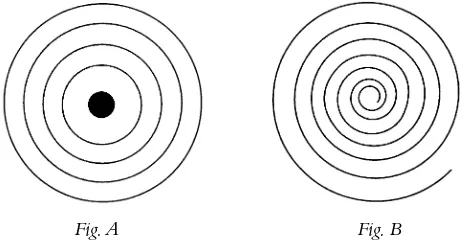
Figure A represents the self as a core or kernel with concentric circles around it.The circles are the experiences of the self, none of which touch it but all of which enclose it and hide it from the out-side. Figure B represents the self as a spiral whose structure, contours, and direction themselves include interaction with the environ-ment. As a result, there is nothing in the spiral to allow any viable distinction between the self and its experience.
According to the kernel theory of personality, the self is “really” separate from its experience. The events that impinge upon a per-son change him only in the sense of adding new attributes to his character and making him seem different. The kernel of his being never changes, and it is with this that his real nature is to be identi-fied.Although this core may be hard to discover or define,it amounts to what the individual is “in his heart”; all the incrustations of his overt development are outer layers that can in principle be stripped away.
On the kernel theory one’s involvement with other persons, things, or ideals can only be such as to draw out what one really is anyhow. In an unhappy life, the outer layers are opaque to the kernel; they smother and distort it. When life is gratifying, how-ever, the kernel controls and profits from the concentric circles of
Fig. A Fig. B
experience. To secure salvation one must recognize one’s own ker-nel and live according to its unique attributes. Other persons, how-ever intimate, can nhow-ever know the kernel of one’s being; and it is this that leads Pascal, for instance, to despair of merely human love: “What is the Ego? . . . Does he who loves someone on account of beauty really love that person? No; for the small-pox, which will kill beauty without killing the person, will cause him to love her no more. And if one loves me for my judgment, memory, he does not love me,for I can lose these qualities without losing myself.Where, then, is this Ego, if it be neither in the body nor in the soul? And how love the body or the soul, except for these qualities which do not constitute me,since they are perishable?”12
The spiral theory denies that there is any inner kernel to be iden-tified with one’s real nature. At any moment a person is just the sum total of his or her experiences.They constitute the spiral as it exists at a particular point and then leads on to further convolutions. On this view there is no break between the self and its experience, for experience isthe self: in toto, the self is only a series of past, pres-ent, and future experiences. By phrases like “real nature” or “true self ” the spiral theory refers to nothing but the ongoing or self-sustaining condition of an organism. In order to know whether someone is fulfilling his or her real nature, we would look not for integrity with an underlying core of personhood, but rather for a spiral that harmoniously wends its way through the universe. Madame Merle, in Henry James’s The Portrait of a Lady,presents this idea as follows:“There’s no such thing as an isolated man or woman; we’re each of us made up of some cluster of appurtenances. What shall we call our ‘self ’? Where does it begin? Where does it end? It overflows into everything that belongs to us—and then it flows back again. I know a large part of myself is in the clothes I choose to wear. I’ve a great respect for things!One’s self—for other peo-ple—is one’s expression of one’s self; and one’s house, one’s
ture, one’s garments, the books one reads, the company one keeps—these things are all expressive.”13
Neither Santayana nor pragmatists like John Dewey and William James consistently hold to either of these theories of human per-sonality. But while the pragmatists strongly emphasize the spiral theory, Santayana leans most heavily on the kernel theory. At the hard inner core he would not place the entire self but only an in-dividual spirit. The outer layers that wrap spirit around are related to the behavior of an organism that cannot survive without pur-posive action. Although at times the pragmatists seem to recognize something like what Santayana calls spirit, their entire orientation refuses to dissociate mind from practical necessities. As a result, their thinking easily merges with behavioristic philosophies, and even when they are not limiting themselves to motor action, they tend to interpret consciousness as itself dynamically active in an indirect, if not explicit, fashion. For the most part, pragmatism denies that anything like spirit can be distinguished from the more or less in-telligent conduct of an organism that exists through interaction with its environment. The self is therefore contingent upon its so-cial and biological development and cannot harbor any private or inviolable core.
In his opposition to pragmatism, Santayana admits that spirit comes into being only as the offshoot of material processes, but he insists that it is inherently different from any of them. He believes there is in human consciousness a somethingthat observes our de-pendence upon the environment without itself being constituted by that circumstance. Unlike Pascal, Santayana does not think the kernel is immortal or supremely valuable in its purified isolation; but like Pascal, he asserts that this mental entity must not be con-fused with the experience that encircles it. In the autobiography we often find him making statements such as these: “I might wish to change my surroundings and my way of living; I never undertook
to change myself. I regard my occupations and interests somewhat as an actor regards his various parts or a painter his subjects.”14
Santayana’s allegiance to some form of the kernel theory serves to clarify many of his other attitudes toward life, as well as the basis of his quarrels with pragmatism. For instance, it is not surprising that, despite his love of order and tradition, Santayana’s political views were essentially those of nineteenth-century liberalism, just as it is not surprising that Dewey’s politics were basically collectivistic. If there is no kernel and our personalities are wholly dependent upon interaction with the environment, the self can never really be de-tached from either nature or society. As a result, collectivism be-comes the groundwork upon which individual liberties must be conceived and constructed.
If, however, we start from Santayana’s point of departure, as did Locke and the American founding fathers, we think of people as separate kernels that the state ought not to tamper with. Society and nature alike may be useful, even indispensable, for the happiness of the kernel, but they can have only derivative importance. They are mere instrumentalities. On the pragmatic view, we are primordially a part of each other, so that our spirals interweave and we acquire our freedom through the personal stamp that each of us impresses upon the inescapable unity. On Santayana’s view, we are residually separate beings whose outer layers overlap without our inner cores ever interpenetrating. And even overlapping, he would say, cannot be justified unless it permits a kernel to reach fulfillment in itself. Similarly, Santayana’s aloofness from political and social duties, and in general his avoidance of communal activities, is explained, or at least symbolized, by his adherence to the kernel theory. It may also account for his tolerant attitude toward the lives that others
choose, and his more or less egoistic concern about his own. A per-son who is secure within his or her kernel need not feel threatened if different people experience the world differently.That only means that their kernels are not the same as our kernel. And neither is ours necessarily in conflict with theirs, or inherently preferable to them. Likewise, one can help other people fulfill themselves not by directly contributing to their welfare, as the spiral theory would suggest, but merely by refusing to impose restrictive outer layers. Because no one can change the inner core, we do best to leave it alone.This, in turn, increases the likelihood of being let alone oneself.
In this context Santayana goes so far as to admit that he is both selfish and heartless in his attempt to “resist human contagion, ex-cept provisionally, on the surface, and in matters indifferent to me.”15 Still, as he also points out, his selfishness was never competitive or aggressive. It was instead the self-absorption of a man who tried to live in the spirit at the same time as he remained at home within the life of reason. Did he enjoy the best of both worlds, or did he ex-clude himself from each in turn? Opinion has varied; and I, for one, would hesitate to judge. Perhaps it is enough to recognize that San-tayana’s “selfishness” was the devotion of a gardener cultivating what nature gave him. And surely, if the world is not to waste,some of its gardeners must live in the way that Santayana did.
This view of Santayana as both a person and a thinker is reinforced by the picture of him that Daniel Cory paints in his memoir San-tayana, the Later Years.16Despite the title, the book is not a life study. It is just an account of the Santayana that Cory knew between the years , when they met, and , when Santayana died. It does, however, amplify what Santayana wrote about himself, and about the world in which he lived. It reveals elements of his personality