CHAPTER II
LITERATURE REVIEW
A. Curriculum
1. Curriculum in General
Curriculum plays an important role in education. It can be the main
key to achieve the success of education. Curriculum started to be popular
in Indonesia since 1950’s. It was popularized by education in USA. In
the past, curriculum was regarded as lesson plan (Arifin, 2013: 8). But
then, along with period development, the old definition of curriculum
was neglected. Now days, many experts give definition of curriculum
widely. These definitions come from dissatisfaction of the result of
education in school and the wish to always improve.
Curriculum has meaning the subject taught in school or the course of
study (Arifin, 2011: 7). The fact, the term of subject still use up to now.
Some experts looked up the curriculum as a sequence of potential
experiences set up in the school for purpose of disciplining children and
youth in group ways of thinking and acting. It means curriculum is not
only the subjects that are taught in the school but also all of the things
that are needed for directness of teaching learning process. In other sides,
Brown (2000: 16) stated curriculum designs are for carrying out a
particular language program. The concern is in the specification of
the needs of a designated the group learners were in a defined context.
Some view or understanding about curriculum which is still used up to
now are: (a) Curriculum is what is taught in school; (b) Curriculum is a
number of subject matters; (c) Curriculum is content; (d) Curriculum is a
study program; (e) Curriculum is a number of learning materials; (f)
Curriculum is a sequence of learning materials; (g) Curriculum is a
number of objectives will be achieved; (h) Curriculum is a number of
subject matters which are learned; (i) Curriculum is everything done in
school, including the activity outside the classroom, guidance, and
relationship between students; (j) Curriculum is what is taught either
inside the school or outside the school guided by the school; (k)
Curriculum is everything planned by the school; (l) Curriculum is a series
of experience done by students in school; (m) Curriculum is what is
experienced by student as the result of school (Poerwati and
Amri,2013:3)
While the definition of curriculum according to the Act No. 20 of
2003 about National Education system is it a set of plans and setting the
objectives, content and learning materials as well as the way used to
guide the implementation of learning activities to achieve specific
educational goals (Chapter 1, Article 1, Paragraph 1).
From some definitions of curriculum above, it can be concluded that
students’ activities, learning materials, school plan, learning method and
the last evaluation.
2. The 2013 Curriculum
Education in Indonesia has undergone several changes in the
curriculum. In the last ten years, Indonesia experienced a change as much
as twice. These changes are not without reasons, but there are several
reasons in making decision changes the curriculum. In opening session of
Deputy Minister of Education and Culture’s seminar with the title “The
Implementation of the 2013 curriculum” explained that there are factors
underlying the change in curriculum, they are : (1) concept of curriculum;
(2) the book that is used; (3) learning process; and (4) the evaluation.
(Kemendikbud, 2014).
Government changed the curriculum because of some reasons.
According to Arifin (2011:3) curriculum must be dynamic. It means that
the curriculum must always undergo the change in accordance with the
times, science, and society needs. The reasons of changing the curriculum
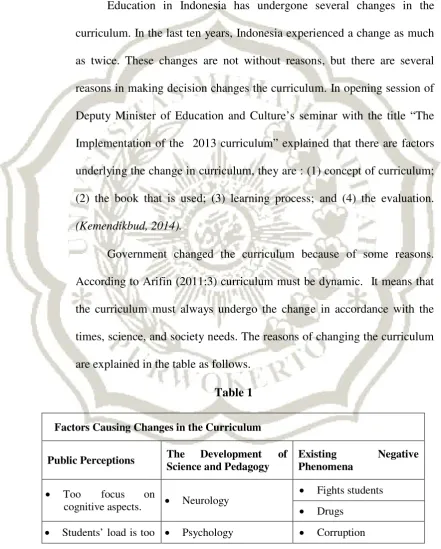
are explained in the table as follows.
Table 1
Factors Causing Changes in the Curriculum
Public Perceptions The Development of
Science and Pedagogy
Existing Negative
Phenomena
• Too focus on
cognitive aspects. • Neurology
• Fights students • Drugs
heavy • Plagiarism
• Less charged
character
• Observation based [discovery] learning
and collaborative
learning
• Cheating in exams
• Social unrest
Source : Kemendikbud.2014a
The 2013 Curriculum is designed to complement the previous
curriculum, KBK and KTSP, where KBK and KTSP still separated
subjects forming attitudes, skills and knowledge. While in the 2013
curriculum that is emphasized on the formation of attitude, skills and
knowledge and it is obtained the three aspects of assessment in each
subjects. Both in KBK and KTSP, competency standards were derived
from content standards that were formulated based on course objectives
(SKL of subjects) are detailed on standard competences and basic
competences. Whereas in the 2013 curriculum standards of competence
of graduates are derived from the needs. Then, the content of standards
derived from SKL through its Core competencies that used for all subject.
Finally, it can be concluded that the 2013 Curriculum is used to make our
education better and appropriate with the needs. The purpose of education
according to government regulation No. 17 years 2010 is to build the
foundation for the development of students’ potentials to be human that
are:
1) faith and fear of the lord of mighty one, noble and noble.
2) knowledgeable, skilled, critical, creative and innovative.
4) tolerant, socially sensitive, democratic and responsible.
Because the 2013 Curriculum is a new curriculum, the
characteristics of this curriculum are different from the previous
curriculum. These are the characteristics of the 2013 curriculum based on
Permendikbud No. 58 Tahun 2014 about the 2013 curriculum of Junior
High School / Islamic Junior High School:
a. Curriculum content, that is competency, clarified in the form of Core
Competence (KI) of class and further explained in Basic Competence
(KD) of subject matters
b. Core Competence (KI) is a description of competence about attitude
aspects, knowledge, and skill (cognitive, affective, and phsycomotor)
which must be learned by students. There are four (KI), they are; a) KI
1 deals with spiritual aspect, b) KI 2 deals with social aspect, c) KI 3
deals with knowledge aspect, d) KI 4 deals with skill aspect.
c. Basic Competence is a competence learned by students to subject
matter in a certain class for Junior and Senior High School
(SMP/MTs, SMA/MA, SMK/MAK)
d. Core Competence and Basic Competence in secondary education level
focuses on attitude aspect while in medium level balances between
attitudes and intellectual abilities.
e. Core Competence becomes organizational elements (organizing
learning process developed to achieve competence in the Core
Competence (KI)
f. Basic Competence is developed based on the principle of
accumulative, reinforcing and enriching each other between subject
matter and education level (horizontal and vertical organization)
g. Syllabus is developed as lesson plan to one subject (SMP/MTS,
SMA/MA, SMK/MAK). In syllabus enclosed the whole Basic
Competence (KD) to theme or subject in the class.
h. Lesson plan is developed from each KD for certain subject and class.
In addition, the 2013 Curriculum has its own style that deals with
teaching learning process in the 2013 Curriculum. Here are the formula
of new curriculum dealing with style of learning: a) learning by doing, b)
integrated learning (knowledge, skill, and attitude), c) learning with
scientific approach, d) adjusting the context of learning with the
surrounding environment at school/home, e) learning sources are not only
textbook and teacher, f) asking students to draw the conclusion from the
concept discussed (discovery learning), g) emphasizing on higher order
thinking skill, h) skill can be concrete things, abstract, and action, i)
project based learning and colaborative learning
B. Scientific Approach
In teaching learning process, teachers have to know what teachers
means teacher should know what approach, method and technique that to
be used to transfer knowledge to the students. Approach is the nature of
the subject matter to be taught and method is the ways to present
something based on the approach that is used (Richard,2002:19). Whereas
technique is the implementation that usually take place in the classroom.
From the definition of approach, method and technique above, it can be
concluded that to make teaching learning process more effective, both
approach, method and technique can be used simultaneously.
In relation with implementation the 2013 curriculum, the
government stated that the approach which is used is scientific approach.
The term of “scientific” usually describes a process or standards required
of a process, not kind an object or category of things (Kosso,2011:1). It
is usually followed by the words method, so if those are combined those
will be scientific approach. Kosso (2011) stated scientific method is not
much different from our day-to-day ways of learning about the world
which means that scientific method is a process that is used in our day life
to know and detect everything. For example, someone will eat bread, but
there is something strange with the bread, then he suspects that the bread
is spoiled. This condition called hypothesis. To make sure it, he checks
the expiree. He looks at the bread and smells it. He is really sure that the
bread has expired. This is the evidence that support you hypothesis. This
Scientific method gives priority to the characteristic of life on the
street than the result. In the collecting information or facts, it may take
days, weeks, or even years. It is not a problem if the study takes a long
time, because in scientific method the important things are the steps that
can be answerable. So, in the implementation of scientific method, it will
be better if the researcher report the true fact that happen in real condition
to make the data more valid.
Scientific approach is an approach that helps students in
recognizing the problem, formulate problems, find the solution, test
answer while investigation, (collecting facts), and ultimately draw
conclusions and present it orally and in written. Many experts believe that
through a scientific approach, besides it can make students more active in
constructing their knowledge and skills, also it can encourage learners to
conduct an investigation to find the facts of phenomenon or event.
(Sudrajat : 2013). It will make the students are trained to be able to think
logically, coherently and systematically.
C. Scientific Approach in Teaching English
By the change of our curriculum from the KTSP to the 2013
Curriculum, makes the change in the implementation of those
curriculums. Take one example is in the approach that was used. At the
beginning 2000, the government decided to use genre approach to plan
competence” that was known at that time by Murcia, et al(1995) in
Permendikbud No 58 about curriculum of junior high school. With the
changes of times, the implementation of KBK or KTSP was considered
not suitable with the goals of our education. This became one of the
background for government to revise the curriculum covered it all and it
changed by the 2013 curriculum that is considered able to meet the needs
of the learners for their future and in accordance with the aim of
education in Indonesia.
In the implementation of the 2013 curriculum, the genre approach
is not used. It is changed with scientific approach that is believed is able
to make the students more active and can explore their knowledge and
their skills in the teaching learning process. To support the scientific
approach, the method that can be used is cooperative learning. Teachers
can use problem based learning, project based learning or discovery
learning. Those methods will help students improving their skills in
identifying the problem until giving the solution and making conclusion
of the problems.
The scientific approach emphasizes modern pedagogical dimension
in learning. According to Kemendikbud (2013), it can be called as
scientific approach if it consists of seven criteria of scientific approach,
they are : first, learning materials based on facts or phenomena that can be
explained by a certain logic or reasoning; going to the extent of
explanation, students’ response, and educational interaction students free
from prejudice necessarily, subjective thinking or reasoning that deviate
from logical reasoning. Third, encourage and inspire students to think
critically, analytically and precise in identifying, understanding, solving
the problems and applying learning materials. Forth, encourage and
inspire students to be able to think in hypothetical look at the differences,
similarities and links to each other. Fifth, encourage and inspire students
to be able to understand, implement, and develop the ways of thinking
rationally and objectively in response to the learning materials. Sixth, it is
based on the concept, theory, and empirical facts that can be answered.
The last, the learning objectives are formulated in a simple obvious but
interesting in the presentation system.
In the real condition, scientific approach is used for all subjects.
Although English is the name of subject, in this subject students not only
learn about English but also learn to do many things that is useful for
their lives by using English. According to Kemendikbud (2013) scientific
approach which has meaning natural based on human characteristic,
broadly speaking the process of learning includes, (1) observing and
repeating the action actively involving all the senses, (2) asking and
questioning new things encountered, (3) trying to do the action
independently, (4) building reasoning by comparing the ways, rules and
the new action that have learned and implement in the real life as social
function of English itself.
The teaching learning process of English by using this approach
according to Permendikbud No 58 Tahun 2014 will be explained below :
1. Observing
In this steps, the activities that can be done is the activities that
are maximizing the use of all the senses; for example seeing,
listening, reading or watching. Students have to observe the
materials in form of social function, structure of the text, and
language features from the text that have been listened or read. Here,
the teacher has to prepare the students activities related to the
material. This is done to make students more focused on the
activities. It is aimed at defining to the material that will be taught.
The observation focuses on content of message, not the theory about
the text. Structure of the text and the language feature do not need to
be explained here. Teacher can help students in this step in order to
make their observation maximal, by giving question.
2. Questioning
Questioning is a process of constructing knowledge about social
function, language features, and structure text by group discussion or
class discussion. Teachers have to develop their curiosity and critical
thinking about the material. It is very useful for the students because
same time, students are taught to ask using English that is reasonable
and meaningful. In this questioning stage, students’ mistakes are
when they are asking is not important, but teacher can give feedback
in the end of the teaching learning process. The problems that are
often faced by the students’ are like the vocabulary building, the
pronunciation and the structure of the sentence. In these steps,
students can improve their vocabulary mastery and pronunciation
skills.
3. Collecting information
Collecting the information can be done through trying or
exploring the knowledge or skills that have been found or learned. In
this process, students try to use the new things that they have learned
and try to implement it in the real life. This is an individual activity
that done collaboratively in the group. Have to remember, teachers’
role here are the facilitator and monitor. In this stage, students are
given the chance to try and explore to reveal the meaning of the text
being studied. Here, students’ creativity is very important and their
activeness also needed to interact with their friends and teacher.
The activities that can be done in this stage are:
- Collecting the facts that will be presented.
- Experimenting and exploring for obtaining and selecting
vocabulary, grammar, and the other language features to be able
- Paying attention, giving feedback, r asking about the various
statements made by their friends. This steps is necessary to enrich
and deepen comprehension of the text that learned.
- Delivering verbal statements that have been planned in writing.
- If necessary, write down every statement of all facts that wish
expressed in the notebook respectively.
4. Associating
Associating stage is a process developing the ability to
categorize and compare a wide range of ideas and events to then put
it into a fragment of memory. In this activity, the students are given
the chance to link the information about the texts that is being
studied with similar text in different form found in other sources for
the goals of enriching and deepening the materials.
5. Communicating
Communicating stage is aimed at developing students’ ability in
presenting all of knowledge and skills that have been mastered or
haven’t mastered yet, both orally and in writing. In this step, not only
the ability in presenting the problem but also the problem that they
faced in the previous stages also can be known here. So, description
of three aspect of curriculum 2013, students’ attitude, knowledge and
skills are described overall. Communicating stage include among
front of the class or in groups, to publish in wall magazines, etc. The
result of this activity can be individual or group works.
In the implementation of scientific approach, those stages have to be
done. In every stage, teacher should prepare all the things needed, for
example the media, worksheets for students, etc. Those are aimed to make
the teaching learning process more meaningful and interesting. It is
important to help teacher in making meaningful and effective learning so
that they don’t have missed the stages, even one stage. As scientific
approach is an approach that is done chronologically, so teachers have to
implement this approach chronologically too.
English has four skills that have to be mastered by students. Those
skills are speaking, writing, reading and listening. In teaching learning
process, those skills have to be covered well by the teacher. Since,
scientific approach is used in implementation of 2013 curriculum, all skills
can be taught integrated or individually. Based on the concept of 2013
curriculum, the integration can be divided into spoken and written. Spoken
here is gotten from listening and speaking, while written is gotten from
reading and writing. For supporting curriculum 2013, those integrated
skills can be implemented by using scientific approach.
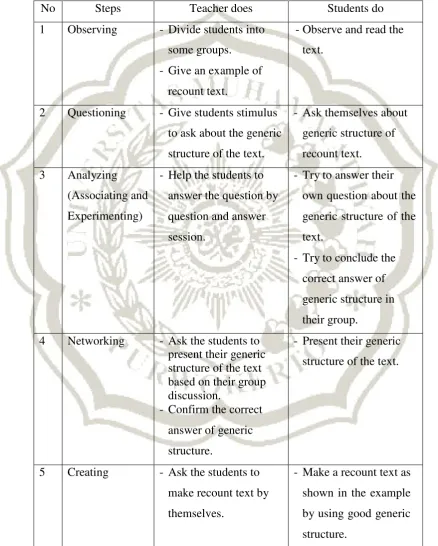
The example of implementation scientific approach in teaching
Table 2
The steps of scientific approach in teaching writing
No Steps Teacher does Students do
2 Questioning - Give students stimulus
e.g of recount text for the material.
Holiday in Bali
We had a wonderful holiday in Bali.
It was a really great place. The people were friendly,
the food was great, and the weather was a lot better than at
home.Most days were pretty. I swam two or three times a
day, but my brother Fachri just spent all his time lying on
the beach with his eyes closed.
Last Saturday I got on the bus and went to the north
of the island, It was much quieter there than here–very
beautiful, but no tourists. The next day we went across to
the east coast to see some of the old villages.
I learned Balinese–I couldn't say much, but it was
fun to try. Fachri actually spoke it quite well, but he was
structure of recount text in the analyzing step. Besides that, the differences
of colour in each paragraph will give stimulus to the students to make
questions, for example; why does every paragraph have different colour?
What does it mean? When the teacher is asked questions by the student,
she or he should not answer the questions directly. Let the students answer
their own questions. Teacher can help the students to answer their own
questions by doing question and answer session. For example, what does
analysis. After analyzing stage, students have to present their discussion of
generic structure of the text. Furthermore, teacher has to confirm the
correct generic structure of the text. When, students have known and
understood about generic structure of recount text, they have to make a
recount text with good generic structure. It is called creating step that can
be added by teacher to know and measure students understanding and their
writing ability.
D. Basic Assumption
The implementation of 2013 curriculum has been started on July 2013,
In all of pilot schools in Indonesia. In this curriculum, the approach that is
used is scientific approach that consists of several stages. The stages or the
steps are observing, questioning, collecting data, associating and networking.
Scientific approach is applied in all subjects in the school, so teacher has to
know well about it. For pilot schools, this curriculum have been implemented
in three semesters while for other schools have implemented it in one
semester. because of that, the writer assumed that the implementation of the
2013 curriculum especially the scientific approach, the pilot schools are better
than others who just used in one semester.
E. Hypothesis
Based on the assumption above, the hypothesis of this research is the
scientific approach is implemented well in English teaching in State junior