ISSN-p : 1410-5918 ISSN-e : 2406-9086 Accepted : 13-03-2017
FORMULATION OF NANOEMULSION MOUTHWASH COMBINATION OF
LEMONGRASS OIL (
Cymbopogon citratus)
AND KAFFIR LIME OIL (
Citrus
hystrix)
AGAINST
Candida albicans
ATCC 10231
FORMULASI MOUTHWASH NANOEMULSI KOMBINASI MINYAK SEREH (
Cymbopogon
citratus
) DAN MINYAK JERUK PURUT (
Citrus hystrix
) SEBAGAI ANTIKANDIDIASIS ORAL
TERUJI IN VITRO TERHADAP
Candida albanicans
ATCC 10231
Meta Juniatik*, Khoirunnissa Hidayati, Fransisca Priskaningtyas Wulandari, Nurul Pangestuti, Na’imatul Munawaroh, Ronny Martien, Sylvia Utami
Faculty of Pharmacy, Universitas Gadjah Mada, Yogyakarta, Indonesia
ABSTRACT
Candidiasis is a fungal infection disease that still become health problem in Indonesia, especially oral candidiasis that largerly caused by Candida albicans abnormal growth on oral cavity. Lemongrass oil and kaffir lime oil have been proven to have antifungal activity against Candida albicans. The composition of limonen, α-terpineol, sitronelil acetate, terpineol, β-pinene, on kaffir lime oil and citronelal on lemongrass oil make the combination of both oils have the potential as an alternative theraphy for oral candidiasis. It formulates in the form of nanoemulsion mouthwash. Nanoemulsion is chosen because it has some advantages like clear, stable, and increasing the antifungal activity of lemongrass oil and kaffir lime oil. The study begins with plants determination, essential oils charecterization tests (solubility, refractative index, and specific gravity), and essential oil content analysis by GC-MS. Nanoemulision formulates by water titration method. Optimization of oil mix and VCO do to get a clear and stable nanoemulsion. The best formula is characterized (transmittance, particle size, viscosity, zeta potential, and stability test), then analyze the essential oil chemical compounds in the optimum formula and test the inhibitory effect of the formula by microdilution method. Inhibiton data analysis use One Way ANOVA. Based on the results of the study, 0.4 % oil mix, 3.6 % VCO, 17.3 % tween 80, 8.7 % PEG 400 dan 70 % water is the best formula that can form a nanoemulsion system with an average particle size 21,4 nm, low viscosity, low zeta potential and stable during freez-thaw storage. Nanoemulsion significantly has inhibitory effect more effective than positive control.
Keyword: nanoemulsion, lemongrass oil, kaffir lime oil, Candida albicans, antifungal
ABSTRAK
Kandidiasis adalah penyakit infeksi jamur yang masih menjadi masalah kesehatan di Indonesia, kandidiasis terutama oral sebagian besar dikarenakan pertumbuhan abnormal Candida albicans pada rongga mulut. Minyak jeruk purut dan serai telah terbukti memiliki aktivitas antijamur terhadap Candida albicans. Komposisi limonen, α-terpineol, sitronelil assetat, terpineol, β-pinene, pada minyak jeruk purut dan citronelal pada minyak sereh membuat kombinasi keduanya minyak memiliki potensi sebagai terapi alternatif untuk kandidiasis oral. Kedua minyak ini dapat diformulasikan dalam bentuk nanoemulsion obat kumur. Nanoemulsion dipilih karena memiliki beberapa keuntungan seperti yang jelas, stabil, dan meningkatkan aktivitas antijamur minyak sereh dan minyak jeruk purut. Penelitian ini dimulai dengan determinasi tanaman, uji karakterisasi minyak atsiri (kelarutan, indeks bias, dan berat jenis), dan analisis kandungan minyak atsiri dengan GC-MS. Nanoemulision diformulasikan dengan metode titrasi air. Optimalisasi campuran minyak dan VCO dilakukan untuk mendapatkan nanoemulsion yang jernih dan stabil. Formula terbaik dikarakterisasi (ukuran partikel, viskositas, potensi zeta, dan stabilitasnya), dilakukan analisis senyawa kimia minyak atsiril dalam formula optimum dan menguji efek penghambatan
formula oleh metode mikrodilusi. Analisis data daya hambat dilakukan dengan One Way ANOVA. Berdasarkan hasil penelitian, 0,4% minyak campuran, 3,6% VCO, 17,3% tween 80, 8,7% PEG 400
dan 70% air merupakan formula terbaik yang dapat membentuk sistem nanoemulsion dengan rata-rata
ukuran partikel 21,4 nm, viskositas rendah, potensi zeta yang rendah dan stabil selama penyimpanan freez-thaw. Nanoemulsi secara signifikan memiliki efek penghambatan lebih efektif daripada kontrol positif.
Key word: nanoemulsi, minyak sereh, minyak jeruk purut, Candida albicans, antijamur
INTRODUCTION
Candidiasis is one of many fungus infection diseases. The most common candidiasis occured in human society is the oral candidiasis (Siregar, 2002). Oral candidiasis is an oportunistic infection in oral cavity mostly due to the abnormal growth of Candida albicans (Dalleau et al., 2008). In Indonesia, the prevalence of oral candidiasis is quite high as happened in Medan, Aceh, and Central Java with each case number 66.1 %, 41 %, 85.4 % (Harahap, 2000; Jamil, 2014 Kusuma, cause the discomfort such as pale, burnt sensation, and dried mouth (Greenberg, 2003). Oral candidiasis can be therepied with mouthwash which contains the anticandida activity.
Lemongrass and kaffir lime are the original Indonesian plant that often used as ingredient of herbs. Lemongrass oil and kaffir lime oil have been proven contain the antifungal activity against Candida abicans (Ruckmani, 2013; Prasart, 2014).
This activity is shown with the availability of limonene compound, α-terpineol, terpineol, β-pinen, and acetate sitronelil within the kaffir lime oil and sitronelal within lemongrass oil (Pinto et al., 2014; Omran et al., 2011; Singh et al., 2012; Taweechaisupapong et al., 2012).
Lemongrass oil has higher inhibition activity against C. albicans rather than kaffir lime oil but lemongrass oil produces unpleasant scent and less freshing than kaffir lime oil scent (Taweechaisupapong et al., 2012). The combination of the two type oils will balance the scent so they will give fresh and pleasant sensation when it consumed.
Nanoemulsion preparation offers unique advantages such as clearer, stable, and increasing efficacy of the oil combination. Lemongrass oil and kaffir lime oil have water insoluble characteristic. Formulating these oils into emulison is the way to use them as mouthwash. The ordinary emulsion has unpleasent form because they had a larger particle sizes. Beside, nanoemulsion, that has a small particle, has ability to be stabil consistanly then the ordinary emulison (Sharma et al., 2010 ). Nanoemulsion also has a low turbidity. It’s pleasent to be used as mouthwash because it
looked like water. Making them into nanoemulsion is a solution to get a clear, stabil, and pleasant mouthwash for people. Some studies also have shown that nanoemulsion can increase the antimicrobial activity of these oils (Mason et al., 2006). Therefore,theoil combination will be better formulated in nanoemulsion mouthwash matter with particle size 20-200 nm (Serano et al., 2014).
Nanoemulsion that had been made consists of mixture of oil phase, surfactant, co-surfactant, and water with certain composition. Lemongrass oil and kaffir lime oil need carrier oil to be able to disperse and form the nanoemulsion. Combination oil will be formulated with some additional substance such as VCO as carrier oil, Tween 80 as surfactant, and PEG 400 as cosurfactant. The composition of VCO, Tween 80, and PEG 400 had been proven to produce nanoemulsion system (Widyaningrum, 2015; K arima, 2015). Nanoemulsion formula from the combination of kaffir lime oil and lemongrass oil is expected to develop as the safe and pleasant oral candidiasis therapy for people.
METHODOLOGY
Preparation of Lemongrass Oil and Kaffir Lime Oil
Lemongrass oil and kaffir lime oil are from CV. Orizho Indonesia, Mantup Baru, Bantul, Yogyakarta. Lemongrass oil and kaffir oil are made through steam distillation method. Lemongrass and kaffir lime are raw materials needed to produce the essential oil. From lemongrass plant, the stalk and the leaves are the used parts, and from the kaffir lime, the leaves are the used part. Those plants are from Kinahrejo, Cangkringan, Yogyakarta. The determination of samples was done to prove the authenticity of used plants species in Pharmaceutical Biology, Faculty of Pharmacy UGM.
Spesification Test of Lemongrass Oil and Kaffir Lime Oil
Analysis the Content of Lemon Grass oil and Kaffir Lime Oil
Essential oil contents is analysed by Gas Chromatography Mass Spectrometer QP 2010 S Shimadzu. The used column is Agilent HP-5MS. The column is length 30 m and diameter 0.25 mm. Carrier gas was helium. The column temperature was 70°C. The analysis methode was developed by Organic and Biochemical Laboratory team, Faculty of Mathematics and Natural Sciences, UGM.
Nanoemulsion Mouthwash Formulation of Lemongrass and Kaffir Lime Oil
First, Lemongrass oil and kaffir lime oil are mixed in the composition of 1:1, called combination oils. Then this combination oils is used for formulating process of nanoemulsion. Regarding to the old experiment, the composition, consists of 4% VCO (as carier oil); 17.3% Tween 80; 8.7% PEG 400; 70% water in (b/b), can produce nanoemulsion (Widyaningrum, 2015). So this composition is determined as the base formulation for making nanoemulsion.
Second, screening the proper composition of VCO and combination oils is conducted. The proper composition of VCO and combination oil from 1:9 till 9:1 is formulated with the other base nanoemulsion formula. The mixture of VCO, combination oil, tween 80, and PEG 400 were stirred with magnetic stirrer for 10 minutes, ultrasonicated for 10 minutes. Water with temperature about 70°C is measured and poured slowly into the surfactant mixture and oil phase using spotting pipette. This process was conducted while the magnetic stirrer was working. the mixture particle is reduced through ultasonication again for 10 minute. The optimum formula is selected due to the high and stable transmittance value result from the formula.
Characteristic Evaluation of The Combination Lemongrass Oil and Kaffir Lime Oil Nanoemulsion
Characterisatic evaluation is conducted to ensure the desired nanoemulsion formula.
Transmittance Measurement
Measurement of formula transmittance is performed by using UV/Vis spectrophotometer with wavelength 650 nm (Jain et al., 2013). Distilled water is used as the blank. Transmittance value closed to 100% is proven that the mixture has nano size (Widyaningrum, 2015).
The Measurement of Particle Size Distribution
Particle size distribution and average
Dynamic Light Scattering (DLS) method and Particle Size Analyzer (PSA) tool Horiba Scientific-100 SZ. Nanoemulsion formula has an average measurement is conducted in Physical Pharmacy Laboratory, Faculty of Pharmacy, Universitas Sanata Dharma Yogyakarta.
Stability Test
Nanoemulsion stability formula is tested through six-cycle freeze thaw method. Samples are kept in temperature -21°C and 25°C for each 24 hours (Vior et al., 2011). Every one cycle, the observation do through measuring the sample transmittance with spectrophotometer UV/Vis on the wavelength 650 nm.
Zeta Potential Measurement
Zeta potential is measured through DLS method and PSA (Horiba Scientific SZ-100) tool. The measurement of zeta potential is conducted in AOMK Laboratory, Faculty of Mathematics and Natural Sciences, UII Yogyakarta.
Chemical Content Analysis within The Combination Nanoemulsion Formula of Lemongrass and Kaffir Lime Oil
Analysis of the chemical compounds in nanoemulsion formula is performed with Gas Chromatography Mass Spectrophotometer 2010 S Shimadzu QP. The column used is Agilent HP-5Ms with column length 30 m, diameter 0.25 mm. The carrier gas is helium. Column temperature is 70°C. This analysis method is developed by the Laboratory of Organic and Biochemistry, Faculty of Mathematics and Natural Sciences, UGM.
Activity Test of Nanoemulsion Mouthwash Formula as Anticandida
The mixture of samples, media, and microbes are filled in 96 well flat bottom microplate polysterene up to a total volume of 200 µL. The first group contains 15 µL of nanoemulsion formula combination of lemongrass oil and kaffir lime oil, 180 µL SDB media and 5 µL microbal test as well as the replication. The second group containsed 195 µL single lemongrass oil 0.4%
(v / v) and 5 µL microbal test as well as the replication. The third group contains 195 µL single kaffir lime oil 0.4% (v / v) and 5 µL microbal test as well as the replication. The fourth group contains a combination of oil of 0.4% (v / v) and 5 µL microbal test as well as the replication. The fifth group of ethanol contains 195 µL samples of 0.37% (v / v) and 5 µL microbal test as well as the replication. The sixth group contains positive controls, such as 15 µL of fluconazole 3 mg/mL, 180 mL SDB media and 5 µL culture of C. albicans as well as the replication. Positive control, is the group of microbe suspension treated by a certain compound inhibiting the growth of C. albicans ATCC 10231. The seventh group contains 200 µL SDB media as media controls. The negative control is 195 µL SDB media and 5 µL test microbe as well as the replication.
Initial OD values are calculated using microplate reader, incubated at a temperature of 37°C for 48 hours. OD values are measured again to determine the percentage of inhibition by the equation Quave, et al. (2008) as follows:
%Inhibition = 1-
(
(OD gc t48 - OD gc t0) (ODt48 - ODt0))
X 100% For: ODt48 = Optical Density testing sample after incubation for 48h; ODgc48 = Optical Density negative control after incubation for 48h; ODgc0 = Optical Density negative control before the incubation.Minimum Bacterial Concentration (MBC) is obtained from the high value MIC measured upon solid media of Saboraud Dextrose Agar (SDA) contained C. albicans. The media is incubated in temperature 37°C for 48 hours. MBC is selected due to the smallest concentration that not cause 90% Candida albicans growth.
RESULT AND DISCUSSION
Plant Determination and Spesification Test of Lemongrass and Kaffir Lime Oil
The plants are used as the raw material to obtain the lemongrass oil from CV Orizho Indonesia, Mantup Baru, Bantul, Yogyakarta. They are the true Cymbopogon citratus and Citrus hystrix. Lemongrass oil has a solubility to ethanol. Lemongrass oil has a refractive index of 1.4597
and a specific gravity of 0.9021 g / mL. Lime oil soluble in alcohol. Lime oil has a refractive index of 1.4764 and density of 0.892 g / mL. Essential oils used in this study is similar to standard essential oil from the Indonesian National Standard (Anonymous, 1995).
Combination Nanoemulsion Formula of Lemongrass Oil and Kaffir Oil
Formula 9 is selected as the optimum formula because it has a large and stable transmittance value until the third cycle. Formula 9 has a ratio of the VCO with oil combination 9:1. The existence of VCO in the formula can help to build nanoemulsion containing essential oil (Widyaningrum, 2015). Essential oil consists of terpenes while the VCO is composed of fatty acids (Baser et al., 2010; Bawalan et al., 2006).
VCO contain the fatty acid constituents of which are mainly lauric acid (Anonymous, 1995). Lauric acid is useful for emulsifying agent in formulation (Rowe et al., 2009). Lauric acid can help to turn the surface tension down so the essensial oil can be dispersed to the water medium very well. Tween 80, one of the important part of this formula, has a function as surfactant. Surfactant has hydrophobic and hydrophilic structures that will bridge the gap between oil composition. Thus, nanoemultion also use PEG 400 to be co-surfactant. PEG 400 is a mid chain hydrocarbon that could be placed among the gap of nanoemulsion system through forming hydrogen chain on them. This process will maximize the emulsification process to develop the nanoemulsion (Kurnia, 2015).
Nanoemulsion Formula Evaluation of Transmittance Lemongrass Oil and Kaffir Lime Oil Combination
that the formula has formed the nanoemulsion (Widyaningrum, 2015). Thus, some characterisation such as particle distribution measurement is performed.
Particle SizeDistribution
Emulsion is categorized as nanoemulsion if it has average particle size less than 100 nm (Auburn et al, 2004). Where microemulsions average particle size is found to be less than 200 nm (Prajapati et al., 2011). Measurement result shows that average particle size of the gained formula was 21.4 nm with PI (Polydispersity index) value 0.324. PI is the deviation standard between average droplet size that shows the homogeneity of droplet size in samples (Gupta et al., 2010). The smaller PI value will cause the more homogenous particle size distribution. Thus the
homogenous droplet diameter size. Mixing droplet size has nanometer scale because of surfactant, cosurfactant, and nanoemulsion creation method that have been conducted (Widyaningrum, 2015).
Viscosity
Viscosity is a very important parameter in the stability and efficiency of the active component release. Viscosity is the friction between adjacent layers of fluid as it moves across each other (Siregar et al., 2013). Components of water, oil, and smix in the formula will affect the formed nanoemulsion viscosity. Increasing the amount of water will decrease the viscosity. The increasing of viscosity value of nanoemulsion formula in line with the rising value of shear stress. The relation of viscosity with rate shear (shear velocity of the Tabel I. Screening Combination Nanoemulsion Formula of Lemongrass Oil and Kaffir Oil
Figure 1. The Curve of Shear Rate vs Viscosity Relation
Figure 2. Transmittance Stability Testing Chart
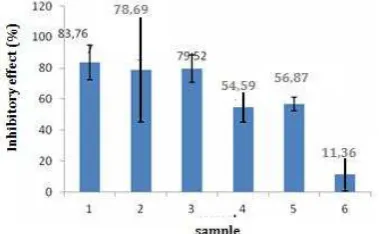
Figure 3. Inhibitory of Candida albicans ATCC 10231 Chart 1. Nanoemulsion, 2. Combination Oil, 3. Lemongrass Oil, 4. Kaffir Lime Oil, 5. Ethano, 6. Positive Control
The curve describes the flow type of dilatant with non-Newtonian system. This system is a heterogeneous dispersion one owned by formula nanoemulsion. This system does not follow the rules of Newton's laws I about the flow, but indicates deviation in the administration of relative increase friction (Bird et al., 1960).
When compared to the absolute viscosity of water, measured with the same tool and conditions, the nanoemulsion formula has relatively same as fluidity as the water.
Nanoemulsion formula will be easily gargled and used as a mouthwash.
Zeta Potential
Zeta potential value associated with the stability of the disperse system shows the level of rejection of the same charge particles adjacent to each other in the system (Sinko, 2006). Zeta potential of 0 to ± 30 mV indicate instability while the zeta potential higher than ± 30 mV indicate stability (ASTM, 1985).
The obtained zeta potentia valuel is -5.6mV. Zeta potential value can be influenced by various factors, such as surfactants type, disperse medium concentration of electrolytes (ionic strength), morphology and particle size, solution pH, and hydration (Simunkova et al,. 2009). The surfactant used is tween 80. Tween 80 is one of nonionic surfactants. Tween 80 does not have a charge on a hydrophobic group, so that the surface of the oil phase droplet covered by surfactants tend to be uncharged (Wahyuningsih and Putranti, 2015).
There are two mechanisms of stability, namely electrostatic and steric mechanisms. Electrostatic stability occurs because of repulsion between the droplets that have a surface charge, while the steric stability mechanism occurs because the layer formation on the surface of the droplet. Both of these mechanisms hinder aggregation. (Wahyuningsih and Putranti, 2015). Nonionic surfactants such as tween 80 has the possibility of stabilizing nanoemulsion with steric mechanism. Stability test is accelerated to determine the stability of the nanoemulsion formula.
Stability
Stability test do through six-cycle freeze thaw method by observing the transmittance value on each cycle. The observation result data shows that fluctuation occurred. After that, analysis with Paired T Test is done with trust rate 95% for determining whether the decrease in transmittance in the last cycle of significant value or not.
Transmittance value before and after the stability test did not differ significantly from before and after storage. This proves that the formula is stable during storage at extreme temperatures.
merging the dispersing medium. This caused a more stable nanoemulsion formula.
Chemical Compounds Content in Lemongrass Oil, Kaffir Lime Oil, and Nanoemulsion Formula
Based on GC-MC analysis result upon chemical compound in lemongrass oil, samples of lemongrass oil contains alpha-pinene, D-limonene and its isomers, pyrollidine, piperidine, citronellol, geraniol, citronellyl acetate, geranyl acetate, germacrene-D, trans-farnesol, elemol, hedycaryol, alpha-asarone, acid pentadokanoat, acid heksadekanoat, and acid octadekanoat. Geraniol and citronellal are components that had the highest composition. Citronellal is one component of lemongrass oil that proven to have inhibitory activity against C. albicans.
The results of GC-MS analysis shows that the lime oil containied 5 types of main components, namely limonene 22.87%, 15.71% α-terpineol, terpineol 14.26%, 9.68% β-pinene and γ- terpinen 5.50%. Limonene compound, α-terpineol, α-terpineol, β-pinene, sitronelil acetate have the activity as an antifungal against C. albicans (Pinto et al., 2014; Omran et al., 2011; Singh et al., 2012; Lima et al., 2005).
Nanoemulsion formula has the following composition: beta-pinene, limonene, citronellal, citronellyl acetate, and geranyl acetate. The highest proportion of the compounds are citronellal, limonene, and beta-pinene. These compounds are an active components in lemongrass oil and kaffir lime oil that have inhibitory activity against C. albicans. It indicates that the formulation proces doesn’t make unstability or cause lost of component.
Antifungal Activity Against C. albicans ATCC 10231
The result of OD measurement after 48 hours incubation is converted to inhibitory percentage. Nanoemulsion has antifungal activity as much as 83.76% against Candida albicans. This inhibitory of nanoemulsion is seven times higher than the positive control.
Nanoemulsion of lemongrass oil and kaffir lime oil combination has a significant difference. Very small particle size can increase the penetration of lemongrass oil and kaffir lime oil, thus providing a better antifungal effect (Widyaningrum, 2015).
Based on a series of research, it can be said that the nanoemulsion formula of lemongrass oil and kaffir lime oil is more effective in inhibiting the growth of C. albicans ATCC 10231 than a single oil or a combination of the oil before it is
CONCLUSION
In summary, lemon grass oil, kaffir lime oil, Tween 80, PEG 400 and water combination cause nanoemulsion formation. The nanoemulsion formula composition of lemongrass and kaffir lime oil consists of 4 grams of oil phase (0.4 grams oil combination and 3.6 grams VCO), 26 grams smix (17.3 grams tween 80 and 8.7 grams PEG 400), and 70 grams of water. It has average particle size 21.4 nm, means the mixture was nanoemulsion. The high transmittance it has also showed that it has high optical clarity. The tested nanoemulsion showed stability during 6 cycles freeze thaw storage. Nanoemulsion formula has low viscosity, so it will be easily gargled to be applied as a mouthwash.
Nanoemulsion formula of lemongrass oil and kaffir lime oil is significantly more effective in inhibiting the growth of C. albicans ATCC 10231 than a single oil or a combination of the oil before it is formulated. So the nanoemulsion formula of lemongrass and kaffir lime oil combination is potent developeved as an alternative therepy of oral candidiasis.
ACKNOWLEDGEMENT
We thank DIKTI for funding this research as student creativity program. Thanks to Dr. rer. nat. Ronny Martien M.Si., Dr. Sylvia Utami T.P.M.Si and Biomaterials and Nano Delivery Research team, espesially Dewa and Wahyudi, for the guidance while researching and writing this report.
REFERENCES
ASTM, 1985, Zeta Potential of Colloids in Water and Waste Water. American Society for Testing and Materials. pp 4187–4182. Auburn, O.S., Simonnet, J.T. and L’Alloret, F. 2004.
Nanoemulsions: A New Vehicle for Skincare Products. Advances In Colloid And Interface Science. 108 –109: 145–149.
Badan Standar Nasional, 1995, SNI No.06-3953, http://sisni.bsn.go.id/index.php?/sni_main /sni/detail_sni/4386, accessed 26 april 2016.
Baser, K.H.C. and Buchbauer, G. 2010. Handbook of Essential Oils Science, Technology, and Applications. CRC Press. pp 921.
Bawalan, D.D. dan Chapman, K.R. 2006. Virgin Coconut Oil: Production Manual dor Micro and Village Scale Processing. Food and Agriculture Organization Regional Office for Asia and the Pacific Bangkok. pp 12-16. Bird, R. B., Stewart, W. E. and Lightfood, E. N. 1960.
Dalleau, S., Cateau, E., Berg`es, T., Berjeaud, J.M. and Imbert, C. 2008. In Vitro Activity of Terpenes Against Candida Biofilms. International Journal of Antimicrobial Agents. 31: 572–576.
Dignani, M.C., Solamkin, J.S. and Anaissie, E.J. 2009, Candida, Clinical Mycology 2nd Ed. 8:
197-230.
Dovigo, L.N., , Pavarina, A.C., Carmello, J.C., , Machado, A.L., Brunetti, I.L., Bagnato, V.S., 2011, Susceptibility of Clinical Isolates of Candida to Photodynamic Effects of Curcumin, Lasers in Surgery and Medicine, 43 (9):927-34.
Graves, S.M. 2008. The Formation, Optical Properties, and Structure of Nanoemulsions. Thesis. Los Angeles, University of California.
Greenberg. M.S. 2003. Burket’s Oral Medicine. 10th
Ed. Hamilton Ontario Bc Decker Inc. pp 94 – 98.
Gupta, P.K., Prandit, J.K., Kumar, A., Swaroop, P. and Gupta, S. 2010. Pharmaceutical Nanotechnologypharma Novel Nanoemulsion High Energy Emulsification Preparation, Evaluation, and Application. The Pharma Research Journal. 3: 117-138. Harahap, M. 2000. Ilmu Penyakit Kulit. 1st Ed.
Jakarta. Hipokrates. pp. 109-15.
Jain, K., Kumar, R.S., Sood, S., and Gowthamarajan, K. 2013. Enhanced Oral Bioavailability of Atorvastatin Via Oil in Water Nanoemulsion Using Aqueous Titration Method. Journal of Pharmaceutical Sciences and Research. 5: 18- 25.
Jamil, K. F. 2014. Profil Kadar CD4 Terhadap Infeksi Oportunistik pada Penderita Human Immunodeficiency Virus / Acquired Immunodeficiency Syndrome (HIV/AIDS) Di RSUD dr. Zainoel Abidin Banda Aceh, Jurnal Kedokteran Syiah Kuala. 14: 2. Karima, N. 2015. Formulasi SNEDDS
(Self-Nanoemulsifying Drug Delivery System) Ekstrak Etanolik Buah Mengkudu (Morinda citrifolia L.) Menggunakan Minyak Nabati, Thesis. Yogyakarta. Universitas Gadjah Mada.
Kurnia, F. A. 2015. Optimasi Formula Nanoemulsi untuk Formulasi Nanoemulgel Ketoprofen Menggunakan Sunflower Oil, Tween 80-Propilen Glikol, dan Air. Thesis. Yogyakarta. Universitas Gadjah Mada.
Kusuma, A. L. 2014 Hubungan Kadar CD4 Dengan Kejadian Kandidiasis Oral Pada Penderita HIV/AIDS Di RSUD Moewardi Surakarta. Thesis. Surakarta. Universitas Muhammadiyah,
Lalwani, J.T., Thakkar, V.T. and Patel, H.V. 2013. Enhancement of Solubility and Oral Bioavaibility of Ezetimibe by A Novel Solid Self Nano Emulsifying Drug Delivery System (SNEDDS). International Journal of Pharmacy and Pharmaceutical Science.5(3): 513-522.
Lima, I.O., Oliveira, R. D. A. G., Lima, E. O., Souza, E. L., Farias, N. P., Navarro, D. F. and Farmacêuticas, R. B. C. 2005. Inhibitory Effect of Some Phytochemicals in The Growth of Yeasts Potentially Causing Opportunistic Infections. Brazilian Journal of Pharmaceutical Sciences. 4: 2.
Mason, T.G., Wilking, J.N., Meleson, K., Chang, C.B. and Graves, S.M. 2006. Nanoemulsions: Formation, Structure, and Physical Properties. J. Phys: Condens. 18:635–666. Omran, S.M., Moodi, M.A., Amiri, S.M.B.N., Mosavi,
S.J., Saeed, S.A.M.G.M., Shiade, S.M.J., Kheradi, E., Salehi, M. 2011. The Effects of Limonene and Orange Peel Extracts on Some Spoilage Fungi, International Journal of Molecular and Clinical Microbiology. 1: 82-86.
Pinto, E., Gonçalves, M.J., Oliveira, P., Coelho, J., Cavaleiro, C. and Salgueiro, L. 2014. Activity of Thymus Caespititius Essential Oil and A-Terpineol Against Yeasts and Filamentous Fungi. Industrial Crops and Products, 62: 107–112.
Prajapati H.N., Dalrymple D.M., Serajuddin A.T.M., 2011, A Comparative Evaluation of Mono-, Di- and Triglyceride of Medium Chain Fatty Acids by Lipid/Surfactant/Water Phase Diagram, Solubility Determination and Dispersion Testing for Application in Pharmaceutical Dosage Form Development, Pharmaceutical Research.
Prasart, Foo-trakul and Chonlada,
Watchiradatsatiean, 2014, Development of Anti-Dandruff Shampoo from Kaffir Lime which is the By-Product of Food Industry, Kasetsart J. (Nat. Sci.) 39 : 725 – 729.
Quave, C.L., Plano, L.R.W., Pantuso, T., & Bennet, B.C. 2008. Effect of Extract from Italian Medicinal Plant on Planktonic Growth, Biofilm Formation and Adherence of Methicillin Resistant Staphyllococcus aureus.Journal Ethnopharmacol. 118 : 418-428.
Rowe, C.R., Sheskey, J.P. and Weller, J.P. 2009. Handbook of Pharmaceutical Excipients. 6th
Ed. American Pharmaceutical Association, London, Chicago.
Nadu. Saveetha Dental College and Hospitals.
Serano, I. O., Oliu, G. O. and Belloso, O. M. 2014. Nanoemulsion Based Delvery Systems to Improve Functional of Lipophilic Components. Front Nutr. 1: 24.
Sharma, N., Bansal, M., Visht, S., Kulkarni, G.T. and Sharma, P.K.. 2010. Nanoemulsion: A New Concept of Delivery System, Department of Pharmaceutical Technology Meerut Inst of Engg. and Tech. pp 2-6.
Simunkova, H., Pessenda-Garcia, P., Wosik, J., Angerer, P., Kronberger, H. and Nauer, G. E. 2009. The Fundamentals of Nano and Submicro Scaled Ceramic Particles Incorporation into Electrodeposited Nickel Layers: Zeta Potential Measurements. Surface and Coatings Technology. 203: 1806–1814.
Singh, D., Kumar, T.R.S., Gupta, I.K. and Chaturvedi, P. 2012. Antimicrobial Activity of Some Promising Plant Oils, Molecules and Formulations, Indian Journal of Experimental Biology. 50: 714-717.
Sinko, P.J. 2006. Martin’s Physical Pharmacy and Pharmaceutical Science. 5th Ed. Lippincott
Williams & Wilkins. Philadelphia. pp 466-467.
Siregar, K.T.T., Tamba, T., Perangin-angin, B., 2013, Viskosimeter Digital Menggunakan Water
Flow Sensor G1/2 Berbasis Mikrokontroller 8535, Saintika, 4:1.
Siregar, R.S. 2002. Penyakit Jamur Kuli. 2th. EGC.
Jakarta.
Taweechaisupapong, S., Aieamsaard, J., Chitropas, P. and Khunkitti, W. 2012 Inhibitory Effect of Lemongrass Oil and Its Majjor Constituents on Candida Biofilm and Germ Tube Formation. South African Journal of Botany. 81: 905-102.
Vior, M.C.G., Monteagudo, E., Dicelio, L.E. and Awruch, A. 2011. A Comparative Study of A Novel Lipophilic Phthalocyanine Incorporated into Nanoemulsion Formulations: Photophysics, Size, Solubility and Thermodynamic Stabilit. Dyes And Pigments. 91: 208-214.
Wahyuningsih, I. and Putranti, W. 2015. Optimasi Perbandingan Tween 80 dan Polietilenglikol 400 pada Formula Self Nanoemulsifying Drug Delivery System (SNEDDS) Minyak Biji Jinten Hitam. Pharmacy. 2: 223-241.