Perjanjian No: 31/LPPM/2012-09/92-P
A Descriptive Study of Rice Value Chain Actors in Indonesia
(case study Purwakarta, Karawang, Cikampek and Subang)
Disusun Oleh:
Maria Widyarini, SE., MT
Lembaga Penelitian dan Pengabdian kepada Masyarakat
Universitas Katolik Prahayangan
ABSTRAK
The role of rice price policy in Indonesia to stimulate rice productivity growth is facing some difficulties. These will give significant affect on the stability rice value chains. The increasing of rice price in the market is suspected by external factors such as weather, the decreased of rice supplies and so on. Practically, the increasing rice price is lower than the cost of rice planting. The issues which be discussed in this study concerns the factors influencing rice price fluctuation in domestik market. The price dynamics all related actors were analysed based on actors behavior on rice value chain using context mechanism output. This study contributes to the better understanding of price fluctuations more sensible that is the interelation between conceptual theory with existing market conditions. The descriptive study is employed to figure out the rice price fluctuations within the rice value chains as described in Figure 3.1. indicates two components, namely decision making and social interactions among actors. In this stage, observations and interviews are conducted in order to get better understanding and to investigate with emphasizing on factors affecting price fluctuations and social interactions on rice value chains (behavioral of rice price transformation along value chain).
The rice marketing system along value chain has been done imperfectly due to (1) climate change ; (2) lack of capital (at farmers positition) ;(3) information assymetry of rice price value chain (less transparency of market prices and costs provides an adequate market signals to middleman to take part on rice price; decision of selling and buying handled by middleman; price reflects cost of seller ) ;(4) rice import and (4) inability of government to give sanctions to someone who violate (such as illegal rice import found in market, rice price fluctuations). But, the long working relationship/social relationship found among actors related such as trust, norm and role. These is Increasing scale of marketing efficiency of rice production facilities and processing works by having colaboration among actors such as rice field owner, saprodi shop, peasant labour, miller and middleman (trasher, retailer and wholesaler). Moreover, the growth of private label in rice retail and strong customer segmentation in retail market between rice premium and mid-‐range impose the rice competition among middleman (traders).
Further, work on value chain analysis allows structuration theory to be more critically examined in this context and the potential connections with other theoretical frameworks to be explored for the next research plan.
BAB I PENDAHULUAN
1.1 INTRODUCTION
The rice price in indonesia is determined on the open market, move naturally along the equilibrium law of supply and demand, but still BULOG intervenes through floor and ceiling prices to help promote some seasonal price stabilisation. One of bulog role together with the Central Statistical Office, is monitoring prices over many years. As Indonesia has a number of rice varieties available, the government task in controlling rice price fluctuations become more difficult. During harvesting period, there have been frequently oversupplies in rice market, and as the result, the farmer’s rice did not absorb and sold well in the market. This make the rice price much cheaper (Timmer, 2005) at the farm rice price level. Thus, it is indicated that the rice price is fluctuating start at farmer level to end consumer.
Rice production is an important sector in Indonesia development. The rice agricultural sector has a significant role to create food self-‐sufficiency, job opportunity, and to increase people’s income, especially the peasants (Timmer, 2005). Thus, Government of Indonesia is planning to overcome rice defisit by opening rice field or creating other planting paddys’ area. Timmer (2004) shows that the current political approach to stimulating productivity growth is through higher tariffs on imported rice, or an outright ban on imports. It means that the role of rice price policy in Indonesia to stimulate rice productivity growth is facing some difficulties. These will give significant affect on the stability rice value chains. The increasing of rice price in the market is suspected by external factors such as weather, the decreased of rice supplies and so on. Practically, the increasing rice price is lower than the cost of rice planting.
The issues which will be discussed in this study concerns the factors influencing rice price fluctuation in domestik market. Most of these issues were analysed using time series model to test hyphotesis about endogenous and exogeneous explanation of rice price fluctuation (Brorse, B Wade et al, 1991; Kajisa, Kei et al, 2004; Chirwa, Ephraim W, 2001; Lorie, Henri et al, 2006; Ismet et al, 1998). The result of this issues can not explain the price dynamics between actors related. Thus, in this study the price dynamics all related actors will analyse based on actors behavior on rice value chain using structuration theory. This study contributes to the better understanding of price fluctuations more sensible that is the interelation between conceptual theory with existing market conditions. Further, work on value chain analysis allows
structuration theory to be more critically examined in this context and the potential connections with other theoretical frameworks to be explored.
1.2 PROBLEM STATEMENT AND OBJECTIVES
As the rice price market mechanism is reflecting the interaction between rice demand, thus the availability of rice supply and government intervention which responsible on maitaning the rice price stability on rice market is important. Therefore, research question of this study are follows :
What factors determine rice prices fluctuations paid by consumers in comparison to those received by farmers ?
This research question explains the conceptual model of rice price fluctuations on rice value chains start from farmer (input production, planting and harvesting activities) to end costumers. Trading reflects marketing activities i.e buying and selling activities of unhulled, hulled rice from farmers, miller, retailer or wholesaler in rice supply chains. Market is one of a meeting point where costumer meet and do transanctions to rice trader.
In line with research question further analyse is conducted to answer:
How is the social interaction of rice value chains ?
This study focus on producer – trades -‐ consumer interaction from a social network perspectives on rice value chains (in what way do consumer, traders and producer interact and come to an agreement on the price in rice value chain). Social interaction defines as a sequence of relations and mutual influences between different entities of a society (individual to individual or individual to group or group to group and group to individual) which has or no has connection with. This relations can be based on friendship, social relationship or political relations (Scott, 2001). The question start from both producers to end consumers networks how they express and exchange their concerns on rice value chains. Moreover, in rice value chains contain interaction flow of material, information, money and social relationships among others.
What are significant factors which are determining the rice prices over time?
This research question identifies factors which are determining rice prices based on time and place ; and further to describe and analyze factors that govern rice price setting in market, which include supply demand conditions, the influence of rice trade, the nature and extent of interactions through rice value chains, trading cost, the storage availability and the use of technology and innovation in rice farming
1.3 RESEARCH CONTRIBUTION
This study is expected will contribute on the following
- Development of social interactions on price fluctuations to discover pathways to better support for rice value chains
- Development of analytical study to get better understanding on behavior of rice actors in rice supply chains.
- The development of value chains theory dealing with a context where social interactions are important in addition to complex interaction between rice value chains organisations at the micro level (farmers) and macro level (government).
- Development of a better social relationship process in terms of collaboration and coordination of several actors in rice supply chains including government relationship.
1.4 STRENGTH AND WEAKNESS OF THE STUDY
Despite of rice is treated as political issue rather than economic issue; this study has several strengths. First, the study provides different views and analyse of how the functioning of rice value chain can be studied using structuration theory. This study will be able to describe price fluctuations phenomena more sensible. Second, the process analysis provides the better understanding on the mechanism of rice fluctuation. Third, the study focuses on rice actors behavior to determine rice price transmition among related actors. As the weaknesses, this study might has limitation (Holweg and Pil, 2008; Jones and Karsten, 2008) which is lacking in offering explanations for the influences of factors that are independent on the social structure (for example an outbreak of pest attacked – wereng and rat). In some circumstances this limitation can be overcome by applying further research using structuration theory.
BAB II TINJAUAN PUSTAKA
2.1 RICE VALUE CHAINS
The Value chains of rice has also created a significant impact in the domestic rice price. As we know from many literatures that providing rice product in time and at different places in the market is very important, especially in Indonesia. The facts that import rice is cheaper than domestic rice price has give a negative impact to the farmers. Thus, the performance of a value chains of rice is related to its structure and strategies of the actors operating these chains or channels.
Value chain analysis is the sequence analysis of related business activities (functions) from specific inputs for a particular product to primary production, transformation, marketing and up to final consumption. In other words, we can say that value chains is perfoming several functions i.e start from producer (rice producer or farmers), processors (farmer or trader), traders (retailer or wholesaler) and transporter (transportation and storage are important functions in the rice channel distributuion system). Reffering to the description of the rice market in Indonesia, I would like to emphasize that there is some room for value chains based on informal collaboration concering exchange information and financial arrangement between farmers and rice traders and rice traders to others. This study will be applied for analyzing in more detail all types of agents/actors that perform different chains functions in the rice domestic market in Indonesia.
Tabel 2.1 Value Chains Research Development Value Chains Theory Development
Integration of Value Chains to other theories or models
Lewis and Suchan, 2003; Chang Hung, 2004; Van der Vorst, 2002; Mardianto et al, 2005; Gumbira-‐Said, 2010; A.Gyau, 2008; Fischer and Reynolds, 2010; Revoredo-‐Giha and Leat, 2010; Li, Sheng and Liu, 2010
My research
position
- To have better understanding on behavioral issues of rice actors created by value chain analysis.
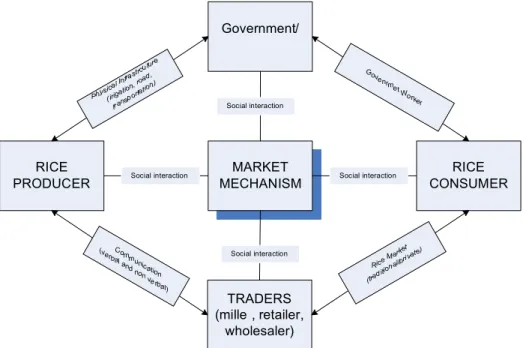
The roles and interest of actors begin from rice producer to rice consumer through rice market mechanism. The rice market mechanism reflecting the interaction of rice information, trader (marketing intermediaries actors) and government (Bulog, Ministry of Agriculture, Ministry of Public Works and Ministry of Trade and Creative Economy).
Graph 2.1 Rice Actors Interation RICE PRODUCER TRADERS ( mille r , retailer , wholesaler ) RICE CONSUMER Government / MARKET MECHANISM C o mm un i c at i on ( ve r b a l a n d n on ve rb a l) Ph y s i c a l I n fr a s tr c u tu r e ( i r ig a ti o n , ro a d , tr an s p o r ta t io n ) Ri c e M ar k e t ( tr a d i ti on al /p r i va t e) Go ve n r me t Wo r ke r
Social interaction Social interaction Social interaction
2.1.1 Agriculture Value Chain
An idea of “value chains” introduces by Michael Porter (1985) introduces has received thought in agricultural sectors in recent years due to a number of economic factors response and customer trends affecting agrifood enterprises. Many researchers, organization and companies defines value chains differently. Generally, these definisitons employ terms such as “parternships”, “alliance” and “collaboration” among actors related and focus on adding value to increase market share or to satisfy consumer demand (Keyser, 2006). Value Chain (GTZ, 2008) defines as (1) the sequence of related business activities from the provision of specific inputs for a particular product to primary production, transformation, distribution and up to end user for consumption; (2) a business model for particular commercial product using a particular technology and a way of coordinating production and marketing; (3) the set of enterprises that performs these functions i.e the producers, processors, traders and distributors of a particular product. Keyser (2006) supports GTZ definition by stated that a value chain is a mutually beneficial partnership among all players involved in the production of a product in which each partner contributes and shares knowledge, information and contributes expertise to improve (differentiate) the final product to better satisfy consumer demand relative to the chain’ competitor. Value chain must efficiently “add value” to the product for the benefit of all involved in the chain;value that is determined by the perceptions of the consumers
The value chain must efficiently “add value” to the product by an interdepent value chain partnership to benefit of all actors involved in the chain;
2.2 DISTRIBUTION CHANNELS
There are many definitions about marketing for agricultural products. Agricultural marketing is a consecutive events or service done for moving (distribute) an agricultural product from the producer to the customer (Ratya, 2004; Mubyarto, 1995; Ade Supriatna, 2002; Agricultural Marketing Series, GS -‐ 1146). Distribution influences almost each aspect in our daily life. It means that there are two or more parties want to exchange something for another thing, it can be said that there is a distribution process. Distribution begins from the need of prospective customer or buyer. For instance, when the farmers decide to sell the husk paddy ready to be harvested to other related parties, there is a distribution activity such as the exchange of husk paddy with rupiah as the profit to other related parties. The
farmers’ need is the money and the need of other related parties as the merchant is the harvested husk paddy.
The growth of economy sector since 1970 gave consequences towards the effort to increase efficiency and effectively of agricultural product distribution. The distribution activity is said to be effective in terms of prosperous economy. Because, it hards to do as generally as producers and customers are often separated by time, place, information and value. These separation appears the gap among distribution activity once distribution process or exchange products occur.
Cannon et al (2008) said that there is a macro distribution function of universal functions of distribution to handle the gap. The function covers purchasing, selling, delivering, storage, standardize and judgment, financing, risk taking and market information (Beckam and Davidson, 1967). The function manner is done by and to whom can be different in many countries and valid to economic system (Lyon and Thompson, 1993). Indonesia agricultural product, buying function means seeking and evaluating product; selling function covers direct selling i.e farmer to vilage traders, farmers to penebas, famers to Village Cooperation (Koperasi Unit Desa), or farmers to milling owners (Arifin, 2004; Daan et.al, 2010; Natawidjaja, 2001; Kitano et.al, 1999).
Buying and selling activities are part of distribution function. These function relates to delivery and transportation activities. Distribution activities consist of several activities such as the movement of goods from one place to another places; storage function means involving goods storage to the need of the customers; standardized function and selection involve selecting agricultural production based on the measurement and quality; financing provides money and credit needed by the production process; storage and selling agricultural production (Arifin, 2004; Hoos, 1951). During the distribution activities, risks possible occur in every activity take place. It means distribution actors responsible to take over uncertainty risk.
Indonesian farmers generally risk taker, because the farmers are taking all risk when farmers decide to plant rice until the harvesting time (it is called failure harvesting process) and storage (the harvesting quality risk is broken unhulled rice) of product. But, when there is a transaction on the customers’ level, so the risk that is faced by the farmer is purchasing price risk. The function of market information to inform rice price at the market (occurs during transaction process known as market price information),
never went to the farmers. The farmer often get loss or even if they get small amount of profit, the profit percentage for the minimum among all the related parties in the distribution channel (Dwidjono, 2001).
2.3 ACTORS IN RICE VALUE CHAIN
This study divides participant of actors in rice supply chain into three groups namely government, broker or trader (middleman) and farmers. Analyzing of rice value chain are intended to provide a systematic knowledge of the flow of the good and services from their origin place to their final destination, including information and price flow. The participant of rice value chain are someone or those who performs physical distribution functions in order to obtain economic benefits as follows :
Government (BULOG or state owned enterprise)
Bulog has a role to keep rice stock, rice availability and stability of rice price in the market. Bulog obligation is buying farmers rice using government buying price schemes. But, Bulog has no longer able to buy rice farmer production, because government buying price is not competitive compare to broker or trader or retailers (including wholesalers).
Broker or Trader
These agents are working for a profit (commission). They performed their job at all levels of distribution channel. They can start their activities from beginning (as capital provider for farmers) and until end customers. Typically, they work for percentage of different price of selling and buying (so called as profit margin). Broker or trader bring buyers and sellers together and assist in negotiations on a more ad hoc basis; but others may operate as auctioneers, on behalf of wholesaler or retailer (trader at village level, sub district and district levels). Mostly, purchasing or selling agents have a good relationship between buyers in Indonesia and payment done by cash. Only trader or broker who has sufficient capital or cash possible sustains cash transaction. Brokers or traders who have limit cash flow are working part time as “ojeg” or building or road construction workers at sub district or municipality area.
Assembler or transporter links between rice farmers to broker, traders or retailers. Transporter collects smaller amount or lots of rice production (rice crops) by his own capital from villages or sometimes he was hired by sub district retailer to deliver rice crops to other province market (in this study is Pasar Johar Karawang and Pasar Caringin Bandung). It can be said transporter is the first link between the farmer and other middleman (retailer or trader).
Retailers
There are different functions of retailer namely retailer at villages or sub district area and retailer at provinces area (pasar induk). The main activity of retailer at sub district or villages is buying rice crops in certain quantity from farmers and sell to wholesaler. Retailer at province areas will buy wholesale rice and sell to consumers (warong, kiosk etc) at convenient locations and times in various forms and quantities. Sometimes, retailers also travel to assemble in rice production areas. At harvest time in particular, when the villages in the neighborhood of the market hold surpluses, retailers prefer to purchase directly from the millers.
Wholesaler
Wholesaler concentrates the various loads and put rice into large or uniform units. Most wholesalers warehouse are located in provinces area. Wholesaler calculates price formation based on qualities (rice grading) and type of rice. Wholesaler also provides information to suppliers (farmers, rural assemblers) and assumes to a varying degree the risks associated with the transfer of property rights attached to the goods and services being bought and sold. Sometimes, he provides and facilitates mass and specialized storage operations, transportation and in general, subsequent distribution operations which is involving retailers. The distinction between wholesaler and retailer is wholesaler concern with the activities of those persons which sell to retailers and other merchants and commercial users, but do not sell in significant amounts to end consumers. But, sometimes rural assembling traders accumulate rice production areas to sell to collecting wholesalers, who carry the commodities to large towns. Once he arrives, he will sell to distributing wholesalers, who in turn sell to retailers.
Millers
Rice miller or processors have a very important role in the distribution (value chains) channels. They transform unhusk paddy to mill rice. The quality of rice in the market depends on the quality of rice (paddy) processing. In some areas, miller owners are also rice trader/ wholesaler. They buy paddy or
unhusked paddy directly from the farmers or rural assemblers, after milling they sell the milled rice to wholesalers or retailers.
Rice Farmers
Rice agricultural sector is believed to be a sector that is able to absorb quite a large number of workers. The number of human resources involved in agricultural sector from the production activity, postproduction (rice milling process, storage, transportation) up to rice distribution in the market will absorb more workers. Sidik (2004) states further that the absorption of unskilled workers in the village sector is potential to decrease the population density in the city on condition that it is supported by the agricultural policy which is pro farmers so as to be able to increase agricultural production. Indonesia farmings are using a simple technology start from planting period until harvesting. The availability of paddy land area is an important asset for farmers and also a key determinant of farmers wealth as farmers household is a net buyer or seller of rice (Timmer, 2004).
BAB III METODE PENELITIAN 3.1 RESEARCH METHOD
The case research method is considered by Miles and Huberman (1998) and Yin (2003) suitable for the following objectives (1) to answer the research question on how and why, (2) researchers can not manipulate the behavior involved during the process; (3) researchers want to get a picture of the contextual conditions associated with the phenomenon. A case research method complemented with a meta-‐theory (theories whose subjects matter is to explain a theory) is employed in this research. Taylor (2005), Fernie and Thorpe (2007) and Holweg and Pil (2007) stated that this method appropriate with structuration theory.
The research framework is developed using the case research method as proposed by Miles & Huberman (2008) and Yin (2003). Based on Figure 3.1 research stages are implemented in these study (1) analysis rice price fluctuations phenomena (2) understand the processes and environment of “the current state” of the rice value chain (information flow including decision is made by actors, negotitation process among actors, etc), and (3) also identify some key factors relevant to the rice price fluctuations through descriptive study. This research is intended to investigate rice fluctuation phenomena empirically (Yin, 2003) and interviewes, observation and FGD to related actors (farmers, trader, government and consumer) are conducted during data collection. The phenomenon of rice price fluctuation is studied using a research framework as defined in Figure 3.1.
Descriptive study
Descriptive study is employed to figure out the rice price fluctuations within the rice value chains as described in Figure 3.1. Figure 3.1 indicates two components, namely decision making and social interactions among actors. In this stage, observations and interviews are conducted in order to get better understanding and to investigate with emphasizing on factors affecting price fluctuations and social interactions on rice value chains (behavioral of rice price transformation along value chain). All qualitative data collects in this stage are explained and analysed using CMO (Context-‐Mechanism-‐ Output) pattern configuration (Pawson and Tilley, 2007). CMO is a contextual approach in which
qualitative investigation in a selected of case studies promote a conceptual model. This conceptual model gives great importance to contextual factors in understanding causality in rice value chain (Pawson and Tilley, 2001; Gill and Turbin, 2001).
The COM helps reveal how interaction of an intervention in rice value chain in Figure 3.1 with a specific context triggers reactions (mechanisms) cause certain outcomes to occur. The CMO outcomes use to design data collection protocol (Yin, 2003). The protocol study is designed to help in formulating the research questions. This study is aimed (1) to get more information among actors interaction; (2) to identify social relationship of actors in rice value chains. and (3) to investigate selected variables to be analyzed further. 3.1 Research Framework
Based on Yin (2003), some cases (with extreme or unique circumstances) were explored to describe rice price fluctuations phenomena, understand the processes and environment of “the current state” of the rice value chain, and also identify some key factors relevant to the rice price fluctuations. Therefore, gathering qualitative data is needed by conducting an individual in-‐depth interview. The strong point of in-‐depth interview is that it produces communication (more than spoken words) between interviewee and the researcher (Newing, 2011; Walliman, 2006). The interviews session will depend on the situation, thus semi-‐structured and informal interviews perform individually with several informants (distribution intermediaries actors such as transporter, miller, retailer and wholesaler), consumers and rice producers. This study also conducts observation (watching what people do – non verbal
Conceptual Model Actors Rice Price Behavior and Interaction Rice Price Fluctuation Multiple Case Study
Interviewes, Observations and FGD
Descriptive Finding Rice Price
communications, listening to what they say and asking for clarifications – verbal communication) during the resarch. This techniques is employed to check the behavior of actors of what they do, they say and they discuss (Walliman, 2006). The output of stage one is descriptive findings which is analysed using pattern matching analysis, within case analysis and enfolding literatur. Three main phenomena are studied in descriptive study as follows:
1. Rice Price Fluctuations reveal how rice fluctuate and convey among rice actors
2. Actors Rice Price Behavior and Interaction describes how actors interact and behave dealing and determining the rice price fluctuations in rice value chain.
3. Rice Price Fluctuation Mechanism identifies factors that govern rice price setting in market, which include supply demand conditions, government influence of rice trade, the nature and extent interactions through rice value chains, the storage availability and the use of technology and innovation in rice farming.
During this stage, once research problems are clarified using CMO pattern configuration, then literature studies undertake to identify important concepts and relationships among actors behaviors in rice value chains. The outcome is a conceptual model that provides a basis for the design of the data collection protocol which will be tested and refined. All theory relates with research question study in this stage are used to develop criteria for the selection of the case studies. Data in the form of interviews, field observations and documents are collected over the period of the study. Preliminary data analysis is taking into account after each interview and in-‐depth analysis undertakes during fieldwork.
3.2 CASE SELECTION
As unit analysis of this research is rice value chains, therefore the use of multiple case study is preferred. Case selection will be based on criteria that is used to select the case and how many cases should be studied. A case will be defined as an instance of a broader phenomenon or as part of a larger set of parallel instances. CMO employs in this study, therefore case selection covers three important components : context – mechanisms – output of rice value chains. For this study, all actors (farmers, traders, customer and government) in rice value chains are treated as important informants. The behaviors and interactions made by actors are the embedded units of analysis in this study. In relation to the level of uncertainty faced by actors is high primarily due to the influence of external factors. Important theoretical characteristics of the case study emerge during the investigation. An experienced
rice value chains researcher, an “informal gatekeeper”, short-‐listed 10 cases in rice fluctuations. Each is reviewed and four to six cases are selected and observed over period of this research. All informants will be contacted by telephone, visited and asked if they are willing to discuss their involvement in the study. A research outline and purpose of the study, the method, time frame and time commitment send to informants in preparation for a pre-‐study interview and preliminary briefing. Once they agree to be involved and permission is obtained to tape then interviewes execute.
3.3 SOURCES AND DATA COLLECTION
In the descriptive study, research data is collected based on interviews and FGD with all actors relate with rice supply chains. Also observation of consumer and trader activities are conducted during this research. Monthly intervals use during this study based on argumentation that actors can remember their tactical decisions over this time frame. The semi-‐structured-‐interview or interview guide are most appropriate data collection method for studying rice price phenomena and actors behavior and interaction. During the research, interview and observation protocols are developed and used to guide and to ensure that all essential and important information regarding proposed research model (research hypothesis and research propositions) are recorded and collected well. The observation activities are drawn according to verbal communications (what people say i.e discussed attributes indicating consumers, traders and producers related with rice price and rice demand. All topic conversation indicates type of relation and importance of social interactions and non verbal communication (i.e buying and sellling strategies including dominance in conversation, gestures and etc). Also, two observation technique conduct, being participant observation and detached observation are used during this research. Detached observation uses more than being participant observation, because it implies more objective and systematic way of observing.
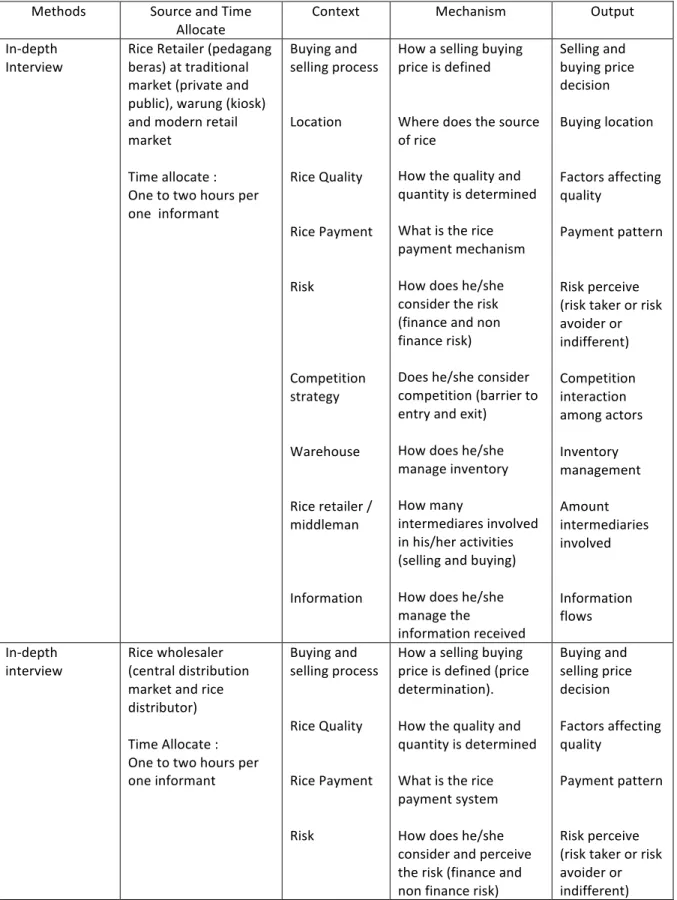
In the case study research, the primary data (i.e interviewes with consumer, traders, government and rice producer) and secondary data (data given by the official government) are collected (see Table 3.1). Secondary data is collected through observations and documents (Yin, 2003). For some importants issues, probing and active listening are used to obtain more information. Multiple forms of evidence possible to be used in this study as a form of triangulation to confirm findings. Any evaluations during this stage are identified along with the factors related with CMO pattern configuration. Interviews are required one to two hours to complete.
Table 3.1 Research Data Source Methods Source and Time
Allocate Context Mechanism Output
In-‐depth
Interview Rice Retailer (pedagang beras) at traditional market (private and public), warung (kiosk) and modern retail market
Time allocate : One to two hours per one informant Buying and selling process Location Rice Quality Rice Payment Risk Competition strategy Warehouse Rice retailer / middleman Information
How a selling buying price is defined
Where does the source of rice
How the quality and quantity is determined
What is the rice payment mechanism
How does he/she consider the risk (finance and non finance risk)
Does he/she consider competition (barrier to entry and exit)
How does he/she manage inventory
How many
intermediares involved in his/her activities (selling and buying)
How does he/she manage the information received Selling and buying price decision Buying location Factors affecting quality Payment pattern Risk perceive (risk taker or risk avoider or indifferent) Competition interaction among actors Inventory management Amount intermediaries involved Information flows In-‐depth
interview Rice wholesaler (central distribution market and rice distributor)
Time Allocate : One to two hours per one informant Buying and selling process Rice Quality Rice Payment Risk
How a selling buying price is defined (price determination).
How the quality and quantity is determined
What is the rice payment system
How does he/she consider and perceive the risk (finance and non finance risk)
Buying and selling price decision Factors affecting quality Payment pattern Risk perceive (risk taker or risk avoider or indifferent)
Competition environment Warehouse capacity “lapak” or “pasar induk” player Information Actor Interaction Trust and social Norms
Does he/she consider competition and negotiation on rice price
How does he/she manage inventory
How many agents or actors involved in his/her activities (selling and buying)
Does the rice information affect selling buying activities
Does he/she have a direct or indirect relationship or
interaction with traders How do they value their trust (social) relationship among related actors Competition and negotitation interaction among actors Inventory management Amount of intermediaries involve Information flows Social interactions Relationship based on trust and fairness In-‐depth
Interview Rice farmer Time Allocate : One to two hours per informant Buying and selling process Rice Quality Rice Payment Risk Competition strategy Warehouse capacity
How a selling buying price is defined (price formation process including buying selling pattern).
How the quality and quantity is determined
What is the rice payment system
How does he/she consider and perceive the risk (finance and non finance risk)
Does he/she consider competition and negotiation on rice value chain
How does he/she manage inventory Buying and selling price decision Factors affecting quality Payment pattern Risk perceive (risk taker or risk avoider or indifferent) Competition and negotitation interaction among actors Inventory management
Broker at village area Information Actor Interaction Trust and social Norms
How decision are made between broker and farmer ? (selling and buying)
How does he/she manage the information How does the information affect selling buying activities
Does he/she have a direct or indirect relationship or interaction with farmers
How do they value their social relationship among related actors Decision pattern Information flows Social interactions Trust relationship In-‐depth
interview Government agencies (bulog, disperindag, local government)
Time Allocate : One hour per informant Buying and selling process Legitimation Resources Rice Price Control Domestic Market Information Distribution Channel Managing actors interaction
How they manage selling buying activities among trader
How do they define role,rules,
responsibility and norms related to rice
How do they define and manage price fluctuation
How they manage price information
How do they explain about structure of rice distribution channel
How do they implement rules or regulations that coordinate market exchange Buying and selling price decision Standard operating procedures and job descriptions Market Price Mechanism and Regulation Information System Management Distribution (chain) pattern
Rules of conduct
Focus Group
Time Allocate : three hour per informant
How does rice price fluctuations affect selling buying activities
Observation - Traditional market
(31 public market and 4 private market in Kota Bandung)
- 3 – 4 modern retail market in Kota Bandung - 30 warung (kiosk) - 1 central market and 10 rice distributor (warehouse)
- paddy field, miller, saprodi shop
- Interaction pattern
- Warehouse capacity and inventory management - Cash flow (capital) pattern
- Bargaining process
Documents - previous research studies - government official website (BPS, Deptan, Depdag, Dinas Pasar) - Government regulation (
- Related previous research findings
- Published documentation (crops, area harvested, saprodi availability, bulog buying price
Focus Group Discussion - Serikat Petani Pasundan - Serikat Petani Karawang - Asosiasi pedagang beras kota bandung Time Allocate : Two to three hours
Issue or topic discussion :
Rice price determination; social relationship among actors; government rules or regulation
BAB IV DATA ANALYSIS
Karawang, Purwarkata and Subang are rice national producer in Indonesia. These region is part of west Java Province, known as one of rice productive harvested area in Indonesia. Indonesian Statistics of Rice (BPS, 2012) noted that Indonesia rice productivity though increase but only in a small percentage. The government is trying to regulate by implementing Undang Undang Pangan to protect rice farmer producer and rice end consumer. Graph 5.1 describes the percentage contribution of West Java Province to Indonesia in terms of rice production and harvested area.
Graph 5.1 Contribution of Rice Production and Harvested Area of West Java Province to Indonesia
Source : BPS, 2012
Graph 5.1 shows during 11 period of years, rice production from West Java Province were volatile (tend to decrease). It is also supported from the decreasing of yearly percentage contribution of harvested area. This condition is worsened by the changing rice field become infrastructures (such as toll roads) or housing areas.
As we known that rice industries feature differing grades of integration from famers as rice producer to consumer. Long working relationship/ social relationship among actors are based on trust, norm and
0.19 0.16 0.16 0.14 0.16 0.16 0.15 0.15 0.15 0.15 0.15 0.15 0.14 0.21 0.18 0.18 0.17 0.18 0.18 0.17 0.17 0.17 0.18 0.18 0.18 0.17 -‐ 0.05 0.10 0.15 0.20 0.25 2000 2001 2002 2003 2004 2005 2006 2007 2008 2009 2010 2011 2012
harvested area (ha) producmon (ton)
role. Trust among farmers can be found during planting until harvesting area. The farmer adhere the cultural norm about social relationship (good cooperation and colaboration) among labour. The role of farmers and its labour has defined long time and not changing by time. The government officers work based on standard and operating procedures from their office with adopting reactive pattern (actions) to the problem occurs instead of preventive actions.
• Rice economics policies -‐ position of rice and trade in Indonesia economy (including govrenment subsidies)
• Cultural norms impose general values to stakeholders with specifically at farmers level. Farmers not only think and act based on margin, but based on how they fulfill their needs (foods, shelter and etc). The social interaction among actors include information exchange, adjustment of actions, construction of shared trust, norms and values.
Major drivers of pricing
• The main factor that affects price transformation through the chain is the market price which is driven by intermediate actors power. The price fluctuation of unhulled paddy price are caused by (1) the the nature of unhulled paddy is influenced by season and (2) farmers are price taker due to the limited amount of farmers capital owned to delay the selling transaction.
• The rice price (including unhulled paddy) is part of market mechanism. Farmers are unable to set the price and time for selling their products. Thus, the rice price fluctuation give more benefit to the middleman than farmers.
• The higher rice price fluctuation gives an opportunity to the wholesaler to control the price by delaying sell the rice into the market. This situation can manipulate the farmers by not giving real price information to the farmers. Thus the price transmition along value rice value chains is assymetry.
The value chain integrations – actors integration models
• Complexity of the chain is showned through many different processing margins – margin costs changing over time, no appropriate one price for farmers. Farmers perceive the price as cost to the seller and tend to receive the decision.
• Less bargaining process at farmer level – price reflects bargaining power of stronger side, representing by wholesaler in Pasar Induk.
• Retail modern market has a power to control (1) timing of new rice procurement round (2) quantity contracted with each rice supplier and (3) well informed on suppliers’ costs
• Wholesaler has capability to delay selling the products because they certain about (1) the rice price market information (2) total output needed and (3) whom they will supply to
• The volatiliy of input price (along rice value chain; both producer -‐ middleman (trasher, miller, wholesaler and retailer) push the more rice price asymetry.
• Harvesting
o Quality of harvesting is determined by the middleman and season, not by the farmers. o Payment system is cash and carry. Bargaining power between farmers to trasher or
farmer to milling owner are not based on negotitation, but on price information. Farmers think at cost + margin, while middleman (miller or wholesaler) think at margin+transportation+marketing (or distribution) cost.
o The relationship between farmers to middleman are mediated by broker. Broker gives information to farmers about the buyers and the price and broker will deliver the information to middleman such as miller or wholesaler.
o Farmers has no inventory handling or stocking system. Middleman has warehous to storage their unhulled rice (gabah kering panen atau gabah kering basah atau gabah kering giling).
o Farmers adopted simple technology though technology of rice planting and harvesting to improve the quality and reliability of products were introduced by government officers.
o Capital intensity in rice warehouse system is changing cost structures
• Marketing
o Information assymetri occurs at farmer level (price reflects cost of seller) until wholesaler level. Less transparency of market prices and costs provides adequate market signals to middleman
o Price reflects bargaining power of stronger side, namely wholesaler in Pasar Induk. They have ability to storage in huge amount and decide when, how and to whom.
o Market dynamic shown at pasar induk in which many wholesaler but similar price buying or selling to many retailer. Retailer power is less compare to wholesaler
o The growth of private label in supermarket impose rice retail packaging its products based on amount customer needs.
o Greater concentration of the retail markets for rice products in supermarkets o Strong segmentation in retail market between rice premium and mid-‐range.
o Direct contact between actors (social interaction) is considered to result in a shared definition about quality and price transformation
• The influence of trade
Rice industry estimates the use of warehousing systems to control its price in the domestic market. The rice industries feature differing degrees of integration from producer to consumer. Unstable rice production impacts on price fluctuates among actors. The Indonesia government still adopting shortage situation will support by import from overseas (bilateral and multilateral aggrement : opening rice import and export). Governement also deterimine the rice quality grading system on the market.
The quality of data
An analysing of price transformation through the value chain in rice industry is made difficult not only by the complexity but also by nthe relevance of available data source. Increased concetration of input production until trading system for only type of rice (IR 64) along with greater role played by rice actors in value chains, reduces the overall data that is available in the industry. At the same time as reported that wholesale price series are relevant as barometer of the domestic rice market, less bargaining power is shown at the farmer level.
Equity owner saprodi shop farmers • Availability of seed, fertilizer, pesticide, land are suported by local saprodi shop; buying mechanism can be cash and carry or credit
Value Chain Integration
• Increasing integration of production,
planting, harvesting and trading along the chain.
• The management of paddy to rice
production through the chain is affected by the middleman
• Most of rice producers integrating
through marketing alliances
• Increasing scale of marketing
efficiency of rice production facilities and processing works by having colaboration among actors such as rice field owner, saprodi shop, peasant labour, miller and middleman (trasher, retailer and wholesaler)
• Farmers higher dependency to
middleman along the marketing chain
•
The marketing approach
• Quality grade and price are
defined by middleman
• Adopting payment system
cash and carry
• Decision of selling and buying handled by middleman
• Information assymetri at
farmer level (price reflects cost of seller)
• Price reflects bargaining
power of stronger side
• Market dynamic shown at pasar induk
Geography factors
• Transportation
insfrastructure
• Structure of farms
(size, capital, ownership) • Climate change Trade impacts • Unstable rice production : price fluctuates among actors • Bilateral and multilateral aggrement : opening rice import and export
• Rice quality grading
system
Cultural and social factors :
• Long working
relationship/ social relationship among actors : trust, norm and role
• Rice economics policies
: position of rice and trade in Indonesia economy (including govrenment subsidies)
• Cultural norms impose
general values to stakeholders
• Social interactions
includes information exchange, adjustment of actions and construction of shared trust, norms and values
Technology and innovation
• Technology of rice
planting and harvesting to improve the quality and reliability of products were introduced • Capital intensity in rice warehouse system is changing cost structures • Less transparency of market prices and costs provides adequate market signals to middleman
Retail market dynamics
• The growth of the
private label in rice retail packaging
• Greater concentration
of the retail markets for rice products in supermarkets
• Strong segmentation in retail market between rice premium and mid-range)
Influence environment (government, regulators, etc) Input
production planting harvesting trading consumption
Marketing and transformation process (trasher, retailer and wholesaler)
WHAT CAN BE CHANGED ?
Area identification which can be increased in terms of
Opportunity/ Needs
market access
buyi