International Journal of Basic & Applied Sciences IJBAS-IJENS Vol: 11 No: 04 37
113604-0909 IJBAS-IJENS © August 2011 IJENS
I J E N S
Comparison Study of
Saron Ricik
Instruments’
Sound Color (Timbre) on the Gamelans of
Nagawilaga
and
Gunturmadu
from
Karaton Ngayogyakarta
Heru Kuswanto
Physics Education Department, Faculty of Mathematics and Natural Sciences,
Universitas Negeri Yogyakarta, Jl. Colombo 1, Yogyakarta 55282, Indonesia
Email: [email protected]
Abstract. The aim of this research is to compare the timbre spectrums of Saron Ricik Instruments of Gamelan Nagawilaga and Gunturmadu of Karaton Ngayogyakarta. These gamelans, as a set of traditional Javanese ensemble, are a pelog scale, seven scales in one octave.
Sound of Saron Ricik Instruments is recorded by sound software. This software can display waveform in the time domain and spectrum in the frequency domain. The fundamental frequency is shown directly by the software. Other peak frequencies can be traced by shifting the cursor on the top of it. The accuracy of frequency that can be produced is 1 Hz
Fundamental frequencies of Saron Ricik of Gamelan Nagawilaga are higher than of Gunturmadu. The locations of the harmonic frequencies are not always consecutive, but sometimes punctuated by another frequency. The number of harmonics or timbre of each instrument of Nagawilaga is different from the one of Gunturmadu..
Keywords: Gamelan, Saron Ricik, Nagawilaga, Gunturmadu
1. Introduction
The gamelan plays many roles in traditional Javanese society: from religion and ceremony to education and entertainment. In recent years, recordings of gamelan music have become available in the West [1, 2, 4, 13].
The gamelan ensemble can be characterized as music based on communal expression. The melody of a single instrument cannot be conceived as separable
from the whole sound of the ensemble. Most of gamelan instruments are tuned to definite pitches corresponding to two kinds of tuning system (laras): five-tone slendro and seven-tone pelog.
Saron is a generic term for a keyed instrument with six or seven keys that covers one octave of either the slendro or pelog tuning system. The instruments of the saron family are saron demung, saron ricik (barung), and saron panerus. They are metallophones with six or seven bronze keys placed on a wooden frame serving as resonators. The demung, which has thick keys, provides the medium octave of the saron group. The saron ricik, which has thick keys (narrower than the ricik’s keys), provides the high octave of the saron group. The saron panerus or peking, which has thick keys narrower than the saron ricik, provides the highest octave of the saron group. It provides the core melody (balungan) in the gamelan orchestra.
The sarons are struck with a mallet (tabuh). Typically, the striking mallet is angled to the right to produce a fuller sound. Saron demung and saron ricik generally use a wooden mallet, while the peking mallet is made of a water buffalo horn, which gives it a shriller sound. Another hand is used to dampen the previous note by grasping the key, in order to prevent a muddy sound. On repeated notes, the note is usually dampened half a beat before it is struck again [6].
International Journal of Basic & Applied Sciences IJBAS-IJENS Vol: 11 No: 04 38
113604-0909 IJBAS-IJENS © August 2011 IJENS
I J E N S 12, 13, 14]. Both of them are gamelan named
Nagawilaga and Gunturmadu.
Javanese sources attributed the origin of Gamelan Sekaten to the nine holy men (Wali Sanga), advisors of the first Sultan of Demak, the 16th century Islamic kingdom. However, Kunst [the renowned Dutch ethnomusicologist] suggests that the sekaten ensemble had already existed for Hindu ceremonial music before the arrival of Islam in Java [2].
The size of the instruments is about three times bigger than that of the regular gamelan. Mallets and hammers are consequently big and heavy, including buffalo horns weighted on the striking head with lead. The tuning of the sekaten ensemble is the seven-tone pelog.
Kunst is the first major studying about the instruments, repertoire, and history of the gamelan (“the result of twenty-eight years’ listening, collecting, and reflecting”) and is the landmark of Music in Java. There are many reasons why gamelan music challenges Western listeners. The timbre of the instruments is unusually bright and harsh. The scales and tunings are unfamiliar.
In many traditional Western forms, the themes are stated, developed, and restated. In contrast, the gamelan performance presents many different ways of disguising the same underlying theme.
There are as many different gamelan tunings as there are gamelans because instruments in the Indonesian musical tradition are not all tuned to a single standard reference scale. Rather, each instrument is tuned and timbrally adjusted to work in its own orchestral context; each instrument is created for and remains with a single ensemble. Each gamelan is tuned to its own variant of pelog or slendro. Every kettle of each bonang, every key of each saron, is hand-shaped with hammer and file. The result is that a piece played on one gamelan inevitably differs in intonation, tone, and feel from the same piece played on another gamelan. Recalling that Western diatonic scales is intimately connected to sounds with harmonic spectra. Perhaps, a similar relationship exists between the pelog
and slendro scales and the inharmonic sounds of the
saron, bonang, gender, or gong. Furthermore, perhaps, the differences among the tunings of various gamelans can be explained in the terms of the differences among the spectra of the various instruments.
The study of the Javanese gamelan has been conducted by experts from both Western and culture of the East. Scientific investigations with the measurement of Javanese gamelan tones had been pioneered by a British physiologist, AJ Ellis, in 1884 on the hose and the voice on the barrel pelog. It was then followed in 1933 by a renowned Dutch musicologist, Jaap Kunst [3], who had conducted investigations on the gamelan tone system intensively by measuring the frequency of
its instrument’s vibration. The main tool used at that time was the thoroughness monochord relying on the ability of hearing (ears) of a person. Then, in 1969, Wasisto Surjodiningrat et al. also investigated the frequency of gamelan instruments’ vibration on various best gamelans’ devices, representatives of Kraton (Kesultanan, Pakualaman, Kasunanan, and Mangkunegaran), government agencies (RRI), and individuals. The instrument used was more modern than the previous, Cathode Ray Oscilicop [3].
The investigations of the gamelan conducted by both Jaap Kunst and S. Wasisto et al. are limited only in measuring the fundamental frequencies, i.e. frequencies that have the highest amplitude, but can not display color frequencies that make up the accompanying sound which are often called the timbre in the study of music theory. Timbre is a trait of the human voice or instrument because of different intensity and number of harmonics and sub harmonics (overtones) that can distinguish one instrument with another instrument. Timbre analysis utilizes Fourier transformation, a transformation that changes the waveform in the time domain to the form of spectrum in the frequency domain. Fourier spectra do an excellent job of identifying the frequency content of individual notes, it is as easy as here to assign fundamentals and overtones. This article examines the color of sound of each instrument for Saron Ricik on Gamelan Nagawilaga and Gunturmadu. The results can be used as a prior study in order to make standardization on the gamelan tone.
2. Research Methods
Data are collected in Karaton Kasultanan Ngayogyakarta (Yogyakarta Sultanate Palace), Indonesia. The musician blends are palace courtiers assigned as the gamelans. The appointment was recommended by Panghageng Kawedanan Hageng Punakawan Kridhamardawa in Karaton Ngayogyakarta, GBPH Yudhaningrat.
Microphones to capture sound are placed near each instrument. These microphones are connected to a portable computer that already contains sound processing software. The resulting sound is recorded and stored. Preliminary analysis is carried out after each recording to determine the consistency of the resulting spectrum. Further analysis is conducted in the laboratory.
d by shifting th hat can be gene
ults and Discu
al Journal of Ba
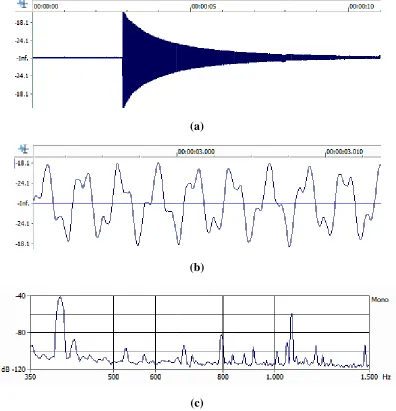
ws the color sp urmadu. The in on of the frequ
d Sciences IJBA
AS-IJENS © August 2 zed
s hilly and stee n in Figure 1
ransformation, a function of fr
a function of sform of the sp
for each instru
al Journal of Ba
amelan Saron R
and (c) as a fun
th highest in undamental f for a Saron Ric
428 Hz. Th nction of the fr
ntensity in ea
AS-IJENS © August 2
(a)
form as a funct trum (Fourier t
tion of time ob transform of th a is higher than
3. The trend as shown in Fig
International Journal of Basic & Applied Sciences IJBAS-IJENS Vol: 11 No: 04 41
113604-0909 IJBAS-IJENS © August 2011 IJENS
I J E N S Table. 1
Fundamental frequency (in hertz) for each Saron Ricik instrument of Gamelan Nagawilaga and Gunturmadu. The Comparison of the results of this study and ones of Wasisto [3].
Instruments number
Gamelans
Nagawilaga Gunturmadu
This study Wasisto [3] This study Wasisto [3]
Fig. 3. Graph comparison of the fundamental frequency of gamelan Saron Ricik Nagawilaga and Gunturmadu.
Both lines are coinciding. The results indicate that without regarding the different fundamental frequencies, their tendencies are equal. This result can be used as reference to standardize the tone of gamelan as western music A shown in Fig. 1 and Fig 2 for instruments number 1, the spectrum shows a different timbre and also their fundamental frequencies.
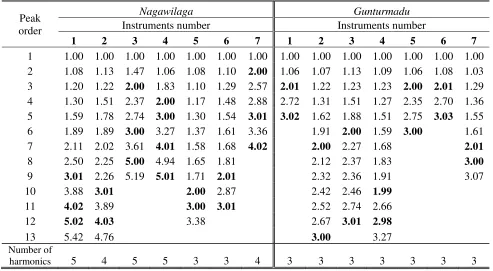
The timbre or sound color of each instruments can be obtained by measured the frequency of each peak of their spectrum Every frequency on every instrument is normalized by referring to the fundamental frequency on the instrument. The results of the normalizations are outlined in Table 2. Figures in bold are the number (and
almost, in a reading error) round, meaning that in these frequencies, they are the harmonics frequencies. The locations of the harmonic frequencies are not always consecutive, but sometimes punctuated by another frequency. This situation is different from the assumption has been stated that in the percussion instruments, there is no harmonic function. This situation is true when comparing it to the fundamental frequency among instruments. The normalization is done from a higher instrument to instrument #1.
International Journal of Basic & Applied Sciences IJBAS-IJENS Vol: 11 No: 04 42
113604-0909 IJBAS-IJENS © August 2011 IJENS
I J E N S Table 2.
The timbre of each instrument of Saron Ricik on gamelan Nagawilaga and. Gunturmadu. Frequency peaks are normalized to the fundamental frequency of each instruments.
Peak order
Nagawilaga Gunturmadu
Instruments number Instruments number
1 2 3 4 5 6 7 1 2 3 4 5 6 7
1 1.00 1.00 1.00 1.00 1.00 1.00 1.00 1.00 1.00 1.00 1.00 1.00 1.00 1.00
2 1.08 1.13 1.47 1.06 1.08 1.10 2.00 1.06 1.07 1.13 1.09 1.06 1.08 1.03
3 1.20 1.22 2.00 1.83 1.10 1.29 2.57 2.01 1.22 1.23 1.23 2.00 2.01 1.29
4 1.30 1.51 2.37 2.00 1.17 1.48 2.88 2.72 1.31 1.51 1.27 2.35 2.70 1.36
5 1.59 1.78 2.74 3.00 1.30 1.54 3.01 3.02 1.62 1.88 1.51 2.75 3.03 1.55
6 1.89 1.89 3.00 3.27 1.37 1.61 3.36 1.91 2.00 1.59 3.00 1.61
7 2.11 2.02 3.61 4.01 1.58 1.68 4.02 2.00 2.27 1.68 2.01
8 2.50 2.25 5.00 4.94 1.65 1.81 2.12 2.37 1.83 3.00
9 3.01 2.26 5.19 5.01 1.71 2.01 2.32 2.36 1.91 3.07
10 3.88 3.01 2.00 2.87 2.42 2.46 1.99
11 4.02 3.89 3.00 3.01 2.52 2.74 2.66 12 5.02 4.03 3.38 2.67 3.01 2.98
13 5.42 4.76 3.00 3.27
Number of
harmonics 5 4 5 5 3 3 4 3 3 3 3 3 3 3
The number of harmonics on the Nagawilaga is more and varied, in contrast to Gunturmadu, in which all instruments only have three harmonic frequencies. The number peaks those indicate their characteristic timbre different for each instruments.
The first instrument of Nagawilaga has five harmonics frequencies but there is no second harmonics. The condition is different of Gunturmadu with three harmonics only. These conditions also occurred for other instruments. This result challenge to compare with more other gamelan in order make standardization due to their different timbre, although the tendencies of fundamental frequencies are similar.
4. Conclusion
Fundamental frequencies of Saron Ricik of Gamelan Nagawilaga are higher than of Gunturmadu. The locations of the harmonic frequencies are not always consecutive, but sometimes punctuated by another frequency. The number of harmonics of each instruments of Nagawilaga is different from one of Gunturmadu, those equal.
Acknowledgements
The author acknowledges the support of National Strategic Research Grant of Universitas Negeri Yogyakarta No. 35/H.34.21/KTR.STRANAS/2009 and
thanks Panghageng Kawedanan Hageng
Kridhamardawa of Karaton Ngayogyakarta Hadiningrat cq GBPH Yudhaningrat, Sumarna, and Agus Purwanto, Department of Physics Education, Universitas Negeri Yogyakarta for their helps.
References
[1] Sumarsam, Gamelan: Cultural Interaction and Musical Development in Central Java, University of Chicago Press, Chicago, 1995 Sumarsam. 2003 Gamelan: Interaksi Budaya dan Perkembangan Musikal di Jawa. Yogyakarta: Pustaka Pelajar,.(in Indonesian)
[2] Sumarsam. Hayatan Gamelan., Kedalaman Lagu, Teori dan Perspektif. Surakarta: STSI Press, 2002 [3] Wasisto S., P.J. Sudarjana, Adhi S., W.
International Journal of Basic & Applied Sciences IJBAS-IJENS Vol: 11 No: 04 43
113604-0909 IJBAS-IJENS © August 2011 IJENS
I J E N S Tone Measurements Of Outstanding Javanese
Gamelan In Yogyakarta And Surakarta, Gadjah Mada University Press,1993 Translated from. Penjelidikan dalam Pengukuran Nada Gamelan-gamelan Jawa Terkemuka di Jogjakarta dan Surakarta. Yogyakarta: Laboratorium Akustik, Bagian Teknik Mesin, Fakultas Teknik, UGM, 1969.
[4] Suprapto, Teguh Suwarto, Sukisno. Gamelan Pakurmatan Kraton Yogyakarta. Yogyakarta: Taman Budaya Prov. DIY. 1993
[5] Mudjijono. Kempyang, Kethuk, Kenong, Kempul, Gong. Yogyakarta: Taman Budaya Prov. DIY. 1990 [6] Tenzer, M. Analytical Studies in World Music
Oxford: Oxford University Press. 2006
[7] Parker, B. Good Vibrations: The Physics of Music. Baltimore: The Johns Hopkins University Press. 2009
[8] Sethares, W.A. Tuning, Timbre, Spectrum, Scale.2ed . London: Springer. 2005
[9] Palgunadi, Bram., Serat Kandha Karawitan Jawi, Bandung, ITB, 2002.
[10] William, S. The Ethnomusicologists’ Cookbook. New York: Routledge. 2006
[11] J.F. Alm, J.S.Walker , Time-Frequency Analysis of Musical Instruments, Siam Review, 44, 3, pp. 457– 476, 2002.
[12] S. Serafini,. Timbre Judgments of Javanese Gamelan Instruments by Trained and Untrained Adults, Psychomusicology,14,137-153, 1995
[13] Spiller, H. Gamelan: The Traditional sounds of Indonesia, Santa Barbara: ABC-CLIO, Inc, 2004 [14] Benamou, M. Rasa: Affect and intuition in
Javanese Musical Aesthetics, Oxford: Oxford University Press, 2010