Institutional Change and eGovernment Innovation Processes
Björn Niehaves
European Research Center for Information Systems (ERCIS), Leonardo-Campus 3, 48149 Muenster, Germany,
Abstract
Governments are investing heavily in modernising public service provision in terms of technology-oriented (eGovernment) and/or management-oriented innovations (New Public Management, NPM). However, the em-beddedness of eGovernment and NPM innovations and innovation processes in the politico-administrative sys-tem (institutional setting) remains under-researched. This is particularly problematic as many governmental systems today are affected by significant institutional changes, often in terms of (central-local) governance decentralisation. Here, an analysis of the impact of institutional changes in the public sector politico-administrative system on IT-enabled innovations and innovation processes is not yet to be found to a necessary extend. Therefore, we address the question of institutional change – specifically central-local governance decen-tralisation – and eGovernment & NPM innovation processes in the public sector. We embedded our study in a broader investigation of the surrounding politico-administrative system. Here, we heavily draw from political science research in order to be able to investigate into public sector institutional changes. In order to substanti-ate our analysis, the exemplary case of Japan is approached by the means of a comprehensive series of qualita-tive-empirical expert interviews conducted in Japanese public administrations.
Keywords
Electronic Government, New Public Management, Innovation Management.
(1) Introduction
is characterised by recent and intensive reform efforts, especially central-local decentralisation approaches. Such high-impact dynamics will potentially shed new light on eGovernment and NPM innovation and diffusion proc-esses (Wollmann, 2003; Pollitt & Bouckaert, 2004).
In the following, we will thus first briefly present a research methodological discussion. Moreover, a frame-work for analysing the politico-administrative system will be derived from the literature review in order to frame our further analysis. Section 3 describes the Japanese case and presents key findings from the qualitative-empirical interview series. The following discussion section seeks to reveal general and generalisable issues on the basis of the Japanese study. Section 5 summarises our findings regarding a) the Japanese case, b) general eGovernment and NPM innovation and diffusion processes, and c) the possibility of interdisciplinary eGovern-ment research.
(2)
Research Methodology
Literature Analysis and Research Framework
Prior to the series of expert interviews, an extensive literature review was conducted. Main fields included (com-parative) studies of public sector reform, comprising eGovernment and NPM approaches, organisational innova-tion studies, political science-oriented innovainnova-tion and diffusion studies as well as adopinnova-tion studies in the public sector. Here, we sought to identify relevant circumstantial dimensions which acknowledge the embeddedness of eGovernment and NPM innovation and diffusion processes in the politico-administrative systems. Here, Pollitt and Bouckaert (Pollitt & Bouckaert, 2004) provide a comprehensive and detailed framework for understanding public sector reforms in their specific national context. Major dimensions of analysis comprise a) external influ-ences to the politico-administrative system, e.g. change events, b) political system characteristics, e.g. party system, c) administrative system characteristics, e.g. federal or unitary structure, and d) system dynamics (see Tab. 1). These dimensions will guide our further analysis in terms of expert interviews.
Dimension Description a) External factors to
the
politico-administrative system
_ External factors often influence politico-administrative systems in and initiate system internal dynamics and changes. Such external factors include change events, such as elections and scandals, but also broader socio-economical developments, such as aging populations or economic recessions. Moreover, general modernisation policies, such as NPM or eGovernment can be considered to have an external influence.
b) Political system characteristics
_ A political system may be shaped, for instance, by its party system, political actors, or lobbies.
c) Administrative sys-tem characteristic
_ An administrative system consists of, for instance, its inner structure (federal or unitary), administrative decision-making characteristics, or administrative culture.
d) System dynamics _ (Politico-administrative) system dynamics often trigger changes in public sector
innova-tion and diffusion processes. This might be the case, if decision-making competencies (with regard to eGovernment and NPM innovations) are shifted from one to another en-tity. At this point, public sector reform approaches, such as eGovernment and NPM, reveal a duality. On the one hand, they represent specific policies; on the other hand, they reshape the politico-administrative system itself. Consequently, public sector inno-vations influence the context for their own emergence and diffusion. Here, the analysis of system dynamics addresses those reform approaches which have impact on the poli-tico-administrative system.
Tab. 1. Major Circumstantial Dimensions to Public Sector Innovation and Diffusion (Pollitt & Bouckaert, 2004)
Expert Interviews
the subjective and organisational embeddedness of interview statements and, in a critical view, acknowledges that such statements do have political dimensions. As a consequence, special attention was paid to the relation-ship of the interview content and the history and current position of the expert interviewed.
(3)
Decentralisation and Innovation – The Case Study Japan
Key Points of Public Sector Reform Dynamics in Japan
Japan is regarded as a late adopter of NPM-oriented approaches while, however, societal and economical chal-lenges (see Tab. 2, a) have triggered major reform efforts since the late 1990s (Muramatsu & Matsunami, 2003). Furthermore, after nearly 50 years of LDP-prime ministers being in office, oppositional parties gained power from 1993 to 1996 and intensified the reform discussion, for instance, regarding decentralisation (see Tab 2., b). While the Japanese politico-administrative system is a unitary system (see Tab. 2, c), strong emphasis of recent public sector reforms is put on decentralisation (see Tab. 2, d).
Dimension Description
ical challenges, also as a consequence of the burst of the Japanese “Bubble Econ-the early 1990s (Yamamura, 1997).
Society” phenomenon hand in hand with a decline of the population (Oe, 2006) s of corruption scandals among high officials lead to a decrease of trust in the
Japa-ernment
f (local government) accountability (as a result of high government-internal financial , e.g. Local Allocation Tax)
b) Politi
_ The beral Democratic Party (LDP) has strongly dominated the political landscape in Ja-ing a LDP prime minister in office from 1955 to 1993 and from 1996 onwards. r, during Hosakawa (1993 to 1994) and the Murayama administration (1994 to veral steps have been undertaken which shape today’s public sector reform in Japan, nce, the decentralisation promotion program (Institute of Administrative Manage-06).
panese administrative system consists of the central government and local govern-he latter is organised as a two-tier system consisting of prefectures and municipali-titute of Administrative Management, 2006). Japan can be considered as a unitary
here, in contrast to, for instance, German federal states, ‘local’ entities are not the stituting elements. However, issues of local autonomy are covered by law.
d) Syste
decentral form” w
m dynamics _ Japanese reforms heavily emphasise decentralisation. Such efforts comprise, for instance, the isation of functions as well as authority and responsibility or the fiscal “Trinity Re-hich shifts tax income from central to local entities (Doi, 2004).
Tab. 2. Major Circumstantial Dimensions to Public Sector Innovation and Diffusion in Japan
These decentralisation efforts comprise agencification (here: “Incorporated Administrative Agencies (IAA)” (Ministry of Internal Affairs and Communication, 2007)) as well as vertical decentralisation in terms of a central to local shift of authority. Niikawa (Niikawa, 2006) identifies two major streams of action underlying to such governance structure reform: (1) The first stream of action aims at strengthening and enabling local governments for larger governance tasks. Such reform efforts include, for instance, building up an operable unit size, here in terms of municipal mergers (1999: 3.229 Japanese municipalities, 2007: about 1.800). Furthermore, a variety of NPM and eGovernment reforms is performed in order to increase Japanese local government managerial effi-ciency and effectives. Examples for such NPM-oriented approaches are project & policy evaluation systems and strategic management while major eGovernment projects address Business Process Management, Open Source Software, and data standardisation issues. (2) Alongside with strengthening local governance capabilities, the central-local relationship is changed in terms of vertical decentralisation. Such decentralisation comprises the transfer of tasks and functions from central to local entities, but more and more also the transfer of genuine au-thority accompanied with a significant change of the fiscal system (“Trinity Reform”) (Doi, 2004).
grow-ing accountability in local entities increases the motivation for local governmental reforms. Second, a greater financial independence fuels such decentralised local reform initiatives. Here, the question arises of how central and local actors make use of such new opportunities in terms of pursuing eGovernment and NPM innovations.
Expert Interviews
The series of expert interviews aims at identifying central and local government influence on local eGovernment and NPM innovation and diffusion. Specifically, it is investigated into how decentralisation of governance opens up for a decentralisation of innovativeness. Here, several institutions have high impact on current streams of innovation and diffusion (see Tab. 3). Such institutions include mass media, educational institutions, local-horizontal cooperation, but also targeted central government measures, for instance, in terms of financial sup-port, know-how transfer, and personnel exchange (‘amakudari’).
Category Main institutions
Statutory-based measures (by Cen-tral Government (CG))
_Central government requires local governments to develop a NPM-oriented “Intensive Reform Plan”. Here, certain categories of reform have to be covered, including, for in-stance, policy and administration evaluation or personnel management issues.
Personnel measures (by CG)
_The Japan-specific ”amakudari”-system allows for central government officials to temporar-ily work in local governments, habitually on the top management level
Know-How-oriented measures (by CG)
_Best-practice NPM reports by the central government Ministry of Internal Affairs and Communication (MIC): nation-wide survey, best-practice identification, nation-wide distri-bution of a best-practices NPM case book, initiated 2005
_Best-practices eGovernment reports by the MIC: nation-wide survey, best-practice identifi-cation, nation-wide distribution of a best-practices eGovernment case book, initiated 2006 Financial measures
(by CG)
_Financial incentives for local eGovernment projects that comply with central government requirements in terms of, for instance, free of cost Open Source Software or funds for joint IT outsourcing projects
Educational meas-ures
_Educational scholarships for (central and local) government officials, often Public Admini-stration Studies in the US or at Japan-based graduate schools
_Education of local government officials in often central government-related educational institutions, for instance, Local Autonomy College (www.soumu.go.jp/jitidai), Japan Acad-emy for Municipal Personnel (www.jamp.gr.jp), or Japan Intellectual AcadAcad-emy of Munici-palities (www.jiam.jp)
Mass media _ Public administration-specific mass media, for instance “Government Technology”,
regu-larly provide information about best-practices in public sector reform and undertakes vari-ous ranking efforts.
_Most leading local government reform projects provide extensive information on their websites.
Local-horizontal relationships
_ Local-horizontal relationships include, for instance, institutional relationships such as
work-ing group collaborations, and pers nal contacts. o
Tab. 3. Institutions in public sector innovation and diffusion in Japan
Here, a recently started central government measure is the distribution of comprehensive best-practice reports on innovative NPM as well as eGovernment projects. Both types of reports follow a similar schema: Central gov-ernment requests prefectures and municipalities to report about their ongoing reform efforts. The resulting pro-ject descriptions are collected and constitute the basis for best-practices selection, a process which is performed by the central government Ministry of Internal Affairs and Communication (MIC). Subsequently, a best-practices case book is compiled and distributed among local entities on a nation-wide basis. Both types of reports have been introduced recently, the first NPM-oriented report (about 100 case descriptions) was issued in 2006, the first eGovernment-oriented report (about 40 cases) in January 2007. Remarkably, the two types of reports are accounted by two different divisions in the central MIC (the former by the Local Administration Division on NPM, the latter by the Division of e-Local Government).
reports on NPM and eGovernment or financial support for local eGovernment projects that comply with central government requirements (see Tab. 3).
Some local governments, in that regard, afforded on own research department which closely watches reform-related activities by other governmental agencies, especially the central government:
The research section is not independent from other projects, it relates to the other reform subjects. A major way of re-searching is learning from other governments. This also means especially watching central government activities: What does the central government think about eGovernment and other public administration reforms. [translated]
Nevertheless, local government officials stated that they perceived significant changes in their eGovernment and NPM activities. A local administration NPM department head argued:
Only five years ago, local government just had to follow central government orders, but that situation has radically changed. We have to be independent in thinking about local government circumstances and about streamlining our own local governmental processes. [translated]
Local governments experience a growing responsibility when it comes to initiating and designing concrete NPM and eGovernment reform projects. With regard to the diffusion of innovations, a local government official stated: We perceive that there is an increasing influence of local governments on public sector reform policies in Japan. Here, the central government acts as a promoter in order to spread local government best-practice ideas to other local gov-ernments. [translated]
Taking a reform example from the field of Public-Private-Partnership, a local government official described the central government influence as follows:
All local governments have to deal with Public-Private-Partnerships, e.g. in the area of facility management. But still, central government still preserves influence on local governments’ facility management. This means that though facility management can be regarded as initially local government-driven (as a lot of local governments introduced NPM-oriented facility management approaches and privatised maintenance) central government now follows these efforts and made a law which is already enacted. [translated]
Consequently, we could identify a multitude of factors that influence NPM and eGovernment innovation and diffusion in Japan. Such factors include traditional as well as new measures undertaken by the central govern-ment, but also a growing trend towards local-horizontal cooperation and diffusion processes.
(4) Discussion
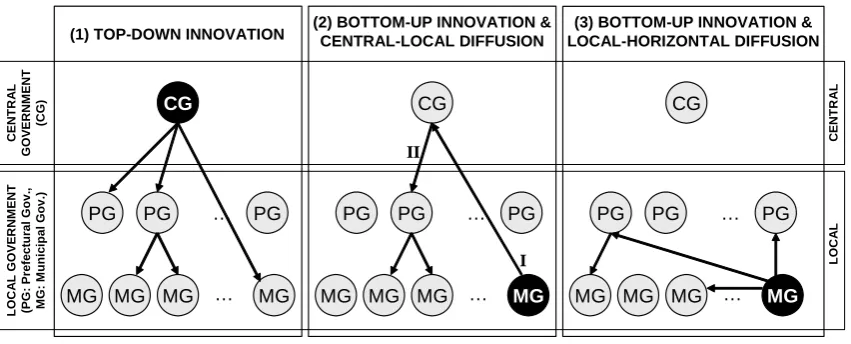
CG
(1) TOP-DOWN INNOVATION (2) BOTTOM-UP INNOVATION &CENTRAL-LOCAL DIFFUSION LOCAL-HORIZONTAL DIFFUSION(3) BOTTOM-UP INNOVATION &
CENT
Fig. 1. Possible pathways of innovation and diffusion in Japan
As a consequence, traditional top-down innovation and diffusion processes are increasingly complemented by bottom-up approaches (see Fig 1., CG: central government, PG: prefectural government, LG: local govern-ment;for other policy fields than NPM and eGovernment see (Ito, 2006)):
(1) Innovation and diffusion processes in the Japanese government have a strong top-down tradition (Jain, 2002; Westney, 1982). Japan is often referred to as the “Catch-up state” (Jain, 2002) that adapts other na-tion’s best-practices to Japanese requirements (e. g., Prussian governmental system). Hence, also eGov-ernment and NPM ideas have been taken from other national practices, for instance, the British govern-ment agency system (in Japan: Incorporated Administrative Agencies (IAA)). Such top-down approach was tied to a strong central government decision-making power and an accordingly strong central govern-ment influence on local governgovern-ment NPM and eGoverngovern-ment innovation and diffusion.
(2) In the tide of decentralisation, an emergence of bottom-up innovation and diffusion processes can be ob-served. Here, the central government might play the role of a multiplicator by collecting best-practice knowledge and distributing it among other governmental entities. In that regard, NPM (2007) and eGov-ernment (2006) best-practice case books (see again Tab. 4) play an important role. An example of such lo-cal innovation and central-lolo-cal diffusion are performance measurement activities first carried out by Mie-Prefecture and today transformed into a national standard for all local governments.
(3) In addition, horizontal-local diffusion of NPM and eGovernment innovations is characterised by a quasi-absence of central government influence. One reason for this might be that the particular innovation is still in an early phase and that the central government does not yet intend to promote this or competing ap-proaches as ‘best-practice’. Also, particular innovations might not lie in the focus of central government attention.
The diversification of innovation and diffusion processes can be explained by decentralisation and capacity building efforts among local governments. Here, innovative local governments might perceive central govern-ment influence as (too) strong as local innovativeness still depends on central financial support to a great extent. On the other hand, at the moment central government tries to sustain certain influence on local government deci-sion-making (see again Tab. 3) arguing that local government capabilities might not yet comply with a fully decentralised governance system. For that reason, central government, until now, plays an active and important role in NPM and eGovernment innovation and diffusion in Japan.
(5) Conclusions
decentrali-sation approaches (institutional change). Such decentralidecentrali-sation and localidecentrali-sation tendencies in the governance structure open up for a decentralisation of eGovernment and NPM innovativeness. From the perspective of local government innovators, e.g. eGovernment managers, a multitude of information sources comes into play includ-ing, for instance, central government information material such as eGovernment and NPM best-practice reports, central government statutory requirements such as an obligatory “intensive reform plan”, but also horizontal-local information sources.
Studying NPM and eGovernment innovation and diffusion processes, the Japanese case exposed the significant effect of decentralisation efforts and changes of governance structures. Traditional top-down approaches are complemented by bottom-up innovations and imply a central government in the role of an innovation multiplica-tor. Such insights open up for further research which might aim at analysing how such multiplication can be improved or how particular innovation practices might be designed in order to function as role model and best-practice for other settings. Such question potentially bridges between a managerial-organisational and a multi-organisational/sectoral perspective on NPM and eGovernment innovations. Furthermore, the presented analysis framework and the Japanese case study provide a starting point for further comparative studies on IT innovation and diffusion processes in the public sector. Here, especially a comparison with federal governmental systems, for instance, in Germany or Switzerland, might be of great interest.
Our political science-oriented study on NPM and eGovernment innovation and diffusion processes revealed that the politico-administrative system entails greatest relevance for public sector innovations, let it be in the field of NPM and/or eGovernment. This calls for further interdisciplinary research that appreciates the politico-administrative embeddedness of socio-technological innovations. Here, a multi-organisational/sectoral perspec-tive on innovation and diffusion processes (see again Tab. 1, Point 4) provides a fruitful starting point as it ad-dresses the question of innovation multiplication and economies of scale from a national perspective. Here, gov-ernments might investigate into which measures stimulate a sustainable innovativeness among governmental entities: Large central government-funded pilot projects (see, for instance, in Germany “Media@Komm”) or rather original means of understanding genuine (local) innovation and its multiplication (see, for instance, NPM and eGovernment best-practice reports in Japan). Here, further qualitative as well as quantitative research is necessary.
Acknowledgment
The study was carried out during a research visit at Waseda University, Tokyo, Japan and co-financed by the Japanese Society for the Promotion of Science (JSPS). My grateful acknowledgments are due to Prof. Koichiro Agata, Prof. Hisao Tsukamoto, Prof. Mari Yanagi Kobayashi (all Waseda University) and Mr. Masao Kikuchi (Meiji University) for their wonderful support and hospitality. Still, the author is solely responsible for all state-ments made in this work.
References
Agarwal, R. and Prasad, J. (1998) A conceptual and operational definition of personal innovativeness in the domain of information technology. Information Systems Research 9 (2), 204-215.
Cooper, R. B. and Zmud, R. W. (1990) Information technology implementation research: A technological diffu-sion approach. Management Science 36 (2), 123-139.
Doi, T. (2004) A missing link in decentralization reform in japan: Trinity reform package. Governance working paper no. 489. East Asian Bureau of Economic Research, ..Sydney, Australia.
Henriksen, H. Z. and Andersen, K. V. (2003) E-procurement adoption: Theory and practice. In Electronic gov-ernment 2003 (Traunmüller, R., Ed), pp 121-124, Springer Lecture Notes in Computer Science, Berlin et al. Institute of Administrative Management (2006) Japan's government and administration at a glance. Institute of
Ito, S. (2001) Shaping policy diffusion: Event history analyses of regional laws in japanese prefectures. Japanese Journal of Political Science 2 (2), 211-235.
Ito, S. (2006) Jichitati-hatsuno-seisakukakushin [policy innovation from local government]. Bokutakusha, To-kyo, Japan.
Jain, P. (2002) The catch-up state: E-government in japan. Japanese Studies 22 (3), 237-255.
Kamlah, W. and Lorenzen, P. (1984) Logical propaedeutic. Pre-school of reasonable discourse. University Press of America, Lanham/MD.
Klein, A. (2006) Das politische system japans. Bier'sche Verlagsanstalt, Bonn.
Krcmar, H. and Schwabe, G. (2000) Piloting socio-technical innovation. In 8th European Conference on Infor-mation Systems, Vienna, Austria.
Ministry of Internal Affairs and Communication, Administrative Evaluation Bureau (2007) Evaluation of incor-porated administrative agencies (tentative translation, unpublished). Ministry of Internal Affairs and Com-munication, Tokyo, Japan.
Muramatsu, M. and Matsunami, J. (2003) The late and sudden emergence of new public management reforms in japan. In Evaluation in public-sector reform: Concepts and practice in international perspective (Wollmann, H., Ed), pp 169-181, Edward Elgar, Cheltenham, UK.
Niikawa, T. (2006) Decentralization and local governance: Reinforcing democracy and effectiveness of local government. In Regional Forum on Reinventing Government in Asia - Building Trust in Government: Inno-vations to Improve Governance, Seoul, Korea.
Oe, M. (2006) Problems and implications of japan's aging society for future urban developments. Policy and governance working paper series no.89. Keio University, Tokyo, Japan.
Pollitt, C. and Bouckaert, G. (2004) Public management reform - a comparative analysis. Oxford University Press, Oxford, UK.
Westney, D. E. (1982) The emulation of western organizations in meiji japan: The case of the paris prefecture of police and the keishi-cho. Journal of Japanese Studies 8 (2), 307-342.
Wollmann, H. (Ed.) (2003) Evaluation in public-sector reform: Concepts and practice in international perspec-tive. Edward Elgar, Cheltenham, UK.