Beyond Words Vol.3, No.1, May 2015 Widya Mandala Catholic University Surabaya, Indonesia Indonesian EFL Teachers in the Swing of Curricula
Ashadi [email protected] Universitas Negeri Yogyakarta
Abstract
In the era of standard-based education which is marked by the reforms in many areas of education including curriculum, it is necessary to understand how Indonesian EFL teachers coped with curricular change in the course of their profession. This study attempts to discover how EFL teachers in Indonesia perceive the curricular changes through their beliefs, attitudes, and practices. Employing an on-line survey combined with semi-structured individual interviews, the qualitative study began with mapping EFL teachers’ generic perceptions towards curricular change. The initial map was then used to probe major emergent themes through individual interviews on purposively selected participants. The result showed that: (1) teachers’ belief was perceived to reshape through adequate socialization and training. (2), it took time to witness teachers’ belief formation and eventually attitudinal change, and (3) as their beliefs and practices were reshaped, teachers’ practice was highly likely to change moreover when improvement in learning gains were achieved by the students. However, the latter is often dismayed by the implementation of high-stakes testing (The National Examinations). This article is closed with relevant recommendations based on the particular findings.
Indonesian EFL Teachers in the Swing of Curricula
Every curriculum needs to change and adapt in order to meet the evolving demands and recent developments in the society. As the nature of the labor market has changed significantly, curriculum changes become unavoidable. The emergence of world knowledge-based and service-based economies has shaped a new industrial order. Indonesia is moving from a developing nation to one of Asia’s biggest economy together with Japan and India. In relation to education, it is interesting to ask if curriculum change is merely to prepare learners for the changing market place or to achieve broader education outcomes. It is widely believed that schools need to prepare students with the life skills, knowledge and individual potentials to be flexible and adaptable in any social changes. Hence, whatever role they hold in the future, students can really learn new skills and acquire new knowledge to move forward regardless of any changes.
This inquiry is an attempt to understand how EFL teachers in Indonesia make sense of the curriculum changes they experienced in their professional course. Sense making of the curriculum change is an important endeavor to comprehend the impacts of the change in teachers’ beliefs and practices. This article discusses how EFL teachers in Indonesian schools perceive their (1) beliefs, (2) practices, and (3) attitudes in response to curriculum changes they experienced. Further recommendations on practice and policy are discussed in the end of this article.
Teachers’ Beliefs, Practices and Attitudes
In relation to teacher change, Guskey (2002) further proposed three major goals of change in the classroom practices of teachers: change in the learning outcomes of students, change in their attitudes, and change in their beliefs. He emphasized the significance of having successful experiences that can change teachers’ prior attitudes and beliefs. When teachers believe it works as they experience themselves, that experience shapes their fresh attitudes and beliefs. Built on the James-Lange theory of emotion feedback, Guskey’s model of teacher change implies that change in teachers’ attitudes and beliefs is principally an outcome, rather than a trigger, of change in the learning outcomes of students. Without any evidence of positive change in students’ learning, significant change in the attitudes and beliefs of teachers is unlikely to occur. Thus, it is their belief that professional development will increase their understanding and competence, grow their professionalism, and develop their instructional practices to what drives teachers to professional development.
Sense-Making Through Organizational Learning
School as a learning institution (for all of its stakeholders) have gained a central function and its leaders and teachers have significant roles to play in school improvement. In Guskey’s (1995) terminology, these leaders’ and teachers’ active learning and collaboration will bring about productive change, leading to organizational learning. It is the inner creative capacity of schools to adjust to the dynamics of educational change (Sleegers & Leithwood, 2010, p. 558). Sleegers & Leithwood add that research often describes this conception of collective learning in school cultures as a professional learning community which has three strong principles: a professionally oriented culture, a learning focus, and appreciation of teachers’ inquiry and association. Hence, it would be suitable to ask relevant teachers and school stakeholders to know to what extent they make sense of curricular changes.
Despite the different indicators and variables to describe and define the learning community, the essential idea of school organizational learning is to help form teachers’ attitudes towards new pedagogies and curricula. The key implication for schools that wish to create learning organization is that they must provide a range of targeted opportunities for teachers to learn and participate in the organizational learning. Such a view inevitably places schools in a significant role as learning opportunity providers for teachers as the agents of school change in this particular study. Thus, knowing how school stakeholders make sense of the changes, the barriers they encounter, and the efforts they make to adapt is essential in the current study.
on-going nature of constructing understanding, directing away from a notion of learning as simple, properly designated activities. On the contrary, teachers might engage in sense-making any time for instance when they encounter difficulty in understanding a policy instruction or have classroom teaching experiences they find bewildering. Moreover, the interpretations teachers draw from these matters is, to a certain extent, related to their identity, including their knowledge, beliefs, and current practices. Thus, employing a sense-making lens to the study of teachers’ sense making facilitates the study to the conception of why, what, how, when, and where teachers change in response to curricular changes.
Indonesian EFL Context
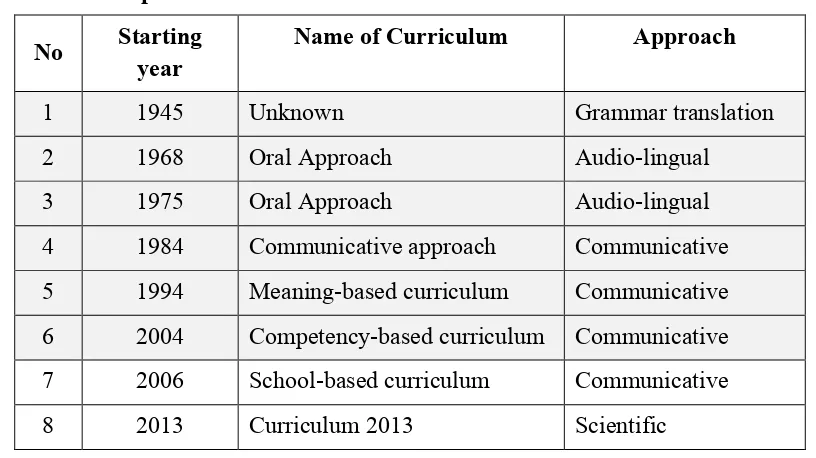
[image:8.612.101.509.271.500.2]According to Lie (2007), Indonesia underwent six EFL curricular changes with three different approaches prior to her publication. With the two recent changes, there have been eight English teaching curricula implemented in the country. Table 1 below describes the English teaching curricular changes that happened in the Indonesian education system (the shaded rows could be found by Lie (2009)).
Table 1.
List of curricula implemented in Indonesia No Starting
year
Name of Curriculum Approach
1 1945 Unknown Grammar translation
2 1968 Oral Approach Audio-lingual
3 1975 Oral Approach Audio-lingual
4 1984 Communicative approach Communicative
5 1994 Meaning-based curriculum Communicative
6 2004 Competency-based curriculum Communicative
7 2006 School-based curriculum Communicative
8 2013 Curriculum 2013 Scientific
Overall, Lie (2009) noted four main constraints in all of the curricular changes experienced by ELT in Indonesia. First, the number of students in classrooms is so large and their socio-economic disparity is so wide that it is difficult to design a curriculum that would work effectively all students in schools. In other words, a one-size-fits-all curriculum would be inappropriate for the Indonesian education setting. The next constraint is the budget shortage which has implications on the large class size, the low teacher salary, and the lack of educational resources. The third constraint is the nature of EFL learning environment where unequal opportunities exist in the learning environment for learners of English in Indonesia. The last constraint is the politics of policy and curriculum. Although teachers were supposed to have the autonomy to develop and carry out the curriculum based on the basic competencies and minimal standards as set in, for instance, the 2004 Curriculum, school practices in regard to EFL teaching did not reflect the ideals of the curriculum. The national exam pressure forces teachers to teach to the test and drill their students for several months of their last year in high school.
Such conditions have put EFL teachers into a dilemma of following the prescribed curriculum or achieving the high scores in the National Examinations (NEs). They are in between the extreme pendulum which to a certain extent impact on their pedagogical practices. The competency-based curriculum approach employed since 2004 is dismayed by the implementation of high-stakes testing as the NEs. After the political heat, the new government seems to take the pro-teacher steps in terms of educational policy. However, still, the voice of teachers remains central despite the policy shifts.
Teacher Resistance
Such resistance is believed to happen when teachers do not comprehend and value the need for change. Under such conditions, they tend to be more interested in keeping the status quo to continue. It must be easier to continue the existing instructional practices in the same way rather than trying to learn new approaches and methods. Greenberg and Baron (2008) argue that teachers might fear the loss of what is familiar and comfortable, and might feel anxious about the new changes when their fixed professional and instructional routines are disturbed. Teacher resistance might also arise from a lowered commitment to change in the late years of career cycle (Huberman, 1989), and from drives to retain status and self-interest when recommended changes are considered intimidating (Fullan and Hargreaves, 1996).
However, Achinstein and Ogawa (2006) and Gitlin and Margonis (1995) remind the danger of stereotypical and biased stigma on teachers who resist curricular reform proposals, and argue that teachers show ‘principled resistance’ only when they identify proposed curriculum changes as unfavorable to their students’ learning.
Brief Methods
In order to answer the proposed research question, the study was designed to accommodate extensive and in-depth information from the participants. For that reason, the study had to cover wide-ranging participants while at the same time the depth of their responses was central. Thomas Schwandt (2007, p. 296) argues that “to thickly describe social action is actually to begin to interpret it by recording the circumstances, meanings, intentions, strategies, motivations, and so on that characterize a particular episode. It is this interpretive characteristic of description rather than detail per se that makes it thick.” Thus, the interpretations of the phenomena made the current study reach what so called ‘thick description’.
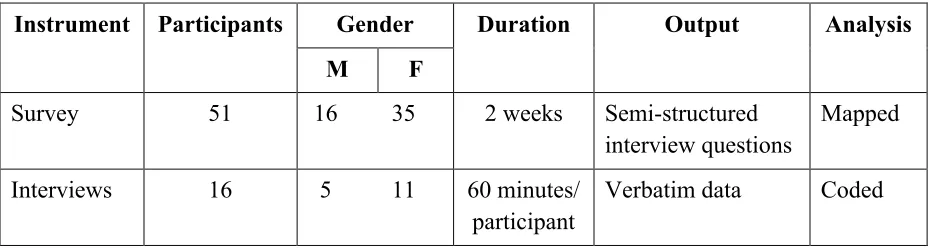
[image:11.612.72.539.553.677.2] [image:11.612.71.535.553.676.2]Embracing a qualitative approach, this study was carried out through two phases of data collection. The first was in the form of on line survey involving EFL teachers of different backgrounds in which the obtained information was used as the initial data. Sent through on line channels such as e-mails and social media applications, the survey gained considerable responses from EFL teachers due to the spiral nature of these technologies. Only expecting for about forty responses, fifty one teachers voluntarily gave their responses within a fortnight. The following table summarizes the details of the participants in the study.
Table 2.
Summary of Participants & Data Collection
Instrument Participants Gender Duration Output Analysis
M F
Survey 51 16 35 2 weeks Semi-structured
interview questions
Mapped
Interviews 16 5 11 60 minutes/ participant
The initial data from the on-line survey was utilized to construct questions for the second stage of semi-structured individual interviews. Sixteen participants were selected purposively to represent different gender, academic background, school type, and teaching experience. With twelve pre-designed questions and probes mapped from the first phase of data gathering, each participant took about sixty minutes to respond in a relaxed situation. All individual interviews were conducted in Indonesian to facilitate comprehension, recorded by means of an audio tape, and the verbatim data were transcribed in order to ease subsequent coding processes.
Results and Discussions
In line with the research questions, this section is divided into three sub-sections to facilitate the discussion. The first sub-section discusses the perceived impacts on EFL teachers’ beliefs. Following that, the perceived impacts on their attitudes will be discussed and finally, this section will elaborate the perceived impact of curricular change on teachers’ practices. Every finding of the study is followed by a discussion with relevant literature to make sense of the data and to locate the findings among the existing studies in related area.
The Perceived Impact on Teachers’ Beliefs
when implementing curricular reform often results in disappointing outcomes. Therefore, it is necessary to first understand set belief incorporated by the teachers before implementing change.
Reflecting on her own experience, another teacher in a well-established vocational school, Anne argued, “It is not easy for us to learn new things instantly. We have to make sure that the change is really favorable for us and for our students.” Her statement reflects teachers’ concern over the short socialization and speedy learning expected from the teachers who have been comfortable in using their preferred curriculum for years. As they claim, it requires time and effort to change their beliefs in the curriculum.
In a rather cynical way, Brad who teaches English in a junior school in the city claimed, “They (the authority) never conducted any study on the (competency-based) curriculum. How could they change it?” As probed further, his voice was not meant to be rebellious but a reflection of his disappointment towards the marginalization he experienced at school, exclusion from policy making, and a form of critical voice that was also heard from most interviews with the participants. These teachers argued that, by all means, they had to comply with the regulation (curriculum) as it has been enacted; they would change. In other words, they would inevitably reshape their beliefs in the existing curriculum in the light of the new one despite their resistant-look and apathy.
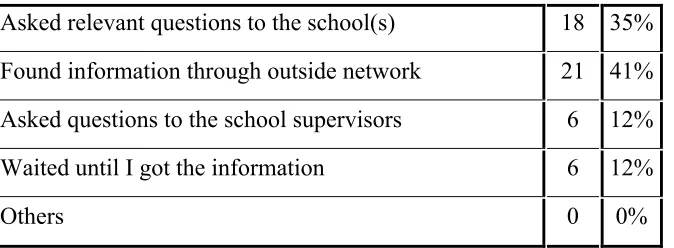
Table 3.
Summary Responses of Participants’ Attitudes
Asked relevant questions to the school(s) 18 35% Found information through outside network 21 41% Asked questions to the school supervisors 6 12%
Waited until I got the information 6 12%
Others 0 0%
Only a half-dozen participants showed their averseness while the rest tried to positively look for information about the change through different channels. It demonstrates that most of the survey participants (EFL teachers) were aware of the curricular change despite their perceived attitudes which are discussed in the following sub-section.
The Perceived Impacts on Teachers’ Attitudes
Two major voices in common among the participants are the demand for better
communication and the emphasis for curricular evaluation before any change. These two themes
were consistently emergent both in the survey and the interviews. The two themes can be said to
become the main drive for teachers’ attitudinal reactions in the study.
Despite his colleagues’ reluctance, he admitted that it would be too long to understand the change if he only waited for the official socialization from the authority.
Ling (2002) finds changes in teacher feelings during curriculum reform. In her study,
teachers’ feelings changed from frustration during the first phase of curriculum change to
confidence when they were able to adapt the materials. It is similar to what Maria, an EFL
teacher who participated in the interview, said, “I was struggling with the new curriculum but
after attending several trainings and workshops, I gradually understood what was required by
the curriculum”. Burns (1995) admits that curriculum change challenges familiar practices but
with the passing of time that brings familiarity, initial concerns are normally resolved. The
familiarity which came with experience as time passed was the factor that helped in reshaping
the teachers’ belief of the change and contributed to improving the teachers’ attitudes.
This could be what happened to the teachers in this study whose initial perceptions of
reform in curriculum changed over time and this adjustment in belief was reflected in their
attitudes and eventually practices. It needs to be emphasized that there are similarities and
differences between teachers in the way they internalize the changes. As what the survey
captures, teacher participants have mixed-responses towards the curriculum reform. Regardless
of their dissatisfaction with their roles in the process of curriculum change, the participants
showed different reactions to this top-down policy and marginalization. It is, therefore, possible
that different teachers drew on their different educational, social, and cultural backgrounds in
managing their responses and reactions towards the newly implemented curriculum.
The Perceived Impact on Teachers’ Practices
professional learning in a rural school. She seemed to resist the change in the way she maintained her instructions. It is interesting to review the literature regarding the phenomenon. Allington, Johnston, and Day (2002, p. 462) viewed teaching as “a complex activity that is not amendable to scripted materials, standardized lessons, or any one-size-fits-all plan for the organization of instruction”. In line with that, teachers, according to Fang (1996), organize instruction in alignment with previous classroom interactions, personal reflections and beliefs, and the observed needs of their students. In more recent research, Van Der Schaaf, Stokking, and Verloop (2008) find that quality teaching is bred when competent teachers align their personal beliefs with their professional practice. Thus, what teachers believe is normally represented in their instructional practice.
Three interview participants voiced their concerns over their hesitation to implement the suggested instructions in the new curriculum. “My friends and I don’t feel confident and comfortable with the new curriculum. We can’t see the difference in the competence standard and the approach is not familiar ELT”, said Charlie, acting as a spoken person for his colleagues. “We are worried that our students also get confused with our new way of teaching”, explained Jessica who also stressed the focus on the National Examinations (NEs). The latter emphasis was a clue to understand the teachers’ reluctance to shift their instructions. The suggested approach and practices on skills and competencies had to collide with the drive of the NEs on the other extreme of the pendulum which noticeably creates disharmony.
occurred among the current study’s participants resemble Au’s meta-synthesis study. Most participants argued that they normally practice (a method) which they believed to be practicable and effective in their classrooms. When a new method or approach to teaching is introduced (through a new curriculum), they tend to ‘wait and see’. Until its benefits and effectiveness are proven, they will seek information on it but maintain their practices regardless of the invitation to change.
Hence, it is actually both matters of time and result for teachers to ‘learn’ and embrace a new change. They realize the work to implement the curriculum through their instructional practices. They want to make sure that the change will facilitate their practice and is effective in terms of achieving students’ academic success. With the implementation of the NEs, the term academic success has been reduced to gaining high scores in the subject (English). Although less than half of the survey participants felt that the problem is on the content of the new curriculum, the interviews suggest that how it is socialized and introduced to them as practitioners and users in the classrooms matters more.
Conclusions & Suggestions
The results and discussions show that teachers kept their practices because the new
curriculum is considered as alien and understanding it takes time. During the period of
adaptation, teachers are actually testing their beliefs and learning to familiarize themselves with
the new curriculum but unfortunately their attitudes are often misinterpreted as forms of
resistance. McKernan (2008, p. 86) argues that teachers need to be given “a fair stake in
qualitative judgment, classroom research and evaluation … (and) decision-making belongs to
individual teachers.” According to Elliott (1994), curriculum development means a process in
develop the curriculum. Similarly, Rea-Dickens and Germaine (1998) argue for the importance
of involving teachers in curriculum development. Being alienated from policy making has made
EFL teachers in Indonesia more calculative in response to curricular changes.
The partial revocation of curriculum 2013 by the new government demonstrates the
importance of engaging teachers the processes of curriculum development, implementation and
evaluations. In terms of developing a language curriculum, the processes of articulating broad
educational philosophies, policies, needs analysis, goals, and methodological approaches need to
take into account EFL teachers’ voice. For instance, Agustien (2014) exemplified that teachers
noticed the flaws in the curriculum particularly in the interpretation of the embraced paradigm
with the reality they faced in the dissemination. She also found that there was no clear guidance for the teachers in training materials as to how to accommodate Scientific Approach elements in the Genre Based Approach method to achieve the targeted communicative competence. Consequently, teachers interpreted the principles in the approach differently. This example should become a lesson in policy learning so that future decision can consider a more participatory approach.
As the current study suggests, teachers know best what happen in the classrooms as they
are the true users of the curriculum. Their criticism and cynical attitudes towards the withdrawn
curriculum should be marked as significant signals from the practitioners in the schools that have
make teachers and teacher candidates aware that change is inevitable and they have to be ready for any change including in their instructional practices. The education context is changing rapidly and EFL teachers need to be equipped with the ability to adapt in order to be able to cope well with the speed of transformation.
References
Achinstein, B., & Ogawa, R. T. (2006). (In) Fidelity: What the resistance of new teachers reveals about professional principles and prescriptive educational policies. Harvard Educational Review, 76(1), 30-63.
Allington, R. L., P. H. Johnston, and J. P. Day. (2002). Exemplary fourth grade teachers. Language Arts 79(6): 462–66.
Au, W. (2007). High-stakes testing and curricular control: A qualitative metasynthesis. Educational Researcher, 36(5), 258-267.
Basalama, N. (2010). English teachers in Indonesian senior high schools in Gorontalo: a qualitative study of professional formation, identity and practice(Doctoral dissertation, Victoria University).
Burns, A. (1995). Teachers’ voices: Curriculum design and change. Paper presented at Japan
Association for Language Teaching conference, November, in Nagoya, Japan. (ERIC
Document Reproduction Service No. ED406 850.)
Clarke, D., & Hollingsworth, H. (2002). Elaborating a model of teacher professional growth. Teaching and teacher education, 18(8), 947-967.
Doyle, W. (1997). Heard any really good stories lately? A critique of the critics of narrative in educational research. Teaching and Teacher Education, 13(1), 93-99.
Fang, Z. (1996). A review of research on teacher beliefs and practices. Educational Research 38(1): 47–65.
Gitlin, A., & Margonis, F. (1995). The political aspect of reform: Teacher resistance as good sense. American Journal of Education, 377-405.
Dyer, C. (1999) Researching the implementation of educational policy: a backward mapping approach. Comparative Education, March 1999, 35 (1)
Elliott, J. (1994). The teacher’s role in curriculum development: An unresolved issue in English
attempts at curriculum reform.Curriculum Studies2, no. 1: 43–69.
Fullan, M. and Hargreaves, A. (1996). What’s worth fighting for in your school?New York: Teachers College Press.
Fullan, M. (2006). Change theory. A force for school improvement.Seminar Series PaperVol. 157. Victoria: Centre for Strategic Education
Fullan, M. (2007).The new meaning of educational change (4thed.)New York: Teachers College Press
Greenberg, J. and Baron, R. A. (2008). Behaviour in organizations. New Jersey: Prentice Hall. Giles. C. (2006). Sustaining secondary school visions over time: Resistance, resilience and
educational reform. Journal of Educational Change, 7(3), 179-208.
Huberman, A.M. (1989). The professional life cycle of teachers. Teachers College Record, 91(1), 31–57
Jenkins, J. (2005). Implementing an international approach to English pronunciation: The role of teacher attitudes and identity. Tesol Quarterly, 39(3), 535-543.
Johnson, K. E. (2009). Second language teacher education: A sociocultural perspective. Routledge.
Lieberman, A. (1997). Navigating the four C’s: Building a bridge over troubled waters. In The
curriculum studies reader,ed. D.J. Flinders and S.J. Thornton, 350–4. New York:
Routledge
Ling, L.M. 2002. A tale of two teachers: Teachers’ responses to an imposed curriculum reform.
Teacher Development6, no. 1: 33–46.
Madya, S. (2010). Developing standards for EFL in Indonesia as part of the EFL teaching reform. TEFLIN Journal, 13(2).
McKernan, J. (2008).Curriculum and imagination: Process theory, pedagogy and action
research.London: Routledge.
Rea-Dickens, P., and K.P. Germaine, eds. (1998).Managing evaluation and innovation in
language teaching: Building bridges.London: Longman.
Riessman, C. K. (2008). Narrative methods for the human sciences. Sage.
Richardson, V., P. Anders, D. Tidwell, and C. Lloyd. (1991). The relationship between teachers’ beliefs and practices in reading comprehension instruction. American Educational
Research Journal28(3): 559–86
Schwandt, T. A. (2007). The Sage dictionary of qualitative enquiry. Thousand Oaks, CA: Sage. Sleegers, P., & Leithwood, K. (2010). School development for teacher learning and change.
International encyclopedia of education, 7, 557-562.
Smagorinsky, P., A. Lakly, and T. S. Johnson. (2002). Acquiescence, accommodation, and resistance in learning to teach within a prescribed curriculum. English Education34(3): 187–213.
Van Der Schaaf, M. F., K. M. Stokking, and N. Verloop. (2008). Teacher beliefs and teacher behaviour in a portfolio assessment. Teaching and Teacher Education34: 1691–1704. Karl E. Weick. (1995). Sensemaking in organizations(Vol. 3). Sage.