• Tidak ada hasil yang ditemukan

THE USE OF SHORT STORY IN TEACHING PRONUNCIATION OF ENGLISH VOWEL SOUNDS | A. Laadi | ELTS JOURNAL 3033 9325 1 PB

N/A
N/A
Protected

Academic year: 2017

Membagikan "THE USE OF SHORT STORY IN TEACHING PRONUNCIATION OF ENGLISH VOWEL SOUNDS | A. Laadi | ELTS JOURNAL 3033 9325 1 PB"

Copied!
15
0
0

Teks penuh

(1)

e-Journal of English Language Teaching Society (ELTS) Vol. 2 No. 2 2014 – ISSN 2331-1841 1

THE USE OF SHORT STORY

IN TEACHING PRONUNCIATION

OF ENGLISH VOWEL SOUNDS

Wardina A. Laadi1, Josef Englebertus Ohoiwutun2, Hastini3

Abstract

The objective of this research was to find out the use of short story could improve the ability of the eighth grade students of MTs Negeri Luwuk in pronouncing the English vowel sounds. This research applied intact group design. The research population was the eighth grade students of MTs Negeri Luwuk. The sample of this research was selected by using cluster sampling technique. The samples of this research were class VIII B as experimental group consisting of 40 students and class VIII E as control group consisting of 40 students. In collecting the data, the writer used test. The test was used once as post-test. Then, the data were analyzed statistically. Having analyzed the data, it was realized that there were different scores obtained from control group and experimental group. In the other words, the counted (12.02) was higher than t-table (1.99). It means that the result indicated the use of short story can be used to improve the pronunciation of English vowel sounds of the eighth grade students at MTs Negeri Luwuk.

Keywords: Pronunciation; Vowels; Short Story

INTRODUCTION

Pronunciation is one of the language components which plays an important role in

communication. Someone will not understand if the interlocutor mispronounces a word. It will

impact the conversation. ɑs Lewis and Hill (1992:72) argue “It is extremely difficult to listen to a speaker when pronunciation is inconsistent and it is tiring to listen to one who varies

considerably from standard. ɒad pronunciation can be seriously blocking the communication”.

The learners of English mostly mispronouncing some words, especially in pronouncing

the vowels sound. It is caused by several problems. The common problem faced by the learners

1

Email: [email protected]

2

Email: [email protected]

3

(2)

e-Journal of English Language Teaching Society (ELTS) Vol. 2 No. 2 2014 – ISSN 2331-1841 2 of English especially Indonesian is that they do not pronounce some vowels or diphthongs

“tense and lax” with an enough duration. They still get confused whether the vowels or

diphthongs are pronounced tense or lax. For instance, when they say the word “name” and “make” which should be pronounced /neɪm/ and /meɪk/ (tense) but in fact they always pronounce /nεm/ and /mεk/ (becomes lax). It is caused by there is a differentiation between

English and Indonesian. Indonesian has 6 vowels (a, i, u, e, ə, and o) while in English there are

12 vowels which contain tense and lax sounds.

Another problem is the Indonesian learners of English still find difficulty in

pronouncing some irregular verbs. It can be seen in the irregular verb of “read” which is

pronounced /riːd/ in present form but becomes /red/ in the past form. The written form of the

word is similar but different in pronunciation. The changing is only in pronunciation not in the

written form. It is caused by English as an inconsistent language, which the word is

inconsistent in pronunciation. ɑs ɒasri (2005:29) states “English has a „bad reputation‟ as a

very inconsistent language in that it shows a great discrepancy between spelling and

pronunciation”.

In addition, the next problem which causes the mistake in pronunciation is most learners

of English always make generalization of all vowel sounds. For example, because the words

“man”, “ban”, and “pan” are pronounced /mæn/, /bæn/, /pæn/ respectively, they will make a

wrong conclusion that all of letters ‹a› putting in a word are pronounced /æ/. Therefore the

words like “far”, “want”, and “car”, which should be pronounced /f ːr/, /w ːnt/, /k ːr/, tend to

be pronounced /fær/, /wænt/, and /kær/ respectively.

There are many techniques and media that can be used in teaching pronunciation of

English vowel sounds to solve those problems. One of them is reading a short story loudly.

Abrams in Pardede (2011:17) defines short story “ɑs a narrative that can be read at one sitting

of from one-half hour to two hours, and that is limited to „a certain unique or single effect,‟ to

which every detail is subordinate”. In other hand the literary of short story is not too long. It

makes this medium can be used in teaching and learning in the class without taking much time.

This idea is supported by Pardede (2011:17) who says “…short stories are the most suitable

literary genre to use in English teaching due to its shortness….” ɒesides, short story is interesting to read because the text contains pictures. It makes the learners of English

(3)

e-Journal of English Language Teaching Society (ELTS) Vol. 2 No. 2 2014 – ISSN 2331-1841 3 Additionally, the cause which makes short story can be used in teaching is because it is

learnt at the eighth grade of Junior high school as stated in Kurikulum Tingkat Satuan

Pendidikan (2006) “Membaca nyaring bermakna teks fungsional dan essai pendek sederhana berbentuk recount dan narrative dengan ucapan, tekanan dan intonasi yang berterima yang

berkaitan dengan lingkungan sekitar”. It is easy to find in students‟ handout and in the online

text. Asking students to read story aloud can develop their speaking as well as listening skills.

Moreover, it also leads to improve pronunciation, especially in vowel sounds. Short story

includes words containing vowel. Furthermore, teacher can use it to teach pronunciation of

English vowel sounds.

In relation to the above background, the writer conducted her research by focusing on

teaching the pronunciation of English vowel sounds at MTsN Luwuk by using short story. The

research question was formulated in the following “Can the use of short story improve the

pronunciation of English vowel sounds of the eighth grade students at MTs Negeri Luwuk?”. It

was aimed to solve the pronunciation problems particularly in pronouncing English vowel

sounds of the eighth grade students at MTs Negeri Luwuk.

METHODOLOGY

In this research, the writer applied intact group design to prove that the use of short

story could improve students‟ pronunciation at the eighth grade students of MTs Negeri

Luwuk. There were two groups in this design. The first was experimental group that was given

treatment and post-test. The second was control group which was given post-test without

treatment. These two groups were given the same post-test. The design of this research

proposed by Hatch and Farhady was (1982:21) as follows:

G1 X T1

G2 T1

Where:

G1 = experimental group

G2 = control group

T1 = post-test for experimental/control group

(4)

e-Journal of English Language Teaching Society (ELTS) Vol. 2 No. 2 2014 – ISSN 2331-1841 4 Population is crucial for the research because it will be an equipment to support her

research. Gay (1996:112) defines “The population is the group of interest to the researcher, the

group to which she or he would like the results of the study to generalizable”. Related to the

statement before, the writer took the eighth grade students of MTs Negeri Luwuk as the

population. Actually it consists of six parallel classes. They are VIII Unggulan, VIII A, VIII B,

VIII C, VIII D, and VIII E. Each class consists of 40 up to 41 students. The total number of the

population is 203. Because VIII Unggulan is a special class, the writer did not put it to be the

research population.

The research should have sample because it is needed in determining a research.

Creswell (2005:146) states “ɑ sample is a subgroup of the target population that the researcher

plans to study for generalizing about the target population.” It is significant for the writer to

determine the sample of the research. Except VIII Unggulan, all of classes in the eighth grade

are taught by the same teacher. That is why the sampling is categorized homogenous. The

writer used cluster sampling technique in selecting the research sample. She followed several

stages. Firstly, she prepared six pieces of papers and then wrote the name of each class on the

paper. Secondly, she folded the papers and put them in a glass. Finally, she shook the glass and

dropped two of the papers folded. The two classes she got would be the sample of the research.

The first paper dropped was experimental group, while the second was control group.

The writer used two variables in this research, dependent and independent variables.

The dependent variable was students‟ pronunciation, while the independent variable was the

use of short story.

To obtain the data needed, the writer employed an instrument of data collection, namely

test. The test covered post-test. The students were given post-test. It was conducted to both

experimental and control groups. The post-test was the test to know the students‟ pronunciation

of English vowel sounds after having the treatment. The writer compared the result of the

post-test of experimental group after getting treatment and the result of the post-post-test of control group

(5)

e-Journal of English Language Teaching Society (ELTS) Vol. 2 No. 2 2014 – ISSN 2331-1841 5

Table 1

The Scoring System of the Test

Name of Tests Number of

tested items Score per item

Maximum

Score

Pronouncing Test of

Individual Words

20 1 20

Total 20

To know the ability of students, the writer firstly computed the individual score by

using the formula by Purwanto (1991: 25) as follows:

Np =

X 100

Where:

Np = students‟ percentage score R = students‟ first score

SM = maximum score

Then the writer computed the students‟ mean score by using the formula proposed by

Hatch and Farhady (1982:55) as follows:

x

Where:

x = mean scores

∑Χ = total of individual scores

N = total of students

After getting the mean score of both experimental and control groups, the writer

computed the mean score of the deviation. The writer used a formula proposed by Arikunto

(2002:276) as follows:

(6)

e-Journal of English Language Teaching Society (ELTS) Vol. 2 No. 2 2014 – ISSN 2331-1841 6 Where:

Md = mean of the difference in post-test between experimental and control groups.

N = number of students

= the number of deviation

After computing the mean of deviation, the writer determined the sigma square

deviation score by using formula proposed by Arikunto (2002:227):

x2d d2

Where:

x2d = total of square deviation

d = total of deviation

N = number of students

Then the writer analyzed the data in order to know the significant difference or testing

hypothesis by using t-test formula as proposed by Arikunto (2002:275) as follows:

Where:

T = t-test value

= mean of the difference in post-test between experimental and control groups.

= total of square deviation = number of students

= valid number

FINDINGS

The post-test was given on February 19th, 2014 for control group while for experimental

group on February 21st, 2014. It was conducted to know the students‟ ability with and without

treatment. The results of post-tests showed whether the medium gave significant improvement

(7)

e-Journal of English Language Teaching Society (ELTS) Vol. 2 No. 2 2014 – ISSN 2331-1841 7

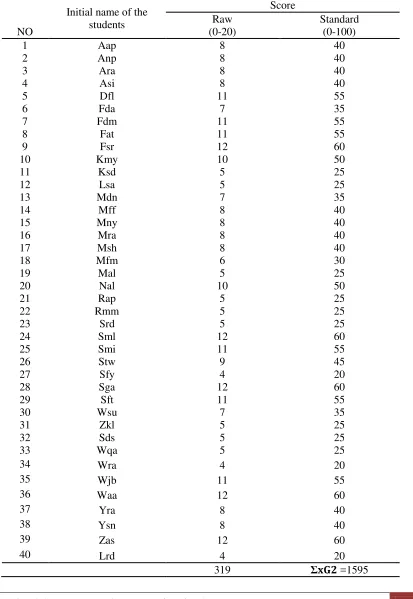
Tabel 2

The Result of Control Group Post-test

NO

Initial name of the students

Score Raw

(0-20)

Standard (0-100)

1 Aap 8 40

2 Anp 8 40

3 Ara 8 40

4 Asi 8 40

5 Dfl 11 55

6 Fda 7 35

7 Fdm 11 55

8 Fat 11 55

9 Fsr 12 60

10 Kmy 10 50

11 Ksd 5 25

12 Lsa 5 25

13 Mdn 7 35

14 Mff 8 40

15 Mny 8 40

16 Mra 8 40

17 Msh 8 40

18 Mfm 6 30

19 Mal 5 25

20 Nal 10 50

21 Rap 5 25

22 Rmm 5 25

23 Srd 5 25

24 Sml 12 60

25 Smi 11 55

26 Stw 9 45

27 Sfy 4 20

28 Sga 12 60

29 Sft 11 55

30 Wsu 7 35

31 Zkl 5 25

32 Sds 5 25

33 Wqa 5 25

34 Wra 4 20

35 Wjb 11 55

36 Waa 12 60

37 Yra 8 40

38 Ysn 8 40

39 Zas 12 60

40 Lrd 4 20

(8)

e-Journal of English Language Teaching Society (ELTS) Vol. 2 No. 2 2014 – ISSN 2331-1841 8

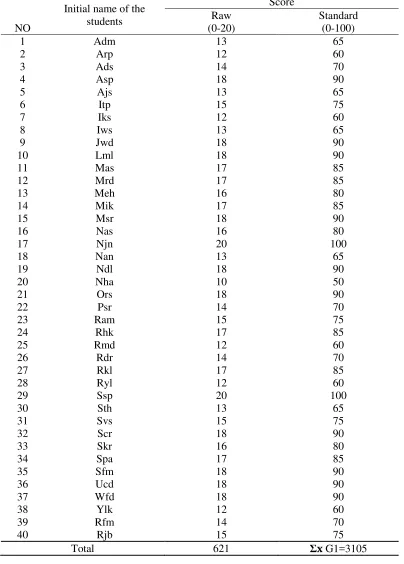
Table 3

The Result of Experimental Group Post-test

NO

(9)

e-Journal of English Language Teaching Society (ELTS) Vol. 2 No. 2 2014 – ISSN 2331-1841 9 Based on the table 2, the highest score of control students in the post-test was 60 and the

lowest score was 20. The writer then calculated the students‟ mean score by applying the

formula proposed by Hatch and Farhady. All of the standard scores of the students were added,

and then divided by the number of the students. The mean computation can be seen as follows:

x

x G2 = 39.875

Referring to the table 3, the highest score of experimental students in the post-test was

100 and the lowest score was 60. It indicated that the treatment had significant role in

increasing the pronunciation of students. Then the writer calculated the students‟ mean score.

x

x G1 = 77.62

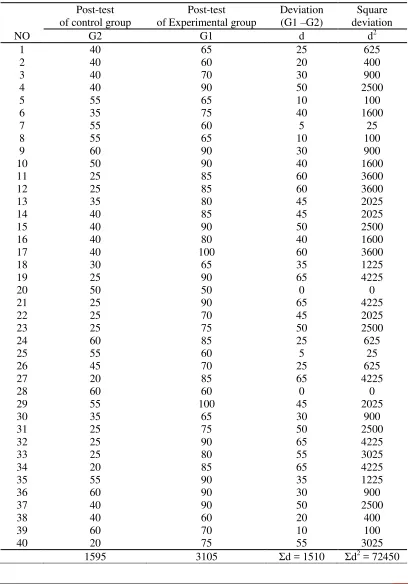
The writer computed the deviation and square deviation of the students‟ scores in the

post-test (both in experimental and control groups) after calculating the mean score. The result

(10)

e-Journal of English Language Teaching Society (ELTS) Vol. 2 No. 2 2014 – ISSN 2331-1841 10

Table 4

(11)

e-Journal of English Language Teaching Society (ELTS) Vol. 2 No. 2 2014 – ISSN 2331-1841 11 The computation of the students‟ mean deviation of experimental and control groups was presented as follows:

Md =

= 37.75

Having counted the mean deviation, the writer determined the square deviation score as

follows:

x2d d2

= 72450 –

= 72450 –

= 72450 – 57002.5

x2d = 15447.5

Finally, the writer needed to statistically analyze to see the difference between the mean

achieved in the post-test of control group and post-test of experimental group by applying t-test

formula as follows:

(12)

e-Journal of English Language Teaching Society (ELTS) Vol. 2 No. 2 2014 – ISSN 2331-1841 12

DISCUSSION

In the process of treatment, the writer taught how to pronounce the English vowel

sounds correctly to the students. In fact, there are twelve vowels in English. As Indriani (2011)

states that they are /i:/ for „tea‟, /ɪ/ for „sit‟, /e/ for „pen‟, /æ/ for „sad‟, /ɜː/ for „bird‟, /ə/ for

„ago‟, / ː/ for „art‟, /ʌ/ for „up‟, /u:/ for „food‟, /ʊ/ for „foot‟, /ɔː/ for „war‟, and / / for „not‟. In

every meeting, the writer taught two vowels to the students in experimental group by using the

words in short story given. The students were asked to read aloud the words in short story

containing English vowel sounds. At the first meeting, the writer taught how to pronounce

sound /ɪ/ and /æ/. The students seemed understand and could pronounce the words given

correctly at the time. It was also happened in other meetings. They could repeat the correct

pronunciation from the writer. The sounds learnt before were forgotten by the students after 2

meetings. The writer needed some extra time to repeat the vowel sounds again and again.

Refferring to the fact of the problem about pronunciation faced by the students, the

writer related to the previous studies that have been discussed obviously from Kurniasih (2009)

and Yuliana (2011). In Kurniasih‟s research, she discussed about teaching interdental sounds

through short passage, while in Yuliana‟s research, she also discussed about whether the use of

reading short passage could improve pronunciation ability. Those two researches were

experimental research design. In this recent research, the writer did the same as the two

previous studies that is experimental research. In contrary, the difference in this research is the

writer used intact group design which the data collection were taken by using post-test while in

Kurniasih and Yuliana researches used pre-test and post-test. In other hand, the recent research

was emphasized on the use of short story to improve the students‟ pronunciation. The writer

(13)

e-Journal of English Language Teaching Society (ELTS) Vol. 2 No. 2 2014 – ISSN 2331-1841 13

research found that the students‟ pronunciation could be improved after getting treatment. It

was different from the students who did not get the treatment which was still in the low

progress. This fact was found by the writer after analyzing the result of post-test in

experimental and control groups. It could be seen from the students‟ score, where in

experimental was higher than the score in control group. Referring to the result, it showed that

short story was one of effective media that helps the students to improve their pronunciation of

English vowel sounds.

Based on the findings, the writer compared the result with previous studies written by

Kurniah (2009) and Yuliana (2011). The result in Kurniah‟s research showed that the t-counted

(3.46) was higher than t-table (2.064). ɒesides that in Yulina‟s research, the result indicated

that counted (21.0) was higher than table (1.729), while the recent research result got that

t-counted was also higher than t-table. From the result above, it showed that short story can be

used to help the students to improve their pronunciation of English vowel sounds.

Based on the result of post-test in experimental group after conducting the treatment,

the writer concluded that the students had positive progress in pronouncing the English vowel

sounds. Few students still made mistakes in pronouncing some words containing the hardest

sound / ː/, /ɜː/, and /ʌ/. In other hands, the mistakes were happened to most of students in

control group. The writer concluded that the students made these mistakes because of

generalization pattern from them. The writer found that most of the students got difficulty in

differentiating the sound / ː/ with the sound /æ/. When there was a word containing letter ‹a›,

they would make a generalization. For example, because the word „bad‟ is pronounced /bæd/,

respectively the students tend to pronounce the word „last‟ become /læst/ while it should be

pronounced /l ːst/. ɑnother example of generalization mistaken was in „bus‟ and „put‟ which the vocal letter was identical but different in pronunciation. In fact, the student pronounced

„bus‟ with correct pronunciation /bʌs/ but in the word „put‟ they was extremely wrong

pronouncing the word become /pʌt/ . Most of the students also made few mistakes because they

read the word as the written form. It could be seen when they should pronounce the word „girl‟

and „word‟ which should be pronounced /gɜːl/ and /wɜːd/, tend to be /gi:l/ and /wɔːd/ respectively. As the result of post-test, the writer divided the dominant error in pronouncing the

vowel into three levels; easy, medium, and hard. The hardest vowel sounds to be pronounced

(14)

e-Journal of English Language Teaching Society (ELTS) Vol. 2 No. 2 2014 – ISSN 2331-1841 14 /æ/ (50%), /ə/ (50%), /ɔː/ (47.5%), and /ʊ/ (30%),while the easiest vowel sounds for the

students were / / (12.5%), /ɪ/ (25%), /e/ (25%), /i:/ (27.5%), and /u:/ (27.5%).

In addition, the positive progress was affirmed by seeing the result of the individual

mean score of post-test in control group and the individual mean score of post-test in

experimental group. The result indicated the difference in improvement between post-test in

control class and in experimental class was (37.74). It was also supported by the result of the

percentage ofthe students‟ error in pronouncing English vowel sounds in control group was

(87.5%) while in experimental group was (2.5%). This fact makes the writer comes to a

conclusion that there is a progress after applying short story as a medium of this research.

CONCLUSION AND SUGGESTIONS

After analyzing the data, the writer draws some conclusions based on the result of the

data analysis. Firstly, the use of short story can improve the students‟ pronunciation particularly

for English vowel sounds. It can be seen that the students‟ score of post-test in experimental

group reached to 77.62. Obviously, it indicated that the pronunciation of the eighth grade

students at MTs Negeri Luwuk was improved after the treatment. Secondly, there was a

significant difference between the mean values of post-test in control group and in

experimental group. It was proved since t-test value 12.02 was higher than t-table value 1.99. It

means that the writer hypothesis was accepted.

Referring to the importance of pronunciation, the writer then would like to offer some

suggestions for the readers. Firstly, it is very crucial to integrate pronunciation with some skills,

such as in speaking or listening skills. It is very useful for the students by being accustomed to

their ear so that it makes their speech correctly in pronunciation. Furthermore, there is no block

in the communication. Secondly, the teacher must provide the students more media which can

support the materials given, for example recording of native speaker, dictionary, or pictures.

Therefore, the recording of native speaker voice as the model will help them in learning the

correct pronunciation, in fact they seldom hear a native speaker voice in their environment.

Finally, every word in the short story, although just a few words, must be pronounced again

and again to make the students remember and be accustomed to the correct pronunciation of the

(15)

e-Journal of English Language Teaching Society (ELTS) Vol. 2 No. 2 2014 – ISSN 2331-1841 15

REFERENCES

Arikunto, S. (2002). Prosedur Penelitian Suatu Pendekatan Praktek (Edisi Revisi V). Jakarta:

PT Rineka Cipta.

Basri, H. (2005). English Phonology I. Palu: Tadulako University, Unpublished Book.

Creswell, J.W. (2005). Educational Research: Planning, Conducting, and Evaluating

Quantitative and Qualitative Research (second ed.). Ohio: Pearson Education, Inc.

Depdiknas. (2006). Kurikulum Tingkat Satuan Pendidikan, Silabus Mata Pelajaran Bahasa

Inggris. Jakarta: NSNP.

Gay, L. R. (1996). Educational Research. Educational Research. New Jersey: Pretice Hall. Inc.

Hatch, E. and Farhady, H. (1982). Research Design and Statistic. Los Angeles: Newbury

House Publishers, Inc.

Indriani, D.M. (2001). English Pronunciation, The English Speech Sounds Theory and

Practice. Jakarta: PT Gramedia Pustaka.

Kurniasih, D. (2009). Teaching Interdental Sounds through Reading Short Passage to The

Second Year Students of SMP Negeri 1 Birobuli. Palu: Tadulako University, Unpublished Skripsi.

Lewis M. and Hill J. (1992). Practical Technique: For Language Teaching. London:

Commersial Color Press.

Pardede, P. (2011). “Using Short Stories to Teach Language Skills”. In Journal of English Teaching [online], Vol 1 (1), 14pages. On:http://jetuki.files.wordpress.com/2011/05/2-using-short-stories-to-teach-language-skills-pp-14-27.pdf[10 December 2013]

Purwanto, M. V. (1991). Prinsip-Prinsip dan Teknik Evaluasi Evaluasi Pengajaran. Bandung: Remaja Rosdakarya.

Yuliana. (2011). Teaching Pronunciation to the Tenth Grade students at Madrasah Aliyah

Gambar

Tabel 2 The Result of Control Group Post-test
Table 3
Table 4

Referensi

Dokumen terkait

accent, the writer analyzed kinds of Australian English sounds (vowels and.. dipthongs) and also analyzed the difference accent between

of digraph <ch> in the pre-final position and it is followed by vowel e , the pronunciation of the digraph <ch> must be [ʃ] like words douche and cliché.

The result of this research indicated that the eighth grade students of SMP Negeri 2 Parigi had poor ability in writing recount text.. The main sources of those errors

This research was carried out in order to prove whether the use of transcription technique was effective in improving the ability in pronouncing English vowel

The objective of this research was to find out that Just-in-Time Teaching (JiTT) technique could improve reading comprehension of the eighth grade students at

The objective of this research was to identify and to analyze the errors made by grade XI students of SMA Negeri 5 Palu in locating stress (stress placement) in English

The researcher concludes that tongue twister can improve the pronunciation of “th” sound by using tongue twister of grade VIII students of SMP Negeri 4 Palu. The researcher needs

Today, you will require this Sounds Great, Book 1: Low Intermediate Pronunciation For Speakers Of English By Beverly Beisbier as one of the most referred book and also the majority