This art icle was dow nloaded by: [ Universit as Dian Nuswant oro] , [ Ririh Dian Prat iw i SE Msi] On: 29 Sept em ber 2013, At : 20: 04
Publisher: Rout ledge
I nform a Lt d Regist ered in England and Wales Regist ered Num ber: 1072954 Regist ered office: Mort im er House, 37- 41 Mort im er St reet , London W1T 3JH, UK
Accounting and Business Research
Publicat ion det ails, including inst ruct ions f or aut hors and subscript ion inf ormat ion: ht t p: / / www. t andf online. com/ loi/ rabr20
Discussion of ‘ Have changes in pension accounting
changed pension provision? A review of the evidence’
Paul Rangecrof t a
a
Principal and consult ing act uary in int ernat ional benef it s consult ing pract ice, Hewit t Associat es LLC
Published online: 04 Jan 2011.
To cite this article: Paul Rangecrof t (2009) Discussion of ‘ Have changes in pension account ing changed pension provision? A review of t he evidence’ , Account ing and Business Research, 39: 3, 269-272, DOI: 10. 1080/ 00014788. 2009. 9663366
To link to this article: ht t p: / / dx. doi. org/ 10. 1080/ 00014788. 2009. 9663366
PLEASE SCROLL DOWN FOR ARTI CLE
Taylor & Francis m akes every effort t o ensure t he accuracy of all t he inform at ion ( t he “ Cont ent ” ) cont ained in t he publicat ions on our plat form . How ever, Taylor & Francis, our agent s, and our licensors m ake no
represent at ions or warrant ies w hat soever as t o t he accuracy, com plet eness, or suit abilit y for any purpose of t he Cont ent . Any opinions and view s expressed in t his publicat ion are t he opinions and view s of t he aut hors, and are not t he view s of or endorsed by Taylor & Francis. The accuracy of t he Cont ent should not be relied upon and should be independent ly verified w it h prim ary sources of inform at ion. Taylor and Francis shall not be liable for any losses, act ions, claim s, proceedings, dem ands, cost s, expenses, dam ages, and ot her liabilit ies w hat soever or how soever caused arising direct ly or indirect ly in connect ion w it h, in relat ion t o or arising out of t he use of t he Cont ent .
This art icle m ay be used for research, t eaching, and privat e st udy purposes. Any subst ant ial or syst em at ic reproduct ion, redist ribut ion, reselling, loan, sub- licensing, syst em at ic supply, or dist ribut ion in any
Kiosse and Peasnell have provided us with a real-ly good paper covering evidence on pension ac-counting and pension provision across a range of countries. As a practitioner I found it very useful. The first point made was that the pension obliga-tions are hard to measure, and undoubtedly they are. We talk a lot about reasonable estimates, and there can be very long discussions on what ‘rea-sonable’ is. I think our present position, at least from a practitioner’s viewpoint, is that what we have to disclose doesn’t really hit the core issues relating to pensions. The core way that you have to manage a pension plan and the way it impacts your business is a risk decision more than it is necessar-ily an accounting standard decision. The signifi-cant message would be that you can and should measure these things and come up with reasonable estimates but at the same time that there is much that we can do to communicate what drives the risk behind these plans and how it can impact your business.
The second point in the paper is that the reduc-tion in DB coverage has been driven by a desire to limit contributions. Most companies that I have worked with that have experienced the process of moving from a defined benefit to a defined contri-bution scheme have used a detailed design process with considerable thought given to many different drivers and competing goals, only one of which is cost. Over the past 10 to 15 years the value of retire-ment benefits has been reduced, in general and in aggregate. It is my view, and this is brought out in the paper very well, that it is far too simplistic sim-ply to say you move to defined contribution to save money. That is not the case in most of the designs I have seen – whether or not the end result is also that there is money saved. It can be saved in many other ways by staying in defined benefit structures.
Third, we look at US post-retirement welfare benefits. While it is true that there is less contami-nation of the post-retirement welfare accounting
rules because there is no funding requirement, there is also no vesting requirement at this point. So it could be viewed as a microcosm of what pen-sions might look like if we had not regulated in the way that we have. The complement to that is when FAS 106 came in and companies had to look at this cost, the standard applied only to publicly traded companies. So you look at the government sector, for example, which did not have to report anything other than pay-as-you-go accounting up until a couple of years ago. And yet many government entities were doing projects on their own in order to try and come up with a number for the true long-term liability of these plans. So I think companies would have arrived at the same outcome in any event. What accounting did was highlight the cost a few years before other organisations, not subject to the same accounting rules.
Furthermore, within the US you have to bear in mind the development of Medicare including drug coverage, changes in other retirement benefits and medical inflation (which has continued to soar). These are examples of many aspects that drove post-retirement welfare design differently com-pared with matters driving pensions. There are many factors to take into account that stop this being a perfect ‘microcosm’.
The last point made here, which is probably the point with which I agree the most, is that account-ing standards have driven asset allocation. The link on which research has not formed a clear view is: does asset allocation drive pension design and pension provision? I think that is something that needs a little bit more work. I can see reasons why it would. I can see a lot of good reasons why it should not. However, I think it is one that probably requires a little bit more work before we make that leap. And without that connection being made we cannot link accounting rules to plan design.
I thought I would introduce a couple more data points to add to the wealth of research in the paper already. Our consulting practice at Hewitt, ran a survey this year on global pension risk facing multinational companies. We had responses from
Discussion of ‘Have changes in pension
accounting changed pension provision?
A review of the evidence’
Paul Rangecroft*
*The author is a principal and consulting actuary in interna-tional benefits consulting practice of Hewitt Associates LLC.
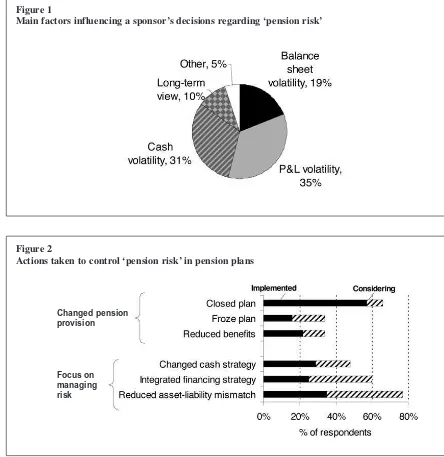
171 companies across 12 countries. The first ques-tion we asked was: ‘When you are making deci-sions around pension risk, what are you looking at? What, to you, is risk?’ and we saw that balance sheet volatility and profit and loss volatility made up more than half of what is being monitored for risk by companies (see Figure 1). Clearly, account-ing rules are critical in how these plans are viewed. Cash is still in there – a sizeable portion – and 10% of companies said they had a long-term view and were not caught up in these short-term meas-ures. I wish that percentage would grow, but unfor-tunately it has actually shrunk since our last survey.
The other question that I would probably draw out here is: when we talk about accounting-based interest rate arbitrage, as mentioned in the paper by Kiosse and Peasnell – how does that play out? Because thinking from a pure US perspective, ex-actly the same thing happens in the cash rules as happens in the profit and loss rules – at a very high level of course. From that perspective, it is not necessarily just accounting-based.
The second question I have taken from the sur-vey is: ‘What are you doing because there is pen-sion risk?’ There are essentially two major ways you can react to pension risk: (1) you can change your pension provision, which is the entire point of our talk today; or (2) you can actually change the way that you finance or manage your plan to ad-dress the risk directly, which is moving into chang-ing your investments and other aspects that Kiosse and Peasnell identify. Our findings are show in Figure 2.
The percentage of respondents who said they had carried out each type of action is in the solid section of the bar. The percentage contemplating doing it in the next 12 months is in the shaded sec-tion of the bar. Take the case of ‘Close the plan to new hires’. This is easy to do and does not cause a lot of disturbance with current workers. As to the question of whether it manages risk a lot, I think most of us would say it does not because it does not attack the existing risk and liability in the plan. It just inhibits growth a little. Nevertheless more and more companies are doing it. Freezing a plan is a much bigger step, much harder to implement, and far fewer companies are contemplating, or have taken that bigger step.
When we consider some of the focus on manag-ing risk, and you get into changmanag-ing your cash strat-egy, looking at integrated financing policies, it becomes more complex – certainly for HR depart-ments to manage and even for many finance de-partments to manage in-house. Consequently, while there is a lot of interest – and we can see that from the bars being just as big as the plan design change bars – less companies have moved in that direction. I think that is an area where increased
disclosure, increased focus on risk measurement and frankly just an increased push from within the company to take a more aggressive stance on asset allocation, derivatives, alternative assets, proactive cash management strategies, will get us to a better place in managing pensions as a whole, which will therefore take the onus off of pension provision being the lever that everybody wants to move.
Continuing that theme – and I think this point is drawn out very well in the last few pages of Kiosse and Peasnell – current statutory disclosures do not give the reader enough to adequately assess the risk that the company is carrying (see Figure 3).
There is no requirement to disclose many of the steps that companies take to mitigate risk, to re-duce the risk that is inherent in the pension plan, such as adding derivatives, adding downside equi-ty protection through swaps and so forth. When you look at some of those actions, it is clear that companies that are making those changes, compa-nies that are doing things to better their position, need to make additional disclosures. It leaves open a huge hole when you look at the percentages here. Even in the UK, which has been most aggressive about taking some of these actions, you are still not even reaching more than a third of companies that provide additional disclosures, which means you have two-thirds of companies sitting out there with large pension plans that don’t tell you any-thing more than the statutory rules, and therefore don’t give analysts and observers enough to decide whether you should be buying their stock or not, or the risk that is inherent in buying it. It’s an area I think that needs to be addressed aggressively as we move forward. So if accounting rules are one of the influencers of pension provision, the more in-formation we put out there, the better the statutory disclosures, the better that influence becomes and the better decisions are made because of it. And I think that is the key extrapolation from what we have seen here.
There is an excellent brochure available if you get a chance to read it, which is Corporate Disclosure and the Cost of Capital.1 There is a
note in there that the communication that works best in getting information across to fund man-agers and analysts is in presentations and one-on-one meetings. It’s interesting to read that, in the UK, making disclosures in accounts is by far the most prevalent method for additional pension dis-closure. The US and Canada seem to have got the message on effective communication, and I don’t think they’ve seen the booklet yet!
270 ACCOUNTING AND BUSINESS RESEARCH
1Armitage, S. and Marston, C. (2007). Corporate
disclo-sure and the cost of capital: the views of finance directors. Briefing, The Centre for Business Performance, The Institute of Chartered Accountants in England and Wales. http://www.icaew.com/index.cfm/route/148607/icaew_ga/pdf.
Figure 1
Main factors influencing a sponsor’s decisions regarding ‘pension risk’
Figure 2
Actions taken to control ‘pension risk’ in pension plans
Figure 3
Companies providing additional information beyond statutory disclosures to elaborate on pension risk and risk mitigation approaches
Changed pension provision
Focus on managing risk
The overall message is that there are many rea-sons for redesigning plans. Accounting, I believe, is one of them, but it is only one. Many of these are worth additional consideration. The regulatory case is a great example. In the UK, there was no coincidence that the rules around job-hopping risk, inflation risk and default risk, occurred around the same time that defined benefit was becoming less attractive. It was plain to see. This implied causal-ity is indicated in Kiosse and Peasnell’s paper.
However, in the US, job-hopping risk was ad-dressed through vesting in the 1970s. Inflation risk has never been addressed in the US. Default risk was addressed in the 1970s as well, and at that time pension plans in the US were still increasing in number. This kind of analysis indicates that there
are many other things that will drive decisions on design beyond merely the accounting aspect.
The US is moving with the continued trend to-wards mark-to-market and increasing short-term volatility. Canada has already adopted IFRS, but that form of accounting is not yet implemented. The question this poses for me is more about ask-ing, given that there is some influence on pension provision here: will the accounting rules promul-gated in the future influence companies to make short-term, inappropriate, sub-optimal decisions or will they influence companies in a way that im-proves overall pension management? That, for me, is probably the question that will unfold in the next few years. It is an absolutely critical one.
272 ACCOUNTING AND BUSINESS RESEARCH