| 389
Pedagogic Mapping of Teacher Competence in Inclusive Schools
Gunarhadia, Sunardia, Tri Rejeki Andayania, Moh Anwarb
aCenter of Studies in Difability, LPPM, University of Sebelas Maret, Surakarta, Indonesia
b
PLB FKIP University of Sebelas Maret, Surakarta, Indonesia
Corresponding Author: [email protected]
Abstract:
The rapid movement of inclusive education has changed the demand of competence in inclusive schools. This
research was a survey on mapping teachers’ pedagogic competence on educational service for children with special needs in inclusive schools. This research aims to (1) to identify the degree of teachers’ knowledge on educational services for children with special needs, (2) to measure the degree teachers’ skill on teaching children with special needs in inclusive schools. This research involved 50 teachers in elementary schools implementing inclusive education in the District of Solo Raya, Central Java Indonesia. The data was collected by means of questionnaire and interview. The data was, then, analyzed by descriptive quantitative and qualitative. The research indicated the result that (1) the teachers in inclusive schools had inadequate knowledge on instruction for children with special needs, (2) they had limited skill on teaching children with special needs. The research concluded that most teachers in regular schools had limited knowledge and skills. In addition to the lack of experience in teaching children with special needs, most teachers were not educationally qualified in special education. It is recommended that the education authority facilitates the potential of teachers through trainings so as to improve the educational service for children included in inclusive schools.
Key words: Pedagogy, knowledge, skill, inclusive education, children with special needs
1. INTRODUCTION
1.1. BackgroundInclusive education has become a central issue of education for all (EFA). Such an issue moved even stronger within the decade of 1990-2000 when several international meetings put up inclusive education as the main agenda. Salamanca Conference and Declaration on Special Needs Education in 1994, International Conference on Adults in 1997, and World Education Forum in Dakar, Senegal were finally set up as the collective commitment by UNESCO in 2000. This collective commitment turns the most authoritative statement of the global aspirations regarding education for all (Hegarty, 2003). It signifies that every country in the world is required to provide education for all citizens. Everyone has the right education regardless of economic, ethnic, cultural, language, religion, physical, and intellectual conditions of individuals. In the context of education opportunity, inclusive education is recognized to be the central service in achieving the goal of education for
such vulnerable persons without
discrimination. The spirit of inclusion is togetherness in diverse community. Instead of putting them in special schools, they have the
right to be included in regular schools to have equal opportunity to learn together and interact with other children of the same ages.
In Indonesia, inclusive education has been the most effective program in realizing the demand of equality of education for all citizens. Similar to the statement of Universal demand of human right to education, equality of education is also explicitly mentioned in Basic Constitution so called UUD 1945 that education is compulsory and free. Article 31 of
the Basic Constitution clearly states that “every
citizen has the right to basic education for free regardless of tribe, culture, and religion”
| 390
which has been running for years and updated continuously from time to time.
The 9 years-education compulsory is addressed to reduce the number of children particularly those with special needs remaining untouched by education. Based on the United Nations Organization (UNO), the number of children is assumed to be 10% out of the total number of normal children. It means the rough number of children with special needs in Indonesia is 4.2 million (health.detik com/read/2013/07/17/184234//1301/number of CNS).
1.2. Challenges of Inclusive Education
There are several challenges coming across the rapid development of inclusive education in Indonesia. Inclusive education is acknowledged as an educational policy which is launched by Ministry of Education No 70/2009 on inclusive education. In the implementation, nevertheless, some programs are often inhibited by practical problems. Internal circumstances such as local autonomy, segregate culture, educational system, and limited number of human resources often trigger the snags in making the program as successful inclusion. Local autonomy and segregate culture often hinder the central policy due to difficulty in adjusting the mindset to the practice of inclusion. Some people may reject the presence of children with special needs in certain schools. They argue that, to some extent, education system regular schools and inclusive schools differ in terms of curriculum, methods of teaching, evaluation, and even the grading system.
For different reasons, some teachers in newly established inclusive schools often show an objection upon the presence of several children with different handicapping conditions in the regular classroom. For instance, they are not familiar with the characteristics of children with mental retardation, autism, or attention deficit and hyperactive in the classroom that they tend to neglect the presence of such children. This kind of complaint is quite common in inclusive schools. Most regular schools do not provide teachers or aide-teachers with a qualification in special education. A previous research (Gunarhadi, 2012), for instance found that 80% of inclusive elementary did not have any
teachers majoring in Special Education of University. Similar research (Sunardi, Munawir, Gunarhadi, Priyono, 2010) also found only 3 teachers majoring in special education worked as part timers in their respective schools. It means the children with special needs do not get sufficient services needed to participate in learn meaningfully in accordance with abilities and capabilities.
1.3. Teacher Competence in Inclusive Schools
In education, teacher competence is
reflected in teachers’ knowledge and skills
applied in the classroom setting. To be an effective teacher in inclusive schools, one is required not only to possess enough command of subject matter, but also to understand the development and learning characteristics of children with special needs, and to create environments that facilitate their unique needs of learning. In general classes, Smith (1969) cited in Cooper, Irizarry, Leighton, et.al. (2011) define teacher competence into four general areas. An effective teacher is required to have good command of theoretical knowledge of learning, mastery of subject matter to be taught, teaching skills, and attitude that fosters learning and human relation.
| 391
foster the human relationship in learning (Cooper, 2011).
In the practice of instruction, these four areas are separable. The close relationship among knowledge, skill, and attitude is inseparable. Knowledge serves an important domain that constitutes to the learner’s behavior and skills leading to attitude. Attitude, on the other hand, serves as a combined domain of cognition, affection, and connation that all the way produce competence to behave in a wise manner and convincing performance (Azwar, 2009). In a similar statement, Slavin (2012) explains that effective teachers do not only know their subjects but
also communicate the knowledge.
Nevertheless, knowledge is a minimum requirement for teaching.
In addition to knowledge, teaching involves skills in transferring knowledge. Woolfolk (2013) requires that effective teachers must be both knowledgeable and inventive. They have to have good skills in transferring the knowledge by developing the strategies. They must also be capable of inventing new strategies. Basic research in classroom management is also needed. Particularly when the classroom routine calls for a change, the teacher must be capable of finding something different to break the routine. Communication is another skill that teachers might need to have when transferring the knowledge to the students (Slavin, 2012). Good communication is believed to occur when there is mutual trust between teacher and the students. In practice, likewise, mutual trust happens when the teacher ensures positive attitude towards the students. In special education, similarly, well knowledgeable teachers believe in their competence in transferring the knowledge to diverse children. Children with special needs might need a differentiated way of teaching in a good manner of communication.
In inclusive education, similarly, teachers are required to be competent in their profession of special education. They are required to have knowledge and teaching skills in special education. Skill for teachers in inclusive education deals with pedagogic competence (Florian & Linklater, 2010). It is important that teachers in inclusive schools have the command of knowledge on the characteristics
of children with special needs in terms of the way they learn, and specific learning problems they may have in accordance with the curriculum and peer interaction during the instructional process in the inclusive classroom. In addition, teachers in inclusive schools are also required to be knowledgeable in the specific areas of special education such identification, assessment, modification of curriculum, individualized instruction, and different modes of evaluation.
A teacher in regular schools is different from the one in inclusive schools. A number of facts show that teaching children with special needs in inclusive schools could not regard knowledge as important as specific teaching skill. A teacher in inclusive schools is not only demanded to be knowledgeable in subject areas to be taught but also skillful in differentiated learning strategies. Many children with special needs in inclusive schools are vulnerable so that they need specific strategy in a different way of learning from other children in general. The teacher is required to be capable in managing the class when such children show negative feeling about their low self-esteem that is originated from their internal handicapping condition. Teaching children with visual impairment, for instance, is quite different from teaching children with hearing impairment or children with low self- concept due to the accompanying physical problems.
Most often, such children exhibit the learning problems because they feel bad about themselves that interfere with their learning. In some cases, their negative feelings become so pervasive that the teachers could not find solutions to help them learn. In an inclusive class, teaching children with low self-esteem is quite common, and scaffolding them individually is the only solution. The possible way to help is by pulling them out to have academic as well as psychological scaffolding in a humanistic approach (Gunarhadi, 2013).
In this circumstance, teacher’s positive attitude
| 392
urgent skill in helping children with special needs in inclusive schools.
1.4. The Purpose of Research
Teachers in inclusive schools demand different competence from the one in regular schools. Teachers in inclusive schools need specific knowledge and skills in special education. The facts, however, show that many in inclusive schools are newly transformed from regular schools. Hence, it is assumed that teachers have limited knowledge and skills of teaching vulnerable children in the respective schools. In short, these variables are the focus being investigated in this study in which the research is all about.
2. METHOD OF RESEARCH
This research is a survey of the implementation of inclusive education. The subject of the research was 50 teachers in special education assigned randomly to represent 197 teachers in inclusive schools located in three districts of Surakarta municipality, Boyolali, and Sragen. These teachers work as either aide-teachers in special education or teachers of regular class where
children with special needs were
mainstreamed. Data was collected from a questionnaire on knowledge, skills, and attitude provided them to be responded as self-assessment. Prior to the administration, each of the questionnaires was tried out to measure the degree of reliability. The number of items was 40 questions for knowledge, 16 items for skill.
Using Cronbach’s Alpha, each of the reliability
was 0,697 for knowledge, and 0,958 for skill respectively. The data was analyzed by quantitative and qualitative descriptive to describe the degree of categorization and percentage.
3. RESULTS & DISCUSSION
3.1. KnowledgeTo measure the degree of knowledge, a multiple choice test was given to these 50 teachers. The knowledge covers various kinds of information such as definition, characteristics of children with special needs, curriculum, teaching strategy, individualized instruction, evaluation, and the role of teachers in an inclusive class with diverse children. The result of the test was classified into three categories; high, middle, and low achievement.
The total achievement on teachers’ knowledge
is indicated in the table 1.
Tabel 1. Category of Knowledge Mastery
Category Score Number of Respondents
Percentage
Low 0 – 11
8 16%
Middle 11 – 21
32 64%
High 22 – 31
10 20%
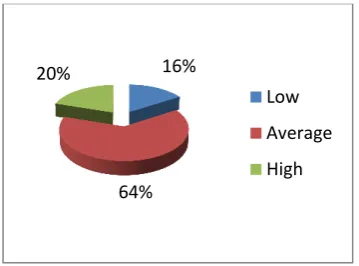
From the above table, it shows that 8 teachers (16%) fall in the low , 32 (64%) in in the middle, and 10 teachers (20%) in high category of achievement. In the pie diagram, the whole picture of achievement is indicated in the figure 1.
Figure 1. Percentage of Knowledge Mastery
It seems that knowledge of special education is not well mastered by all of the teachers working in inclusive schools. To be teachers in inclusive schools, they are expected to have full knowledge of special education. To be effective teachers, they are supposed to
master the knowledge in terms of
characteristics of diverse children, teaching strategy, evaluation system, individualized instruction, as well as the role teachers in serving children with special needs.
Knowledge should not be a problem for every teacher (Slavin, 2012). Effective teaching would never occur when the teacher is not competent. Yet, the fact shows that only 20% of them have high competence in special education for children with special needs in inclusive schools. There should be, at
16%
64% 20%
Low
Average
| 393
least, two reasons to discuss why these teachers lack of knowledge on special education. First, some of these teachers do not have a qualification on special education. For such teachers, inclusive education is a new trend that the presence of children with special needs is beyond their experience that they never imagine before. Secondly, those with the qualification in special education do not work as class teachers in inclusive schools. Some of them, furthermore, work as part timers in inclusive schools. Hence, they could not be fully responsible for the educational service of children with special needs the respective schools (Sunardi, et.al. 2010) Another possible reason could the fact that inclusive schools teachers lack of opportunities to have trainings on inclusive education.
3.2. Skills
The skill of teaching children with special needs in inclusive schools is measured by means of rating scaled tests. The teachers are supposed to have self-assessment on several statements to reveal the degree of experience dealing with educational services for children with special needs. The skills of teaching include experience of carrying out the identification, assessment, and designing the educational program for children with some learning problems.
The experience in modifying curriculum, teaching experience, managing behavior, and individualized instruction is the main part of skills that the test is expected to reveal. Like the test on knowledge, the result of skill test was classified into three categories; high, middle, and low degree of experience. The degree of teachers’ experience is demonstrated in the table 2.
Tabel 2. Category of Skills Mastery
Category Score Number of Respondents
Percentage
Low 0 – 47
9 18%
Average 48 – 73
35 70%
High 74 – 100
6 12%
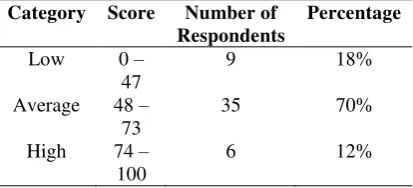
The above table shows that 9 teachers (18%) fall in the low, 35 (70%) in in the
middle, and 6 teachers (12%) in high category of experience. In the pie diagram, the whole picture of achievement is indicated in the figure 2.
Figure 2. Percentage of teachers’ Skill
This figure shows that the highest skill of teaching is experienced by the least number of teachers (12%) in inclusive schools. On the other hand, 70% of them have an average experience of teaching children with special needs. It seems there is a close relationship between knowledge and skills of teaching.
One thing is important to be noted here is that many people know who the children with special needs are, but less people experience in teaching them. It implies that most teachers welcome the children in their schools, but not every teacher can teach them. For example, many people know an autistic boy and his characteristics, but it does not mean they can teach him in the right way. To some extent, perhaps, someone has an experience of teaching but fails to be a good teacher for a different child with similar characteristics of autism. Only a qualified teacher with a lot of experience can effectively teach such a child. The percentage shown in the above figure is just to describe that every teacher has an experience of teaching a child with special needs. The quality of experience, however, falls on the average number. In the similar reasons to knowledge, teachers in inclusive schools are not experienced in dealing children with special needs in their classes. Having children included in regular schools is a new experience for most of them. Some others feel totally new to have children with special needs in their classes. In addition, they hardly have time to learn the skills through trainings (Gunarhadi, Sugini, Tri Rejeki Andayani, 2012). Only few of them show adequate skills,
18%
70% 12%
Low
Average
| 394
and they are part time teachers qualified in special education.
4. CONCLUSION
Based on the mentioned objective above, the map of teachers’ degree of knowledge and skills can be exposed in the following conclusion.
4.1. Teachers’ Knowledge in Inclusive Schools
Knowledge on the presence of children with special needs varies among the aide-teachers. However, it is promising to the development of inclusive education in Indonesia. The different degree of knowledge among the teachers could be influenced by different experience, the education background, and the frequency of joining the training on inclusive education. However, it is assumed that massive campaigns through declaration on inclusive education in the last two years would have made them more people knowledgeable about the right to education for all (EFA). For the government, importantly, big number of knowledgeable teachers in inclusive education means a major contribution to securing EFA.
4.2. Teachers’ Skill in Inclusive Schools
Most teachers in inclusive schools possess average skills in dealing with the educational service for children with disabilities. Skills in this research deal mainly with the experience of conducting an assessment, modifying curriculum, designing instructional program, and administering the evaluation addressed, particularly, to children with special needs in inclusive schools. The fact shows only few of them have good skills. The rest indicate limited skills particularly in in designing and conducting the instruction for children with special needs in their respective classes.
4.3. Recommendation
To accelerate the government program of EFA, it is required that knowledge, skills, and attitude of teachers are to be asserted as to improve their performance in giving educational service to children with special needs in inclusive schools. Hence, it is recommended that this research should be followed by a further research through training
for trainers which is conducted through lesson study
5. ACKNOWLEDGEMENT
Special thanks are addressed to the Center of Studies in Difability (PSD), LPPM UNS for research facilitation.
6. REFERENCES
Azwar Saifuddin. (2009). Sikap manusia: Teori dan pengukurannya. Yogyakarta: Liberty
Cooper, J.,M., Irizarry, J., G., Leighton, M., S., et.al. (2011) Classroom teaching skills. Belmont, CA: Wadsworth, Cengage Learning.
Badan Pusat Statistik (2013). Persentase penduduk usia 7-24 tahun. Diperolah 24 Juni 2015, dari
http://www.bps.go.id/linkTabelStatis/view/id/1 533
Florian, L., & Linklater, H. (2010). Preparing teacher for inclusive education: Using inclusive pedagogy to enhance teaching and learning for all.
Cambridge Journal of Education, 40, (4),
369-386.
Gunarhadi, dkk (2013). The Instructional Startegy in Inclusive Education through Cluster Model in Inclusive Schools ( Collaborative Research and Interanional Publication). Laporan Penelitian. Surakarta : LPPM UNS.
Gunarhadi, Sugini, Tri Rejeki Andayani. (2012). Teachers’ Performance in Inclusive Education.
Procceding, Asean Academic Community
International Conference, HS-36-PF, 48-51.
Hegarty, S. (2003). Inclusion and EFA: Some
persperpectives from outside education. Key
note Speech in International Conference on Inclusive Education. The Hongkong Institute of Education, 16-19 Desember 2003.
Sunardi., Yusuf, M., Gunarhadi., Priyono. (2010). The Implementasi of Inclusive Education for Student With Special Needs in Indonesia.
Laporan Penelitian (International
Collaboration Research UNS With The
University of Pittsburgh, USA). Surakarta :
LPPM UNS.
Permendiknas No. 70/2009 Tanggal 5 Oktober 2009 tentang Pendidikan Inklusif bagi Peserta Didik yang memiliki Kelainan dan memiliki Potensi Kecerdasan dan/atau Bakat Istimewa
Schunk, D., H. (2009). Learning theories: An educational
perspective. Upper Saddle River, New Jersey:
Pearson Prentice Hall.
Singh, U.,K. and Nayak, A., K. (2005). Special
education. New Delhi: Ajay Verma
Slavin,R., E. (2012). Educational psychology: Theory
and practice. Upper Saddle River, New Jersey:
Pearson Education, Inc.