World Scientific Publishing Co. Pte. Ltd. P O Box 128, Farrer Road, Singapore 912805
USA office: Suite 1B, 1060 Main Street, River Edge, NJ 07661 UK office: 57 Shelton Street, Covent Garden, London WC2H 9HE
Printed in Singapore.
British Library Cataloguing-in-Publication Data
A catalogue record for this book is available from the British Library.
For photocopying of material in this volume, please pay a copying fee through the Copyright Clearance Center, Inc., 222 Rosewood Drive, Danvers, MA 01923, USA. In this case permission to photocopy is not required from the publisher.
ISBN 981-02-4427-4
All rights reserved. This book, or parts thereof, may not be reproduced in any form or by any means, electronic or mechanical, including photocopying, recording or any information storage and retrieval system now known or to be invented, without written permission from the Publisher.
Copyright © 2001 by World Scientific Publishing Co. Pte. Ltd.
ix
Foreword xviii
Acknowledgements xxi
PART I INTRODUCTION 1
1. Overview and Outline 3
PART II MULTINATIONAL CORPORATIONS AS
CATALYSTS 9
2. Multinational Corporations as Change Agents 11 Rationales for Presence 12
Rationales for Entry 12
Market Imperfections 12
Internalization 15
Strategic Management 17
Manufacturing Processes 17
Oligopolistic Markets 19
Rationales for Growth 19
Market Imperfections 20
Internalization 20
Rationales for Decline 22
Internalization 22
Strategic Management 23
Relations with Stakeholders 24
Owners and Managers 24
Market Imperfections 25
Internalization 26
Strategic Management 26
Labor 27
Manufacturing Process 27
Governments 28
Oligopolistic Markets 28
Redistribution 29
States 32
International Relations 32
Societies 35
Dependent Development 36
The World 38
Global Networks 38
Theoretical Assumptions 39 Static Analytical Schemes 39 Efficient Control and Coordination 40 Stable Relations with Stakeholders 40 3. Reassessing Theories of Multinational
Corporations 42
Dynamic Analytical Schemes 42 Illusory Control and Coordination 47 Shifting Relations with Stakeholders 49 4. Applying the Theories to South Africa
during Apartheid 53
Explaining Multinationals’ Behaviors 53
General Motors (GM) 55
Revlon 55
International Business Machines (IBM) 55
Goodyear 56
Conclusions 56
Leaving or Staying in South Africa 57 Total Liquidation and Piecemeal Sale of Assets 58 Sale to South African or European Company 59 Sale to another US Company 60 Sale to Local Management 60
Formation of Trust 62
No Additional Investment by US Headquarters 63 Increased Investment by US Headquarters 64
Summary 65
PART III MULTINATIONAL CORPORATIONS
AS CHAMELEONS 67
5. The Development of Multinational Corporations 69 Forces for Organizational Development 69 Environmental Determinism 70
Purposeful Actions 71
Power 72
Rationales for Organizational Development 73 Rationales for Growth 74
Technical-Efficiency Forces 74
Ideological Forces 75
Political Forces 75
Rationales for Consolidation 77
Technical-Efficiency Forces 79
Ideological Forces 81
Political Forces 82
Rationales for Decline 84
Ideological Forces 86
Political Forces 86
Relations with Stakeholders over Time 88 6. Why Multinational Corporations Leave Host States 92 A Political-Action Framework for Multinationals 93
Sources for Inertia 96
Sources for Metamorphic Change 100 Hypothesizing why a Multinational may Leave 103 Headquarters’ Inducements to Stakeholders 104
Links to Headquarters’ Actions on
Subsidiary’s Presence 105
Voice and Exit Actions of Headquarters’
Stakeholders 105
Links to Headquarters’ Actions on
Subsidiary’s Presence 106
Headquarters’ Inducements to Stakeholders
as a Mediator 106
Links between Voice and Exit Actions of
Headquarters’ Stakeholders 107
Dominant Coalition’s Stability 107
Links to Voice and Exit Actions of
Headquarters’ Stakeholders 107
Links to Headquarters’ Actions on
Subsidiary’s Presence 108
Links to Dominant Coalition’s Benefits 109 Multinational’s Competitive Strategies 110
Links to Dominant Coalition’s Benefits 110
Links to Headquarters’ Actions on
Subsidiary’s Presence 111
Subsidiary’s Symbolic Actions 113
Links to Headquarters’ Actions on
Subsidiary’s Presence 113
Headquarters’ Inducements to Stakeholders
Subsidiary’s Profits and Importance in
Global Operations 114
Links to Headquarters’ Actions on
Subsidiary’s Presence 115
Subsidiary’s Noncompetitive Strategies with
Host State 115
Links to Subsidiary’s Symbolic Actions 116
Links to Subsidiary’s Profits 117
Links to Headquarters’ Actions on
Subsidiary’s Presence 117
Suppression of Voice and Exit Actions by
Host State 118
Links to Subsidiary’s Symbolic Actions 118
Links to Subsidiary’s Profits 119
Links to Subsidiary’s Noncompetitive
Strategies with Host State 119
Links to Headquarters’ Actions on
Subsidiary’s Presence 120
Subsidiary’s Inducements to Host State 120
Links to Subsidiary’s Symbolic Actions 120
Links to Suppression of Voice and Exit
Actions by Host State 121
Summary 122
PART IV DATA, ANALYSES AND RESULTS 123
7. Methodology 125
The Setting 125
The Time Frame 128
The Population 132
The Variables 140
Headquarters’ Actions on Subsidiary’s
Presence (PRESENCE) 140
Measurement 145
Headquarters’ Inducements to Stakeholders
(INDUCE1 and INDUCE2) 148
Measurement 148
Primary Sources of Data and Checks 148 Voice and Exit Actions of Headquarters’
Stakeholders (SR, SD, GP and GD) 149
Measurement 149
Primary Sources of Data and Checks 149 Dominant Coalition’s Stability (TMT) 150
Measurement 151
Primary Sources of Data and Checks 151 Dominant Coalition’s Benefits (BENEFITS) 151
Measurement 151
Primary Sources of Data and Checks 152 Multinational’s Competitive Strategies
(ADVERTISING, RESEARCH, DIVERSIFY,
BACKLOGS and INTEGRATION) 153
Measurement 153
Primary Sources of Data and Checks 154 Subsidiary’s Symbolic Actions (SYMBOL) 154
Measurement 155
Primary Sources of Data and Checks 156 Subsidiary’s Profits (ROA) 157
Measurement 157
Primary Sources of Data and Checks 157 Subsidiary’s Importance in Global Operations
(ASSETS, SALES and EMPLOYEES) 157
Measurement 158
Primary Sources of Data and Checks 158 Subsidiary’s Noncompetitive Strategies with
Host State (CONTRACT and COOPT) 158
Measurement 159
Suppression of Voice and Exit Actions by
Host State (SUPPRESS) 160
Measurement 160
Primary Sources of Data and Checks 161 Subsidiary’s Inducements to Host State
(INDUCE3) 161
Measurement 162
Primary Sources of Data and Checks 162
Summary 162
8. Analyses and Results 163
The Analyses 163
The Analytical Models 165
The Results 167
Voice and Exit Actions of Headquarters’
Stakeholders 171
Links to Headquarters’ Actions on
Subsidiary’s Presence 171
Dominant Coalition’s Stability 175
Links to Headquarters’ Actions on
Subsidiary’s Presence 175
Links to Voice and Exit Actions of
Headquarters’ Stakeholders 176
Multinational’s Competitive Strategies 178
Links to Headquarters’ Actions on
Subsidiary’s Presence 178
Links to Dominant Coalition’s Benefits 182 Subsidiary’s Symbolic Actions 185
Links to Headquarters’ Actions on
Subsidiary’s Presence 185
Subsidiary’s Profits and Importance in
Global Operations 187
Links to Headquarters’ Actions on
Subsidiary’s Noncompetitive Strategies with
Host State 192
Links to Headquarters’ Actions on
Subsidiary’s Presence 192
Links to Subsidiary’s Symbolic Actions 193 Suppression of Voice and Exit Actions by
Host State 195
Links to Headquarters’ Actions on
Subsidiary’s Presence 195
Links to Subsidiary’s Symbolic Actions 195
Links to Subsidiary’s Noncompetitive
Strategies 196
Subsidiary’s Inducements to Host State 198
Links to Subsidiary’s Symbolic Actions 198
Summary 198
Generalizability of the Results 198
PART V THEORETICAL AND STRATEGIC
IMPLICATIONS 201
9. Understanding and Influencing Multinational
Corporations 203
Understanding Multinationals 203 Decoding the Results 204
Voice and Exit Actions of Headquarters’
Stakeholders 205
Dominant Coalition’s Stability 206
Multinational’s Competitive Strategies 206
Subsidiary’s Symbolic Actions 207
Subsidiary’s Profits and Importance in
Global Operations 207
Subsidiary’s Noncompetitive Strategies
with Host State 208
Suppression of Subsidiary’s Voice and Exit
Future Research 209 Influencing Multinationals 212 Sanctioning Myanmar 212
Monitoring Nike 219
Questions for the Future 222
References 227
By Ingo Walter:
This volume represents a valuable addition to the literature on the multinational firm, which dates back to the 1960s and continues to evolve in depth and richness. It brings out many of the subtleties associated with the interlinkage of the multinational and host countries. These include, at the very outset of the volume, the role of the multinational firm as a change agent affecting an array of interests at various levels of aggregation. This is followed by a first-rate review of the conceptual foundations of the multinational enterprise. Both discussions are then brought to bear on the involvement of multinationals in South Africa under apartheid — one of the most complex and politically-charged stories in recent memory. In retrospect, did multinationals prolong or accelerate the demise of apartheid? And conversely, what was the impact of the political pressures exerted on them, in the US and elsewhere, to withdraw or modify their South African operations in the waning years of the old regime? There is, of course, no way to run the world twice, but the analysis provided by Professor Haley provides a solid foundation for thinking about such issues. The final part of the book focuses specifically on the issues of adaptation and withdrawal,
which are critical to an assessment of this question. For all of these reasons the book is likely to remain a valuable reference work on multinationals for years to come.
By William D. Guth:
There is considerable business and governmental interest in sanctions today, more than there was in the 1980s when multinational corporations in South Africa were the focus of organized stakeholder opposition. Stakeholder opposition continues against companies such as Nike, Shell and Disney and governments such as Myanmar’s. Until the study reported in this book, however, all of the systematic research on sanctions had been done at the level of the nation state; at the level of the company, we had only anecdotal evidence. This is the first book that systematically studies why multinationals leave host states and the circumstances that prompt their leaving at the level of the company. Professor Haley has shed considerable new light on our understanding of the impact of stakeholder sanctions by including the values of top managers compared to those of other stakeholders as critical elements shaping companies’ decisions. This important book identifies which sanctions by both governments and private pressure groups “work” and which do not, and explains why. It identifies the responses of corporate managements to these pressures, and demonstrates how frequently, and explains how and why, management turns situations that appear to be victories for the sanctioning parties into business-as-usual under a different format.
This book stems from my doctoral dissertation completed a decade ago at the Stern School of Business, New York University. Fascinated by newspaper reports and stakeholders’ activism surrounding multinational corporations in South Africa, I was surprised to find that our existing theories did not explain adequately why multinationals left a country, how they left and in what form they left. I undertook the brave (or foolhardy) task of devising such an explanation. The dissertation took three years and extracted its toll in other respects too. Two years into its writing, the end appeared nowhere in sight. At that time, Professor Donald Lessard, visiting from MIT, was delivering an invited lecture on international business at Stern. Seeing this dejected, struggling and penurious doctoral student, Don stopped to provide some insights and encouragement. He said, “These years will soon be a memory and when you leave, you will be bombarded by opportunities. You will not have the time again, to think about one idea for three years as you are doing now. Take advantage of the moment.”
Don’s words have rung true. After leaving Stern, I was sucked into a whirlwind of opportunities to understand and to influence multinationals and governments in Italy, Mexico, Singapore, Malaysia, Australia, Vietnam, India, China and South Korea. I wrote over 70 books and journal articles, yet, never had the time to think about one idea, by itself, for six months — let alone for three years. Recently, while discussing at Harvard efforts to
sanction Myanmar, and while correspondingly exploring with friend and activist Professor David Boje, efforts to pressure Nike, I was struck again by the applicability and freshness of the ideas I had explored earlier. This book is the result. I believe the ideas hold greater validity than they did a decade ago, as the benefits of hindsight have now come to bear as well as the opportunity to influence new developments.
The ideas in this book owe a great deal to the people who supported my efforts and provided guidance over the period of my dissertation as well as later through my professional career — Professors Ingo Walter and William Guth, who co-chaired my dissertation committee. Both Ingo and Bill generously provided the opportunity to explore concepts with them as well as commented copiously on rewrite after rewrite. Both provided their unique and stellar wisdom, knowledge and experience to the understanding and completion of this monumental book project. Both showed by example as well as deed that knowledge in business schools should aim to understand as well as to influence. Professors Thomas Pugel and Janice Beyer also provided many helpful comments on my dissertation over a decade ago, especially on the methodology, which I have incorporated in part into this book. To Ingo, Bill, Tom and Jan, I express my gratitude and thanks.
Others helped on this book project. Editor Karen Quek at World Scientific, read chapters and granted more time for the completion of this project when needed, supporting its goals from the outset. In the Management Department at the University of Tennessee, Knoxville, Professors Oscar Fowler and Michael Stahl contributed greatly to an intellectually stimulating environment that encourages scholarship and research on international and strategic issues. Ms. Jackie Cook and Ms. Jane Moser in the Management Department helped me with diagrams and tables in a timely and efficient fashion. Thank you, Karen, Oscar, Mike, Jackie and Jane.
with me during my dissertation and later, provided comments on the manuscript and moral and emotional support throughout. To George, I dedicate this book.
“May you live in interesting times.” Ancient Chinese curse
This book advances and tests a theory of why foreign corporations leave host states. Theories of international business have often ignored the complexity of corporate decisions about leaving foreign countries, generally assuming that the economic and competitive reasons that prompt multinational corporations (hereafter referred to as “multinationals”) to enter host states (such as the desire for new markets) also explain their subsequent reasons for leaving (for example, when the markets dry up, multinationals leave). Alternatively, this book proposes a theory of how different stakeholders’ values and ethics shape multinationals’ strategic leaving behaviors. Tested in South Africa when US multinationals were facing diverse pressures from stockholders, governments and consumers to leave, the research provides a prism to isolate how different stakeholders’ actions influenced multinationals’ behaviors. Detailed analyses of subsidiary-level archival data over a period of four crucial years revealed that the multinationals engaged in diverse forms of leaving reflecting their involvements, strategies and stakeholders’ influences. The research, the first to test which stakeholders’ strategies, including boycotts and sanctions, influenced multinationals and which did not, and to identify their effects on multinationals’ behaviors, has enormous implications for policy makers, managers and social activists. The book also
applies the findings and explores implications for recent stakeholders’ attempts at influencing multinationals and governments, such as Nike in Asia and Myanmar’s government, through sanctions, resolutions and boycotts. Part 2 sketches how theorists have generally portrayed multinationals as catalysts. Like catalysts, multinationals have been depicted as changing host states without substantially changing themselves. Theorists have argued that multinationals grow or decline to use intangible assets efficiently and to coordinate operations. Essentially, the multinationals’ reasons for entering host states are assumed to constitute reasons for their subsequent behaviors including growth, decline or leaving. Chapter 2 reviews theories that explain the entry, growth and decline of multinationals. To decipher multinationals’ behaviors, researchers have generally assumed that the multinationals employ static (as opposed to dynamic) analytical schemes, control and coordinate operations efficiently, and maintain stable relations with stakeholders. Consequently, researchers have generally argued that the reasons that prompt multinationals to enter host states also guide their subsequent growth and decline, including leaving. Chapter 3 contends that reasons for entry may not provide an adequate understanding of multinationals’ subsequent behaviors. First, multinationals’ analytical schemes, or how they process, codify and evaluate information, often change with experience. Second, stakeholders within multinationals may stave off managerial control and pursue their own interests; therefore, managerial control and coordination may prove illusory in reality. Finally, and partially because of the prior two reasons, multinationals’ relations with key stakeholders may change over time, affecting their goals and rationales. Chapter 4 illustrates some of the issues that the theories of international business generally address and ignore. Using seven multinationals in apartheid-practicing South Africa as examples, this chapter summarizes how existing theories failed to predict or even to explain why the multinationals maintained, decreased or increased investments in South Africa.
Stakeholders form major parts of multinationals’ environments and their actions, ethics and values in home and host states affect managerial strategies at both headquarters and subsidiaries. These actions, ethics, values and strategies act and react in a system incorporating minor changes and frictions to display overall identifiable continuity, especially in values. For example, headquarters’ managers may use competitive and noncompetitive strategies that articulate established goals, change the multinational, and yet maintain the participation and support of key stakeholders. Also, subsidiaries’ managers may use symbolic strategies to placate key stakeholders with divergent ethics or values, and again maintain their participation and support. However, under some circumstances, stakeholders’ ethics and values may differ so significantly from those of managers that the latter groups’ strategies and symbolic efforts may prove insufficient to maintain support. These stakeholders would then induce disequilibria in the system and its disintegration. In South Africa, and elsewhere, decisions on leaving and in what form the leaving would be carried out, reflect managerial efforts to reinstate equilibrium or stability in the system; they also reflect stakeholders’ power or lack of it. Chapter 5 indicates how the growth, consolidation, and decline of multinationals constitute phases in organizational development emphasizing diverse stakeholders’ values and goals. The chapter also reviews contributing technical-efficiency, ideological and political forces that induce changes in relations with major stakeholders over time. Chapter 6 develops the metaphor of multinationals as chameleons. Like chameleons, multinationals fluctuate and respond to their environments; like chameleons, multinationals change from both purposive and reflex actions; and like chameleons, multinationals have limited abilities to change and simultaneously to maintain their integrity in different environments. A political-action framework captures the growth, consolidation, and decline of multinationals in host states. Several sets of hypotheses propose to test the theory on US multinationals in South Africa including the conditions and forms of their leaving.
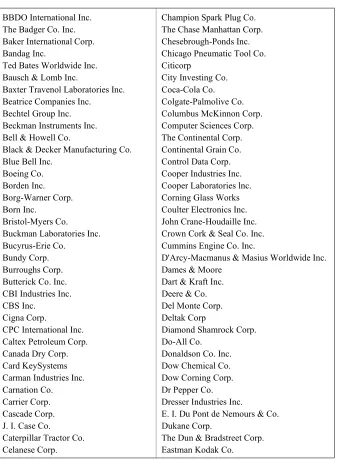
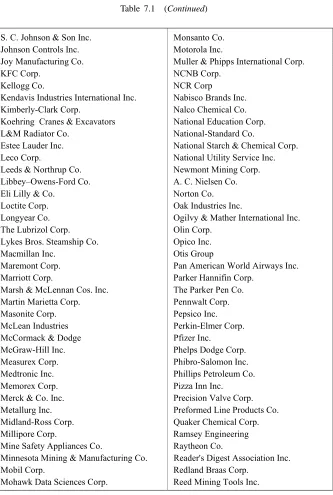
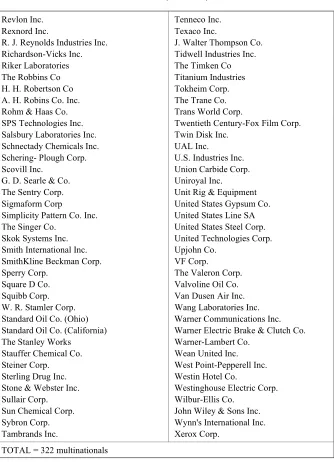
on the population of 322 US multinationals in South Africa from 1982 to 1987. Eleven sets of variables (about five variables per set and two indicators per variable) made the theory operational. Readers, who wish to avoid the technical details in this section, may skip to the summary sub-sections for quick overviews. Chapter 7 provides details on the setting, the time frame, the population and the sets of variables to be tested. At least three sources of data existed for each variable — a main source, a source to crosscheck data and a source to resolve discrepancies. Chapter 8 provides information on the analytical procedures used to test the hypotheses including logistic regression and linear regression analyses with lagged independent variables and pooled cross-sections. These techniques reflect the time frame of the study, the population’s attrition over the period under study and the diverse scales that measured the variables. The chapter highlights the significant results and discusses their generalizability.
as Change Agents
A catalyst is a change agent. In chemistry, the term depicts a substance that by its presence either speeds up or slows down a chemical reaction. In the process, the catalyst itself undergoes no permanent chemical change. In general, the catalyst brings an alternative path to the reaction.
Theories have generally portrayed multinationals as catalysts. For example, some theorists have argued that multinationals move resources, like capital, from places with low returns to places with high returns. Consequently, multinationals bid up the prices of abundant resources, like labor. Other theorists have posited that by making more efficient uses of global resources than domestic firms, multinationals may boost global outputs. In this fashion, theorists have shown the growth of multinationals as causing reactions in the environments from which multinationals come, and in the environments to which multinationals go. However, multinationals themselves have been portrayed as substantially unchanged by the growth: supposedly, the motivations for their behaviors alter very little. Thus, multinationals are depicted as changing stakeholders, but not as being changed substantially by them.
In this book, the variable “presence” captures a firm’s or organization’s structural changes — the entry, growth, and decline of that firm or organization over time. Many theories have proposed explanations for the presence of multinationals in host states. Other theories have built on these
rationales to analyze their presence in broader social contexts. The second category of theories has portrayed multinationals as catalysts in host states. This chapter covers some rationales that existing theories of international business have offered for the presence and catalytic reactions of multinationals. The chapter also highlights which stakeholders the theories emphasize and critically analyzes some underlying theoretical assumptions.
Rationales for Presence
Many theories have proposed explanations for the entry, growth and decline of multinationals in host states (e.g., see Buckley and Ghauri, 1999). Most of these theories have assumed that market failures in host states prompt multinationals’ behaviors. Desires to maximize profits and efficiencies, as well as to control and to coordinate operations, fuel multinationals’ behaviors in imperfect markets. Multinationals’ reasons for growth and decline are generally depicted as arising from their reasons for entry.
Rationales for Entry
Entry refers to a multinational’s actions to produce in foreign markets. Generally, the entry of multinationals has been portrayed as a response to market failures in host states. Theories of market imperfections, internalization, strategic management, manufacturing processes and oligopolistic markets have sketched the distinctive characteristics that help multinationals to surmount entry barriers in host states.
Market Imperfections:
of local product markets and conditions. Hymer (1960) contended that in perfect product markets, domestic firms with local knowledge would out-compete foreign firms. Consequently, profit-maximizing foreign firms could only exist in imperfect product markets that allow them to use their special assets.
Hymer (1970) also argued that imperfect knowledge (information) markets influence profit-maximizing multinationals’ decisions to produce abroad rather than to license knowledge to host states’ firms. He theorized that such imperfections arise from buyers’ uncertainty (buyers of knowledge cannot assess its worth until they possess it), lack of institutionalized markets for knowledge and multinationals’desires for secrecy. In imperfect markets, multinationals cannot induce competitive bids to get full returns on their investments. Licensing may also result in extra costs like the costs of policing property rights to the knowledge (Buckley and Davies, 1980). Therefore, Hymer (1970) contended that profit-maximizing motives, like firms’ desires to control knowledge, and their fears of creating competitors, cause firms to favor foreign production over licensing.
restrictions. Gorecki (1976), using Canadian data, tested and confirmed the proposition that intangible assets help multinationals to overcome entry barriers in host states’ markets.
Besides efficiencies, theories on the entry of multinationals have placed critical importance on their profitability. According to the theories, anticipated profits to stockholders translate firms’ abilities to enter host states into their actual desires to do so (Buckley, 1985). For example, theorists have contended that multinationals prefer to produce goods abroad (rather than to export goods) when tariff and transport-cost barriers exist, or when local production permits them to adapt products more economically to local conditions.
Other theorists discussed financial-market imperfections rather than imperfections in product and knowledge markets (e.g., Agmon and Lessard, 1977; Aliber, 1970). These theorists looked at owners’ (stockholders’ and investors’) efforts to diversify risks and to maximize profits. For instance, Aliber (1970) argued that multinationals enjoy advantages in international financial markets over host states’ firms; consequently, foreign direct investment can take place even if the markets for licensing are perfect. Aliber’s (1970) analysis centered on currency premiums. Holders of debt denominated in particular currencies bear risks that will reduce their returns if those currencies depreciate in values relative to other currencies. In perfect markets, if investors are risk neutral, the rates of interest on debts denominated in particular currencies will exactly reflect expected rates of depreciation of those currencies. But investors are risk averse and demand premiums for bearing exchange-risk uncertainties. According to Aliber (1970), markets bias applications of these currency premiums. Investors are myopic in Aliber’s (1970) model — they treat all the assets of subsidiaries as if they were in the same currency areas as the parent firms. An English factory is a sterling asset; but if a US company owns the factory, the market regards the factory as a dollar asset. Consequently, multinationals originate from those states that can borrow at lower interest rates. Also, markets value multinationals more highly because their earnings are capitalized at home states’ currency rates.
thereby eliminate the phenomena? Would not international markets recognize that multinationals are multiple currency earners and that such earnings are subject to exchange risks if converted to home states’ currencies? Aliber’s (1970) theory also fails to explain the distributions of foreign direct investment among industries, and simultaneous cross-investments within industries and between currency areas.
In his analyses of financial markets, Lessard (1979) pointed out that multinationals have advantages that accrue from internalizing financial transactions. These advantages stem from exchange-control arbitrage, credit-market arbitrage, and equity-credit-market arbitrage (risk reduction through diversification). Agmon and Lessard (1977) theorized that as capital transfers between countries entail costs, multinationals provide investors with indirect means for risk reduction through diversification. Therefore, individual investors’ desires to diversify their holdings may contribute to the existence of multinationals. Agmon and Lessard (1977) argued that multinationals serve as diversification vehicles when two conditions exist: first, portfolio-capital flows must cost more than direct-investment flows; and, second, investors must recognize that multinationals provide diversification vehicles. Agmon and Lessard (1977) provided some evidence that investors take the international involvement of US multinationals into account. However, Jacquillat and Solnik (1978) found that portfolios made up of multinationals’ shares appear to form poor substitutes for international portfolio diversification. Also, the international involvement of firms had very little influence on their stock prices (Jacquillat and Solnik, 1978).
Internalization:
of knowledge, justifying foreign direct investment over alternatives like licensing (Teece, 1976).
The distinctive characteristics of some knowledge may contribute to internalization. For example, Caves (1982) argued that intangible assets, like research and development skills, often constitute public goods (goods that can be used at different locations with few extra costs or reductions in original amounts). Consequently, intangible assets tend to be priced inefficiently. Transactions in intangible assets suffer from failures like impactedness, uncertainty and opportunism in markets for information. So, managerial desires to control intangible assets may prompt firms to enter host states.
Magee’s (1976; 1977) theory of appropriability enunciates the distinctive characteristics of technology that encourage internalization. Multinationals discover and develop products, production functions and markets. Therefore, Magee (1976) contended, multinationals generate technology that they wish to appropriate. Magee (1976) deduced that as competitors have more difficulties imitating sophisticated technologies than simple technologies, multinationals have more success appropriating the returns from sophisticated technologies. As multinationals can also transfer sophisticated technologies more efficiently via internal channels than through markets, Magee (1976) asserted that managers have incentives to generate sophisticated technologies — to the detriment of some users like less-developed countries.
Internalization theorists have assumed that multinationals endeavor to retain the firm-specific advantages that they generated in their home markets; so, foreign subsidiaries tend to be branch plants (miniature replicas) of parent firms (Grosse, 1982).
Strategic Management:
Information markets are imperfect and search costs are higher for foreign than for domestic investment decisions. These higher, fixed costs constitute larger barriers to entry for smaller, foreign firms (Aharoni, 1966). Consequently, many strategic-management theories have assumed that only large firms, able to make substantial capital outlays, decide to enter host states.
The exact factors precipitating the entry decisions of multinationals often seem quite random: their export markets may be threatened or their competitors may go abroad. Multinationals may see these precipitating factors as appropriate instances in which to exploit their intangible assets (Aharoni, 1966; Michalet and Delapierre, 1976).
Strategic-management theorists have argued that investment opportunities are often noticed at lower-management levels. For example, Bower (1970) contended that functional departments down the line, rather than top management, often propose entry into host states. Once proposed, such projects must gather sufficient supporters along organizational hierarchies to bring them to the notice of top managers. The control structures of multinationals influence who decides to support what projects, and the impetus that projects get as they move along hierarchies.
Manufacturing Processes:
contended that these strategies prompt the entry of multinationals into host states.
Manufacturing-process theories have proposed the following chronology (Stobaugh, 1968; Wells, 1972): Preliminary, innovative phases occur in advanced, industrialized states because of their large home markets (i.e., demand) and the resources that firms can devote to innovative activities (i.e., supply). Uncertainties in production processes and communication costs cause innovating firms to produce initially at home with home states’ resources such as labor. As foreign demand rises, firms begin to export to foreign markets in other industrialized countries. In time, growth of foreign demand, diffusion of firms’ technologies to foreign competitors, and rising trade barriers in foreign markets make foreign production of goods feasible and necessary. Therefore, firms decide to enter host states. During these secondary phases, manufacturing processes continue to improve. In the final phases, multinationals standardize and actually move their manufacturing processes to less-developed states. Or, multinationals may shift only the labor-intensive phases of production to less-developed states with low labor costs. Multinationals may then use the less-developed states as export platforms for global markets, including home markets (Vernon, 1966).
Oligopolistic Markets:
Oligopolistic markets are characterized by entry barriers and therefore by small numbers of firms. Entry barriers in oligopolistic markets result from factors such as patented technology, unpatented secret know-how, large capital requirements and economies of large-scale production. Like market-imperfection theories, oligopoly theories see market structures as granting multinationals competitive advantages over domestic firms.
For instance, Knickerbocker (1973) posited that multinationals enter host states because oligopolistic markets motivate follow-the-leader behaviors in firms. Knickerbocker (1973) argued that oligopolistic firms try to increase their potential competitive actions by occupying the same markets as their competitors. These imitative efforts may cause firms to follow their competitors abroad.
Knickerbocker (1973) proposed that loose-knit (rather than tight-knit) oligopolies encourage firms to invest abroad: Firms in loose-knit oligopolies recognize their interdependence with their rivals, but lack sufficient, mutual understanding to coordinate their activities. Consequently, firms adopt simple patterns of imitative behaviors. Knickerbocker (1973) tested his notions statistically with US multinationals in 23 countries from 1948–1967. By calculating entry-concentration indices, Knickerbocker (1973) found that concentrations of entries increase with concentrations of sellers to a point, and then decline. Knickerbocker (1973) viewed these findings as confirming his propositions: high-concentration industries breed collusion; low-concentration industries lack firms’ interdependence; therefore, firms in moderate-concentration industries seem most likely to follow competitors into host states.
Rationales for Growth
investments in the first place. Theories of market imperfections, internalization, and strategic management have also dealt with growth.
Market Imperfections:
Market-imperfection theorists have reasoned that by understanding when markets fail, one can also comprehend multinationals’ strategic behaviors like growth. Theorists have posited that markets fail when production techniques and commodities’ properties prevent market mechanisms from allocating resources efficiently. Briefly, theorists have proposed that lumpy, technical and managerial knowledge (knowledge that has to be used in conjunction with other inputs to be efficient), or knowledge that gives rise to spillovers, contributes to market imperfections (Johnson, 1970). Johnson (1970) identified three types of market failures that contribute to imperfections: external effects, public goods and economies of scale. Theorists have concluded that the imperfections in turn hinder efficient, international production and international transfers of knowledge. Therefore, the growth of multinationals reveals efforts to surmount market imperfections.
Market imperfections have been used to explain the horizontal and vertical growth of multinationals in host states. Horizontal investments enable multinationals to function efficiently by producing similar goods in both home and host markets. Vertical investments ensure multinationals with supplies of raw materials, and other inputs, and contribute to economies of scale. Theorists’ analyses of horizontal and vertical growth have emphasized firm-specific advantages such as established marketing systems, controls over transportation, managerial skills and access to capital that enable multinationals to exploit market imperfections.
Internalization:
and control exceed the revenues from growth (e.g., Buckley and Casson, 1985).
Magee (1976) used technology cycles to explain growth through internalization: in young industries, firms create technologies at rapid rates. Consequently, as internal transfers are more efficient, firms expand to internalize the technologies that they produce. In more mature industries, firms create technologies at slower rates, and therefore, the optimal sizes of these firms diminish. Magee’s (1976) theory implies that as industries mature, foreign direct investment should dwindle relative to licensing or exporting.
Strategic Management:
Other researchers extended Fayerweather’s (1969) framework. For example, Porter (1986) argued that successful multinationals configure (locate) and coordinate their activities nationally or globally to exploit advantages in production, procurement, service, technology, marketing and sales. The advantages may vary across industries (Porter, 1986). Similarly, Hamel and Prahalad (1983) reasoned that profitable multinationals follow national, rather than global, strategies when subsidiaries adapt products to national markets; subsidiaries cannot exploit scale economies in R&D, manufacturing, and purchasing; subsidiaries face large numbers of non-global competitors in national markets; nationally distinctive distribution channels exist; product substitutes exist; and, subsidiaries do not depend on headquarters for R&D. And, Ghoshal (1987) added that multinationals’ competitive advantages stem from their abilities to coordinate national differences in input and output markets, economies of scale and economies of scope. These abilities, as well as desires to maximize efficiencies, to reduce risks and to enhance learning prompt managers of successful multinationals or transnationals (Bartlett and Ghoshal, 2000) to trade globally and nationally responsive strategies (Ghoshal, 1987).
Rationales for Decline
Decline refers to cutbacks in sizes, reductions in absolute rates of growth, and multinationals’ leaving host states. The decline of multinationals in host states has often been explained as the flip side of their reasons for entry: Decline sets in when multinationals cease to operate as profit-maximizing and efficiency-driven firms or cease to coordinate their operations. Theories of internalization and strategic management have offered some rationales for decline.
Internalization:
Shapiro (1986) also used internalization theories, along with market-imperfection theories, to depict the comparative ease with which multinationals could leave states. Shapiro’s (1986) explanation enlarged the Caves–Porter analysis (Caves and Porter, 1976; Eaton and Lipsey, 1980; 1981) of the symmetrical relations between entry and exit barriers. Caves and Porter (1976) focused on domestic firms’ investments in durable and firm-specific assets such as durable plant and equipment, advertising expenditures, firm-specific human capital, R&D expenditures, as well as economies of scale. Caves and Porter (1976) argued that new firms must duplicate these expensive assets, with limited, resale markets, to remain competitive. Consequently, existing firms’ uses of durable and specific assets constitute entry barriers for new firms. In addition, assets’ specificities limit their scrap values and increase new firms’ risks of entry. However, these characteristics also make the assets exit barriers for existing firms: the committed assets, with their limited marketability, become nonrecoverable costs. Simply stated, firms become bound to their markets, unable to divest (Caves and Porter, 1976). Shapiro (1986) argued that as exit barriers seem similar to entry barriers, multinationals’ subsidiaries are less restricted than domestic firms by exit barriers. Subsidiaries’ intangible assets are deployed relatively cheaply, reducing multinationals’ necessary, recoverable costs (Shapiro, 1986). In addition, the assets may be transferred within multinational systems, using internal, rather than external markets. Analyzing Canadian data from 1972–1976, Shapiro (1986) found that investments in technology did deter domestic firmsfrom leaving but appeared not to deter multinationals. Therefore, he concluded that multinationals may leave industries more easily than domestic firms do.
Strategic Management:
multi-nationals, Tornedon and Boddewyn (1974) concluded that the divestitures of subsidiaries depended on their profitability, changes in headquarters’ strategic positions, as well as various environmental influences on headquarters. Headquarters’ decisions to leave host states seemed to emanate from a series of incremental, investigative decisions, rather than from conscious strategic decisions (Tornedon and Boddewyn, 1974). The next section traces the effects of multinationals’ strategic behaviors on various stakeholders.
Relations with Stakeholders
This section covers theoretical rationales for multinationals’ relations with stakeholders. For the most part, theories have built on multinationals’ behaviors in imperfect markets. As Figure 2.1 describes, most theories have emphasized either multinationals’ profit-maximizing and efficiency-driven behaviors, or their control and coordination of global operations.
Theories dealing with market imperfections, internalization, and strategic management have concentrated on multinationals’ internal characteristics, portraying them as entrepreneurial firms. In the process, they have delineated owners’ and managers’ interests and influences. A second set of theories dealing with manufacturing processes, oligopolistic markets, redistribution, international relations, dependent development and global networks generally have specified multinationals’ abilities to affect labor, governments, states, societies and the world. The second set of theories has portrayed multinationals as catalysts, or change agents: the theorists have assumed for the most part that as multinationals possess certain characteristics, their presence brings about catalytic reactions.
Owners & Managers
Market Imperfections:
Market-imperfection theories have painted multinationals as entrepreneurial firms that strive to maximize profits and efficiencies. Consequently, the theories have granted owners’ (stockholders’ and investors’) interests paramount importance. The theorists have generally ignored other stakeholders’ interests.
[image:43.432.57.377.113.388.2]As market-imperfection theories have explained the presence of multinationals as arising from their abilities to exploit market imperfections, many have highlighted the advantages that multinationals provide to stockholders and to investors. For example, Caves (1971) depicted
Figure 2.1 Reviewing multinational corporations’ effects on stakeholders.
! " # #
$
%#%"#
%
& $"
multinationals’ behaviors in host states as arising from their profit-maximizing efforts to utilize efficiently their intangible assets. Similarly, Aliber (1970) and Agmon and Lessard (1977) argued that multinationals’ behaviors constitute efforts to diversify and to reduce the risks of stockholders’ portfolios.
Internalization:
Internalization theories have explained some of multinationals’ relations with managers. Like market-imperfection theorists, internalization theorists have assumed that managers exist to pursue owners’ interests through maximizing profits and efficiencies. However, many of the theories also deal with how managers recoup transaction benefits by common governance of separate but inter-related activities located in different states. That is, the theories explain why managers control and coordinate operations. Many of the theorists have assumed that subsidiaries are miniature versions of headquarters. Consequently, subsidiaries’ and headquarters’ managers are portrayed as having similar interests and views.
Strategic Management:
Strategic-management theories have focused on how headquarters’ managers may control subsidiaries to maximize profits. When the theories have explained labor’s or governments’ behaviors (Bartlett, 1986; Doz, 1986; Encarnation and Wells, 1986; Mahini and Wells, 1986), they have concentrated on the circumstances under which the stakeholders hinder or help managers’ coordination and control activities.
profitability, Bartlett and Ghoshal (1987) advocated more sophisticated, management controls based on headquarters’ cooptation of subsidiaries’ managers.
Strategic-management theorists have often discussed the most efficient types of management controls in multinational systems. For example, through a series of field studies, Prahalad and Doz (1981), and Doz and Prahalad (1981), concluded that various organizational mechanisms enhance the abilities of headquarters’ managers to elicit valid, reliable information from subsidiaries’ managers. These include data-management mechanisms such as information systems, measurement systems, resource-allocation procedures and strategic-planning and budgeting processes; managerial mechanisms such as choices of key managers and career paths, reward-and-punishment systems, management-development programs and socialization patterns; and conflict-resolution mechanisms such as decision-responsibility assignments, task forces, issue-resolution processes, coordination committees, integrators and business teams (Doz and Prahalad, 1981).
Labor
Manufacturing-process theories have related multinationals’ growth and expansion to technological developments. They have derived multinationals’ effects on home and host-states’ labor from their profit-maximizing and efficiency-driven behaviors.
Manufacturing Processes:
innovations in European countries seem substantially less capital-intensive than those in the USA; also Haley (2000a) identified several examples of process innovation in the Asia-Pacific developing countries that have forced multinationals from industrialized countries to respond.
Vernon, and other theorists (e.g., Wells, 1972), also used manufacturing processes to explain multinationals’ effects on domestic labor. As multinationals’ technologies evolve, their operations may utilize foreign rather than domestic labor. Efficiency and profit considerations may prompt multinationals to export labor-intensive jobs from home to less-developed states. In effect, multinationals may snatch jobs from home states’ labor. Thus, theorists explained social phenomena, such as the antagonistic behaviors of home states’ labor towards multinationals.
Governments
Oligopoly and political-economy theories have portrayed some of multinationals’ effects on governments. They have derived the effects from multinationals’ profit-maximizing and efficiency-driven behaviors.
Oligopolistic Markets:
Oligopoly theorists have argued that multinationals may prevent the growth of domestic firms. Therefore, oligopoly theories have strong implications for governmental roles in industries in general, and in the regulation of multinationals’ activities in particular.
In many oligopoly models (e.g., Knickerbocker, 1973), multinationals’ behaviors become defensive strategies in response to competitors’ price cuts and maneuvers. Graham (1978) referred to the relations between oligopolistic multinationals as exchange-of-threat motivations. Oligopoly theorists have often concluded that as multinationals increase their response potentials, they concurrently reduce domestic and global competition and stabilize markets.
oligopoly theories derive directly from classical and neoclassical economic assumptions: Social relations between economic actors, such as a few multinationals, constitute frictional drags that impede competitive markets. For example, Adam Smith (1776/1979:232) complained “people of the same trade seldom meet together, even for merriment and diversion, but the conversation ends in a conspiracy against the public, or in some contrivance to raise prices”. Consequently, the theorists assume that governments should intervene to maintain competitive markets, and to promote social welfare, by correcting the imbalances perpetuated by multinationals.
Redistribution:
Political-economy theories have depicted redistributions of powers and resources between multinationals and governments. Early political economists utilized bilateral-monopoly models to analyze the relations between multinationals and governments: Multinationals control capital, technology, management and marketing skills to launch economic projects; governments control access to states before multinationals invest, and control conditions for operation afterwards. Multinationals and governments were generally represented as struggling over the distributions of benefits from economic projects. For example, Penrose (1959) argued that at first, multinationals receive just enough benefits to induce them to commit investments; later, they receive just enough to prevent them from withdrawing.
Kindleberger (1965) contended that Penrose’s formulation constituted the lower limits that multinationals receive. He posited that the scarcity values of multinationals’ investments to governments decide the upper values of the benefits that multinationals receive from governments. The upper values then constitute the prices at which governments would rather forego the investments. The distance between, upper and lower values affords opportunities for negotiations (Kindleberger, 1965).
investments, governments structure contracts to reward multinationals handsomely for successful projects. Consequently, initial contracts tilt heavily in favor of multinationals. However, if projects prove successful, risks and uncertainties dissipate. Hostage effects also take place, as multinationals cannot credibly threatento exit once they have invested heavily in states. Besides host states may move up learning curves of bargaining and managerial skills, drive harder bargains with multinationals and threaten to replace them if they fail to renegotiate contracts. Whatever the causes, the obsolescing bargain predicts that initial agreements favoring multinationals are likely to be renegotiated in favor of host governments.
Bennett and Sharpe (1985) sketched a bargaining model to explain multinationals’ powers vis-à-vis the Mexican government. They argued that governments’ cohesion and organizational unity greatly influenced their relative powers vis-à-vis multinationals. They also highlighted institutional environments that limit multinationals’ and governmental powers. Bennett and Sharpe (1985) contended that firms’ behaviors (firms’ incorporation of local content, exports and pricing behaviors) shape policies on industrial structures (questions regarding the numbers of firms and of foreign ownership) by setting decision-making agendas. Governmental powers to act on these agendas depend on their planning capacities, their administrative abilities to monitor and to control foreign capital, and the technical knowledge that governmental officials have about industries; multinationals’ powers depend on their knowledge of local markets and political systems, and their administrative abilities to negotiate with governments (Bennett and Sharpe, 1985). Bennett and Sharpe (1985) portrayed multinationals as homogeneous entities with common, internal interests; and, they confined their analyses of institutional restraints to market structures.
Generally, the theories have focused on how multinationals influence governments. Theorists have argued (e.g., Parry, 1980) that multinationals cause efficiency and equity effects in states. Efficiency effects deal with multinationals’ abilities to increase states’ outputs: As multinationals move resources like capital from places where returns are low, to places where returns are high, they bid up the prices of abundant resources, like labor, in host countries. By their more efficient uses of global resources, multinationals may increase global outputs. By increasing market competition, multinationals may also boost domestic firms’ efficiencies. Equity effects deal with the distribution of the incremental outputs between governments and multinationals. Equity effects generally take place through host states’ taxes, lower prices for consumers and increased profits for multinationals.
Political-economy theorists often viewed governments and multinationals as antagonists, arguing over allocations of incremental outputs through taxes or repatriated profits. Yet, governments and multinationals sometimes form networks to distribute benefits as in Singapore (Haley, 2000a; Haley, Low and Toh, 1996). Generally, however, the only other stakeholders that theorists have acknowledged — labor forces — often lose in these theories: Multinationals’ strivings for increased efficiency, together with their flexibility, cause labor forces to lose their bargaining powers.
States
For the most part, international-relations theories have drawn on neoclassical, economic propositions about multinationals’ profit-maximizing and efficiency-driven behaviors. The theories have highlighted multinationals’ effects on nation states and global, economic and political orders.
International Relations:
Many international-relations theorists have assumed that from the early 1900’s until World War II, the USA constituted the world’s dominant military and economic power. As the dominant power, the USA greatly contributed to creating and to maintaining the international economy through institutions like multinationals (e.g., Gilpin, 1975; 1987). After World War II, the USA, Western Europe and Japan formed the dominant powers. Today, this triad, and the economic order it maintained, is in disarray. International-relations theorists have offered at least two contradictory explanations for multinationals’ roles in the aftermath of this hegemonic collapse.
One explanation was initially proposed by Vernon (1971) in his influential book Sovereignty at Bay. Vernon (1971) argued that economic inter-dependence, and technological advances in communication have undermined the traditional, economic rationales for states. World efficiencies and domestic, economic welfares will continue to decrease states’ powers vis-à-vis multinationals and other international institutions (Vernon, 1971).
employment and regional-development opportunities by sanctioning multinationals (Johnson, 1970).
Sovereignty-at-bay deduces that the flexibility and vast resources of multinationals grant them advantages in confrontations with states (Vernon, 1971). If multinationals move production facilities elsewhere, states lose employment, corporate resources and access to world markets. Thus, the theorists have argued that multinationals often escape states’ controls and emerge as powers to change international, political relations (Huntington, 1973).
Obversely, the theorists have contended that states often face the possibility of losing control over economic affairs to multinationals. States may not be able to retain traditional sovereignty and to meet their citizens’ rising economic demands. Therefore, the sovereignty-at-bay model views states’ efforts to enhance security and power as incompatible with an interdependent world economy that generates absolute gains. The theorists have contended that economic forces will eventually contribute to the end of nationality as we know it (Huntington, 1973). The sovereignty-at-bay world consists of interdependent economies with voluntary cooperative relations that accelerate everyone’s economic growth and welfare. In this world, multinationals,freed from nation states, form critical transmission belts of capital, ideas and growth.
In the new order, states manipulate economic arrangements to maximize their own interests, even at the expense of stakeholders. States’ interests concern domestic matters (like employment and price stabilities), as well as foreign-policy matters (like security and independence). Thus, mercantilist theories have granted priority to states’ economic and political objectives over global economic efficiencies. In pursuit of economic objectives and national interests, states attempt to control actors within their realms, including multinationals (Krasner, 1978).
Mercantilist theorists have argued that international competition has intensified because the USA has lost its technological lead in products and manufacturing processes. The US multinationals must now increasingly compete on the bases of prices and a devalued dollar. Thus, the USA can no longer draw on the technological rents associated with its industrial supremacy and the supremacy of US multinationals in the economic order has come to an end. Consequently, US multinationals play greatly diminished roles in maintaining the USA’s hegemonic rule. States will now increasingly form regional, trade and monetary alliances to advance their own interests. This regionalization will replace the USA’s emphases on multilateral free trade, the dollar’s international role and the US multinationals’ supremacy. In the wake of the Asian Crisis, and the subsequent dominance of US multinationals and management (Haley, 2000a; 2000b), many of the mercantilists appear anachronistic.
Statists have proposed that even the strongest states enjoy uneven powers across policy areas. For example, Katzenstein (1978) distinguished between strategies open to Japan and to France that can apply policy instruments at industry-sector levels, and to Britain and to the USA that must rely on macroeconomic manipulations of fiscal and monetary parameters. Therefore, Statists have contended that complete analyses of states’ powers require examinations of the organizations and powers of states, of socioeconomic interest groups such as multinationals and of other societal actors. Statists have depicted multinational-state relations from states’ viewpoints as states’ efforts to influence multinationals; they have not attempted to build a coherent theory of multinationals, or of their influences.
In a critique of international-relations theories, Nye (1986) concluded that hegemonic theories offer inadequate explanations for multinationals’ roles in the 1980’s. Nye (1986) argued that relationships between the spread of multinationals and of the USA’s military power have never been established. Similarly, sovereignty-at-bay seems jaded and dated: Incidences of nationalizations and protests in developing countries have declined dramatically since the 1970’s, reflecting changes in multinationals’ and states’ bargaining powers. Nye advised against generalizations. He predicted (Nye, 1986) that states and multinationals would muddle through as in the past, with bilateral agreements, weak multilateral measures, some sectoral closures, and a great deal of flexibility and adaptation. Different industries, sectors and firms may present different patterns; but, the patterns have yet to be discovered (Nye, 1986).
Societies
Dependent Development:
A variety of contentions, some contradictory, have emerged from the dependency theorists. Drawing on Hymer’s characterizations of multi-nationals, dependency theorists have argued that multinationals distort economic development in less-developed states by forcing them into associated or “dependent development” relationships (Evans, 1979). They have charged multinationals with creating branch-plant economies of small, inefficient firms that are incapable of propelling overall development. They have argued that foreign subsidiaries exist as appendages of their home firms, and as enclaves in states’ economies, rather than as engines of self-reliant growth (Rosen and Kurth, 1974). They have accused multinationals of introducing inappropriate, technological developments and of employing capital-intensive, production techniques that cause unemployment and prevent the emergence of domestic technologies. They have asserted that multinationals add skewness to the income distributions among classes in less-developed states (Evans, 1981). And, because of their repatriation of profits and their superior access to local capital, they have contended that multinationals prevent the rise of indigenous enterprises (Hirschman, 1969).
Dependency theorists have also concluded that multinationals have negative, political consequences for less-developed states (Breton, 1964; Johnson, 1965; 1967; Vernon, 1967). For example, theorists have asserted that multinationals require stable, host governments that are sympathetic to capitalism; therefore, dependent development encourages authoritarian regimes in host states and creates alliances between multinationals and domestic, reactionary elites. They have contended that multinationals’ home governments sustain these exploitative alliances by intervening in the internal affairs of less-developed states. In this fashion, multinationals tend to make host states politically dependent upon home, industrialized states.
systems increase inequalities. For example, Robinson (1976) suggested that multinationals’ effects on inequalities are mediated by their penetration of societies. Multinationals are more likely to penetrate states with weak, national apparatuses; therefore, weak states have more inequalities (Robinson, 1976). Similarly, Bornschier and Ballmer-Cao (1979) argued that multinationals weaken the power of labor and middle-class groups and strengthen the hands of traditional, power holders.
Still other dependency theorists have concentrated on multinationals’ negative effects on societies and cultures (Evans, 1981). They have argued that states may lose control over their culture and social development. Therefore, multinationals may contribute to cultural imperialism or CocaColaization of less-developed societies. The theorists have proposed that multinationals undermine societies’ traditional values by introducing new values and tastes through advertising and business practices. These new values often create demands for goods that do not meet the masses’ true needs.
The World
Anthropological theories have analyzed multinationals’ attempts to control and to coordinate their operations by managing global environments. The theories have emphasized how multinationals de-emphasize profit-maximizing criteria as they forge global, social networks.
Global Networks:
with their partners in joint ventures. For example, multinationals may loan money and sell products to each other at prices well below the market. One multinational may sell another a raw material that is in such short supply as to be unavailable to firms unaffiliated with the system. In this fashion, multinationals may control and coordinate their operations at global levels, while not necessarily maximizing profits or efficiencies.
Theoretical Assumptions
Generally, theorists have argued that the reasons for the entry of multinationals into host states also explain their subsequent growth and decline. Multi-nationals bring new, scarce resources that they strictly control — capital, technology, management and marketing skills; their strategic uses of these resources change stakeholders for better or for worse. Consequently, many of the theories have implied that multinationals behave as catalysts in states. To depict these catalytic effects, theories of multinationals have incorporated certain assumptions about their behaviors. In particular, most theorists have assumed that multinationals use static, analytical schemes, coordinate and control operations efficiently, and enjoy relatively stable relations with stakeholders.
Static Analytical Schemes
Most theories also fail to distinguish between multinationals’ initial investment decisions and subsequent, incremental investment flows. Yet, as Kogut (1986) pointed out, incremental investments in established subsidiaries form the predominant shares of foreign direct investments’ flows. In the light of these trends, existing theories of multinationals provide incomplete explanations for multinationals’ behaviors (Kogut, 1986).
Efficient Control and Coordination
Some theories of multinationals have emphasized headquarters’ need to control and to coordinate multinationals’ operations. The theorists have argued that multinationals can exploit intangible assets efficiently only when organizational forms are efficient, i.e., when headquarters can control and coordinate operations for optimal benefits. Most of the theorists have posited that headquarters control multinationals’ operations to increase efficiencies, to add to social welfare, to increase adaptability and therefore to increase profits. For example, according to internalization theories, multinationals grow so long as the benefits from growth exceed the costs of coordination and control. Conversely, internationalization theories imply that multinationals divest when they no longer benefit from internalization. Consequently, the theories grant internal-market efficiencies more importance than external-market efficiencies.
Stable Relations with Stakeholders
Most theories of multinationals have taken the stability of relations with stakeholders for granted, presumed the recurrence of environmental conditions and stated that multinationals can improve performances by building cumulatively on past experiences. Externally, most of the theories have focused on relationships with established publics. Theories have examined the relations between multinationals, labor, governments, societies and states. Generally, the relationships have been depicted as antagonistic and conflict ridden.
Multinational Corporations
Most theorists would agree that multinationals have characteristics that distinguish them from domestic firms. Fewer theorists would agree that multinationals change only in preset and anticipated ways, operate efficiently, rarely deceive their stakeholders, and rarely make mistakes. Yet most theories of multinationals have included only these behaviors. Thus, as Chapter 2 indicated, multinationals’ strategic behaviors in host states are largely derived from their reasons for entries.
This chapter argues that contrary to most theories, multinationals’ reasons for entries may not explain their subsequent growth and decline or relations with stakeholders: multinationals and environments change. In particular: multinationals’ analytical schemes change; control and coordination of operations by multinationals often prove illusory; and multinationals’ relations with stakeholders change.
Dynamic Analytical Schemes
Kogut (1986) pointed out that incremental investments in established subsidiaries constitute the predominant shares of foreign direct investment flows. No evidence indicates that the evaluation criteria that multinationals’ managers use remain the same across these decisions. Yet, most theories of
multinationals have failed to distinguish between multinationals’ initial investment decisions and subsequent decisions on growth.
According to the simple, neoclassical, one-period model, firms operate in highly competitive industries in static, certain environments. Production functions relate various input possibilities to outputs. Optimum inputs can be inferred from input and output prices, from the outputs obtainable from input combinations and from goals of profit maximization. Firms maximize net profits — incomes from sales less the costs of inputs. In this one-period model, firms’ strategies maximize the resources available for firms’ consumption in later periods. At profit-ma