The Real Condition of
Freedom of Religious/Belief
From the monitoring of SETARA Institute, in the period of 2012, the amount of intolerance action case and discrimination of freedom of religious/ belief has increased. It was represented by 264 and 371 cases on violations of freedom of religious/ belief as the constitutional rights which protected and guaranteed by the state. he number of 264 and 371 as representing as in the graphic of the amount of Cases and Actions (see graphic 1), shows the signiicant escalation about minor situation in freedom of religious/ belief if compared with last year, where the each “only” 244 and 299.
he various violations of freedom of religion / belief on this year occurred in diferent months (see graphic 2). Violations that occurred along this year mostly occurred in May (38 violations) and October (40 violations). he factor of month in this case is not a primary factor analysis to ind certain patterns relating to the violation of freedom of religion / belief of the time (months) occurrence. In the previous year research, the month that became the “culmination” month of the violation was on February (45 violations) and March (48 violations).32
32 See Hasani and Naipospos (Eds), 2012, Politik Diskriminasi Rezim Susilo Bambang Yudhoyono: Kondisi Kebebasan Beragama/Berkeyakinan di Indonesia
he spread of those violations in various month describes about the pattern which relatively “static”, which related to the “major” incident that stimulates some of “derivative” violations.
he culmination of violations which occurred on May and October also could be interpreted symbolically. he two “sacred” months for the Republic actually unable to evocative the spirit of the people of Indonesia to sow tolerance as stipulated as the concept of “Bhinneka Tunggal Ika” among the adherents and followers which has diferent sight of religion and belief.
As we all know, May and October are the important month of Indonesian people where the precious moments of Indonesia commemoration, namely “bulan kebangkitan nasional” (he National Awakening Day-on May), and October as the day of Sumpah Pemuda (youth pledge), that day being the historic day of Indonesian concatenation-history of nation shapers (young people) to be united in their diferent.
Indonesian which has diferent and diversiication as their naturally given. Politically, this condition coul be read as a serious problem for existence and national integration of our nation (nationality). Are the nation as a community, be imagined – or at least base on the opinion of Huntington – be treated such as through the reproduction of sacred symbols of nationality.
Graphic 1
Amount of the incidents and actions.
Graphic 2
he Monthly report of Distribution of Occurrence Violation Time
21
8 22
23 38
22
11 28
25 40
24
2
From the location of occurrence violation, SETARA’s monitoring shows that most of provinces of administrative jurisdiction area of Republic of Indonesia, contributes some violations’ data on freedom of religious/ belief. hose violations to spread occur in 28 provinces (see graphic 3). he number of violations leveled on more than 10, occurred in 6 (six) provinces. While the most massive and signiicant violation, quantitatively occurred to spread in 5 areas (graphic 4). he most-high violations occurred-province is West Java. It becomes the “champion” of the past. In fact, in terms of the quantity, the violations that occurred in that neighbor-city of Indonesia – 76 cases of violations – it increased if compared to the condition on last year which “only” 57 cases.
he stable status of West Java as the most intolerance province in Indonesia, relects the deepest apprehension if related to its position as the biggest demographic contributor of Indonesia. As recorded in statistical notes of Central Statistics Agency (BPS/ Badan Pusat Statistik),33 West Java is the most densely-populated provinces of
Indonesia. By analyzing the relation pattern of Indonesian population, could be assumed that the level of diversity of West Java is also high. hereby, the failure of experimentation on tolerance in the terms of diferences (including religious/ belief) in West Java can be interpreted as a failure of tolerance hotbed in the greatest socio-demographic miniature of Indonesia.
Trough the data, is also needed to be asked the epistemological questions, why West Java? SETARA Institute within the Framework regrets the weak position and role of local elites, in this case is the Governor of West Java. Governors who are the real power in West Java is a igure at once carried by the Prosperous Justice Party (PKS), the Islamic Party since 2009 claims have formally transformed into
an opened-party. he political platform as the opened-party should be applied concretely by Ahmad Heryawan in his politico-juridical policy as the head of government of West Java in order to establish West Java become the inclusive and tolerance province.
From the deployment regional where the violations occurred also could be identified its stagnancy or deterioration in compliance of freedom of religious/ belief as the constitutional right in top 5 provinces. The highest contributor of violation on freedom of religious/ belief this year is not shifting. The shifting only occurred in North Sumatera and Banten. North Sumateran on the last research ranked the second after West Java with the number of violations as much as 45 cases of violations, and now it “donates” 3 cases. The position of North Sumatera on top 5 was replaced by “neighbor country” Naggroe Aceh Darussalam with 36 cases. And Banten which became the place where 14 cases happened, now is out of top 5 with 4 cases only. The top 5 position of Banten was replaced by Central Java when this year ranked on third position as intolerance province in Indonesia with 30 cases of violations.
Meanwhile three (four) provinces as the other occupant of the top 5 other, was not shifting. The position of West Java, East Java and South Sulawesi stayed on top 5 (five) as same as last year. From the quantity the freedom of religious/ belief increase significantly in West Java (last year 57 cases) and East Java (31 cases). This phenomenon of province’s position which “again” on the top of 3 as the intolerance provinces, reflecting the lack of regional initiative to take progressive actions to fulfill the constitutional rights of its citizens in the form of freedom of religious/ belief. There’s fact of strong tendency that Regional Government did the omission even in certain extend in order to create worsen the situation of intolerance and discrimination. That tendency could be captured in East Java by the case of persecution on Shia congregations in Sampang and West Java, case of GKI Yasmin, and case of HKBP Filadelfia.
policy in order to promote the constitutional guaranty for freedom of religious/ belief. Not only that, the data also show inefectiveness of relations among the provinces-districts/municipality cum governor-regent/mayor which represented by disability of governor “to control” or “to direct” his underling-governmental unit. his inefectiveness relation is reinforced by the amount of violations which carried out by the district government/municipality government or regent/mayor (see graphic 6) as one of factors.
his minus situation aggravate the similar situation in national level, where the regulation in governmental level, ministry, and institutions “the auxiliary” of the state, such as MUI34 and
Bakorpakem, tend to fail in embodying the constitutional guaranty for freedom of religious/ belief in the ield of politico-juridical policy under the basic law of the state. Incongruence and inconsistence of governmental policy both politically or administratively with constitutional policy design which stipulated in the 1945 Constitution (UUD) of the state, becoming the fundamental problem for freedom of religious/ belief. his description has been done in Chapter 1 of this report.
Graphic 3
he Regional Distribution of Violations Occurrence (per-Province)
36
he Top 5 (ive) Regional of Highest Violations Occurrence
From the side of actors behavior, by using the normal category in study and human rights perspective, the violations on freedom of religious/ belief can be categorized as two kinds, such as; the actions committed by state, and action committed by non-state actor. he research result of SETARA Institute shows that the action committed by state actor tend to lower than by non-state actor, means 39% of violation, compared with the percentage of action which committed by non-state actor, means 61% (see graphic 5). Cumulatively, the percentage of this action classiication based on the actor, is not signiicantly shifting.35
Graphic 5
he intensity of Action by Actors
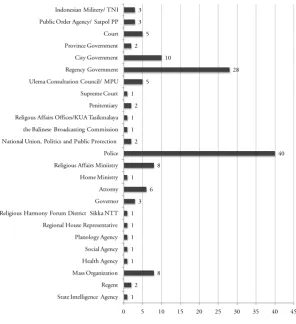
State actor which being the biggest violation quantitatively is Indonesia National Police (Polri), means 40 cases. his conirms that
35 In counting the actor, SETARA Institute bases itself to who involved in an incident. In one incident, some governmental institutions could be merged to do an action. Likewise happened between the state institutions and society groups could be merged to do some of actions in an incident.
Actions by the State
the position of the state police as the potential ofender which in human right perspective generally congruence with its Tri Brata Corps in the speciic issue of freedom of religious/ belief. he violations committed by the police, on this year as equal as which committed by them on years ago (40 cases of violations). Meanwhile, the other institutions which committed the highest action of violation after police, is district with 28 cases and city with 10 cases. he composition of violation which committed by district government and city government (38 cases) escalates signiicantly if compared with last year condition (only 18 cases).
Mostly the actors of state government (executive) are who sat in national or local level, as the main state agencies or auxiliary state agencies. hose state institutions --exclude police and district government/municipality government—namely attorney, ministry (particularly Religious Afairs Ministry), provincial government, Public Order Agency (Satpol PP), agency, sub-district head, and so other.
If classified by using the perspective of human rights, the violation committed by the state could be divided into 3 kinds, such as direct-act violation (by commission), indirect-act violation (by omission), and through the policy which overarching or provoked the violation (by rule/judiciary). Mostly violation committed in the form of direct action (112 cases/ 77, 2%). Indirect act violation occurred around 28 times (19, 3%), and in the form of policy around 5 (ive) times of violation (3, 5%). he direct act committed by state actor could be including the prohibition of establishing a place of worship, to force a belief, the dissolution of the discussions, dissolution the religious activity, misdirection, investigation on allegations of religious desecration, suspicion of religious desecration, prosecution on religious desecration, verdict of indictment, and so on (see table 1).
Graphic 6
State Actor and Amount of Violations
1 State Intelligence Agency
Regent Inter-Religious Harmony Forum District Sikka NTT Governor Attorny Home Ministry Religious Affairs Miniistry Police National Union, Politics and Public Protection the Balinese Broadcasting Commission Religous Affairs Offices/KUA Tasikmalaya Penitentiary Supreme Court Ulema Consultation Council/ MPU Regency Government City Government Province Government Court Public Order Agency/ Satpol PP Indonesian Militery/ TNI
Table 1
Violation Act by the State
Violation Amount
hreat of Dismissal 1
hreat of worshipping place closure 1
Discrimination 18
Intimidation 4
Discriminative policy 5
Disallowance of religious belief 1
Disallowance of worshipping 5
Disallowance of religious activity 1
Disallowance of establishing Educational
Institution of Religion 1
Disallowance of establishing worshipping place 4
Coercion of belief 7
Disallowance of freedom of expression 7
Omission 28
Dissolution of discussion 1
Dissolution of religious activity 1
Extrajudicial investigation 1
Detention 2
Detention on Religion Desecration 1
Arbitrary Detention 1
Arrestment 6
Neglect of Refugees 2
Eviction 2
he Sealing Action of House of Worship 19
Misdirection 6
Investigation on Allegation of Religion
Desecration 1
Suspicion on Religion Desecration 3
Prosecution on Religion Desecration 4 Verdict of indictment on Religion Desecration 4
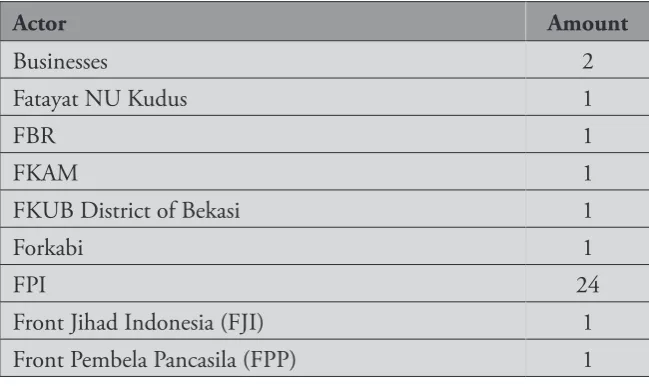
Meanwhile, the act committed by non-state actors (61% from the whole of violation’s cases) mostly cases involving the organization and religious irregulars, society/individual, and other non-state organizations (see table 2). he institutional actor which in the research data is mentioned as biggest contributor in doing violations on freedom of religious/ belief, is Indonesian Ulema Council (MUI)36 with 25
violations and Islam Defenders Front/ Front Pembela Islam (FPI) which “donates” 24 violations. he violations committed by those institutions is only lower that committed by society – individual group which its collective ailiation and organization, is diicult to be identiied – committed 76 cases of violation.
Table 2
Non-State Actor and the Amount of Violation.
Actor Amount
Businesses 2
Fatayat NU Kudus 1
FBR 1
FKAM 1
FKUB District of Bekasi 1
Forkabi 1
FPI 24
Front Jihad Indonesia (FJI) 1
Front Pembela Pancasila (FPP) 1
FUI 1
FUUI 1
Garis 1
Gerakan Anti Maksiat (GAM) 1
Gerakan Anti Pemurtadan dan Aliran Sesat (Gapas) 1 Gerakan Muslim Penyelamat Aqidah (Gempa) 1
Gerakan Pemuda Ka’bah (GPK) 2
GP Anshor 1
HTI 1
Individual 6
Educational Institution 9
IPNU-IPPNU Kudus 1
Jamaah Hizbullah 1
JAT 1
Kokam 1
Laskar Sabilillah(LS) 1
Laskar Umat Islam Solo (LUIS) 1
LPI 1
LSM Pandam 1
Majelis Mujahidin Indonesia (MMI) 5
Muhammadiyah Jatim 1
MUI 25
NU Jawa Timur 2
Hindu-Student Organization (KMHDI Bali, BEM
IHDN Denpasar) 1
Pagar Aqidah (Gardah) 2
Islamic Mass Organization 10
Persis Bandung 1
Religious Leaders 6
Residents 76
Related to MUI and FPI, if juxtaposed with last-year data, so could be inference that both organizations are being the serious obstacles in compliance and realization of freedom of religious/ belief. On 2011, violations committed by these organizations were also high, more increased around 2-3 points. Referring the last-year data, both each organization was committing 28 cases of violations, and it meant lower than violations committed by society, 80 cases.37
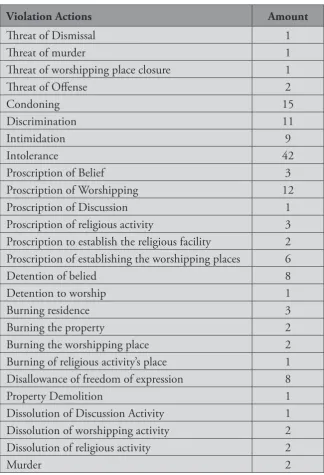
Connected to the number of “contribution/donation” on violations of freedom of religious/ belief, should be noted that society could be the agents of violation or harshness in incidentally in the name of religion/belief, even systematically or sporadically. This facts show about the weakness of lower layer condition among plural Indonesian society. Besides that, on the level of curative-prosecutorial, the in juridical-management on violations of freedom of religious/ belief would be facing serious troubles in some cases and claim of violation victim’s rights. And, the violation committed by non-state actor, is mostly formed in intolerance action (42 cases) and misdirection (23 cases). The violation which mostly committed also is offensive and torture actions. The number of physic persecution which generally occurred (murder, torture, sporadically offense, destruction of worshipping places and property of different group, burning of worshipping places, residence, and other property of minority group) was sharply increasing in 2012 (see table 3).
Table 3
Violation Action by Non-State Actor
Violation Actions Amount
hreat of Dismissal 1
hreat of murder 1
hreat of worshipping place closure 1
hreat of Ofense 2
Condoning 15
Discrimination 11
Intimidation 9
Intolerance 42
Proscription of Belief 3
Proscription of Worshipping 12
Proscription of Discussion 1
Proscription of religious activity 3
Proscription to establish the religious facility 2 Proscription of establishing the worshipping places 6
Detention of belied 8
Detention to worship 1
Burning residence 3
Burning the property 2
Burning the worshipping place 2
Burning of religious activity’s place 1 Disallowance of freedom of expression 8
Property Demolition 1
Dissolution of Discussion Activity 1
Dissolution of worshipping activity 2
Dissolution of religious activity 2
Terror/shooting of worshipping place 1
Torture 13
Eviction 1
Road access closure 2
Residence Sealing 1
Worshipping Place Sealing 5
Sporadic attack 15
Discretion 23
Worshipping place destruction 5
Property destruction 5
Worshipping place destruction 13
Total 226
he important question that also explored by SETARA Institute which related to the violation on freedom of religious/ belief is about who become the victim and how is the quantitative overview of that violation on that victim. he monitoring data shows the variety of victim’s group. Generally, SETARA Institute classiies these groups based on its special socio-religious identity when the violation on freedom of religious/ belief occurred.
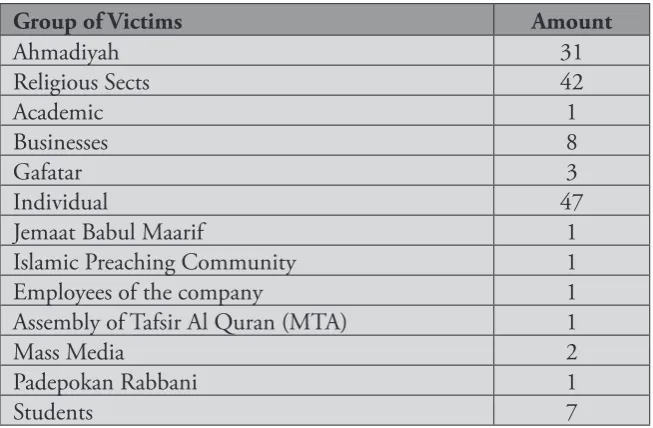
By using that indicator, the victims could be divided into 25 groups, plus 2 “groups” of victims which hard to be identiied its collective-ailiation and special social identity when the violation occurred; there is individual (for individual victim) and society (for more than one victims in every one action of similar violation). he group of victims which being the object of violation with highest amount are Christian (50 cases). he next victim with number of highest violation is individual object (47 cases), religious sects (42), Shia (34) and Ahmadiyah with 31 cases (see table 4).
minority in the country of Pancasila which “united in diversity”, still littered by constrain that inally put the majority as the ordinate and also potential ofender, whereas the minority become the subordinate of cum vulnerable victims.
However, the irrespective of number of mathematic problem, from the point of identity (especially socio-religious) the violation on freedom of religious/ belief could involves the followers of certain religion/belief. Almost all of worshipping place of religion has problems (see table 7). hose violations could alict the Christians, Moslem, Islamic preaching assembly, students, member of padepokan (small organization), and another. It shows that violation on freedom of religious/ belief could alict everyone. his portrait reconirms that violation on freedom of religious/ belief is a common enemy which can alict everyone in a country.
Consequently, in order to protect all of human being, the “presence”, real presence, and rigidity of state strongly needed to protect all of citizens from the ofender/violator.
Table 4
Group of Victims and Violations on them
Group of Victims Amount
Ahmadiyah 31
Religious Sects 42
Academic 1
Businesses 8
Gafatar 3
Individual 47
Jemaat Babul Maarif 1
Islamic Preaching Community 1
Employees of the company 1
Assembly of Tafsir Al Quran (MTA) 1
Mass Media 2
Padepokan Rabbani 1
Human Rights Activist 3
Pluralism Activist 4
Social Activist 2
Civil Oicial of Purbalingga District (PNS Pemkab
Purbalingga) 1
Islamic Boarding School 2
Student of Islamic Boarding School 1
Shia 34
Religion Leader 2
Buddhist 7
Hindu 1
Moslem 3
Confucians (Konghucu) 5
Christian 50
Residents 3
Total 264
Graphic 7
List of Afected Worshipping Place
3
25 1
1 2 1
5
0 5 10 15 20 25 30
Islamic Sects Christian Confusius Hinduism Budhism Shia Ahmadiyah
commits violation, and the victims. Since the irst time monitoring data was done in 2007 up to now shows escalation numbers. he rate of violation on freedom of religious/ belief could be in graphic 8. he violation which statically increased, describes of main situation; the failure of state’s politic to give guaranty and protection on freedom of religious/ belief as the protected and strengthened basic right in the constitution of the state.
he failure of state’s politic mainly occurred in 3 points: 1) failure of legislation system (as the joint authority between legislative and executive) in creating regulation which refers to and derived from guaranty of the 1945 Constitutional; 2) failure of regulation system to conform provisions of one regulation and others. And some of regulation that allowed by state to be not aligned are Law 1.PNPS/1965 and Law 39 of 1999: 3) political failure of state law to guarantee of all national regulations from central level up to smallest juridical unit of state must be in line and in same breath with the 1945 Constitution and other derived regulation which already conformed to guarantee the freedom of religious/ belief as the basic right of people and citizen.
Graphic 8
Incident and Violation Action in 6 years
hose negative situation conirmed by the product of discriminative regulation which still being maintenance, such as Law 1/PNPS/1965, Joint Decree of Minister of Religion and Minister of Internal Afair, and other discriminative local regulations. All of mentioned law products have been factually used as the legitimacy instruments for extreme Islamic organizations and people to do some violations.
hose failures and violations facts boils down to basic questions, what and where is the role of President as the head of government and also head of state? he whole portraits of research result and monitoring shows about the weakness of leadership of President Susilo Bambang Yudhoyono in realizing the constitutional guaranty of freedom of religious/ belief.
Mosque and house belong to Ahmadiyya followers broke by the citizen, Ciranjang Street Cisaat Village RT 01/08 Cipeuyeu Haurwangi District, Cianjur West Java, Friday, February 17th, 2012. (source: vivanews).
apparatus only. hat perspective is totally wrong in understanding the concept of human rights. As long his leadership period, the violation on fundamental right on freedom of religious/ belief has been violated.
Similar to the condition in 2011, the leadership of Susilo Bambang Yudhoyono seems to prefer in giving speech about tolerance than working seriously and measurably to build the tolerance by giving the guaranty of freedom to all of his people. Without guaranty of freedom, tolerance would be a speech of president and could not contribute anything for advancement of human rights. During 2012, not less than 15 times, Susilo Bambang Yudhoyono was giving message of tolerance in some events. It was less than 2011 where the President conveyed the message in 19 times.