O
ver the past 50 years, veterinary medicine has expanded from its roots in agriculture to make contributions in biomed-ical research, stem cell biology, gene therapy, vaccines, food safety, pet medications, the care of free-ranging wildlife in a host of different ecosys-tems, and many other activities that havebeneited from veterinary expertise. Now, the stressors of the 21st century—changes in food-animal production, soaring human populations, global warming, invasions of exotic species, and outbreaks of infectious disease—means the ield of veterinary science must evolve further to meet new goals for protecting animal and human health. However, the profession is facing a time of economic and other challenges.
For many years, the numbers of U.S. veteri -nary schools and students have been matched to U.S. needs, but in the last two decades, reports of dificulties in obtaining veterinary services have emerged from several sectors, including in rural food-animal production, biomedical science, private industry, and even companion animal practice. A mismatch between society’s needs and the available talent has begun to plague the veterinary medical workforce: some employers seeking veterinarians with advanced training cannot ind them, and other employers cannot provide salaries high enough to support
the basic veteri-nary expertise they need. Meanwhile, since the economic downturn that began in 2007, veterinary schools have lost tens of millions of dollars in public inancial support and have had to increase class sizes and the transfer of additional tuition costs to students. New veterinary school graduates are carrying educational debt that cannot be serviced practi-cally with the salaries that they can command.
These changes have brought the veterinary medical profession to a critical juncture. Academe is struggling to balance the multiple goals with limited resources. As a result, leaders in veterinary medicine have raised concerns about the health of the profession, the future of its graduates, and the strength of its schools and colleges.
Current Trends in the Veterinary
Medicine Workforce
Today, more than 50 percent of veterinarians are companion-animal practitioners—veterinarians who take care of pets—but projections about the future growth of companion-animal practice are uncertain. Some studies show that expenditures on pets are closely linked to household incomes, which although strained in the current economic The veterinary medical profession faces several challenges in coming years, including main-taining the economic sustainability of veterinary practice and education, building its scholarly foundation, and evolving to meet changing societal needs, this report inds. In recent years, the dominant focus of the profession has shifted from farm animal health to companion animal care, and concerns are growing that this emphasis is directing resources away from veterinary medicine’s other, equally important roles in basic research, public service, food production, and other sectors, resulting in a workforce that may be insuficient to address priorities for protecting and advancing animal and human health.
Workforce Needs in Veterinary Medicine
recession, are likely to rebound. However, the recent accreditation of additional schools outside the United States will increase the supply of companion-animal veterinarians and could place downward pressure on salaries if the demand for pet services does not increase over time.
Veterinarians in the companion-animal sector are increasingly pursuing specialized training in ields such as surgery, oncology, and orthopedic medicine, due to growing demand for specialized services, the potential for higher earnings, and intellectual interest in specialty ields. The requirements for specialty certiication are set by independent Boards, which often require faculty advisers and two to four years of training. However, most veterinary schools do not have additional manpower to support that training, so specialty training draws resources away from the central obligation of veterinary schools to educate entry-level Doctors of Veterinary Medicine (DVMs).
Furthermore, as veterinary school curricula have focused increasingly on companion animal care, subjects such as infectious diseases, public health, and environmental toxicology—which are important for careers in industry or public practice—have received less emphasis. The trend for a narrower spectrum of veterinary training threatens the profession’s ability to maintain robust research programs and develop high-quality scientiic investigators who can lead the cross-disciplinary and inter-professional studies that will advance basic veterinary knowledge in all sectors of the profession, including progress in companion-animal medicine. If veterinary colleges are to be successful in meeting all of society’s demands, they need a clearer picture of the demand for companion-animal services in particular, and to ind a way to support training in companion-animal specialties.
▪
Finding realistic strategies for meeting companion-animal veterinary medical workforce needs will require the collaboration of the Association of American Veterinary Medical Colleges, American Animal Hospital Association, and American Veterinary Medical Association. Building such a strategy requires reliable national data on consumer demand for companion-animal care, the economics of private practice, the role of veterinary technicians in extending companion-animal care, and the implications for the profession of growth inaccredited and non-accredited veterinary schools both inside and outside the United States.
▪
Addressing current concerns will require that veterinary academe increase its commitment to research, developing future faculty, and encour-aging current faculty to work across disciplinary and professional boundaries. The Association of American Veterinary Medical Colleges is well-positioned to take on this challenge.Supply and Demand in the Veterinary Medical
Workforce
The report’s authoring committee investigated the supply and demand of veterinarians in the various sectors of veterinary medicine. Although there are no widespread shortages of veterinarians overall, some sectors are struggling to ind enough well- qualiied candidates, even when offering high salaries. For example, the industrial sector is facing a shortage of candidates with advanced training in topics such as biochemistry, toxicology, or pathology; and veterinary colleges are in need of research faculty with the grant-writing skills to leverage funding for their programs. The committee concluded that opportunities for highly trained veterinarians in industry and research are growing, with a clear shortage in the supply of qualiied applicants to ill these jobs. These shortages could be addressed by mentoring veterinary students and inding support to train future veterinarians to meet the requirements for these positions.
In other sectors, for example veterinary practice in many rural areas, veterinary expertise salaries are too low to attract applicants despite needs. Here, appropri-ately-paid employment opportunities could be created by rethinking how veterinary services are provided. For example, a practice could employ several veteri-nary technicians under the supervision of one veterinarian to expand veterinary care (see Box 1).
The public sector has unilled positions for veteri-narians who have specialized training in epidemiology, food safety, wildlife and ecosystem health, and public health. Jobs in these ields typically offer salaries much lower than those in the private sector, and so cannot attract the top candidates. However, public-sector veterinarians are essential for maintaining the safety of foods of animal origin and controlling diseases of wildlife and livestock. An insuficient workforce of public-practice veterinarians places at risk the health of American citizens, the well-being of the nation’s food-animal industry, and the health of U.S. wildlife resources and the U.S. economy.
▪
The veterinary profession should formulate new ways of delivering cost- effective services to rural America, using veterinary tech nicians to extend animal health services to underserved areas.Public and Private Support for Veterinary
Education and Training
Since the economic downturn of 2007, there has been a precipitous decline in state support for faculty positions and tuition support in veterinary academe. This has resulted in reduced hiring, layoffs, and the elimination of whole programs from veterinary schools. As noted earlier, it is becoming increasingly dificult for veterinary schools to support the educa-tion of DVMs, let alone post-DVM specialty and graduate research training. Veterinary schools and colleges could share facilities and offer distance education and webinars to expand class offerings and reduce the cost of a veterinary education.
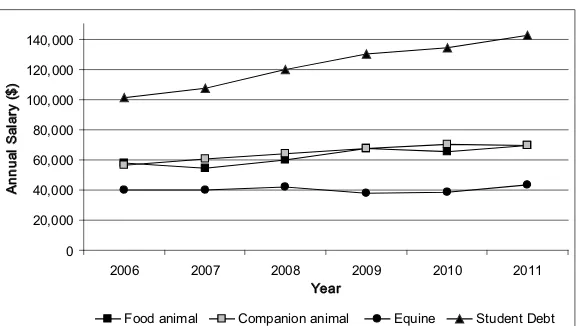
Tuition fees for veterinary education have risen sharply. Although starting salaries in private veteri -nary practice increased by 148 percent beyond inlation from 1987 to 2007, mean debt increased by 285 percent in the same period (see Figure 1), and the inancial return on investment in veterinary education is below that in other medical professions such as pharmacy, dentistry. This could lead to a decline in the quality of applicants to veterinary school. The veterinary medicine profession will need to convince the public of the value of funding veterinary medicine training in state and federal budgets, and could also look for alternative sources of revenue to support veterinary education.
▪
To stimulate the collective actions needed to ensure economic sustainability of veterinary colleges, practices, and students, professional veterinary organizations, academe, industry, and government▪
Industry veterinary workforce shortages can be addressed by deeper partnerships betweenacademe and industrial employers of veterinarians. Academe should more actively seek industry biomedical research partnerships, student mentoring, and opportunities in the curriculum to expose students to corporate practice.
▪
To meet the need for positions for veterinarians in public practice, the committee urges state and federal governments to re-examine their policies on remuneration, recruitment, and retention ofveterinarians.
Food-Animal Veterinary Care
Population growth and increasing consumption of animal products such as milk, meat, and eggs has changed food production in the United States —and has also altered demand for veterinary services in the care of livestock, poultry and swine. Overall, the number of livestock farms nationwide has decreased, and food-animal production has been consolidated to fewer but much larger farms. The role of
veterinary professionals in food-animal practice has changed from providing care to individual animals on small farms to main-taining the health of animal herds, overseeing environmental stewardship efforts, and increasing farm productivity and income.
▪
To increase the economic value of veteri-nary services to producers, the education of food-animal practitioners should be reoriented towards herd health andinter-ventions aimed at improving the inancial
health of the farm operation. Veterinary schools and colleges should work together to achieve this goal by creating centers of emphasis on food-animal medicine.
2006 2007 2008 2009 2010 2011
Year
Food animal Companion animal Equine Student Debt
Figure 1. Student debt and mean starting salary for new DVM graduates. Data Source: AVMA Market Statistics, 2006-2011 Box 1. Rethinking Veterinary Services in
Rural Areas
Committee to Assess the Current and Future Workforce Needs in Veterinary Medicine: Alan M. Kelly (Chair), University of Pennsylvania School of Veterinary Medicine, Philadelphia (Emeritus); Sheila W. Allen, University of Georgia, Athens; Val R. Beasley,
University of Illinois at Urbana-Champaign; Bonnie Buntain, University of Calgary Veterinary Medicine, Alberta, Canada; Henry E. Childers, Cranston Animal Hospital, Rhode Island; Gary Cockerell, Cockerell Alliances, Grand Junction, Colorado; Harold Davis, Amgen, Covington, Georgia (Retired); James G. Fox* (IOM), Massachusetts Institute of Technology; Malcolm Getz, Vanderbilt
University; Tracey S. McNamara, Western University of Health Sciences, Pomona, California; Gay Y. Miller, University of Illinois at Urbana-Champaign; Bennie I. Osburn, University of California, Davis; Mark V. Pauly (IOM), Wharton School of University of Pennsylvania; Fred W. Quimby, The Rockefeller University, New York (Retired); Willie M. Reed*, Purdue University; John A.
Shadduck†, Shadduck Consulting LLC, Denton, Texas; Michael A. Stoto‡, Georgetown University; Stephen F. Sutherland, Pizer
Animal Health, Kalamazoo, Michigan; Robin A. Schoen (Director, Board on Agriculture and Natural Resources—BANR), Peter Henderson (Director, Board on Higher Education and Workforce—BEHW), Jim Voytuk (Senior Program Oficer, BEHW), Camilla Yandoc Ables (Program Oficer, BANR), Peggy Tsai (Program Oficer, BANR), Janet M. Mulligan (Research Associate, BANR), Kara Murphy (Program Assistant, BEHW), National Research Council.
IOM – member, Institute of Medicine; *through February 2008; †through October 2007; ‡through March 2008
The National Academies appointed the above committee of experts to address the speciic task requested by the Association of American Veterinary Medical Colleges, American Veterinary Medical Association, American Animal Hospital Association, Bayer Animal Health, and Burroughs Welcome Fund. The members volunteered their time for this activity; their report is peer-reviewed and the inal product signed off by both the committee members and the National Academies. This report brief was prepared by the National Research Council based on the committee’s report.
For more information, contact the Board on Agriculture and Natural Resources at (202) 334-3062 or visit http://dels.nas.edu/banr. Copies of Workforce Needs in Veterinary Medicine are available from the National Academies Press, 500 Fifth Street, NW,
Washington, D.C. 20001; (800) 624-6242; www.nap.edu.
Permission granted to reproduce this brief in its entirety with no additions or alterations.
Permission for images/igures must be obtained from their original source.
© 2012 The National Academy of Sciences
Read or purchase this report and locate information on related reports at http://dels.nas.edu/banr
will need to work together with a sense of urgency. A national committee or consortium should be jointly supported to bring together initiatives that focus on the economic sustainability of the profession in all sectors of service, education, and research.
▪
As part of a comprehensive strategy to address the economic sustainability of the veterinary profes-sion, the working groups appointed by the consortium should create nationally shared curricula.▪
U.S. veterinary colleges should evaluate and implement alternative options for the delivery of veterinary education and research.One Health Initiative
Veterinarians are becoming increasingly involved in addressing issues of ecosystem and wildlife health, and this trend can be expected to continue to grow. The need for veterinarians to be involved in the challenge of global food security also is expanding. With global population rising and becoming more urban, demands for animal products such as meat, milk and eggs are growing rapidly, putting stress on agricultural systems and increasing populations of food animals. The veterinary profession can make systems more sustainable by making livestock and poultry production more eficient, preventing and
controlling outbreaks of infectious diseases, and developing ways to protect the environment by recycling waste.
One strategy to better understand and address health issues that affect humans, animals, and the environment is the concept of One Health, a holistic concept of health that recognizes the complex link-ages between humans, wild and domestic animals, and their ecosystems. This initiative that calls for the collaboration of multiple disciplines, including veterinarians, physicians, ecologists and conserva-tion biologists, on local, naconserva-tional and global scales.