STRATEGIC RESILIENCE
ASSESSMENT (STRESS) REPORT
Sichuan Province, China
BRUCE RAVESLOOOT, RANIYA SOBIR DECEMBER 2016
A
Table of Contents
Acronyms 3
List of Tables 3
List of Figures 3
Acknowledgements 4
Executive Summary 5
I. Introduction 9
A. Research purpose: understanding urban resilience 9
B. Research context: urbanization in Sichuan Province, China 10
II. STRESS Methodology 12
A. STRESS approach 12
B. Research framework 13
C. STRESS process 15
D. Primary data collection methods and target groups 16
E. Limitations 17
III. Main Research Findings 18
A. Development constraints in a peri-urban system 18
B. Shocks and stresses affecting migrants and MSBs 22
C. Impact of shocks and stresses 24
D. Resilience capacities 26
IV. Conclusions and Recommendations 30
A. Resilience pathways 30
B. Opportunities and challenges for Mercy Corps China 32
A
List of Tables
Table 1 List of Acronyms 3
Table 2 Research Methods and Target Groups 17
Table 3 Rural Migrants 30
Table 4 Micro and Small Businesses 31
List of Figures
Figure 1 Mercy Corps’ Resilience Framework 12
Figure 2 Economic Structure and Trends 23
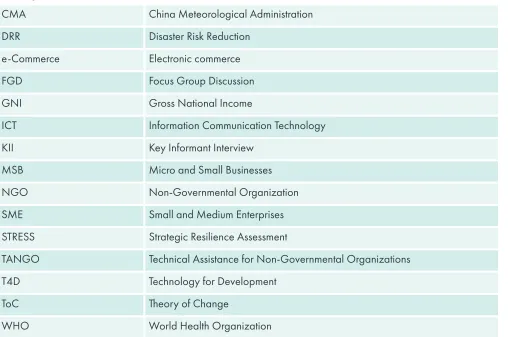
TABLE 1: LIST OF ACRONYMS
Acronym Definition
CMA China Meteorological Administration
DRR Disaster Risk Reduction
e-Commerce Electronic commerce
FGD Focus Group Discussion
GNI Gross National Income
ICT Information Communication Technology
KII Key Informant Interview
MSB Micro and Small Businesses
NGO Non-Governmental Organization
SME Small and Medium Enterprises
STRESS Strategic Resilience Assessment
TANGO Technical Assistance for Non-Governmental Organizations
T4D Technology for Development
ToC Theory of Change
A
Acknowledgements
TANGO International wishes to thank Mercy Corps for making the research a very constructive experience. This study owes enormous credit to the outstanding work of Mercy Corps China. The country office team contributed to the scoping of the research, directly engaged in literature review and successfully completed fieldwork, working through long days and unexpected challenges with continued patience. Special thanks also go to the program colleagues who coordinated the overall logistics for the research and for providing excellent support to the TANGO team during fieldwork as well as through the scoping and analyzing phase of the study. Additionally, TANGO is grateful for the technical and strategic oversight provided by the following Mercy Corps colleagues: Elena Buryan, Director of Programs, Mercy Corps China; Eric Vaughan, Senior Technical Advisor - Environment, Energy, and Climate; Olga Petryniak Director, Regional Resilience; and Arzu Culhaci, Regional Resilience Learning Officer.
Finally, we are indebted to the key informants who gave freely of their time and company to be interviewed by the research team, including representatives from Non-Governmental Organizations (NGOs), local government, public colleges, individuals and small businesses. Without their generosity and openness, this important research would not have been possible.
TANGO International
A
Executive Summary
In the past decade, China’s urbanization has been characterized by rapid economic and population growth. Of the total population, 70 to 75% will live in urban areas by 2050, contributing to 90% of the national economy.1 The scale
and pace of urbanization in China is unprecedented and changing the socio-economic landscape in both urban and rural areas. Added to this rapid pace and scale of urbanization, external factors such as natural disasters, climate stressors and economic transition create major imbalances to the urban transition process and contribute to negative consequences for population groups that are already disadvantaged in the urbanization process.
The purpose of this research is to guide Mercy Corps and other development practitioners to design resilience-focused strategies that can support programs within the emerging context of China’s rapid urbanization. The research specifically aims to understand the dynamic context of peri-urbanization in China due to its rapid growth and constant population inflows and outflows. Peri-urbanization refers to the dynamic process of physical and socio-economic change beyond the contiguously built-up areas of large cities.2 Peri-urban conditions exist in China in
two scenarios: (1) the build-up or expansion around urban centres or cities, and (2) in industrializing villages that are transitioning into towns although they are not part of a major city nexus. This process is also known as “urban-rural integration” (chengxiang yitihua).3 The Peri-urban context in this study refers to these two scenarios as the
issues and vulnerable groups analyzed are relevant to both. This paper focuses on peri-urban areas as they play a strategic role in livelihood patterns and risks facing migrants and Micro and Small Businesses (MSBs) and due to the residential function they serve for migrants. Similar to cities and municipalities, peri-urban areas also suffer from weak governance and limited resources to provide urban services to meet these demographic changes.
Sichuan province was selected as the target region for this research as this province has seen an acceleration of urbanization coupled with rapid economic growth in the recent decade. Economic growth has been driven by the government’s ‘Go West’ policy introduced in 2001, which promotes economic growth and poverty reduction in China’s underdeveloped Western regions. As a result, the urban population in Sichuan province reached 15.92 million in 2010.4 The province is also of interest to this research as the region is highly vulnerable to natural
hazards and climate risks including earthquakes.
The main target groups researched were migrants, referred to in this report as rural migrants, and MSBs. Rural migrants are defined as those who move from rural to urban areas in search of economic opportunities. They were selected as a target group as they make up a large proportion of the resident population in peri-urban areas and are disadvantaged due to their migrant status and low educational skills sets. By focusing on MSBs, this study also tries to get a better understanding of the economic and livelihood opportunities and risks in peri-urban areas given the evolving agriculture to non-agricultural transition and associated land use and to understand the inter-dependencies of these businesses and urban migration processes.
The research utilizes Mercy Corp’s Strategic Resilience Assessment (STRESS) methodology to build an
understanding of the dynamic social, ecological and economic systems in which communities are embedded. STRESS consists of four phases. The first phase, the scoping phase, aimed to develop the research questions and the research framework. This was completed through a literature review, a stakeholder workshop and an internal scoping workshop with the Mercy Corps China country team. The second phase, called the inform phase,
1. China Science Center of International Eurasian Academy of Sciences, China Association of Mayors and UN-HABITAT. 2012. The State of China’s Cities 2012/2013. Foreign Languages Press of China International Publishing Group.
2. Peri-Urbanization in Chengdu, Western China: From “Third Line” to Market Dynamics Douglas R. Webster, Jianming Cai, Larissa Muller, and Binyi Luo 2004. Asia-Pacific Research Center. Stanford University.
3. Daniel Abramson and Yu Qi. 2011. Urban rural integration’in the Earthquake Zone: Sichuan’s Post-Disaster Reconstruction and the Expansion of the Chengdu Metropole. Pacific Affairs: Volume 84, No. 3 September 2011.
A
involved data collection based on the research framework through an additional desk review, semi-structured Key Informant Interviews (KIIs) with institutional stakeholders, and structured Focus Group Discussions (FGDs) with target groups in Mianyang city, Sichuan province. Secondary and field data were consolidated and analyzed during the third or analyze phase. During the final phase, the strategizing phase, an internal Theory of Change (ToC) reflection workshop was held with the Mercy Corps country team to determine resilience pathways and key strategies for future programming.
The findings of the study highlight urban development constraints in peri-urban systems in China and indicate how shocks and stresses affect rural migrants and MSBs. The key development constraints in peri-urban areas show local governance challenges, such as lack of planning capacity and financial resources, to provide residential services in peri-urban areas including affordable housing and associated infrastructure (e.g. water supply, drainage and waste management) and social services. With regards to livelihoods and economic opportunities, the research indicates that the level of skills and education among rural migrants affects their ability to find work. This subjects them to low-wage employment in unsafe working environments and self-employment in informal and unstable conditions. Similarly, MSBs face risks of land eviction as most operate on and use available land for small business purposes without any legal protection. Their informal status and land restrictions prevent MSBs from accessing loans and business support functions from service providers. The shocks and stresses covered in this report show how livelihood risks can worsen for the target groups and result in income and market losses. Equally, the challenges of local governance can contribute to these shocks and stresses, as poor drainage systems or waste management capacity can worsen the effects of heavy rainfall or create conditions for disease. At the same time, the shocks and stresses strain the existing local government’s ability to provide urban services and extend additional protection for rural migrants and MSBs to mitigate the negative impacts of economic stresses or natural disasters.
Application of the STRESS process and a resilience lens focused on migrants and MSBs in peri-urban areas helped identify a key set of absorptive, adaptive and transformative capacities that would enable these actors to better deal with the combined impacts of shocks and stresses and the development challenges. The analysis conducted indicated which capacities currently exist among these groups and what gaps need to be addressed to build other key resilience strategies. Taking into account the scope within which Mercy Corps China can address these resilience-building strategies, the following interventions are recommended for programming:
A Explore additional research. The report highlighted various topics that were beyond the scope of this study. It is recommended that the following themes be explored further to better inform program design for rural migrants and MSBs:
– Conduct in-depth research and analysis on migration patterns of those that migrate with families and on how intra-family dynamics are affected by the development challenges and shocks and stresses in peri-urban areas. This research could provide a better understanding on social impacts of migration such as psychological impact on children, discouraged youth and gender dynamics.
– Assess disaster-based insurance products available in China and identify the barriers for MSBs to participate in such insurance schemes.
– Conduct a scoping of new value chain sectors for MSBs, particularly green industries such as renewable energy and recycling business opportunities.
A
employment information such as the community-based committees or neighborhood committees with employment monitoring systems and assist with job market assessments on a regular basis.
A Work with business development service providers to integrate business continuity planning for MSBs. Discussions on resilience capacities indicated the importance of having business continuity plans for MSBs to cope with various shocks and stressors. Mercy Corps currently works with NGOs that provide rural market development and micro-finance services. Mercy Corps can work with NGOs and other service providers that assist MSBs with business development services to incorporate business continuity planning.
A Engage with the private sector to tailor skills training that meet industry/economy’s needs.
One of the key capacities for migrant groups is the diversification of skills required to cater for the needs of employers in urban areas. Feedback from the private sector indicates that existing vocational training institutes and training programs in China do not cater to the needs of employers. Mercy Corps can facilitate a partnership between selected companies and vocational training institutes to conduct joint skills needs assessments in order to develop more tailored skills training programs for companies.
A Promote the role of local NGOs in public procurement. The report highlighted the potential role NGOs can play in improving urban governance and service provision in peri-urban areas. Strengthening the capacity of local NGOs is a strategic priority for Mercy Corps China and the Government of China has a policy to outsource community based service provision to NGOs. Mercy Corps can identify NGOs that are interested in participating in the public procurement process in peri-urban areas and provide any necessary training on leadership, management, or urban resilience topics as highlighted in this study.
A Promote accountability systems through local-level participation. The role of NGOs in local decision making with a view to improving accountability is a potential intervention area. Some NGOs interviewed for this study conduct public forums for local government budget reviews, where residents have the opportunity to submit proposals highlighting their priorities to the local government. However, this is mainly taking place in rural communities. Through a partnership with other NGOs, such feedback mechanisms can be further strengthened and scaled out to peri-urban areas.
A Promote the use of technology for timely information access. One of the key requirements for improving the adaptive capacity of migrants and MSBs is to improve information flows so that informed choices can be made towards adaptive strategies. The role of technology can be promoted to address this and to improve information access. Various software applications and tools exist, such as social media applications like WeChat, that can be enhanced to include real time market information for businesses and real time job information for migrants. Similar types of reporting can also help monitor stresses like migration trends, which can be used by local governments for planning and budgeting processes. These IT platforms can also enhance access to business development support for MSBs.
A
A
I. Introduction
A. Research purpose: understanding urban resilience
The concept of resilience is a growing theme in urban development, as it helps to factor uncertainties and risk and identify cross-sector capacities to achieve development goals. This research used a resilience framework to understand issues around urbanization and its implications for different urban population groups in China.
The purpose of this research is to guide Mercy Corps China and other development practitioners to design resilience-focused strategies for new programs and revitalize existing initiatives within the context of China’s rapid urbanization. Mercy Corps has been working in China since 2001. The organization is committed to improving economic access and growth for poor and vulnerable populations within China and beyond by leveraging technology and partnerships between government, businesses, and civil society. Mercy Corps’ investments currently focus on humanitarian response, post-emergency recovery, youth and women’s empowerment, agricultural market development, DRR and the strengthening Chinese civil society. Until recently, Mercy Corps China has focused on rural market resilience. Given the drastic urbanization scale and pace in China, Mercy Corps is increasingly looking at vulnerabilities among rural migrants who move to
urban areas mainly for employment opportunities as well as MSBs, as these groups may be particularly vulnerable to deepening poverty and inequality due to urbanization.
The specific research questions for this study, presented below, were determined by the Mercy Corps China team based on their capacity to address or advocate for urban resilience strategies, and were validated by TANGO and the Mercy Corps technical team.
Research questions:
1. How are rural migrants and MSBs affected by shocks and stresses facing the peri-urban systems?
2. What resilience capacities do rural migrants and MSBs have and what are their key gaps in dealing with shocks and stresses?
3. Based on vulnerabilities and capacities identified in questions (1) and (2), what are the options to strengthen resilience pathways for rural migrants and MSBs?
RESILIENCE
Mercy Corps defines resilience as ‘the capacity of communities in complex socio-ecological systems to learn, cope, adapt, and transform in the face of shocks and stresses.’
A
B. Research context: Urbanization
in Sichuan Province, China
In 2011, the urban population in China amounted to 690.79 million, which is more than half of the total population (51.27%).5 In the past decade, China’s
urbanization has been characterized by the fast acceleration of economic and population growth and is expected to represent 70 to 75 percent of the total population by 2050 accounting for 90% of the national economy.6 The ‘National New-type
Urbanization Plan (2014-2020)’ anticipates that 60 percent of China’s people will be living in cities by 2020.
While urbanization in China poses significant economic opportunities, the scale and pace of urbanization is also a stress factor, dramatically changing the socio-economic landscape in both urban and rural areas. These changes, combined with rapid economic growth, create major pressures on urban and rural services and the ecological systems, or natural environment. Effective urban governance strategies are needed to manage these transitions in people, infrastructure, businesses and the ecosystem. Emerging issues such as economic slowdown, climate change and natural disasters further add complexity to existing problems of sustainable urban development and management. These shocks and stresses also threaten to reverse existing urban development gains.
Urbanization in China takes place in three inter-related forms – urban population growth due to migration, land urbanization due to the development of land for urban use (such as real estate), and de-agriculturalization where agriculture work is converted to non-agricultural work. Population migration to cities includes the move to both nearby cities within the province and long-distance cities outside the
province. Pull factors for migration to urban areas include an increase in the rural-urban poverty gap, a decline in agricultural productivity affected by the smallholder land tenure system, climate and weather risks such as floods, drought and land overuse, increased economic opportunities in cities and relaxation of the “Hukou” residential registration system. Hukou is a household registration status introduced in 1958 that governs where a person lives and ties the types of benefits and social services to which a person entitles to the place s/he lives. The system is broadly categorized into rural Hukou status and urban Hukou status; a person with a rural Hukou can face restrictions in the types of public services and benefits that they are entitled to in an urban area and vice versa.
SICHUAN FACTS
Sichuan is located in West China and is the fifth largest province in the country with a governing area of 486,000 square kilometers. It has a diverse topography with plateaus and mountainous terrains and high altitudes (4000 metres above sea level) in the west and basins and hilly areas with low altitude in the east (1,000 to 3,000 metres above sea level). The three major parts of the province are the Sichuan Basin, the Sichuan Northwest Plateau and the Sichuan Southwest Mountains. The Gross National Income (GNI) per capita was 3,788 at Purchasing Power Parity (PPP$) rate in 2010 (national average is 5,311 PPP$).
5. China Science Center of International Eurasian Academy of Sciences, China Association of Mayors and UN-HABITAT. 2012. The State of China’s Cities 2012/2013. Foreign Languages Press of China International Publishing Group.
A
Within the overall urbanization landscape, peri-urban areas play a strategic role in the urbanization process, which is discussed in detail in the Section II.B. Peri-urbanization refers to the dynamic process of physical and socioeconomic changes beyond the contiguously built-up areas of large cities.7 Peri-urban conditions exist in
China in two scenarios: (1) the build-up or expansion around urban centres or cities, and (2) in industrializing villages that are transitioning to towns although they are not part of a major city nexus. This process is also known as “urban-rural integration” (chengxiang yitihua).8 The peri-urban context in this study refers to these two
scenarios as the issues and vulnerable groups analyzed are relevant to both.
Sichuan province was selected as the target region for this research as the province has seen an acceleration of urbanization coupled with rapid economic growth in the recent decade. Economic growth has been driven by the government’s ‘Go West’ policy introduced in 2001 to promote economic growth and poverty reduction in China’s underdeveloped Western regions. As a result, in 2010, the urban populationin Sichuan province reached 15.92 million.9 Sichuan province is also of interest to this research as the region is highly vulnerable to natural hazards
and climate risks including earthquakes (further details can be found in Section III.B below).
Chinese cities vary in population size, geography, strategic economic significance, and central government policy influence and as a result, the government does not have a standardized criterion for the classification of cities. In some reports and contexts, first-tier cities are the municipalities directly governed by the Chinese central government (for example, Beijing, Chongqing, Shanghai, and Tianjin). The second-tier cities consist of the capital cities of provinces. The rest are considered third tier cities. In Sichuan, under a new four-tier city system observed by the Sichuan Provincial government, Chengdu is recognized as a megacity; Mianyang, Panzhihua, Deyang, Zigong as large cities; Guangyuan, Suining, Dazhou as medium-sized cities and Guanghan, Jiangyou, Langzhong as small cities.10 The study focuses on peri-urban areas as detailed below in Section II.B Research
Framework and therefore targeted the peri-urban areas around Mianyang city for field research. Mianyang city was chosen as it is a medium sized city representative of the majority of cities in China and for strategic reasons due to Mercy Corp’s established contacts that have access to the research target groups in the peri-urban areas around the city.
7. Peri-Urbanization in Chengdu, Western China: From “Third Line” to Market Dynamics Douglas R. Webster, Jianming Cai, Larissa Muller, and Binyi Luo 2004. Asia-Pacific Research Center. Stanford University.
8. Daniel Abramson and Yu Qi. 2011. ‘Urban rural integration’ in the Earthquake Zone: Sichuan’s Post-Disaster Reconstruction and the Expansion of the Chengdu Metropole. Pacific Affairs: Volume 84, No. 3 September 2011
9. United Nations Development Program. 2013. China Human Development Report. 2013: Sustainable and Liveable Cities: Toward Ecological Urbanisation: English. China Transla-tion and Publishing CorporaTransla-tion. Beijing.
A
II. STRESS Methodology
A. STRESS approach
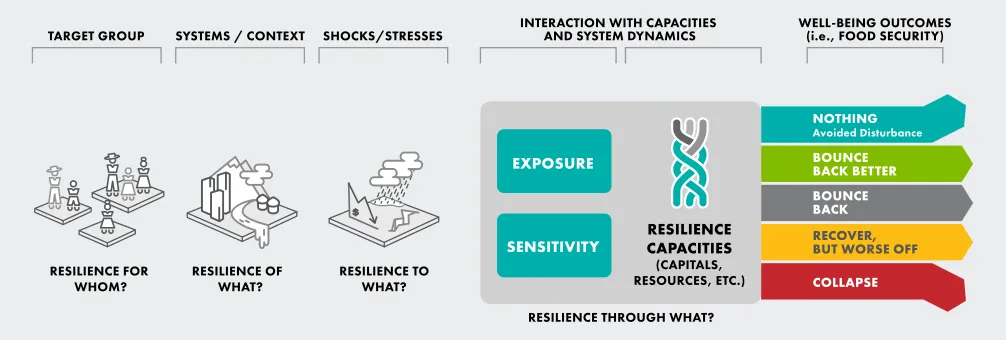
The Mercy Corps Resilience Framework in Figure 1 below forms the basis for the STRESS approach. The
framework helps to understand how the wellbeing outcomes of a target group are affected by the interaction of development constraints, shocks and stresses, and resilience capacities in a given context.
Figure 1: Mercy Corps’ Resilience Framework
The STRESS approach requires a detailed look at causes and effects and the interplay of various systems that affect development outcomes in a given context. Recognizing complexity, STRESS employs systems thinking to understand how disturbances and development constraints contribute to changes that affect development outcomes for people and communities.11 The process hones our ability to understand the individual parts of
a system, cause and effect relationships, and interconnectedness across scales and sectors. In addition, by providing us tools to ask “what if” questions about the future, systems analysis allows us to create interventions that proactively build the capacity of communities to deal with potential crises. Our ability to articulate these new approaches enhances development outcomes despite repeated exposure to shocks and stresses. The STRESS assessment is grounded in four guiding questions on resilience:
A Resilience of what? The context and boundaries of the assessment, including the target geography; the relevant elements of social, economic and ecological systems within that geography that relate to resilience.
A Resilience for whom? Vulnerability varies across geography and social groups such as gender, race, wealth group, ethnicity, and age.
A Resilience to what? The risk profile of the assessment area comprised of shocks and stresses that, collectively, threaten various population groups at multiple geographic and temporal scales and across social, economic and ecologic systems.
A Resilience through what? Access and use of capacities, including resources and livelihood strategies, that enable individuals, households, communities and systems to absorb and adapt to risks over
time. Underpinning these are transformative capacities—the governance processes, formal rules and regulations and informal norms, attitudes and perceptions that enable or unlock the full potential of RESILIENCE FOR
TARGET GROUP SYSTEMS / CONTEXT SHOCKS/STRESSES INTERACTION WITH CAPACITIES AND SYSTEM DYNAMICS WELL-BEING OUTCOMES(i.e., FOOD SECURITY)
NOTHING
A
absorptive and adaptive capacities. By mapping socio-ecological systems and the hazard environment, Mercy Corps can understand how different populations may be affected and what capacities they require to bounce back—and “bounce back better”—after a shock.
This STRESS approach, in particular the through what question, focuses on the need to address and strengthen resilience capacities that can generally serve three functions:
A Absorptive capacity – the ability to minimize exposure to shocks and stresses through preventative measures and appropriate coping strategies to avoid permanent, negative impacts;
A Adaptive capacity – the ability to make proactive and informed choices about alternative livelihood strategies based on an understanding of changing conditions;
A Transformative capacity – governance mechanisms, policies/regulations, infrastructure, community networks as well as formal and informal social protection mechanisms that constitute the enabling environment for systemic change.
B. Research framework
The research framework for this study was based on the four resilience questions. The pre-scoping workshop that was facilitated directly by Mercy Corps, the literature review conducted and facilitated by TANGO, and the deliberations during the scoping workshop facilitated by TANGO provided the following answers to the four resilience questions.
Resilience of what?
The peri-urban context was selected for the study for two main reasons. Peri-urban areas can help understand existing livelihood opportunities and risks facing migrants and small businesses and the interdependencies between these small businesses and migration processes. The peri-urban focus can highlight how migrants and small businesses access economic opportunities from within the peri-urban area and within the broader peri-urban nexus of larger cities and industrial sites within proximity. Secondly, compared to more central locations, peri-urban areas play an increasing residential function for migrants due to affordability of housing and other services. Secondary data indicates that urban peripheries house an estimated 80 million to 100 million people in informal settlements in China.12 The peri-urban focus helped to examine, in-depth, the issues around
urban service provision associated with this residential function. This includes the provision of services that range from housing, water, sanitation, drainage, waste management, schooling for migrant families, healthcare, etc.
The peri-urban context is also relevant to China’s urbanization strategy as part of the country’s Twelfth Five Year Plan, which aims to utilize large cities to drive the development of smaller cities and to promote the coordinated development of cities of all sizes.13 The government also has a policy to resettle populations and attract migration to smaller towns
with peri-urban characteristics. This was particularly evident in Sichuan province during the Wenchuan earthquake reconstruction process, where recovery was seen as an opportunity for urbanization of small towns and villages.
Resilience for whom?
The study targeted rural migrants (people from rural areas migrating to peri-urban areas) and MSBs. Migrants were selected as they make up a large proportion of the peri-urban population. Rural to urban migration is increasing at a fast pace. By the end of 2010,
12. The World Bank. China’s urbanization and land: a framework for reform. https://www.worldbank.org/content/dam/Worldbank/document/EAP/China/Urban-China-SRs4-7.pdf
A
rural migrant workers accounted for over half of urban employees working in the manufacturing, processing, excavation and service industry as well as in construction.14 Within the rural migrant population, the following
groups were identified as having vulnerable characteristics based on skill set, Hukou status, age, etc.
A Migrants who were previously farmers migrating to urban areas to work in the formal sector (manufacturing, construction etc.) or to engage in self-employment (as cleaners, waiters, garbage collectors, street vendors and other menial labor).
A Young migrants from rural areas who may have completed basic schooling but are not seeking higher education, do not have any farming skills, and are moving to urban areas for work.
A Farmers whose land may have been taken by the government for construction and other development purposes and are issued an urban residential status.
The research targeted MSBs as peri-urban areas have a range of small businesses that take advantage of migration trends and industrial growth around large cities. For example, rental businesses, workshops, and warehouses are intermingled with fields still used for agriculture, mostly for growing vegetables easy to market in the city nearby. These businesses operate in an informal nature and are of interest to this study as they highlight an increasing population of small-scale entrepreneurs who are vulnerable due to their informal status. Furthermore, the focus on MSBs brings to light their dependency on migration. Most of these MSBs cater to the migrant market and their survival depends on migration trends (e.g. real estate businesses, shops, catering), while migrants depend on them for basic supplies and services. Increased migration inflows will boost these businesses while any outflows will threaten their existence. Many of these MSBs are either owned by rural migrants themselves (such as restaurants and cleaning services) and or provide employment for rural migrants (e.g.. small-scale manufacturing workshops, shops, etc.).
Resilience to what?
The main shocks and stresses that are likely to affect the peri-urban system and the vulnerable groups identified above were identified as the following:
A Rapid increase in migrant population as well as fluctuations in migration trends – which will add pressure on existing infrastructure and labor market;
A General slowdown in the economy and restructuring - slowdown in manufacturing, construction sectors and emerging sectors such as e-commerce;
A Climate and disaster risks – which include earthquake hazards, landslides, flooding due to high intensity of rain and flash floods. Although less frequent now, climate change is likely to increase frequency of extreme weather events. In addition, climate change effects can be exacerbated by haphazard urban development patterns.
Resilience through what?
The scoping phase found limited information on existing resilience capacities of rural migrants and MSBs. Strengthening this understanding was therefore a main focus during the primary data collection. Preliminary information from the scoping phase indicated the following key research areas for the data collection:
A
A Absorptive capacities, such as access to early warning, emergency response, insurance and other coping strategies in the face of stresses discussed above;
A Adaptive capacities such as access to climate information, skills diversification and small business diversification;
A Transformative capacities such as land reforms, Hukou reforms, skills diversification policies, access to micro finance and business development services by small businesses.
C. Methodology: STRESS process
The STRESS process involves four phases, which were used to develop the information base to answer the three main research questions:
Phase One – Scope: The scoping phase aims to identify the development context of the research target area using the four guiding resilience questions. A pre-scoping workshop was held in April 2016 to identify key problems and vulnerabilities in the urban context in
China, which informed the Terms of Reference and the formulation of the specific research questions for the current study. Upon award of the research consultancy to TANGO International in June 2016, TANGO conducted a literature review15 and supported a guided desk review
of Chinese literature by Mercy Corps China staff to fill data gaps in the key topics of interest for the research.
As part of the scoping process, a stakeholder meeting was held in Chengdu, China on 13 July 2016 in
collaboration with the Institute for Disaster Management and Reconstruction of Sichuan University-Hong Kong Polytechnic University. The stakeholder meeting was attended by key researchers, experts on climate and disaster risks, and urban planning practitioners working with migrant populations in urban areas. The participants provided additional insights and inputs to the four research question areas and provided recommendations on the geographic targets for the assessment. An internal scoping workshop was organized from 14-15 July 2016, which focused on a preliminary systems analysis of the urbanization context in China to further reflect on and validate the for whom answer (migrants and MSBs in peri-urban areas) and develop a preliminary information base for the remaining three STRESS questions. Based on the results of the workshop, TANGO and Mercy Corps finalized the research framework and primary data collection methodology for this study. The research framework was initially centered around two research questions; (1) What are the key drivers of vulnerability for migrant populations and MSBs in peri-urban
Overview of the STRESS Process
The STRESS process employs systems thinking across four phases to identify the relevant context, hypothesize relationships between different elements of the system, and develop theories of change that foster improved capacity of people and communities to deal with shocks and stresses:
1. Scope: Build a contextual understanding of the system based on the four resilience questions and establishes the: 1) research focus based on knowledge gaps, and 2) key capacities for resilience identified in the systems mapping process.
2. Inform: Employ a mixed-methods approach to collecting the quantitative and qualitative information needed for an informed analysis.
3. Analyze: Evaluate and synthesize collected information.
4.Strategize: Develop a ToC, which includes the key elements required to build resilience.
ANALYZE STRATEGIZE
SCOPE INFORM
A
areas? (2) How are these vulnerabilities affected by the capacity of peri-urban systems to manage the rural to urban transition? Given that the analysis of rural to urban transition required a more in-depth of scope of study, the research focus was changed to assess urbanization issues specific to peri-urban areas. The reformulated research questions are presented in Section III of this report with the main research findings.
Phase Two – Inform: This phase focused on primary data collection, which was conducted by five program staff members from Mercy Corps China with some additional secondary data review of sources identified during the scoping workshop. For this study, primary data collection involved Key Informant Interviews (KIIs) with experts and key stakeholders and Focus Group Discussions (FGDs) with migrant populations and MSBs. TANGO International trained Mercy Corps China staff members on interview and data management techniques and research ethics. The research tools and interview techniques were tested in the target location before roll out. The data collected was organized using an excel-based top-line report template provided by TANGO International.
Phase Three – Analyze: In this phase, the information gathered was summarized and analyzed through an iterative process with the Mercy Corps team, which culminated in a reflection workshop facilitated by TANGO to validate the main research findings and finalize analysis themes. Following the workshop, the research findings and analysis were written-up and presented in Section III of this report.
Phase Four – Strategize: This phase included the development of key elements of a Theory of Change (ToC) framework which was consolidated in an internal reflection workshop with Mercy Corps China program staff. The structure and format for the design of the ToC framework was mainly guided by the Urban Resilience Measurement Training Curriculum developed by Mercy Corps as part of a USAID-funded Technical and Operational Performance Support (TOPS) grant. The ToC and strategic recommendations for Mercy Corps are presented in Section III.E and IV of this report.
D. Primary data collection methods and target groups
A
E. Limitations
The following factors limited the efficiency and effectiveness of the research activities:
A Research scope: Given that urbanization is a new and potential programming area for Mercy Corps China, the scope of the research was kept broad in terms of the overarching themes (governance, environment, livelihoods) within which urban challenges were analyzed. This limited full utilization of the systems perspective of the STRESS, which is where its main value lies, as the research scope was too broad to analyze systems, impact areas, and linkages in detail.
A Access to reliable information: Feedback from most academic researchers during the stakeholder meeting raised caution on the validity of information and statistics reported by the government on various issues. This resulted in unanticipated additional time to validate any facts that were reported or to find alternative sources.
A Access to information in English: Given that the majority of the literature is in Mandarin, more time than anticipated was taken for secondary data review, translation and analysis by Mercy Corps staff, which made it difficult to capture the full extent of the literature.
A Access to key informants: Access to institutional stakeholders, mainly government officials, is a challenge for research in China, particularly as this study is funded by an external organization. During the research, the target for local government interviews was not achieved. While the research intended to include local government officials involved in planning and urban development issues as key informants, most of the government officials interviewed were community-based officers, who represent the government and operate at a very grassroots level.
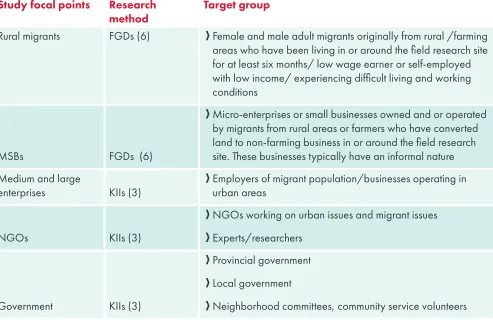
TABLE 2: RESEARCH METHODS AND TARGET GROUPS
Study focal points Research method
Target group
Rural migrants FGDs (6) AFemale and male adult migrants originally from rural /farming areas who have been living in or around the field research site for at least six months/ low wage earner or self-employed with low income/ experiencing difficult living and working conditions
MSBs FGDs (6)
AMicro-enterprises or small businesses owned and or operated by migrants from rural areas or farmers who have converted land to non-farming business in or around the field research site. These businesses typically have an informal nature
Medium and large
enterprises KIIs (3)
AEmployers of migrant population/businesses operating in urban areas
NGOs KIIs (3)
ANGOs working on urban issues and migrant issues
AExperts/researchers
Government KIIs (3)
AProvincial government
ALocal government
A
A Apprehensiveness to share information: During the study, a general apprehension to critically discuss issues and problems of interest to this research were observed across different stakeholders. This could not be mitigated within the tight research timeline. Some of the key informants participating in the study were reluctant to share information or discuss topics around government capacity or policies. Key informants from the private sector were unwilling to discuss topics on environment. Similarly, most of the migrants during the FGDs were not comfortable to disclose income levels and savings information.
III. Main Research Findings
This section describes the results of the literature review and field data collection. The findings for research question 1 are presented through three sub sections, with an integrated narrative covering both migrant populations
and MSBs (Sections III.A-C). The findings for research question 2 are presented in one sub section with a disaggregated description of the resilience capacities for migrant populations and MSBs (Section III.D). The subsequent section answers research question 3, where the findings from research question 1 and 2 are mapped to identify the domains and pathways of change for the ToC framework (Section III.E).
Research questions:
1. How are rural migrants and MSBs affected by shocks and stresses facing the peri-urban systems?
2. What existing resilience capacities do rural migrants and MSBs have and what are their key gaps in dealing with shocks and stresses?
3. Based on vulnerabilities and capacities identified in question (1) and (2), what are the options for resilience pathways for rural migrants and MSBs?
A. Development constraints in a peri-urban system
This section outlines the development constraints for rural migrants and MSBs in peri-urban areas. Development constraints are the conditions that determine the exposure and severity of shocks and stresses on people and communities. These were identified and consolidated through the literature review and the scoping workshop and were further validated during the fieldwork.
Labor supply and demand
A
Land and land tenure
The land tenure system and restrictions on the sale of land and land use by individuals or households in peri-urban areas is the main reason for the informal status of MSBs. This acts as a barrier to their growth and sustainability. According to China’s Constitution, there is no private ownership of land. It is owned either by the state or collectively by rural villages. Rural land is owned collectively by the village and is managed by the rural collective unit, which monitors the land use and in some cases retains the right to lease land for construction and development. Urban land, on the other hand, is owned by the state and in some cases the state expropriates land from the rural collective in order to lease the land for construction and urban use. Farmers or households in peri-urban areas have limited flexibility to convert farm plots for peri-urban use or non-agricultural work. However, given the demand for housing from those migrating from rural areas, farmers and families in peri-urban areas often convert land plots to residential space, run restaurants or open small-scale manufacturing workshops. Lack of legal protection of the land indicates the risk of eviction. Farmers often lose access to land when rural collectives or the state expropriates the land to lease it for urban development purposes. An estimated 53 million farmers have lost their land and farm-based livelihood in the process of urbanization over the past 20 years.16 Although
the government provides monetary compensation or alternative housing, this is not satisfactory for most farmers and the risk of eviction prevents them from investing strategically in their land for business growth and expansion.
Access to finance and business development support
MSBs face restrictions on accessing business development services and finance due to their informal status, which, in turn, undermines business stability and growth. This was confirmed during FGDs with MSBs in Mianyang, during which they indicated that such services were not available to them. Business development services include entrepreneurship-counselling, services that assist MSBs in business planning to support business expansion and to facilitate necessary paper work to access finance, services to support marketing and creative branding, and to identify and tap into formalized value chains such as contract based supplying. Access to finance, which includes availability of small-scale loans with terms and interest rates that are affordable for MSBs, are limited. Additionally, the lack of legal status of land for business use prevents MSBs from being able to use the land for collateral or to access loans.
Urban infrastructure and service delivery
Insufficient supply of low-cost affordable housing is a challenge for most migrant workers.17 Field work during
this study in Mianyang showed that migrants are occupying poor quality houses that were built in the 1960s without any sanitation facilities or water pipe systems. Almost half of the residents in this community were migrants who are taking advantage of cheaper rents, which costs around 2,300 Yuan a month (around 365 USD). Field observations also indicated poor waste management and unsanitary conditions in some of the localities visited. Due to the unplanned nature of these settlements, local governments do not collect property management and waste disposal fees and, as a result, these services were not available to the residents of these settlements.
Amongst the social service provision, quality of schooling was one of the key issues raised during the FGDs with migrants. The rural Hukou status of migrants, the household registration status which determines access to public services and benefits based on location of household registration, restricts migrants’ access to public schools in peri-urban areas, which has resulted in the development of ‘migrant schools’ that are privately run, lack legal status and are often under-resourced in terms of teachers and facilities. KIIs with NGOs working with such migrant schools in Mianyang indicated that at least half of the children are unlikely to pursue higher education due to a lack of interest and poor grades. This is associated with the quality of teachers and school facilities available to migrant children and due to the lack of parental guidance (as most parents work and commute for long hours).
16. Xu, X., S. Liu, X. Fan, Q. Li, Z. Wu, M. Tan, Y. Li, and J. Yang. 2013. “Study on Adhering To and Improving the Basic Operation System for Rural Areas.” Development Research Center of the State Council, Beijing.
A
Where migrants have access to public schools, it is determined by the neighborhood and, in general, the quality of public schools in migrant neighborhoods in peri-urban areas is low. This is due to the lack of local government investment in facilities and teachers in these areas. Access to good quality schools are competitive and require high fees at around 4000 Yuan (USD 600) per year, as quoted by FGD participants. Access to healthcare is partly determined by medical coverage in the urban areas while migrant workers are reported to be relying on informal channels such as pharmacies for medical advice.
Social insurance coverage has disadvantages for rural migrants engaged in informal employment and MSBs without a formal/legal status as the social insurance scheme is mainly based on a system of employer/employee and in some cases based on individual and state contributions. For example, in Mianyang city, 1.02 million people who have formal contracts with employers have paid pension insurance; 2.363 million people who are farmers, unemployed and workers without formal contracts are paying pension insurance by themselves.18 China’s
social security system has five types of insurance: medical insurance, pension, unemployment, work injury and maternal insurance. Except for medical insurance, all other insurance are arranged through employer/employee contributions and individual private purchase. The state and the individual have to cover medical insurance in the absence of an employer. Migrant workers who do not have a formal contract with an employer will have to pay for their social insurance contributions themselves and if they are not able to afford their share of the contributions, they opt to not participate in the scheme and are left without coverage. Similarly, MSBs with an informal status will not cover social insurance for their employees and owners of MSBs will have to obtain insurance on their own. Surveys show that the proportion of rural migrant workers participating in pension insurance, medical insurance, work-related injury insurance and unemployment insurance was 18.2 percent, 29.8 percent, 38.4 percent and 11.3 percent respectively.19
Local governance processes
The local government’s capacity in key processes – such as planning, budgeting, monitoring and coordination – affects urban service delivery for both migrants and MSBs. Compared to city governments, many local governments in peri-urban areas do not have the data and up-to-date tools to comprehensively plan for the diverse needs of migrant populations, test trade-offs in investments and project future urban growth trends for urban service delivery expansion.
The current performance incentives of local government officials are a barrier to the emerging and complex roles that these governments have to play in light of urbanization. The current performance evaluation system of local government officials, which influences local government decision-making processes, has a strong focus on economic growth compared to social development and environmental sustainability measures.20 This undermines
prioritization of investments in social and the environment sectors such as education, waste management and lowering pollution.
Moreover, the financial status of local governments further hinders investments in urban planning and service delivery. In China, the central government controls over 51 percent of the national fiscal revenues while covering less than 20 percent of the expenditures. In other words, local governments have to be responsible for over 80 percent of the fiscal expenditures with less than 50 percent of the revenue, despite some intergovernmental transfers from the central government.21 To bridge the gap, the local government relies on land transference
fees, which is the amount paid by land developers for leasing the land for commercial, industrial or residential purposes. Between 1999 and 2009, the proportion of local financial revenues from land transfer fees increased
18. Mianyang statistical yearbook 2013.
19. China Science Center of International Eurasian Academy of Sciences, China Association of Mayors and UN-HABITAT. 2012. The State of China’s Cities 2012/2013. Foreign Languages Press of China International Publishing Group.
20. United Nations Development Program. 2013. China Human Development Report. 2013: Sustainable and Liveable Cities: Toward Ecological Urbanisation: English. China Translation and Publishing Corporation. Beijing.
A
from 9 percent to 44 percent.22 Local governments also borrow against future land transfer revenues, which has
created a debt situation. This increasing practice of land financing as outlined above and debt levels discourage well-planned budgeting strategies for implementing urban development goals.23 The financial gains of land
development also undermines local government’s adherence to appropriate land use planning and zoning, taking into account disaster risks, natural resource and land conservation. The financial challenges of local governments hinder the implementation of Hukou reforms that are being advocated at the national level such as the 2006 policy framework to remove entitlement barriers for migrant workers in cities with respect to social services. Implementation of these reforms is challenging due to the costs associated with residentialization, i.e issuing an urban Hukou status to a migrant or increasing the eligibility for migrants to access social services and benefits in the urban or peri-urban area, irrespective of the Hukou status.24 The current cost for the residentialization of each
rural migrant worker is estimated at 80,000 Yuan (approximately 12,700 US dollars).25
Coordination and effective communication of decisions and information flow between local government bureaus is complex due to the multi-sector and multi-layer local governance system. KIIs with a migration coordination office led by Labor and Social Security Bureau of Fucheng District in Mianyang highlighted that for employment issues for instance, the office has to coordinate with a range of bureaus such as the civil affairs bureau, financial bureau, education bureau, agriculture bureau, poverty reduction office, women’s federation, and workers union etc. For the housing problems, the housing and construction bureau would lead while coordinating with the Development and Reform Council, financial bureau, tax bureau etc. The same complexity exists for disaster preparedness coordination and communication. Vertical coordination with higher-level city governments and provincial governments is also key for local governments to better understand the functions of the peri-urban system within the broader city nexus. For example, if city governments or provincial governments develop industrial zones/parks, the local governments within nearby peri-urban areas can develop residential and transport functions for those seeking employment in these areas.
Limited opportunities for civil society organizations and the public to participate in local decision making
The lack of participation and feedback platforms from the public and NGOs affects the local governments’ ability to understand the diverse needs of migrant populations and to receive feedback on existing service delivery and its quality. There are limited platforms for the public including migrants to discuss issues, self-organized public consultations or providing feedback on government interventions. The government has introduced community-based service systems where neighborhood or community community-based committees consisting mostly of volunteers operate common facilities and services.26 These services range from provision of employment information, social
security information, social services, living allowance, culture and recreation and social safety issues.27 This system
is still at a premature stage and FGDs with migrants indicated that they were not represented in these committees.
Lack of public participation restricts accountability, information disclosure on local government decisions and creates channels for misuse of funds. The limited feedback channels also prevent appropriate monitoring and
22. United Nations Development Program. 2013. China Human Development Report. 2013: Sustainable and Liveable Cities: Toward Ecological Urbanisation: English. China Translation and Publishing Corporation. Beijing.
23. Lim Ye and Alfred. M Wu. 2014. Urbanization, Land Development, and Land Financing: Evidence From Chinese Cities. Journal of Urban Affairs. Volume 36, Issue 1 -May 2014.
24. Hukou, is a household registration system which was divided into urban and rural categories in the 1950s, to control migration. Traditionally, the migrants from rural areas have restricted access to public services and public sector jobs due to the lack of urban Hukoa status. In the past two decades, this system is increasingly being relaxed, where rural migrants can access healthcare, schooling and social insurance in non-rural areas, irrespective of their Hukou status.
25. United Nations Development Program. 2013. China Human Development Report. 2013: Sustainable and Liveable Cities: Toward Ecological Urbanisation: English. China Translation and Publishing Corporation. Beijing.
26. Community service system refers to the service network and operation mechanism with government direction and support and social participation by regarding urban and rural community as the basic unit, depending on various types of community service facilities, serving for all residents and units in the community, focusing on public service, voluntary mutual aid service and convenient service to the people, aiming for satisfying the requirements of community residents for living and production and improving their living quality.
A
enforcement of environmental laws. KIIs with an NGO in Mianyang indicated a case where the NGO alerted the local environment bureau in Mianyang of river pollutions levels that did not meet minimum standards for water supply use. The bureau shared some test results with the NGO confirming that river water supply safety standards were met, but the NGO was concerned that there was no way of verifying these results shared by the bureau.
On the engagement of civil society, although the government recognizes the efficiency gains from engaging with NGOs, to provide localized urban services, as evidenced in the public procurement policy, this bottlenecks the implementation of such a strategy.28 KIIs with NGOs in a Mianyang indicated that reforms are needed to ease NGO
registration and operation. The majority of NGOs in Mianyang are active only in DRR awareness raising after the recent earthquake response experiences and selected NGOs work with migrant groups. The key informants for this study were not aware of any NGOs currently taking part in the public procurement processes in the area.
B. Shocks and stresses affecting migrants and MSBs
The following shocks and stresses are creating varied disturbances to the peri-urban system.29 The impact of these
shocks and stresses on the target groups are further analyzed in the next section.
Demographic fluctuations due to migration
Peri-urban areas experience unanticipated and often unplanned levels of migrant inflows. At the same time, similar outflow trends have resulted in what is often termed as ‘hollowed out villages’ or ‘ghost towns’. This is due to the high mobility of migrants. The demographic fluctuations are considered as a higher-level disturbance to the peri-urban system, given the pressure on residential demands and the dependence of peri-urban economies on the presence of migrants. The unplanned nature of migration inflows and outflows affects the availability of markets and labour for MSBs.
Migration trends are mainly determined by economic opportunities and in the case of China, mobility among migrants is high. The UN Habitat’s State of China’s Cities 2012/2013 report indicates that the average
employment time in the current inflow cities was 5.3 years.30 This indicates that migrants retain their temporary/
migrant status and do not settle in the cities they work in. High mobility exists among migrants because of the informal nature of employment and businesses they occupy and due to lack of opportunities for residentialization through the Hukou system, where migrants transfer their rural Hukou to an urban Hukou and they become
registered residents of a city or town, often giving up their rural home/land.
Economic slowdown and restructuring
Economic slowdown affects the availability of jobs for rural migrants and markets for MSBs. The current economic slowdown and market changes in China are associated with the restructuring and upgrading of the Chinese economy. The Central Economic Work Conference, which sets out the government’s agenda for economic development, anticipates a temporary negative impact on China’s economic growth due to restructuring and that as a result, GDP growth is expected to be lower.31 The government anticipates that the economic restructuring will
involve the Chinese economy being increasingly driven by technology-based goods and services and the expansion of the service sector. Electronic-Commerce (e-Commerce) is also an emerging trend. According to the China Online Shopping Market Research Report in 2012, by the end of 2012, the transaction value of China’s online shopping market reached 1,259.4 billion Yuan and the number of online shoppers reached 242 million persons.32
28. The government has an overall policy on public procurement whereby service provision can be outsourced to NGOs. 29. These shocks and stresses were identified in the scoping workshop and were further validated during the field work.
30. China Science Center of International Eurasian Academy of Sciences, China Association of Mayors and UN-HABITAT. 2012. The State of China’s Cities 2012/2013. Foreign Languages Press of China International Publishing Group.
31. KPMG. 2015. China Economic Outlook.
A
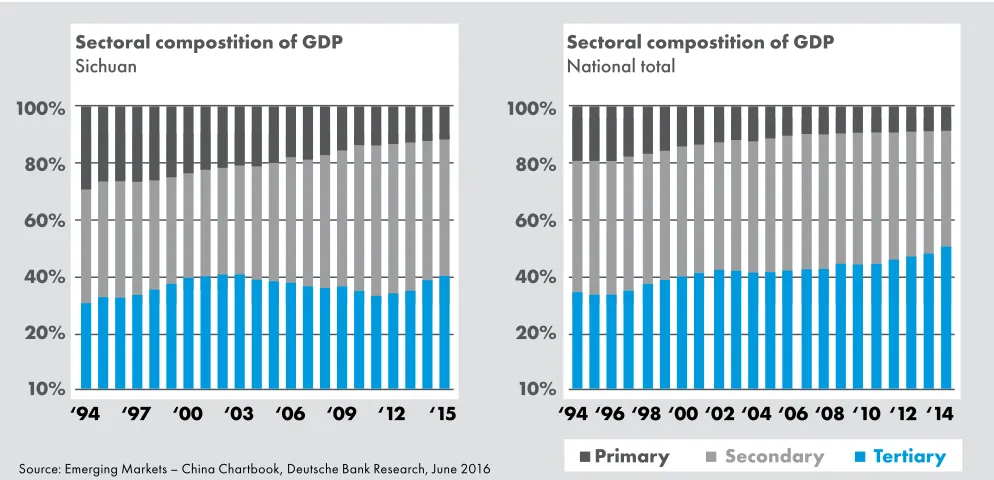
Figure 2 below indicates these trends, where the role of the primary sector (such as farming or mining) in the economy is diminishing. At the national level, the tertiary sector, which includes the service sector, is steadily increasing while the share of the secondary sector, mainly labor intensive sectors such as manufacturing and construction activities, are seeing a slowdown. In Sichuan, the service sector growth is more prominent in the last few years and the share of the secondary sector was seeing a decline from mid-2000s until the last few years where there is growth. This may be associated with the expansion of construction sector for post-earthquake recovery and economic stimulus schemes in the 2008 financial crisis context. These schemes included post-recovery work and are now phasing out in Sichuan province, which makes the economic outlook less positive.
Figure 2 Economic structure and trends
Climate and natural disaster risks
Natural hazards and climate change have adverse impacts on rural migrants. Migrant populations are likely to be most vulnerable to disaster events given the poor working and housing conditions and lack of social security and support networks in the cities.
Sichuan Province, specifically Southern Sichuan, is prone to geological hazards. Recent events include the 2008 Sichuan Earthquake, which measured 8.0 on the Richter scale and the Ya’an earthquake in 2013 measuring 7.0 on the Richter scale. The 2008 Sichuan earthquake resulted in 90,000 dead or missing and 4 million people affected. Sichuan province also faces high risks of floods as there are four rivers in the province (Jaling Jiang, Tuo Jiang, Yalong Jiang, and Jinsha Jiang). Floods are caused by high intensity of precipitation, which is associated with climate change, and are easily exacerbated by the decrease in permeable surfaces in urban areas, inadequate drainage and uncoordinated infrastructure development. Heavy rainstorms in June 2013 led to major floods which affected 3.44 million throughout the 21 prefectures in Sichuan.33 Other climate stresses in
Sichuan include heat strokes in the summer, drought and extreme winters. Mianyang city, where field work was undertaken, is vulnerable to floods due to nearby rivers.
33. Kaubin Wosti Neupane, Lara Rubinyi, Thirunavukkarasu Sivappha, Yimin Wang (2016) Climate Migrants and Urban Adaptation in India and China Prepared for University of Notre Dame Global Adaptation Index (ND-GAIN).
toral compostition of GDP
National total
Sectoral compostition of GDP
Sichuan
100% 80% 60% 40% 20% 10%
‘94
Primary Secondary Tertiary
‘94 ‘96 ‘98 ‘00 ‘02 ‘04 ‘06 ‘08 ‘10 ‘12 ‘14 ‘97 ‘00 ‘03 ‘06 ‘09 ‘12 ‘15
100% 80% 60% 40% 20% 10%
A
Interlinked stresses
Economic stresses, climate risks and disaster events further reinforce migration patterns and fluctuations. Given that migration decisions are primarily determined by economic opportunities, the current employment uncertainty and decline in availability of work in the construction and manufacturing sectors is likely to affect migration trends, making urban migration patterns less predictable. Similarly, climate stresses such as drought encourage rural populations to move to the cities. FGD participants for this study consistently stated drought as a major contributing factor to the decline of agricultural productivity, which affects migration from rural to urban areas.
Disaster events add to the migration stress. In Sichuan province, the majority of migrants have moved long-distances; out of the province to coastal cities. As a result, the number of permanent residents declined from 82.1 million in 2005 to 80.8 million in 2012.34 Following the 2008 earthquake, however, many residents returned to
Sichuan province from coastal areas to engage in the post-earthquake recovery and reconstruction and to be with their families, which led to an increase in the resident population of 0.5 million over the previous year.35
C. Impacts of shocks and stresses
This section will examine how migrants and MSBs are affected by the interface of shocks and stresses and existing development constraints in peri-urban contexts.
Loss of income and limited prospects for employment and business growth
The shocks and stresses outlined above exacerbated by the development constraints outlined in section III.A result in livelihood challenges for migrants and MSBs in the following ways:
A Decline in job availability or loss of jobs for migrant workers – Because migrant employment opportunities are largely derived from labor-intensive sectors, such as manufacturing and construction, the slowdown in these sectors has significantly impacted their employment prospects. FGD feedback with migrant workers, particularly construction workers, noted the decline in availability of work in Mianyang area. The latter is also associated with the phasing out of earthquake reconstruction work in Sichuan province. As a result, migrant workers experience loss of incomes or reduced incomes and unstable incomes in cases where they are involved in day jobs or informal work. Many have migrated to other provinces or cities to find work or returned to rural areas to engage in seasonal farming. Climate and disaster events such as earthquake and floods also lead to job losses. Migrants often lose their livelihood or employment in the aftermath of a natural disaster, as they choose to temporarily return to their
hometown to be with their families.
A Widening skills gap for migrant workers – The issue of skills gap is a permanent and critical problem for unskilled migrant workers at a time when the economy is transitioning to high value
manufacturing, technology and service sectors as highlighted in Figure 2. KIIs with researchers indicated that service sectors such as hospitality could absorb a proportion of migrant workers with some level of a skills upgrade. This is a possible option for younger migrants given that returning to rural areas is not an option for them due to their inexperience and lack of interest in farming. Skills upgrade or alternative employment prospects will be a major challenge for migrant workers who are in the higher age groups.
A Decline in markets for MSBs – Feedback from FGDs with migrants engaging in micro-enterprises or self-employment indicates a decline in demand for the goods they sell such as food items. This decline is
34. Li Zhang. 2013. Increasing Cities and Shrinking Regions (Increasing Cities and Shrinking Regions: Migration in China’s Urbanization-Cases from Sichuan and Henan Prov-inces), China’s Academy of Urban Planning & Design, China.
A
partly due to the overall slump in consumer demand, which is evident by the low inflation rate recorded at 1.9 percent as of June 2016.36 Feedback from FGDs with small businesses indicated that the latter is
associated with growing e-Commerce trends. The economic down turn is particularly affecting small-scale manufacturing businesses and workshops in peri-urban areas. KIIs indicated the case of Pixian in Sichuan province, which is now referred to as a ghost town as small manufacturing workshops were shut down. These small business owners and their workers either returned to their rural homes to engage in farming or combine seasonal farming with informal day wage work in urban areas, or they migrated to larger cities to find work. The economic stresses combined with unpredictability of migration patterns is affecting MSBs engaged in real estate and rental businesses in peri-urban areas. During FGDs in Mianyang, MSBs reported loss of rental earnings due to decline in demand for housing in the area.
Ability to improve urban services and disaster protection constrained
Given the high concentration of migrant populations choosing to live in peri-urban areas, provision of housing and associated services such as utilities, waste management and schooling is a challenge. Similarly, the support infrastructure such as roads, transport mechanisms and access to markets are critical for MSBs in these areas. The shocks and stresses identified in this study affect delivery of these services in the following ways:
A Weakened local governance processes to expand or sustain services - The unpredictable migration patterns affect local government’s ability to plan and implement service delivery to
accommodate migrant populations. A KII with a local government official indicated that in his district, some schools have classrooms with up to 60 pupils due to the migrant influx. The economic restructuring is likely to affect the local government’s financial status. Due to slow economic growth and to stimulate the service sector in the current economic transition stage, tax breaks were given in the service sector, which meant that local government tax revenues would fall and could worsen the local government debt burden.37 Lack of consultative and participatory mechanisms also adds to this complexity in planning,
as these mechanisms are key to understanding how vulnerable groups are affected in the context of emerging migration, climate and economic stresses.
A Increased potential for ecological and health risks - Increased migration flows and population growth is likely to push local governments to further compromise land use and zoning for prospective real estate demand. Economic stresses are likely to affect local government financial status as well as profitability of large businesses. As part of cost reduction, businesses and local governments may not operate waste treatment facilities. This can further worsen pollution and health risks for urban populations, particularly migrant workers. Two hundred million more urban residents were exposed to high air
pollution levels in 2010 compared with the beginning of the decade. Estimated annual premature mortality from air pollution in Chinese cities increased from 418,000 to 514,000 between 2001 and 2010 despite a 25 percent reduction in average PM10.38
A Asset losses from increased disaster exposure - Migrants in general occupy low quality housing which is situated in areas more exposed to natural hazards such as floods and earthquakes. MSBs in peri-urban areas, particularly real estate businesses and small-scale manufacturing workshops, are operated in low quality infrastructure or housing structures. KIIs with local government officials indicated that for some districts within Mianyang, the housing occupied by migrants were built by the residents themselves and, as a result, lack appropriate integration to city sewage and drainage systems, and do not adhere to appropriate building codes and earthquake/flood resistant construction standards.
36. Emerging Markets – China Chartbook, Deutsche Bank Research, June 2016. 37, Ibid.