Fifie Nurofia, Debbie Rachmiati
Faculty of Psychology, Maranatha Christian University, Bandung, Indonesia
E-mail: [email protected], [email protected]
RESILIENCE ON HELPER (GURU
PENDAMPING) FOR SPECIAL NEED
STUDENTS AT ELEMENTARY SCHOOL
• No child wants to be borne with ‗special needs‘
No parents want their child to have ‗special needs‘ Special needs children need to be educated in
academic achievement and self caring as well
Teachers for these special needs children or students need HELPERS to keep education sessions effective
Helpers duties are calm downing these special
needs students while they are in an unpredictable tantrum as they having lessons at class; and
nurturing student‘s progress in academic
HELPERS
PROBLEMS AT WORK :
• STAY INVOLVED
• KEEP
SUPPORTING THE STUDENTS TO GIVE POSITIVE INFLUENCE
• VIEW PROBLEMS AS CHALLENGE TO WIN
THEORETICAL
FRAMEWORK
Maddi, Salvatore R.,
&
Helper‘s stressors: • Hazardous situation as tantrum behavior emerge
• Expectation of improvement of the students
• Transformational coping skill
• Social support skill
Hardiness motivation
& courage low
•
Descriptive
→ su vey te h i ue
• Questio ai e → self ad i iste ed
questionnaire consist of 63 valid items to 26
helpers as respondents
• Validity test → .4 6 –
0.842
• Relia ility test → .
• A alyzi g data → f e ue y dist i utio ,
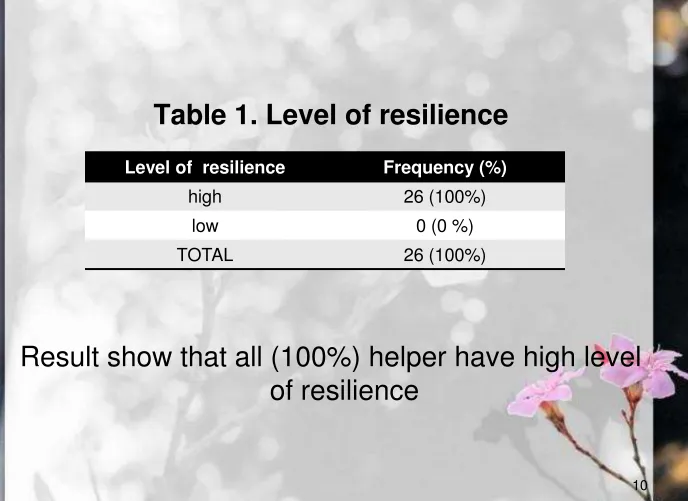
Table 1. Level of resilience
Result show that all (100%) helper have high level
of resilience
Level of resilience Frequency (%)
high 26 (100%)
low 0 (0 %)
Level of resilience
Frequency (%)
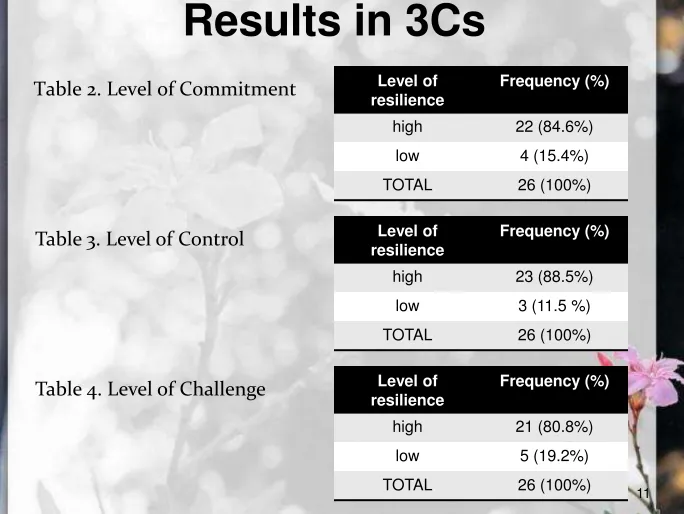
Results in 3Cs
Table 2. Level of Commitment Level of
resilience
Frequency (%)
high 22 (84.6%) low 4 (15.4%) TOTAL 26 (100%)
Table 3. Level of Control Level of
resilience
Frequency (%)
high 23 (88.5%) low 3 (11.5 %) TOTAL 26 (100%)
Cross tabulation
commitment
Total Low High
resilience Low 0 0 0
high 4 22 26
Total 4 22 26
control
Total Low High
resilience Low 0 0 0
high 3 23 26
Total 3 23 26
challenge
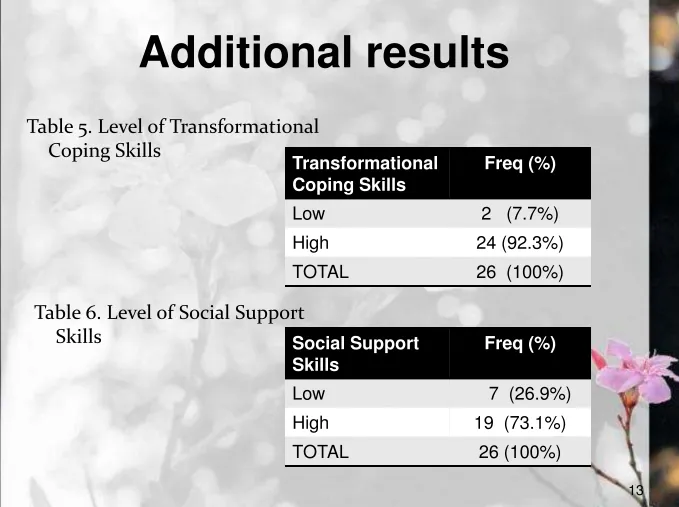
Social Support Skills
Freq (%)
Low 7 (26.9%)
Additional results
Table 5. Level of Transformational Coping Skills
• Level resilience in 3Cs – Commitment, Control & Challenge are all mostly high
• Aspects Control are mostly used by helper (88.5%), they firstly need to put efforts to give positive influences toward the problem that they faced. They attempt to
control the situations and there fore they can predict the consequences of each alternative reasons. The clearer the stress-situation the easier they cope with that stress.
• As they (Helpers) take control of the stress-situations, they keep facing their problems, with all attentions, thoughts and efforts (Commitment 84.6%)
• As an accordance to theoretical framework that 3C‘s
attitudes grows two kinds of skills for coping
problems—transformational coping skills and social support skills.
• Additional results showed that almost all helpers
(92.3%) develop more transformational coping skills than social support skills (73.1%). They broad their
views‘ perspectives so that stress can be seen from
different point of views. Social support skills improving social relations through listen &