L
Journal of Experimental Marine Biology and Ecology 243 (2000) 283–293
www.elsevier.nl / locate / jembe
Dynamics of dimethylsulfoniopropionate (DMSP) in a
migratory grazer: a laboratory simulation study
* Kam W. Tang
Department of Marine Sciences, University of Connecticut, Groton, CT 06340, USA
Received 29 January 1999; received in revised form 4 August 1999; accepted 5 August 1999
Abstract
Laboratory experiments were conducted to simulate an environment in which the copepod Acartia tonsa (Dana) migrates between food-abundant, low salinity water and food-limiting, high salinity water. The goal of this study is to understand how migratory grazers influence the dynamics of dimethylsulfoniopropionate (DMSP) in a vertically stratified water column. Results show that the DMSP content of A. tonsa was determined mostly by food availability instead of salinity. Individual copepods accumulated DMSP in their bodies during feeding, but most of the ingested DMSP was not retained in their body tissues. The percentage of ingested DMSP not incorporated into body tissues is estimated to range from 88 to 100%; hence, the percentage of ingested DMSP transported to deep waters by actively migrating copepods is estimated to be less than 10%. Therefore, it is suggested that grazers like A. tonsa help mediate the downward flux of DMSP by producing fast sinking fecal pellets when they are feeding in the surface waters. 2000 Elsevier Science B.V. All rights reserved.
Keywords: Acartia tonsa; DMSP; Estuary; Flux; Migration; Sulfur chemistry
1. Introduction
In recent decades there has been a growing interest in understanding the global dynamics of the sulfur compound dimethylsulfoniopropionate (DMSP) (e.g., Charlson et al., 1987; Andreae, 1990). DMSP is a precursor of dimethyl sulfide (DMS), a major candidate for sea–air sulfur exchange (Lovelock et al., 1972; Nguyen et al., 1978, 1983; Andreae and Raemdonck, 1983) and an agent for the formation of cloud condensation nuclei and acid rain (Andreae, 1990). The marine environment is a major source of
*Tel.: 11-860-405-9097; fax:11-860-405-9153.
E-mail address: [email protected] (K.W. Tang)
DMSP because DMSP is synthesized by many marine phytoplankton species as an osmolyte (Keller and Korjeff-Bellows, 1996; Kirst, 1996). Therefore, the dynamics of DMSP in the ocean will have an important influence on the global DMS production. The role of planktonic grazers in DMSP dynamics has begun to receive attention in recent years. For example, Dacey and Wakeham (1986) suggested that copepods release DMSP from phytoplankton cells through sloppy feeding. Grazer-mediated vertical flux of DMSP has also been discussed (Daly and DiTullio, 1996; Kwint et al., 1996). Tang et al. (1999) reported the presence of DMSP in five species of estuarine copepods after gut clearance, which may account for a substantial portion of particulate DMSP in the water column. These authors also showed that the body DMSP content of the copepod Temora
longicornis was determined by supply (food type, food concentration) and demand
(external salinity) of DMSP. T. longicornis is thus able to adjust its body content of DMSP in response to fluctuations in external salinity — the copepod reduces its body DMSP content when salinity decreases and vice versa (Tang et al., 1999). Many planktonic grazers are known to perform diel vertical migrations (Pearre, 1979; Lampert, 1989). In a vertically stratified water column, such as the case of an estuary, phytoplankton is concentrated in the upper layer of lower salinity while the deeper, more saline layer contains less food. As a result, vertically migrating grazers will experience an uncoupling of supply and demand of DMSP: supply of DMSP is mostly limited to the upper, food-abundant layer where the need for DMSP is less due to the lower salinity. On the other hand, demand for DMSP for osmoregulation will be higher when the grazers return to the more saline, food-limiting deeper layer.
Migratory grazers can facilitate material fluxes in the water column by two processes: the ‘Archimedian pump’, which is the sinking of fecal matter produced by the grazers in the surface layer, and the ‘reciprocating pump’, which is the process achieved when the grazers migrate to the deep layer and release materials from their bodies (Longhurst, 1991). The ‘reciprocating pump’ has been shown to be an important mechanism for driving the downward flux of carbon and nitrogen in various oceanic settings and is, at times, comparable in magnitude to the ‘Archimedian pump’ (Longhurst and Harrison, 1988; Longhurst et al., 1989, 1990; Dam et al., 1995; Le Borgne and Rodier, 1997).
Acartia tonsa (Dana) (Calanoida: Copepoda) is a ubiquitous copepod species
commonly found in temperate estuaries and is known to perform diel vertical migration (e.g., Stearns and Forward, 1984; Cervetto et al., 1995; DeMeester and Vyverman, 1997). In the present study, I simulated in laboratory experiments an environment in which the copepod A. tonsa switches between a food-rich, low salinity medium and a food-limiting, high salinity medium. The goal of this study is two-fold: (1) to understand how the DMSP content of grazers could respond to fluctuations in salinity and food supply as the animals migrate in a stratified water column; and (2) to estimate the relative importance of the ‘Archimedian pump’ and the ‘reciprocating pump’ of migratory grazers in driving the downward flux of DMSP in the water column.
2. Material and methods
by towing near the surface a 0.5 m standard ring net equipped with a 200mm mesh and a solid cod end. Upon return to the laboratory, individuals of mature female A. tonsa with intact appendages were sorted out and maintained in natural surface seawater at the experimental temperature (2060.58C). This temperature was used throughout the study. The prasinophyte Tetraselmis impellucida (McLachlan et Parke) PLY429 was used as food for the experiments. The alga was grown in f / 2 medium of salinity 20 and 30‰ at a light–dark cycle of 12 h:12 h. Fresh f / 2 media of the appropriate salinities were added regularly to maintain the alga in active growth. Before experiments, aliquots of the algal cultures were diluted with 0.2 mm-filtered (Vacucap) Instant Ocean artificial seawater (FSW) of the same salinity to make up the desired food concentrations.
2.1. Migration simulation experiment
Individuals of A. tonsa were sorted into four 2 l polycarbonate bottles of 30‰ and two 2 l bottles of 20‰ FSW without food (60 copepods per bottle). All bottles were kept in the dark. After 12 h, copepods from the 30‰ bottles were pooled. Triplicate samples of five individuals were taken for measurements of initial DMSP content. The remaining copepods were split into groups A and B. Copepods from the 20‰ bottles were pooled and triplicate samples of five individuals were taken for measurements of initial DMSP content. The remaining copepods from the 20‰ bottles were designated as group C. The three groups of copepods were used as described as follows.
Group A. Copepods were divided into six beakers of 500 ml, each containing 20‰
21
FSW and approx. 1000 cells ml of T. impellucida. Aliquots of the food medium were taken for cell counts and DMSP measurements. The beakers were kept in the dark and were stirred manually every hour. After 12 h, aliquots were taken from each beaker for final food concentration measurements. Copepods from one of the beakers were sacrificed for DMSP measurements. Copepods from each of the remaining beakers were gently collected on a 200 mm nylon mesh, briefly rinsed with FSW and transferred to 500 ml of 30‰ FSW without food. After another 12 h, one of the beakers was sacrificed
21
for DMSP measurements and the others were switched to 1000 cells ml of T.
impellucida at 20‰. Therefore, copepods in group A were switched between ‘30‰ no
food’ and ‘20‰ with food’ every 12 h for a total of 60 h. DMSP in food particles and in copepods was measured as described by Tang et al. (1999).
Group B. Copepods in group B were treated in a similar way as copepods in group A except that the copepods were switched between ‘no food’ and ‘with food’ at a constant salinity of 30‰. The treatment continued for up to 72 h.
Group C. Copepods in group C were treated in a similar way as copepods in group A except that the copepods were switched between ‘no food’ and ‘with food’ at a constant salinity of 20‰. The treatment continued for up to 72 h.
Table 1
Salinities used in the migration simulation experiments. Individuals of Acartia tonsa were acclimated for 12 h before experiments. Copepods were transferred to new media after every 12 h. ‘1F’ indicates the presence of
3 21
food (approx. 10 cells ml of Tetraselmis impellucida) during the 12-h feeding periods. Food was absent during the other periods. Incubation in group A terminated after 60 h due to insufficient copepods. Group A simulates a water column stratified in food supply and salinity. Groups B and C simulate a water column of constant salinity with stratified food supply
Group Acclimation Hour
0–12 12–24 24–36 36–48 48–60 60–72
A 30‰ 20‰1F 30‰ 20‰1F 30‰ 20‰1F
B 30‰ 30‰1F 30‰ 30‰1F 30‰ 30‰1F 30‰
C 20‰ 20‰1F 20‰ 20‰1F 20‰ 20‰1F 20‰
their intracellular DMSP content within the 12-h experimental period. Thus, feeding rates were calculated based on the equations of Frost (1972), assuming that the cellular DMSP concentration of the food did not change during the feeding periods.
2.2. Food concentration experiment
A separate set of experiments was conducted to further investigate the effects of food concentration on migrating A. tonsa. Several hundred individuals of mature female A.
tonsa were acclimated to the experimental temperature for 24 h. When the experiment
started at 0 h, the copepods were divided into two groups of seven beakers, each with 20
A. tonsa in 500 ml of 30‰ FSW without food. One group switched between ‘30‰ no
3 21
food’ and ‘20‰ low food’ (10 cells ml of T. impellucida) every 12 h. The other
4 21
group switched between ‘30‰ no food’ and ‘20‰ high food’ (2310 cells ml of T.
impellucida) every 12 h. The experiments proceeded as described in the migration
simulation experiments (Section 2.1) and lasted for 84 h.
3. Results
3.1. Migration simulation experiment
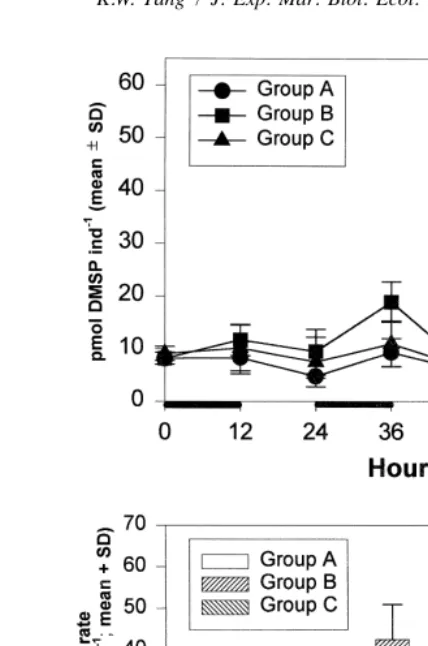
The body DMSP content of A. tonsa in all three groups oscillated in a similar pattern: it increased during the feeding periods and decreased during the starving periods (Fig. 1, upper panel). All three groups had similar body DMSP content at the end of the starving periods (hour 24 and 48). Groups A and C also showed similar body DMSP content at the end of hour 72. At the end of each feeding period (hour 12, 36 and 60), A. tonsa in group B tend to contain more DMSP than the other two groups, but the difference is statistically significant only at hour 60 (ANOVA, P,0.05).
21 21
Ingestion rates of A. tonsa in terms of pmol DMSP copepod h in groups A and C showed little variation with time (Fig. 1, lower panel). Overall, the ingestion rates
21 21
Fig. 1. Migration simulation experiment. Upper panel: body DMSP content (mean6SD) of Acartia tonsa during the course of the experiments. Black bars on the x-axis indicate the periods when food was available. Lower panel: ingestion rates (mean1SD) of A. tonsa during the feeding periods. Experimental conditions for groups A, B and C are explained in Table 1.
21 21
group B increased continuously from 22 to 60 pmol copepod h over the course of the experiments.
3.2. Food concentration experiment
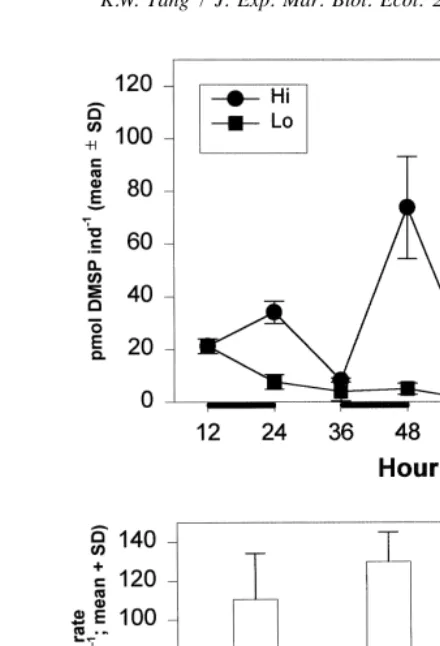
Except for the first 12 h, the body DMSP content of A. tonsa at both high and low food concentrations oscillated in a similar pattern: it increased during the feeding periods and decreased during the starving periods (Fig. 2, upper panel; note that the scale of the
y-axis is different from Fig. 1). Copepods feeding at the high food concentration
Fig. 2. Food concentration experiment. Upper panel: body DMSP content (mean6SD) of Acartia tonsa during
4 21 3 21
the course of the experiments. Hi5approx. 2310 cells ml and Lo5approx. 10 cells ml of Tetraselmis impellucida. Black bars on the x-axis indicate the periods when food was available. Lower panel: ingestion rates (mean1SD) of A. tonsa during the feeding periods. Notice that the scale of the y-axis is different from Fig. 1.
Although starvation resulted in a decline in body DMSP content in both treatments, the gap between the two treatments widened significantly with time (ANOVA, P,0.05).
4. Discussion
4.1. Migration simulation experiment
This set of experiments was designed to simulate an environment where the copepod
there was no significant difference among the groups at the end of the starving periods (A, B and C at hour 24 and 48; also A and C at hour 72 in Fig. 1) indicates that salinity, in the absence of food, does not affect how much DMSP the copepods will retain in their bodies. This is in contrast to another calanoid copepod, T. longicornis, which retains more DMSP at 30‰ than at 20‰ even after gut clearance (Tang et al., 1999). A. tonsa has been shown to osmoregulate with its internal free amino acid pool (Farmer and Reeve, 1978). The weak response of its DMSP content to salinity suggests that DMSP is a less important osmolyte than free amino acids in this species. Individuals in group B tend to contain more DMSP than the other two groups at the end of the feeding periods (Fig. 1, upper panel). Such a difference can be explained by the elevated ingestion rates in group B (Fig. 1, lower panel) as a result of the higher cellular DMSP level of the algae plus higher clearance of the copepods at the higher salinity. T. impellucida contained more cellular DMSP when grown at 30‰ than at 20‰ because the alga used DMSP as an osmolyte. A briefly elevated clearance rate at a higher salinity has been observed in another estuarine copepod species (Powell and Berry, 1990). Higher clearance rates might also be an adaptation to increase energy uptake for osmoregulation at the higher salinity (Farmer, 1980). Nevertheless, more studies are required to understand the effects of salinity on feeding and other metabolic processes of A. tonsa.
4.2. Food concentration experiment
Food concentration affected the body DMSP content of A. tonsa in two ways: the higher food concentration resulted in significantly more DMSP in the body, a result consistent with the previous conclusion that the body DMSP content of A. tonsa is dependent on ingestion (Section 4.1). In addition, during the course of the experiments, the discrepancy in body DMSP content of A. tonsa between the two treatments after starvation (hour 36, 60 and 84) increased significantly with time. This may indicate that the copepods became more acclimated to the food at the higher food concentration and were able to incorporate more DMSP toward the end of the experiments.
4.3. Dynamics of DMSP in migratory A. tonsa
In order to understand how grazing of A. tonsa will affect the dynamics of DMSP in the water column, I here define the parameter K according to the following formula:
B1I2A
]]]
K5 3100
I
where B is the DMSP content of A. tonsa at the beginning of each feeding period, A is the DMSP content of A. tonsa at the end of that feeding period, and I the total amount of DMSP ingested per individual during that feeding period. Thus, K is equal to the percentage of ingested DMSP that is not incorporated into the copepod bodies.
Table 2
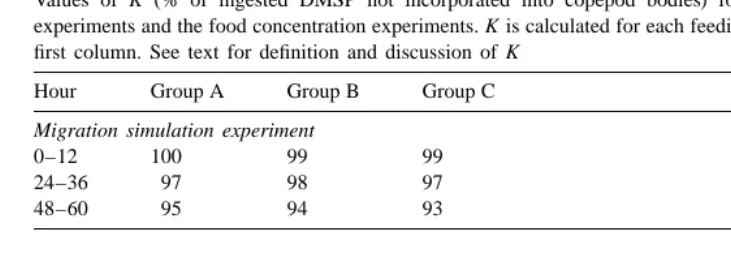
Values of K (% of ingested DMSP not incorporated into copepod bodies) for the migration simulation experiments and the food concentration experiments. K is calculated for each feeding period as indicated in the first column. See text for definition and discussion of K
Hour Group A Group B Group C
Migration simulation experiment
in all cases close to 100%, suggesting that almost all of the ingested DMSP was not incorporated into the copepod bodies (Table 2). Hence, the processing of the ingested DMSP will be the major consideration in how copepod grazing will affect the dynamics of DMSP in the water column. Two possibilities will be considered here: (1) DMSP is released as a dissolved compound or in fecal pellets; (2) DMSP is transformed into other compounds through cleavage and demethylation, for instance.
Two metabolic pathways for DMSP have been described in bacteria (Taylor and Visscher, 1996). These processes involve either DMSP cleavage via DMSP-lyase (Ledyard and Dacey, 1994; Van der Maarel and Hansen, 1996) or demethylation of DMSP (Visscher and Taylor, 1994; Visscher et al., 1996). While certain phytoplankters are able to break down DMSP enzymatically (e.g., Stefels and van Boekel, 1993; Stefels et al., 1996; Steinke et al., 1996), the reason for them to do so is not clear (Stefels et al., 1996; c.f. Wolfe et al., 1997). To date, no metabolic or breakdown pathways for DMSP have been demonstrated in copepods. Dacey and Wakeham (1986) showed that when the copepods Labidocera aestiva and Centropages hamatus fed on the dinoflagellates
Gymnodinium nelsoni and Prorocentrum micans, about one-third of the ingested DMSP
Table 3
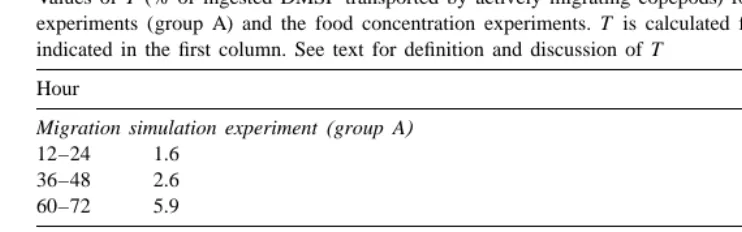
Values of T (% of ingested DMSP transported by actively migrating copepods) for the migration simulation experiments (group A) and the food concentration experiments. T is calculated for each starving period as indicated in the first column. See text for definition and discussion of T
Hour
is feeding in the surface layer, 88 to 100% of the ingested DMSP is released in fecal pellets, of which 30% may be degraded by bacteria within the first 24 h. Since the fecal
21
pellets of A. tonsa feeding on autotrophic flagellates descend at a rate of about 20 m d (Feinberg and Dam, 1998), in shallow estuaries, 70% of the DMSP in the fecal pellets (or 62–70% of the ingested DMSP) would be transported below the pycnocline before degradation occurs.
Another way migratory grazers can transport DMSP is by migrating from the surface layer to the bottom layer and then releasing DMSP below the pycnocline. Using results from group A in the migration simulation experiments (Section 3.1) and results from the food concentration experiments (Section 3.2), I define the parameter T as:
F2E
]]
T5 3100
I
where F is the DMSP content of A. tonsa at the beginning of each starving period, E the DMSP content of A. tonsa at the end of that starving period, and I the total amount of DMSP ingested per individual in the 12 h prior to starving. In other words, T represents the percentage of ingested DMSP being released below the pycnocline when the copepods return to the deep waters after feeding. Note that the F for calculating T for each starving period is equal to the A for calculating K for the preceding feeding period. Similarly, the E for each starving period is equal to the B for the successive feeding period. In the present study, T ranges from 1.6 to 9.3% (Table 3); thus less than 10% of the ingested DMSP would be released in the deep waters by the migrators. Therefore, the impact of migratory A. tonsa on the dynamics of DMSP will be largely limited to periods when the copepods are feeding in the surface layer and producing DMSP-containing, fast sinking fecal pellets.
Acknowledgements
G. Dam (University of Connecticut) and by Sigma Xi Grants-in-Aid of Research awarded to the author. The author thanks H.G.D. and two anonymous reviewers for comments on the manuscript, and Pieter T. Visscher (University of Connecticut) for providing research facilities. The Marine Science and Technology Center (MSTC) of the University of Connecticut (UCONN) provided research vessels for this study.
Contribu-tion No. 307 of MSTC, UCONN. [RW]
References
Andreae, M.O., 1990. Ocean–atmosphere interactions in the global biogeochemical sulfur cycle. Mar. Chem. 30, 1–29.
Andreae, M.O., Raemdonck, H., 1983. Dimethyl sulfide in the surface ocean and the marine atmosphere: a global view. Science 221, 744–747.
Cervetto, G., Pagano, M., Gaudy, R., 1995. Feeding behavior and migrations in a natural population of the copepod Acartia tonsa. Hydrobiologia 301, 237–248.
Charlson, R.J., Lovelock, J.E., Andreae, M.O., Warren, S.G., 1987. Oceanic phytoplankton, atmospheric sulphur, cloud albedo and climate. Nature 326, 655–661.
Dacey, J.W.H., Wakeham, S.G., 1986. Oceanic dimethylsulfide: production during zooplankton grazing on phytoplankton. Science 238, 1314–1316.
Daly, K.L., DiTullio, G.R., 1996. Particulate dimethylsulfoniopropionate removal and dimethylsulfide production by zooplankton in the southern ocean. In: Kiene, R.P., Visscher, P.T., Keller, M.D., Kirst, G.O. (Eds.), Biological and Environmental Chemistry of DMSP and Related Sulfonium Compounds, Plenum Press, New York, pp. 223–238.
Dam, H.G., Roman, M.R., Youngbluth, M.J., 1995. Downward export of respiratory carbon and dissolved inorganic nitrogen by diel-migrant mesozooplankton at the JGOFS Bermuda time-series station. Deep-Sea Res. 42, 1187–1197.
DeMeester, L., Vyverman, W., 1997. Diurnal residence of the larger stages of the calanoid copepod Acartia tonsa in the anoxic monimolimnion of a tropical meromictic lake in New Guinea. J. Plankton Res. 19, 425–434.
Farmer, L., 1980. Evidence for hyporegulation in the calanoid copepod, Acartia tonsa. Comp. Biochem. Physiol. 65, 359–362.
Farmer, L., Reeve, M.R., 1978. Role of the free amino acid pool of the copepod Acartia tonsa in adjustment to salinity change. Mar. Biol. 48, 311–316.
Feinberg, L.R., Dam, H.G., 1998. Effects of diet on dimensions, density and sinking rates of fecal pellets of the copepod Acartia tonsa. Mar. Ecol. Prog. Ser. 175, 87–96.
Frost, B.W., 1972. Effects of size and concentration of food particles on the feeding behavior of the marine planktonic copepod Calanus pacificus. Limnol. Oceanogr. 17, 805–815.
Keller, M.D., Korjeff-Bellows, W., 1996. Physiological aspects of the production of dimethylsulfoniopropion-ate (DMSP) by marine phytoplankton. In: Kiene, R.P., Visscher, P.T., Keller, M.D., Kirst, G.O. (Eds.), Biological and Environmental Chemistry of DMSP and Related Sulfonium Compounds, Plenum Press, New York, pp. 131–142.
Kirst, G.O., 1996. Osmotic adjustment in phytoplankton and macroalgae. In: Kiene, R.P., Visscher, P.T., Keller, M.D., Kirst, G.O. (Eds.), Biological and Environmental Chemistry of DMSP and Related Sulfonium Compounds, Plenum Press, New York, pp. 121–129.
Kwint, R.L.J., Irigoien, X., Kramer, K.J.M., 1996. Copepods and DMSP. In: Kiene, R.P., Visscher, P.T., Keller, M.D., Kirst, G.O. (Eds.), Biological and Environmental Chemistry of DMSP and Related Sulfonium Compounds, Plenum Press, New York, pp. 239–252.
Lampert, W., 1989. The adaptive significance of diel vertical migration of zooplankton. Funct. Ecol. 3, 21–27. Le Borgne, R., Rodier, M., 1997. Net zooplankton and the biological pump: a comparison between the
Ledyard, K.M., Dacey, J.W.H., 1994. Dimethylsulfide production from dimethylsulfonio-propionate by a marine bacterium. Mar. Ecol. Prog. Ser. 110, 95–103.
Longhurst, A.R., 1991. Role of the marine biosphere in the global carbon cycle. Limnol. Oceanogr. 36, 1507–1526.
Longhurst, A.R., Harrison, W.G., 1988. Vertical nitrogen flux from the oceanic photic zone by diel migrant zooplankton and nekton. Deep-Sea Res. 35, 881–889.
Longhurst, A.R., Bedo, A., Harrison, W.G., Head, E.J.H., Horne, E.P., Irwin, B., Morales, C., 1989. NFLUX: a test of vertical nitrogen flux by diel migrant biota. Deep-Sea Res. 36, 1705–1719.
Longhurst, A.R., Bedo, A.W., Harrison, W.G., Head, E.J.H., Sameoto, D.D., 1990. Vertical flux of respiratory carbon by oceanic diel migrant biota. Deep-Sea Res. 37, 685–694.
Lovelock, J.E., Maggs, R.J., Rasmussen, R.A., 1972. Atmospheric dimethyl sulfide and the natural sulfur cycle. Nature 237, 452–453.
Nguyen, B.C., Gaudry, A., Bonsang, B., Lamber, G., 1978. Reevaluation of the role of dimethyl sulphide in the sulphur budget. Nature 275, 637–639.
Nguyen, B.C., Bonsang, B., Gaudry, A., 1983. The role of the ocean in the global atmospheric sulfur cycle. J. Geophys. Res. 88, 10903–10914.
Pearre, Jr. S., 1979. Problems of detection and interpretation of vertical migration. J. Plankton Res. 1, 29–44. Powell, M.D., Berry, A.J., 1990. Ingestion and regurgitation of living and inert materials by the estuarine copepod Eurytemora affinis (Poppe) and the influence by salinity. Estuarine Coastal Shelf Sci. 31, 763–773. Stearns, D.E., Forward, Jr. R.B., 1984. Copepod photobehavior in a simulated natural light environment and its
relation to nocturnal vertical migration. Mar. Biol. 82, 91–100.
Stefels, J., van Boekel, W.H.M., 1993. Production of DMS from dissolved DMSP in axenic cultures of the marine phytoplankton species Phaeocystis sp. Mar. Ecol. Prog. Ser. 97, 11–18.
Stefels, J., Gieskes, W.W.C., Dijkhuizen, L., 1996. Intriguing functionality of the production and conversion of DMSP in Phaeocystis sp. In: Kiene, R.P., Visscher, P.T., Keller, M.D., Kirst, G.O. (Eds.), Biological and Environmental Chemistry of DMSP and Related Sulfonium Compounds, Plenum Press, New York, pp. 305–315.
Steinke, M., Daniel, C., Kirst, G.O., 1996. DMSP lyase in marine macro- and microalgae. In: Kiene, R.P., Visscher, P.T., Keller, M.D., Kirst, G.O. (Eds.), Biological and Environmental Chemistry of DMSP and Related Sulfonium Compounds, Plenum Press, New York, pp. 317–321.
Tang, K.W., Fenn, T.D., Visscher, P.T., Dam, H.G., 1998. Occurrence of DMSP in marine copepods: a missing piece of the global DMSP budget? EOS 79, 1.
Tang, K.W., Dam, H.G., Visscher, P.T., Fenn, T.D., 1999. Dimethylsulfoniopropionate (DMSP) in marine copepods and its relation with diets and salinity. Mar. Ecol. Prog. Ser. 179, 71–79.
Taylor, B.F., Visscher, P.T., 1996. Metabolic pathways involved in DMSP degradation. In: Kiene, R.P., Visscher, P.T., Keller, M.D., Kirst, G.O. (Eds.), Biological and Environmental Chemistry of DMSP and Related Sulfonium Compounds, Plenum Press, New York, pp. 265–276.
Van der Maarel, M.J.E.C., Hansen, T.A., 1996. Anaerobic microorganisms involved in the degradation of DMSP. In: Kiene, R.P., Visscher, P.T., Keller, M.D., Kirst, G.O. (Eds.), Biological and Environmental Chemistry of DMSP and Related Sulfonium Compounds, Plenum Press, New York, pp. 369–379. Visscher, P.T., Taylor, B.F., 1994. Demethylation of dimethylsulfoniopropionate to 3-mercaptopropionate by
an aerobic marine bacterium. Appl. Environ. Microbiol. 60, 4617–4619.
Visscher, P.T., Guidetti, J.R., Culbertson, C.W., Oremland, R.S., 1996. Dimethylsulfonio-propionate as a potential methanogenic substrate in Mono Lake sediments. In: Kiene, R.P., Visscher, P.T., Keller, M.D., Kirst, G.O. (Eds.), Biological and Environmental Chemistry of DMSP and Related Sulfonium Compounds, Plenum Press, New York, pp. 361–368.