1 | T h e S e c o n d I C I C P , D e n p a s a r - B a l i
Factors Influencing The Sincretism Among Javanese-Muslim
in Surabaya: An Exploratory Study
Marselius Sampe Tondok dan Nita Trisnawati Faculty of Psychology, University of Surabaya e-mail: [email protected]; [email protected]
Syncretism as an attempt to merge two religious beliefs/practices or more is easy to find among the Javanese-Muslim in Surabaya and surrounding areas. This study aims to: (1) describe the syncretic behaviors of the Javanese-Muslim, and (2) determine the factors that influence the behavior of such syncretism. The subject of this study (N = 85; consisted of 39 men and 46 women) are adherents of Muslim and is derived from the Javanese, who selected based on purposive and snowball sampling. Technique of data analysis using descriptive analysis and exploratory factor analysis (EFA) Result of descriptive analysis shown that the most performed syncretic behaviors are “slametan” rituals for newborns as well as pregnancy and the death of family member. Furthermore, the exploratory factor analysis shown that there are five factors influencing syncretism among Javanese-Muslim, namely: (1) fidelity to tradition as the implementation of personal benefits and positive attitude, (2) status and social identity, (3) the influence of a model of social change, (4) self-awareness in tradition, and (5) social compliance.
Key words: syncretism, Javanese-Muslim, influencing factors, factory analysis.
The existence of syncretism which still in debate among Indonesian people because syncretism can not be fully accepted by the religions in Indonesia. Nowadays a lot of the problems that arise in Indonesia are regard to religious matters. Many cases are assuming that religion is no longer purely because many incorporate traditional elements (customs) into an indigenous religion and hope it can be accepted as a religious doctrine. In addition, many of the problems often raised about the existence of a religious tradition as well as customs that should be preserved. Several people tried to reconcile both of these with finding a solution that is syncretic. Syncretism serve as a way out by adherents of a particular religion to keep them running their both religion’s doctrine and their particular traditions (customs) of their culture. Though the true meaning of syncretism is not yet able to be well understood by most people. However there are some people of Indonesia who perform their tribal customs without understanding that it is a form of syncretism and they just went along with it. Nevertheless, some Indonesian people still preserve their tribal traditions although they already understand about syncretism. Their reason to do syncretism is to preserve their tribal customs. Syncretism is a fusion of religion with cultural traditions or customs traditions such as the unification of methods of commemoration of the people died in 40 days, 100 days, 1000 days which is actually an animist and Hindu culture (Bimosaurus, 2008).
The general meaning of syncretism is the process or result of combining two or more different systems or opposing principles in such a way, thus forming a new principle of the system, which is different from previous systems principles (Putra, 1995). People who follow syncretism consider that all religions are good and true. They like to combine the elements of various religions, which are fundamentally different or even opposite one another (Simuh, 1988). According to several previous definition of syncretism, it can be concluded that syncretism is a process of pooling or combining elements from a variety of religious or other principles that are fundamentally different and even opposite.
2 | T h e S e c o n d I C I C P , D e n p a s a r - B a l i
and others. Before the arrival of religions such as Islam, Christian, Hindu, Buddhist (so-called world religions) to Javanese community, the Javanese people actually have had a "religion" that was derived from the heritage of a traditional mores (Gultom, 2005).
According Koentjaraningrat (1984), the syncretism process in Javanese people can be seen in two levels, namely belief and ritual systems. First, belief system is divided into three levels, that are theological level (appeare in the concept of transcendental one in Javanese Religion), cosmological-cosmogonical level (a set of concepts and views on the origins of the universe and humans), and eskatalogical level (a set of beliefs concerning the view of the events in the days to come after this life). Second, ritual system is divided into three activities, namely: “slametan” (ritual to invoke the safety and tranquility to families/community), “nyadran” (ritual to honor the ancestral spirits, held before the fasting month of Ramadan), and “tirakat” (fasting on certain days for special intention).
The previous studies of syncretism among Javanese people tend to use a qualitative approach to data collection techniques through observation, in-depth interviews, as well as existing documentation. Moreover as far as our knowledge, there has been no previous study that explains the factors influencing the syncretism among Javanese people in around Surabaya. Surabaya and surrounding area are selected because Surabaya and it’s surrounding area are closest area to the northern beach of Java Island that are often found the tombs several sunan (the muslim missionaries). The tombs are Sheikh Malik Ibrahim’s in Gresik, Sunan Ampel’s in Surabaya, Sunan Giri’s in Gresik, Sunan Drajad’s in Lamongan, Sunan Bonang’s in Tuban. The tombs are used as a place of pilgrimage or prayer.
Based on the description above, this research question is: 1) how the description of Islam-Javanese syncretism among Javanese people in Surabaya and it’s surrounding area?; 2) What factors are those drive a person to perform the Islamic-Javanese syncretism?
Cultural syncretism in Javanese People
Syncretism in general is the process or result of processing, pooling, combining and aligning two or more different religious systems or opposing principles in such a way, thus forming a new principle of the system, which is different from previous systems principles (Santosa, 2008). “Kejawen” (Javanese Beliefs) is a mix (syncretism) of Javanese culture with religion entrants namely Hinduism, Buddhism, Islam and Christianity. Among the most dominant mixing is the religion of Islam (Ridwan et al, 2008). The syncretism process in “Kejawen” can be seen in two levels, namely at belief systems and ritual system. At the level of syncretism, there are three stages of syncretism is a theological, cosmological-cosmogonical, and eschatological. Furthermore, the syncretism in ritual system has form Islamic-Javanese syncretism that are “slametan”, “nyadran”, and “tirakatan” (Santosa, 2008).
Influencing factors of syncretism among Javanese People
3 | T h e S e c o n d I C I C P , D e n p a s a r - B a l i
Picture 1. Chart of the factors influencing syncretism (source: preliminary study)
METHODS
The focus of this research is the factors that influence the syncretic behavior
among Javanese people. This research is a. The subjects of this descriptive-exploratory
research are 85 people who are adherents of Islam-Javanese syncretism. The subjects
stay in Surabaya and Sidoarjo with a minimum age of 17 years and minimum education
level of junior high school. Subject are determined by the characteristics of adherents of
Islam-Javanese syncretism that stated by Koentjaraningrat (1984):
1. Active fasting during Ramadan and on certain days (Monday-Thursday fasting).
2.
Doing “n
yadran
”
ritual (visit the graves and praying at the tomb, usually do before
the month of Ramadan).
3. Installing
“sesajen” or
offerings to the deceased person.
4.
Do “s
lametan
”
ritual to mark the days of the religion of Islam, slametan ritual for the
dead (40 days, 100 days, 1000 days).
Data were collected in two phases. The first phase we do qualitative stage
through library research, interviews, and observations. This qualitative phase became
the basis for the second phase of quantitative data collection that consists of 11 variables
that elaborate in enclosed questionnaire. The quantitative data are analyzed by
exploratory factor analysis (EFA) to determine the answer this research questions.
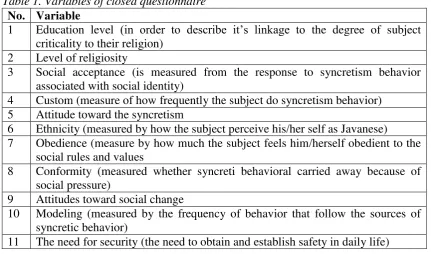
Following is the variable of closed questionnaire:
Influencing factors of syncretism
Internal factors
Educational level
Religiosity level
Ethnisity
Attitude toward social change
Compliance
Attitude toward syncretism
Eksternal factors
Conformity
Social acceptance
Customs
4 | T h e S e c o n d I C I C P , D e n p a s a r - B a l i
Table 1. Variables of closed questionnaire
No. Variable
1
Education level
(in order to describe it’s linkage to
the degree of subject
criticality to their religion)
2
Level of religiosity
3
Social acceptance (is measured from the response to syncretism behavior
associated with social identity)
4
Custom (measure of how frequently the subject do syncretism behavior)
5
Attitude toward the syncretism
6
Ethnicity (measured by how the subject perceive his/her self as Javanese)
7
Obedience (measure by how much the subject feels him/herself obedient to the
social rules and values
8
Conformity (measured whether syncreti behavioral carried away because of
social pressure)
9
Attitudes toward social change
10
Modeling (measured by the frequency of behavior that follow the sources of
syncretic behavior)
11
The need for security (the need to obtain and establish safety in daily life)
Those above variables are supported by some relevant questions in order to describe the
subject’s
demographic (sex, age, education, Javanese-Muslim criteria), and their
syncretic behaviors (form and reason of behavior).
RESULTS
The description of demographic variabel of research subjects based on sex is
summarized in the table below.
Table 2. Frequency Distribution of subject based on sex
Sex Frequency Percentage
Male 39 45.9
Female 46 54.1
Total 85 100
Table 2 shows that the number of female subjects more than the number of male subjects is as much as 54.1% (46 people) while the number of male subjects as much as 45.9% (39 people). Furthermore the age of research subjects are summarized in the following table:
Table 3. Frequency Distribution of subject based on age
The above table shows that most of the study subjects are in the age range 17-26 years as much as 32.9 (28 people). While the least are in the age range 57-66 years or 3.5 (3 people). Education level of research subjects are summarized in the following table:
Age (in year) Frequency Percentage
57-66 3 3.5
47-56 17 20.0
37-46 12 14.1
27-36 25 29.4
17-26 28 32.9
5 | T h e S e c o n d I C I C P , D e n p a s a r - B a l i
Table 4. Frequency Distribution of subject based on education
The table above shows that the majority of the study subjects had a high school education with a percentage of 42.4 or 36 people. Data of research subjects based on their Javanese-muslim criteria are summarized in the following table:
Table 5. Frequency Distribution Status Javanese-Muslim
Item Frequency Percentage
Derived from the Javanese and Muslim (item 1) 85 100
Born and settled in the island of Java (item 2) 84 98.8
Fluent in Javanesse (item 3) 63 74.1
Have a belief that older people should be respected (item 4) 83 97.6 Believe in the good days (good days believe their calculations
according weton) (item 5)
51 60
Doing “tirakatan” (fasting on certain days) (item 6) 56 65.9
Doing “slametan” (item 7) 76 89.4
Should not worship other than Allah (item 8) 85 100
Fasting during the month of Ramadan (item 9) 85 100
Give thanks for the gift given by God Almighty (item 10) 85 100
Ancestral spirits must be respected (item 11 74 87.1
Data subject of research by behavioral criteria syncretism can be summarized in the following table:
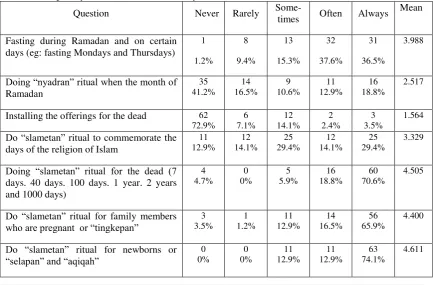
Table 6. Frequency Distribution Behavior Syncretism
Question Never Rarely
Some-Doing “nyadran” ritual when the month of
Ramadan
Installing the offerings for the dead 62 72.9%
Do “slametan” ritual to commemorate the
days of the religion of Islam
11 Educational level Frequency Percentage
6 | T h e S e c o n d I C I C P , D e n p a s a r - B a l i
Table 7. Frequency distribution of the reasons doing synctetism
The table above shows the reason the subject of religion but still carries on the tradition. the reason most of the chosen subject is to preserve the culture with a frequency of 35 (41.2).
Factor Analysis
The results of the feasibility test feasibility test samples and results can be summarized in a table variable as follows:
Table 8. Test KMO and Bartlett's Test
Kaiser-Meyer-Olkin Measure of Sampling Adequacy. 0.606
Bartlett's Test of Sphericity
Approx. Chi-Square 180.118
Df 55
Sig. 0.000
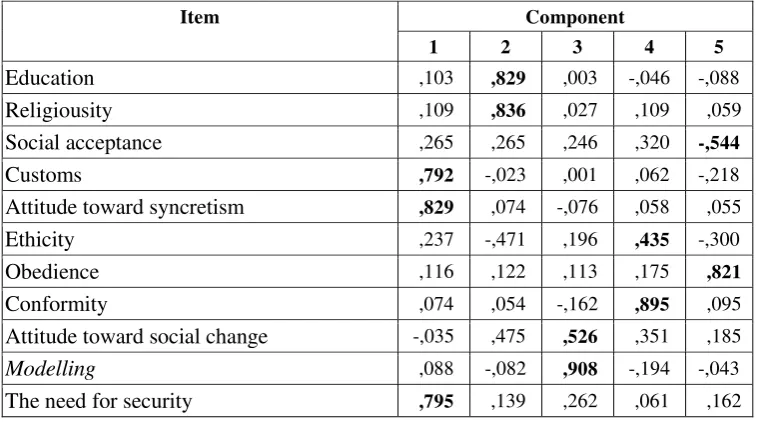
Value of KMO and Bartlett's Test was 0.606 (above 0.5) with a significance of 0.000. It indicates that the adequacy of the sample for doing factor analysis. The test result with Rotated Component Matrix shows that there is no item rejected for further analysis.
Table 9. Results Rotated Component Matrix
Item Component
1 2 3 4 5
Education ,103 ,829 ,003 -,046 -,088
Religiousity ,109 ,836 ,027 ,109 ,059
Social acceptance ,265 ,265 ,246 ,320 -,544
Customs ,792 -,023 ,001 ,062 -,218
Attitude toward syncretism ,829 ,074 -,076 ,058 ,055
Ethicity ,237 -,471 ,196 ,435 -,300
Obedience ,116 ,122 ,113 ,175 ,821
Conformity ,074 ,054 -,162 ,895 ,095
Attitude toward social change -,035 ,475 ,526 ,351 ,185
Modelling ,088 -,082 ,908 -,194 -,043
The need for security ,795 ,139 ,262 ,061 ,162
The table above shows the distribution of 11 item classified into five factors namely:
1. Factor 1: item 4. 5. 11
2. Factor 2: item 1. 2
3. Factor 3: item 9. 10
4. Factor 4: item 6. 8
5. Factor 5: item 3. 7
Reason Frequency Percentage
Preserving culture 35 41.2
Not deviate from the religion teachings 29 34.1
Not according to religious law 8 9.4
Receiving personal benefit 7 8.2
Establish communication with the public 4 4.7
Not in accordance with religious law 2 2.4
7 | T h e S e c o n d I C I C P , D e n p a s a r - B a l i
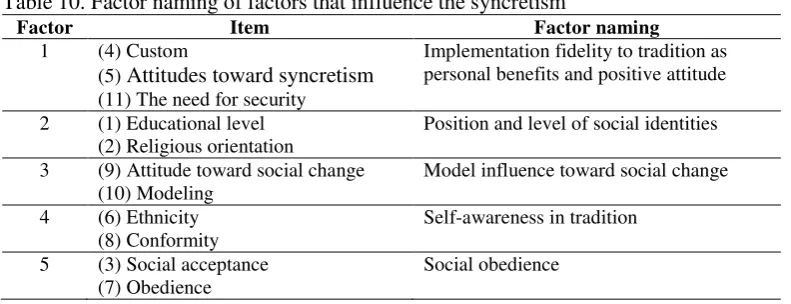
After item scattered in several factors, these factors are labeled according to the contents
of each factor (factor naming).
Table 10. Factor naming of factors that influence the syncretism
Factor Item Factor naming
1 (4) Custom
(5) Attitudes toward syncretism (11) The need for security
Implementation fidelity to tradition as personal benefits and positive attitude
2 (1) Educational level (2) Religious orientation
Position and level of social identities
3 (9) Attitude toward social change (10) Modeling
Model influence toward social change
4 (6) Ethnicity (8) Conformity
Self-awareness in tradition
5 (3) Social acceptance (7) Obedience
Social obedience
Based on the data of 85 subjects of this research (see Table 6), the syncretic behaviors that are still do intensively among Javanese-Muslim (sequentially from the most intensive to least intensive) are:
1.
Doing “slametan” ritual for newborns or “selapan” and “aqiqah”2.
Doing “slametan” ritual for the dead (7 days. 40 days. 100 days. 1 year. 2 years and 1000 days)3.
Doing “slametan” ritual for family members who are pregnant or “tingkepan”4.
Fasting during Ramadan and on certain days (e.g.: fasting Mondays and Thursdays)5.
Doing “slametan” ritual to commemorate the days of the religion of Islam6.
Doing “nyadran” ritual when the month of Ramadan7.
Installing the offerings for the deadThere are several reasons why Javanese-Muslims in Surabaya and surrounding areas keep doing the syncretic behaviors. The two most important reasons are preserving culture and the syncretic behaviors perceived not derivated from their religious teachings.
This study finds five factors that influence religious and cultural syncretism among Javanese-Muslin in Surabaya and surroundings area, namely:
1. Implementation fidelity to the tradition of personal benefits and positive attitude. This factor explains about how frequently the subject of doing syncretism. Positive-negative attitude towards the subject of syncretism own behavior and also the need for security that arose in the subject.
2. Position and level of social identities. This factor relates to the degree of criticality of the subject matter the subject of religion and religious orientation (inclined intrinsic or extrinsic). 3. Model influence toward social change. This factor describes the attitude of the subject in response to the social changes that occur in the environment such as the existence of a new culture coming in to replace the old culture deeply rooted in everyday life subjects (selective-loose). Moreover this factor also explains the absence of influential role models in the subjects themselves in making syncretism.
4. Self-awareness in tradition. This factor explains about how big the subject feel that he is the person who must remain preserve Javanese traditions of the ancestors and this factor also explains the behavior of the syncretic done because of pressure from others or from yourself. 5. Social obedience. These factors explained the behavioral response to syncretism associated
with social identity (good-bad) and also on how much subjects felt they abide by the rules and social values.
8 | T h e S e c o n d I C I C P , D e n p a s a r - B a l i CONCLUSIONS
Based on the results and discussion that has been stated above, some conclusions from this study are:
1. Syncretism behaviors are still often done among Javanese-Muslim community in Surabaya and surrounding areas because they want to preserve their culture as well as the syncretic behaviors perceived not derivated from their religious teachings.
2. There are five factors that influence syncretic behaviors among Javanese-Muslim namely: 1) loyalty to tradition as the implementation of the personal benefits and positive attitude; 2) the position and level of social identities. 3) the model influence toward social change, 4) self-awareness in tradition, and 5) social obedience.
REFERENCES