677 7TH INTERNATIONAL SEMINAR ON NUSANTARA HERITAGE
INDUSTRIAL REVOLUTION 4.0
BASED ON CREATIVITY ARTS AND CULTURE
Arya Pageh Wibawa, Indonesia Institute of Arts Denpasar
I Wayan Swandi
Indonesia Institute of Arts Denpasar
ABSTRACT
The industrial revolution is a sign in history that changes all aspects of everyday life. In its development, society in the world has undergone industrial revolution three times. The first industrial revolution took place when human equipment was replaced by machines. The second industrial revolution occurred when the mass production based on the division of labor introduced. The third industrial revolution occurred when the use of electronics and information technology for product automation emerged. The fourth industrial revolution is marked by the emergence of the Internet of Things (IoT) where everything is a virtual world that connects people, machines and data. The purpose of this study is to see the creative arts and cultures that can be developed based on the fourth industrial revolution. The method used is descriptive qualitative to provide an overview of industry based on artistic and cultural creativity that can be developed in the industry revolution 4.0. The results obtained are artistic and cultural creativity to support the industry revolution 4.0 in Indonesia are quite a lot and varies that it is worthy to be developed.
678 7TH INTERNATIONAL SEMINAR ON NUSANTARA HERITAGE
INTRODUCTION
President of the Republic of Indonesia Ir. H. Joko Widodo in a speech at the opening of the
Industrial Summit 2018 and the launch of Making Indonesia 4.0 in Jakarta said that Industrial
Revolution 4.0 is a great opportunity if prepared, planned and anticipated well. He also
mentioned that the impact of the Industrial Revolution 4.0 was 3000 times compared to the
impact of the first industrial revolution about 200 years ago. The president is convinced that
the Industrial Revolution 4.0 is not a threat but a great opportunity to prepare, plan, and
anticipate well (Susilo, 2018). In the opening of the Industrial Summit 2018, President Joko
Widodo also revealed that the government has grouped five major industries prepared for the
Industrial Revolution 4.0, namely food and beverage, textile, automotive, electronics, and
chemical industries. The five industries are examined to contribute more job vacancies and
new technology-based investments (Erdianto, 2018).
At the inauguration of the Campus Convention XIV and the annual meeting of XX Forum of the
2018 Rector of Indonesia held at Baruga Building, Andi Pangeran Pettarani, Hasanuddin
University, Makassar City, President Joko Widodo said that digitalization, computing power
and analytic data have spawned surprising breakthroughs in various fields, which disrupted
life. It even disrupted civilization, which changed the global economic landscape, national, and
regional economic landscape and global, national, and regional political landscape. Global
interaction landscape, national, and regional interactions landscape. Everything will change
(rzy, 2018).
In a lecture presentation by Bandung Institute of Technology (ITB), Richard Mengko quoted
from A.T. Kearney, reveals the history of industrial revolution until the end touching the 4th
generation. The four phases of the evolution of the industry from the past to the present (II,
2018):
1. End of the 18th century
The first industrial revolution took place at the end of the 18th century marked by the
discovery of a mechanical loom that used the first hydropower and steam in 1784. The work
679 7TH INTERNATIONAL SEMINAR ON NUSANTARA HERITAGE
2. Early 20th century
The second industrial revolution occurred in the early 20th century with the introduction of
mass production recognition based on division of labor. The first production line involves
slaughter houses in Cincinnati in 1870.
3. Early 1970s
The third industrial revolution occurred in the early 1970s marked by the use of electronics
and information technology for production automation. The emergence of the first
Programmable Logic Controller (PLC), which is the 084-969 modem makes the industrial
machine no longer controlled by humans which impacts production costs becoming cheaper.
4. Beginning of 2018
The fourth industrial revolution (4.0) is characterized by a cyber-physical system where the
industry has started to touch the virtual world, in the form of human connectivity, engine and
data, all already everywhere. This term is known as the Internet of things (IoT).
Chairman of the Republic of Indonesia House of Representative, Bambang Soesatyo, in the
"National Discussion of Industry Revolution 4.0: Challenges of the Future of Workers" held at
the Central Board of Golkar Party Hall on Monday 7th May 2018 explains the impact of
advances in information technology, especially the digitization and the making of robotization
the industrial revolution will continue to change the habits of people in their lives. He also give
example of online shopping that makes it easy to buy household needs only through mobile
phones and so on (Sabran, 2018).
I. LITERATURE REVIEWS
In a lecture presentation by Bandung Institute of Technology (ITB), Richard Mengko quoted
from A.T. Kearney, reveals the history of industrial revolution until the end touching the 4th
generation. The four phases of the evolution of the industry from the past to the present (II,
2018): 1) End of the 18th century; 2) Early 20th century; 3) Early 1970s; 4) Beginning of 2018.
Creativity is the ability to produce work that is both novel (i.e., original, unexpected) and
680 7TH INTERNATIONAL SEMINAR ON NUSANTARA HERITAGE
II. PROBLEM STATEMENTS
How are the forms of Indonesian art and cultural creativity in the industrial revolution 4.0?
III. RESEARCH METHOD
The research method used is descriptive qualitative to provide an overview of the industry
based on artistic and cultural creativity that can be developed in the industry revolution 4.0.
IV. RESULT
Art and culture is a hereditary heritage given by the ancestors of a nation. Indonesia, which
has 17,504 islands and 300 ethnic groups or more precisely 1,340 ethnic groups according to
the 2010 BPS census, certainly has a lot of art and culture.
Batik
Batik many exist and spread throughout Nusantara. Each region has different batik motifs.
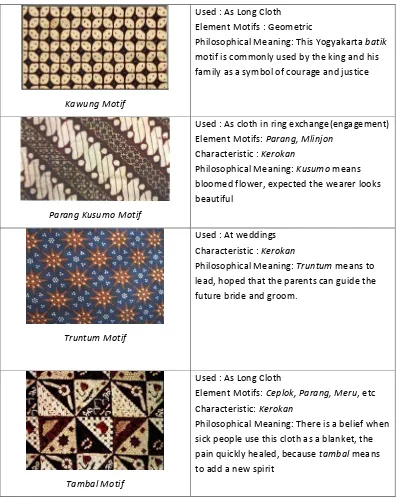
Yogyakarta has batik motif kawung, motif parang kusumo, truntum motif, tambal, pamiluto,
sidomukti, sidoasih, wahyu tumurun, ceplok/grompol, lereng, nitik motif, semen (Batikazizah,
681 7TH INTERNATIONAL SEMINAR ON NUSANTARA HERITAGE Table 1. Yogyakarta Batik Motifs
Kawung Motif
Used : As Long Cloth Element Motifs : Geometric
Philosophical Meaning: This Yogyakarta batik motif is commonly used by the king and his family as a symbol of courage and justice
Parang Kusumo Motif
Used : As cloth in ring exchange(engagement) Element Motifs: Parang, Mlinjon
Characteristic : Kerokan
Philosophical Meaning: Kusumo means
bloomed flower, expected the wearer looks beautiful
Truntum Motif
Used : At weddings Characteristic : Kerokan
Philosophical Meaning: Truntum means to
lead, hoped that the parents can guide the future bride and groom.
Tambal Motif
Used : As Long Cloth
Element Motifs: Ceplok, Parang, Meru, etc Characteristic: Kerokan
682 7TH INTERNATIONAL SEMINAR ON NUSANTARA HERITAGE Pamiluto Motif
Function : As Long Cloth during engagement
Element Motifs: Parang, Ceplok, Truntum, etc
Philosophical Meaning: Pamiluto is derived
from the word “pulut”, means adhesive, in
Javanese means kepilut [pulled].
Sidomukti Motif
Function: As a cloth in marriage ceremony
Element Motifs: Gurda
Philosophy: It is expected that the wearer is always in well off condition and happiness.
Sidoasih Motif
Used : Temanten Putri(used on wedding
night)
Element Motifs: semen derived from the
word semi
Philosophy: Two souls become one
Wahyu Tumurun Motif
Element Motifs: The flying crown pattern that became the main motif, symbolizes the holiness.
Philosophy : This Yogyakarta batik motifs reflect the hope that the wearer gets
guidance, blessings, grace, and the abundant grace of Almighty God. Hope to achieve success in achieving goals, position or rank. Whereas in a special case such as marriage, this motif implies the blessing of inner life in married life, harmony and lasting and eternal happiness. In it the meaning of this
household life that makes the motif of wahyu
683 7TH INTERNATIONAL SEMINAR ON NUSANTARA HERITAGE worn in the traditional wedding ceremony of Java
This batik motif can be applied in various industries. In addition to clothing, this motif is used
as decoration on other products. Here is an overview of the application of Yogyakarta batik
motifs on existing products.
Picture 1. Application of batik motifs on various products
Picture 2. A combination of batik motifs by Darbotz and Ykha Amelz
Darbotz (graffiti artist) and Ykha Amelz (illustrator) became the first two local artists who had
the opportunity to design a limited edition of Guinness One Indonesia using batik motif.
684 7TH INTERNATIONAL SEMINAR ON NUSANTARA HERITAGE
philosophy of batik in a workshop for one month. Both admitted it is the first time to draw
with the theme of batik. "After doing the research, I chose batik parang motif. Coincidentally
parang symbolized the water, and I got the element of water and fire, and there was also
another visual that added in accordance with my style. Although the demands must be batik,
there is my ego here,” said Darbotz in interview with Liputan6.com, at Applebee's, Plaza
Senayan, Jakarta recently (Nadya, 2017).
Food and Beverage Industry
Regional food and beverage type in Indonesia are quite a lot. In fact there are some foods that
have been well known by the people outside the country such as ayam betutu come from the
area of Bali, gudeg originating from the area of Yogyakarta, and so forth. The traditional foods
of this region are in great demand by the foreign community because it is considered to have
a distinctive taste. In the 29th Trade Expo Indonesia (TEI) held at the Jakarta International Expo
(JIExpo) on October 8-12, 2014 themed "Towards Green Business", placed processed food
products to be prima donna. This product is increasingly appreciated after able to record
export increase up to 12,76%. The buyers appreciate in terms of quality, packaging, up to the
story telling behind the creation of the product. The export value of Indonesian processed
food products in 2013 reached US $ 4.63 billion. While the export value in the period of
January to July 2014 amounted to US $ 2.98 billion or an increase of 12.76% compared to the
export value of the same period in 2013. Viewed from the trend of export growth of processed
foods during the period 2009-2013, this product is experiencing positive growth of 15.43% per
annum (Baihaqi, 2014). According to data from the Ministry of Industry, the value of processed
food export transactions in 2017 was recorded at USD 2.61 billion, while for April 2017 it was
USD 2.44 billion. As for the same period in 2016, recorded processed food industry recorded
exports of USD 1.99 billion. Data from the Ministry of Industry also shows that the total export
of manufacturing industry is still in positive trend. In month-to-month, the manufacturing
industry grew by 8.72%, while the year-on-year increase was 18.09% (Kertiyasa, 2017).
On 8-10 september 2017, a traditional food product exhibition was held which was the
685 7TH INTERNATIONAL SEMINAR ON NUSANTARA HERITAGE LIPI" held at Taman Pintar Yogyakarta. There are at least 42 types of traditional culinary food
recipes that have been packed with traditional food packaging technology that has been
through the stage of traditional food packaging research since 2004 and began to be used by
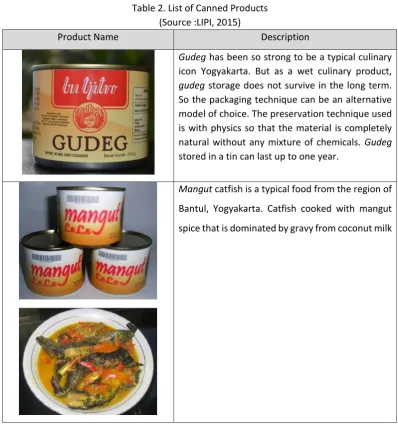
the community since 2008 (Handito, 2017). Here are traditional food products that have been
using packaging technology.
Table 2. List of Canned Products (Source :LIPI, 2015)
Product Name Description
Gudeg has been so strong to be a typical culinary icon Yogyakarta. But as a wet culinary product, gudeg storage does not survive in the long term. So the packaging technique can be an alternative model of choice. The preservation technique used is with physics so that the material is completely
natural without any mixture of chemicals. Gudeg
stored in a tin can last up to one year.
Mangut catfish is a typical food from the region of
Bantul, Yogyakarta. Catfish cooked with mangut
686 7TH INTERNATIONAL SEMINAR ON NUSANTARA HERITAGE
Sayur lombok ijo can is a typical food in Wonosari
area, Yogyakarta. Sayur lombok ijo is a vegetable
consisting of green chili and tempe plus sauce and
other spices.
Tempe is a fermented product of soy that is
popular among all the people in Indonesia because
of its cheap price. Tempe canned curry is packed
with cultivated in a hygienic and durable curry
spice.
.Sea snails are members of the gastropod mollusca
class of soft animals that have shells. Keong
Usal(Turbo argyrostomus) is one type of sea snail from turbinidae tribe that has not been used as a
value-added product. So far the usage of Keong
Usal only in the form of culinary dish that is found in the coastal area of Gunung Kidul Regency.
Sea snail used is a type of sea snail "usal"(Turbo argyrostomus, Linnaeus) originated from the Gunung Kidul beach. Developed 2 kinds of processed products namely rica-rica and tongseng
usal. Stages of canning include precooking,
687 7TH INTERNATIONAL SEMINAR ON NUSANTARA HERITAGE
Arts and culture are quite numerous and diverse in Indonesia, very supportive in the
development of industrial revolution 4.0. Art is not only visual art but also other performing
arts and other arts. The local arts that are present in community groups which are further
developed and passed down through generations and live in a sustainable manner in the
community which further becomes the icon of the region need to be continuously preserved
and developed. This is important because local art and culture that flourish in society can
become the brand ambassador for the region. Like for example in Bali which has traditional
art of dance barong and rangda has become brand ambassador for Bali and become identity
of Bali wherever located. Even art and packaging products utilize that identity in their
688 7TH INTERNATIONAL SEMINAR ON NUSANTARA HERITAGE
a b c
d e f
Picture 3. Barong as brand ambassador
Note: a. T-Shirt; b. Pecel Seasoning; c. Pie Susu Bali; d. Sticker; e. Handbag; f. Arak Bali
In general it can be said that the arts and culture that exist in Indonesia can be a supporter in
government efforts in the face of industry revolution 4.0. The Indonesian government needs
to give more serious impetus and guidance to the artists and culturists in order to continue to
develop the creativity that has economic value so as to improve the living standard of the
community.
V. DISCUSSION
In the opening of the Industrial Summit 2018, President Joko Widodo also revealed that the
government has grouped five major industries prepared for the Industrial Revolution 4.0,
namely food and beverage, textile, automotive, electronics, and chemical industries. Batik
many exist and spread throughout Nusantara. Each region has different batik motifs. Regional
food and beverage type in Indonesia are quite a lot. In fact there are some foods that have
been well known by the people outside the country such as ayam betutu come from the area
689 7TH INTERNATIONAL SEMINAR ON NUSANTARA HERITAGE
VI. CONCLUSION.
The industrial revolution is a sign in history that changes all aspects of everyday life. In its
development, the world community has undergone industrial revolution three times. The first
industrial revolution took place when human equipment was replaced by machines. The
second industrial revolution occurred when the introduction of mass production based on the
division of labor. The third industrial revolution occurred when the emergence of the use of
electronics and information technology for product automation. The fourth industrial
revolution is marked by the emergence of the Internet of Things (IoT) where everything is a
virtual world that connects people, machines and data.
The art and cultural creativity that is quite a lot and diverse in Indonesia to support the industry
revolution 4.0. worthy to be developed. Various art and culture owned by the community can
become the brand ambassador of the area so as to bring the identity for the region. The
Indonesian government needs to give more serious impetus and guidance to the artists and
culturists in order to continue to develop the creativity that has economic value so as to
690 7TH INTERNATIONAL SEMINAR ON NUSANTARA HERITAGE
REFERENCES
(Editor), A. S. (2018, May 7). Revolusi Industri 4.0, Indonesia Diyakini Masuk 10 Besar Kekuatan Ekonomi Dunia. Retrieved from Tribun News.com:
http://wartakota.tribunnews.com/2018/05/07/revolusi-industri-40-indonesia-diyakini-masuk-10-besar-kekuatan-ekonomi-dunia
Baihaqi, M. B. (2014, 10 14). Ekspor Produk Makanan Olahan Naik 12,76%. Retrieved from Harian Ekonomi Neraca Website: http://www.neraca.co.id/article/46435/ekspor-produk-makanan-olahan-naik-1276
Batikazizah. (2016, oktober 20). Macam-macam Motif Batik Yogyakarta. Retrieved from Batikazizah.com: http://batikazizah.com/baju-batik/motif-batik-yogyakarta/
Erdianto, K. (2018, April 29). Menuju Revolusi Industri 4.0, Jokowi Diminta Bentuk Badan Riset Nasional. Retrieved from Kompas.com:
https://nasional.kompas.com/read/2018/04/29/16154831/menuju-revolusi-industri-40-jokowi-diminta-bentuk-badan-riset-nasional
Handito, D. N. (2017, September 8). 42 Jenis Makanan Tradisional Sudah Dikemas dengan Teknologi Kemasan. Retrieved from TribunJogja.com:
https://economy.okezone.com/read/2017/07/16/320/1737413/terungkap-ekspor-industri-makanan-olahan-berjaya-minuman-terseok-seok
II, A. R. (2018, May 28). Mengenal Konsep Revolusi Industri 4.0. Retrieved from detik.com: https://inet.detik.com/business/d-4041437/mengenal-konsep-revolusi-industri-40
Kertiyasa, M. B. (2017, Juli 16). Terungkap! Ekspor Industri Makanan Olahan Berjaya, Minuman Terseok-seok. Retrieved from Okezone.com:
https://economy.okezone.com/read/2017/07/16/320/1737413/terungkap-ekspor-industri-makanan-olahan-berjaya-minuman-terseok-seok
LIPI, B. P. (2015, 07 06). Aneka Makanan Tradisional dalam Kaleng. Retrieved from lipi.go.id: http://bptba.lipi.go.id/bptba3.1/?u=blog-single&p=303&lang=id
Munandar, U. (2002). Anak Unggul Berotak Prima. Jakarta: PT. Gramedia.
Nadya, N. (2017, Oktober 15). Debut 2 Seniman Lokal Desain Batik di Guinness One Indonesia. Retrieved from Liputan6.com: https://www.liputan6.com/lifestyle/read/3128539/debut-2-seniman-lokal-desain-batik-di-guinness-one-indonesia?source=search
rzy. (2018, Februari 16). Jokowi Ingin Masyarakat Manfaatkan Revolusi Industri 4.0. Retrieved from Okezone.com: https://economy.okezone.com/read/2018/02/16/320/1860447/jokowi-ingin-masyarakat-manfaatkan-revolusi-industri-4-0
Semiawan, C. R. (2009). Memupuk Bakat dan Kreativitas Siswa Sekolah Menengah. Jakarta: Gramedia.
691 7TH INTERNATIONAL SEMINAR ON NUSANTARA HERITAGE
Sunaryo. (2004). Psikologi untuk Keperawatan. Jakarta: EGC.