and Business Application 5 (3) 133-146
©UB 2017 University of Brawijaya Malang, Indonesia http://apmba.ub.ac.id
Business Model and Bank Risk in Indonesian
Islamic Bank
Panji Patra Anggaredhoa
Rofikoh Rokhimb*
abFaculty of Economic and Business, University of Indonesia, Depok, Indonesia
Abstract
This study aimed to analyze the relationship between the business model of bank’s risk in Islamic banks in Indonesia. Bank risk is represented by Z-score, while business model is represented in two ways, namely the portion of fee-based income in income structure and the portion of nondeposit funding in funding structure. This study analyzed panel data observed through the data 33 Islamic banks in Indonesia in 2005 to 2015. The results of this study concluded that the overall size of the data portion of fee-based income effect on the risk of the bank, while the magnitude of the portion of nondeposit funding is not effected on bank’s risk. Then, for robustness checks, We conducted a regression between variables to categorize Islamic banks into large and small Islamic banks. In the category of large banks, both fee-based income and nondeposit funding did not affect bank’s risk, while for banks categorized as small, the magnitude of the
portion of fee-based income has an influence on the risk of bank, while the magnitude
of portion of non deposit funding has no effect the bank’s risk.
Keywords
Islamic Bank, Bank Risk, Business Model, Fee Based Income, Non Deposit Funding
Received: 25 January 2017; Accepted: 20 February 2017; Published Online: 28 April 2017
DOI: 10.21776/ub.apmba.2017.005.03.2
Introduction
Islamic banking today shows impressive growth, which according to a report released by Ernest and Young (2016), Global Islamic banking assets at the end of 2014 has exceeded US $ 882 billion and is projected to grow to US $ 1.8 trillion in the year 2020. On
this significant asset growth, Islamic banking is one segment of the financial
industry’s most promising in the world
of global finance industry (Hasan and
Dridy, 2010). This condition indicates that Islamic banking is the answer and an alternative for the public who want to avoid the practice of interest.
The growth of Islamic banking also include the countries in Southeast Asia, Karwowski (2009) said that the growth in this area is very impressive, which Indonesia is one of the largest
and influential countries in the Islamic finance industry in this region.
highest in the world in terms of growth rates of assets, where the average rate of growth in each year is equal to 29% in 2014 and then, where this condition is higher than Pakistan (27%), Turkey ( 25%), Qatar (22%) and Saudi Arabia (20%) (Ernest & Young, 2016).
In the last decade, it has been many researchers who study on Islamic banking, where the main focus of research on this topic is associated with differences in performance and instruments is used between Islamic banks and conventional banks (Srairi:2013). Chong and Liu (2009), did research in the context of the Malaysian banking, stated that Islamic banking in practice is not much different from conventional banking. While another research about the comparison between Islamic banks and conventional banks also conducted by Beck et al (2010) who was comparing the four aspects such as
business orientation, cost efficiency,
asset quality and the degree of stability. The study of Islamic banking continues to grow from regulatory issues, supervision until the Islamic banking stability issues (Srairi, 2013) as
conducted by Cihak and Hesse (2008),
which stated that for the small category size, Islamic banks are more stable than conventional banks, while in the category of large, conventional banks are relatively more stable than Islamic
banks. Cihak and Hesse (2008) also
made a comparison between the level of stability of banks for the large and small category, where the result shows that the large-sized Islamic banks have a higher risk than small Islamic banks. Furthermore, the studies that discuss the risk-taking behavior of Islamic banks
also increased the risk by looking at the perspective of ownership structure, where is one of research as conducted by Srairi (2013) on the Middle East and North Africa. Srairi shows the results that empirically Islamic banks as stable as conventional banks.
For the next several studies, many researchers try to see the business model of Islamic banks against risk behavior of bank itself. According to Kohler (2014), the Business model is bank’s ability
to generate profit by understanding
each element of income in its income structure and obligation on the liability side. Kohler represents business model
into two things, first, the structure of
income is measured with how large a portion of fee-based income in the total income of the bank and second, the funding structure which is measured by how much non deposit funding portion of total funding. In his research, Kohler assesses the magnitude of the portion of the fee-based income has the positive effect on bank’s stability. The Kohler study is different to the Demirguc-Kunt
and Huizinga (2010) study who believe
the opposite opinion, that in the large portion, fee-based income will make the bank is likely to become unstable. Beside that as for the portion of non deposit funding, Kohler agrees with
Demirguc-Kunt and Huizinga opinion
who said that the bank-oriented retail will be less stable if the portion of nondeposit funding is large, while for the investment bank, Kohler assess the small portion of nondeposit funding that likely will make the bank becomes more stable.
studied further especially for Islamic
bank’s which is this study specifically
aims to determine relationship of business models in banking to Islamic banks risk in Indonesia furthermore business model relations are represented
into two things: first, income structure
measured by amount of fee-based income portion of revenue bank. Second, on funding structure measured by the amount of nondeposit funding on banks liabilities. We consider it is important for doing this study besides for complement the existing literature on the Islamic bank stability, this paper can contribute to measuring the stability of Islamic banks from another point of view (business model).
Literature Review of Bank Risk and Business Model
Risks according to Uyemura & Deventer (1993) is a standard deviation or
volatility of cash flows of the business. This definition could mean also that
the risk of a variant on the condition of every possible distribution of the
results, whether it be profit or loss can be attributed to a specific alternative.
Research on the bank’s risk has been growing, in which researchers incorporate the business model of the banks as factors that affect the bank’s risk. The business model is to conduct its business activities, banks learned each share of income in the income structure and try to compare it with the cost structure of funding or in the liabilities side. Understanding of banks on the income structure and funding structure to make banks trying to be creative and come up variations of the business models new bank, where the
variation to optimize the bank’s assets
(Demirguc-Kunt & Huizing, 2010).
Creativity banks in optimizing this asset becomes unavoidable, for more than two decades, banking industry has progressed very quickly, especially on technology and communication, so that many banks began to look at fee-based income as
a significant share in contributing to
income structure ( DeYoung & Rice, 2003), and this condition applies both conventional banks and Islamic bank (Chang, 2012). Fee-based income in Islamic banks, according to Beck et al (2003), has a high portion to the total income, for doing his research Beck et al (2003) based on the population of data of Islamic banks in 141 countries around the world.
Fee-based income may be income derived from investment banking service charges, commission and trading is a new source of revenue and is regarded
as an income diversification for banks
(Altunbas et al: 2011). On Islamic banking, fee-based income is the
nonfinancing income include revenue
assurance, commission (which in this case can be either a sales commission on Sukuk/Islamic securities) or income other services such as currency sales (Sharf), pawn (Rahn), account management, payment transaction services, and others. (Shahimi et al, 2006).
previous studies conducted by Altunbas et al (2011) and Kohler (2014), in the context of conventional banks, stating that the bank has a major portion of fee-based income in income structure considered more stable than the Bank which had revenue a majority interest in
its income structure. However, Kohler
stated condition is different from the investment banks that are considered at high risk if the income fee-based income of his dominant in the income structure. In his research Ashraf et al (2016) using data from all conventional banks (commercial and saving) and Islamic banks in GCC countries (Gulf Cooperation Council) in the period 2000-2011, while Altunbas et al (2011) used the 1,100 banks in 15 European countries and the United States in the crisis and pre-crisis period (2003-2007), and Kohler (2014) using data on 15 countries in Europe with a total of as many as 25 966 observation which includes 3,362 banks in the period 2012-2014.
DeYoung and Roland (2001), Stiroh (2002), and Demirguc-Kunt and
Huizinga (2010) has opposite view that
the magnitude of the portion of the fee-based income in the income structure of banks caused banks to become unstable and increase bank’s risk. In his research, DeYoung and Roland (2001) used data 472 commercial banks in the United States for the period 1988-1995, while Striroh (2002) uses data bank in the United States in the period 1988 to 2001 with coverage of more than 15,000 observations. Then, Demirguc-Kunt
and Huizinga (2010) used data on 1,334
banks in the world with 101 countries in the period 1995 to 2007.
Meanwhile, in order to optimize business activities in funding structure on its liabilities side, the bank is required to determine the exact size of the deposit and nondeposit funding on the composition of fund structure in order
to obtain optimal profit. Non-deposit
funding according to Bank Indonesia is a source of funding obtained other than Third Party Fund (DPK) in the form of securities, borrowings, and liabilities to other banks, where a model of nondeposit funding is not only applicable to conventional banks but also on Islamic
banks as defined by Hassan (2006).
The portion of non-deposit funding in
Islamic banks confirmed by Beck et al
(2013) is allowed during the Islamic bank not to deviate from the principles of sharia-compliant (There is no element of Maysir, Gharar, and Riba).
The benefits of non-deposit funding
are that banks can perform fundraising in large numbers, quickly and with a relatively low cost. But the question of whether the funding structure is more dominant against nondeposit funding affect the risk of the bank, there are several opinions. Demirguc-Kunt and
Huizinga (2010) argue that the bank’s
risk is higher if the portion of non-deposit funding dominant in the structure of funding. This opinion was corroborated by Kohler (2014) which stated the same thing, especially in a retail-oriented bank. While Altunbas et al (2011) stated
that the lack of diversification in funding
structure has a greater risk, especially in times of crisis.
Furthermore, in Indonesia, the development of Islamic banks has
recorded significant growth which is
has reached 356 trillion or has a market share of 5.21% of the total assets of banks in Indonesia (OJK: January 2017). This condition shows quite a lot of Indonesian customers who choose Islamic banks as an alternative compared to conventional banks. There are several reasons why some customers make Islamic banks as
the preference, firstly, sharia compliance / religious affiliation, where adherence
to religious orders becomes a major reason in choosing banks (Kontot et al: 2016), secondly, as another alternative in
maximizing profits. (Aysan et al: 2017).
Methodology
In this study, we took samples in Islamic banking industry in Indonesia that includes Islamic Banks (BUS) and Islamic Business Unit (UUS). BUS and UUS number registered in Bank Indonesia is 11 and 24. We took data on nearly the entire population, of whom, taken 11 BUS and UUS 22. There are 2 UUS that are not taken since they do not have a reporting in Bank Indonesia over the past of two years. The whole population is taken because the number of Islamic banks in Indonesia is still relatively small and newly established, moreover by taking entire population for the sake of robustness itself.
We followed Gamaginta and Rokhim (2012) which has been developing
models of Cihak and Hesse (2008),
where UUS is a bank of its own, this is
because the financial statements UUS
that existed and has been separated. This study uses secondary data combined with frequency unbalanced panel of quarterly
financial reports banks listed on the official website of Bank Indonesia and
Financial Services Authority of Republic
of Indonesia during the period December 2005 to June 2015. Finally, we estimate data by using E views 9.
Furthermore, for measuring bank’s risk, We used a Z-Score, as conducted by Stiroh & Rumble (2006),
Demirguc-Kunt and Huizinga (2010), Houston
(2010), Srairi (2013) and Kohler (2014). Z-score is proxied as the probability of insolvency risk, in addition to the Z-score is also used as a measurement of the level of bank stability (Laeven & Levine, 2009), so that high level of Z-score can be interpreted a lower risk of the bank (Srairi 2013) & (Kohler 2014). Z-score can be explained:
Mean of ROA + Capital Asset Ratio
Standary Deviation of ROA
ROA (Return on Assets) is calculated
based on bank’s net profit divided by
the bank’s assets for the year, while the Capital Asset Ratio is calculated based on bank’s capital divided by assets of the bank for the year. While the business model is measured in two ways, income structure, and the funding structure. Income structure is proxied as amounts of fee-based income (FBI) of bank’s income. Ashraf et al (2016), Kohler (2014) and Altunbas et al (2011) wrote that high portion of fee-based income indicates that the bank has well
managed on income diversification and
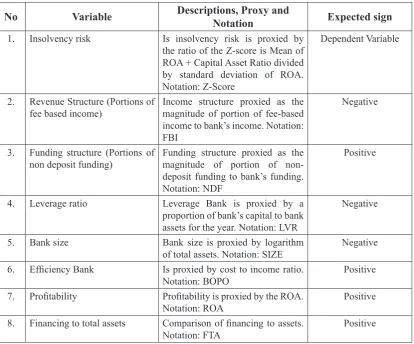
has a negative relationship with the bank’s risk. While the funding structure is proxied as amounts of non-deposit funding of funding structure of bank’s, in conducting this proxy, we expect a positive relationship between the high portion of non-deposit funding to the bank’s risk. (Demirguc-Kunt and
Table 1. Variables and Operational Definitions
No Variable Descriptions, Proxy and
Notation Expected sign
1. Insolvency risk Is insolvency risk is proxied by the ratio of the Z-score is Mean of ROA + Capital Asset Ratio divided by standard deviation of ROA. Notation: Z-Score
Dependent Variable
2. Revenue Structure (Portions of fee based income)
Income structure proxied as the magnitude of portion of fee-based income to bank’s income. Notation: FBI
Negative
3. Funding structure (Portions of non deposit funding)
Funding structure proxied as the magnitude of portion of non-deposit funding to bank’s funding. Notation: NDF
Positive
4. Leverage ratio Leverage Bank is proxied by a
proportion of bank’s capital to bank assets for the year. Notation: LVR
Negative
5. Bank size Bank size is proxied by logarithm
of total assets. Notation: SIZE
Negative
6. Efficiency Bank Is proxied by cost to income ratio. Notation: BOPO
Positive
7. Profitability Profitability is proxied by the ROA. Notation: ROA
Positive
8. Financing to total assets Comparison of financing to assets. Notation: FTA
Positive
We also include a bank-specific as a
control variable where the variable also
probably influencing on bank’s risk. We do proxy bank specific to five things: leverage ratio, bank size, efficiency, profitability and financing to assets ratio.
Leverage ratio is proxied as a proportion of capital to bank’s assets for the year (LVR), we expect this ratio is negative
and associated with the bank’s risk. High
capital indicates low risk of the bank itself (Kohler, 2014) and (Srairi, 2013). Bank size as measured by the logarithm of total bank assets. Garcia-Marco & Robles-Fernandez (2008) said the larger banks better for managing a risk so that the risk behavior is also getting smaller.
Garcia-Marco & Robles-Fernandez opinion has also strengthened by Srairi (2013) and Kohler (2014). Bank
efficiency, as measured by the cost to income ratio (BOPO). High BOPO
indicating that the bank has lower capacity on managerial and riskier and expected a positive relationship with
risk variable. Profitability, as measured by Return on Assets (bank’s net profit
versus bank assets for the year). Srairi (2013) assumes that high ROA ratio tends to the high level of risk anyway in accordance “ high-risk high return”, so we assume this variable has a positive relationship with one another. Financing to assets, Kohler (2014) says that the
more prone to the risk of exposure, so we expect this positive relationship with another.
Here are brief submitted proxy variables
and the direction of relationship in the table above.
Table 2. Descriptive Statistics
Full Sample Mean
Large Banks Mean
Small Banks Mean
Obsv. St.Dev. Obsv. St.Dev. Obsv. St.Dev.
Bank’s Risk Variable Z-score
853 5,612 5,548 171 10,582 5,938 682 4,292 4,491
Business Model Variable
FBI 853 0,194 0,153 171 0,199 0,194 682 0,196 0,150 NDF 853 0,084 0,100 171 0,065 0,077 682 0,089 0,104
Bank Specific
Variable
LVR 853 0,061 0,076 171 0,069 0,041 682 0,062 0,092
SIZE 853 14,132 1,513 171 16,154 1,212 682 13,659 1,243
BOPO 853 0,761 0,197 171 0,797 0,111 682 0,753 0,220
ROA 853 0,021 0,019 171 0,016 0,010 682 0,022 0,020
FTA 853 0,728 0,133 171 0,766 0,083 682 0,719 0,142
Noted : This data has winsorized
Then, for the empirical model, we estimate this paper by the following equation:
yit = α + β1 FBIit + β2 NDFit + β3 Bit + α1
- εit
yit is dependent variable (bank’s risk) that proxied as Z-Score, i indicating the name of bank (i = 1,2, ... etc.), t as the time period (t = 12: 2005, 3: 2006. .., 6: 2015). The FBI is the portion of fee-based income to income structure and NDF is the portion of non-deposit funding to funding structure. The bit
is controlled variables (bank specific)
is proxied by leverage ratio, bank
size, bank efficiency, profitability and financing to assets ratio.
We used a fixed effect model with General
Least Square (GLS) Weight Cross
Section as techniques of estimation, and
of the robustness test we used a fixed
effect model in the category of large banks, and random effects models for small banks. techniques of estimation are used both is the General Least Square (GLS) Weight Cross Section.
Descriptive Statistics Analysis
risk of the larger bank of Islamic banks is better than the small assets. This condition is consistent with the study
conducted by Cihak and Hesse (2008)
which says that larger Islamic banks tend to be more stable than the small Islamic banks and shows that a larger bank management is more professional than small Islamic banks.
Based on the statistical results descriptive, the share of fee-based Islamic bank is big enough where the overall average fee-based income amounted to 19.40% (0.194) of the total income of the bank’s operations. Meanwhile, if the income is derived by category, showing no
significant difference between larger
Islamic banks (19.90 %) and small Islamic (19,60 %). This result showing that Indonesian people still reluctant to use Islamic banks for the transaction an evidenced by Islamic banking assets still has the small portion (4,84 %) compared to the entire national banking assets in Indonesia 4.84 %.
In other business models, funding structure, the descriptive statistical results the amounts of non-deposit funding in the funding structure of Islamic banks amounted to 8.40% (0.084), indicating that overall funding Islamic bank is still supported by the Third Party Funds (DPK). Meanwhile, if the funding structure is derived by category, small Islamic banks have greater share (8.90%/0.089) than large Islamic banks (6.50%/0.065) more rely DPK rely for funding support, this condition showing a large Islamic banks have adequate banking facilities, such as
office services and more comprehensive
IT network, as an incentive to attract the public.
Leverage Ratio (LVR) results that overall Islamic bank capital is at 6.1% (0.061), then if we derived by category, the composition of bank capital are large banks better than small banks (0.069 this results showing a large Islamic bank’s healthier leverage. Then, Size of Islamic banks in the form of the natural logarithm of total assets, showed 14,132 that if derived by category, large banks
filled only by five banks (BNI Syariah,
BRI Syariah, Permata Syariah, BSM, Muamalat) and still have a greater score (16.154) than small banks which contains of 33 islamic banks, the statistics indicating that the Indonesian islamic banking is concentrated, because large islamic banks relative aged much longer than small islamic banks and further supported by parent company’s, which are banks that hold the majority in the portion of Indonesian banking industry. The other descriptive results that Islamic banks have a high composition
of financing in the structure of assets
(0.728), it’s showing that Islamic banks
make financing as a strategic asset in generating profits. Then, based on by
categories of banks, large banks have
high composition for financing in asset
structure (0.766) than small banks (0.719), it demonstrates that large Islamic banks more aggressively.
For overall data, the descriptive results
of Indonesian Islamic banks is efficient
enough (76.1%), and then if we scaled back on each category, small Islamic
banks is more efficient (0,753) than large
small Islamic banks have a level of good
profitability, which amounted to 0,022
rather than large Islamic banks (0,016), it demonstrates that small Islamic banks better for optimizing all of its assets to
achieve profitability.
Results
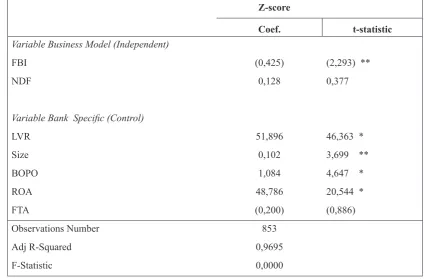
Table 3 shows that the number of observations is 853-panel observations, where Adj R-Squared of this model is at 0.9695 which shows the level of determination of the independent variable and control variable to dependent variable and can also be interpreted that Z-score can be explained as much as 96.95% by independent variables and control variables. F-Statistic on this
modeling is equal to 0.0000 thus we can conclude that the independent variable and control variable together have a
significant influence on Z-score, so that
we can say this model is good enough. Fee-based income showed negative
coefficient and the significance level
of alpha below 5%, which means that the variable fee-based income has a
significant effect on the bank’s risk and
have a negative relationship with one another. These results are consistent with the hypothesis in the previous chapter, where the greater portion of fee-based income it will make bank risk decreases, this is because the banks are more able to do diversify their income.
Table 3. Full Data Results
Z-score
Coef. t-statistic
Variable Business Model (Independent)
FBI (0,425) (2,293) **
NDF 0,128 0,377
Variable Bank Specific (Control)
LVR 51,896 46,363 *
Size 0,102 3,699 **
BOPO 1,084 4,647 *
ROA 48,786 20,544 *
FTA (0,200) (0,886)
Observations Number 853
Adj R-Squared 0,9695
F-Statistic 0,0000
Noted:
1. Data presented has winsorized.
For variable non-deposit funding has a positive relationship, but did not have
a significant effect on the bank’s risk.
These results differ from
Demirguc-Kunt and Huizinga (2010) and Kohler,
who said that the magnitude of the portion of non-deposit funding compared favorably to bank’s risk. We suspect this condition due to the still small portion of non-deposit funding from the average individual Islamic banks is only equal to 0084 of the bank’s total operating income. The small portion of non-deposit funding is also almost evenly throughout the Islamic bank, where the standard deviation of the portion of non-deposit funding only stands at 0,100 or not so far from the numbers mean. For the control variables, LVR which is the ratio of total capital to assets
showed a significant positive coefficient
on the bank’s risk, these results become
interesting because it defines a greater
capital affect bank’s risk. We speculate that is caused, banks that have large capital more aggressive in they feel meet the requirements of capital adequacy ratio (CAR).
Size showed the significant positive coefficient result which means the bigger
bank show bank risk getting bigger, this opinion is different from Kohler (2014), Srairi (2013) and Garcia-Marco and Gobles-Fernandez (2008) that says otherwise. We suspect that magnitude of risk of a large bank in accordance opinions of Ashraf et al (2016) who said that the role of major banks to the
stability of the financial industry led to
the bank’s risk behavior became more excessive (too big too fail).
Furthermore, BOPO has a significant positive coefficient figure, where this
proves more efficient bank has more
bank risk is low. While ROA also showed
a significant positive coefficient, which
means that the greater bank capitalizes
profit making bank risk becomes higher,
which is consistent with “high-risk high return”, in accordance with the Srairi opinion (2013). For FTA is the ratio of
the total financing to total assets, showed negative and insignificant, we suspect
this condition because Islamic banks
more cautious in extending financing,
where one of the fundamental aspects of Islamic banks is the underlying transactions are clear and more oriented to the sector real as revealed by Ali (2011).
Robustness Test
We conducted a robustness test which divided into two groups of Islamic banks, namely large banks, and small banks, where the large banks for assets > 12 trillion, while the small bank for assets < 12 trillion.
The total number of observations is 853 observations, with details of 171 for large banks and 682 for small banks. Adj R-squared in large banks is 0.9881, where this model can be explained by Z-score (98.81%) of all the variables that affect it. For the small bank category, Adj. R-squared appearing is equal to 0.7210 which means the level of determination and control of independent variables on the dependent variable is equal to 72.10%.
For the F-statistic, both large banks and small banks have a value of 0.0000, which means that both models (independent and control variables) have
variable (Z-score). This condition can be explained that models are good enough and reliable.
Furthermore, For the large banks, fee-based income has shown a negative
coefficient alone but has no significant
effect on bank’s risk. This situation is different with the hypothesis in the previous chapter that describes that portion of fee-based income has only a negative relationship and has the
significant effect on the bank’s risk.
While for nondeposit funding though has a positive relationship, but did not
have a significant effect on bank’s risk.
This condition is in accordance with the results of the regression on overall
data in the previous session, and also prove that the hypothesis is built not
proven. On insignificant results for all
variable independent to the Z-score, we estimated that the number of Islamic banks grouped into this categories is not
too much (only five banks).
Then, for small banks, a robustness test is consistent with the regression in the previous section, where fee-based
income has a significant influence on the
Z-score and have a negative relationship one another. This further reinforces the robustness test hypotheses built earlier and also in line with the study conducted by Kohler (2014) and Altunbas et al (2011).
Table 4. Robustness Checking
LARGE BANKS SMALL BANKS
Z-score Z-score
Coef. t-statistic Coef. t-statistic
Variable Business Model (Independent)
FBI (0,620) (1,268) (0,783) (1,729)***
NDF 0,732 0,885 0,620 1,073
Bank Specific (Control Variable)
LVR 109,399 63.034* 43,895 37,765*
Size 0,091 1,461 0,311 5,845*
BOPO 1,409 1,760*** 2,705 6,433*
ROA 89,114 10,226* 56,968 12,346*
FTA 0,408 0,510 (0,362) (0,873)*
Observation Number 171 682
Adj R-Squared 0,9881 0,7210
F-Statistic 0,0000 0,0000
Noted:
1. Data presented has winsorized.
Meanwhile, on nondeposit funding variable also showed consistent results of the regression that we did in the whole data sample in the previous session this happens because the portion of non-deposit funding on Indonesian Islamic banking is still small.
In control variables, LVR showed a
significant positive number which is
consistent with the previous regression. Size in large banks showed positive
coefficient results are not significant, we
thought that the number of samples is
not many, only covers five banks. While the small banks, size showed significant
positive numbers, this is consistent with the regression on the entire bank.
For BOPO variable, both banks (large
and small banks) showed a significant
positive number, which means that it strengthens the banks that have high BOPO indicates less adept at managing
finances, resulting in inefficient and
ultimately will make the bank’s risk is higher. ROA, variable testing is also consistent with results of previous regression where high ROA will make the bank’s risk is higher. Further to FTA, on both banks alike showed no
significant this is in accordance with
our opinion of the previous session that Islamic banks tend to be channeled to the
real sector so that high/less of financing
may not affect any of bank’s risk.
Conclusion
This study was conducted to determine
how the influence of business model of
Indonesian Islamic bank into the bank’s risk, we represent business model into 2 things, namely income structure and funding structure. Income structure is
proxied by amounts of fee-based income to operating income, while the funding structure is proxied by amounts of non-deposit funding to bank funding. On the data processing that we do, then the conclusions are as follows:
1. Income structure is shown to have a
significant effect on the bank’s risk
and has a negative correlation with each other. These results are consistent with the hypothesis that was built in the previous chapter, where the greater portion of fee-based income it will make bank risk decreases, this is because the banks are more able to do diversify their income can be more likely to survive. These results also indicate that our study is in line with the study conducted by Kohler (2014) and Altunbas et al (2011). 2. Funding structure did not have a
significant effect on bank’s risk. We
suspect this condition due to the portion of non-deposit funding of each Islamic bank is still small only equal to 0,084 (mean) of the bank’s total operating income. The small portion of non-deposit funding is also almost evenly throughout the Islamic bank, where the standard deviation of the portion of non-deposit funding only at 0,100 or not so far from mean.
Notes on Contributors
Panji Patra Anggaredho is a
practitioner of Islamic banking, His
research interest is Risk Management.
Rofikoh Rokhim is a senior lecturer of Management Department of University
of Indonesia. His research interest is
risk management, bank stability dan
References
Altunbas, Y., Mangenelli, S., Marques-Ibanez, D., (2011). Bank Risk During The Financial Crisis – Do Business Model Matter? Working Paper Series No.1394. European Central Bank. Frankfurt.
Ashraf, Dawood., Ramady, Mohamed., Albinali, Khalid., (2016). Financial Fragility of Banks, Ownership Structure and Income
Disversification: Empirical
Evidence From GCC Region.
Research in International Business and Finance, 38, 56 – 68.
Aysan, A.F., Disli, M., Duygun, M.,
Ozturk, H., (2017). Religiosity
versus rationality: Depositor behavior in Islamic and conventional banks. Journal of Comparative Economics. 000, 1-19.
Beck, T., Demirguc-Kint, A., and Merrouche, O., (2013). Islamic vs Conventional Banking, Business
Model, Eficiency and Stability. Journal of Banking and Finance, 37, 443-447.
Beck, T., Demirguc-Kint, A., and Merrouche, O., (2010). Islamic vs Conventional Banking, Business
Model, Eficiency and Stability. The World Bank Policy Research Working Paper, No.5446.
Boyd, J.H. & Graham, S.L., (1986). Risk, Regulation, and Bank Holding
Company Expansion. Quarteely Review Federal Reserve Bank of Minneapolis.
Chang, JYH., (2012). Income
Disversification and Performance
of Islamic Banks. Manchaster :
Thesis of University of Manchester.
Chong, B.S., & Liu, M., (2009). Islamic Banking: Free or Interest-Based. Pacific-Basin Finance
Journal, 17, 125 -144.
Cihak, M., & Hesse, H., (2008). Islamic
Banks and Financial Stability: An Empirical Analysis. IMF Working Paper, WP/08/16.
Demirguc-Kunt, A., & Huizinga, H., (2010). Bank Acitivity and
Funding Strategies : The Impact on Risk and Returns. Journal of Financial Economics, 98, 626 -650.
DeYoung, R., & Rice, T., (2003). Noninterest Income and Financial Performance At US Commercial Banks. Federal Reserve Bank of Chicago. Policy Studies.
DeYoung, R., & Roland, K.P., (2001). Product Mix and Earnings Volatility at Commercial Banks : Evidence From a Degree of Total Leverage Model. Journal of Financial Intermediation 10, 54-84.
Ernest & Young. (2016). “World Islamic Banking Competitiveness Report 2016.
Gamaginta, Rokhim., R., (2012) The Stability Comparison between Islamic Banks and Conventional Banks: Evidence in Indonesia.
Journal of Islamic Finance and Business Research. 1. 51–76. Garcia-Marco, T., & Robles-Fernandez,
M.D., (2008). Risk-Taking Behaviour and Ownership in The Banking Industry : The Spanish Evidence. Journal of Economics and Business 60, 332 – 354.
Hasan, M., & Dridi, J., (2010). The
Islamic and Conventional Banks: a Comparative Study. IMF Working Paper, WP/10/201.
Hassan, MK., (2006). The X-Efficiency
in Islamic Banks. Islamic Economic Studies. 3(2).
Houston, J.F., Lin, C., Lin, Ping., Ma,
Y., (2010). Creditor Rights, Information Sharing and Bank Risk Taking. Journal of Financial Economics. 96, 485 – 512.
Imam, P., & Kpodar, K., (2010). Islamic
Banking : How Has It Diffused. IMF Working Paper, WP/10/195. Karwowski, E., (2009). Financial
Stability: The Significance and
Distinctiveness of Islamic Banking in Malaysia. The Levy Economics Institute Working Paper. No.555. Kohler, M., (2014). Which Banks are
More Risky? The Impact of Business Model on Bank Stability.
Journal of Financial Stability, G Model JFS-280.
Kontot, K., Hamali, J., Abdullah.,
(2016). Determining Factors of
Customers Preferences : A Case of Deposit Products in Islamic Banking. Procedia – Social and Behaviour Science, 224, 167-175. Shahimi, Shahida.bt., Ismail, A.G.B.,
Ahmad, S.B., (2006). A Panel Data Analysis of Fee Income Activities in Islamic Banks.
Srairi, S., (2013). Ownership Structure and Risk Taking Behaviour in Conventional and Islamic Banks : Evidence for Mena Countries.
Borsa Istanbul Review, 13, 115-127.
Stiroh, K.J., & Rumble, A., (2006). The
Dark Side of Disversification : The Case of US Financial Holding
Companies. Journal of Banking and Finance. 30, 2131 – 21.