Risk Management Analysis on The Car Drivers in Indonesia
Hendro Kuntohadi
STMT Trisakti [email protected] [email protected]
Yosi Pahala
STMT Trisakti [email protected]
Rohana Sitanggang
STMT Trisakti [email protected]
ABSTRACT
Car drivers in Indonesia will always face many kinds of risks. This research contains the context determination of this research, identiies all the signiicant risks, measures the frequency and impact of all the risks, draws all the identiied risks in the chart, and describes how to manage or mitigate the risks. The dangerous risks which have high frequency and high impact are: 1) Many car drivers get the driving license without taking a driving course and without learning carefully the theory of driving a car; 2) Many car drivers get the driving license through illegal procedure; 3) Many car manufacturers eliminate some car safety equipment to lower the sales price; 4) The ingredients of the gasoline cannot fulill/match the need of the car (e.g. RON number); 5) In some places the trafic is too crowded; 6) Many damaged roads may cause accidents; 7) Many roads and transportation modes cannot fulill the demands of transportation. The recommendation (mitigation) for Risk Controlling is that all stakeholders (legislative, executive, judicative, manufacturers, people, car drivers, schools and universities, researchers, etc) should obey the regulations, moral, ethics for car riders. It is mandatory that every candidate of car driver take a course in a certiied car driving ourse. Police should arrange a complete and comprehensive reference book for car driver candidates to get a driving license.
Introduction
The result of an initial observation shows that the number of vehicles, especially cars, has increased steadily since last three years, whereas the road is still the same. The risk for car drivers in Indonesia recently has increased in terms of its frequency, scale, and iimpact. It is necessary for people of Indonesia to know what risks will happen to car drivers. They also need to know what causes the risks to happen.
In general, the car drivers in Indonesia face many risks, namely: 1. First category, the risk caused by the condition of the car drivers themselves. The example for this category is the inappropriate way of driving. The driving license (SIM) is not obtained through formal procedure;
2. Second category, the risk caused by the condition of the car driven. The example for this category is using spareparts and or accessories that are not fulilling the requirements; 3. Third category, the risk caused by the operational condition that much inluences the drivers. The example for this category is the trafic jam due to so many vehicles passing through that they make crowd.
Subsequently, 4. the fourth category, that is called method, exempliied by the issues of regulations and law enforcement. The example cause of this risk is weak law inforcement on the trafic regulations breached by the drivers; and 5. The problems and causes for all the categories of risk mentioned above will be found through a process of risk identiication.
The aims of this research are: 1. To know and analyze what risks faced by the car drivers in Indonesia; 2. To know and analyze the risk categories, especially from frequency of occurence whether the risks seldom, sometimes, or frequently occur.
Subsequently, the risk is viewed from its impact or cost to be incured to face it. The research methods used here are
bibliographical research (secondary data) and ield research (primary data). These are conducted by interviewing experienced people as “informants” and observing the situation in the ield (observation).
Results and Discussion
1. Risk Identiication
To identify the risks faced by car drivers the Cause-Effect Diagram is used. In this diagram causes and effects are described in terms of all the problems and their causes (Figure 1).
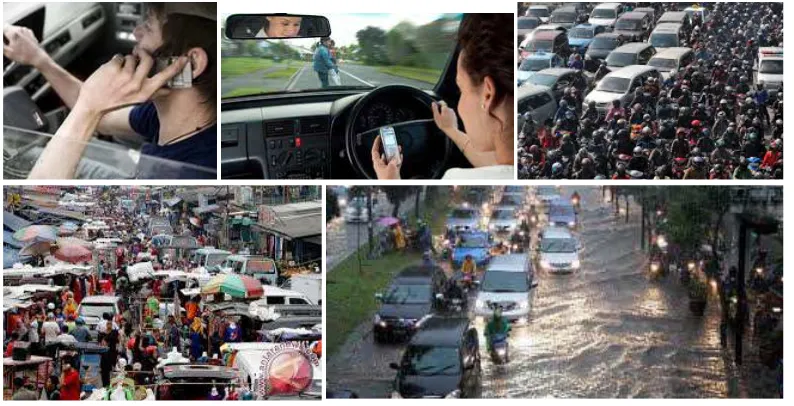
Subsequently, Figure 2 shows the Driving Manner of Car Drivers and the Operational Condidtion of Trafic in Jakarta.
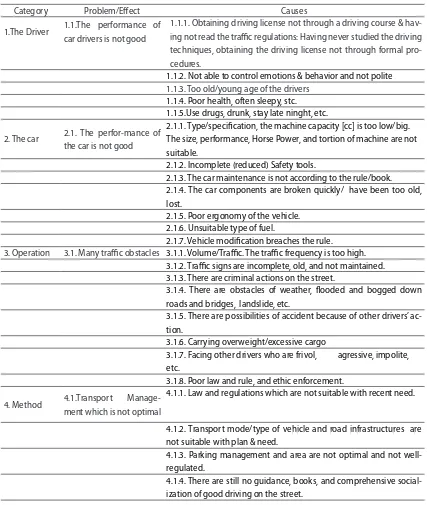
The next description is about the problems and the causes of risks faced by car drivers (Table 1).
Subsequently, the risk mapping of car drivers based on the category of human resources, car, operation, and method (Graphic 1).
Conclusion
1. The risks faced by car drivers in Indonesia can be divided into four categories:
a. Risk i: threatening the car drivers, it frequently happens with big impact. b. Risk ii: low frequency with big in Indonesia happen in the category of risk I and risk II, where as not in the category III and IV.
RISIKO PENGENDARA tidak melalui Kursus & Belum membaca buku peraturan lalu lintas. Belum pernah Belajar teknik
Mengemudi. Mendapatkan SIM tidak lewat prosedur
resmi
1.1.2.Kurang bisa Mengendalikan emosi,
&Perilaku, dan tidak Bersikap Sopan santun Cc mesin terlalu kecil/ Besar. Kinerja, Horse Power,
Torsi Mesin tidak sesuai 2.1.2.Peralatan Keselamatan cepat rusak/ sudah
tua, hilang Lalu Lintas terlalu Besar/ Tinggi
3.1.2.Rambu2 Lalu Lintas Tidak Lengkap, sudah tua,
& tidak dipelihara 3.1.3.Ada usaha Tindakan Kriminal di Jalan Raya 3.1.4.Ada Hambatan Cuaca , Jalan & jembatan Banjir, Ambles, Longsor, dll 3.1.5.Ada Kemungkinan Terjadi
Kecelakaan Lalu Lintas karena tindakan pengemudi lain
3.1.6.Membawa Muatan Berlebihan
3.1.8.Penegakan Hukum, Aturan, Etika Yang Sangat Lemah 4.1.1.Undang2/ Peraturan, Regulasi
yang sudah tidak sesuai kebutuhan masa kini
4.1.3.Pengelolaan dan lahan parkir tidak optimal & tidak
tertib 4.1.2.Moda Transportasi/ Jenis Kendaraan,
Infrastruktur Jalan Raya Tidak Sesuai rencana & Kebutuhan
4.1.4.Belum adanya panduan, buku, & sosialisasi berlalu lintas yang bagus dan
komprehensif
3.1.7. Menghadapi pengendara lain Yang ugal2an, agresif, tidak
sopan, dll
4.1.Manajemen Transportasi Yang tidak optimal
Gambar Diagram Ikan Yang Menggambarkan Masalah/Akibat dan Penyebabnya
Figure 1. Risk Identiication using Fishbone Diagram that Illustrates the Problems and the Causes of Risk faced by Car Drivers
Figure 2. Driving Manner of Car Drivers and Operational Condition of Trafic a. The parking management nearby
streets is not optimal and not well-regulated. road infrastructures have not been suitable with the plan and need.
4. Several causes of the risk in category II (low frequency with big impact): a. The drivers consume drugs, are
drunk, stay up late at night, etc. b. The drivers are not so healthy, often
sleepy, etc. but they keep driving. c. There are criminal actions on the
Category Problem/Efect Causes
1.The Driver
1.1.The performance of car drivers is not good
1.1.1. Obtaining driving license not through a driving course & hav-ing not read the traic regulations: Havhav-ing never studied the drivhav-ing techniques, obtaining the driving license not through formal pro-cedures.
1.1.2. Not able to control emotions & behavior and not polite 1.1.3. Too old/young age of the drivers
1.1.4. Poor health, often sleepy, stc. 1.1.5.Use drugs, drunk, stay late ninght, etc.
2. The car 2.1. The perfor-mance of the car is not good
2.1.1. Type/speciication, the machine capacity [cc] is too low/big. The size, performance, Horse Power, and tortion of machine are not suitable.
2.1.2. Incomplete (reduced) Safety tools.
2.1.3. The car maintenance is not according to the rule/book. 2.1.4. The car components are broken quickly/ have been too old, lost.
2.1.5. Poor ergonomy of the vehicle. 2.1.6. Unsuitable type of fuel.
2.1.7. Vehicle modiication breaches the rule. 3. Operation 3.1. Many traic obstacles 3.1.1. Volume/Traic. The traic frequency is too high.
3.1.2. Traic signs are incomplete, old, and not maintained. 3.1.3. There are criminal actions on the street.
3.1.4. There are obstacles of weather, looded and bogged down roads and bridges, landslide, etc.
3.1.5. There are possibilities of accident because of other drivers’ ac-tion.
3.1.6. Carrying overweight/excessive cargo
3.1.7. Facing other drivers who are frivol, agressive, impolite, etc.
3.1.8. Poor law and rule, and ethic enforcement.
4. Method 4.1.Transport Manage-ment which is not optimal
4.1.1. Law and regulations which are not suitable with recent need.
4.1.2. Transport mode/type of vehicle and road infrastructures are not suitable with plan & need.
4.1.3. Parking management and area are not optimal and not well-regulated.
4.1.4. There are still no guidance, books, and comprehensive social-ization of good driving on the street.
Graphic 1. Risk Mapping of Car Drivers Based on
Suggestions:
1. Many parties should pay full attention to the car drivers:
a. The government who are the executive having duties of planning, developing, and supervising.
b. The regulators: the police and the Parliament (DPR).
c. The law enforcers (especially the police).
d. Public, educators, university, research institute, transportation community.
2. Shift the risks to the third party, for example car insurance, accident insurance, health insurance, natural disaster insurance, etc.
3. Establish an organization/working unit comprising the government and private who handle the risk management of trafic.
Bibliography
Adhelia O. B, 2011. Jurnal Analisis Risiko Operasional Pada PT. Karisma
Teknika Citeurep Bogor, Bogor,
Institut Pertanian Bogor.
Bramantyo Djohanputro, 2013. Manajemen Risiko Korporat Terintegrasi. Jakarta. Penerbit PPM.
David P Doane & Lori E Seward, 2008. Essential Statistics in Business and
Economics, New York, McGraw Hill
International.
Ferry N. Idroes, 2011. Manajemen Risiko Perbankan. Jakarta. Rajawali Pers.
Herman Darmawi, 2010. Manajemen
Risiko. Padang. Penerbit Bumi
Aksara.
J Supranto, 2006. Statistik, Teori dan Aplikasi. Jakarta. Penerbit Erlangga.