View the article online for updates and enhancements.
UDP-Lite Enhancement Through Checksum Protection
Suherman*, H Abdurrahman, O S Sitompul and N Mubarakah
Electrical Engineering Department, University of Sumatera Utara
Abstract. UDP drops packet when checksum bits in header does not match the checksum bits calculated from the receive data. UDP-Late improves UDP by using partial checksum coverage. However, checksum error in both UDP and UDP-Lite headers is potentially leading to wrong decision in dropping part(s) of packet. This article proposes protocol to avoid the problem by using Forward Error Correction (FEC) code to protect checksum bits. The evaluation results show that the number of the received bytes increases up to 0.3% compared to UDP-Lite, which leads to 3 dB increment of the received image quality.
1.Introduction
Checksum is a method to detect bit error within a bit sequence. Basically, checksum adds the bit sequence and folds the results up to 16 digits. User Datagram Protocol (UDP) [1] employs checksum to check error within its packets. If error exists, packet is discharged. On the other hand, many multimedia codecs allow information with error(s) to be decoded. Dropping packets caused by checksum error is not suitable for multimedia applications. Therefore, checksum is often ignored and left empty by using zero padding. However, Internet Protocol version 6 (IPv6) does not allow zero padding on checksum [2], so that UDP should activate the checksum field.
The UDP-Lite [3] tackles UDP problem by reducing checksum coverage only for sensitive data which potentially degrades encoding process if error occurred. The UDP-Lite replaces length field on UDP header to be coverage field. Length field in UDP means the number of octets of all UDP data, while coverage field in UDP-Lite means the octet position of data which is covered by the checksum.
There is a research to improve UDP-Lite performance by adding the same functionality in medium access layer (MAC) which is referred as to mac_lite [4]. The mac_lite treats voice as a priority which removes the MAC layer checksum on voice packets but applies checksum to other types of traffics. Even though it improves UDP-Lite, the mac_lite works only in a single link, depending on the type of mac. If the mac_lite is implemented on all links, the mac_lite potentially degrades the overall performances as each link is busy with error corrections. Furthermore, the mac_lite works in MAC layer, UDP-Lite is on transport layer.
checksum bits. For evaluation purpose, this article employs Hamming code.
The addition of FEC code within UDP-Lite generates redundant or parity bits. However, as aforementioned in Section II, the coverage field on UDP-Lite does not use the whole space of length field; this article allocates the space for FEC redundant bits.
3.Research Method
In order to evaluate the proposed method impact to the streamed data, this article employs NS-2 simulator with network configuration as depicted in Figure 1. The evaluated traffic is taken from akiyo_cif.yuv, encoded using MPEG4 with bitrates 540 Kbps. The 802.11 media is used to introduce error about 5%, 10% and 15%. Constant bit rate (CBR) traffic is employed as background traffic.
Figure 1. Simulated Network
The performance metrics are the average of delay, packet loss, throughput and PSNR (Peak Signal to Noise Ratio). The proposed protocol is compared to UDP and UDP-Lite. All protocols employ checksum on their payload.
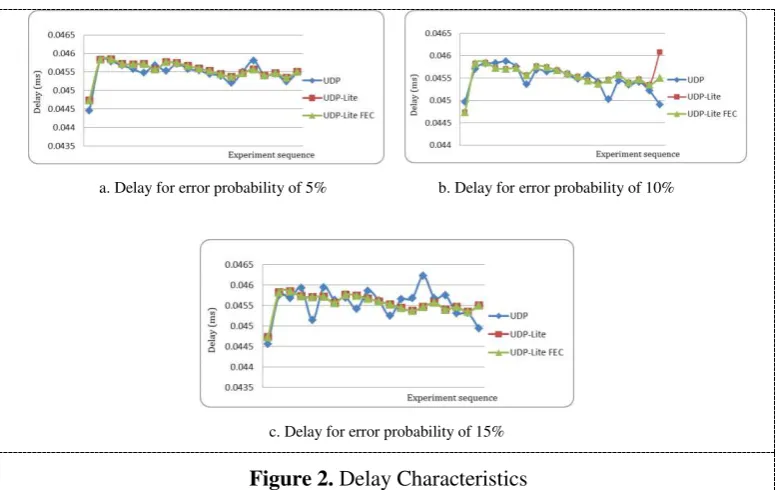
a. Delay for error probability of 5% b. Delay for error probability of 10%
c. Delay for error probability of 15%
Figure 2. Delay Characteristics
4.Results and Analysis
4.1.Delay and Jitter
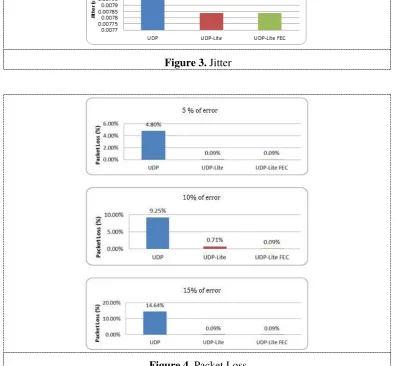
Delay characteristics are shown in Figure 2 for each error probability. Protocols delays vary around 45 ms. All protocols have almost similar delay. UDP-Lite and the proposed improvement have more stable jitter than UDP (Figure 3). UDP jitter is more than 8 ms, while UDP-Lite and the proposed one are less than 8 ms.
Figure 3. Jitter
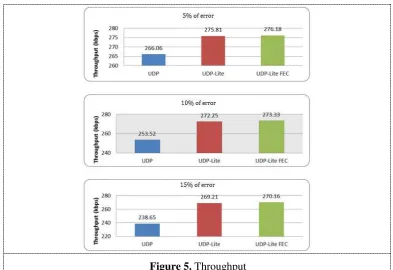
Figure 4. Packet Loss
4.2.Packet Loss
UDP drops packet once it detects checksum error. Packet will be discharged even there is only 1 bit error. It causes UDP experience tremendous packet loss. The UDP packet loss achieves 4.8% for link error rate 5%. The loss increases linearly to link error, which causes UDP suffer 9.25% and 14.64% for link error 10% and 15% (Figure 4).
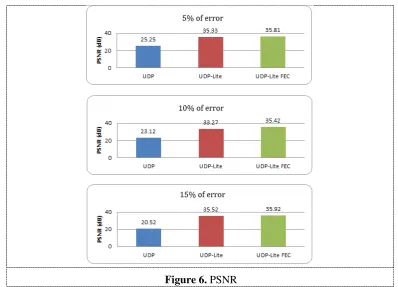
Figure 5. Throughput
4.3.Throughput and PSNR
UDP-Lite drops part(s) of the received packet when checksum detects error. The dropped byte causes the number of received bytes reduced. UDP-Lite has no capability to determine whether error occurs in data or in header. The proposed protocol improves this weakness which avoids byte reduction within the received packet when error occurs in header, so that the overall throughput improved (Figure 5).
The proposed protocol is able to increase throughput from 0.13% to 0.4% over UDP-Lite and 3.8% to 13.2% over UDP (Figure 5). In average, checksum protection using FEC within the proposed method is able to increase throughput up to 0.3% over the basic UDP-Lite. Although this improvement is relatively small, the dropped bytes reduction within video frame avoids the frame quality degradation.
Figure 6. PSNR
When the received packet is reconstructed and decoded to video image, and then compared to the original image, the result is PSNR improvement on the received image where FEC is applied. Figure 6 shows the average PSNR values for the three protocols. PSNR of the proposed protocol increases 1.12% to 6.46% over UDP-Lite and 41.8% to 75% over UDP.
5.Conclusion
To conclude, the FEC protection over the checksum bytes is able to avoid the wrong decision in dropping part(s) of Lite packet. It is proven by the increase of throughput up to 0.4% over the base UDP-Lite. Even though this increment is relatively small, it is able to improve image quality up to 3 dB in average.
On the other hand, delay and jitter are not affected by the FEC insertion. Delay and jitter are relatively similar. This article uses a simple Hamming code as FEC which results small improvement and stable delay. Future works may apply more complicated FEC codes that may increase the performance even more and its impact on delay can be explored deeper.
References
[1] Postel J 1980 User datagram protocol 1-3
[2] Deering S E 1998 Internet protocol, version 6 (IPv6) specifications
[3] Larzon L A 2002 The UDP lite protocol (Internet Engineering Task Force-Internet Draft). [4] Yang B and Zhang Z 2011 An improved UDP-lite protocol for 3D model transmission over
wireless network Proceedings of the 2011, International Conference on Informatics, Cybernetics, and Computer Engineering (ICCE2011) November 19–20 2011 Melbourne Australia 351-357 Springer Berlin Heidelberg.
[5] Alfredsson S 2001 TCP lite-a bit error transparent modification of TCP Master's thesis June [6] Schmidt F Orlea D and Wehrle K 2013 A heuristic header error recovery scheme for RTP