Bitcoin for Nonmathematicians
Exploring the Foundations of Crypto
Payments
Slava Gomzin
Bitcoin for Nonmathematicians: Exploring the Foundations of Crypto Payments
Copyright © 2016 Slava Gomzin All rights reserved.
No part of this book may be reproduced or transmitted in any form or by any means, electronic or mechanical, including photocopying, recording, or by any information storage and retrieval system,
without written permission from the publisher
Title: Bitcoin for nonmathematicians : exploring the foundations of crypto payments / Slava Gomzin. Description: Boca Raton, FL : Universal Publishers, 2016. | Includes bibliographical references and
index.
Identifiers: LCCN 2016930001 | ISBN 978-1-62734-071-7 (pbk.)
Subjects: LCSH: Bitcoin. | Money. | Electronic commerce. | Mobile commerce. | Cryptography--Data processing. | Data encryption (Computer science) | BISAC: BUSINESS & ECONOMICS / Money & Monetary Policy. | BUSINESS & ECONOMICS / E-Commerce / General. | COMPUTERS / Electronic Commerce. | COMPUTERS / Security / Cryptography.
To Svetlana
About the Author
Credits
Technical Editor Ken Westin Copy Editor
Adaobi Obi Tutton Foreword
Doug McClellan Publisher & CEO Jeff Young
Photo
Acknowledgments
Contents at a Glance
Foreword by Doug McClellan
Introduction
Part I
From Coins to Crypto
Chapter 1
Traditional Money
Chapter 2
Digital Gold
Chapter 3
Centralized Digital Payments
Chapter 4
Cryptocurrencies
Part II
Bitcoin Cryptography
Chapter 5
Types of Encryption
Chapter 6
RSA Step by Step
Chapter 7
How Elliptic Curves Work
Bonus Chapter Experimenting with the Code
References
Contents
Foreword by Doug McClellan
Introduction
Part I
From Coins to Crypto
Chapter 1
Traditional Money
Commodities versus Gold
Payment Cards
Mobile Payments
From Coins to Crypto
Chapter 2
Digital Gold
Gold Standard
E-gold
e-Bullion
Chapter 3
Centralized Digital Payments
DigiCash and ecash
Online Currencies: Flooz and Beenz
Liberty Reserve
Online Payment Processors
Chapter 4
Cryptocurrencies
Satoshi Nakamoto White Paper
Double-Spending Problem
Decentralization
Privacy: Anonymity or Pseudonymity
Blockchain
Byzantine Generals’ Problem
Mining
Part I Summary
Part II
Bitcoin Cryptography
Chapter 5
Types of Encryption
Symmetric Encryption
One-Way Hash Functions
One-Way Function and Message Digest
Collision
SHA-256
RIPEMD-160
Public-Key (Asymmetric) Cryptography
Digital Signatures
Chapter 6
RSA Step by Step
One-Way Functions
Let’s Start
Public Key: Just a Random Number
Modulus: It’s Like a Clock Dial
Encryption: Plaintext to the Power of Public Key
Private Key: Phi Function + Modular Inversion
Decryption: Ciphertext to the Power of Private Key
Chapter 7
How Elliptic Curves Work
The Graph
Horizontal Symmetry and Points of Intersection
Point Operations
Point Addition
Point Doubling
Point Multiplication
One-Way Function
Limiting the Curve for the Sake of Cryptography
Generating the Keys
Encryption
Decryption
Just a Little Bit of Math
Point Addition: C = A + B
Point Doubling: C = A + A = 2A
Now Let’s Play with the Numbers
Encryption
Decryption
Bonus Chapter Experimenting with the Code
Modulus
Modular Inversion
Representing the Points
Point Doubling
Point Addition
Point Multiplication
Calculating the Public Key
Encryption
Decryption
Part II Summary
References
Foreword
by Doug McClellan
I’m a numismatist, which is a fancy word for a coin collector. I’m also a software developer for electronic funds transfer (EFT) systems by profession and, like most readers here, also an investor.
So when Slava told me he was writing a book about bitcoins, I knew I wanted to read it because it was an area I’ve always had an interest in from the three perspectives I’ve just mentioned. Bitcoins mainly tie into the future of electronic payments, but also have been used as an investment vehicle and could very well have an impact on the future of numismatics.
I’ve been collecting coins ever since I was a kid, and started building my collection over 45 years ago with a Lincoln Cent album. For the last 25 years I’ve developed software for the retail merchant industry, and specialized in EFT systems for the convenience store market segment for the last 17 years. When you buy a soda at the convenience store or swipe your card at the pump, there is software needed to process your transaction electronically.
I will expand more on that in a bit, but first I want to introduce you to the author, Slava Gomzin. For those of you who are not familiar with his work from his blog at www.gomzin.com or from the other books he has published in the area of cybersecurity, such as Hacking Point of Sale, along with his Application Security and Cyber Privacy book series titles for electronic data security, I think you will join me in appreciating his insight in this area.
I met Slava in 1999 when we worked together to create an EFT software system through our mutual employer. Slava had emigrated from Russia to Israel when President Reagan had challenged the Russian government to allow its citizens to have more freedom in their lives. Slava was one of those people who saw the opportunity and had the courage to build a new life in a foreign country. He moved his family to Israel, where he found employment using his computer programming skills. Later he again utilized his pioneer spirit when he moved with his wife and children to America, the true land of opportunity.
company was rapidly expanding here in the United States. While managing multiple development projects with different EFT networks, he had taken an interest in cyber security, which was in its infancy at the time. He read, studied, and attended courses in cybersecurity, and has earned many certifications over the years. Slava also served on the PCI standards committee when the early standards were being developed. So, as you can see, Slava knows cybersecurity. In fact, I would say he is an expert in the field.
In this book, Slava brings the reader along on a journey from the origins of money and electronic payments and into the implementation of bitcoins as a cybercurrency.
I find the term bitcoin to be rather clever as a name. It is not, of course, a coin in the physical sense, but an electronic implementation of money represented by bits, the electronic 1s and 0s that computers use to store data. The origin of bitcoin is rather mysterious, as you will learn in the book.
Using the standard economic concepts that the value of anything is what a willing buyer will pay a willing seller in an arm’s length transaction, cost is what you give up to get something else, and money is a standardization of trade units that allow for marketplace transactions to occur, bitcoins are an attempt to create a new type of currency that is separate from a central system (such as government-issued currency) and that can also be deployed as an electronic payment system.
Throughout history, money has always been physical. The earliest coinage originated in Asia Minor about 2,500 years ago from an alloy known as electrum or “elektron” to the Greeks. It is composed of silver and gold, along with other trace metals, occurs naturally in nugget form, and is found in riverbeds. It worked well for its purpose prior to the development of technology needed to separate elements. Merchants allowed trusted customers to carry a tab (the first use of credit) and pay with electrum coins when the bill was sufficiently high. The nuggets varied in size and weight and were treated as bullion. The first designs on coins were simple striation lines, which mimicked the lines formed on the nuggets from the water flow in rivers. It was Aristotle that championed the importance of having an image on the obverse, which really transitioned bullion into true coinage.
An important characteristic of a sovereign nation is the right to issue its own coins, and America began exercising that right in 1792 by issuing pattern coins, followed by copper coins in 1793, silver coins in 1794, and gold coins in 1795. Before the denominations we have circulating today, there have been some more unusual ones, starting with the half cent in 1793, two-cent pieces (1864–1873) in which the motto “In God We Trust” first appeared, along with three-cent pieces (1851–1889). There have also been half dimes (1794–1873) and twenty-cent pieces (1875–1878). Gold coins have been minted in denominations of $1, $2.50, $3, $4, $5, $10, and $20. Gold $50 and platinum $100 coins are issued today by the US Mint, but these are considered bullion. There have been various reasons for the different denominations, but bitcoin transactions can occur in fractions of a bitcoin, making them very versatile.
As our society moves to a cashless environment, I wonder how that will impact future coin collectors. Bitcoins will never become a collectable, since they lack the characteristics of physical coins. Blockchains are free to anyone and have no varying condition state from circulating. At some future point in time, there won’t be a need for physical coinage and the billions of coins the US Mint currently produces each year will become obsolete. Will there still be an interest in collecting something that future generations would have never used for their intended purpose in their daily lives? Only time will tell.
The future of bitcoins is also unknown. Early investors had a wild ride with large gains followed by large declines as they sought to find bitcoins’ true value in relation to other currencies. They had started to obtain a reputation as taboo due to their use in criminal activities based on the notion that they can be held anonymously. But as Slava explains, bitcoins are not entirely anonymous and can be traced and tracked back to a unique IP address.
One thing is certain: bitcoins are becoming mainstream, and with their lower cost as a payment system, many merchants not only accept bitcoins as tender, some actually prefer them as a cost-saving method for processing electronic payments.
Introduction
There are no conditions of life to which a man cannot get accustomed, especially if he sees them accepted by everyone about him. —Leo Tolstoy
Several years ago I was fascinated by an experiment I did. I was trying to live cashless, paying only with plastic cards, either debit or credit. My attempt was pretty successful until I went on a business trip abroad. My first (but not last!) failure was in a restaurant, when I received a check without a placeholder for a tip amount. There were no problems paying with a credit card, but there was no way to add a tip to the bill. So I had to ask my friend (who was not participating in my experiment) to pay a cash tip. The payment system, even though it was “aware” of electronic payments, was not fully integrated into the world of plastic money. Such a situation is still common in many places, especially outside North America and Europe.
I would face similar challenges today if suddenly I decided to do the same experiment with bitcoin, but this time the limitations would be different. Instead of geographical borders that divide the world into cash and cashless zones, there is an invisible Rubicon between the offline and online worlds. In this new version of my experiment, I could live a sustainable life without cash (or plastic) if I didn’t leave my house. I could shop online and even order food from local restaurants. Whenever I needed to make a transfer of traditional money, for example, to pay the commodity bills (still virtual but counted in dollars rather bitcoins), I could exchange my bitcoins online and convert them to dollar transfer. I could even earn a living by mining the cryptocurrencies at home. However, this pattern breaks very quickly when you go offline and enter traditional brick-and-mortar stores. Few retailers today accept bitcoin or any other cryptocurrency, despite the obvious benefits: convenience, security, lower transaction fees, and attracting new generation of customers.
One of the most important goals of this book is to help people who are not closely familiar with math and cryptography to understand crypto payments. In order to do it smoothly and wisely, we need to understand several things, the first being the place cryptocurrency has in the modern payment ecosystem.
will prove it by answering very basic questions, such as what are the players in the existing electronic payments game, and whether it is possible to integrate bitcoin into it painlessly without breaking the major rules.
While I realize that the readers of this book might be in a sense obsessed with crypto payments, we should stay calm and remember that there were (and in fact still are!) other types of currencies and methods of payment. Although bitcoin enthusiasts often use the term “revolution,” from many perspectives, especially from the merchants’ point of view, creation of cryptocurrency is just an evolution of a payment system that was made possible by modern science and technology, namely cryptography and the Internet.
If you ask how to characterize bitcoin in a single word, many would answer “cryptography.” Although I agree with this answer, it is too generic, so my answer would be more specific (but contain more words): “public-key encryption and hash function.” Here is why.
If we analyze existing payment systems—predecessors of bitcoin—there are two main problems in their design: security and centralization. Security flaws in the design of payment cards resulted in the creation of PCI data security standards, which forced merchants, service providers, banks, and payment brands to invest billions of dollars into security controls, which eventually failed to protect them from data breaches. On the other hand, as you will see in part I of this book, centralized management of the first virtual currencies was the main reason for fiasco.
Bitcoin design provides solutions to both the security and centralization problems: digital signature and proof of work. A digital signature is based on public-key cryptography, while a cryptographic hash function is the essential part of both a digital signature and a proof-of-work implementation.
Before the invention of digital signatures, it was impossible to broadcast the message throughout a public channel such as the Internet and verify through multiple recipients that this message was unchanged since its creation by the original sender. Along with public-key encryption, the cryptographic hash function made creation of a digital signature possible, which protects the integrity of crypto transactions—a solution for security problems.
At the same time, a cryptographic one-way hash function, besides its participation in digital signature design, made proof-of-work implementation possible, which is a solution for centralization problems.
PART I
From Coins to Crypto
In This Part
Chapter 1: Traditional Money Chapter 2: Digital Gold
CHAPTER 1
Traditional Money
Money is like muck, not good except it be spread —Francis Bacon
Many books start telling their stories ab ovo,1 and this book is no exception. One can say that bitcoins are created from thin air. While perhaps it’s true, the idea wasn’t born in a vacuum. There was life before bitcoin, and its daring ancestors helped to build a foundation for what we recognize today as cryptocurrency. Learning more about the history of traditional and digital money and payment methods might help us to understand the common rules of the game and predict the challenges facing cryptocurrencies.
This book does not pretend to be a full reference on bitcoin design and implementation, but rather focuses on cryptography. However, it would be reckless to discuss other aspects of cryptocurrencies without reviewing its implementation, and especially without comparing this design with other cashless payment implementations, such as plastic cards.
Commodities versus Gold
There are several important criteria for choosing a commodity to become money.3 First, the
commodity should be in widespread use, or in heavy demand, so everyone would be willing to accept it as a payment for their goods. Second, it should be highly divisible so that it can be divided into small chunks in order to process micropayments, for example. Another important feature is portability, which, in most cases, is boiled down to the high value per unit weight. If money units with relative low value are too heavy, it is difficult to carry and transport them. In addition, a commodity must be highly durable so that it can be reused many times and stored for a long time as savings. Due to this last requirement, foodstuffs, for example, cannot be used as money. Another property, fungibility, means that different pieces of the material are equal, and can be equally interchanged. For example, pure gold is fungible, while coffee beans are not because they can be a different type, age, quality, weight, and so on. And finally, the commodity must have a limited supply in order to maintain its value, meaning that there should be no easy way to voluntarily add large amounts of money to the existing money turnover. Gold, silver, and other precious metals are rare elements and thus they ideally fit this requirement.
As you can see in Table 1-1, Bitcoin has much more of a chance to be accepted as money than coffee beans or salt; however, it still loses to gold, which is desirable by everyone due to historical traditions and physical characteristics.
Payment Cards
PIN (EMV) transaction flow is similar to magnetic stripe cards, but EMV cards have an enhanced cardholder authentication mechanism based on cryptography thanks to a built-in chip.
Figure 1-1: Typical Credit Card Transaction Processing Flow
Figure 1-2: Basic Bitcoin Transaction Processing Flow
In a bitcoin transaction, there is no card issuing or acquiring bank and no payment processor or gateway.
Note: In fact, a payment processor is required in many cases in order to process bitcoin transactions between merchants and customers, especially in brick-and-mortar environments. However, a simple transaction between two individuals, for example, can be done using basic tools, without any intermediary, which is impossible in the case of credit card payments.
Nevertheless, credit and debit card payments still dominate the market of both offline (initiated in brick-and-mortar stores) and online electronic payments (although Internet transactions with credit cards are often processed through special online payment processors, which are discussed later in this chapter).
Mobile Payments
customer and the point of sale (POS), with the same information being entered into the payment system (such as a token representing the banking account or credit card number). There are different technologies currently used to exchange information between the mobile wallet and the POS: Near Field Communication (NFC), barcode scanners, and even magnetic field emitters.6 One interesting implementation of mobile checkout is the Starbucks mobile payment app.7 It uses design principles
similar to what I proposed in my 2009 white paper, “Mobile Checkout”.8 The app displays the QR code,
which is scanned by the POS scanner, so the transaction is completed without physical contact between the customer device and point of sale.
Bitcoin mobile wallets also use QR codes to exchange data between the wallet and the point of sale, but the process that happens behind the scenes is completely different.
From Coins to Crypto
The chronology of world history shows that time is running much faster these days. If in the past there were hundreds or thousands of years between major inventions, nowadays major developments happen in a matter of a few years or even months. It’s not just intuitive assumption—in fact, there is a scientific theory and mathematical model that confirms these observations.9 Physicist and demographer Sergei
Kapitza explains why historical periods eventually become shorter and shorter.10
At the beginning of humanity in the Lower Paleolithic, the interval for substantial change was roughly a million years. During the Middle Ages the period of change was a thousand years, and currently the period of change is only 45 years.
Figure 1-3: Time Intervals between Major Inventions in Payment Systems
Figure 1-3 shows the shortening time intervals between major events related to the development of payment systems. The first coins were created in Lydia (now Turkey) in sixth century BC. The ancient Greeks were the first society that accepted new inventions. In the Western world, it took more than a millennium until the creation of paper money in the seventeenth century. The first bank checks, however, were already in use by Italian banks in the fourteenth century.11 The automatic clearing houses
started working in the 1970s. Diners Club created the first credit card in 1950. The first Internet payment system using “gold money”—e-gold—was introduced 46 years later in 1996, and then payment systems with the independent digital currency started right after it in 1999. And finally, the first crypto payment using the bitcoin network was performed in 2009, just 13 years after implementation of first online currency. We can see how time intervals between those major events in history of payments have been reduced from a magnitude of thousands to just a few years.
The first bank in the world was created by the Knights Templar, and it was active for almost 200 years until the full collapse of the Order of the Temple in 1314. But the failure of the first bank wasn’t the end of the banking system, which flourishes to this day. The first and once biggest bitcoin online exchange service, Mt. Gox, collapsed in 2014, just four years after it was launched in 2010. But the fact that its lifespan was so short does not necessarily mean that the entire bitcoin system is broken. It’s just that time runs faster according to the explosive growth theory.
money transfers, face-to-face payments, and so on. Second, merchants want to please as many groups of buyers as they can. There are people who have no clue about bitcoins. And there are people who don’t have access to a banking system (credit cards, checks, etc.).
CHAPTER 2
Digital Gold
The golden rule is that there are no golden rules. —George Bernard Shaw
There is a science fiction novel by Alexei Tolstoy12 called The Garin Death Ray, also known as The Hyperboloid of Engineer Garin.13 In his novel the author tells the story of a Russian engineer who
creates a “hyperboloid”—the device that emits a heat ray of tremendous power, capable of destroying any obstacles. The device got its name because of the design, which consisted of two hyperbolical mirrors made from astronomical bronze and shamonit (fictional carbonic mineral with high refractoriness). Hyperboloid, in a sense, is a prototype, or prediction of the invention of modern lasers, although the novel was written 30 years before the first real “death ray” was created in 1957.14 Garin
escapes Soviet Russia for France and finds funding for manufacturing various types and sizes of his hyperboloids. Eventually, he captures an uninhabited island in the Pacific, where, using his hyperboloids, he starts excessively mining gold from previously inaccessible depths of the Earth. With access to virtually unlimited supplies of gold, he undermines the international gold prices, which puts the world into a severe financial crisis. As a result, Garin buys the entire US industry and becomes a world dictator.
The novel was written in 1927, long before the United States stopped tying the dollar to gold in 1971. Back then, gold meant money, and money meant gold. Nowadays, gold still equals money, but not vice versa. State currencies such as the dollar and the euro became fiat money—money that is regulated by the state.
Gold Standard
fiduciary, money. Its value rests on the confidence that goods or services can be paid for (the term fiat is derived from fiat lux in Latin, which means “Let there be light.”15)
The fact that traditional money is not guaranteed by any state or by private gold reserves anymore in a sense made the creation of virtual digital currencies possible: if an official fiat currency is not backed by gold, why can’t an alternative private currency exist?
Nowadays a sudden excessive supply of gold probably would disrupt the world economy, but it would unlikely crash it completely. Ironically or naturally, however, the first truly digital currencies (Table 2-1) were tied directly to gold, just like their shiny real-life predecessors in the glorious past.
Table 2-1: Defunct Digital Gold Currencies
E-Gold
E-gold was founded in 1996 by Gold & Silver Reserve, Inc. The system was operating with precious metals—silver, gold, platinum, and palladium—which were stored in Gold & Silver Reserve vaults. The users could create accounts by buying one of the precious metals at its market price. This feature made e-gold very convenient and popular for processing international payments because user accounts were not tied to any national currency. In addition, the fluctuating rates of fiat currencies had no effect on e-gold account owners (unlike the fluctuations of the market price of precious metals).
In May 2007 a federal grand jury indicted e-gold, accusing the company of money laundering, conspiracy, and operating an unlicensed money-transmitting business.
Federal authorities accused e-gold of helping criminals collect and transfer millions of dollars in ill-gotten gains. The stakes were high, the government alleges. Criminals operating an investment scam using 10 specific e-gold accounts were able to move $146 million through the e-gold system, the indictment says. It also accuses the company of knowingly allowing child pornographers to move money through the e-gold system.16
It was the beginning of the end of the first successful digital currency and payment system. The company shut down its operations completely in 2008.
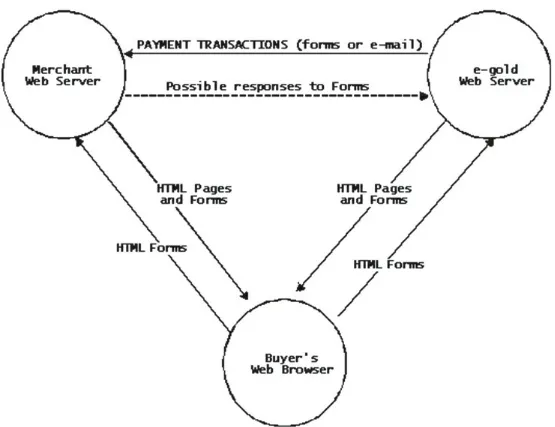
E-gold is probably the most notable digital gold currency because it was the first digital payment system that introduced, back in April 1998, one of the most important features of digital payment systems: the application programming interface (API) which allowed merchants to accept e-gold payments.17 The API specification, called the “e-gold shopping cart interface,” defined the interaction
between the three parties of online payment process using digital money: the buyer (the payer, merchant); the payee; and e-gold, the payment processor (as shown in Figure 2-1).
Source: e-gold Shopping Cart Interface specification
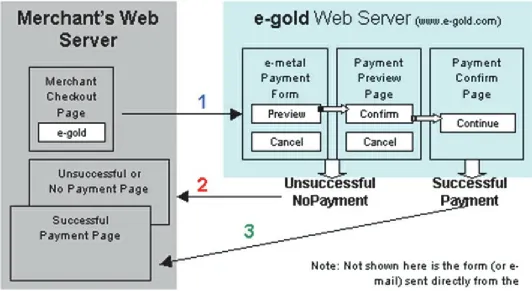
The API specification included description of flows and messages of payment, void, and return transactions, as well as security features intended to protect confidentiality and integrity of the messages between the customer’s browser, the merchant’s website, and the e-gold payment processing server (as shown in Figure 2-2).
Figure 2-2: e-gold Online Payment Transaction Flow Source: e-gold Shopping Cart Interface specification
The confidentiality of the messages was provided using the Secure Socket Layer (SSL) protocol, while the integrity was provided using the MD5 hash function (a simple analog of the digital signature). The disadvantage of the MD5 hash when compared to a full digital signature is that in addition to integrity the latter also provides the authenticity protection (you can find more detailed information about hash functions and digital signatures in chapter 5).
currency, which is linked to gold reserves stored in bank deposits. Bitcoin became the first decentralized digital currency to overcome this barrier and become a digital currency that was fully abstracted from the traditional financial systems.
Now try to replace the word “e-gold” with “US Dollar,” “Bank of America,” “PayPal,” or “bitcoin.” The indictment statement still sounds sensible. However, there is a difference between bitcoin and gold currencies such as e-gold. It was relatively easy to shut down e-gold and Liberty Reserve because they both were privately held companies with centralized systems. Such systems can be destroyed by arresting their owners and terminating their servers. National currency can be destroyed by country occupation and declaration of new currency. Bitcoin can’t be destroyed by the same means simply because it does not have owners or a specific central location.
e-Bullion
e-Bullion, another digital gold payment system, was founded by Jim Fayed and his wife, Pam Fayed, in 2001. A user could choose from three types of funds storage in an e-Bullion account: weight units of gold or silver, or US dollars (e-Bullion Gold, e-Bullion Silver, and e-Bullion Currency respectively). If a user chose one of the first two options, the account balance constantly changed depending on the market value of gold or silver.
E-Bullion did not charge any fees for deposits or money transfers between internal accounts. However, all these advantages were “compensated” by a monthly, fixed “service fee” for account maintenance. In addition, e-Bullion had a “liquidation fee” for account cancellation which was 3 percent for e-Bullion Gold and Silver and 2 percent for e-Bullion Currency. The truth was that it was just the fee for the withdrawal of funds from the account. This fee was charged for any withdrawal by bank transfer or check.
One of the most interesting features that distinguished e-Bullion from other payment systems was the fact that they probably were the first to use two-factor authentication in order to protect user accounts. Of course, this security measure was an option due to its cost (about $100). Users who were interested in higher security and were ready to pay the fee could order a special CRYPTOCard, which was made using CRYPTOCard Secure Password Technology. This card, which was implemented by e-Bullion in 2002, could be sent by mail to any place in the world. With CRYPTOCard, users could log into their accounts from any computer without having to worry about the safety of the account, whereas such operation was not recommended with regular accounts or other systems.
CHAPTER 3
Centralized Digital Payments
Everyone has as much right as he has might. —Benedict Spinoza
Since we are going to deal with crypto payments, we should understand the difference between two terms that are both associated with money: currency and a payment system. Digital currency is an independent medium of exchange which has a value and can be exchanged for goods, services, or other currency. A payment system supports the currency (including digital currency) by providing a method of exchange between different people and entities. The dollar and euro are currencies, while cash and credit cards are payment systems.
Felix Martin, in his book called Money: The Unauthorized Biography, provides the following definition of money:
Money is not a commodity medium of exchange, but a social technology composed of three fundamental elements. The first is an abstract unit of value in which money is denominated. The second is a system of accounts, which keeps track of the individuals’ or the institutions’ credit or debit balances as they engage in trade with one another. The third is the possibility that the original creditor in a relationship can transfer their debtor’s obligation to a third party in settlement of some unrelated debt.19 Note that cryptocurrencies such as bitcoin perfectly fit the first two elements of this definition. But let’s take a look at the third element, which can be translated from financial to technical language as a payment system. In addition to several digital gold currencies, there are multiple (over 20020) e-payment
systems that are not tied to gold deposits and are divided into two groups: digital currencies and online payment processors (as listed in Table 3-1 and Table 3-2 respectively).
The dollar is also a kind of digital currency in a sense because only 8 percent of all the dollars in the world exist as paper or coins, while the vast majority of most acceptable fiat money is stored as digital records in bank computers. However, despite such a close connection, the Internet environment is not a native habitat of the dollar. There are various multilayer electronic superstructures built around the dollar that allows it to be kept in virtual form.
Table 3-1: Defunct Centralized Digital Currencies
DigiCash and ecash
Although credit cards still remain the most popular method of electronic payment since they first became popular several decades ago, their security has significant flaws embedded in the original design that took place before the beginning of the Internet era. This fact encouraged many enthusiasts who tried to introduce privacy and security to online payments.
In 1983 David Chaum proposed the use of cryptography for implementing digital payments.21 He
his crypto invention, blind digital signatures.22 In 1993 Chaum invented the digital payment system
ecash. The ecash payer was anonymous but “under exceptional circumstances” could reveal her or his identity, for example, in order to provide proof of payment.23, 24 The anonymity of the payer was
achieved by blinded signatures using the RSA (Rivest, Shamir, Adleman) encryption algorithm.
According to insiders, it was a technically perfect product that made it possible to safely and anonymously pay over the Internet. This was a field in which a lot of work needed to be done, according to the ever-paranoid cryptographers. They considered paying with a credit card to be extremely insecure. Someone only had to intercept the number to be able to spend someone else’s money. Credit cards are also very cumbersome for small payments. The transaction fees are simply too high. Ecash, however, was perfectly suited for sending electronic pennies, nickels, and dimes over the Internet.25
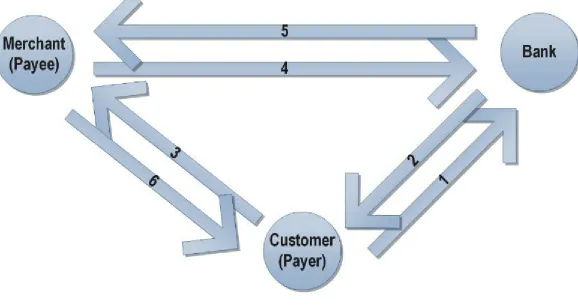
Even though ecash already contained elements of modern cryptocurrency, there was a fundamental difference: it was dependent on central management by a financial institution, which processed the actual financial transactions by debiting the payer account and crediting the payee account. The entire payment process was supposed to be implemented and orchestrated by banks. Therefore, in order to pay or get paid with ecash, both the consumer (the payer) and the merchant (the payee) had to open bank accounts, as shown in the diagram in Figure 3-1.
Figure 3-1: ecash Payment Flow
originated from the payer (isn’t it similar to bitcoin?). The public key was available for banks, merchants, and anyone else who wanted to verify the message and ecash transactions initiated by the payer (bitcoin, once again!). When the payer needed to send a payment, the following steps were performed:
1. The ecash software generated the “notes” for each required denomination according to the total amount of the transaction. A set of standard fixed denominations protected the identity of the payer by using the unique transaction amount. In addition, the payer’s client software generated a random “blinding” factor that was used to blind the denominations in order to provide anonymity (such as hiding the exact total transaction amount to make the payer impossible to identify from a relatively unique number such as $1,327.89). The blinded denominations were then encrypted with the bank’s public key and sent to the bank.
2. The bank decrypted the message using its private key, signed the blinded notes with its private key, debit the payer account, and sent the signed blinded denominations back to the payer.
3. The payer received the signed notes from the bank—and here is the most important step—took out the blinding factor. The bank signatures still remained valid, and the bank could now validate those signatures but was unable to identify the payer. So the original notes, along with the bank signatures, became the actual ecash, and the payer could send them to the payee.
4. Upon receipt of the ecash (original notes plus bank signatures), the payee validated it using the payer and the bank public key, and then could sent the message to the bank for further verification, double-spending check, and actual payment processing.
5. The bank confirmed the validity of the ecash, checked if it wasn’t spent already, and credited the payee account.
6. The payee then sent the payment confirmation back to the payer.
Perhaps the most important feature of ecash was support of both online and offline transactions. The payee could accept ecash payment offline because it was possible to validate the payer and the bank signatures offline. Of course, the offline transaction was not protected against double-spending; however, the bank could recognize the fraudulent transaction after the fact and identify the payer. Bitcoin offers a different, more elegant, completely decentralized, but not less powerful, anti-double-spending mechanism.
Online Currencies: Flooz and Beenz
beenz worked according to TIME magazine:
First, you open a free account with Beenz.com, a New York City-based outfit that’s been in business since 1998. You then earn beenz by visiting certain websites that give beenz away as a means of rewarding customer loyalty in exchange for personal information or as a reward to surfers for just showing up. Then, once your virtual wallet is bulging, you can spend beenz at any of the 200 e-commerce sites that accept beenz as a form of payment.26
The company eventually closed its operations in 2001.27
Flooz started in 1999 and also died in 2001. Similar to Beenz, it was trying to invent online currency but failed after it fell victim to a softening economy due to the dot-com bubble collapse as well as “a ring of credit card thieves operating out of Russia and other parts of eastern Europe…suspected of using stolen cards to buy the [flooz] currency.”28
Liberty Reserve
Figure 3-2: Liberty Reserve Money Transfer Scheme Source: Department of the Treasury29
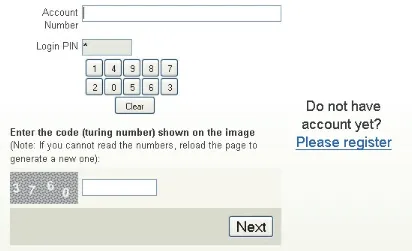
Figure 3-3: Virtual Keyboard for Entering the PIN on the Liberty Reserve Login Screen
After successfully completing the PIN entry, the system prompted the user to enter the regular password, which could be typed using either the virtual or regular keyboard. In addition, the system displayed the personal welcome message that was previously created by the user during the registration process to protect against fishing attacks. If the message displayed to the user during login is different from the one he or she chose at registration, or there is no image at all, it indicated that the login web page was faked and that the user should immediately abort the login attempt and scan the system for malware. Even today many banks still do not have such sophisticated security controls.
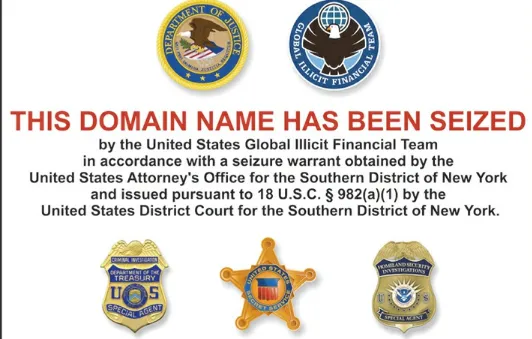
Nevertheless, eventually, it was found that Liberty Reserve facilitated money-laundering activities, and on May 2013 its funds were confiscated, the domain was seized, and the website was closed by law enforcement agencies (Figure 3-4). The indictment against Liberty Reserve contains interesting implementation details which emphasize the anonymous character of the system:
Figure 3-4: Liberty Reserve and 35 Exchangers’ Domains Have Been Seized Source: Liberty Reserve website31
The collapse of Liberty Reserve in 2013, which was preceded by a similar failure of other centralized digital currencies such as e-gold, e-Bullion, and DigiCash, finally cleared the road for decentralized crypto payment systems such as bitcoin, exactly in the same way as the shutdown of the once popular free music download site Napster in 2001 inspired creation of peer-to-peer content sharing technologies such as BitTorrent.32
However, the way in which this defunct payment system has been destroyed teaches us a lesson that should be taken into account before trusting cryptocurrencies. Liberty Reserve was using third party exchangers in order to deposit and withdraw funds from user accounts, which is very similar to how the bitcoin network functions:
avoid collecting any information about its users through banking transactions or other activity that would leave a centralized financial paper trail.
Liberty Reserve’s “exchangers” were third-party entities that maintained direct financial relationships with Liberty Reserve, buying and selling LR in bulk from Liberty Reserve in exchange for mainstream currency. The exchangers in turn bought and sold this LR in smaller transactions with end users in exchange for mainstream currency.
The Liberty Reserve website recommended a number of “pre-approved” exchangers. These exchangers tended to be unlicensed money-transmitting businesses operating without significant governmental oversight or regulation.
Eventually, not just the Liberty Reserve website and domain were destroyed, but most third-party exchangers—a total of 35 domains—were shut down.33 Thus, even though the payment processor theoretically could restore itself—for example, by setting up new servers in a different country and modifying the domain name—the whole payment network was already distrusted because its users could not make new deposits or withdraw their savings.
Unlike centralized payment systems, bitcoin and other cryptocurrencies cannot be shut down just by targeting a single domain. But their exchangers are still based on the same principles as their predecessors as they are centralized, privately owned companies located in a particular jurisdiction. By destroying local exchangers, national governments can distrust a particular crypto payment network even though they are unable to destroy the cryptocurrency as a whole.
Online Payment Processors
Nowadays, PayPal, Amazon Payments, WebMoney, and many other online payment processors dominate the market of Internet payments (major processors are listed in Table 3-2). In a nutshell, online payment processors are simply extensions, or superstructures, of the banking and credit card systems, which after all, use fiat money as a medium of exchange. Therefore, they are a great invention of their time; however, they cannot be classified as digital money.
Table 3-2: Online Payment Processors
CHAPTER 4
Cryptocurrencies
Freedom, Security, Convenience: Choose Two.35
—Dan Geer
There are many questions around the future of bitcoin. Will it eventually be accepted as a mainstream method of payment? Or, putting it in a more dramatic way, will it exist at all? Let’s face it: just a few years have passed since the invention of bitcoin, and despite many thousands of users paying with it, many merchants accepting it as legitimate tender, and various companies servicing both those users and merchants, this question is still open.
If the majority of national governments decide that they don’t want to see the powerful and unregulated alternative to their national fiat currencies and traditional payment systems anymore, together they are still able to doom it. However, what they can’t do is destroy the principles of bitcoin. Those principles are good and right, and therefore they will probably stay with us for a long time, even if they are implemented in a different form using different, perhaps even better, technologies. They were once formulated in the Satoshi Nakamoto white paper,36 and then enhanced and developed by the
bitcoin community. Even today, there are more than 200 cryptocurrencies that implement bitcoin principles, and it’s hard to believe that they will disappear.
Satoshi Nakamoto White Paper
The principles of bitcoin design were proposed in a technical white paper published by Satoshi Nakamoto in 2008. To date nobody knows who is hiding behind this name—whether it is a real person, a pseudonym, or a group of individuals. There were several attempts to identify the author(s), but nothing was concluded with realistic results.37, 38, 39, 40
Nevertheless, in one of the letters explaining the white paper, Satoshi Nakamoto defines the main properties of bitcoin:
Double-spending is prevented with a peer-to-peer network.
There is no mint or other trusted parties.
Participants can be anonymous.
41Let’s try to break down these points into several concepts so we can understand them.
Double-Spending Problem
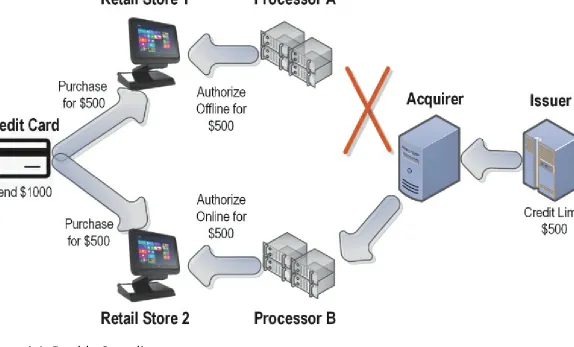
Double-spending is one of the main problems for electronic payments in general. In the plastic cards world this problem is resolved (partially) by a single point of authorization. All credit and debit transactions eventually come to the issuing bank for authorization. If the cardholder’s account has enough credit (or in case of debit cards—enough funds) available to cover the transaction amount, the issuer approves the payment.
Figure 4-1: Double-Spending
In theory, overspending can equate to more than double-spending if you find another store 3 that is also in fallback mode. In many situations, the payment system goes automatically to offline mode, for example, due to communication failure. However, there are scenarios when payment systems wittingly switch to offline approval mode—for example, in order to save on communication or transaction fees when the transaction amount (read risk of money loss) is relatively small. In any case, the merchant is the one who is taking the risk and pays in case of chargeback—the situation that occurs when the issuer rejects paying for a transaction when it comes to the settlement phase and finds that the cardholder account is empty.
Decentralization
One may ask a simple question: if the fact that bitcoin is both currency and a payment system prevents it from gaining mainstream acceptance, wouldn’t it be easier to take just the crypto payment element and link it to the existing fiat currency? Wouldn’t the resulting system—let’s call it “cryptodollar”—be a great replacement for insecure credit and debit networks? I do not rule out the possibility that there are big corporations and small startups already working in this direction. But the problem is the maintenance of such a system. Bitcoin is not maintained by just enthusiasts, at least not today. Those people earn money not just by transaction processing but also by mining—a process of creating new bitcoins. The same incentive can’t be used directly in the cryptodollar system because the Federal Reserve has exclusive rights to manufacture the new dollars. Therefore, all the cryptodollar processing nodes would need to be maintained by (or associated with) the Federal Reserve, which contradicts one of the main principles (and advantages!) of cryptocurrency—decentralization.
As we discussed in chapter 1, the reason for the failure of some pre-bitcoin virtual currencies was their centralized management. There was always a single site, or well-defined group of sites, that was responsible for maintaining the availability and integrity of the payment system. Integrity here means that there should always be a trusted party, such as a website in case of virtual currency, or an issuing bank in case of credit card payments, that is responsible for maintaining the user account balance.
Privacy: Anonymity or Pseudonymity?
Availability is one of three key principles of information security (in addition to confidentiality and integrity) which is often overlooked, or sometimes even considered a nonsecurity topic. However, when it comes to existence of the system, whether it is a social network or virtual currency, availability is the key feature that can be targeted using denial of service (DoS) attacks, for example. In case of online currencies, such as Liberty Reserve, the law enforcement agency simply obtained an order to shut down all the relevant websites, which effectively killed the entire system. In order to be resistant to DoS or government attacks, bitcoin employs a peer-to-peer network, which is “based on cryptographic proof instead of trust, allowing any two willing parties to transact directly with each other without the need for a trusted third party.” Such an approach gives us hope that bitcoin will be able to sustain most technical and political challenges that could emerge as cryptocurrencies become more popular and start seriously competing with big corporations and national governments.
In today’s world of total electronic surveillance, it’s difficult to be an active player in financial life while enjoying complete privacy, regardless of which method of payment you choose. Unfortunately, bitcoin technology is not an exception.
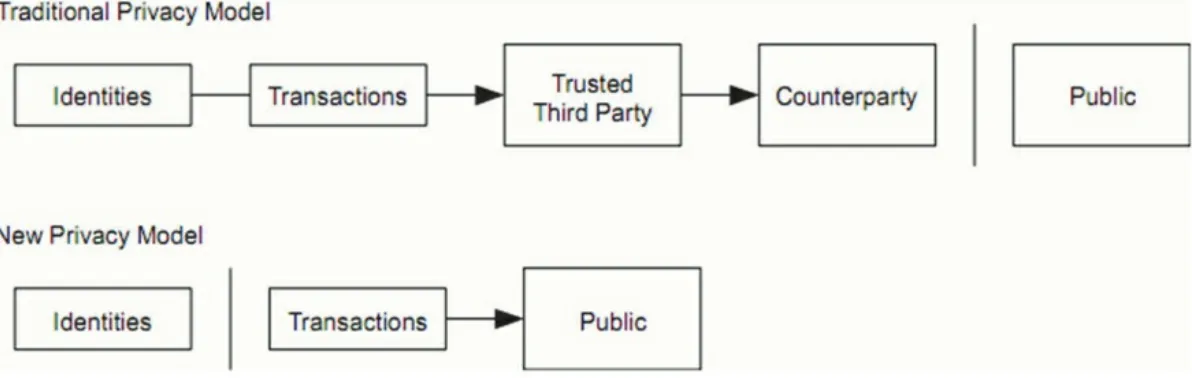
Satoshi Nakamoto’s white paper contains the following definition of bitcoin’s “new privacy model,” comparing it to the traditional approach used by the financial industry (Figure 4-2):
The traditional banking model achieves a level of privacy by limiting access to information to the parties involved and the trusted third party. The need to announce all transactions publicly precludes this method, but privacy can still be maintained.
Figure 4-2: Bitcoin Privacy Model
Source: Satoshi Nakamoto white paper
Unlike the traditional approach used by banks, where financial transaction records are kept secret, along with the identities of their owners, bitcoin transactions are stored in a public registry, or ledger, called blockchain, which is freely accessible to anyone, anytime. In this situation, the user’s identity is kept private due to the anonymity of bitcoin accounts, which are not linked to particular individuals. When creating the bitcoin wallet, there is no need to provide and prove your identity—something that is mandatory when you open a bank checking or credit account. There are advantages and disadvantages to this approach. On the one hand, there is no one who knows (and therefore can potentially disclose) your identity. On the other hand, all your transactions are permanently visible to anyone, and therefore can be potentially traced to your identity using high-tech methods of surveillance and analytics.
In chapter 3 we briefly discussed the ecash technology, which was invented and developed in the 1990s by David Chaum, who once said, “The difference between a bad electronic cash system and well-developed digital cash will determine whether we will have a dictatorship or a real democracy.”42
Perhaps ecash was the first serious attempt to resolve the privacy issue associated with electronic payments. Similar to ecash, bitcoin does not really provide full privacy and anonymity, but rather pseudonymity. There are at least two reasons.
there is no direct link between the payer identity and the bitcoin wallet—anyone can create any number of bitcoin addresses, which are simply a series of bytes, and use them anonymously. However, the very fact that transaction records are not secret makes anonymity incomplete and vulnerable because theoretically it is still possible to link the identity to the address, for example, by tracing the IP address of the machine where the wallet resides. Once the ownership of the address is determined, all the past and future payments associated with this wallet can be traced to its owner by analyzing the blockchain.
Another vulnerability of bitcoin, which makes it a pseudonymous rather than an anonymous system, is the way the funds are deposited into or withdrawn from the bitcoin network. We still live in the real world, which is far away from total adoption of cryptocurrencies. Therefore, we need a way to trade our day-to-day fiat money for bitcoins in order to make a payment, or exchange bitcoins for bucks or other national currency to accept the payment. Unlike many other electronic payment systems, the bitcoin network itself is isolated from the exchange services that trade fiat currency for bitcoins and vice versa. This isolation is good and bad. It’s good because by looking at only bitcoin blockchains it is impossible to tell where the money originally came from. It’s bad because we rely on third-party exchange services, which can be compromised just like any other financial institution, and spit out their trade records.
Unlike traditional money, which is controlled and managed by national governments and commercial banks, cryptocurrencies are governed by the rules defined by computer programmers. This is one of the major differences between the traditional and cryptocurrencies that makes bitcoin extremely transparent, understandable, and therefore trustworthy.
Blockchain
Although bitcoin implementation consists of multiple elements, blockchain without a doubt is both the heart and the brain of any cryptocurrency. In order to understand how it works, let’s try to imagine giant virtual necklace made of transaction records instead of stones or pearls. Each bead, which is called a block, consists of multiple transaction records (the number varies from a few hundred to more than a thousand43). In beadwork, in order to create a real piece of art, you cannot just randomly add different
types of beads. Instead, you should follow some patterns and rules, so before you can string another bead you need to make sure it matches the color, form, and other features of the previous bead, usually in a way only known to the artist. In a virtual world of cryptocurrencies, the new block of transactions also cannot be connected to the previous block without implementing a special procedure called proof of work (please see more details about proof of work later in this chapter in the Mining section).
that unlike real-world beadwork, where usually only a single artist is crafting with any particular beads, there are multiple nodes (owned by bitcoin users) trying to add blocks to the same blockchain simultaneously. Each node is a piece of bitcoin software running on a computer connected to the Internet. A copy of an entire blockchain is usually stored on each and every node. Therefore, each bitcoin user has instant access to the full report of every crypto transactions ever done since bitcoin was created.
The first node that manages to add a new block gets a bonus in the form of a newly created bitcoin— that’s how mining works. As I mentioned before, there are multiple nodes trying to mine—or earn new bitcoins—at the same time. According to the rules, which are hardcoded into the bitcoin software running on each node, the node must accept the newly compiled block from another node that managed to do it faster, and propagate this change to other connected peers. But what if two nodes are disconnected (which is a very normal situation in the Internet) and created two different new blocks at the same time? Or even worse—a malicious node adds a block containing a fraudulent transaction? Then we get a fork which will be resolved once the connectivity is restored. Eventually, all the nodes will accept the longest fork, or in other words, the version of the blockchain supported by majority of the nodes. This mechanism is an answer to a phenomenon called the Byzantine Generals’ Problem.
Byzantine Generals’ Problem
The Byzantine army is besieging the city. It is the evening before the decisive offensive. But the Byzantine army is heterogeneous and consists of multiple separate divisions, each of which is under the command of its own general. The forces of the Byzantines is just slightly more superior than the enemy forces, so in order to win, all the generals need to agree on the exact time and place of the attack. The problem is that communication between the generals is unreliable, and messages can be either lost or counterfeited. But the communication problem is not the worst issue. Some generals are bribed by the enemy and traitors. They want to thwart the offensive by sending false messages to other generals.
In such a difficult situation, the city will be defeated only if a majority of the generals agree on the plan of the attack by relying on a majority of the messages that match, and ignoring a minority of the messages that are different (counterfeited). Bitcoin works on the same principle: the majority always wins. Therefore, the “traitors,” who try to add new blocks containing fraudulent transactions to the blockchain, will be automatically detected and eventually ignored.
Mining
new block? The answer is simple: the one who has more power (pretty common rule, isn’t it?) In case of bitcoin it requires more processing power in order to provide proof of work by finding the appropriate hash value.
Each block has a header. One of the block header fields contains the value of the hash calculated for the previous block (double SHA-256). This way separate blocks are connected into a single blockchain. For those familiar with programming, this is what the header looks like in the code:
class CBlockHeader
Computers and Internet connections are fast these days, so bitcoin nodes can generate new blocks almost instantly as soon as new transactions come in. In order to reduce the number of forks containing the wrong blocks, bitcoin artificially increases the time interval between adding new blocks by complicating the process. The hash value of the block must meet a special condition which is called proof of work. When translated to a binary number, the value of the hash must be less than a special global bitcoin constant called target. The lower the target, the more difficult it is to generate a block. This an example of the bitcoin target value:
0000000000000000171A8B0000000000 00000000000000000000000000000000
The block header has a special variable called nonce. By changing (incrementing) the nonce and recalculating the hash, the miner can eventually find a hash value that is less than the target value, which means that this new block can be added to the blockchain and accepted by other nodes.
Part I Summary
Money and payments began from barter and commodities, which eventually inspired the creation of the first metal coins more than 2500 years ago. Since the creation of coins, invention of new tenders, such as paper money, bank checks, credit cards, mobile checkout, and online currencies, did not eliminate previous payment methods.
Digital gold currencies such as e-gold and e-Bullion were the first successful online payment systems that were backed by real gold. Ecash was the first electronic payment system based on cryptography.
There are two major groups of electronic payment systems: centralized and decentralized. E-gold, ecash, Liberty Reserve, PayPal, and Amazon Payments are all examples of centralized payment systems. However, e-gold and Liberty Reserve have been operated independently from traditional financial institutions. Bitcoin is the first decentralized payment system that also does not depend directly on banks, clearinghouses, or credit card networks.
The stories of e-gold, e-Bullion, and Liberty Reserve demonstrate that most attempts to create an independent, centralized e-money ecosystem that would be more than just an extension of traditional banking and credit card systems, but introduce a real alternative currency and protect user privacy, eventually have been executed and failed. Unlike centralized currencies, bitcoin cannot be destroyed simply by shutting down the group of Internet domains.
The principles of the bitcoin design, which are currently used by other cryptocurrencies, were first defined in a technical white paper published by Satoshi Nakamoto, a person (or a group of people) whose real identity is still unknown.
There are a few basic points of bitcoin design:
Provides a solution to the double-spending problem by processing the transaction
through a peer-to-peer network and storing them in a publicly accessible blockchain
Decentralizes the “account” management, which protects transactions from DoS
attacks and national governments
Gives bitcoin users limited anonymity, called pseudonymity
transactions.
PART II
Bitcoin Cryptography
In This Part
Chapter 5: Types of Encryption Chapter 6: RSA Step by Step
Chapter 7: How Elliptic Curves Work
CHAPTER 5
Types of Encryption
If you want to keep a secret you must also hide it from yourself. —George Orwell
From the name of the classification where bitcoin belongs—cryptocurrency—it is already clear that “crypto” is the most important component of bitcoin. But what does this mean exactly? Obviously, without an answer to this question, we will hardly be able to move on to other components of cryptocurrencies.
Two of the three main areas of information security theory—confidentiality and integrity—are essential for cryptocurrency design. The third one—availability—is also consequential, though often forgotten. Availability à la bitcoin means that your money is never lost as long as you have access to your secret key—your bitcoin address. The beauty of bitcoin is that even though it is completely virtual and electronic currency, the address can be still stored on a small piece of paper. And like any conventional money, this piece of paper can be stored offline—for example, in a bank deposit box, far away from Internet connections, which means out of reach of hackers.
While maintaining confidentiality is important in order to preserve the ownership of the currency, supporting integrity is required for keeping transaction records intact. But both confidentiality and integrity intertwine when we talk about the ability to recognize the authenticity of payment transactions as well as preventing double-spending. All those existential preconditions of successful cryptocurrency design were made possible by using cryptography.
Symmetric Encryption
but some of them are still in use—for example, the one-time pad.44 Its meaning lies in the fact that each
character in the original message—which is called plaintext in cryptography —is substituted with a new unique symbol taken from a special text—the one-time pad. The characters in the one-time pad are randomly generated, so it is impossible to predict or calculate their sequence, therefore, a one-time pad is still the simplest and most secure method of encryption.
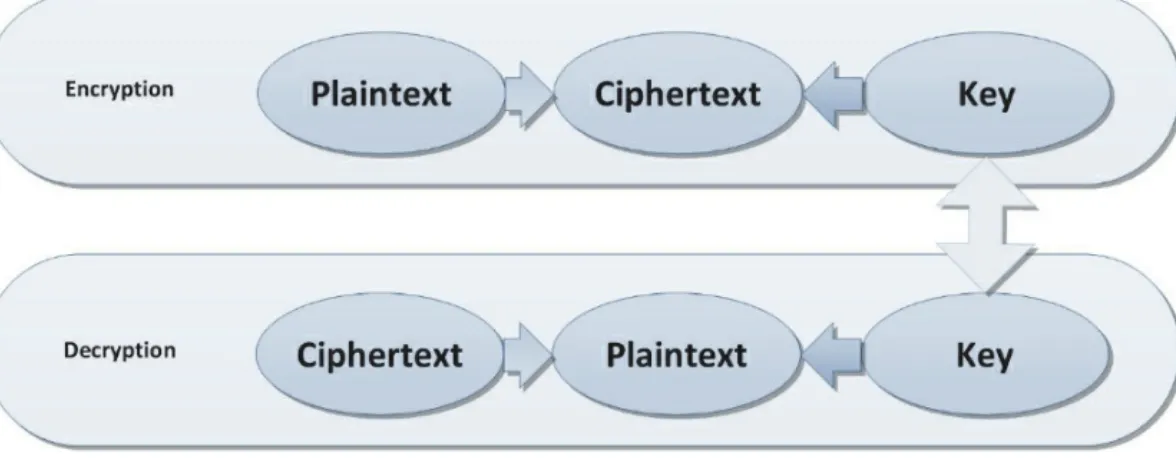
The entire sequence of special characters in the one-time pad is called a shared secret, or a key. In order to decrypt the resulting message, also called ciphertext, another party of the crypto conversation must have the same one-time pad, or the same key. Encryption algorithms using the same key for both encryption and decryption are called symmetric (Figure 5-1).
Figure 5-1: Symmetric Encryption
There are many other symmetric algorithms besides one-time pad. Some of them, such as Caesar shift cipher,45 are very old and simple, and most of them are vulnerable to cryptanalysis—a part of
cryptology, which deals with breaking the ciphers. Most modern symmetric encryption methods are based on complex algorithms and so they are sustainable to cryptanalysis, but only if they use a suitable key size. The size of the key usually determines the degree of the crypto system’s secrecy based on the simple principle “the bigger the better.” Thus, a one-time pad is the ideal cipher as its key is the same size as the size of the plaintext.
However, a one-time pad can be used only in certain situations because it must be disposable: the same one-time pad cannot be used twice to encrypt different plaintexts, otherwise the ciphertext becomes susceptible to cryptanalysis. Frequent updates required for such a bulky key are not a trivial task.
which is used each time for a new fragment of the data being encoded, called a block. Therefore, those ciphers are called block ciphers. You may already be familiar with block ciphers, which are widely used in communication and the payment security industry. For example, the Advanced Encryption Standard (AES) is the default protocol for Transport Layer Security (TLS), also known as the Secure Socket Layer (SSL), which protects the communication between your Internet browser and the web server.46 Another, older algorithm called the Data Encryption Standard (DES), or more precisely its upgraded version called Triple DES (TDES), is the standard method implemented in payment terminals and ATMs for debit card PIN encryption.47
Now hold your breath: symmetric algorithms are not used in bitcoin implementation. But you have not wasted your time reading about symmetric encryption. We had to briefly review it in order to understand how different it is from public-key cryptography, which is essential for cryptocurrency design.
The integrity and authenticity of bitcoin transactions are provided by using digital signatures, in particular the Elliptic Curve Digital Signature Algorithm (ECDSA).48
ECDSA is based on three main concepts:
One-way hash functions
Public-key (asymmetric) cryptography
Digital signatures
One-Way Hash Functions
Figure 5-2: Cryptography in Bitcoin Implementation
One-Way Function and Message Digest
door” (or “private key” in asymmetric encryption), so once the ciphertext is calculated by the hash function, there is no way to reverse it back to the original plaintext (Figure 5-3).
Figure 5-3: One-Way Hash Function
Another synonym for a way function is message digest, which is a good illustration of how one-way functions are useful in day-to-day life. For example, the digest formula called mod 10 (also known as the Luhn formula, named after its creator, Hans Peter Luhn50) is used in the payment card industry in
order to validate the primary account number (PAN) of the credit and debit cards.
When you take a look at the PAN, which is embossed on every plastic card, you can normally see 16 digits. But the unique part of this number, which actually identifies your account, is only nine digits. The first six digits are the bank identification number (BIN), which consists of the numbers assigned to the user by the financial institution (issuing bank). And the last digit is the check digit—the digest of the first 15 digits.51
When you swipe your card at the point of sale terminal, or especially when you or a cashier manually key in the number, the point of sale takes the first 15 digits, calculates the mod 10 digest value, and compares it with the value of the last digit it received as part of the entered PAN. If the two values match, the PAN is valid, and the POS will start processing the payment. If the result of the calculation is different from the digit that was actually entered, it indicates an error, which could be either a human mistake (when the card is manually keyed) or hardware failure (when the card is swiped). If any digit in the account number is altered, the result of the mod 10 calculation will always be different from the original check digit value. In the example shown in Table 5-1, if we change the first digit of the account from 4 to 5, it will not pass the validation procedure.
Collision
The mod 10 formula is very simple and can be easily calculated with pencil and paper. It produces just 1 byte of the result, which is convenient in many applications, such as PAN check digit (which we reviewed before). However, there is a problem with mod 10 algorithms: two (in fact, many) different inputs can produce the same output. Such a feature is called collision. In our example with credit card numbers, multiple different accounts may have the same check digits.
A high probability of collision in the mod 10 algorithm is not an issue for the payment card industry because the purpose of the check digit is mainly recognizing the human errors, when usually only a small part of the message (one or two digits) is altered or missing. However, if the account number has been altered on purpose, there would be no way to recognize the fact of tampering if check digit has been also re-calculated. In example shown in Table 5-2, two account numbers have the same check digit 1, and so they are both valid numbers: