Disposal of household burned garbage and risk of low birth weight in
Central Sulawesi Province, Indonesia
Puti Sari Hidayangsih,
1Dwi Hapsari Tjandrarini,
1Antonius Yudi Kristanto,
1Noor Edi W. Sukoco,
21 Center for Public Health Intervention Technology, National Institute of Health Research and Development,
Ministry of Health, Jakarta
2 Center for Health Policy, Community Development and Humaniora, National Institute of Health Research and
Development, Ministry of Health, Jakarta
Corresponding author: Puti Sari Hidayangsih, SKM, MSc.PH e-mail: [email protected] or [email protected]
Received: September 18, 2014; Revised: November 18, 2014; Accepted: November 20, 2014.
Abstrak
Latar belakang: Pembakaran sampah di dalam rumah tangga dapat mempengaruhi berat badan bayi lahir rendah (BBLR). Pada tulisan ini disajikan pembakaran sampah di rumah tangga terhadap risiko BBLR. Metode: Analisis data menggunakan sebagian data studi potong lintang Riskesdas 2013 di Provinsi Sulawesi Tengah. Data yang dianalisis ialah data bayi berusia 0-11 bulan. Berat badan bayi waktu lahir berdasarkan catatan berat bayi saat lahir yang tercatat dalam kuesioner Riskesdas. Bayi dikategorikan BBLR jika berat badan waktu lahir kurang dari 2500 gram.
Hasil: Di antara 281 bayi yang mempunyai catatan berat badan lahir terdapat 10,6% (23 bayi) yang BBLR. Bayi yang tinggal di rumah tangga dengan perilaku pengelolaan sampah dengan cara dibakar dibandingkan dengan selain dibakar mempunyai risiko 2,3 kali lipat mengalami BBLR (RRa=2,28; 95% CI=1,18-8,61). Kesimpulan: Bayi yang tinggal di rumah tangga dengan sampah dibakar dibandingkan dengan tanpa sampah dibakar mempunyai risiko lebih tinggi BBLR di Provinsi Sulawesi Tengah, Indonesia. (Health Science Indones 2014;2:89-93)
Kata kunci: berat badan lahir rendah, pembakaran sampah
Abstract
Background: The management of household waste by burning can affect the incidence of low birth weight (LBW). This paper aims to identify the burning of garbage at home and risk of low birth weight.
Methods: This analysis used a part of Riskesdas 2013 data in the Central Sulawesi Province. Subjects analyzed were infants aged 0-11 months. Baby’s weight was based on the baby’s birth weightwhich was recorded in the questionnaire of Riskesdas. The infants were categorized as LBW, if the recorded birth weight was less than 2500 grams.
Results: Out of 392 babies, 281 babies had recorded birth weightswhich could be proved by documentary evidence. The majority of babies were boys (50.9%) and lived in rural areas (58.7%). The proportion of babies who had LBW was 10.6% (23 infants). The babies who were living in households with exposure to burned garbage had 2.3-fold increased risk to be LBW [adjusted relative risk for gender and availability of window (RRa) = 2.28; 95% confi dence interval (CI) = 1.18 - 8.61].
Conclusion: The babies who live in households exposed to burned garbage condition had an increased risk to be LBW in Central Sulawesi Province, Indonesia. (Health Science Indones 2014;2:89-93)
The Indonesia Demographic and Health Survey (IDHS) in 2012 stated that infant mortality rate (IMR) in Indonesia was 32 per 1000 live births. In the Millennium Development Goals (MDGs), Indonesia is targeting a reduction of IMR of 17 per 1000 births in 2015.
A World Health Organization (WHO) news release reported that newborn or neonatal deaths account for 40% of all deaths among children under fi ve. One of the main causes of newborn deaths is low birth weight (LBW), which contributes to 60% to 80% of all neonatal deaths. The global prevalence of LBW is 15.5%.1
A previous studystated that compared with infants of normal birth weight, infants with LBW were almost 40 times more likely to die in the neonatal period, because infants with very low weight at birth had a relative risk of neonatal mortality for almost 200 times.2
Furthermore, LBW’s infants may be more at risk for motor and social development or learning disabilities, potential negative effects on their operational dynamics, hyperactivity disorders, developmental issues related with school achievement, and may experience increased chronic diseases in later life.3-6
Several factors contributed to the LBW. Previous studies noted that intrinsic and extrinsic factors in addition to economic status and maternal nutritional status affected LBW. The intrinsic factors: unhealthy behavior, maternal age (between 20-35 years), range between one pregnancy to another pregnancy, and infectious disease. While extrinsic factors that may affect the LBW are social support, psychology factor, spousal support, access to health services and antenatal care.7
Furthermore, several studies suggested that reducing the possibility of infants born with LBW can be achieved by improving the air quality.8-9 Burning
household waste is one of the common sources of air pollution beside stoves in the home, motor vehicles, industrial facilities, and forest fi res. Dioxin and particulate matter are some pollutants that emit from garbage burned and have been known as a major public health concern. Several studies showed there is an association between indoor and outdoor air pollution, especially solid cooking fuel and garbage burned, with LBW.10-11
Riskesdas 2013 reports the prevalence of infants with LBW in Indonesia is about 10.2%. Central Sulawesi Province was recorded as having the highest LBW in Indonesia (17%). Moreover, Riskesdas results showed that the Province of Central Sulawesi had one of the 4-highest-levels of air pollution in the
household because 80% of the people still use fi rewood as cooking fuel and more than 50% still burn their household waste.12
This study aimed to determine the effect of garbage burned in households in Central Sulawesi Province and the risk of LBW.
METHODS
This analysis used a part of the data of the National Basic Health Survey (Riskesdas) 2013.
The general information on Riskesdas 2013 is as follows:12
The survey was conducted in all 33 provinces in Indonesia. Riskesdas covered several aspects such as some infectious and noninfectious diseases, health care systems, medicine, community behavior, environment and so on. Information about the record of the baby’s weight at birth was part of the Riskesdas’s questionnaire.
Riskesdas sample households in 2013 were selected based on the Population Census listing (SP) 2010. The household selection process was determined by the Statistics Central Bureau (BPS) which gave a list of selected census buildings from selected census blocks.
The total sample of children under fi ve years in Riskesdas 2013, boys and girls, were 82,666 infants from 33 provinces in Indonesia. The number of infants aged 0 to 11 months in Central Sulawesi Province amounted to 392 babies. However, of that number, 281 had their weight at birth recorded and these were analyzed in this study.
To minimized recall bias, the record of a baby’s weight at birth was obtained from documented evidence such as the maternal and child’s health (MCH) book. The interviewer asked the mother to show documented evidence on the baby’s birth weight. If the mother could show one of them, then the baby’s birth weight was recorded in the questionnaire. However, if the mother was not able to show any documentary evidence, the interviewer may not be allowed to record an infants’ birth weight to the questionnaire. The data analysis included the mother’s age, mother’s education and employment, parity, prenatal care, maternal diseases during pregnancy such as malaria and tuberculosis.
We categorized the mother’s age (between 20-35, and age at risk: < 20 years or> 35 years); mother’s education level (junior high school/higher, and elementary school/ lower); mother’s work status (yes and no); parity (less than 3, and 3 or more children); mother suffered from malaria during pregnancy (yes and no); mother suffered from tuberculosis during pregnancy (yes and no); residency area (urban and rural); utilization of kitchen (separated room and not separated); availability of window (present and none); cooking fuel (fi rewood and other); and garbage treatment (burned and other).
The family’s economic status (rich and poor) based on the following manner. 12Riskesdas 2013 used
proprietary index for economic status calculation through calculations polychoric correlation (PCA) to the ownership of durable goods, such as houses, cars, motorcycles, bicycles, a refrigerator plus a few other variables. Variables forming the index were: 1) the primary source of water for drinking, 2) cooking fuel, 3) ownership defecation facilities, 4) type of toilet, 5) the fi nal disposal of feces, 6) a source of illumination, 7) motorcycles, 8) TV, 9) water heater, 10) gas cylinder 12 kg, 11) refrigerator, and 12) car.
Furthermore, the index has been formed into fi ve quintiles: lowest (quintile 1), lower middle (quintile 2), medium (quintile 3), high (quintile 4), and the highest (quintile 5). These quintiles represented the economic status in Riskesdas 2013.12 Particularly for this analysis
of LBW, the economic status was facilitated by simplifying those 5 quintiles into 2 categories, namely the family with a rich economic status (quintiles 3-5) and poor (quintiles 1-2). This study analysis used Cox regression with constant time.13
RESULTS
Out of 392 infants, 281 infants had recorded birth weights. The majority of the infants were boys (50.9%) and lived in rural areas (58.7%).
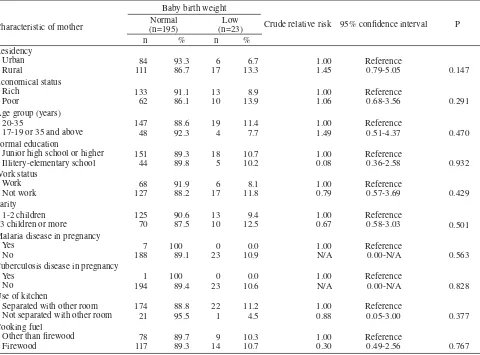
Table 1 shows that the percentage of LBW in Central Sulawesi Province was 10.6% (23/213). In terms of residential area, the percentage of LBW in urban areas was lower than in rural areas.
Table 1. Several sociodemographic characteristics, household environment variables and the risk of baby’s low birth weight
Characteristic of mother
Baby birth weight
Crude relative risk 95% confi dence interval P Normal
Junior high school or higher Illitery-elementary school
151
Malaria disease in pregnancy Yes
Tuberculosis disease in pregnancy Yes
Separated with other room Not separated with other room
Normal and LBW were similarly distributed with respect to a mother’s economic status, age group, formal education, work status, parity, history of malaria disease, history of tuberculosis disease, separation of the kitchen from other rooms, and cooking fuel.
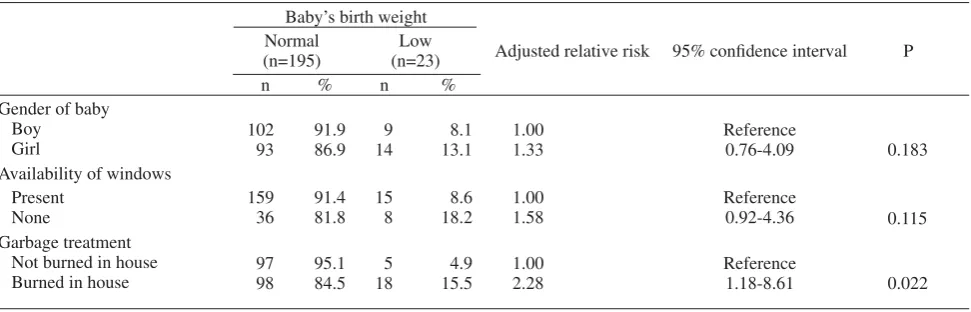
Our fi nal model, table 2, shows three dominant risk fac-tors related to LBW. Compared to a baby who lived in a house without burning garbage in house, the baby who lived in a house where garbage was burned had a 2.3-fold greater risk to be LBW [adjusted relative risk for gender and availability of windows (RRa) = 2.28; P = 0.022].
Table 2. Relationship between gender, availability of window, garbage treatment and risk of baby’s low birth weight
Baby’s birth weight
Adjusted relative risk 95% confi dence interval P Normal
(n=195)
Low (n=23)
n % n %
Gender of baby Boy
Girl
102 93
91.9 86.9
9 14
8.1 13.1
1.00 1.33
Reference
0.76-4.09 0.183
Availability of windows Present
None
159 36
91.4 81.8
15 8
8.6 18.2
1.00 1.58
Reference
0.92-4.36 0.115
Garbage treatment Not burned in house Burned in house
97 98
95.1 84.5
5 18
4.9 15.5
1.00 2.28
Reference
1.18-8.61 0.022
DISCUSSION
This study had several limitation. Incomplete data in Riskesdas 2013 may result in failure to assess a critical variable’s infl uence on LBW. For example, this study found that out of 392 infants, only 281 infants had recorded birth weights. This might due to that study sudy was conducted in area out of Javaand most of the subjects deeived from rural area, that was in Central Sulawesi Province which usualy had less couples to record their new babies. Furthermore, Riskesdas 2013 had limited environmental variables (availability of window, room utililization, type of cooking fuel, and garbage management). There are many variables which may affect LBW which were not available in Riskesdas 2013. For example duration of cooking activity, frequency of garbage burning, or type and concentration of air pollutants. However, this analysis was considered necessary because there were rare community-based study in Indonesia on the relationship environment factor related to LBW.
Using a kitchen which was separate from other rooms showed no signifi cant difference to those which were not separated. Type of cooking fuel also had no signifi cant difference between fi rewood and other types of fuel.
Our fi nal model suggested that garbage burning increased the risk of low birth weight by 2.3-fold.
This fi nding was in accordance with a study in Ghana which indicated babies born to mothers who reported garbage burning in their homes during pregnancy would increase the risk of LBW by 195%.14
Based on theory, garbage burning relates to dioxin, a hazardous chemical substance that has been shown in animal studies to severely impair fetal growth. This is because garbage burned emits smoke which contains a number of pollutants which includes carbon monoxide (CO) and some particulate matters (PM) into the air. If a human inhales CO and PM, it would impair fetal growth. CO blends with hemoglobin to penetrate the placenta and reducing oxygen supply which limits the ability of the placenta to transfer nutrients to the fetus. The PM decreases the lung function of the baby’s mother and then as a result, it reduces oxygen delivery to the fetus and causes cell damage.15-16 In addition, the
growth of fetal impairment may lead to an increased of risk of LBW.16-17
Acknowledgments
The authors wish to thank Prof. Bastaman Basuki and Dr. Elisabeth Emerson for technical assistant during preparation of this paper.
REFERENCES
1. WHO [Internet]. Geneva: Maternal, newborn, child
and adolescent health. Care of the preterm and/or low-birth-weight newborn [updated 2014 May; cited 2014 Oct 27]. Available from: http://www.who.int/ maternal_child_adolescent/topics/newborn/care_of_ preterm/en/
2. MacDorman MF, Mathews TJ.The challenge of
infant mortality: have we reached a plateau.Public Health Reports.2009.
3. Centers for Disease Control and Prevention [Internet]. Atlanta:
National Center for Environ mental Health. Environmental Health Tracking Branch [updated 2014 June 06; cited 2014 Oct 27]. Available from:http://ephtracking.cdc.gov/ showRbLBWGrowthRetardationEnv.action
4. Konstantyner T, Leite HP, Taddei AC. Effects of a
very low birth weight newborn on family: literature review. Nutr Hosp. 2007;22:138-45
5. ConleyD, BennetNG. Is biology destiny? Birth
weight and life chances. American Sociological Review.2000;65(3):458-467
6. Black RE, Allen LH, Bhutta ZA, et al. Maternal and
child undernutrition: global and regional exposures and health consequences. Lancet. 2008;371:243–60.
7. Kramer MS, Goulet L, Lydon J, et al. Socio economic
disparities in preterm birth: causal pathway and mechanisms. Paediatric & Perinatal Epidemiol. 2001;15(Suppl.2):104-23.
8. Rogers JF,Anne LD. Air pollution and very low
birth weight infants: a target population?. Pediatrics [Internet]. 2006 Jul [cited 2014 Sept 18];118(1):156-64. Available from: http://pediatrics.aappublications.org/ content/118/1/156.full
9. Bell ML. The relationship between air pollution and
low birth weight: effect by mother’s age, infants sex, co-pollutant, and preterm birth. EnvironResLett. 2008;3:44-7.
10. World Health Organization. Indoor air pollution from
solid fuels and risk of low birth weight and stillbirth: report from a symposium held at the Annual Conference of the International Society for Environmental Epide-miology (ISEE). Geneva: WHO. 2007.
11. Araban M, Kariman N, Tavafi an SS, et al. Air
pollution and low birth weight: a historical cohort study from Tehran. EMHJ. 2012;18:556-60.
12. National Institute of Health Research and Development.
Based health research report (Riskesdas) 2013.Jakarta: The Institute. 2013.
13. Baros AJ, Hirakata VN. Alternatives for logistic regression
in cross-sectional studies: an empirical comparison of models that directly estimate the prevalence ratio. BMC Med Res Methodol[Internet]. 2003 Oct 20[cited
2014Oct 16];3:21:[about 1 p.]. Available from: http:// www.biomedcentral.com/1471-2288/3/21
14. Amegah AK, Jaakkola JJK, Quansah R, et al. Cooking
fuel choices and garbage burning practices as determinants of birth weight: a cross sectional study in Accra, Ghana. Environ Health [Internet]. 2012 Oct [cited 2014 Sept 18];11:78:[about 1 p.].Available from:http://www.ehjournal.net/content/11/1/78
15. Washam C. Cooking with wood may fuel birth
weight. Kitchen smoke puts babies at risk. Environ Health Perspect. 2008;106:61-6.
16. Mishra V. What do we know about health effect
of smoke from solid fuels combustion? East-West Center working papers. Population and health series. 2004;117:1-40.
17. Smith KR, Mehta S, Freuz M. Indoor air pollution