75
UNFAVORABLE INFANT FEEDING PRACTICES IN EAST LOMBOK HAVE NOT
YET CHANGED MUCH IN THE LAST DECADE
(
PRAKTIK PEMBERIAN MAKAN BAYI YANG TIDAK TEPAT BELUM BANYAK
MENGALAMI PERUBAHAN DALAM SATU DEKADE
TERAKHIR DI LOMBOK TIMUR
)
Nur Handayani Utami1, Umi Fahmida2, Otte Santika2
ABSTRAK
Latar belakang: Salah satu kabupaten yang belum dapat mencapai target perbaikan gizi nasional adalah Lombok Timur, di mana prevalensi gizi kurang untuk anak bawah dua tahun adalah sebesar 25,5 persen. Salah satu penyebab tidak langsung dari kekurangan gizi adalah praktik pemberian makanan yang tidak tepat, yang terjadi pada tahun pertama kehidupan. Beberapa faktor yang dapat menyebabkan hal ini terjadi, yaitu pengalaman ibu, kebutuhan keluarga, sosio-ekonomi, dan kepercayaan (faktor budaya). Tujuan: Untuk mengeksplorasi kebiasaan makan bayi (ASI dan MP ASI) pada bayi umur 9-11 bulan di Lombok Timur. Metode: Studi cross-sectional (potong-lintang) ini menggunakan metode kualitatif. Pengumpulan data dilakukan dengan wawancara kelompok ibu dari bayi berumur 9-11 bulan. Konfirmasi dilakukan dengan wawancara kelompok kader, wawancara petugas kesehatan, dan observasi pada lokasi penelitian. Analisis data dilakukan dengan membuat kontras, perbandingan antar-data, dan mencari tema dari da6yuta yang tersedia. Hasil. Berdasarkan hasil studi ini, beberapa praktik pemberian makanan bayi masih belum optimal, di antaranya yaitu: pemberian ASI eksklusif, konsumsi makanan prelakteal, dan makanan “papah” masih banyak dijumpai di Lombok Timur. Pengenalan MP-ASI yang terlalu dini dan kurangnya frekuensi makan serta makanan selingan dalam sehari juga masih sering ditemui. Praktik kebersihan juga merupakan hal yang harus mendapatkan perhatian, yaitu kebiasaan minum air mentah (“air nyet”). Kurang optimalnya praktik pemberian makanan bayi di Lombok Timur ini, bahkan belum banyak mengalami perubahan sejak hampir sepuluh tahun yang lalu. Berdasarkan hasil-hasil studi yang dilakukan sebelumnya, praktik pemberian makanan pada bayi yang tidak tepat masih belum banyak mengalami perubahan pada satu dekade terakhir. Kesimpulan. Sebagian besar praktik pemberian makanan bayi di Lombok Timur masih belum optimal. Rekomendasi. Untuk meningkatkan pengetahuan ibu mengenai praktek pemberian makanan bayi yang benar, dibutuhkan materi edukasi gizi yang spesifik di daerah tersebut disertai dengan partisipasi dari tokoh agama setempat. Saluran/media lain dalam masyarakat seperti arisan atau pertemuan kampung juga direkomendasikan untuk dapat dimanfaatkan dalam menyampaikan pesan-pesan kesehatan [Penel Gizi Makan 2011, 34(1):75-85]
ABSTRACT
Background: One of the districts that haven‟t reached the national nutrition recovery target was East Lombok, the prevalence of underweight among under two children was 25.5 percent. One of the underlying causes of under-nutrition is inappropriate feeding practices that occur during the first year of life. Several factors lies behind these practices, such as experiences, family demands, socio-economic circumstances, and cultural beliefs. Objective: To explore the infant feeding (breastfeeding and complementary feeding) practices among 9-11 month infants in East Lombok. Methods: This cross-sectional study use qualitative method. Four Group Interview with the mothers of 9-11 month infants were conducted. Confirmation was done from Group Interview with the cadres, interview with local health officers and observation from study site. Analysis was done by making contrast, comparison or themes emerged from the data. Results: This study revealed that the infant feeding practices still haven‟t optimal as indicated by low exclusive breastfeeding practices for 6th month, pre-lacteal feeding and the consumption of pre-masticated foods (“papah”) still commonly happen in East Lombok. Furthermore, the early introduction of complementary food and less frequency of meals and snacks a day also still practiced. The hygiene practices also still have to be considered where the consumption of unboiled water
(“air nyet”) among infants still familiar in this area. Comparing to several studies have been conducted, these unfavorable infant feeding practices in East Lombok have not yet changed much in the last decade. Conclusion: Most of the infant feeding practices in East Lombok were haven‟t optimal. Recommendation: Local-specific nutrition education was needed with the involvement of religious leader in the community in delivering the messages. Other community channel (like arisan or pertemuan kampung) was also recommended to deliver the messages.
Keywords: infants; breastfeeding practice; complementary feeding practice
1
76 INTRODUCTION
he period from pregnancy to 24 months of age is a crucial window of opportunity for reducing under-nutrition and its adverse effects.1 The immediate consequences of poor nutrition during these formative years include significant morbidity and mortality and delayed mental and motor development. In the long-term, early nutritional deficits are linked to impairments in intellectual performances; work capacity, reproductive outcomes and overall health during adolescence and adulthood.2 Among infants, 9-11 months have the biggest nutritional needs from complementary food, while the gastric capacity still too small to support these nutritional needs. Furthermore, low appetite was commonly happening in this age group.2 Therefore, the under-nutrition is commonly happen among them.
Nevertheless, under-nutrition still become a serious public health problem among this age group. Indonesia as one of the developing country also still has to face this problem. Based on Basic Health Research the national prevalence of underweight among under-two children was 24.9 percent. This prevalence was varied between the districts. One of the districts that haven’t reached the national nutrition recovery target was East Lombok, the prevalence was 25.5 percent.3,4
According to UNICEF conceptual framework defining the causes of under-nutrition, one of the underlying causes of under-nutrition is inappropriate feeding practices that occur during the first year of life.5 The feeding practices were beginning too early or too late. Exclusive breastfeeding rate was still low and the complementary food was low in nutritional quality. Several factors influence the feeding practices by the mothers. Mothers often base their infant feeding decisions on an array of factors, including their experiences, family demands, socio-economic circumstances, and cultural beliefs.6 Therefore, this study done to explore the infant feeding practices. Objective of the Study
Objective of the study was to explore the infant feeding (breastfeeding and complementary feeding) practices among 9-11 month infants in East Lombok.
METHOD
Study Design
This was a cross-sectional study. The data collection was conducted in February 2010. Method used in this study was qualitative.
Study Population
The criteria for the subjects were: mothers of infants aged 9-11 month (on the day of the study recruitment), breastfed, apparently healthy (did not suffer from illness that may changes their food intake), and willing to join the study. The exclusion criterion was severe undernourished.
Infants aged 9-11 month was chosen because based on previous study done,7 infants in this age group hasn’t reached an optimal nutrient intake. Whereas on the final CFRs (Complementary Feeding Recommendations) developed by Linear Programming Analysis showed that with all the constraints met, calcium, iron and zinc could not achieve 2/3 recommended nutrient intake. In addition, mothers no longer cooked special foods for the 9-11 month infants; they provided their infants with foods that prepared for the whole family member. This will reduce their opportunity to consume fortified food products such as commercial milk porridge, which usually still consume by 9-11 month infants. Furthermore, this was a preliminary study of The Development of Local Nutrient-dense Complementary Feeding Recipes for 9-11 month infants.
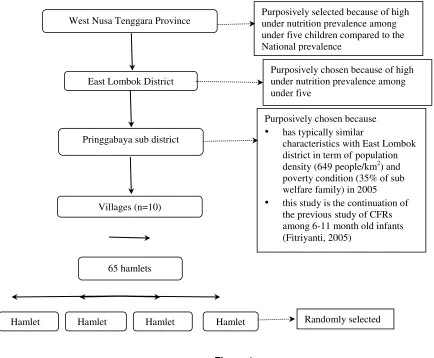
Sample Size and Sampling Procedure Four Group Interview (GI) with the caregivers and cadres were conducted in four randomly selected hamlets (each group consist of 2-6 informants). Summary of sampling method was presented in Figure 1.
77 Figure 1
Sampling Procedures in the Study
Data Collection Methods
Group Interview (GI) with caregivers was conducted 4 times in 4 randomly selected hamlets. There are no definitive rules for calculating sample sizes in qualitative research, but including at least two or three individuals per participant category in each population unit is recommended.8 The GI was done in convenient place, in cadres or in community leader house (“Kepala Dusun”). The GI of the caregivers facilitated with one facilitator. Duration of each GI was range between 60-75 minutes. All information obtained from this activity were documented and recorded by the researcher. Permission for recording the group interview was obtained prior to each GI.
The purpose of the GI with the caregivers was to explore the information on existing infant feeding practices. Variables that explored were (initiate of
breastfeeding within 1 hour after delivery, length of exclusive breastfeeding practice, pre-lacteal feeding, breastfeeding on demand, age of introduction of solid, semi-solid and soft food, meal frequency, strategies when child refuse to eat, situation of feeding, feeding during illness, type of food taboo/belief related to child feeding practices). The other information obtained from the GI with the caregivers was hygiene practice; utilization of boiled drinking water. The information of community channel in the study area was collected to identify the possible channel to deliver the health messages.
Confirmation was gathered from GI with the cadres, interview with local health officers and observation in the study site. Data Analysis
The GI with caregivers were transcribed verbatim and translated into Indonesian (when the interviews are in West Nusa Tenggara Province
East Lombok District
Pringgabaya sub district
Villages (n=10)
65 hamlets
Purposively selected because of high under nutrition prevalence among under five children compared to the National prevalence
Purposively chosen because of high under nutrition prevalence among under five
Purposively chosen because
•
has typically similarcharacteristics with East Lombok district in term of population
density (649 people/km2) and
poverty condition (35% of sub welfare family) in 2005
•
this study is the continuation ofthe previous study of CFRs among 6-11 month old infants (Fitriyanti, 2005)
78 local language). Initial matrixes were made to transfer all information from the verbatim of each GI according to each indicator. A summary of initial matrixes was made for the data’s presentation. Analysis was done by making contrast, comparison or themes emerged from the data.
RESULTS
Characteristics of Study Subjects
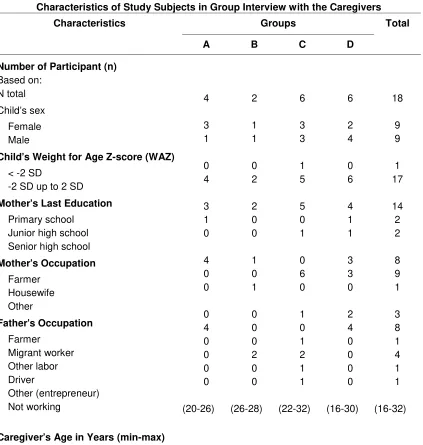
There were 18 respondents, the composition between male and female infants was equal (9:9). One respondent generation as a farmer or other occupation. The youngest mother was 16 years old and the oldest was 32 years old. All of the mothers were moslem and were Sasak tribe. While the fathers, more than half of them work as the migrant worker, the others were driver, farmer or laborer.
Table 1
Characteristics of Study Subjects in Group Interview with the Caregivers
Characteristics Groups Total
Child’s Weight for Age Z-score (WAZ)
< -2 SD
-2 SD up to 2 SD Mother’s Last Education Primary school
79 Characteristics of the cadres that join the group interview were presented in Table 2. Most of the cadres had been cadres for 3-6 years. Most of the cadres were graduated from junior high school. The level of education of the cadres in
near-market hamlets was higher than in far-market hamlets. In far-market hamlets there were still cadres that only graduated from primary school. Sixteen cadres were housewife, four were entrepreneurs and three were unemployed.
Table 2
Characteristics of Cadres Participating in GI
Characteristics
Groups
Far (n=6) Near (n=9)
Length of time being cadre, n
< 3 years 2 2
3-6 years 4 5
> 6 years 0 2
Level of education, n
Primary school graduated 2 0
Junior high school graduated 4 4
Senior high school graduated 0 4
Bachelor degree 0 1
Occupation, n
Unemployed 0 3
Housewife 3 3
Entrepreneur 1 3
Farmer 1 0
Other 1 0
Breastfeeding Practices
Half of the mothers didn’t practiced early initiation of breastfeeding; usually the reason was because the breast milk hasn’t come out yet. Most of them also didn’t practiced exclusive breastfeeding for sixth month. Some of them still practiced the previous exclusive breastfeeding recommendation, which was for 4th month. There was also some who already practiced the new recommendation, for sixth month. In contrast, some of them only practices exclusive breastfeeding as early as 2 month, and the worst was one of them directly gave the food after the baby was
born. All mothers were practiced breastfeeding on demand.
Pre-lacteal feeding was still commonly practiced. Usually, they use formula milk, honey and coconut flesh. There was differences in the belief of using coconut flesh, where in far-market hamlet they said “it was the representative of the young babies born....” While, in near-market hamlet they said “it will make the babies growth more fertile....”
80 after birth. There was a traditional habit to give pre-masticated rice (nasi papah) to the newborn infants. The rice is usually chewed in advance by the mother, and then the next day it was given to her infants. They said “it will make the infants calm....”
As the soft foods introduced early, so the other consistency of foods also introduced earlier. Almost all infants in this age were given pre-masticated foods by the mothers. Some said because it already a habit, some also said they didn’t have time to make special foods like porridge for the babies, so giving pre masticated foods will reduce their time for preparation of infants foods. They already stop to make special food for the babies, usually until 6th month. After that they gave the family food but pre-masticated. nothing when the infants refuse to eat. She said, “If he didn’t want to eat, I will let him until he ask for it….”
Regarding the situation of feeding, one mother said “Sometimes inside the food taboo/belief for particular foods. Mothers on the far-market hamlet had more taboo/belief than mothers in near-market hamlet. Some of mothers in far-market hamlet still believed that fish can make the feces smell bad, coconut milk can make diarrhea, corn can cause cough, mung bean can make itchy skin, and soda can make stomach problem. While in near-market hamlet they only avoided coconut milk. In contrast, fish head was believed to make the babies smart and this belief was still avoided giving fish because it made the feces smells fishy. However, most of the mothers, in near and far-market hamlet said there were no avoidance of a particular foods.
Hygiene practice, especially the utilization of boiled drinking water still become a problem in East Lombok, where there was still a habit to use unboiled drinking water (“air nyet”) for whole family member including for the infants. They said it will make the infants more healthy and continue their habit to use unboiled drinking water. They also said they done the practice for the efficiency of their family expenses. However, some of the mothers use boiled drinking water or mineral water. Some of them said the well water was no longer clean, so they were afraid to drink it without boiling it first. However, they admitted that still many mothers in their neighborhood gave unboiled drinking water for their infants.
Community Channel
Based on group interview with the mothers, the health information was only delivering in monthly growth monitoring program (POSYANDU). Therefore, the cadre and local health officers play important role in delivering the message to the community. However, the mothers admitted that the information of infant feeding practices was still rarely informed by cadres or local health officers to them.
81 competition etc in this celebration. With these religious environment, religious leader then take important role in the community.
DISCUSSION
The results of this study provided evidence that the infant feeding practices were haven’t optimal in East Lombok. In fact, the condition was not really much different from HKI report from the Nutrition Surveillance System they conducted in 2002 and also previous study done.7,9,10 Exclusive breastfeeding for sixth month still didn’t practiced by most of the mothers.
Early initiation of breastfeeding only practiced by half of the mothers. Moreover, pre-lacteal feeding still commonly practiced by the mothers. This condition more or less similar with HKI report that only half of the mothers practiced breastfeeding initiation within 1 hour. Exclusive breastfeeding only practiced by 12 percent infants aged 4-5 month. In that time pre-lacteal feeding such as formula milk was given to 7 percent while honey was given to 6 percent of the infants.9
82 Table 3
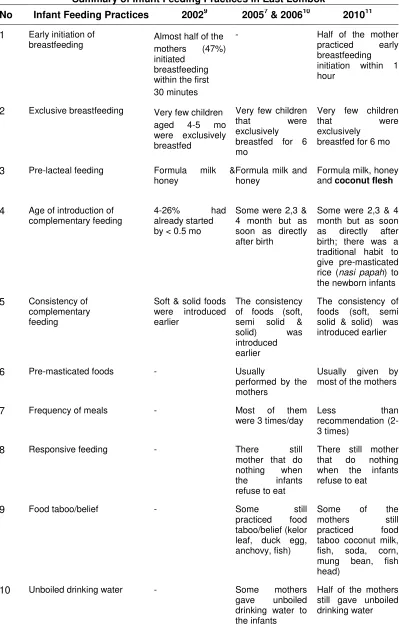
Summary of Infant Feeding Practices in East Lombok
No Infant Feeding Practices 20029 20057 & 200610 201011
1 Early initiation of
breastfeeding Almost half of the mothers (47%) initiated
2 Exclusive breastfeeding Very few children aged 4-5 mo breastfed for 6 mo
3 Pre-lacteal feeding Formula milk & honey
Formula milk and honey
Formula milk, honey and coconut flesh
4 Age of introduction of traditional habit to give pre-masticated
Soft & solid foods were introduced most of the mothers
83 This study also found that the introduction of complementary foods was beginning too early. Almost 10 years ago, HKI found approximately 12 percent of mothers introduced complementary foods within the first two months of life. HKI also found 84 percent infants already consumed solid foods from 4-5 mo.9
Previous studies done also found the similar condition. In East Lombok the early introduction of complementary foods lead to the consumption of pre-masticated foods by the infants. Some said because it already a habit.7,10 Among Sasak tribe in Lombok, mother that just deliver the babies gave pre-masticated rice (nasi papah) to
said they didn‟t have time to make special
foods like porridge for the babies.12
Therefore, this study revealed that besides cultural belief in the community,
commitment include household production, particularly time-intensive and labor-intensive task such as carrying-water or gathering fuel-wood and other economic activities including agricultural work, informal labor and formal labor activities.13 Instead of time limitation, we captured a laziness of the mothers, because based on observation in the study area; usually a housewife had enough spare time in a day that they can use to prepare special foods for their infants. Instead, they tend to give pre-masticated foods that were more
practical and didn‟t require much time.
Regarding the frequency of meals, from this study it was found that the mothers gave less meals a day than the recommendation by the WHO and Ministry of Health. Most of them gave 2-3 times a day. Even though there were still mothers
that didn‟t give snacks to the infants, the
majority of them already gave snacks to the infants.13,14
The recommendation by WHO and Ministry of Health on the frequency of feeding is calculated from the energy
needs from complementary foods and assuming a gastric capacity of 30 g/kg body weight/d and a minimum energy density of complementary foods of 0.8 kcal/g.15 When energy density of the usual complementary foods is less than 0.8 kcal/g, or infants typically consume amounts that are less than the assumed gastric capacity at each meal, meal frequency would need to be higher than the values shown above.16 Therefore, less frequency of meals and snacks in a day will lead to inadequate of energy intake and furthermore will lead to undernourished.
The study found that not all of the mothers practice responsive feeding to the infants. Some mothers tried to give vitamin to the infants, persuade or gave favorite foods when the infants refused to eat. But, there was also mother that do nothing when the infants refuse to eat. This practice was explain by Dettwyler in a series of report from Mali, that mothers tend to believe that children should control the amount of food ingested. In the presence of frequent or persistent anorexia among children, this practice will lead to under nutrition.13
Even though most of the mothers said there was no avoidance with particular foods, some mothers still practiced food taboo/belief, especially for fish. There were two contradictory beliefs on fish. Some mothers belief the fish could make the feces smells fishy, this happen especially in far-market hamlets. However, based on Group interview with mothers, all infants already consumed fish. In contrast, some mothers in near and far-market hamlets belief that the fish head could make the infants growth smarter.
Fish avoidance for the child also
happen among „Anak Dalam‟ tribes in East
Sumatera.17 While, in Bogor and Indramayu, fish was avoided by lactating mothers, because it believed can make the breast milk smell fishy so that the babies
wouldn‟t breastfeed.18
84 un boiled drinking water. In fact, they have the program that promoting the use of sun-heated water since 2003 (SODIS). practice was also happening in other place in Indonesia, such as in Purbalingga and Ende.19,20 With this regards, the factor lies behind this practice was usually the level of knowledge. Those studies found that most infection that will be danger for the infants. Water and foods is the major vehicle for the transmission of fecal pathogens.5 Therefore, the consumption of unboiled drinking water was one of the practices that should be avoided since it can be harmful for the infants.
Several reasons implied behind these unfavorable practices, one of them probably because lack of the knowledge of the community to that recommendations, or the cultural/belief that lies behind the practices in the community. This was in line with the study done by Susanti that found
there was relation between mother‟s
knowledge and community socio-culture with infant feeding practices.21 Even though
we‟re not assessed the knowledge of the
mothers but most of the mothers in this study were only graduated from primary school. Ruel et al in WHO publication stated that mothers with more schooling often have more nutritional knowledge.13 Therefore this study revealed that the low education level of mothers in East Lombok was one of the factor that lead to the unfavorable infant feeding practices. CONCLUSION AND RECOMMENDATION
Infant feeding practices in East Lombok as represent in the study were
haven‟t optimal as indicated by low
exclusive breastfeeding for 6th month, pre-lacteal feeding practice, early introduction of complementary foods, less frequency of meals and snacks a day and the consumption of pre-masticated foods
(“papah”). In fact, the condition was not really much different in the last decade. The hygiene practices also still have to be considered where the consumption of unboiled water (“air nyet”) among infants still familiar in this area.
Several factors lies behind these community, that still becomes hindering factors of an optimal infant feeding practices.
Therefore, one of the effort to solve the suboptimal infant feeding practices in East Lombok was through the nutrition education that consider the belief/related norm lies in the community, most probably through exploration studies, so there will be district-specific nutrition education. It was also important to deliver the nutrition education through other community channel (like arisan or pertemuan kampung) instead of only deliver it through monthly meeting in Posyandu. Involvement of religious leader in the community in delivering the messages was also one of the things that should be considered.
ACKNOWLEDGMENTS
The author would like to thanks to all mothers and children who participated in this study, all research team and also the local health officers, cadres and midwifes for the information and kindly cooperation. REFERENCES
85 4. Badan Penelitian dan
Pengembangan Kesehatan (Balitbangkes) Departemen Kesehatan RI. Laporan Hasil Riset Kesehatan Dasar: Provinsi Nusa
Tenggara Barat. Jakarta:
Balitbangkes Depkes RI, 2008. 5. UNICEF. Strategy for Improved
Nutrition of Children and Women in Developing Countries. New York: UNICEF, 1992.
6. Pak-Gorstein S, Haq A, Graham EA. Cultural influences on infant feeding practices. Pediatr. Rev. 2009; 30(3): e11-e21.
7. Fitriyanti S. Development of Food Based Dietary Guidelines for 6-11 Month Old Infants Using Linear Programming, in East Lombok, West Nusa Tenggara. Thesis of Post Graduate in Community Nutrition. Jakarta: SEAMEO TropMed UI, 2005.
8. Dicken K, Griffiths M, Piwoz E. Designing by dialogue: a program planners’ guide to consultative research for improving young child feeding. Washington, DC: Health and Human Resources Analysis for Africa Project, USAID, 1997.
9. HKI. Crisis Bulletin: Indonesia in Transition, Breastfeeding and Complementary Feeding; Practices in Rural Lombok. Year 4 Issue 25, December 2002.
10. Harper TB. Improving the Complementary Feeding Practices and Behaviours of Rural Indonesian Infants. Thesis of Master of Science. New Zealand: University of Otago, Dunedin, 2006.
11. Utami NH. Development of Modified Local Nutrient-Dense Complementary Food Recipes for 9-11 Month Old Infants. Thesis of Post Graduate in Community Nutrition. Jakarta: SEAMEO TropMed UI, 2010.
12. Maas LT. Kesehatan Ibu dan Anak: Persepsi Budaya dan Dampak Kesehatannya. Medan: Fakultas Kesehatan Masyarakat, Universitas Sumatera Utara, 2004. Digitalized by USU Digital Library.
13. WHO. Complementary Feeding of Young Children in Developing
Countries; A Review of Current Scientific Knowledge. Geneva, 1998. 14. Departemen Kesehatan RI. Buku Kesehatan Ibu dan Anak. Jakarta: Departemen Kesehatan dan JICA (Japan International Cooperation Agency), 1997.
15. Dewey KG, Brown KH. Update on technical issues concerning complementary feeding of young children in developing countries and implications for intervention programs. Food Nutr Bull 2003; 24(1): 5-28.
16. Dewey K. Guiding Principles for Complementary Feeding of the Breastfed Child. Geneva: Pan American Health Organization & WHO, 2001.
17. Tripitasari ID. Konsep dan Praktek Ibu dalam Pemberian ASI dan MP-ASI serta Pemantauan Pertumbuhan Balita di Komunitas Adat Tertinggal: Studi Kualitatif pada Suku Anak Dalam Sungai Teras Kabupaten Musi Rawas Sumatera Selatan. Undergraduate thesis. Semarang: Diponegoro University, 2009. Lingkungan dan Hygiene Perorangan Dengan Kejadian Demam Tifoid di Puskesmas Bobotsari Kabupaten Purbalingga. Undergraduate thesis. Semarang: Diponegoro University, 2006.
20. Rambut K. Pengetahuan, Sikap dan Praktek Kesehatan & Sanitasi: Studi Kasus Kecamatan Pulau Ende, Kabupaten Ende, NTT. Working Paper. Kupang: FKIP Universitas Flores, Ende, 2009.