The Audiovisual Translation of Humour: Dubbing
the First Series of the TV Comedy Programme
Friends
into Italian
Margherita Dore
(BA in Modern Languages, MSc in Translation Studies)
Thesis submitted for a degree of Doctor in Philosophy
Department of Linguistics and English Language
ii I hereby declare that this thesis is my own work and has not been submitted for an award of higher degree elsewhere.
iii
iv In reaching the final stage of this endeavour, I would like to thank all those people who helped and supported me throughout it. Firstly, I would like to thank my supervisor Dr. Elena Semino whose continuous guidance and support often went beyond the academic involvement a student could normally expect. Secondly, I am grateful to my family for their love and encouragement. Words may not express my affection for them but dedicating this work to them will hopefully demonstrate it.
I would also like to express my gratitude to my colleagues Yufang Ho and Dimitra Valdimirou who made this experience at the Department of Linguistics and English Language at Lancaster University more enjoyable. I would also like to thank all my friends for being there and believing I could achieve this more than myself. In particular, I would like to thank Irene Mulas, Tiziano Satta, Luca Mura, Theodoris Papadopoulos, Cleopatra Kouveli, Daniela Ponzio and George Kollias, Ramin Ramezani, Hayat Kara, Bruno Casella and Mišela Mauric, and the Italian friends in Lancaster who made these last few months unforgettable. I am particularly grateful to Michela Masci for being an enthusiastic colleague and great friend during my teaching years at the Department of European Languages and Culture at this University. Special thanks go to Yannis Katsaros for his loving support and friendship.
v Humour is a relative, idiosyncratic and generally complex phenomenon, which also varies according to culture and time. It is therefore not surprising that scholars in various fields of research (e.g. Palmer, Attardo, Oring amongst others) struggle to provide a unified definition of humour. However, they attempt to unveil the mechanisms that this phenomenon involves and the function(s) it has within the text in which it occurs. In Translation Studies, some scholars (e.g. Delabastita, Zabalbeascoa, Chiaro to name just a few) have produced a fair amount of literature on the audiovisual translation (henceforth AVT) of humour, concentrating in particular on those language and culture-specific features (punning, wordplay, allusive wordplay, etc.) that pose significant problems in translation. In doing so, they have taken into account those factors that influence the translator’s decision making process such as
time pressure and expertise.
On the grounds of these considerations, this study aims at contributing to this on-going research in the AVT of humour, and dubbing in particular. To this end, I have carried out an in-depth analysis of the original North-American and the Italian dubbed version of the first series of the TV comedy programme Friends (aired for the first
vi scriptwriters of Friends exploited wordplay, culture-specific allusions and creative
metaphors for humorous purposes. Moreover, I have found that they use these devices in order to convey idiosyncratic clues about the six main characters and to enhance the themes of the series (i.e. friendship, interpersonal relationships, work, and sex). My contrastive analysis of the ST and the TT indicates that the Italian translators were sensitive to the role these mechanisms play in the success of the series. Hence, they deployed several translation strategies to retain them, which often resulted in a high level of manipulation of the ST. More importantly, my research demonstrates that such a manipulation produced some interesting differences between the two datasets in terms of humour potential. Finally, it confirms that dubbing can greatly influence
the translators’ decision making process. As a matter of fact, this translation mode
vii AVT: Audiovisual Translation
BT: Blending Theory
CMT: Conceptual Metaphor Theory FEI: Fixed Expression and Idiom
GTVH: General Theory of Verbal Humour HS: Humour Studies
KR: Knowledge Resource LA: Language
LM: Logical mechanism NS: Narrative strategy RQ: Research Question SC: Source Culture SI: Situation
SL: Source Language SO: Script opposition
SSHT: Semantic Script Theory of Humour ST: Source Text
TA: Target
viii
1.2 The Scope of this Study: Humour and its Translation 2
1.3 A Preliminary Introduction to Friends 5
1.3.1 World-Wide Success 6
1.3.2 Academic Research 7
1.4 Research Questions 10
1.5 The Structure of the Thesis 12
Chapter 2. Humour Studies and Humour in Comedy 16
2.1 Introduction 16
2.2 Defining Humour and its Relationship with Laughter 18
2.3 Overview of the Theories of Humour 21
2.4 Script-Based Theories 26
2.4.1 The Semantic Script Theory of Humour 27
2.4.2 The General Theory of Verbal Humour 34
2.4.3 Application of the GTVH and Some Criticism 38
2.5 Humour in Conversation 40
2.5.1 Function(s) of Humour in Conversation 42
2.6 Humour in TV Comedy 44
2.7 Conclusions 47
Chapter 3. Audiovisual Translation and Humour 49
3.1 Introduction 49
3.2 Audiovisual Translation (AVT) 50
3.3 Subtitling 55
3.4 Dubbing 57
3.4.1 Constraints and Advantages of Dubbing 60
3.5 Italy and its Dubbing Tradition 64
3.5.1 Historical Background 65
3.5.2 Present Situation 66
3.6 On the (Im)Possibility of Translating Humour 73
3.6.1 Attardo’s Theory of Humour Translation 78
3.7 The AVT of Humour 80
3.7.1 Priorities and Strategies in the AVT of Humour 82
3.8 Conclusions 88
Chapter 4. Data and Methodology 91
4.1 Introduction 91
4.2 The Data 92
4.2.1 Description of Friends 92
4.2.2 Reasons for Choosing this Data 94
4.3 Some Considerations Regarding the ST and TT 95
4.3.1 The Two Parallel Corpora 95
4.3.2 Canned Laughter 98
4.4 Methodology 102
4.4.1 Technical Issues 103
4.4.2 Identifying Instances of Potential Humour in the Data 104
4.4.3 Identifying Script Oppositions and Targets in the Data 110
4.4.4 Further Methodological Issues 113
Chapter 5. Humorous Wordplay 116
5.1 Introduction 116
5.2 Wordplay 119
ix
5.6 Puns Based on Fixed Expressions and Idioms (FEIs) 149
5.6.1 Categorisation of FEIs 150
5.6.2 FEIs and Variation 152
5.6.3 Variation of FEIs and Humour 156
5.7 Translation of FEI-Based Puns 158
5.7.1 Translation Strategies for FEI-Based Puns 159
5.8 Data Analysis 163
6.2 Defining the Concept of Culture-Specific Allusion 188
6.3 Categorisation of Culture-Specific Allusions 189
6.3.1 Types of Culture-Specific Allusions 190
6.3.2 Sources of Culture-Specific Allusions 192
6.4 Function(s) of Humorous Culture-Specific Allusions 194
6.5 (AV)Translation of (Humorous) Culture-Specific Allusions 197
6.5.1 Translation Strategies for allusive Proper-Names (PNs) 199
6.5.2 Translation Strategies for allusive Key-Phrases (KPs) 201
6.5.3 The AVT of Humorous Culture-Specific Allusions 203
6.6 Data Analysis 207
6.6.1 Transference of SL Name 210
6.6.2 Explanation (or Retention and Guidance) 214
6.6.3 Replacement by SL Name 216
6.6.4 Neutralisation or Omission and Use of Common Noun 219
6.6.5 Omission of Name 224
7.4 Complementary use of CMT and BT 256
7.5 Metaphor and Humour 258
7.7.3 A Complex Example: SEX IS A ROCK CONCERT 285
7.8 Findings and Conclusions 294
Chapter 8. Conclusions 300
8.1 Introduction 300
8.2 Main Findings 301
x
8.3.1 Implications for HS 314
8.3.2 Implications for TS 316
8.4 Issues Arising From the Analysis 318
8.4.1 Limitations of this Study 319
8.4.2 Humour and Canned Laughter 319
8.5 Suggestions for Further Research 321
Appendix I – Summary of Episodes 324
Appendix II – Humorous Wordplay 334
Appendix III – Humorous Culture-Specific Allusions 338
Appendix IV – Humorous Metaphors 345
CD-Rom Content 348
Bibliography 349
Primary Online Resources 378
xi
Figure 2.1:Reproduction of the hierarchical organisation of Knowledge Resources 36
Figure 3.1:Hours of dubbed and subtitled programmes broadcast weekly in Italy 67
Figure 3.3:Percentages of dubbed programmes broadcast weekly on national Italian channels 67
Figure 6.1:Revision of Ramière’s model of procedures for the translation of source-culture
allusions 206
Figure 7.1:Grady et al.’s conceptual integration network: surgeon as butcher 254
Figure 7.2:Conceptual integration network: SEX IS A ROCK CONCERT, Men’s point of view 289
Figure 7.3:Conceptual integration network: SEX IS A ROCK CONCERT, Women’s perceived
xii
Table 2.1: Reproduction of Attardo’s (1994) categorisation of Theories of Humour 23
Table 2.2:Summary of Script Oppositions postulated in Raskin (1985) 30
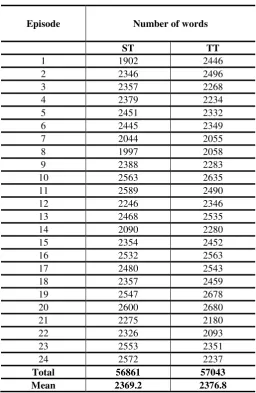
Table 4.1:Number of spoken words in the ST and the TT 96
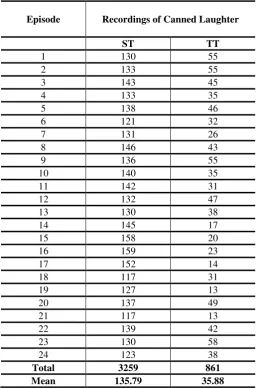
Table 4.2:Recordings of canned laughter in the ST and the TT 100
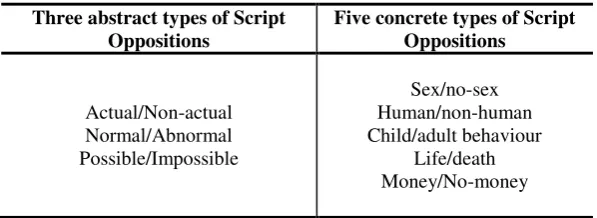
Table 4.3:Summary of Script Oppositions used during the analysis in this thesis 112
Table 5.1:Modified version of Delabastita’s (1996) typology grid 123
Table 5.2:Summary of Delabastita’s (1996) suggested translation strategies 126
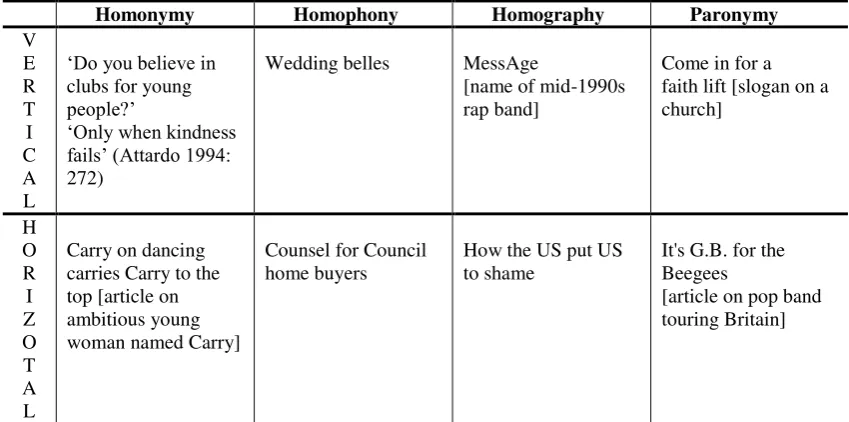
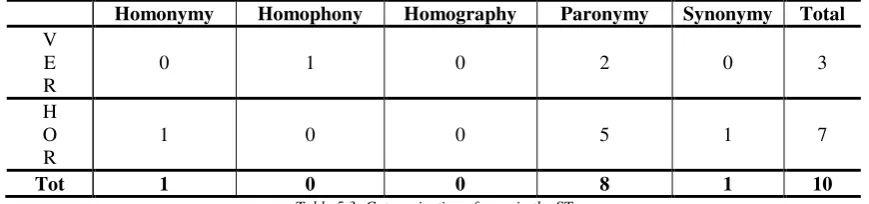
Table 5.3:Categorisation of puns in the ST 128
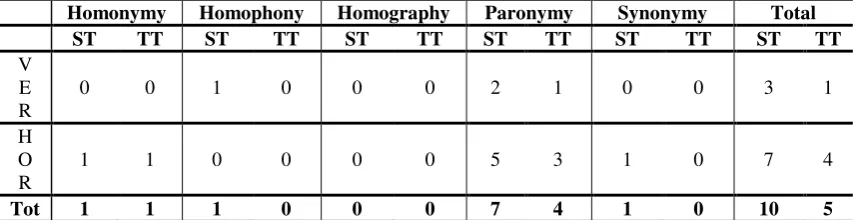
Table 5.4:Comparison of puns in the ST and the TT 149
Table 5.5:Summary of Veisbergs’s (1997) suggested translation strategies 159
Table 5.6:Comparison of FEI-puns in the ST and the TT 174
Table 5.7:Summary of translation strategies applied to the TT 181
Table 6.1:Summary of Leppihalme’s (1997) framework of types of allusions 191
Table 6.2:Combination and revision of Leppihalme’s (1997) categorisation of allusive PNs
and KPs and Davies Gonzáles & Scott-Tennet’s (2005) taxonomy. 208
Table 6.3:Contrastive analysis of the use of translation strategies for PNs and KPs 242
Table 7.1:Summary of translation strategies applied to the TT 297
Table 8.1:Concrete SOs in Wordplay, Culture-Specific Allusions and Metaphor in the ST and
the TT (detailed) 303
Table 8.2: Concrete SOs in Wordplay, Culture-Specific Allusions and Metaphor in the ST and
the TT (general) 303
Table 8.3:Abstract SOs in Wordplay, Culture-Specific Allusions and Metaphor in the ST and
the TT (detailed) 305
Table 8.4:Abstract SOs in Wordplay, Culture-Specific Allusions and Metaphor in the ST and
the TT (general) 306
Table 8.5:TAs of Wordplay, Culture-Specific Allusions and Metaphor in the ST and
the TT (detailed) 307
Table 8.6:TAs of Wordplay, Culture-Specific Allusions and Metaphor in the ST and
the TT (general) 307
Table 8.7:General strategies for Wordplay, Culture-Specific Allusion and Metaphor 310
Table 8.8:Instances of canned laughter for Wordplay, Culture-Specific Allusions and Metaphor
1
Chapter 1.
Introduction
Analyzing or judging the translation of humour should
always involve understanding to the best of one’s ability what the translator’s motivations, criteria and circumstances
were in dealing with each item of the text. (Zabalbeascoa 2005: 206)
1.1 Introduction
In this thesis I conduct a contrastive analysis of the fist series of the TV comedy programme Friends (1994-2004, Marta Kauffman and David Crane) and its dubbed
Italian version. The former is the Source Text (ST) and the latter is the Target Text (TT). In particular, I concentrate on three general mechanisms of humour creation that are often regarded as sources of translation problems: wordplay, culture-specific allusions and metaphor.
Consequently, this study combines insights from both Humour Studies (HS) and Translation Studies (TS), and its subfield of research Audiovisual Translation (AVT). However, the inner complexities of humour, its development and translation within a multisemiotic system such as the audiovisual setting call for an eclectic approach that extends beyond these fields. Therefore, this study also integrates observations by scholars in Film Studies, Corpus Linguistics, Cognitive Linguistics and Stylistics. Furthermore, it takes into accounts suggestions provided by professionals in AVT.
In this introductory chapter I will first present the reasons that motivate this study. Subsequently, I will briefly introduce my data and highlight its undisputed success across the world in terms of popularity. I will then summarise some of the academic research that Friends has inspired in many fields.
2 culture within which it was created. This seems to go against the traditional view in translation theory that humour cannot be translated. Bearing this in mind, I aim to answer the research questions outlined in Section 1.4. This chapter will conclude with an overview of the thesis.
1.2 The Scope of this Study: Humour and its Translation
Among the many cognitive abilities of human beings, creating humour may be considered one of the most complex. Humour can be described as a linguistic, semiotic, cognitive and social phenomenon. Its fascination lies in the fact that it can serve a wide range of purposes: in-group bonding (Archakis and Tsakona 2005: 41), disparagement, correction of socially improper behaviour (cf. Superiority Theory, Raskin 1985, Attardo 1994), and so on and so forth. It is therefore not surprising that scholars from different disciplines (e.g. Linguistics, Psychology, Philosophy, Cognitive Linguistics, etc.) are interested in its multifaceted nature. This academic interest has culminated in the creation of a research field in its own right called Humour Studies (HS).
HS has stimulated research and produced interesting debates. With this thesis, I aim to contribute to the on-going research in this field. In particular, I hope I can shed some light on three mechanisms (wordplay, culture-specific allusion, metaphor) used in Friends in order to create humour (although they can be also found in various types
3 account for the potential humour of a text. More importantly, the GVTH metric can be used in the contrastive analysis of the ST and TT. Despite receiving little attention so far (cf. Antonopoulou 2002, 2004 and Dore 2002), this approach can reveal interesting differences between the two datasets. However, the use of the GTVH for the analysis of TV comedy and its translation also shows this model’s limitations. Both strengths and limitations will be discussed at the end of each chapter of data analysis as well as in the concluding chapter of this thesis.
As mentioned above, my main concern is the translation of humour in the audiovisual setting, with specific reference to dubbing. Wordplay, culture-specific allusions and metaphor appear to be intriguing mechanisms for the production of humour in Friends. More importantly, the possibility of their transfer across languages
and cultures is often challenged. According to some scholars in TS, the process of humour translation is impossible (e.g. Lendvai 1996, Hickey 1999, etc.) while others hold the opposing view (Delabastita 1996, Zabalbeascoa 1996). Chiaro (2005) summarises the issue when she points out that:
[H]umour discourse, which is naturally impeded by linguistic and social barriers, actually succeeds in crossing geographical frontiers. The translation of Verbally Expressed Humour (VEH) concerns one of the most complex types of language to translate owing to the fact that it needs to come to terms with the very tenets of translation theory, those of equivalence and (un)translatability (ibid.135).
‘Equivalence’ is a controversial term in TS. A concise but comprehensive overview of the issues revolving around this concept can be found in Kenny (1998a), who
generally defines equivalence as: “the relationship between a source text (ST) and a
target text (TT) that allows the TT to be considered as a translation of the ST in the
4
described above has subsequently been developed in terms of ‘dynamic, or functional,
equivalence’ (Nida and Taber 1969). The functional approach sees the production of a TT in terms of its specified purpose (its skopos; cf. Vermeer 1996, quoted in Schäffner
2004: 1255). In humour translation, the concept of equivalence can be seen according to this functional approach. In other words, translators aim to produce a TT so that the target audience can experience “the same or a similar effect” (Vandaele 2002a: 151)
conveyed by the ST. I will return to this issue in more detail in Chapter 3 when I discuss the peculiarities of the AVT of humour (cf. Section 3.6 in particular).
As can be seen, humour translation (and translation in general) poses a range of
“objective problems” (pragmatic, linguistic and textual) that can be further complicated by “subjective difficulties” (e.g. translators’ expertise, time pressures) (Nord 1991, quoted in Popa 2005: 51). The objective problems that arise in dubbing are directly related to the multisemiotic nature of this translation mode. Constraints such as lip synchronization and the combination of visual and verbal text come into play. Researchers need to take into account all these factors in order to understand the way professionals tackle the problems translation poses (cf. the quotation from Zabalbeascoa 2005 at the beginning of this chapter).
Unlike some scholars in TS who offer prescriptive models that suggest how to treat
a given phenomenon during the translation process (cf. Newmark’s model for the
translation of metaphor in Ch.7 in this thesis), the scholars mentioned above favour an approach that takes into account the contextual and cultural factors influencing the work of the translator (cf. also Delabastita’s and Veisbergs’s models in Ch.5 and Leppihalme’s and Antonopoulou’s suggestions in Ch.6). This view falls into the
5 behaviour is analysed according to the socio-historical context they work in and the translation norms such context has established (Toury 1995). As a consequence of this, researchers can offer an insight into the translation process they analyse and possibly detect procedural patterns. For example, they may be able to establish whether a source- or target-oriented approach is favoured. In discussing literary translation, Venuti (1992, 1995, 1998) respectively calls these approaches ‘foreignisation’ and ‘domestication’. In a foreignising or source-oriented approach, translators attempt to retain in the TT the linguistic and cultural differences of the ST, thus making evident that the former is a translated version of the latter. In a domesticating or target-culture approach, the TT is made fluent, “intelligible and even familiar to the target-language reader” (Venuti, 1992: 5; cf. also Nida’s concept of dynamic equivalence reported
above). These concepts can obviously be applied to the analysis of any type of translate text, including TV comedy.
With these premises in mind, I will conduct my research on the Italian dubbed version of the first series of Friends by considering the Italian cultural context (i.e. its
dubbing tradition) and the translators’ working environment and situation. This can help me understand the reasons why they opted for particular solutions rather than others. This contrastive analysis can also help me highlight the differences between the ST and TT. By doing so, I hope to shed some light on the translation of humour in the first series of Friends and (if possible) draw some general conclusions about it.
1.3 A Preliminary Introduction to Friends
Friends is a North American TV comedy programme created by Marta Kauffman and
6 details of each episode of the first series can be found in Appendix I, “List of Data”.
In Chapter 4 I offer an exhaustive description of the programme, explaining in particular the reasons for choosing the first series for this study. In these subsections I describe Friends in terms of its remarkable world-wide success and (some of) the
academic research it has inspired.
1.3.1 World-Wide Success
Friends was broadcast for the first time in the U.S.A on 22nd September 1994. The
NBC aimed to produce a successful sitcom that would ensure and maintain good ratings. In their report on the pilot episode, the NBC analysts discussed the viewing rates in relation to the audience the series intended to target (18-24 year old viewers). Moreover, they commented on both the characters and storyline’s credibility1. The NBC analysts seemed sceptical about the future success of the series and concluded their report by giving it a failing grade.
Despite this initial uncertainty, the series soon became an acclaimed success and the six main actors were nominated and won many awards for their performance in the series: Jennifer Aniston (starring as Rachel Green), Courteney Cox (Monica Geller), Lisa Kudrow (Phoebe Buffay), Matt LeBlanc (Joey Tribbiani), Mathew Perry (Chandler Bing) and David Schwimmer (Ross Geller). In the U.S. the ten series scored an average of 25 million viewers per series. The programme was exported to other English-speaking countries such as the United Kingdom (cf. Ross 1998: 91-95) and Australia2, thus extending its popularity. Similar success soon followed
1The report is available at: http://www.thesmokinggun.com/archive/0510041friends1.htmlfind (last
visited: 09/08/2008)
7 wide. The programme was purchased, translated and broadcast in many European countries, including Italy3.
Interestingly, in the U.S.A. the ten series of Friends were usually broadcast on
Thursdays at 8.30 or 9.30 p.m., which is considered primetime. This contributed to the
programme’s high viewing rates. In Italy the first four series were broadcast for the first time by the state-owned channel RAITRE around 8.30 p.m. Due to its increasing success, Friends was transferred to RAIDUE, a more popular RAI channel. Series five
to ten were broadcast by this channel around the same time (8.00 p.m.). Primetime on Italian TV is usually around 9.00 p.m. or later; nevertheless, the scheduling of the programme just before this time guaranteed high viewing rates for Friends. On a
recent visit to Italy, I have found that both RAIDUE and ITALIA UNO (a privately owned TV channel) are currently rerunning the programme, thus confirming its enduring popularity.
The success of the series has also produced a wealth of interest in the academic community. In the next section I will summarise some scholarly research on the series.
1.3.2 Academic Research
Scholars and researchers have investigated Friends from different points of view. For instance, Ross’s (1998: 92) study focuses on the language of humour. In discussing
the way North-American TV comedy developed, Ross notices that Friends moves
away from the idea of the family, which is the central focus of the traditional sitcom.
am aware that Wikipedia and The Internet Movie Database (IMDb) cannot be considered entirely reliable sources of information. However, I used them here so as to give a general idea of Friends as a
word-wide phenomenon.
8 This seems to have contributed to its success, which is also confirmed by related merchandise produced and marketed across the world (ibid.)4
Fouts and Burggraf (2000) consider the use of disparaging comments regarding
women’s body weight in a series of TV sitcoms, one of this being Friends. They claim
that they have chosen Friends because of its popularity among young adolescents
(ibid.926). Tagliamonte and Roberts (2005) instead investigate the language in
Friends. Their analysis attempts to verify whether the language used on television can
influence the way people talk. Interestingly, their study suggests that the repeated use
of intensifiers such as ‘so’, ‘very’ and ‘really’ in Friends has encouraged their
everyday use in English.
The investigation of the humour in Friends has also been the subject of several
studies. For example, Purandare and Litman (2006) analyse the actors’ acoustic
prosody in Friends by means of computerised programmes. They show that while
expressing humour the male characters tend to use a higher pitch of voice while women use a lower one. Hence, they suggest a gender difference in humour production in the series (ibid.212). It would be interesting to verify whether dubbed versions retain similar prosodic features.
Walte (2007) carried out an extensive study of the humour in the ten series of
Friends. She aims to understand who the initiators and targets of the humour of the
series are. Moreover, she attempts to verify how the humour developed throughout the ten series of the programme. Finally, she considers the themes upon which the humour
develops and their relation to the characters’ gender.
On the basis of her analysis, Walte claims that the characters are almost equally the targets of the humour in the series but Chandler is often the initiator of disparaging
4 Cf. also
9 humour towards his friends and others. In contrast, Joey and Phoebe do not joke about others whereas Ross often makes fun of himself. As Walte explains, these results reflect the way the scriptwriters of the series portray the six main characters (i.e. Chandler is quick-minded and sarcastic, Joey simple minded, etc.; ibid.81-83). Regarding the relevance of sexuality and taboo-related topics in Friends, Walte finds
that sex- and taboo-related jokes are very frequent. In particular, Joey appears to be the one who mostly utters (in)direct sex-related comments, which are also consistent with his character (e.g. womaniser). Interestingly, Chandler and Rachel are those who are mostly targeted by sex-related jokes (ibid.96-97). As for the development of the humour in the series, Walte points out that major changes in terms of initiators or targets of jokes and sex-related jokes are not relevant. Hence, the humour can be seen as constant throughout the ten series (ibid.104). Finally, Walte finds that in general the three male characters seem to be more responsible to the production for humour than the female ones but the difference is not extremely marked (ibid.108).
More importantly, Walte concludes that what seems to appeal to the audience is the fact that the characters in Friends experience situations that can happen to anybody in
life. However, these situations often lead the characters to confront non-standard problems the audience can laugh about. In addition, she claims that Friends seems to
10 humour in Friends. Hence, I will return to Walte’s study in Chapter 8, where I will
summarise my findings.
Scholars in TS have also devoted much attention to the translation of Friends.
Lebtahi (2004) compares the French subtitled and dubbed versions of various Anglo-American sitcoms, including Friends. Romero Fresco (2006) specifically concentrates
on the dubbed version of Friends into Spanish. According to his findings, the
language used in the Spanish version does not flow naturally and is often inconsistent in terms of register (ibid.147). Ranzato (2006) reaches similar conclusions in her comparative examination of the Italian, Spanish, French and Brazilian-Portuguese versions of Friends. In particular, Ranzato shows how the Italian and Spanish versions
tend to manipulate the text to the extent that it becomes banal while the French is more faithful to the ST. Interestingly, Ranzato points out that the Portuguese version tends to be more explicit regarding taboo-related topics (ibid.152-159). It should be noticed that the Brazilian-Portuguese version is probably subtitled and this may to
some extent influence the translators’ decision making process (cf. Bucaria 2007 on
the use of subtitling in translating humour).
As can be seen, Friends is not only a world-wide success in terms of viewing
ratings and revenues but it is also the object of considerable academic interest. Hence,
Friends constitutes a valid candidate for the study of humour in audiovisual material
and its transfer across linguistic and cultural boundaries.
1.4 Research Questions
It can be said that Friends is a TV comedy programme whose main objective is to
entertain its audience. Hence, it relies on the production crew and in particular the
11 world they inhabit. In order to be appreciated across languages and cultures, this programme has to be translated. However, humour translation (and translation in general) is often believed to be impossible. Despite this assumption, there is empirical evidence to the contrary. Like many other potentially humorous texts (books, cartoon, etc.), Friends was transposed into several languages and has became popular across
the world. It seems therefore interesting to investigate how the translation of its humour has been achieved.
Furthermore, nowadays state-owned and private TV channels across the world purchase a large amount of entertainment programmes produced in other countries, especially the U.S. (cf. Ch. 3). Due to this continuously growing market, the AVT of humour becomes increasingly important everywhere in the world. The case of the long-established dubbing tradition in Italy seems worth researching because it has developed its own peculiarities (cf. Ch. 3, Section 3.4).
Bearing in mind the specificity of the text under investigation and the peculiar constraints and advantages existing in dubbing, I intend to focus my investigation on the translation of three main mechanisms for the creation of humour: wordplay, culture-specific allusions and metaphor. These phenomena are exploited in Friends
for humorous purposes, as I will show, but are also regarded as potentially problematic in the translation literature. In particular, I aim to answer the following Research Questions (RQ):
12 RQ2. What strategies have been adopted in order to translate humorous instances of wordplay, culture-specific allusions and metaphor in the Italian dubbed version of the first series of Friends (Target Text)?
RQ3. What differences between the Source Text and the Target Text does a contrastive analysis of these three phenomena reveal, with specific reference to humorous potential?
I will return to my research questions at the end of each chapter of data analysis and in the concluding Chapter 8. At the end of this thesis I hope I will be able to draw general conclusions about the findings in my data. In addition, I will also suggest further implications for the on-going research in both HS and TS.
1.5 The Structure of the Thesis
This thesis comprises eight chapters, including this introductory chapter.
In Chapter 2, I provide an overview of relevant areas of research from HS. Because of the focus of this thesis, I concentrate on the development of incongruity-based theories and their application to the linguistic investigation of humour. In particular, I devote a large part of my discussion to Raskin’s (1985) Semantic Script Theory of
13 review some research regarding the way potential humour is construed in comedy and perceived by the audience.
In Chapter 3, I present the second part of my literature review. Firstly, I describe the similarities and differences between the two most used translation modes in AVT, which are subtitling and dubbing. As my main interest is the dubbing of Friends, I
focus on the various constraints and advantages that this translation mode involves (e.g. lip synchronisation, omission of original soundtrack, time pressure, etc.). Secondly, I discuss the historical and cultural reasons that led Italy to adopt dubbing rather than subtitling as its main AVT mode. Subsequently, I explain the present situation of dubbing in Italy. I then move on to consider the specific issues that the translation of humour raises. In particular, I offer an overview of the on-going debate on the (im)possibility of translating humour. This is followed by a brief summary and
discussion of Attardo’s (2002a) theory of humour translation and Zabalbeascoa’s
(1996) study of the priorities in dubbing humour.
In Chapter 4, I present my data and methodology. I describe Friends in more detail
and explain the reasons for choosing the first series. I give an account of some interesting differences between the two datasets, which include, in particular, a striking difference in use of canned laughter in the ST and TT. I then outline the methodology according to which I have carried out my analysis. This includes a detailed description of the approach I use to select instances of potential humour in the ST. Moreover, I explain how I apply Raskin’s SSTH and Attardo’s GTVH to my data. Chapter 5 is the first of three chapters of data analysis. I concentrate on wordplay as a mechanism of humour creation in Friends that potentially poses translation
14 Veisbergs 1997) and then I carry out my data analysis. A briefer discussion on the creation and translation of wordplay based on rhyming is also included. In general, my analysis confirms the difficulties relating to the translation of wordplay due to its language dependence. In addition, it shows how wordplay is used to convey characterisation cues and to support the themes of the series. The contrastive analysis of the two datasets demonstrates that the Italian translators strived to retain the original mechanism. When this was not possible they attempted to retain the ST’s entertainment function by means of other strategies. The translations of the ST into Italian resulted in some differences in the potential humour and characterisation. I provide a detailed discussion of my findings at the end of the chapter.
Similarly, in Chapter 6, I start by considering some relevant studies regarding culture-specific allusions, with particular reference to their potentially humorous function. In order to categorise my data, I discuss the possibility of combining some scholarly research that classifies this phenomenon according to type (Leppihalme 1997) and source (Davies González and Scott-Tennent 2005). The analysis reveals that the types and sources of culture-specific allusions in my data are coherent with its genre (TV comedy programme starring six main characters of average education, apart from Ross). Moreover, it shows that a large amount of culture-specific allusions are drawn from the so-called ‘popular’ culture, which fit the fictional world of the
series. Hence, culture-specific allusions contribute to the characterisation of the six main characters. All these factors confirm the difficulty of transferring the culture-specific allusions in Friends into Italian. The contrastive analysis of the ST and TT
15 humour of the text. The resulting differences between ST and TT are pointed out throughout my analysis and at the end of the chapter.
In Chapter 7, I discuss the way humour is conveyed in Friends by means of
metaphor. As with the other mechanisms, I first discuss some relevant literature regarding metaphor production and comprehension. In particular, I refer to two influential approaches in metaphor research: Conceptual Metaphor Theory (CMT) and Blending Theory (BT). I then consider the relationship between humour and metaphor and the problems arising in transferring potentially humorous metaphors across languages and cultures. The analysis of the ST shows that the scriptwriters seem to exploit the image or the linguistic expression upon which these metaphors are based in order to convey humour. More importantly, they use these creative metaphors so as to transmit idiosyncratic features about the character who utters them (e.g. Rachel is a shopaholic; Joey is a womaniser; etc.). The contrastive analysis of the ST and TT shows that the Italian translators attempted to transfer the metaphor, sometimes substituting the source domain in the TT. As with the other mechanisms, the translation process resulted in some differences in terms of the potential humour and characterisation.
16
Chapter 2.
Humour Studies and Humour in Comedy
And conversation is the natural home of punning, allusion, and joking. (Norrick 1993: 1)
2.1 Introduction
The difficulty that arises in any attempt at defining humour in general terms is caused by the fact that humour itself is a relative, idiosyncratic concept that varies according to culture and time. As a matter of fact, individuals in every social group or culture make great use of humour in their everyday life and conversations. It is therefore not surprising that Humour Studies is an interdisciplinary field that covers research from anthropology, psychology, philosophy and linguistics (Norrick 1993: 3, Palmer 1994: 3). Scholars interested in humour have sought to explain its essence, mechanism(s) and effects on society by means of different approaches and from different points of view.
The goal of the present chapter is to offer an overview and discussion of some of the most prominent theories of humour that can hopefully provide the reader with sufficient knowledge on this fascinating phenomenon. Since each chapter of data analysis in this thesis focuses on one type of humour creation (Ch. 5 discusses the use of wordplay; Ch. 6 deals with culture-specific allusions; Ch.7 investigates the use of potentially humorous metaphor), the relevant literature on each of these topics is not introduced here.
Before presenting my overview, in Section 2.2 I will consider some scholars’
17 will select the data under investigation in this thesis. In Chapter 4, I will provide more details regarding the use of (canned) laughter in my methodology.
In Section 2.3 I will summarise some of the theories of humour which were mostly developed throughout the twentieth century. In Section 2.4 this will culminate in a discussion of the currently most influential theories for the analysis of humour. I will first introduce Raskin’s (1985) Semantic Script Theory of Humour (SSTH) and its main tenets. I will then move on to describe its subsequent revision: the General Theory of Verbal Humour (GTVH), first outlined in Attardo and Raskin (1991) and further developed in Attardo (1994, 1998, 2001). I will also consider some scholarly research based on the application of the GTVH and some criticism that has resulted from it.
In Section 2.5 I will briefly discuss important issues relating to the production of humour in conversation. This is particularly relevant because to some extent sitcoms attempt to replicate everyday language and situations (Bubel and Spitz 2006: 73). In Section 2.6 I will focus on the specific case of humour in TV comedy, the way it is construed and perceived. I will point out the differences between humour in naturally occurring language and comedy. In particular, I will suggest that conversational exchanges in comedy are not entirely realistic and are often exaggerated for humorous purposes.
In Section 2.7 I will conclude this overview by reporting Nilsen’s (1989:123)
18
2.2 Defining Humour and its Relationship with Laughter
As anticipated in the introduction, the very essence of humour cannot be easily captured because of its multifaceted nature. However, Raskin (1985: 2) remarks that
“the ability to appreciate and enjoy humor is universal and shared by all people, even
if the kinds of humor they favor differ widely”. Hence, he defines humour as “a
universal human trait” (ibid.; emphasis in original). By describing “an individual
occurrence of a funny stimulus [as] the humor act” (ibid.3; emphasis in original),
Raskin aims to establish what factors characterise and influence it (e.g. participants, their experience and psychological status, the society they live in, the stimulus, the situation it describes). Among these factors, Raskin also includes laughter, and attempts to explore the relation between humour and laughter from a physiological and psychological point of view. He discusses the various manifestations of laughter
and states that “humor usually causes laughter” but “humor holds no monopoly for
laughter” (ibid.4-5, 14-19). Yet, he concludes that humour and laughter can be used interchangeably because in his opinion they are similar or adjacent terms (ibid.8; 28).
Similarly, Chiaro (1992: 11) and Nash (1985: xi, passim) seem to suggest that
humour and laughter have an implicit relationship while Palmer (1994: 1, passim) and
Morreall (1983) see laughter as an integral part of humour. In contrast, Oring (2003: x) talks about laughter and humour as separate phenomena pointing out that they are
conditions of our humanity and therefore ‘cultural universals’. Nevertheless, he also sees laughter and humour as directly linked.
19
laughter are linked as an adjacency pair” (ibid.23). From a technical point of view, Norrick considers laughter as a parameter that signals the presence of humour in the text. However, he also highlights the fact that some people can choose not to respond or to withhold laughter. In doing so, they may be signalling that they understand and, at the same time, distance themselves from the humour they perceive (ibid.133; cf. also Mulkay 1988: 114-119 for a similar discussion).
Hay (2001) analyses the relation between humour and laughter from another perspective. She does not object to the association of humour with laughter but she demonstrates that people can use other strategies to support humour, some of which can be considered more appropriate in a given context. She lists these strategies and accompanies them with a wealth of examples. Ways of supporting humour can be, for example, contributing more humour (e.g. jointly constructing the scenario), echoing the words of the speaker, offering sympathy or contradicting self-deprecating humour. Making use of irony can also be considered as a support strategy (cf. Hay ibid.60-61 for a full list). Interestingly, in my opinion Hay’s analysis shows how some of these
supporting strategies can depend on personal choice or style (e.g. contributing with more humour, irony) while others are socially imposed (e.g. contradicting self-deprecating humour). More research in this area is obviously needed and it could provide fascinating results.
Clearly, the relationship between humour and laughter is one of the most controversial and debated. Attardo (1994: 10) questions this usually taken-for-granted relation and points out that more often than not humour is incorrectly assimilated to
laughter. He supports his claim by reporting, among others, Freud and Bergson’s
works, which seemed to suggest that humour is funny because it elicits a laugh and
20 counterargument against these claims is based on Olbrechts-Tyteca’s (1974) analysis
of the concepts of humour and laughter. According to the latter, there are five reasons why humour and laughter cannot be considered directly related. Laughter can be provoked by other causes (e.g. hallucinogens), it may serve other purposes (e.g. express embarrassment; cf. also Norrick ibid.37-40) and is not directly connected to the intensity of humour (e.g. some people may respond to humour with an intense laugh, others only with a mild laugh). Moreover, humour can elicit a laugh in some people and only a smile in others. Finally, both smile and laughter can be simulated, thus requiring interpretation (e.g. in different social context they may have different meanings) (ibid.11-12; cf. also Norrick’s discussion above).
The above observations confirm the difficulties involved in defining humour. More importantly, they demonstrate that laughter cannot be used as the sole parameter to gauge the potential funniness of a text. In my opinion, humour and laughter can be seen as distinct phenomena, which are however connected. In this thesis I accept
Attardo’s (1994: 9) broad definition of humour as “whatever a social group defines as
such”. However, as I will explain in Chapter 4, I use laughter as a way to operationalise the definition of humour, thus offering solid ground for its linguistic analysis. This becomes particularly relevant when dealing with TV comedy, which often makes use of pre-recorded or canned laughter that accompany some of the
characters’ turns. Canned laughter can be seen as a valuable tool for determining the jocular nature of a turn in the text under investigation (cf. Section 4.4 on my methodology).
21 perlocutinary [intended] effect is laughter” (ibid.13). This idea is also supported by Archakis and Tsakona (2005: 44), who suggest that “laughter can at least establish a
humorous frame of interpretation for the utterance with which it occurs”. After all,
“anything laughed at is worth investigating” (Vandaele 2002a: 222; my emphasis).
In the next section I will give a brief account of some theories of humour, focusing in particular on modern approaches to it.
2.3 Overview of the Theories of Humour
Limitations of space prohibit an extensive review of the large literature on humour produced throughout human history. Furthermore, such a task certainly falls beyond the scope of this thesis. Comprehensive discussions of theories of humour have been provided by scholars from various fields such as Philosophy (Palmer 1994, Critchely 2002) and Folk Studies (Oring 2003). Others have concentred on the social function of humour (Mulkay 1988, Billig 2005). In the first chapter of his 1994 book, Attardo offers a long survey of the studies on humour by Greek, Latin, medieval and modern scholars, who analysed it not only from a linguistic, but also philosophical and psychological points of view.
In this chapter I base my overview on Morreall (1983), Raskin (1994) and Attardo (1994) as they offer comprehensive descriptions of the theories of humour put forward by scholars in various fields. Both Morreall (1983) and Raskin (1985: 30-41) propose a tripartite categorisation of these theories. Morreall (ibid.4-37) distinguishes among:
22
Incongruity theories: Kant, Schopenhauer and, to some extent, Beattie claimed that humour is the result of experiencing an incongruity between what we know and what we expect;
Relief theories: Spencer and Freud saw laughing at others as a form of relieving pleasure.
Raskin (1985: 30-41) focuses in particular (but not only) on modern approaches to the study of humour. Interestingly, he points out that different theories highlight one or two prominent features of humour. Hence, their synthesis can foster a better understanding of humour than considering each feature separately (ibid.30). Like Morreall, Raskin suggests a group that comprises theories based on incongruity. This group includes theories based on the idea that humour occurs when two concepts or ideas clash because their meanings oppose each other. These are essentialist theories that aim to explain the essence of the phenomena from a structuralist point of view (ibid.31-36). Raskin’s script-based theory (the SSTH) and Attardo’s subsequent
development (the GTVH) can also be included in this group, as I will show later in this chapter.
Raskin’s (ibid.36-38) second group includes a larger set of theories (hostility, superiority, malice, derision) whose basic idea is that humour is created by the
speaker’s aggressive attitude towards the object of her/his humorous utterance
(disparagement). As Raskin points out, many researchers that used this approach considered themselves followers of Hobbes. The latter suggests that laughter is an expression of the speaker/receiver’s sense of superiority over the target of the
23
‘exclusive’ humour and opposed to ‘inclusive’ humour, which is used for a cohesive
purpose).
Raskin’s third and final group includes theories that tend to see humour as a means of freeing oneself from the conventions imposed by society. He labels it the ‘release theory’ group and identifies Freud as its main proponent. Raskin sees these theories as directly associated with suppression/repression laughter, although they are usually related to sex (ibid.39).
Attardo (ibid.47-50) summarises Raskin’s (1985) general classification outlined
above and labels the three groups as ‘Incongruity’, ‘Hostility’ and ‘Release’
respectively. In particular, he highlights each group’s orientation. As I have said earlier, ‘Incongruity Theories’ aim to understand the essence and the creation process of humour. Therefore, Attardo considers them as cognitive-based approaches. In contrast, the sociolinguistic orientation of the ‘Hostility Theories’ emphasises the
interpersonal (or social-behavioural) aspect of humour. Finally, the ‘Release Theories’
mostly analyse humour from a psychological point of view because they try to understand its psychological causes and effects. I have reproduced Attardo’s
summarising table below for the sake of completeness. The theories are subsumed under three groups but they are not hierarchically ordered. They are all at the same level:
Cognitive Social Psychological
Incongruity Hostility Release
Contrast Aggression Sublimation
Superiority Liberation
Triumph Economy
Derision Disparagement
24 More importantly, Attardo points out that there have recently been some relevant developments in humour research from the linguistic point of view (ibid.59). Thus, he provides a survey of the most prominent linguistic theories of humour, including Structuralist Theories, Semiotic and Text Theories, Script-Based Theories and Theories of Contextual Humour. I will briefly introduce the first two groups here because they have contributed to the development of the Script-based Theories, which
include Raskin’s SSTH and Attardo’s GTVH. The Theories of Contextual Humour
will be treated separately because they are relevant to the analysis of conversational humour and comedy in particular.
In a nutshell, Attardo explains (ibid.62-63) that Structuralist Theories are mainly based on Greimas’s (1983 [1966], quoted in Attardo ibid.) ‘Isotopy-Disjunction
Model’ and focus on the analysis of verbal jokes. According to Greimas, jokes are composed of two main sections whose isotopies are in implicit opposition. More specifically, he points out that, when a text is produced, it can contain various different meanings resulting from the linguistic items of which it is composed. In order to establish a single meaningful reading of a whole text, a disambiguation process is needed. Hence, Greimas introduces the notion of isotopy as a tool that facilitates this disambiguation process. An isotopy allows the interpretation of all the elements composing a text according to a single meaning given by the context within which they are embedded (ibid.69).
25 set of options chosen between the various meanings of the lexical items of which a text is composed. Therefore, when the isotopy is established, the text is disambiguated. Most importantly, Attardo explains that this process is usually carried out according to a linear reading of the text which allows its receivers to understand it (ibid.94).
Drawing on Morin (1966), Attardo finds three functions that account for the linear composition of a joke. The first function (F1) establishes the content and the context
of the text. The second function (F2) contains a ‘connector’, which is a word whose
meaning (isotopy) is given according to its context. The connector also links this part
of the text to the following one. The third function (F3) introduces the ‘disjunctor’,
whose role is to display the opposition between the first serious sense (established in the previous part of the text) to the second humorous one. This model is based on the linear sequence of the elements listed above (F1 + F2 + F3). The connector and disjunctor in the text operate in order to create the humorous effect (cf. also Tsakona 2003 on the analysis of jokes according to these three functions). This process explains how the humorous effect is created by the speaker and processed by the receiver (ibid.85-101). As I will demonstrate shortly, the isotopy can be seen as the
forerunner of the concept of ‘script’, which is introduced in the next section.
Attardo’s second group includes what he calls Semiotic and Text theories. The latter (or Linguo-Literary Approaches) are language-based and focus on literary texts with humorous content. The Semiotic Theories mainly derive from Koestler’s (1964) book on creativity and the ‘Bisociation Theory’ proposed in it. In Koestler’s (1964: 35,
quoted in Attardo ibid.175) view, bisociation is a cognitive process provoked by the presence of two incompatible ideas in the same text (or context). Perlmutter (2000:
155) explains the concept of bisociation connected to humour as “the collision of lines
26 making us laugh (cf. also Kyratzis’s (2003) use of bisociation in his study on
humorous metaphors).
For Attardo (ibid.175), these cognitive approaches can be associated with the incongruity theories mentioned above. Indeed, they combine the notion of isotopy and script opposition (described in the next section). Drawing on Manetti’s (1976)
semiotic approach to humour, Attardo explains that the punch line of a joke carries a relevant load of information which also triggers the opposition between the isotopies of the text by identifying its incongruous parts. Most importantly, Attardo points out
that Manetti’s major contribution to the understanding of the process of humour is
based on the idea that certain isotopy oppositions can be considered as recurrent patterns. Manetti introduces the so-called ‘relational grid’, according to which it is
possible to establish which oppositions can be considered humorous in a given culture. In this light, it seems plausible to think that a humorous text is created on the basis of pre-existing isotopy oppositions in a given culture. However, Attardo reminds us that Manetti fails to present any list of possible oppositions (ibid.177-178). This gap is
filled by Raskin’s theory, which will be discussed in the next section.
2.4 Script-Based Theories
As mentioned earlier, the semantic theories of humour do not seem to present a list of possible (isotopy) oppositions that can be exploited in producing humour. Raskin’s
Semantic Script Theory of Humour (SSTH) seeks to fill the gap in the understanding of the mechanism(s) involved in humour creation. Hence, I summarise Raskin’s work
in the first subsection below. This will be followed by an account of Attardo and
Raskin’s subsequent revision of the SSTH, called the General Theory of Verbal
27 subsection, I will discuss some developments of the GTVH and its use in the study of various types of humorous texts. Moreover, I will consider some criticism in terms of its applicability.
2.4.1 The Semantic Script Theory of Humour
Raskin (1985: 41) claims that little has been done by humour theorists in explaining the structure of humour from a linguistic point of view. Hence, he proposes a script-based theory of verbal humour. Raskin concentrates on the linguistic analysis of
“joke-carrying text”, although he points out that the theory can in principle handle texts that contain multiple jokes (ibid.45). He clearly states that his aim is to propose a set of necessary and sufficient conditions for the text to be funny (ibid.57). In his view, jokes can be considered humorous if they satisfy two fundamental conditions:
1. The text is compatible, fully or in part, with two different scripts;
2. The two scripts with which the text is compatible are in opposition (ibid.99).
In order to understand Raskin’s statements and his theory’s practical application, I
must first explain the pivotal notion of ‘script’.
A ‘script’ is defined as “a large chunk of semantic information surrounding the
word or evoked by it” (ibid.81). Attardo (1994: 199) adds: “It is a cognitive structure
internalized by the speaker which provides the speaker with information on how
things are done, organized, etc.”
28
Abelson’s (1977: 41) seminal work on Artificial Intelligence, which defines a script as
“a structure that describes appropriate sequences of events in a particular context”.
Raskin (1985: 81) also notices that in the literature the term ‘script’ has been
sometimes used to refer to a temporal sequence of frames. However, it should be pointed out here that some scholars tend to use the terms ‘script’, ‘frame’ and ‘schema’
to refer to different types of background knowledge1. Nonetheless, Attardo (1994: 200) reports that many scholars agree with the idea that scripts contain “information which is typical, such as well-established routines and common ways to do things and to go
about activities”. This further explanation seems a fair compromise and it is also
accepted here.
To return to Raskin’s (1985) explanation, scripts can contain both lexical (linguistic) and non-lexical (encyclopaedic) information and they are connected to one another by virtue of semantic links (such as synonymy, hyponymy, antonymy and so on). For example, the script SPOON can be connected to the script CUTLERY because
the latter is its hyperonym, or superordinate. When we hear or read a sentence or text, its constituting elements evoke and combine scripts. The whole text thus becomes a
‘semantic network’ of scripts according to certain combinatorial rules. These rules shape not only the text, but also its coherent interpretation (ibid.80-86).
Raskin (ibid.104-114) points out that ambiguity in language is caused by the fact that a text can be fully or partially compatible with two or more scripts (e.g. the script
BUYING CANDLES in a text can be associated with the scripts BIRTHDAY and GO TO CHURCH; my example). However, this partial or full overlapping of two scripts is not
a sufficient condition for the creation of a humorous text. Raskin’s empirical
investigation, carried out on a corpus of jokes, demonstrates that humour is created
1 Cf. For example Schank and Abelson (1977) for an in-depth discussion on the concept of ‘script’, Bartlett (1932) and Rumelhart (1980) for ‘schema’ and Goffman, E. (1974) and Minsky (1975) for
29 when the scripts that are potentially evoked by these texts not only overlap but are also in opposition.
Raskin’s well-known example (ibid.100; 117-127) is used here to demonstrate the practical application of his theory:
[2.1]“Is the doctor at home?” the patient asked in his bronchial whisper. “No,” the doctor’s young and pretty wife whispered in reply. “Come right in.”
According to Raskin, in (2.1) the humour is caused by the fact that the text is partially compatible with both the DOCTOR (and HUSBAND) and LOVER scripts, which “are perceived as opposite in a certain sense” (ibid.100). The former requires his physical presence in order to provide a medical service. His absence instead leads to the introduction of the opposing script LOVER (and ADULTERER), which can also
evoke a sex/no-sex opposition that explains the humour of the text.
As I said earlier, Manetti introduced the idea of a set of pre-existing isotopy oppositions but he does not provide a list of possible oppositions. In contrast, Raskin’s
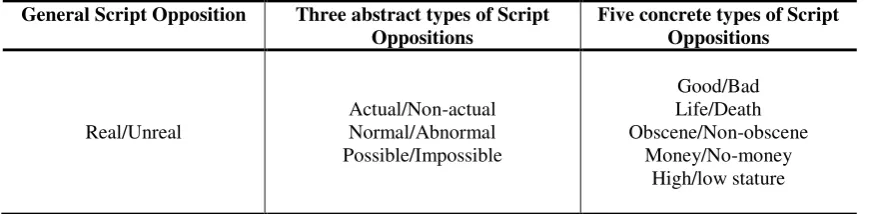
30 have reproduced the three script oppositions of the abstract level. In the right column I have reproduced the five types of script opposition of the ‘concrete’ level:
General Script Opposition Three abstract types of Script Oppositions
Table 2.2: Summary of Script Oppositions postulated in Raskin (1985: 108-114; 127)
According to Raskin, each of the jokes he analyses “describes a certain ‘real’
situation and evokes another ‘unreal’ situation, which does not take place and which is
fully or partly incompatible with the former” (ibid.108). For example, the joke in (2.1)
above describes a situation in which “the patient comes to the doctor’s house to see
the doctor” which is opposed to “the patient comes to the doctor’s house not to see the
doctor” (ibid. 110; my emphasis). Furthermore, Raskin (ibid.111) points out that the jokes he analyses can fall into three different types of oppositions between the real and unreal situation that they describe or evoke, which are:
1) Actual situation vs. non-actual situation: there is an opposition between the actual setting of the joke and a non-existing situation which is incompatible with it. In Raskin’s view, example (2.1) above can be classified as an instance of this actual/non -actual opposition because it is true that the patient went to see the doctor and it is false that he did not go to see the doctor2.
2) Normal versus abnormal state of affair: there is an opposition between an expected and an unexpected state of affairs. For example, Raskin proposes the
31
following example: ‘“Who was that gentleman I saw you with last night?” “That was
no gentleman. That was a senator”’ (Esar 1952, quoted in ibid.25). In Raskin’s view,
the opposition is between the normal expectation for a senator to be a gentleman and the abnormal state of affair which the joke introduces (the senator is not a gentleman). 3) Possible versus impossible situation: there is an opposition between a plausible and an implausible situation. Raskin explains that the joke: ‘Nurse: “That’s a pretty bad cold you have, sir. What are you taking for it?” Patient: “Make me an offer!”’
(Spalding 1976: 163, quoted in ibid.25) contrasts a possible and an impossible situation. It is possible to conceive a situation in which a nurse takes care of a patient and asks him/her what medication s/he is taking. However, a situation involving someone selling an illness can be said to be impossible.
As anticipated above, Raskin also proposes a set of more concrete oppositions. He explains that jokes can be categorised according to five binary categories that are
“essential to human life” (ibid.113): good vs. bad, life vs. death, obscene vs. non-obscene, money vs. no-money, high vs. low stature (cf. right column in Table 2.2 above). In his view, some of these more concrete dichotomies can be found in the same joke. For example, a joke about old age can include both the good/bad and the life/death oppositions (ibid.114).
In his review of Raskin’s taxonomy, Attardo (1994: 204, 2001: 20) points out that
the three abstract classes of oppositions above are more likely to be shared by many, if not all cultures. By way of contrast, he observes that the five concrete oppositions tend to vary from culture to culture. For example, Attardo suggests that the five-fold taxonomy could include the excrement/non-excrement script opposition, which is often present in jokes and other types of humorous narratives. Interestingly, Attardo
32 unpublished doctoral thesis. The latter proposes an intermediate level of oppositions, which can be placed between the contextual script opposition and the concrete one. For instance, in example (2.1) the levels of script oppositions should be: 1) doctor/lover; 2) sex/no-sex; 3) obscene/non-obscene, 4) actual/non-actual and 5) real/non-real. Unfortunately, Di Maio does not offer a list of possible oppositions for this intermediate level (Attardo p.c.). Moreover, the introduction of another level may lead to an unmanageable categorisation process.
Both Raskin and Attardo explain that the number of script oppositions that can be found is virtually infinite and they can be identified according to the linguistic rules summarised above. However, I personally find that identifying them is, to some extent, a matter of subjective judgement and interpretation (I will return to this point in Ch. 4, Subsection 4.4.3 and Ch. 8, Subsection 8.3.1). In addition, Raskin’s five-fold taxonomy seems questionable because some oppositions are very specific (i.e. life/death and money/no-money) while others are extremely general (good/bad, obscene/non-obscene and high/low stature). In addition, in my opinion the money/no-money opposition can be essential to human life in some cultures but not in others (e.g. the members of an African tribe may not consider money as essential to their lives). Furthermore, it could be argued that, even if humour based on the good/bad opposition is likely to be found in many if not all cultures, what counts as good and what counts as bad may differ. Finally, Raskin only mentions the high/low stature opposition in his discussion of the doctor joke (cf. example (2.2) above) but does not explain it clearly. As a consequence of this, it seems somehow difficult to categorise examples according to his taxonomy.
33 elaborations very useful. I believe that the categorisation process can help me identify patterns of humour creation in my data. Moreover, it can facilitate the contrastive analysis of the ST and TT and help me detect possible differences between the two datasets. In Chapter 4, I will offer a detail account of my methodology and I will explain how I have adapted Raskin’s model and Attardo’s and Di Maio’s suggestions
to the analysis of my data. This revised version will then be adopted during my data analysis in Chapter 5, 6 and 7.
Before moving to the discussion of Attardo and Raskin’s revision of the SSTH, it
seems worth mentioning the relationship between jokes and Grice’s (1975) ‘ Co-operative Principle’ of communication. As Raskin (1985: 102-104) explains, Grice proposes a bona-fide mode of communication requiring the commitment of the
speaker(s) to four maxims: quantity, give exactly as much information as required; quality, say only what you believe to be true; relation, be relevant; manner, be
succinct.
However, several scholars such as Nash (1985:113-116), Raskin (1985) and Grice himself (1989, quoted in Attardo 1994: 272) have noticed that jokes (and humorous texts in general) tend to subvert the four maxims of the Co-operative Principle. A speaker who utters a joke cannot respect this bona-fide mode of communication and
its maxims if s/he wants her/his joke to be effective. Humorous exchanges thus seem to be based on a paradox: they are successful communicative acts, while at the same time breaking or flouting the rules which are supposed to guarantee successful
communication (Grice’s maxims).