KBS
BY:
DEASY MONICA P 131111003 YEDIE CHAHYADIE 131111028 KG-3A
KBS || Girder and Slab at Fly Over
Deasy Monica P | Yedie Chahyadie i
PREFACE
Thank to Almighty God who has given His bless to the writer for finishing the English paper assignment entitled “Gider and Slab at Fly Over”.
The writer also wish to express his deep and sincere gratitude for those who have guided in completing this paper. This paper contains about girder and slab at fly over. There are six point that we explain about girder and slab at fly over.
Our paper also can be used as the guidance for those who want to learn more about slab and girder at fly over. Hopefully, this paper can help the readers to expand their knowledge about fly over.
Bandung, March 25th, 2016
KBS || Girder and Slab at Fly Over
Deasy Monica P | Yedie Chahyadie ii
TABLE OF CONTENTS
PREFACE... i
TABLE OF CONTENTS... ii
TABLE OF FIGURES... iii
CHAPTER I. INTRODUCTION ... 1
1.1 Issue Background... ... 1
1.2 Problem Indentification... 1
1.3 Objectives of This Write... 1
CHAPTER II. OVERVIEW ... 2
2.1 Definition... 2
2.2 Basic Guide to Choose the Structure... 3
2.3 Types of Girder... ... 4
2.4 Types of Slab... 7
2.5 Advantages and Disadvantages Using Girder... 8
2.6 Advantages and Disadvantages Using Slab... 9
CHAPTER III. DISCUSSION PROBLEM... 11
3.1 Case 1 ... 11
3.2 Case 2 ... 12
3.3 Case 3. Girder Failure ... 13
3.4 Case 4. Slab Failure... 14
CHAPTER IV. FINAL ... 16
5.1 Conclusion ... 16
KBS || Girder and Slab at Fly Over
Deasy Monica P | Yedie Chahyadie iii
TABLE OF FIGURES
Figures 2.1 The Golden Gate Bridge... 2
Figures 2.2 JJ Fly Over... 2
Figures 2.3 Girder and Beam... 3
Figures 2.4 I-Girder... 4
Figures 2.5 T-Beam... 4
Figures 2.6 Segmental concrete girder box form... 5
Figures 2.7 Rolled steel girder... 5
Figures 2.8 Anatomy of plate girder... 6
Figures 2.9 Surviving section of Chepstow Railway Bridge girder, now at Brunel University, Uxbridge... 6
Figures 2.10 Brunel's bridges over the entrance locks to theCumberland Basin, Bristol Harbour... 7
Figures 2.11 Solid slab... 7
Figures 2.12 Void slab... 7
Figures 3.1 Corrosion at concrete reinforcement... 11
Figures 3.2 Crack at girder... 12
Figures 3.3 Tay Rail Bridge... 13
Figures 3.4 Inverythan Rail bridge... 13
Figures 3.5 Seong su bridge... 14
Figures 3.6 The car... 14
KBS || Girder and Slab at Fly Over
Deasy Monica P | Yedie Chahyadie 1
CHAPTER I
INTRODUCTION
1.1 Issue Background
Transportation is one of our most basic human needs. Transportation is the act of moving something from one place to another. If we do not have a mode of transportation we will not be able to go to our job or to social functions as much as we want.
To move from one place to another, we can use land-transportation, air-transportation or water-air-transportation. For land-air-transportation, we can use road or railway for connection. For air-transportation we can use plane for connection. For water-transportation, we can use sailorship.
Fly over is one of alternative way for land-transportation which is the different construction from usual road. Fly over can passing the road or passing the river. Fly over itself has many kind of construction, like girder, pylon, abutment, slab and etc. This kind of construction can determine the strengthness of fly over. So, the choosing good material and design is a must for making fly over.
Slab and girder is one of construction that have to well-designed. Because the slab and girder is one of construction which is directly used by user. It based on the srength and comfort.
The problem that explained above made the writers interested to analize about construction of slab and girder at fly over. It based on choosing material, kind of the construction and etc.
1.2 Problem Identification
What the definition about fly over, slab and girder.
What is basic guide to choose the structure.
What kind of classification about slab and girder for fly over.
What the Advantages and Disadvantages with using slab and girder for fly over.
What kind of issues or problems that always happen at slab and girder for fly over.
1.3 Objectives of This Write
To know the definition about fly over, slab and girder.
To know the basic guide to choose the structure.
To know kind of classification about slab and girder for fly over.
To know the Advantages and Disadvantages with using slab and girder for fly over.
KBS || Girder and Slab at Fly Over
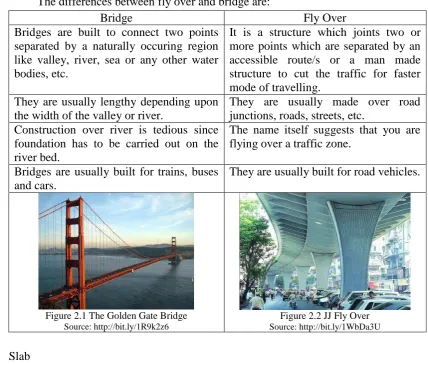
Fly over is a structure which joints two or more points which are separated by an accessible route/s or a man made structure to cut the traffic for faster mode of travelling. Reason behind going for a flyover is the traffic on the road goes on increasing and it’s don’t have any space left in both the dimensions, then the only option left will be to go to the third dimension and that is done through flyover construction.
The differences between fly over and bridge are:
Bridge Fly Over the width of the valley or river.
They are usually made over road flying over a traffic zone.
Bridges are usually built for trains, buses and cars.
They are usually built for road vehicles.
Figure 2.1 The Golden Gate Bridge
Source: http://bit.ly/1R9k2z6
Figure 2.2 JJ Fly Over
Source: http://bit.ly/1WbDa3U
Slab
KBS || Girder and Slab at Fly Over
Deasy Monica P | Yedie Chahyadie 3
Suspended slabsareslabsthat are not in direct contact with the ground. They form roofs or floors above ground level.Suspended slabsare grouped into two types: one wayslabswhich are supported on two sides.
Girder
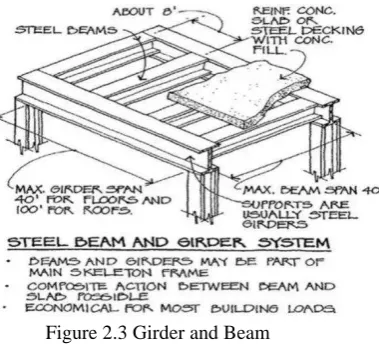
Agirderis a support beam used in construction. It is the main horizontal support of a structure which supports smaller beams.Girdersoften have an I-beam cross section composed of two load-bearing flanges separated by a stabilizing web, but may also have a box shape, Z shape and other forms.
Figure 2.3 Girder and Beam
Source: http://bit.ly/1SCiseH
2.2 Basic guide to choose the structure Based on the function
The function of fly over which is on the middle of city to avoid the traffic jam must be different with the function of fly over which is to connect one village to another village. It means, based on the function is important to choose what kind of structure that we need.
Based on strength and stability
Load factor give the affect of choosing the structure. If the load factor more than the carrying capacity of slab, so the slab has posibillity to collapse, because it can’t resist with the load factor.
Based on the economy
The availabilities of fees give the affect of choosing the structure. If we don’t have much money, we can push the fees from choosing shape or structure.
Based on the implementation
KBS || Girder and Slab at Fly Over
Deasy Monica P | Yedie Chahyadie 4
2.3Types of Girder
a. Types of Girder Based on The Shape
o I-Girder Bridge
This girder can made of composite material or non-composite material. For choosing kind of material, we have to consider strength or cost for this construction. An I-Girder is very simple to design and build and works very well in most cases, but more prone to torque/twisting forces. Box girders, being more stable are also able to span greater distances and are often used for longer spans, where I-beams would not be sufficiently strong or stable. However, the design and fabrication of box girders is more difficult than that of I beams.
Figure 2.4 I-Girder
Source: http://bit.ly/225EsRE
o T-Beams
A reinforced-concrete bridge consisting of a floor slab monolithic with the supporting beams so that a cross section resembles a series of T beams. T-Beams is very economic for length 40-60 ft. But for tilt bridge structure, designing T-Beam need more complicated way. The comparison between length and width at T-Beam is recommended about 0.07 for simple T-Beams and 0.065 for continous T-Beams
Figure 2.5 T-Beam
Source: Ilmutekniksipil.com
o Box Girder
A box girder or "tub girder" is, as the name suggests, a box shape. They consist of two vertical webs, short top flanges on top of each web, and a wide bottom flange connecting the webs together. A box girder is particularly resistant to torsion and, while expensive, are utilized in situations where a standard girder might succumb to torsion or toppling effects.
KBS || Girder and Slab at Fly Over
Deasy Monica P | Yedie Chahyadie 5
Rectangular steel box girder
Trapezoidal steel box girder b. Concrete box girder
Rectangular concrete box girder
Trapezoidal concrete box girder
Figure 2.6 Segmental concrete box girder forms
Source: http://bit.ly/1R9pAcU
b. Another Types of Girder
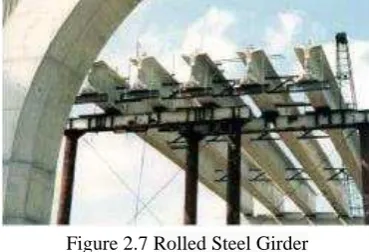
o Rolled Steel Girder
Arolled steel girderis a girder that has been fabricated by rolling a blank cylinder of steel through a series of dies to create the desired shape. These create standardizedI-beamand wide flange beamshapes up to 100 feet in length.
Figure 2.7 Rolled Steel Girder
KBS || Girder and Slab at Fly Over
Deasy Monica P | Yedie Chahyadie 6
o Plate Girder
Figure 2.8 Anatomy of Plate Girder
Source: http://bit.ly/1R9bVcd
A plate girder is a girder that has been fabricated by welding plates together to create the desired shape. The fabricator receives large plates of steel in the desired thickness, then cuts the flanges and web from the plate in the desired length and shape. Plate girders can have a greater height than rolled steel girders and are not limited to standardized shapes. The ability to customize a girder to the exact load conditions allows the bridge design to be more efficient. Plate girder can be used for spans between 10 metres and more than 100 metres (33 feet to more than 330 feet). Stiffeners are occasionally welded between the compression flange and the web to increase the strength of the girder.
o Ballon Flange Girder
Figure 2.9 Surviving section ofChepstow Railway Bridgegirder, now atBrunel University,Uxbridge
Source: http://bit.ly/1UfwPHs
KBS || Girder and Slab at Fly Over
Deasy Monica P | Yedie Chahyadie 7
Figure 2.10 Brunel's bridges over the entrance locks to theCumberland Basin,Bristol Harbour.
Source: http://bit.ly/1R9oVbp
c. Types of Girder Based on Construction method
o Cast in Situ
Cast in situ is one of conventional method. Because, the making of concrete is in the location of slab construction.
o Precast
Precast is one of slab construction method with fabrication in factory. Standard beam can be pre or post tension.
2.4Types of Slab
a. Based on forms.
Solid Slab
Solid slab is the most simple thing of slab. Usually solid slab using the concrete reinforcement conventional.
Figure 2.11 Solid Slab
Source: http://bit.ly/1Wqqm9T
Void Slab
Void slab is modification from solid slab. The function is for to reduce the load which isn’t be required near the neutral axis when the deflection happen
Figure 2.12 void Slab
KBS || Girder and Slab at Fly Over
Deasy Monica P | Yedie Chahyadie 8
b. Based on structures.
Corrugated, usually where the concrete is poured into a corrugated steel tray. This improves strength and prevents the slab from bending under its own weight. The corrugations run across the short dimension, from side to side.
A ribbed slab, giving considerable extra strength on one direction.
A waffle slab, giving added strength in both directions and it looks hollow from bottom.
c. Based on length and width.
A one-way slab needs movement resisting reinforcement only in its short-direction because the movement along long axes is so small that it can be neglected. When the ratio of the length of long direction to short direction of a slab is greater than 2 it can be considered as a one way slab.
Long direction = ly Short direction = lx One way slab IF ly/lx > 2
A two-way slab needs movement resisting reinforcement in both directions. If the ratio of the lengths of long and short side is less than two then movement in both direction should be considered in design.
Two way slab IF ly/lx < 2
d. Based on construction.
Cast in Situ
Cast in situ is one of conventional method. Because, the making of concrete is in the location of slab construction.
Precast
Precast is one of slab construction method with fabrication in factory. So, if the slab fabrication in factory is done, slab taken on the location of construction afterthat the slab is directly errected.
2.5 Advantages and Disadvantages using girder
o I-Girder
Advantages Disadvantages
Cheap Limited in length (lateral torsional
buckling)
Simple to errect Less efficient
o Plate Girder
Advantages Disadvantages
Designer has greater freedom to vary the section to correspond with changes in the applied forces.
Compared with trusses they are
KBS || Girder and Slab at Fly Over
Deasy Monica P | Yedie Chahyadie 9
Plate girders are aesthetically more pleasing than trusses and are easier to transport and erect than box girders.
The provision of openings for services is also more difficult. The low torsional stiffness of plate girders makes them difficult to use in bridges having small plan radius.
Plate girders can sometimes pose problems during erection because of concern for the stability of compression flanges.
o Box Girder
Advantages Disadvantages
The very large Torsional rigidity Difficult to cast in-situ due to the inaccessibility of the bottom slab and the need to extract the internal shutter Interiors of box girder bridges can be
used to accommodate service such as gas pipes, water mains etc.
For large spans, bottom flange could be used as another deck accommodates traffic also.
The maintenance of box girder is easier in interior space is directly accessible without use of scaffolding. It has high structural efficiency which minimizes the prestessing force required to resist a given bending moment, and its great Torsional strength with the capacity this gives to re-centre eccentric live loads,
minimizing the prestress required to carry them.
2.6 Advantages and Disadvantages using slab
Based on the forms
o Solid slab
Advantages Disadvantages
Easy to construct with solid slab. Because of with conventional method
KBS || Girder and Slab at Fly Over
Deasy Monica P | Yedie Chahyadie 10
The function is for to reduce the load which isn’t be required near the neutral axis when the deflection happen
o Void slab
Advantages Disadvantages
The load of building itself can be reduce
Usually void slab is one of precast method and using precast is not suggested for high rise building. Because it’s not good when there is earthquake
Based on the length and width
o A One Way Slab
Advantages Disadvantages
It’s suitable for a long span It’s not effective if used in short span
o A Two Way Slab
Advantages Disadvantages
It’s suitable for short span It’s not too effective if used in long span
Based on the construction
o Precast
Advantages Disadvantages
The duration of construction is efficient
Need big invesment
It’s not depend on the wheater The controlling of material isn’t optimum
It’s very efficient in terms of economy if the building is big scale
o Cast in situ
Advantages Disadvantages
The fees of making the concrete can be pushed
The making of the concrete depen on wheater
The connection each segmen can more homogen
Have to made the framework within the duration of working
KBS || Girder and Slab at Fly Over
Deasy Monica P | Yedie Chahyadie 11
CHAPTER III
DISCUSSION PROBLEM
3.1 Case 1. Corrosion at concrete reinforcement
Figure 3.1 Corrosion at concrete reinforcement
Source: http://1.usa.gov/1XweVxL
Cause
The corrosion was caused by Carbonation from the air, Chlorides from sea water, Magnesium salts, Sulphate attacks from sea water and etc.
Impact
1. The structure slowly but surely become crack. 2. The capability of load resistance is decreasing.
3. The cost will be higher for paying the maintenance service. 4. Dangerous for safety bridge’s user
Prevention
1. Do a protection for reinforcment that we use. Like if we see the redness at reinforcement, we can clean the surface. Afterthat, we paint the surface of reinforcement.
KBS || Girder and Slab at Fly Over
Deasy Monica P | Yedie Chahyadie 12
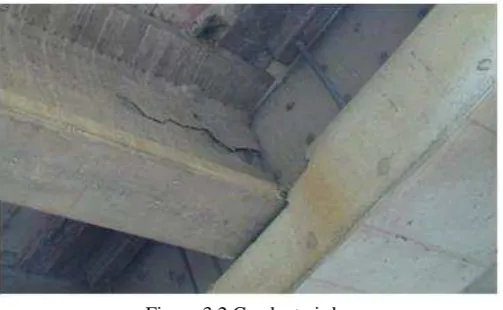
3.2 Case 2. Crack at Girder
Figure 3.2 Crack at girder
Source: http://1.usa.gov/1XweVxL
Cause
There are factors that caused crack at girder before the construction 1. Temperature.
2. Corrosion at reinforcement. 3. Bad construction method. 4. Using bad material.
5. Arrange the reinforcement with not properly.
There are factors that caused crack at girder after the construction 1. Wheather.
2. Load.
Impact
The strengthness of girder will be dicreasing and solwy but surely it will be dangerous for the structure and bridge’s user.
Prevention
KBS || Girder and Slab at Fly Over
Deasy Monica P | Yedie Chahyadie 13
3.3 Case 3. Girder failure.
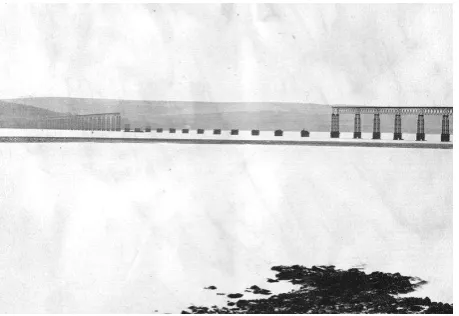
1. Tay Rail bridge
Figure 3.3 Tay Rail bridge
Source: http://bit.ly/1XwfcAV
Location : Dundee
Country : Scotland
Date : 28 December 1879
Construction type : Continous girder bride, wrought iron framework on cast iron
columns, rail way.
Reason : Faulty design, construction and maintenance, structural
deterioration and wind load.
Casualities : 75 killed and no survivors.
Damage : Bridge unusable, girders partly reused and train damaged.
2. Inverythan Rail Bridge
Figure 3.4 Inverythan Rail bridge
Source: http://bit.ly/1WrTeyC
Location : Aberdeenshire
Country : Scotland
Date : 27 November 1882
Construction type : Cast iron girder rail
Reason : Hidden defects in cast iron caused collapse as train passed
KBS || Girder and Slab at Fly Over
Deasy Monica P | Yedie Chahyadie 14
Casualities : 5 killed, 17 injured
Damage : Bridge rebuilt
3.4 Case 4. Slab failure and case
1. Seong su bridge
Figure 3.5 Seong su bridge
Source: http://bit.ly/1XwhWhs
Location : Seoul
Country : South Korea
Date : 21 October 1994
Construction type : Cantilever bridge crossing Han River
Reason : Structural failure was caused by improper welding of the
steel
Trusses of the suspension structure beneath the concrete slab
Roadway.
Casualities : 32 killed, 17 injured
Damage : 48-metre slab between the fifth and the sixth pier collapsed
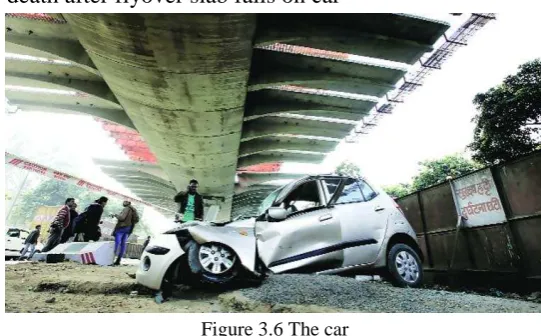
2. Couple cheats death after flyover slab falls on car
Figure 3.6 The car
KBS || Girder and Slab at Fly Over
Deasy Monica P | Yedie Chahyadie 15
Location : Delhi
Country : India
Date : 15 Februari 2015
Reason : The concrete slab reportedly loosened from the crane hoist
while the labourers were trying to install it
Casualities : A husband and wife and a labourer were death
Damage : 48-metre slab between the fifth and the sixth pier collapsed
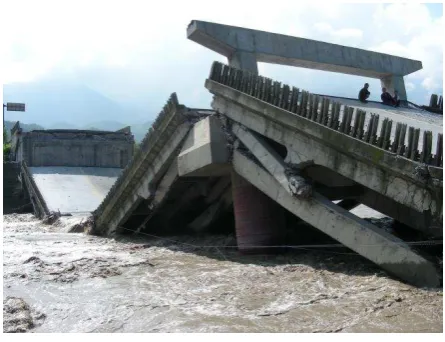
3. Bridge and slab failure after earthquake
Figure 3.7 Bridge and slab failure
Source: http://bit.ly/1PcZ1lP
Location : Wenchuan
Country : China
Date : 12 May 2008
Reason : Earthquake with 7.9 magnitude
Casualities : Killed 69.197 people and left 18.222 missing because of
earthquake
KBS || Girder and Slab at Fly Over
Deasy Monica P | Yedie Chahyadie 16
CHAPTER IV
FINAL
4.1
Conclusion
From the explaining above, we can conclude that
1. Basic guide to choose the structure are based on the function, strength and stability, economy and implementation.
2. Types of girder are I-Girder, T-Beams and box girder. On the other hand, there are another types of girder, like rolled steel girder, plate girder and ballon flange girder. 3. Types of slab are based on forms, structures, length and width and constructions.
4.2
Suggestion
1. For slab, We have to choose kind of slab wisely. Because so many types of slab based on forms, structures, length and width and constructions. We have to choose the structure based on the function, strength and stability, economy and implementation.
2. For girder, if you need for short span, you can use I-Girder. If you need for long span and easy for errection, you can use plate girder. If you need for long span, high torsional and easy to maintenance, you can use box girder. Last but not least,choose the structure it’s still based on the function, strength and stability, economy and implementation for itself.