BUSINESS MODELS FOR SMES IN BANDUNG:
SWOT ANALYSIS
Senen Machmud
1, Iwan Sidharta
2STIE Pasundan Bandung
Email: [email protected] Email: [email protected]
Abstract
The main objective of this study is to find the model business for small and medium-sized enterprises (SMEs) with management strategy and business strategy approach. This research to help researchers, owners of SMEs and government in developing a framework for management strategy and business strategy on how the best result of business models. This study is valuable considering the limited among of empirical work previously done on the topic in question. The result of management strategies is internal and external factor analysis than analysis with strength, weakness, opportunities, and treatment (SWOT).
Keywords: model business; strategic management; business strategy; SWOT analysis; SMEs
Abstrak
Tujuan utama dari penelitian ini adalah untuk menemukan model bisnis untuk usaha kecil dan menengah ( UKM ) dengan strategi manajemen dan pendekatan strategi bisnis. Penelitian ini untuk membantu para peneliti, pemilik UKM dan pemerintah dalam mengembangkan kerangka kerja untuk strategi manajemen dan strategi bisnis tentang bagaimana hasil terbaik dari model bisnis. Penelitian ini berharga mengingat terbatasnya antara pekerjaan empiris sebelumnya dilakukan pada topik yang dimaksud. Hasil strategi manajemen adalah analisis faktor internal dan eksternal dari analisis strength, weakness, opportunities, and treatment ( SWOT ).
Kata kunci: bisnis model; manajemen strategis; strategi bisnis; analisis SWOT; UKM
INTRODUCTION
Global competition makes companies struggling to maintain business sustainability, such as that experienced by SMEs in developing countries. The growth of information technology is growing rapidly create competition coupled with the increasingly competitive global push toward world trade. According to Aaker (1989) noted that the assets and skill of the firm, which are the basis for competition, provide the foundation for sustainable competitive advantages (Man, 2009). Competitive advantages can be achieved if SMEs choose the right business strategy is to first conduct the strategic management process (Kraus., et,. al,. 2011).
Implementation of strategic management can increase competitiveness, reduce costs, improve decision-making, facilitate implementation of employee motivation system, shorten delivery times, higher quality of customer satisfaction, etc (Holatova and
Brezinova, 2013). Authors such as Tenai, et al (2009) highlight a strong link between competitiveness and enterprise strategy. Oltra and Flor (2010) highlighted the existence of a moderating effect of business strategy, especially in defender form, the cost and quality priorities influence positively. In the years of 2015 at which time the applicant agreement Asean Economic Community which resulted in a free market in Southeast Asia SMEs comprise about 99 per cent of all enterprises within the Asia Pacific región, and their importance to national economies cannot underscored (Wiesner and Millett, 2012). The same thing with Indonesian enterprises, according to Indonesian Statistics, an SMEs was 99 percent of total enterprises. Selection of Bandung as the study site because it is the third largest city in Indonesia with 18.25 percent of the total national population and is the capital of West Java province.
Efforts to make the SMEs to be able to compete, independent and able to make a major contribution to the economy of the city of Bandung is not enough just through government policy. Mohammad, et al., findings the career choice of entrepreneurship (i.e., being self employed) showing its significance in solving the graduate unemployment problem. The highlight that these enterprises have displayed growth and are more likely to contribute to the economy (Blackburn., et.al., 2013). Therefore it is necessary strategic steps in developing SMEs in Bandung . As for SMEs include the flagship center of clothing suci, center of jeans cihampelas, center of textile cigondewah, center of shoes cibaduyut and center of knitting binong jati. In general the problems of SMEs in Bandung according to Regional Government publications such as business competition, capital access, structure and infrastructure, high cost of material, weathers, raw material access, marketing and technology.
According to NetRegs (2009) despite 91 per cent of SMEs struggling see or acknowledge the environtmental impacts of their activities and businesses without prompting, it is highlighted that SMEs report some enviromental activity in areas such as waste minimisation and resources efficiency (Howarth and Fredericks, 2012). To overcome the problems in developing SMEs in Bandung there are many factors that influence. These factors can be classified into two groups; internal and external Factor. Kunene (2008) stated that internal factors are dominant factors affecting the success of SMEs in emerging countries.
The purpose of this study is to analyze SMEs in implementing the strategy concepts that will serve as guidelines in formulating policy and strategy of development of SMEs by applying a generic choice of internal and external strategies based on factor analysis and SWOT analysis. This study base on previous study by Machmud and Sidharta (2013) to analysis business models for SMEs in Bandung. Another contribution of this study is that it adds to the principal activities and tool that comprise the strategic practices undertaken in SMEs. This study is expected to provide benefits for SMEs information regarding the type of strategies that can be used in developing the business and for the Local Government and related parties to provide contributions to the development of SMEs in their area.
The results of this study are expected to be useful for SMEs for developed strategies in Bandung which also contains information about supporting factors in the success of the development of SMEs in the city of Bandung, the results of the analysis of the type of grouping industrial strategy, the results of the analysis of the success of the implementation of development strategies of SMEs, and the effective short-term strategy and long-term development of SMEs.
LITERATURE REVIEW
Management Srategic
needs strategic management skill in addition to entrepreunerial skills to be able to survive in competitive environtment (Ireland, 2007; Brockmann and Lacho, 2010). Changes in market and the competitive strategies of large organizations have increased the pressure on SMEs to focus on innovation, innovation capabilities and innovation management (McAdam et al., 2004; Hotho and Champion, 2011). Author Zubaedah et al., (2013) concluded that the success of firms in carrying out innovation is determined by the structure of which processes are organized. The relates environmental condition, organizational capabilities and stategic orientation SMEs to profit performance (Prett., and Wolf., 2007). Whereas a firm or corporate level strategy condisers the broad direction of a firm – growth, stability, or retrenchment – a competitive or business strategy soutline how as business unit competes within industry (Parnel, 2010). Oftentimes when strategic orientation has been tested in the entrepreneurship literature (c.f., Covin, et al., 2006; Ireland, et al., 2003; McGrath and MacMillan, 2000; Meyer and Heppard, 2000).
The basic of strategic management is the notion that strategy creates an aligment between an enterprise’s internal strengths and weaknesses on the one hand and its external opportumities and threats on other hand (Andrews, 1987; Kraus et al, 2011). However, a strategic plan for an estabilished and growing venture needs to address the interaction and management strategy in balance with availabel resources and organisational structure (Chandler, 1962; Mazzarol, et al., 2007). There are four important things, such as management strategy is a process, the process used to formulate and implement a strategy, a strategy used to provide the best customer value in order to realize the vision of the organization and the manager and employee is the perpetrator management strategy. Strategic management is regarded as an important process for businesses (Bowman and Asch, 1987; Kumar, 2010; Thomson and Strickland, 2003; Chaimankong and Prasertsakul, 2012). The strategy was in essence a general plan of action, long-term and wide-ranging. Strategy is determination of the baisc long-term goals and objectives of an Enterprise, and the adoption of action and allocation of resources necessary for carrying out these goals (Chandler, 1962; Malik and Naeem, 2011).
Some research shows that organizations that have a clear strategy or formal, outperformed its performance compared to organizations with no or no clear strategy formulation. The literature suggests that two main perspectives shape our standing of strategy and strategic choice; the industrial organization persepective (Porter, 1985), and the resources-based view (Peteraf, 1993; O’regan and Ghobadian, 2005). In the business the term suggests a plan that incorporates strategies, linking a broad and integrated with the company's strategic advantage and environmental challenges that are designed to ensure that the company's main goal can be achieved through proper execution by the company.
Typhology of Strategy
findings of earlier Works regarding Miles and Snow’s typology (Moore, 2005, Brunk, 2003, DeSarbo, et al., 2005; Pleskho and Nickerson, 2006).
SWOT Analysis
SWOT analysis or categorizing issues into strengths, weaknesses, opportunities, and threats is one of the most respected and prevalent tool for strategic planning (Glaister and Falshaw, 1999; Helms, et al., 2011). The resource-based strategic paradigm is based upon the tenets of SWOT analysis and represents a renewed interest in internal organizational influences (Hoskisson, et al., 1999; Hajikhani and Jafari, 2013). Usually, it is ”an effective way of gathering and classifying information, illustrating particular matters, and generating strategic planning ideas for a business” (Chan, 2011). The relationship between the company and environment in terms strategic management refers to external conditions and internal environment factors (Yuksel, 2012).
Researchers in strategic management agree SWOT analysis provides the foundation for the realization of the desired alignment of organizational variabelor issues (Ansoff, 1965; Andrews, 1987; Porter, 1991; Mintzberg et al., 1998; Helms, and Nixon, 2010). Strategic formulation process conducted through three stages of analysis, the input stage, phase analysis, and decision stages. The final stage is a case analysis to formulate a decision to be taken.
RESEARCH METODOLOGY
Planning approach that can be used in this study is a mixed scanning planning approach which is a combination of rational, comprehensive approach with disaggregated approach, that simplifies the overall approach within the scope of insight at a glance and deepen strategic overview of the elements of the overall problem. The approach used in this study refers to the theoretical foundation based on SWOT analysis.
Furthermore SMEs located in Bandung will be identified based on the variables that represent the four types of strategies above and further grouped according to internal and external factors. The population of the study is the principal priority of SMEs in Bandung.
The purpose of the data processing in this case is to get an alternative strategy where the largest contribution to the success of businesses SMES. This use case model SWOT matrix. At this stage it will be acquired strategies to be implemented. With the use of quantitative models in the formulation of strategy can be seen in the institutional conditions map development of small and medium industries in Bandung. The results of the analysis of the evaluation matrix table internal and external factor is mapped on a matrix position.
Based on the identification of factors internal and external factors that are strengths and weaknesses can be made internal factor analysis table by means of the weighting and rating. Assigning weights to each factor based on the consideration of "very important" (0.1) up to "very unimportant" (0.0), which factors are likely to have an impact. Further ratings are calculated for each factor by providing a scale ranging from 4 (outstanding) to 1 (poor) based on the influence of these factors on the development of SMEs in Bandung. Rating for scoring strengths are positive factors (factors greater strengths were rated +4, but if small strengths were rated +1). Conversely, the rating for scoring weaknesses patterned inverted factor, if very large weaknesses were rated 1 and if the minor weaknesses were rated 4. Next step in value by multiplying the weight values to obtain a value rating score weighting for each factor.
RESULT
Strategic Factors Environment
Internal and external environmental factors that will be identified based on the findings of the field, covering the potential factors. All of these factors will be identified strengths, weaknesses, opportunities and weaknesses level, as;
Stenghts
1. SMEs is an industry segment that can be used as a vehicle and the main pedestal of the most promising for the creation of new entrepreneurs, as it is the closest level that can be reached by people who are just starting entrepreneurship.
2. SMEs has the characteristics of large capacity to the realization of the aspirations of the wider community to obtain an economic livelihood, especially those classified as low-income and middle-income.
3. SMEs has high flexibility and resilience to anticipate and adapt to the dynamic changes or market developments, due to its dominant foothold benefited from the domestic market and strongly in the use of inputs (raw materials) derived from Bandung.
4. There are many financial institutions in the banking and non-banking and supporting business capital of the government of Bandung Revolving credit and loans.
5. Not easily penetrated by its domestic market of similar products imported because the level of sophistication of the technology used is low and does not require high skills. 6. The majority of SMEs is already incorporated and under the monitoring and
evaluation of the Department of the Ministry of Bandung and majority of SMEs are already incorporated in the form of associations.
7. Facilities and infrastructure to support the development of SMEs, especially in terms of the amount is sufficient there in Bandung.
Weaknesses
1. People who are involved in many highly qualified SMEs yet reliable and professional, especially also in the field of entrepreneurship.
2. Limitations of local labor and skills of trained human resources in the field of SMEs resulting limitation management, marketing, capital, partnership and technology. 3. Most of raw naterials need still come from outside or imported, skill of production
technology and product quality as well as insight into the orientation of the majority of SMEs is still limited and has not been developed, including innovation, the production technology used mostly still relatively simple / traditional and the limited use of information technology to promote SMEs.
4. Ability to capital is limited, and the ability to access sources of funding / capital is also limited and limited realization of capital support from the government.
5. The ability and the aggressiveness of the SMEs entrepreneurs to access markets is still limited, entrepreneurs in general are still not able to meet the market demand requires the stability of quality, a large number of orders, fast and timely delivery and there is a shortage of effective marketing institutions and other support facilities for SMEs products.
6. Not its financial administration and management system that is good because its not yet separated the ownership and management of the company and SMES development of business networks and lack of data and information that is sharp and up to date of SMEs are ready to be marketed and specification needs of individual SMEs.
7. Condition of facilities and infrastructure, especially from the aspect of quality is still relatively low, such as roads, electricity, water, waste disposal, etc.
1. The high political support and commitment of the central government in the development of SMEs and the high political support and commitment of the provincial government in the development of SMEs.
2. Still the involve potential natural resource to develop SMEs and the availability of human resources, workforce in large numbers are still not utilized productively. 3. There is still the potential wealth of local traditional culture and art that has not been
optimally utilized to develop SMEs and the increasing public awareness of the pivotal role played by SMEs in improving their welfare.
4. Potential opportunities in the domestic market, the need for products, goods SMEs results still have not been met and opportunities would be open export markets, at least it will be easy access to the markets of Southeast Asia in the framework of AFTA, as well as exports to non-ASEAN region.
5. The emergence of new technologies and production processes in the field of information and communication technology (ICT) that really support dynamic business activities, including supporting the ability to access the market quickly. 6. The national security conditions more conducive.
Threats
1. Not to the realization of the commitment, consistency of policy and the spirit of integration of various parties / policy decision makers to the development of SMEs, not only the vision and attitude as well as the integration of SMEs handler's guidance from the government, and not full support arrangements by the government, facilitate, ease and expedite business entrepreneurs incentives for SMEs, among others, special rates, easier requirements, subsidies and technical assistance, fraud protection against large employers.
2. The use of materials that are less efficient, the instability of the exchange rate against foreign currencies, There are many raw materials that must be brought in from outside, and the low participation of residents in the activities of SMEs.
3. There is a widespread embedded caring attitude, partnership and social solidarity of large employers to SMEs, In the perspective and attitude is not negative, as would be set, do not want to exploit the potential of the wealth of art and culture that is optimal, essentially all of which is a challenge for the development of SMEs.
4. In the perspective and attitude is not negative, as would be set, do not want to exploit the potential of the wealth of art and culture that is optimal, essentially all of which is a challenge for the development of SMEs.
5. The use of modern technology must be supported by the scale of high demand, and the use of modern technology must be supported by a relatively large capital.
6.
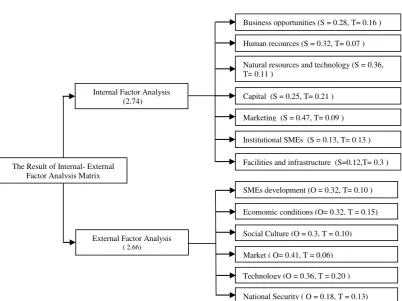
The existence of security threats from certain parties and from parties such as labor demands wage increases.Based on the analysis of internal-external matrix with a total score of IFAS = 2.74 and EFAS = 2.66. Internal factor that influences iditification is greater than the effect of the external factor which means SMEs in Bandung potential to be developed by the relevant parties and sufficiently open to support economic development in Bandung.
SWOT Analysis
In formulating various alternative strategies can be used SWOT analysis matrix models. There are four alternative strategies that can be suggested; SO, WO, ST and WT strategy. SWOT matrix analysis model using data obtained from tables IFAS and EFAS.
Strategy SO
1. Increased partnerships, both in the areas of marketing, technology and capital needs to be done with great entrepreneurs.
2. Development of SMEs needs to be done in an integrated and synergy with development medium and large scale industries.
3. Creating a favorable business climate for the development of SMEs and to encourage the creation of new entrepreneurs through business modernization policy, policy stability Enterprises, SMEs and weaknesses elimination.
4. To involve SMEs in the program of exhibitions and bazaars in order to help SMEs to market and promote their products through exhibitions and bazaars or the people in the domestic market and abroad.
Strategy WO
1. Empowerment existing SMEs, and development of SMEs in an integrated manner in the field and has a strong commitment to do the development of SMEs.
2. Human resource development such as; entrepreneurship training, training production technology SMEs for various types of businesses, training of marketing management, training in the field of banking credit financing and training in export-import.
3. Development promotion services unit, technical services unit, information services unit, promotion and marketing center, development trading house and development promotion center.
Strategy ST
1. Designate one official who actually became a coordinating body to be a "filter". It is expected that the role and functions of the Central Agency have been coordinating the implementation of coaching. The benefits of coordination on the ground, so that each agency is able to perform the function not to over-lapping, because is a tendency to overlap in coaching.
2. Facilitate Meeting venture between entrepreneurs of SMEs with financial institutions such as the Bank, PT. PNM, Social Security Insurance, empowering microfinance institutions, utilizing the fuel subsidy fund every developed district of the KSP patterns and non-Islamic sharia, and provide loan funds as “Bawaku Sejahtera”. 3. Increased participation and community participation (Kadin, Hipmi, Association and
NGOs) in the development of SMEs.
4. To disseminate the importance information technology, especially the use of the internet to promote the products of SMEs, and need to have a system of computer networks and the Internet to connect with related agencies as well as having a website that can be accessed by the public or prospective buyers both domestically and abroad.
5. Creating a conducive security conditions.
Strategy WT
1. MOU entered into empowering SMEs in Bandung between the Department of the Ministry with the local college.
2. Special effort provisioning scheme for entrepreneurs SEMs. 3. Supplying government market.
4. Lightening system in the field of venture capital.
5. Diversification system / marking scheme (ie venture capital, loan guarantees, etc.), and
CONCLUSION
The results of this study can be useful for SMEs for developed strategies in Bandung which also contains information about; supporting factors in the success of the development of SMEs in the city of Bandung, the results of the analysis of the type of grouping industrial strategy, the results of the analysis of the success of the implementation of development strategies of SMEs, and the effective short-term strategy and long-term development of SMEs.
REFERENCE
Aaker., D. A., (2009), “Managing assets and skills: the key to a sustainable competitive advantage”, California Management Review, 31(2)m, 91-106.
Andrews., K, R,. (1987), “The concept of corporate strategy”, Richard D. Irwin, Homewood, IL.
Ansoff., H, I,. (1965), “Corporate strategy”, McGraw-Hill, New York.
Ates, A., Patrizia G., & Paola C., (2013), “The development of SME managerial practice for effective performance management”, Journal of Small Business and Enterprises Development, 20(1), 28-54.
Blackburn., R. A., Mark, H., & Thomas, W., (2013), “Small business performance: business, strategy and owner-manager characteristics”, Journal of Small Business and Enterprises Development, 20(1), 8-27.
Bawman., C,. & Asch, D., (1987), “Strategic management”, Macmillan, London.
Business opportunities (S = 0.28, T= 0.16 )
Human recources (S = 0.32, T= 0.07 )
Natural resources and technology (S = 0.36, T= 0.11 )
Capital (S = 0.25, T= 0.21 )
Marketing (S = 0.47, T= 0.09 )
Institutional SMEs (S = 0.13, T= 0.13 )
Facilities and infrastructure (S=0.12,T= 0.3 )
SMEs development (O = 0.32, T= 0.10 )
Ecomomic conditions (O= 0.32, T = 0.15)
Social Culture (O = 0.3, T = 0.10)
Market ( O= 0.41, T = 0.06)
Technology (O = 0.36, T = 0.20 )
National Security ( O = 0.18, T = 0.13) External Factor Analysis
( 2.66) Internal Factor Analysis
(2.74)
The Result of Internal- External Factor Analysis Matrix
Figure 1. The result of scoring internal-external factor analysis
Brockmann, E. N., & Lacho, K., J., (2010), “Strategic planning: a practical primer for entrepreuner”, The Entrepreunerial Executive, 15, 25-32.
Brunk, S, E., (2003), “From theory to practice: applying miles and snow’s ideas to understand and improve firm performance”, The Academy of Management Executive, 17(4), 105.
Chaimankong, M., & Prasetsakul, D., (2012), “Impact od strategy implementation on performance of generic strategy: evidence from Thailand”, The South East Asian Journal of Management, 6(1), 1-14.
Chan, Xia., (2011), “A SWOT study of the development strategy of Haier Group as one of the most successful Chinese enterprises”, International Journal of Business and Sosial Science, 2(1),147-153.
Chandler, A, D., (1962), “Strategy and structure: chapters in the history of the industrial enterprises”, MIT Press, Cambridge, MA.
Covin, J., Green, K., & Slevin, D., (2006), “Strategic process effects on the entrepreunerial orientation-sales growth rate relationship”, Entrepreneurship Theory and Practice, 30(1),57-81.
Croteau, A, M., Raymond, L., & Bergeron, F., (1999), “Testing the validity of miles and snow’s typology”, Procceedings of the Academy of Information and Management Science, 3(2), 1-8.
Desarbo, W, S., Benedetto, C, A, D., Song, M., & Sinha, I., (2005), “Revisiting the miles and snow strategic framework: uncovering interrelationships between strategic types, capabilities, environtmental uncertainties, and firm performance”, Strategic Management Journal, 26, 47-74.
Garrigo, S, F, J., Marque’s, D, P., & Narangajavana, Y., (2005), “Competitive strategies and performance in Spanish hospitality firm”, International Journal of Contemporary Hospitally Management, 17(1), 22-38.
Glaister, K. W., & Falshaw, J, R., (1999), “Strategic planning still going strong”, Long Rang Planning, 32(1), 107-116.
Hafer, R. W., (2013), “Entrepreneurship and state economic growth”, Journal of Entrepreneurship and Public Policy, 2(1), 67-79.
Hajikhani, A., & Jafari, H, R., (2013), “Developing a mix method of SWOT, BSC & QFD toward strategic planning”, Interdisiplinary Journal of Contemporary Research in Business, 5(1), 476-489.
Hambrick, D, C., (1980), “Operationalizing the concept of business-level strategy in research”, Academy of Management Review, 5(4), 567-575.
Helms, M., Rodriguez, M, A., Rios, L, D., & Hargrave, W., (2011), “Entrepreneurial potential in Argentina: a SWOT analysis”, Comparative Review: An International Journal, 21(3), 269-287.
Helms, M, M., & Nixon, J., (2010), “Exploring SWOT analysis – where are we now?: a review of academic research from last decade”, Journal of Strategy and Management, 3(3), 215-251.
Holatova, D., & Brezinova, M., (2013), “Basic characteristic of small and medium sized enterprises in term of their goals”, International Journal of Business and Social Science, 4(15), 98-104.
Hotho, S., & Champion, K., (2011), “Small business in the new creative industries: innovation as a people management challenge”, Management Desicion, 49(1), 29-54.
Howarth, R., & Frederick, J., (2012), “Sustainable SME practice, a reflection on supply-chain environmental management intervention”, Management of Environmental Quality: An International Journal, 23(6), 673-685.
Ireland, R, D., (2007), “Strategy vs entrepreneurship”, Strategic Entrepreunership Journal, 1(1), 7-10.
Ireland, R, D., Hitt, M, A., & Sirmon, D, G., (2003), “A model of strategic entrepreneurship: the construct and its dimentions”, Journal of Management, 29, 963-989.
Kraus, S., Kauranen, I., & Reschke, C. H., (2011), “Identification of domains for a new conceptual model of strategic entrepreneurship using the configuration approarch”, Management Research Review, 34(1), 58-74.
Kumar, K., (2011), “Similarities and differences in the strategic orientation, innovation patterns and performance of SMEs and large companies”, The Business Review, 16(2).
Kuratko, D,F., Ireland, R, D., Covin, J, G., & Hornsby, J, S., (2005), “A model of middle-level managers’ entrepreneurial behavior”, Entrepreneurship Theory & Practice, 29(6), 699-716.
Kunene, T, R., ( 2008), A Critical Analysis of Entrepreneurial and Business Skills in SMEs in the Textil and Clothing Industry in Johannesburgh, Dissertation, University of Pretoria, South Africa.
Machmud, S., & Sidharta, I. (2013). Model Kajian Pendekatan Manajemen Strategik Dalam Peningkatan Sektor UMKM Di Kota Bandung
.
Jurnal Computech &Bisnis, 7(1), 56-66.
Malik, M. E., & Naeem, B., (2011), “Miles and snows strategy typology: a critical commentary”, Journal of Contemporary Research In Business, 3(4), 805-812. Mazzarol, T., Reboud, S., & Soutar, G, N., (2007), “Strategic planning in growth
oriented small firms”, Jurnal Computech & Bisnis, 15(2), 320-345.
Man, M, M, K., (2009), “The relationship between distinctive capabilities, innovativeness, strategy types and the performance of SMEs of Malaysian Manufacturing Sector”, International Business & Economics Research Journal, 8(11), 21-33.
McAdam, R., McConvery, T., & Armstrong, G., (2004), “Barriers to innovationwithin small firm in a peripheral location”, International Journal of Entrepreneurial Behavior & Research, 10(3), 206-221.
McGranth, R, G., & MacMillan, I., (2000), “The entrepreneurial mindset”, Boston, MA: Harvard Business School Press.
Meyer, G, D., & Heppard, K, A., (2000), “Entrepreneurship as strategy: competing on the entrepreneurial edge”, Thousand Oaks, CA: Sage.
Mintzberg, H., Ahlstrand, B., & Lample, J., (1998), “Strategy safari: a guide through the wilds of strategic management”, Free Press, New York.
Mohamad, N., Lim, H., Yusof, N., Kassim, M., & Abdullah, H., (2014), “Estimating the choice of entrepreneurship as career: the case of University Utara Malaysia”, International Journal of Business and Society, 15, 65-80.
Moore, M., (2005), “Towards a confirmatory model of retail strategy types:an empirical test of miles and snow”, Journal of Business Research, 58(5), 696. Oltra, M, J., & Flor, M, L., (2010), “The moderating effect of business strategy on the
relationship between operations strategy and firm’s results”, International Journal of Operations and Production Management, 30(6), 612-638.
Parnell, J. A., (2010), “Strategic clarity, business strategy and performance”, Journal of Strategiy and Management, 3(4), 304-324.
Paulson, S. K., (2009), “Business strategy perspectives and economic theory: a proposed integration”, Academy of Strategic Management Journal, 8, 87-98. Peteraf, M, A., (1993), “The cornerstones of competitive advantage: a resource-based
view”, Strategic Management Journal, 14(3), 179-191.
Pleshko, L, P., & Nickerson, I., (2006), “A simple measure for the miles & snow strategy groups”, Proceedings of The StrategicManagement, 5(2), 27-31.
Porter, M, E., (1985), “The competitive advantage: creating and sustaining superior performance”, The Free Press, New York.
Porter, M, E., (1991), “Towards a dynamic theory of strategy”, Strategic Management Journal, 12, 95-117.
Prett, T., & Wolf, J. A., (2007), “SME performance: a case for internal consistency”, Journal of Small Business Strategy, 18(1), 1-16.
Ruperto, Hoyos M. D., Jose, M. R., Bo. C., & Kalle. L., (2013), “Networking:A critical success factor for entrepreneurship”, American Journal of Management, 13(2), 55-72.
Russu, C., (2013), “SWOT analysis of the state and prospects of the Romanian manufacturing industry’s sectors”, Economic Insights – Trends and Chalengges, 2(4), 13-35.
Slater, S, F., Hult, G, T, M., & Olson, E, M., (2010), “Factors influencing the relative importance of marketing strategy creativity and marketing strategy implementation effectiveness”, Industrial Marketing Management, 39, 551-559. Snow, C, C., & Hrebiniak, L, G., (1980), “Strategy, distingtive competence and
organizational performance”, Administrative Science Quartely, 25(2), 317-336. Tenai, J, K., Bitok, J, K., Cheruiyot, T, K., & Maru, L, K., (2009), “Moderating
variabel on SME’s Strategies and competitiveness for international trade: a survey of horticultural trader in urban and peri-urban areas in Kenya”, International Business and Economic Research Journal, 8(12), 105-116.
Thomson, A, A., & Strickland, A, J., (2003), “Strategic management: concepts and cases”, McGraw-Hill/Irwin, Boston.
Vaz, E., Teresa de N. V., Purificacion V, G., & Peter N., (2014), “Modelling innovation support systems for regional development-analysis of cluster structures in innovation in Portugal”, Entrepreneurship & Regional Development: An International Journal, 26(1), 23-46.
Venkataraman, S., & Sarasvathy, S, D., (2001), “Strategy and entrepreneurship:
outlines of an untold story”, in Hitt, M. A., Freeman, E, and Harrison, J, S.,
(Eds), Handbook of Strategic Management, Blackwell, Oxford, pp. 650-668. Walker, O., & Ruekert, R., (1987), “Marketing’s role in the implementationof business
strategies: a critical reviewand conceptual framework”, Journal of Marketing, 51(3), 15-33.
Wheelen, T., & Hunger, D., (2000), “Strategic management and business policy”, Addison-Wesley Publishing, New York.
Wiesner, R., & Millet, B., (2012), “Strategic approarches in Australian SMEs: deliberate or emergent?”, Journal of Management and Organization, 18(1), 98-122.
Yuksel, I., (2012), “An integrated approarch with group decision-making for strategy selection in SWOT analysis”, International Journal of Research in Business and Sosial Science, 2(11), 134-161.
Zubaedah, Y., Fontana, A., & Affif, A, Z., (2013), “Revisiting the miles and snow typology: Strategic path mediating business strategy and resource configuration for innovation”, The South East Asian Journal of Management, 7(1), 16-40. Zahra, S., & Dess, G, G., (2001), “Entrepreneurship as a field of research: encouraging