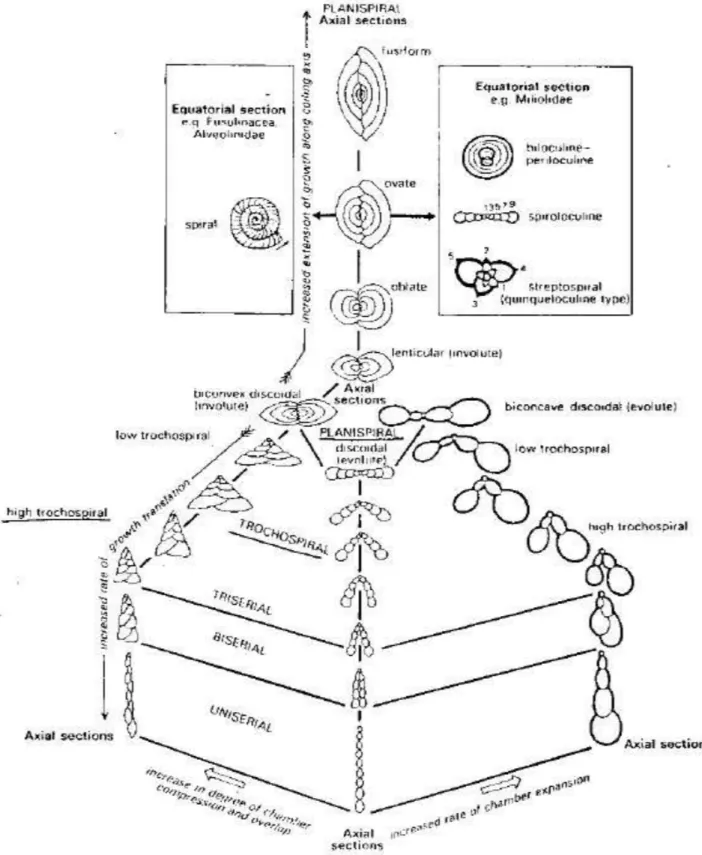
(gambar mofifikasi dari http://www.ucmp.berkeley.edu/fosrec/) (gambar mofifikasi dari http://www.ucmp.berkeley.edu/fosrec/)
Oleh Oleh
KHOIRIL ANWAR MARYUNANI
KHOIRIL ANWAR MARYUNANI
P
1 1 DAFTAR ISI DAFTAR ISI 1. 1. Sampling Sampling 2. 2. Sampel Sampel 3. Metoda Preparasi 3. Metoda Preparasi 4. Peralatan Praktikum 4. Peralatan Praktikum 5. 5. Glossary Glossary 6. Morfologi Foraminifera 6. Morfologi Foraminifera
7. Kunci Identifikasi Genus dan Species Plangton Umur Plistosen
7. Kunci Identifikasi Genus dan Species Plangton Umur Plistosen - Resen- Resen 8. Kunci Identifikasi Genus dan Species Plangton Umur Kenozoikum
8. Kunci Identifikasi Genus dan Species Plangton Umur Kenozoikum 9. Kunci Identifikasi Genus dan Species Plangton Umur Mesozoikum 9. Kunci Identifikasi Genus dan Species Plangton Umur Mesozoikum 10. Kisaran Umur Beberapa
10. Kisaran Umur Beberapa Marker Marker Plangton Plangton 11. Kunci Identifikasi Genus Bentonik
11. Kunci Identifikasi Genus Bentonik
12. Diskripsi Beberapa Genus Foraminifera Plangton 12. Diskripsi Beberapa Genus Foraminifera Plangton
13. Diskripsi Beberapa Genus Foraminifera Bentonik yang Kosmopolitan di Endapan 13. Diskripsi Beberapa Genus Foraminifera Bentonik yang Kosmopolitan di Endapan
Neogen Neogen
14. Foraminifera Besar 14. Foraminifera Besar 15. Kisaran Umur Beberapa
15. Kisaran Umur Beberapa Marker Marker Foraminifera Besar Foraminifera Besar 16. Kunci Identifikasi Genus Kelompok Fusulinid.
16. Kunci Identifikasi Genus Kelompok Fusulinid. 17 Penyajian Data
17 Penyajian Data 18. Interpretasi Umur 18. Interpretasi Umur
19. Interpretasi Lingkungan Pengendapan 19. Interpretasi Lingkungan Pengendapan 21. Non-Foraminifera
21. Non-Foraminifera 22.
Dirangkum oleh: Khoiril Anwar M Dirangkum oleh: Khoiril Anwar M 2 2 PANDUAN PRAKTIKUM PANDUAN PRAKTIKUM MIKROFOSIL FORAMINIFERA MIKROFOSIL FORAMINIFERA
Panduan praktikum ini merupakan penjelasan singkat tentang parameter-parameter yang Panduan praktikum ini merupakan penjelasan singkat tentang parameter-parameter yang digunakan untuk mengidentifikasi/mengklasifikasi atau mendeskripsi genus atau species digunakan untuk mengidentifikasi/mengklasifikasi atau mendeskripsi genus atau species foraminifera serta pedoman dalam menginterpretasi umur dan lingkungan pengendapan foraminifera serta pedoman dalam menginterpretasi umur dan lingkungan pengendapan berdasarkan foraminifera.
berdasarkan foraminifera.
1.
1. S S amampliplingng
Sistematika pengambilan sampel untuk analisa fosil f
Sistematika pengambilan sampel untuk analisa fosil foraminifera secara umum ada dua oraminifera secara umum ada dua caracara yaitu :
yaitu : a.
a. spot spot sampling sampling ;;
b.
b. sistematic sistematic sampling sampling ..
Sample
Sample bisa berasal dari permukaan ( bisa berasal dari permukaan (surfacesurface outcropoutcrop) atau dari hasil pemboran.) atau dari hasil pemboran.
2.
2. S S amampleple
Ada empat macam
Ada empat macamsamplesample yang yang dikenal dikenal yaitu:yaitu:
-- OutcropOutcrop ( (samplesample lapangan) lapangan)
-- DicthDicth Cutting Cutting
-- Sidewall Sidewall CoreCore (SWC) (SWC)
- Core - Core
Masalah dalam interpretasi dapat disebabkan adanya fosil yang tidak
Masalah dalam interpretasi dapat disebabkan adanya fosil yang tidak in situin situ bisa karena bisa karena reworked (rombakan) atau
reworked (rombakan) atau displace/contamdisplace/contaminant inant . Beberapa hal yang dapat menyebabkan . Beberapa hal yang dapat menyebabkan kontaminasi adalah:
kontaminasi adalah:
a. caving: yaitu material yang berasal dari lapisan yang lebih tinggi dalam suatu sumur a. caving: yaitu material yang berasal dari lapisan yang lebih tinggi dalam suatu sumur pemboran, material tersebut dapat dikenali dari ciri litologi yang sama yang telah terlihat pemboran, material tersebut dapat dikenali dari ciri litologi yang sama yang telah terlihat diatasnya dalam satu sumur.
diatasnya dalam satu sumur.
b. Recirculation: recirculation ini terjadi akibat adanya material/microfossil dari batuan yang b. Recirculation: recirculation ini terjadi akibat adanya material/microfossil dari batuan yang
telah dibor yang kemudian ikut
telah dibor yang kemudian ikut masuk kembali ke sumur bersama aliran masuk kembali ke sumur bersama aliran lumpur pemboranlumpur pemboran dan
dan kemudian berkokemudian berkontaminasi dentaminasi dengan sampngan sampel yang el yang ada.ada.
c. Lost circulation material : kontaminasi berasal dari material pengisi rongga sumur pada c. Lost circulation material : kontaminasi berasal dari material pengisi rongga sumur pada
waktu terjadi lost circulation waktu terjadi lost circulation d. Cement: semen
d. Cement: semen untuk casing juga dapat mengandung foram untuk casing juga dapat mengandung foram yang dapat mengakibatkanyang dapat mengakibatkan kontaminasi
kontaminasi e. Drilling mud e. Drilling mud
Dari empat macam sjenis sampel dicth
Dari empat macam sjenis sampel dicth cutting merupakan sampel yang mempunyai karaktercutting merupakan sampel yang mempunyai karakter yang berbeda (banyak mengandung contaminat) sehingga berbeda pula dalam yang berbeda (banyak mengandung contaminat) sehingga berbeda pula dalam interpretasinya. Sampel dari outcrop, swc atau
interpretasinya. Sampel dari outcrop, swc atau core akan memberikan gambaran lebih baikcore akan memberikan gambaran lebih baik mengenai assos
mengenai assosiasi fosil yang iasi fosil yang sebenarnya sebenarnya (in situ) dibanding (in situ) dibanding ditch cutting.ditch cutting.
Jenis litologi juga harus diperhatikan dalam interpretasi, misal batupasir dilihat dari Jenis litologi juga harus diperhatikan dalam interpretasi, misal batupasir dilihat dari mekanisme sedimentasinya jenis batuan ini merupakan hasil
mekanisme sedimentasinya jenis batuan ini merupakan hasil tranportasi, sehingga fosil yangtranportasi, sehingga fosil yang berasosiasi dengan batupasir harus dilihat dengaan hati-hati.
berasosiasi dengan batupasir harus dilihat dengaan hati-hati.
3. Metoda Preparasi 3. Metoda Preparasi
The techniques used to prepare and concentrate samples for examination vary according The techniques used to prepare and concentrate samples for examination vary according to rock type (composition and grain size), how hard or resistant the sediment or rock is, to rock type (composition and grain size), how hard or resistant the sediment or rock is, how abundant the foraminifera are, and how they
how abundant the foraminifera are, and how they are preserved within are preserved within the sediment matrix.the sediment matrix. The discussions that follow focus on sediment types that
The discussions that follow focus on sediment types that can be disaggregated in order tocan be disaggregated in order to free the foraminiferal tests.
3 3
produced when these sediments are
produced when these sediments are hardened (sandstones, siltstones and shales,hardened (sandstones, siltstones and shales, respectively). For the hard limestone usually can be
respectively). For the hard limestone usually can be examination using thin section.examination using thin section.
Foraminifera can be recovered from bulk sediment samples, although their presence or Foraminifera can be recovered from bulk sediment samples, although their presence or absence in any given sample often cannot be established until after processing. The absence in any given sample often cannot be established until after processing. The sampling strategy is simply to collect bags of
sampling strategy is simply to collect bags of sediments/sedimentarsediments/sedimentary rocks that can later y rocks that can later bebe broken down and processed for foraminifera. Another approach is to process sediment broken down and processed for foraminifera. Another approach is to process sediment contained within larger fossils that one m
contained within larger fossils that one might collect. For example, the fossil ight collect. For example, the fossil shells of marineshells of marine snails and clams are often filled with the same sediment that surrounds them. Processing snails and clams are often filled with the same sediment that surrounds them. Processing these sediment fillings may yield foraminifera. Processing samples in the laboratory will these sediment fillings may yield foraminifera. Processing samples in the laboratory will require a source of running water, a sieve, a funnel and some filter paper, and perhaps require a source of running water, a sieve, a funnel and some filter paper, and perhaps detergents or chemicals to help disaggregate the sediments.
detergents or chemicals to help disaggregate the sediments. Precautionary Note: Make sure that labeling is
Precautionary Note: Make sure that labeling is carefully and accurately transcribed at everycarefully and accurately transcribed at every step. A mislabeled sample has little, if any, scientific value.
step. A mislabeled sample has little, if any, scientific value.
a. Pencucian (Washing) a. Pencucian (Washing)
The object of all techniques described below is to isolate microfossils, in this case The object of all techniques described below is to isolate microfossils, in this case foraminifera, from the sediment grains that surround them.Unconsolidated sediment and foraminifera, from the sediment grains that surround them.Unconsolidated sediment and some soft rocks will break down after soak
some soft rocks will break down after soaking in water for a fing in water for a few hours, whereas harder rocksew hours, whereas harder rocks may first require crushing and then boiling. The rule of thumb here is to utilize the simplest may first require crushing and then boiling. The rule of thumb here is to utilize the simplest and easiest technique that will provide the desired results. If simple soaking is all that is and easiest technique that will provide the desired results. If simple soaking is all that is required to disaggregate the sediment, then forego more involved techniques. Regardless required to disaggregate the sediment, then forego more involved techniques. Regardless of which technique you utilize, initially breaking the sediment or rock into fragments several of which technique you utilize, initially breaking the sediment or rock into fragments several mm in maximum dimension, or
mm in maximum dimension, or slightly larger, will speed the slightly larger, will speed the process.process.
Simple Soaking
Simple Soaking —— If your sample is If your sample is composed of unconsolidated sediment or sedimentarycomposed of unconsolidated sediment or sedimentary
rock that can be easily disaggregated, simple soaking may be
rock that can be easily disaggregated, simple soaking may be all that is all that is required. Soaking inrequired. Soaking in distilled water is most
distilled water is most desirable, but using a dilute desirable, but using a dilute Calgon solution often helps to diaggregateCalgon solution often helps to diaggregate fine sediments (muds). Calgon can be purchased in the laundry detergent section of most fine sediments (muds). Calgon can be purchased in the laundry detergent section of most grocery stores. This can be done in a large beaker or any other clean glass container that is grocery stores. This can be done in a large beaker or any other clean glass container that is available. Experiment to see how long any given
available. Experiment to see how long any given sample needs to be soaked.sample needs to be soaked. Once the muds have been dispersed, the sample can be
Once the muds have been dispersed, the sample can be washed through a sieve (awashed through a sieve (a stainless steel U. S.
stainless steel U. S. Standard Sieve No. 230 with mesh openings of 63 Standard Sieve No. 230 with mesh openings of 63 microns ismicrons is
recommended). Gently agitate your water/sediment mixture, introduce it gradually onto recommended). Gently agitate your water/sediment mixture, introduce it gradually onto thethe sieve, and wash under a gentle stream
sieve, and wash under a gentle stream of water. Most professionals recommend distilledof water. Most professionals recommend distilled water, but tap water may be used at this stage. The muds will pass through the sieve and water, but tap water may be used at this stage. The muds will pass through the sieve and be discarded. Do not do this at a standard sink that is not equipped with a sediment trap. be discarded. Do not do this at a standard sink that is not equipped with a sediment trap. IfIf you do, you will have a clogged sink line in very short order. If you do not have a sink with you do, you will have a clogged sink line in very short order. If you do not have a sink with a sediment trap, do this
a sediment trap, do this outdoors or use a large bucket toutdoors or use a large bucket to catch what passes through theo catch what passes through the sieve. You can then dump contents of
sieve. You can then dump contents of the bucket outside. What remains on the sieve is the bucket outside. What remains on the sieve is aa concentration of sand-sized material, including any foraminifera that are
concentration of sand-sized material, including any foraminifera that are in the sample.in the sample. Rinse this material into filter paper placed within a funnel, allow the sample to drain, and Rinse this material into filter paper placed within a funnel, allow the sample to drain, and then air dry in
then air dry in place safe from contamination and breezes. When dry, the place safe from contamination and breezes. When dry, the grains should notgrains should not adhere to one another. If
adhere to one another. If they do, some mud still remains and they do, some mud still remains and the soaking/sievingthe soaking/sieving procedure should be repeated. When satisfactorily clean, the dried sample should be procedure should be repeated. When satisfactorily clean, the dried sample should be stored in a properly labeled
stored in a properly labeled vial until ready for vial until ready for microscopic examination.microscopic examination.
Don't get in a hurry during the sample processing phase. A bit of extra time invested in Don't get in a hurry during the sample processing phase. A bit of extra time invested in properly cleaning your samples will save time and
properly cleaning your samples will save time and frustration when you examine themfrustration when you examine them under the microscope.
Dirangkum oleh: Khoiril Anwar M 4
Hydrogen Peroxide (H2O2) Method — If your sample is more resistant, additional
treatments may be required to breakit down. Soaking and, if necessary, boiling in a dilute solution of hydrogen peroxide is an effective means of breaking down such samples (kadar peroksida yang digunakan jangan lebih dari 15 persen).
The steps in the H2O2 method are:
1) air-dry sample for several days or oven-dry sample for 24 hours at about 45°C; 2) place sample in 500-ml or 1000-ml pyrex beaker;
3) add fifteen percent hydrogen peroxide solution (volume of solution should be 2 to 3 times that of sample being processed);
4) gently agitate and let soak for 24 hours at room temperature or in oven at about 45°C (stir occasionally and keep covered to prevent contamination);
5) heat solution containing sample for 15 to 20 minutes, stirring frequently and taking care that the solution does not boil over;
6) wash sample over No. 230 U. S. Standard Sieve as described earlier;
7) if sample is not disaggregated, transfer it back into beaker and repeat steps 3 through 6; 8) wash sample over No. 18 U.S. Standard Sieve (1-mm openings) and No. 230 U.S.
Standard Sieve, trapping coarser material on the No. 18 sieve and the sand fraction containing foraminifera on the No. 230 sieve (a coarse screen of the proper mesh size, available at any hardware store, can substitute for the No. 18 sieve);
9) dry and examine any material retained on the No. 18 sieve (not likely to be forams but may include other fossils of interest);
10) transfer sample retained on No. 230 sieve to filter paper; 11) air-dry or oven-dry sample at 45°C;
12) transfer dried material to labeled vial for storage.
Other Techniques — Literature on the foraminifera describes other methods for
disaggregating sediment samples. A product called Quaternary O, a highly active but low sudsing detergent, was widely used for many years (e.g., Snyder et al., 1983). Although it is no longer available, a product called Miramine is a suitable and inexpensive substitute. It is available from the Miranol Chemical Company, 68 Culver Road, Dayton, NJ 08810. The methodology for using surfactants such as Quaternary O or Miramine is exactly like that desribed above for the use of hydrogen peroxide. Simply use the appropriately diluted detergent solution in place of the H2O2 solution.
Another technique for additional cleaning involves use of a sodium pyrophosphate or a sodium metaphosphate solution (e.g., Snyder and Waters, 1984). After an int ial soaking (in distilled water or a dilute Calgon solution), the sand-sized residue trapped on the No. 230 sieve is placed in 0.1 M solution (five grams of chemical to one liter of distilled water) and gently agitated for 20 to 30 minutes. This process effectively removes persistent clay-sized particles that may partially obscure important features of the test.
Finally, some of the older literature, not cited here because the techniques may be
extremely hazardous, advocates the use of much harsher chemicals, including kerosene, gasoline, Varsol (similar to white gas or mineral spirits), and concentrated H2O2. Use of
these methods is not recommended because they can be dangerous, both to the preparator and the environment.
CONCENTRATING THE TESTS OF FORAMINIFERA
Foraminiferal tests may be rare compared to nonbiogenic sediment particles. If foraminifera are reasonably abundant, the best procedure is simple microscopic examination of the processed sample in order to find them. However, there may be instances where the time required to examine the sample in this manner is prohibitive. Then it may be desirable to
5
float the foraminifera in order to separate them from other sediment grains. The only reason this works is because foraminifera, with their hollow chambers, have an effective density much less than solid sediment grains of comparable size. If the foraminifera are filled with sediment or secondary mineral material, they will not float.
Soap Float — One of the simplest ways to concentrate foraminiferal tests is to employ a
soap float. Here the detergent is not of the low sudsing variety (such as Quaternary O), but rather a standard detergent or soap that produces a sudsy froth. The processed sample is added in small increments to a solution of soap and distilled water. With frequent agitation, the foraminifera become suspended in the surface froth while solid sediment particles such as quartz grains sink to the bottom of the container. The froth can be periodically decanted onto a No. 230 sieve and washed in a gentle stream of water to eliminate the suds. What remains will be a concentration of foraminiferal tests, perhaps with some very fine sands of nonbiogenic origin. This residue can be dried and examined under the microscope.
Other techniques can provide an even cleaner separation, but many involve the use of chemicals that are extremely hazardous. For example, bromoform and carbon tetrachloride have been widely used to concentrate foraminiferal tests by f loating. However, both are carcinogenic and must be used under a fume hood. The fumes are toxic and the chemicals can be absorbed through the skin. Consequently, use of these chemicals to concentrate foram tests is not recommended. The use of another, safer chemical to accomplish the same sort of separation is described below.
Flotation Using Sodium Polytungstate — Sodium polytungstate [also known as sodium
metatungstate: Na(H2W12O40)] is a non-toxic, high-density agent that is ecologically safe,
easy to use, and recoverable so that it may be re-used several times. It has a density of 3.1 g/ml, which can be reduced to any desired lesser density simply by adding distilled water that is heated above 20°C. Although calcite has a density of 2.7 g/ml, air is usually trapped within the foraminiferal tests making them more bouyant than quartz (density = 2.65 g/ml). For best results, the sodium polytungstate solution should be diluted until a piece of
gypsum (density = 2.32 g/ml) floats and a piece of orthoclase (density = 2.57 g/ml) sinks. If the gypsum and orthoclase sink, the liquid can be boiled off to increase the density.
Sodium polytungstate is available as a salt (in powder form) from GEOLIQUIDS, Inc., 15 E. Palatine Rd., Suite 109, Prospect Heights, IL 60070 and can be ordered by calling 1- 800-827-2411. The cost is about $90.00/lb.
EXAMINING AND PICKING FORAMINIFERA
Processed samples, once dried, can be stored indefinitely in labeled vials until one desires to examine them. The sample is then sprinkled sparsely across a picking tray and
examined under a binocular microscope. Brass picking trays with a grid of rectanglar
subdivisions, all of equal size, are typically used by professionals. The surface of the tray is a dull black (to minimize reflection) and the grid lines may be white or gold. Sources for these trays are very difficult to find, but less sophisticated trays serve nicely. Any shallow plastic tray measuring a few inches per side will suffice. If it is clear or highly lustrous, simply cut a piece of black construction paper or cardboard to fit in the bottom of the tray. This will provide a background that will not strain your eyes, and it provides a nice contrast to the foraminifera, which are typically white.
Any binocular microscope with reasonably good optics and the power to magnify 30 to 40 times will be adequate for the study of foraminifera. Of course, scopes with better optics and magnifications up to 100 times are helpful.
Dirangkum oleh: Khoiril Anwar M 6
Individual foraminiferal specimens encountered while examining samples strewn across the picking tray can be picked and mounted for permanent reference. A recessed area in an 18-ply cardboard slide provides a black background that can be coated with a water-soluble glue (e.g., Tragacanth). The cardboard slides will also need glass cover slides and 18 ply aluminum holders.
Any foram specimens encountered on the picking tray can be captured using the wetted tip of an artist's brush (buy size 000, sable hair). Simply dip the tip of the brush in water, touch it to the specimen you desire to pick, and transfer the specimen to the glued slide. The glue, being water soluble, will then dry and secure the foram to the slide. At any time,
wetting the specimen will release the glue so that the specimen may be turned and viewed from different perspectives. A metal clip holds a glass cover slide over the cardboard
micropaleontology slide to protect specimens during prolonged storage. Using these slides, you can build a reference collection of foraminifera to share with students.
You need to pick a set number of forams from the tray. In scientific studies 300 specimens (if the number of preserved foram are avaliable) are usually picked. There is nothing magic in this number. It is an arbitrary stopping point above which additional rare species are encountered more and more infrequently. Make sure that you pick a representative suite of specimens. That is, do not pick only large specimens, or only small ones, or only pretty ones. The best way to do this is to mark your picking tray with a numbered grid. Then use a random numbers table to select a square. Pick all the specimens from that square and then select a second square. Continue this process until your target number is reached and the specimens have been transferred to a gum tragacanth-coated cardboard slide.
b. Sayatan tipis
Sayatan tipis umumnya ditujukan untuk pengamatan foram besar. Sayatan tersebut dapat berasal dari sayatan batuan ataupun individu foram besar. Untuk batuan yang sangat kompak (indurated) biasanya juga diamati dengan membuat sayatan tipis.
Ada beberapa cara untuk membuat sayatan pada individu foram besar: b.1 sayatan pada satu sisi
Fosil foram besar kita ambil dan kita tempelkan pada slide kaca dengan penggunakan kanada balsam. Atur posisi fosil sesuasi dengan keinginan kita (sayatan horisontal, vertikal atau obliq). Dengan menggunakan slide kaca yang salah satu sisi permukaanya sudah dikasarkan, kita gosok sisi fosil tersebut pelan-pelan. Pada waktu menggosok. amati dibawah mikroskop yang reflected light sambil sekali-seklai kaca penggosoknya diberi air. Penggosokan (mengampelas) dilakukan sampai terlihat/ memotong kamar embrionik.
b.2 sayatan pada 2 sisi
Lakukan tahapan pada b.1. Kemudian lepaskan fosil tersebut dari slide kaca, dan kemudian posisinya dibalik (permukaan yang sudah digosok, kita letakkan pada slide kaca), gunakan kanada balsam untuk menempelkanya. Kemudian gosok kembali sambil diamati dibawah mikroskop refleted light. Hentikan menggosok bila sudah diperoleh ketebalan yang diinginkan (sekitar 0,3 mm). Pengamatan sampel seperti ini harus menggunakan mikroskop yang transmited light.
4. Peralatan Praktikum:
- Mikroskop (reflected dan/atau transmited lights) + lampunya. Mikroskop jenis reflected light digunakan untuk mengamati sampel hasil pencucian, sedang yang transmited light untuk pengamatan sampel dalam bentuk sayatan tipis.
7
- Kuas kecil dan besar - Pewarna
- Tray dengan dasar warna hitam dan bergaris (kotak) - Slides (bisa lubang 1, 2, 3, 4 atau yang bernomor) - Kertas dan pinsil
- micro-spliter
Catatan
Untuk mengambil (picking) dan menempelkan pada slide jangan memakai lem, tetapi dengan cara membasahi kuas dengan ludah (dengan cara ujung kuas dikulum dalam mulut). Kalau menggunakan lem akan susah untuk membolak-balik fosil bila sudah kering (fosil akan pecah dan lubang2 akan tertutup, sedangkan air tidak akan menempelkan fosil dengan kuat (mudah lepas)). Penggunaan jarum akan membuat fosil pecah atau loncat. Selama membolak-balik fosil gunakan kuas yang sudah dibasahi supaya fosil tidak loncat dan tektur dinding kelihatan. Pewarna digunakan untuk melihat tektur dinding atau lubang apertur.
Dirangkum oleh: Khoiril Anwar M 8 5. GLOSSARY
Aff. (affinis): bentuk species ini dekat/mirip dengan species tertentu
Aperture (apertur): lobang bukaan atau bukaan-bukaan dari kamar dalam test sampai
bagian luar
- jenis:
a. primary(utama): lobang bukaan utama, biasanya terletak dibagian luar dari
kamar akhir dari test.
b. seconder(kedua): bukaan tambahan pada kamar utama, posisi bisa areal,
sutural atau peripheral
c. accesory(tambahan): bukaan yang tidak berhubungan langsung dengan kamar
utama, tetapi kemenerusan dari bawah atau melalui struktur accesory misal: tegila, bullae
- posisi :
a. equatorial : simetri, tepat diatas tepi peripheral dari putaran awal test planispiral
atau hampir planispiral.
b. interomarginal: bukaan pada bagian dasar test pada tepi kamar akhir,
sepanjang sutura akhir; pada cangkang yang terputar posisinya bisa umbilical, extraumbilical atau equatorial
c. marginal:bukaan yang letaknya dibagian ujung atau tepi
d. umbilical: pada bagian umbilical
e. extraumbilical: bukaan pada kamar akhir suatu test yang tidak berhubungan
dengan umbilicus, umumnya disepanjang sutura antara umbilicus dan peripheri.
f. sutural: bukan pada sepanjang sutura
g. terminal:dibagian akhir suatu test
h. areal: tersebar pada kamar akhir
i. basal: pada bagian dasar kamar
Alar prolongation: winglike extension of umbilico-lateral portions of involute chambers on
lateral surfaces of previous whorls in lenticular tests. May be meandering
Bladed : struktur yang tercompres/tertekan secara lateral
Bilamellar wall: in perforate foraminifera a chamber wall formed primarily of two mineralized
layers (outer and inner lamellae) on both sides of a primary organic sheet. See also lamellar wall; outer lamella; inner lamella; median layer; primary organic membrane or sheet
Biserial : mempunyai kamar-kamar yang tersusun dalam dua baris
Biform : tersusun oleh dua macan susunan kamar = dari uniserial menjadi biserial; triserial
kemudian uniserial dll.
Bulla : dari bahasa latin untuk buble atau blister; merupakan material tambahan pada
kamar-kamar yang terputar normal. bisa berada pada umbilical, sutural atau areal.
Carina : keel atau flange : suatu dinding kamar yang perforate dan menebal seperti
punggungan, hadir pada peripheri dari test/cangkang
Cancellate: mempunyai permukaan seperti sarang lebah
cf. (confer): tidak pasti apakah bentuk2 ini termasuk dalam species tertentu tetapi dapat
disamakan dengan species tersebut
Clavate : bentuk yang memanjang, kadang inflated (menggelembung) di bagian ujung,
punya suatu bentuk gada
Cortex : sebuah lapisan dari ectosome yang terkeraskkan oleh cangkang yang beda,
berasal dari bahan organik atau mineral atau keduanya
Evolute : kamar-kamarnya tidak saling memeluk (kamar-kamar pada putaran berikutnya
menempel diatas putaran sebelumnya)
9
Flange : platelike marginal extention along chambers (misal pada Sphaeroidinella) atau
batas apertur yang tinggi karena pembentukan apertural lip (misal pada
Hantkenina)
Flap : suatu dinding kamar yang tak berpori yang merupakan perpanjangan atau
tambahan kamar, terletak diluar dari struktur yang ada dan berada diatas atau sepanjang apertur utama
Flush : bercampur, bentuk suatu permukaan yang menerus
Globular : bentuk yang membundar
Hemispherical: inflated pada satu sisi, sisi yang berlawanan datar
Hispid : ditutupi oleh spine (duri) yang halus, pendek seperti rambut
Infralaminal : bukaan sepanjang tepi dari struktur accesory (misal: bulla)
Involute : overlap yang sangat kuat, putaran kamar berikutnya seluruhnya melingkkupi
putaran sebelumnya)
Keel : bagian dari peripheri dinding kamar yang menebal seperti punggungan dan tidak
berpori
Lamellar wall: test-wall built of layers of calcite or aragonite formed at consecutive instars
and covering exposed surfaces of previously formed test. Wall generally possessing true pores. Most lamellar genera are bilamellar and some primarily multilamellar
Limbate : menunjuk pada batas atau tepi kamar yang menebal, umumnya pada suture,
bisa juga suatu tinggian
Lip : batas yang tinggi/menebal dari apertur, bisa hanya pada satu sisi apertur ataupun mengelilinginya
Lobate : suatu bentuk yang arcuate
Ovate : bentuk seperti telur bila dipotong secara vertical
Planispiral: terputar pada satu bidang datar
Pustule : tonjolan-tonjolan kecil, mempunyai pusat cekungan akibat duri-duri yang
menyatu
Pseudocarina (pseudo keel): bagian perpheri dari dinding kamar yang berlobang-lobang,
menebal seperti punggunagan
Reticulate:seperti jaring, menunjuk pada ornamen berupa punggungan ( ridge) pada suatu
permukaan cangkang
Robus : kokoh, kuat
Rugose : ornamentasi kasar yang tak beraturan, bisa berupa punggungan
Sensu lato: dalam arti luas, menunjuk pada nama taxon dalam arti luas.
Sensu stricto: dalam arti sempit
Spinose : permukaan cangkanya mempunyai duri-duri halus yang memanjang
Spiral side (dorsal): bagian sisi evolute dari suatu test yang terputar trochospiral
Stellate : berbentuk seperti bintang
Streptospiral: suatu perubahan dari putaran trochospiral dimana bidang coiling selalu
berganti. (terputar seperti putaran benang bola)
Sutura : garis yang menghubungkan dua kamar atau antara dua putaran
Test : shell (cangkang) atau tulang penutup, bisa berupa sisa-sia buangan, gelatin,
chitinous, dinding yang padat, gampingan, aglutinant, silicieoous, atau kombinasi dua atau lebih dari bahan diatas
Taxa : bentuk jamak dari taxon
Tegillum : suatu penutup bidang umbilcal pada cangkang planktonik foraminifera (seperti
pada Globotruncana), teridiri dari suatu pemanjangan kamar (seperti suatu lip yang memanjang/menerussampai umbilicus) yang menutupi seluruh apertur utama, sepanjang tepinya bisa jadi mempunyai lobang bukaan yang kecil-kecil.
Dirangkum oleh: Khoiril Anwar M 10
Triserial : kamar-kamarnya tersusun dalam tiga baris
Tumid : lebarnya lebih dari setengah diameter
Umbilical side (ventral): bagian sisi involute dari suatu test yang terputar trochospiral,
punya umbilicus
Umbilicus: ruang yang dibentuk oleh tepi bagian dalam dinding umbilical daari kamar-kamar
dalam satu putaran yang sama
Uniform : satu jenis susunan kamar = biserial atau uniserial atau yang lain
Uniserial : kamar-kamarnya tersusun dalam satu baris,
6. Morfologi Foraminifera
Test (Shell)/Cangkang Foraminifera
Test atau cangkang foraminifera bisa terdiri dari sebuah kamar atau beberapa kamar yang berukuran umumnya kurang dari 1 mm (kecuali foraminifera dari beberapa kelompok
Rotaliina dan Fusuliina) dan masing-masing kamar terhubungkan oleh sebuah bukaan (foramen) atau beberapa bukaan (foramina). Batas antar kamar disebut sutura dan mempunyai satu atau lebih lobang bukaan yang di sebut apertur. Foramina sering kali termodifikasi dan berbeda dengan apertur
Berikut ini beberapa hal penting mengenai morfology test foraminifera. istilah-istilah bisa dilihat di glossary.
1. The basic building block of foraminifera tests consists of a cavity with a surrounding wall called a chamber .
2. Although a few species consist of only a single chamber, most species are
multi-chambered.
3. The simplest multi-chambered arrangement is a single linear series forming auniserial
11
4. Externally a line or junction forms where the septa meet the chamber walls. This external line formed between two chambers is called asuture.
5. In addition to a uniserial arrangement,biserial and triserial chamber arrangements are common.
6. Instead of forming a straight series of chambers, some foraminifera coil. Each volution in a coil (through 360 degrees) is called a whorl.
7. If the test coils in a single plane (that is, the chambers are centered on the plane), the coil is called planispiral. Because of the bilateral symmetry, both sides of the test will appear identical.
8. If the test coils in a spire, like a snail, the coil is calledtrochospiral. A raised area in the center of a coil is called an umbo and a depression, anumbilicus. A test in which
earlier chambers become enveloped by later ones is called involute. One in which chambers from a previous whorl are visible is called evolute. In many trochospiral
forms the spiral side is evolute and the umbilical side is involute. Some foraminifera add their chambers in several planes.
9. A common arrangement in which five chambers are visible is calledquinqueloculine. 10. Some Major evolutionary trends in coiling include Triserial to biserial to uniserial.
However, some lineages have reversable trends (e.g. Unilocular to multichambered to unilocular)
6.1 Struktur dan komposisi:
Penyususun cangkang mempunyai beberapa macam struktur dan komposisi, secara umum sebagai berikut (Gambar 1):
A. Organic (dimiliki oleh Suborder Allogromiina): umumnya merupakan dinding yang tidak rigid yang terbuat dari bahan-bahan protein atau pseudochitin yang umumnya disebut tectin.
Dinding berkomposisi organic ini umumnya mudah hancur dan jarang menjadi fosil. Foraminifera dengan cangkang berkomposisi organik banyak ditemukan pada lingkungan air tawar (fresh water foraminifera).
Contoh: Allogromia, Neogullmia
B. Gampingan (Calcareous):
Dinding gampingan ini umumnnya terdiri dari kristal-kristal kalsit dan aragonit, mempunyai berbagai susunan/struktur yang berbeda satu sama lain, antara lain:
- porcelin ( dimiliki oleh Suboder Miliolina):
di mikroskop yang reflected: milky while (seperti porselen Cina) di mikroskop yang transmited: amber colour (light brown)
Contoh: Quinqueloculina, Spiroloculina, Pyrgo.
- hyaline (dimiliki oleh i.e. Suboder Rotaliina): di mikroskop yang reflected: glassy
di mikroskop yang transmited: grey to clear (tergantung jenis hyaline yang mana) ada beberapa jenis dinding hyalin:
1. hyaline radial; -contoh: plangtonik (Globigerinida); Nodosariida 2. hyaline obliqe
3. hyaline intermediate; - contoh: Cibicides refulgens
4. hyaline compound; - contoh: Cibicides lobatulus, Heterolepa floridanus, Lepidocyclina, Miogypsina
Dinding yang terdiri dari kristal-kristal aragonit misalnyaHoeglundina
Dirangkum oleh: Khoiril Anwar M 12
Contoh: Fusulinid, Ammonia, Pseudorotalia, Paleotextularia
C. Agglutinan/Arenaceous(dimiliki oleh Suborder Texulariina) :
penampakan luarnya (tektur) terlihat seperti batupasir, dinding tersebut merupakan kumpulan bahan-bahan organic dan mineral yang tersemenkan oleh semen organic, kalsit atau ferric oxide.
Contoh: Ammobaculites, Textularia, Bathysiphon, Haplophragmoides, Trochammina
Gambar 1 Jenis-jenis dinding foraminifera (Brasier, 1980)
6.2 Perkembangan kamar dan test
Test bisa terdiri dariUnilocular(Gambar 2): terdiri dari satu kamar dan Multilocular : terdiri dari dua atau lebih kamar. Pada susunan kamar yang multilocular, kamar-kamar bisa tersusun secara uniserial, biserial dan triserial atau gabungan dari dari susunan diatas, i.e: uniform (misal. keseluruhan test tersusun dari kamr yang biserial), biform (misal: dari uniserial menjadi biserial), triform (misal: bagian bawah triserial kemudian menjadi biserial dan yang terakhir uniserial).
Dinding dari jenis hyaline dapat terdiri dari satu atau beberapa lapis, macamnya (Gambar 3):
non-laminar (= non-lamellar, meskipun sebenarnya istilah ini kurang tepat) : bila kamar
berikutnya (kamar baru) langsung nempel diatas kamar sebelumnya (tidak ada dinding kamar yang dilingkupi dengan dinding kamar sebelumnya)
multilaminarbila dinding masing-masing kamar mempunyai beberapa lapisan, bisa berupa:
13
bilamelar:masing-masing dinding kamar mempunyai konstruksi dasar yang terdiri dari
dua lapisan
Penting untuk diperhatikan adalah jumlah kamar, terutama jumlah kamar pada putaran terakhir, bila kamar-kamarnya terputar.
6.3 Arsitektur dan bentuk kamar
Susunan dan/atau putaran kamar-kamar pada foraminifera sangat bervasiasi dapat berupa: Untuk test yang unilocular: globular, tubular/branching, globular/tubular, planispiral, zigzag, irregular, sac-shape, radiate, glomospirral
Untuk test yang multilocular: rectilinear, arcuate, uniserial, biserial, triserial, planispiral (evolute, involute), trochospiral streptospiral, putaran milioline (quinqueloculine: 144 o,
biloculine: 180o , triloculine: 120o), polymorphine, anular discoidal, anular complex. (Gambar
4)
Dirangkum oleh: Khoiril Anwar M 14 gross shape (profil):
Profil test foraminifera bisa dideskripsi secara umum, atau dilihat dari salah satu sisi, misal dari periheral (samping), dorsal (sisi spiral) atau ventral (sisi umbilicus). Bentuk profil test (cangkang) tersebut antara lain (Gambar 5, 6): planoconvex (spiroconvex dan umbilicoconvex), biconvex/lenticular, globular, spherical, stellate, discoidal, fusiform, trihedral, palmate (i.e. Frondicularia), sagitate (ie. Bolivina) , flabiliform (i.e. Pavonina), dll.
shapes of chamber (bentuk kamar):
globular, ovoid, crescentic, clavate, digitata, apiculate, wedge-shape conical
15
Dirangkum oleh: Khoiril Anwar M 16
17
Dirangkum oleh: Khoiril Anwar M 18 6.4 Apertur:
Apertur merupakan suatu lubang bukaan pada cangkang foraminifera, bukaan ini merupakan tempat dimana tubuh protoplasm berhubungan/mempunyai akses kebagian exterior (Gambar 7,8,9,10 &11).
jenis: primer, sekunder, aksesori dan modifikasinya jumlah: single , multiple
posisi: interomarginal, marginal, umbilical, extraumbilical, sutural, terminal, areal, basal, peripheral.
bentuk: slit atau loop-like, low arch, hig arch, irregular, straight, phialine (bentuk leher botol), radiate, denritik, rounded, dll
modifikasi: apertual lip, flap, portici, tegilla, apertural teeth (valvular tooth, simple toth, bifid tooth, flattened tooth) , bulla, umbilical bos
19
Gambar 7 Apertur utama (primary aperture) foraminifera (Loeblich & Tappan, 1964)
Dirangkum oleh: Khoiril Anwar M 20
Gambar 8 Macam-macam apertur tambahan (1-6) dan apertur aksesori (7-11) (Loeblich & Tappan, 1964)
21
Gambar 9 Bentuk dan macam modifikasi apertur pada foraminifera (flap, tooth, flang, lip, bulla, tegilla) (Loeblich & Tappan, 1964)
Dirangkum oleh: Khoiril Anwar M 22
(Loeblich & Tappan, 1964) Gambar 10 Modifikasi internal apertur pada test foraminifera
Gambar 11 Bentuk modifikasi aperture(Stainforth, 1972)
6.5 Sutura:
Sutura merupakan pertemuan antar kamar atau antar putaran, dapat dibedakan dari bentuknya, apakah : lurus (straight), arcuate (lengkung), sinusous (bergelombang) dan karakternya: flush, depresed, incised, beaded. Seringkali sutura foraminifera menebal dan biasa disebut sebagai limbate.
6.6 Ornamentasi (sculpture):
Oramen merupakan hiasan yang ada pada test foraminifera. Seringkali ornamen tersebut melibatkan bagian dari test misalnya pada permukaan kamar, sutura, peripheri, sutura spiral dan bisa juga pada aperture. Bentuk dari oramen ini bermacam-macam bisa berbentuk permukaan dinding kamar yang smooth, berduri-duri, hispid, cancellated, keel (carinate), rim, rugose (rugae), costate, sriate, granulate, reticulate, fissure, acicular spine, pitted, chamber flange, ribbed, raised bosses peripheral keel, papillate (Gambar 12).
23
Gambar 12. Macam-macam ornamen pada foraminifera (Loeblich & Tappan, 1964)
(Catatan: Hati-hati dalam penggunaan parameter identifikasi terkait variasi pada tahap
ontogeni dan juga pengaruh oleh lingkungan)
6.7 Umbilicus
Parameter lain yang sering digunakan untuk deskripsi adalah umbilicus yaitu axial area yang mana dari sisi ini kamar2 tampak memencar (radiate). Umbilicus bisa tertutup (closed : terlihat hanya sebagai titik dimana sutura bertemu) atau narrowly deep ( bentuk seperti pinhole: lubang kecil dan panjang) bentuk2 tersebut umumnya dimiliki oleh yang mempunyai putaran ketat; bentuk lain dari umbilicus adalah terbuka.
Dirangkum oleh: Khoiril Anwar M 24
Ada juga peneliti yang memakai parameter ini untuk identifikasi misal, Saito dkk. 1981. Pada permukaan test dilihat apakah non spinose atau spinose, misal: spines, spine bases, granules, pustules
6. 9 Ukuran:
Termasuk ukuran diameter dan panjang atau tinggi. Jika mungkin ukuran dari proloculus dan kecepatan peningkatan ukuran dan diameter kamar serta putaranya.
Catatan:
Berikut ini adalah urutan parameter yang digunakan untuk kriteria klasifikasi dalam urutan hirarkinya:
1. wall composition and microstructure
2. chamber arrangement and septal addition 3. apertural characters and modifications 4. chamber form and ornament
5. life habits and habitats 6. protoplasmic features 7. ontogenetic changes 8. genetics
Sejauh ini paramenter 1 s/d 4 adalah yang paling penting didalam taxonomi foraminifera (dalam panduan ini, parameter 6.1 s/d 6.9). Parameter/unsur-unsur tersebut harus diperhatikan dalam mengamati atau mendiskripsi fosil foraminifera, terutama pada foraminifera kecil. Pengamatan pada foraminifera besar lebih komplek meskipun pada dasarnya parameternya hampir sama.
Berikut adalah cara determinasi / identifikasi foraminifera: 1.
Untuk melakukan identifikasi terhadap suatu fosil, secara praktis adalah sebagai berikut:
- pertama diamati dulu semua parameter diatas
- tentukan apakah fosil foraminifera tersebut termasuk plangtonik atau bentonik (kalo bentonik, lihat apakah foram besar atau kecil)
- lihat kunci untuk mengenali genus maupun species dan ikuti langkah-langkah pada kunci tersebut.
- untuk mengechek apakah identifikasi tersebut benar, coba bandingkan dengan ilustrasi atau gambar/foto dan lihat diskripsi dari holotype genus atau species yang dimaksud yang dibuat oleh yang menamakanya (author).
Dalam mendiskripsi suatu fosil hendaknya mengikuti aturan tertentu (lihat contoh diskripsi) dan usahakan sejelas mungkin.
Contoh diskripsi plangtonik
Globoquadrina altispira altispira (CUSHMAN & JARVIS), 1936
Cangkang besar, trochospiral dimana tinggi dan diameternya hampir sama. Putaran terakhir umumnya terdiri dari 4 kamar tetapi kadang bisa 6 kamar. Kamar-kamar tersusun secara kompak (tight), awalnya globular dan membesar dengan cepat, selanjutnya agak tertekan (depressed) dan memanjang kearah umbilicus. Profil spiral subcircular, agak menggantung pada sutura; pada pandangan samping ovate sampai agak subtriangular. Sutura jelas,
25
tertekan (depressed). Apertur umbilical, ditutupi oleh triangular flap (gigi) dari material yang tak berpori. Umbilicus terbuka dan dalam, dengan apertural teeth dari kamar sebelumnya kelihatan didalamnya. Dindingnya cancelate halus. Diameter dan tingginya 0.45 sampai 0.75 mm.
Dirangkum oleh: Khoiril Anwar M 26 7. Kunci untuk identifikasi genus dan species umur Pli stosen- Resen
(Saito et. all. 1981)
I. Test surface rough under light microscope (spine, spine bases, granules, pustuloses): A. Spine visible on living or well-preserved specimens; spine-bases on most specimens,
located interporate area [Hastigerinnidae; Globigerinidae]
1. Spines or spine bases restricted to distal end of chambers [Hastigerinidae]
a. globular to subglobular chamberss, planispiral coiling [Hastigerina], species:H. pelagica, parapelagica
b. clavate chambers, streptospiral coiling [Hastigerinopsis], species: H. digitiformans
2. Spines or spine baseson all portion of test wall [Globigerinidae] a. primary aperture only
a.1 radially elongate chambers
low trochospire: [Globigerinella], species: G. adamsi, aequilateralis, calida mediumtrochospire or streptosspire [Bella], species: B. digitata
a.2 globular or sperical chambers [Globigerina], species: G. antartica,
bernudezi, bulloides, decoraperta, falconensis, quinquiloba, umbilicata b. suplementary aperture present
b.1 sperical to subbglobular chambers
singgle spherical chambers [Orbulina], species O universa, suturalis subglobular chambers [Sphaeroidinella], sspecies: S. dehiscens, excavata
subglobular - spherical chambers [Globigerinoides], species:
conglobatus, elongatus, fistulosus, obliquus, pyramidalis, ruber, sacculifer B. Pustules or granules visible under light microscope on test surface, no spines or
spine bases [ globorotalidae]
1. Surface granular, coarsely pitted
a. pustules present only near aperture
Apertural tooth present [Globoquadrina], species: G. conglomerata, pseudofoiliata
No apertural tooth [Globorotaloides], species: G.hexagona
b. pustules not prominent (generally with apertural tooth) [Neogloboquadrina] low to medium trochospire; species N. asonoi, blowi, eggeri, humerosa,
pachyderma, pseudohumerosa, himiensis
medium to high trochospire, species: dutertrei 2. Surface pustulate
a. peripheral keel absent
Singular pustules [Globorotalia], species: hirsuta, inflata, oceanica, scitula, tosaensis, hessi, ronda;
Multiple pustules[Neocarinina], species: N. blowi
b. peripheral keel present [Globorotalia (keeled)], species: frimbiata, flexuosa, menardii, tumida, pertenuis, theyeri, truncatulinoides, cultrata ungulata, viola II. Test surface smooth to shiny under light microscope (microgranular)
A. Surface visible perforate [Globorotalidae]
1. Trochospiral coiling, non keeled [Globorotalia], sppecies: bernudezi, crassaformis, inflata, planispira
2. Streptospiral coiling [Pulleniatina], species: finalis, obliqueloculata, primalis, praecursor
3. Chambers flanges [Sphaeroidinella], species: dehiscens, excavata B. Surface looking imperforate (Candeinidae, Heterohelicidae)
27
1. trochospiral coiling
a. primary aperture with bulla
strongly inflated chambers [Globigerinita], species: glutinata, iota, uvula,minuta weakly inflated subglobular or radial elongated chambers [Turborotalita],
species: humilis
b. primary aperture extraumbilical [Berggrenia], species: praepumilio, pumilio, riedeli
c. sutural aperture [Candeina], species: nitida 2. biserial coiling [Streptochilus], species: tokelauae
Dirangkum oleh: Khoiril Anwar M 28 8. Kunci untuk identifikasi genus plangtonik umur Kenozoik
(Postuma, 1971)
1. Test seluruhnya planispiral: 1.1 Equatorial aperture:
1.1.1 kamar-kamar globular sampai subglobular =Hastigerina
1.1.2 pada putaran awal kamar globular, pada putaran terakhir memanjang atau clavate = Clavigerinella
1.1.3 pada putaran awal kamar globular, pada putaran terakhir pointed =Bolliella
1.1.4 kamar subglobular atau radial memanjang dengan tubulos-spine =
Hantkenina
1.2 Apertur utama equatorial dengan accesory aperture berupa aerial aperture: 1.2.1 kamar sublobular dengan tubulos-spine = Cribrohantkenina
2. Test planispiral pada awalnya, kemudian menjadi enrolled biserial 2.1 apertur extraumbilical
2.1.1 kamar globular sampai subglobular = Cassigerinella
3. Test seluruhnya trochospiral: 3.1 Umbilical aperture:
3.1.1 tanpa bulla
3.1.1.1 apertur dengan atau tanpa lip tipis, tak ada apertur tambahan =
Globigerina
3.1.1.2 apertur dengan atau tanpa lip tipis, dengan aperture suture tampahan
= Globigerinoides
3.1.1.3 aperture ditutupi oleh suatu struktur gigi umbilical, tak ada aperture tambahan = Globoquadrina
3.1.1.4 apertur pada putaran akhir berupa suture aperture dengan jumlah banyak = Candeina
3.1.2 dengan bulla:
3.1.2.1 bulla berada di umbilicus, kadang sedikit memanjang ke arah satu atau dua sutura; apertur berada disekitar bulla pada suture dengan jumlah bervariasi 1-5 =Catapsydrax (=Globigerinita of Blow, 1979) 3.1.2.2 bulla (bentuk seperti bulla) yang merupakan perpanjangan kamar
akhir yang menutupi umbilical aperture dan mempunyai lokasi bukaan terbatas sepanjang suture = Globigerinita
3.1.2.3 bulla menutupi umbilicus dan menerus dengan bentuk sinuous
sepanjang suture pada sisi umbilical; punya banyak apertur tambahan sepanjang tepi-tepi bulla = Tinophodella
3.2 Aperture extraumbilical-umbilical tanpa bulla: 3.2.1 tanpa apertur tambahan pada sutura
3.2.1.1 kamar lonjong (subglobular) sampai rhomboid runcing atau conical runcing, dengan atau tanpa hiasan tunggal = Globorotalia
NOTE (menurut Blow, 1979):
BILA KAMAR SUBGLOBULAR TANPA KEEL = Turborotalia;
BILA KAMAR PIPIH DENGAN KEEL =Globorotalia
BILA KAMAR SUBGLOBULAR-SUBANGULAR-CONICAL, DINDING PERFORATE DENGAN SPINOSA TANPA KEEL = Acarinina
BILA KAMAR SUBANGULAR-CONICAL, DINDING PERFORATE DENGAN SPINOSA DAN MEMPUNYAI KEEL (KEEL YANG BERUPA KUMPULAN DURI-DURI) =Morozovella
29
BILA KAMAR ROUNDED TO POINTED, LOW TROCHOSPIRAL =
Bella
3.2.1.2 kamar putaran akhir radial memanjang, clavate atau cylindrical tanpa hiasan tepi = Clavatorella
3.2.1.3 mempunyai struktur gigi pada apertur = Neogloboquadrina
3.2.2 dengan apertur tambahan pada sutura di bagian dorsal = Truncorotaloides
4. Test pada putaran awal trochospiral, putaran akhir atau kamar akhir melingkupi sebagian atau seluruh kamar putaran sebelumnya
4.1 tanpa bulla
4.1.1 seperti globigerina, putaran akhir atau kamar akhir melingkupi sebagian umbilical dengan aperture tambahan pada sutura melingkupi umbilical ruang =
Globigerapsis
4.1.2 seperti globigerinoides dengan kamar akhir mempunyai aperture tambahan pada sutura yang melingkupi umbilical ruang = Orbulinoides atau
Praeorbulina
4.1.3 seperti globigerina dengan kamar akhir seluruh atau hampir seluruhnya melingkupi kamar pada putaran sebelumnya; aperture sepanjang sutura dan aerial aperture pada kamar akhir = Orbulina
4.2 dengan bulla
4.2.1 seperti globigerina, putaran akhir atau kamar akhir membulat menutupi
umbilicus, mempunyai aperture tambahan pada sutura yang ditutupi oleh bulla sempit ( tiap bulla punya lubang infralaminal) =Globigerinatheka
4.2.2 seperti globigerinatheka, sutura lebih tak teratur; aperture multiple tersebar pada kamar akhir yang ditutupi oleh bulla; bulla appressed, bervariasi menutupi sebagian besar test , tiap bulla mempunyai lubang infralaminal (infralaminal aperture) sepanjang tepi-tepinya = Globigerinatella
4.3 dengan atau tanpa bulla
putaran awal seperti globigerina, putaran akhir terdiri 2 atau 3 kamar yang berpukan erat, stuktur dinding komplek terdiri dari lebih satu lapisan kulit meterial.
aperture slit-like atau iregular
4.3.1 hanya punya satu apertuer = Sphaeroidinellopsis
4.3.2 punya dua atau lebih apertur = Sphaeroidinella
5. Test pada putaran awal trochospiral menjadi streptospiral pada putaran akhir; pada putaran awal umbilicus terbuka, pada putaran akhir tanpa ada umbilicus =
Pulleniatina
6. Test streptospiral, kamar clavate, radial elongated, pada pertumbuhan selanjutnya menjadi bifurcating atau trifurcating = Hastigerinella
Dirangkum oleh: Khoiril Anwar M 30 9. Kunci untuk identifikasi genus plangtonik umur MesozoiK
(Bollii et. all. , 1985)
1. Test trochospiral
1.1 primary aperture umbilical-extraumbilical
1.1.1-with sutural suplementary apertures at umbilical: (Rotaliporinae): -chamber sperical, without keel : Ticinella
-with keel : Rotalipora
1.1.2-without suplementary aperture at umbilical -without keel: (Hedbergellinae)
-with lip
-without relict aperture at spiral side: Hedbergella -with relict aperture at spiral side: Loeblichella -with tegilla and infralaminal ap. acc.:Globotruncanella -with 1 or 2 keel (composed of : pustules and/or imbrication): (Marginotruncaninae)
-radial sutura, depressed at umbilical side - with lip or portici
- 1 keel : Praeglobotruncana - 2 keel : Dicarinella
- with tegila and infra and intralaminal aperture accesory:Abathomphalus
-sutura sigmoid at umbilical side, 2 keel : Marginotruncana
1.2 primary aperture umbilical
1.2.1-no distinctly keel or present fairly 2 keel, sutura radial at umbilical side (Rugoglobigerinae)
-primary aperture nearly extraumbilical with portici :Whiteinella
-Primary aperture umbilical with tegilla:
-without costellae: Archeoglobigerina -with costellae : Rugoglobigerina
1.2.2-with 1 or 2 keel
-sutura sigmoid at umbilical side, tegilla with infra and intralaminal aperture accessories : Globotruncana
2. Test early portion trochospiral, later planispiral, aperture extraumbilical, tending to become equatorial:
- chaamber elongated, with a hollow bulb-shape or spine-like extention in equatorial plane: Schackoina
- chambers elongated, some or all chambers of the last whorl with two or ccasionally more, hollow bulb-shape extention on each side of the equatorial plane:
Leupoldina
3. Test planispiral
-Primary aperture equatorial bordered by a lip, with relict aperture: - with keel: Planomalina
- without keel:
-chambers globular to ovate: Globigerinelloides -chambers radial-ellongate : Hastigerinoides
31 RANGE OF SELECTED PLANKTONIC FORAMINIFERA MARKERS (Blow, 1979)
M L
P19 P20 P21 P22 N4 N5 N6 N7 N8 N9 N10 N11 N12 N13 N14 N15 N16 N17 N18 N19 N20 N21 N22 N23
Globigerina calida calida Globorotalia truncatulinoides Globorotalia tosaensis Globigerinoides obliquus obliquus Globigerinoides obliquus extremus
Globigerinoides fistulosus Sphaeroidinellopsis seminulina Globoquadrina altispira altispira Globoquadrina altispira altispira
Globigerina apertura Globigerina nepenthes Globoquadrina dehiscens dehiscens Sphaeroidinellopsis subdehiscens Globorotalia margaritae Globigerina venezuelana
Globorotalia merotumida Globorotalia pleisotumida Globigerina praebulloides praebulloides
Globorotalia lenguaensis Globorotalia paralenguaensis Globoquadrina baroemoenensis Globorotalia continuosa Globoquadrina dehiscens adveda
Globorotalia siakensis Globorotalia druyii Globigerinoides subquadratus
Cassigerinella chipolensis Globorotalia mayeri Globorotalia fohsi fohsi Globorotalia fohsi lobata Globorotalia fohsi robusta Globorotalia praefohsi Globorotalia praemenardi praemenardi Globorotalia peripheroacuta Globorotalia peripheroronda Globorotalia archeomenardii Globorotalia birnageae Praeobrulina glomerosa circularis Praeobrulina glomerosa glomerosa Praeobrulina transitoria Globigerinoides sicanus Globigerinoide diminitus Globigerinatella insueta Praeobrulina glomerosa curva Globigerinoita stainforthi stainforthi
Globigerinoides altiaperturus Globigerinita unicava Globigerinita dissimilis Gloquadrina dehiscens praed ehiscens
OLIGOCENE MIOCENE PLIOCENE PLEISTO
CENE
Dirangkum oleh: Khoiril Anwar M 32 RANGE OF SELECTED PLANKTONIC FORAMINIFERA MA RKERS Blow, 1979)
M L
P19 P20 P21 P22 N4 N5 N6 N7 N8 N9 N10 N11 N12 N13 N14 N15 N16 N17 N18 N19 N20 N21 N22 N23
Globigerinoides primordius erina ouachitaensis ciperoensis
Globorotalia kugleri Globigerina angulisuturalis Globigerina tripartita
Globigerina sellii lobigerina gortanii Globorotalia opima nana
talia opima opima lobigerina galavisi
bigerina prasaepis Pulleniatina finalis
bigerina officinalis Globigerina dutertrei
pliapertura Globorotalia frimbiata
ensis Globigerinarubescens
micra Sphaeroidinella dehiscens dehiscens
cens Globorotaliaungulata
rtura Pulleniatina obliqueloculata
Globigerinoides fistulosus Globigerinoides conglobatus Globorotalia tumida tumida Globorotalia humerosa Globorotalia crassaformis s.l. Globorotalia acostaensis Globigerinoides elongatus Globigerinoides ruber P19 P20 P21 P22 N4 N5 N6 N7 N8 N9 N10 N11 N12 N13 N14 N15 N16 N17 N18 N19 N20 N21 N22 N23
OLIGOCENE MIOCENE PLIO CENE PLEISTOCENE
33 1. KEY TO SOME IMPORTANT BENTHIC FORAMINIFERAL GENERA
( Chusman ?.)
1. a. Wall agglutinated ... 2) b. Wall calcareous, imperforate; adult externally agglutinated ... 21) c. Wall calcareous, perforate ... 33) 2. a. Test low trochospiral ...Trochammina
b. If not, please going to ... 3) 3. a. Test planispiral ... 4)
b. Test not planispiral ... 5) 4. a. Chambers completely involute ...Cyclammina
b. Chambers evolute, test discoidal ... Ammodiscus
5. a. Chambers arrangement milioline ... 22) b. If not , please going to ... 6) 6. a. Biserial to Uniserial ... 7)
b. Biserial ... 9) c. Triserial or multiserial ... 16) 7. a. Early stage biserial, later uniserial, aperture terminal and rounded ...Bigenerina
b. Early stage trochospiral, via triserial and biserial reduced to uniserial; test cylindrical, aperture terminal (arcuate) slit bordered by a lip ...
Martinotiella
c. Early stage triserial, at least early stage triangular in section ... 8) 8. a. Rounded terminal aperture with tooth ...Clavulina
b. Terminal aperture without tooth ...Tritaxia
9. a. The test is biserial througt ... 10) b. If not, please going to ... 11) 10. a. Aperture basal, low arch ...Textularia or juvenille Bigenerina
b. Aperture terminal, rounded, on a short neck ...Siphotextularia
11. a. Early stage triserial, often triangular ...Gaudryina
b. If not, please going to ... 12) 12. a. Early stage planispiral, later portion biserial ... 13)
b. Early stage trochospiral, four or more chambers in each whorls, later reduced to biserial. 14)
13. a. Test begining with a well developed planispiral coil ...Spiroplectamina
b. Test begining with a very small planispiral coil of a few chambers ... .Textularia
(microspheric)
14. a. Aperture a basal slit ...Dorothia
b. Aperture terminal, bordered by a lip or on short neck ... 15) 15. a. Terminal aperture rounded (bordered by lip, or on a short neck) ...Karreriella
b. Aperture elongate slit, often arch-like ...Martinotiella
16. a. At least the earliest part is trochospiral (4-5 chambers in each worl) ... 17) b. Initial part is triserial, test often triangular in section ... 18) 17. a. Aperture a basal slit ...Eggerella
b. Test cylindrical, aperture terminal elongate slit, with a bordering ...Martinotiella
(juvenile)
18. a. Aperture with tooth ... 19) b. Aperture without tooth ... 20) 19. a. Aperture basal, test triserial throught, later portion may have more than 3 chambers
to whorl ...
...Valvulina
Dirangkum oleh: Khoiril Anwar M 34
21. a. Test (externally) agglutinated ... 22) b. If not, please going to ... 23) 22. a. Chambers arrangement quinqueloculine ...Quinqueloculina
b. Chambers arrangement triloculine ...Triloculina
c. Chambers arrangement sigmoiline ...Sigmoilopsis
d. Chambers arrangement quinqueloculine in the initial stage, later becoming
biloculine (evolute) ...Massilina
23. a. Aperture with a broad, flat tooth or flap, partially closing it ... 24) b. If not, please going to ... 25) 24. a. Chambers arrangement quinqueloculine ...Scutuloris
b. Chambers arrangement triloculine ...Miliolinella
c. Chambers arrangement biloculine ...Biloculinella
d. Chambers arrangement biloculine in the initial stage, later becoming planispiral with 3 chambers per whorl, increasing to 5 or 6 ...Nummoloculina
25. a. Test discoidal ... 26) b. If not, please going to ... 29) 26. a. Test composed of a globular proloculus followed by an undivided, planispiral coiled
tubular second chamber, at least partially evolute ...Cyclogyra
b. Test composed of numerous small chambers, arranged in annular series ... 27) c. Test planispiral coiled, with very broad chambers ... 28) 27. a. Test in a later stage composed of a single layer of annular chamber, a single row of
aperture at the periphery
...Sorites
b. Test in a later stage composed of double layer of annular chambers, a double row of aperture at the periphery ...
Amphisorus
28. a. Test planispirally coiled, later portion may be uncoiling. Chambers very broad, mostly longitudinally striate. Aperture a single row of slits along the apertural face ... Peneroplis
b. Test planispiral, involute, later becoming evolute, aperture a double row of pores on the apertural face
... Archaias
29. a. Chambers arrangement quinqueloculine ...Quinqueloculina
b. Chambers arrangement triloculine ... 30) c. Chambers arrangement biloculine, all chambers visible from outside ...Spiroloculina
d. Chambers arrangement biloculine,only the last two chambers visible from outside 31)
e. Chambers arrangement sigmoiline ...Sigmoilina
f. Other chambers arrangement ... 32) 30. a. Aperture with normal (simple of bifid) tooth ...Triloculina
b. Aperture with a cruciform or dentritic tooth ...Cruciloculina
31. a. Aperture with normal (simple of bifid) tooth ...Pyrgo
b. Aperture with an Y or X shape tooth ...Pyrgoella
32. a. Chambers arrangement quinqueloculine in early stage, later becoming evolute biloculine ...
Massilina
b. Chambers arrangement in early stage milioline, later uniserial ... Articulina
c. Test consisting of a globular proloculus followed by evolute planispiral chamber arrangement; chambers gradually decreasing to half a whorl in length
...Opthalmidium
35
b. Test consist of more chambers ... 36) 34. a. Aperture on elongate neck with a lip ...Lagena
b. Aperture not on a neck ... 35) 35. a. Aperture rounded, may have radiate grooves, entosolenian tube projecting into the
test ...Oolina
b. Aperture slit-like, or rounded in the centre of a slit-like cavity; entosolenian tube projecting into the test
...Fissurina
c. Aperture slit-like or arched with overhanging hoodlike extention of chamber wall; entosolenian tube projecting into the test
...Parafissurina
36. a. Aperture radiate ... 37) b. Aperture not radiate ... 47) 37. a. Chambers arrangement uniserial throughout ... 38) b. Chambers arrangement uniserial only in the last stage ... 42) c. Chambers arrangement along a curved axis, or planispiral ... 45) d. Chambers arrangement otherwise ... 46) 38. a. Test straight, rectilinear ... 39)
b. Test elongate, arcuate ... 41) c. Test elongate or palmate, strongly flattened, chambers are formed low and broad ...
Frondicularia
39. a. Test rounded in section ... 40) b. Test compressed or ovate in section ...Vaginulina
40. a. Sutures oblique ... 41) b. Sutures perpendicular to axis of test ...Nodosaria or Pseudonodosaria
41. a. Asymetrical terminal aperture ...Dentalina
b. Asymetrical terminal aperture, early stage slightly coiled ... ...Marginulina
42. a. Initial stage biserial, changing to uniserial, sutures limbate ...Plectofrondicularia
b. Initial stage biserial often becoming uniserial; chambers strongly overlapping, aperture with entosolenian tube
...Glandulina
c. Initial stage planispiral (coiled along curved axis); sharp break between this and uniserial part ...
Amphicoryna
d. Initial stage planispiral, gradually uncoilling ... 43) 43. a. Test strongly compressed, carinate margins ...Planularia
b. Test triangular in section ...Saracenaria
c. Test ovate or rounded in section ... 44) 44. a. Test roud in section, early chambers planispiral whorl ...Marginulinopsis
b. Test ovate and compressed in section, early chambers planispiral whorl ... ...
Vaginulinopsis
45. a. Test strongly compressed, the low and broad chambers are added along a curved axis. Astocolus
b. Test a true planispiral, rarely slightly trochoid, periphery angled or keeled ...Lenticulina
46. a. Chambers biserially arrenged, twisted; sigmoiline in early stage ...Polymorphina
b. Chambers arrengement quinqueloculine, 3 chambers visible on one side, and two on the other ...
Globulina