AGAINST AGARWOOD-INDUCING FUNGI,
Fusarium solani
155-165Eka Novriyanti1,2, Erdy Santosa3,Wasrin Syaii4, Maman Turjaman3,
and Irnayuli R. Sitepu3
ABSTRACT
his paper provided information regarding artiicial agarwood production. Fungi are considered as biological agent for agarwood formation and agarwood is assumed as tree defense mechanism product. his research was aimed at investigating the anti fungal activity (AFA) of Aquilaria crassna, one of the agarwood-producing trees, against Fusarium solaniin vitro. Aquilaria crassna wood mill was extracted by 70% ethanol to investigate the anti fungal activity. he result are Aquilaria crassna exhibited low extractives content, which was only 2.0% (w/w) and a low anti fungal activity in vitro, especially for ethanol extract. However, further fractionation and bioassay showed that the most active component was likely in the ethyl-acetate soluble fraction that exhibited strong anti fungal activity (52.5%) at 4.0% of concentration.
Keywords: Artiicial agarwood production, agarwood-producing tree, extractives, in vitro anti fungal activity-assay
I. INTRODUCTION
Agarwood is considered as the most exalted perfumery material because it imparts a unique lasting odor to the perfumery products. his commodity in fact is yielded from rich resinous heartwood of agar tree as a wounding or a pathogenesis embarked on tree stem. Its use as a perfume has been recorded in the Old Testament, also, agarwood has been used in traditional alleviation (Barden et al. 2000). hese and other uses continue today.
Since agarwood occurrence is believed as plant responses to pathogen infection or wounding, thus, not every tree of these plants contains agarwood. Agarwood quality is formed along the process of its forming development, while the highest quality is achieved at the end of the process that usually takes time (Sumadiwangsa and Harbagung, 2000). he agarwood is produced by some tropical trees of hymeleaceae family, whereas two genera of its most sought sources, i.e. Aquilaria and Gyrinops, have been listed in
1 Research Institute of Fiber Producing Forest, FORDA, Jl. Raya Bangkinang-Kuok km 9 Kampar Riau. 2 Corresponding Author. Email: [email protected]
Appendix II CITES (CITES, 2004; Blanchette, 2006) because the declination of their natural resources. he declination is due to the intensive indiscriminate felling in their natural habitat that is stimulated by high price and market demand of the product.
Artiicial agarwood production to ofset demand for the lack of wild stock, has been developed but it seems likely such eforts have not appeared satisfactorily, in terms of both commercial quality and quantity. Researches in aiming the better production of artiicial agarwood have increased and developed for the last decades (e.g. Barden et al., 2000; Persoon and Van Beek, 2008). However, it is important to ensure the guarantee of the continuity of the agarwood formation by artiicial induction (Blanchette, 2006). Once the induction takes place, many factors afect the continuity of the agarwood formation, such as environment, the inducing agent, the genetic or condition of the tree, and human interference (Agrios, 1997).
Agarwood is a plant phytoalexin that is formed ater plant sufer an attack, thus it is an induced defense of agarwood-producing trees (Isnaini, 2004; Novriyanti, 2008). However, large variation in agarwood forming should consider variation in phytoanticipin (i.e. constitutive defense) of the plants that usually consist of phenolic compound in its mechanism. his plant phytoanticipin would determine the tree susceptibility to agarwood formation.
Defense mechanism of certain plants is due to its genetic. Tree builds defense against stress or disease through certain ways, physically or chemically. he chemical composition of the tree is considered as one of its defense system. As for agarwood, its forming is poorly understood, but it is assumed as part of tree defense mechanism against the causal agents, either environmental stress or disease (Barden et al., 2000). herefore, observation on agarwood tree chemicals, especially secondary metabolites, is essential to select the potential susceptible tree for the agarwood formation. he assumption is that the more susceptible tree would respond well to the induction of agarwood forming agents, and then tree with the less defense compounds would be more preferred in artiicial agarwood production.
he agarwood causal agent could be divided into chemical, physical, and biological agents (Prema and Bhattacharyya, 1962; Sumarna, 2005; Pojanagaroon and Kaewrak, 2006). Mechanical injury could be considered as physical inducer of agarwood formation, as the induction of some chemicals, such as oil, sugar, or methyl jasmonate is considered as chemical inducer. Fungi are considered as one of the biological agents that induce agarwood formation. his biological agent is more preferred since its formation development is considered progressive (Erdy Santoso, personal communication).
II. MATERIALS AND METHODS
A. Materials
Wood of A. crassna was collectedfrom agarwood stands at Dramaga Research Forest, Bogor. he source tree was about 10 years old (it was planted in 1998). Ethanol, n-hexane, ethyl acetate, and buthanol were used as solvent for extraction. F. solani (Gorontalo, Indonesia origin, isolate number: FORDA-CC 00509)and assay media were obtained from Laboratory of Microbiology of Forest and Nature Conservation Research and Development Center, Bogor. he assay media were potato dextrose agar (PDA). he PDA media was prepared by boiling 100 g of potato to get the extract out. hen the acquired extract was added with 20 g of dextrose and 10 g of agar before passing into 1000 ml of solution.
B. Extraction and Fractionation
Wood mill of A. crassna that passed through 40-mesh screen but retained on 60-mesh was extracted following modiied-method by Wu et al. (2005). We used wood mill instead of small wood-pieces as mentioned in Wu et al. (2005) and we used buthanol instead of water in this research. Aterwards, 2 kg of the wood mill was extracted in 70% ethanol until the extract solution obtained was clear. his ethanol extract was then successively fractionated by using n-hexane (n-C6H14), ethyl acetate (EtOAc), and buthanol (BuOH) in order to acquire dissolved fractions of n-hexane, EtOAc, BuOH, and residue (Figure 1).
Wood mill of A. crassna
Ethanol-soluble extract
n – hexane-soluble Fraction Residue-I
Ethyl acetate-soluble fraction Residue-II
Buthanol-soluble fraction Residue fraction-III N-hexane
Ethyl acetate
Buthanol
Active fraction
70%; ethanol
We use the scheme in Figure 1 to group the extracted-compounds based on their polarity. We expect n-hexane would retain oils and waxs from the crude ethanol extract, and then we targeted phenolic acids and lavonols from the ethyl acetate fractionation, and phenol resins from buthanol fraction.
he content of ethanol-soluble extract, its corresponding fractions (n-hexane-soluble, ethyl acetate-(n-hexane-soluble, and buthanol-soluble), and the residue in the wood mill were determined based on extract in oven dry weight per wood mill in oven dry weight (%, w/w).
C. Antifungal Bioassay Against F. solani fungi
Ethanol-soluble extract; n-hexane-soluble, ethyl acetate-soluble, and buthanol-soluble fractions; as well as residue fraction were assayed against F. solani in plate. Each of the fractions was made in concentrations of 0% (control), 1%, 2%, 3%, 4%, and 5% (w/w, extract weight/agar media weight). he research was arranged in a completely randomized design with those concentration levels as the factor, in three replications. he PDA media were prepared in sterile condition. Prior to addition of the extract, the assay media were sterilized by autoclaving for 15 minutes at 121°C and 1.05 kg/cm2
pressure. Aterwards, each extract was added to the media. Once the media solidiied, the mycelial plug of F. solani (5 mm in diameter) was inoculated to the media. Control media were added with 2 ml ethanol, since the dilutive agent for the extracts was ethanol. Ater 10 days of incubation, the mycelium growth was measured (mm). he anti fungal activity (AFA) was measured following Mori et al. (1997).
AFA (%) = X 100% GC-GT GC-A
Where: AFA: anti fungal activity (%); GC: mycelia growth of control or 0% concentration (mm); GT: mycelia growth of treatment (mm); A: mycelia diameter at the initiation of the assay (mm)
Table 1. Classiication of anti fungal activity level
Antifungal activity (AFA) Activity level
AFA ≥ 75% 75% ≤ AFA < 50% 50% ≤ AFA < 25% 25% ≤ AFA < 0
0
Very strong (++++) strong (+++) moderate (++)
weak (+) not active (-)
Source: Mori et al. (1997)
III. RESULTS AND DISCUSSION
Result of extraction and fractionation revealed that only 2.0% of extractives content and most of them were semi polar compounds (Table 2). It was quite low extractives content in a tree, whereas other tropical tree could contain extractives more than 10% of its dry weight, as the case for extractive content of wood bark of Acacia auriculiformis A. Cunn. ex Benth. that can reach up to 19.7% (Yanti, 2008). Lestari and Pari (1990) mentioned that extractives content is classiied as high if wood contains it more than 4%. Low extractives content resulted in this study was probably due to the nature of the healthy wood of A. crassna. he healthy wood of aquilaria usually white-yellowish in color, sot in texture, and light in weight (Adelina, 2004), those characteristic are common at wood with low content of extractives. Low extractives content is common character of fast growing species such as aquilaria.
Table 2. Extractives content of A. crassna
Concentration (%,w/w)*) Fractions**) concentration
(%,w/w)*)
Ethanol extract 2.0 n-hexane 0.2
Ethyl acetate 0.6
Buthanol 0.3
Residue 0.9
Total 2.0 Total 2.0
Classiication by Mori et al. (1997) showed that ethanol extract of A. crassna in average had low anti fungal activity (AFA), which is 15.2% (Figure 2 and 3). However, successive fractionation of ethanol extract into n-hexane, ethyl acetate, and buthanol showed increasing of AFA against F. solani.
0 10 20 30 40 50 60 70
Ethanol n-Hexan Ethyl Acetate Butanol Residue
AFA
value (%)
0% 1% 2% 3% 4% 5%
Figure 2. AFA value of ethanol-soluble extract and its corresponding fractions, speciied by the extract/fraction concentrations (1%, 2%, 3%, 4%, and 5%)
-10,00 20,00 30,00 40,00 50,00 60,00
Ethanol n-Hexan Ethyl Acetate Butanol Residue
AFA value
(%)
c
b b
b
a
Figure 3. Average of AFA value of A. crassna’s ethanol-soluble extracts and its
he residue fraction showed no anti fungal activities at all as the mycelia grew perfectly at media with residue fraction (Figures 2 and 3). he mycelia grew at residue fraction was at the same rate with that at the control media (Figure 4). Presumably, the residue might contain substances that in fact supported the life of the fungi; it might contain substances that are digestible and preferable by the fungi. Residue fraction in this study was assumed to contain the most-polar components of A. crassna wood extractives, that would be potential to be further dissolved in water. A study by Gite et al. (2010) indicated that water-soluble extract could contain sugar.However, the possible substance in residue fraction of this study should be further investigated. Kartal (2004) stated that residue fraction in his study could contain substances, such as vanillin and something else that are digestible and preferable by termite in the bioassay against termite.
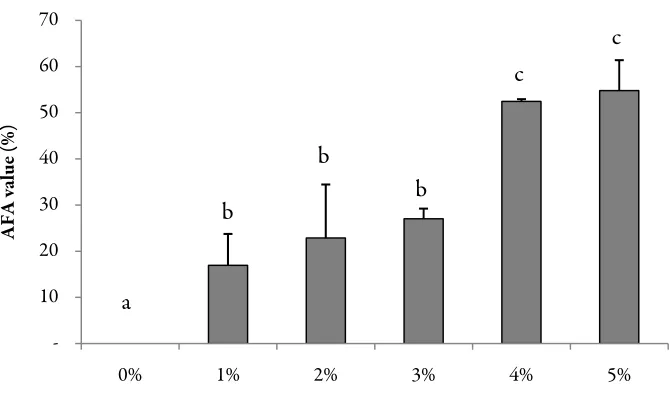
Duncan’s test showed that ethyl acetate-soluble fraction exhibited the highest AFA (Figures 2 and 3). Ethyl acetate as prepared at concentration 1% and 2% still showed low anti fungal activity (AFA 17.0% and 22.9%, respectively), further it aforded AFA at moderate category at 3% (27.0%), and strong category at 4% with AFA 52.5% (Figures 3 and 4).
α
β
-10 20 30 40 50 60 70
0% 1% 2% 3% 4% 5%
AFA
value (%)
Concentration of ethyl acetate fractions
a
b
b
b
c
c
Figure 4. Averages of AFA (%) at each concentration of ethyl acetate-soluble fraction. he same letter at top of the bar indicated that the bars value were not signiicant diferent (Duncan Test, α 0.05)
e
Figure 5. Mycelial growth of F. solani on agar plate with ethanol-soluble extract and its corresponding fraction
Agarwood producing trees will react to fungal infection in order to defend themselves and alleviate its condition. he resistance of the tree will settle on the winner; it would be the host or it would be the pathogen. In agarwood case, the pathogen is expected to win, so its formation could take place. Chemical compounds of the tree are those among defense systems against pathogen. he components in agarwood itself are already identiied as sesquiterpenoid, a phytoalexin type in many plants defense compounds. How big the tree chemicals afect F. solani is considered to be related to the tree resistance against this fungus.
IV. CONCLUSIONS
Further fractionation of A. crasna ethanol-soluble extract revealed increasing antifungal activity. Ethyl acetate-soluble fraction showed the highest antifungal activity at 4% concentration that is categorized as strong class with AFA at 52.5%.
It is important to examine further the most active single compound in ethyl acetate-soluble fraction of A. crassna wood, thus the agarwood with highest concentration of this compound could be excluded in artiicial agarwood production.
ACKNOWLEDGEMENT
We thank the Ministry of Forestry, Government of Indonesia, Laboratory of Forest Microbiology of the Forest and Nature Conservation Research and Development Center (FNCRDC), and ITTO Project PD 425/06 Rev.1 (I) for funding the research. Specially, we thank Dr. G. Pari and Prof. S. Achmadi for their help and some discussions. We also thank all staf of Laboratory of Forest Microbiology of the FNCRDC, especially Mr. Najmulah and Mr. Yanto for their assistance in the work.
REFERENCES
Adelina, N. 2004. Seed Lealet: Aquilaria malaccensis Lamc. Forest and Landscape Denmark. www.SL.kvl.dk. [2 Februari 2007].
Agrios, G.N. 1997. Plant Pathology. Fourth Edition. California: Academic Press. Anushia, C., P. Sampathkumar and L. Ramkumar. 2009. Antibacterial and antioxidant
activities in Cassia auriculata. Global Journal of Pharmacology 3(3): 127–130. Barden, A., N.A. Anak, T. Mulliken and M. Song. 2000. Heart of the matter: agarwood
use and trade and CITES implementation for Aquilaria malaccensis. www.traic. org. [22 Mei 2007].
Blanchette, R.A. 2006. Sustainable agarwood production in Aquilaria trees. www. therainforestproject.net. [2 Februari 2007].
CITES. 2004. Convention on International Trade in endangered Species of Wild Fauna and lora: Amendments to Appendices I and II of CITES. http://www.cites.org/ common/cop/13/raw/props/ID-Aguilaria-gyrinops.pdf.
Gite, V.N., R.D. Pokharkar, V.V. Chopade and S.B. Takate. 2010. Evaluation of physicochemical standardization parameter of Enicostemma axillare. Journal of Bioscience Technology 1(4): 187–190.
Ishihara, M., T. Tsuneya, M. Shiga and K. Uneyama. 1991. hree Sesquiterpenes from Agarwood. Phytochemistry30(2): 563–566.
genotypes and their efect on Phytophthora meadii. Annals of Applied Biology 142: 63–69.
Kartal. 2004. Preliminary evaluation of fungicidal and termicidal activities of iltrates from biomass slurry fuel production. Bioresource Technology 95: 41–47. Lestari, S.B. and G. Pari. 1990. Analisis kimia beberapa jenis kayu Indonesia. Jurnal
Penelitian Hasil Hutan7(3): 96–100.
Mori, M., M. Aoyama, S. Doi, A. Kanetoshi and T. Hayashi. 1997. Antifungal activity of bark extract of deciduous trees. Holz als Roh und Werkstof 55: 130–132. Mihara, R., KM. Barry, C.L. Mohammed and T. Mitsunaga. 2005. Comparison of
antifungal and antioksidant activities of Acacia mangium and Acacia auriculiformis heartwood extracts. Journal of Chemical Ecology 31(4): 789–804.
Novriyanti, E. 2008. Peranan zat ekstraktif dalam pembentukan gaharu pada Aquilaria crassna Pierre ex Lecomte dan Aquilaria microcarapa Baill. he Graduate School of Bogor Agricultural University. Bogor, Indonesia. (Unpublished thesis). Persoon, G.A. and H.H. Van Beek. 2008. Growing ‘the wood of Gods’: agarwood
production in Southeast Asia (abstract). Advance in Agroforestry5(3): 245–262. Pojanagaroon S. and C. Kaewrak. 2006. Mechanical methods to stimulate aloes wood formation in Aquiliria crassna Pierre ex H Lec (kritsana) trees. ISHS Acta Hort 676. www.actahort.org. [22 Mei 2007].
Phongpaichit, S., N. Pujenjob, V. Rukachaisirikul and M. Ongsakul. 2004. Antifungal activity from leaf extracts of Cassia alata, L., Cassia istula L. and Cassia tora L. Journal of Science and Technology 26(5): 741–748.
Prema B.R. and P.K. Bhattacharrya. 1962. Microbial transformation of terpenes. National Chemical Laboratory. India.
Sumadiwangsa, E.S. and Harbagung. 2000. Growth rate of agarwood (Aquilaria malaccensis) stand in Riau that planted in high cultivation intensity and manual. Forest Product Info6(1): 1–16.
Sumarna, Y. 2005. Teknologi Pengembangan Rekayasa Produksi Gaharu. Makalah pada Promosi Gaharu dan Mikoriza. Pekanbaru. (Unpublished paper).
Syaii, W., M. Samijima and T. Yoshimoto. 1987. he role of extractives in decay resistance of ulin wood (Eusideroxylon zwageri T. et B.). Bulletin of Tokyo University Forest77: 1–8.
Wu, J-H., Y-T. Tung, S-Y. Wang, L-F. Shyur, Y-H. Kuo and S-T. Chang. 2005. Phenolic antioxidant from the heartwood of Acacia confusa. Journal of Agricultural and Food Chemistry 53: 5917–5921.