Naional Audit Oice
Notre Dame Ravelin
Floriana FRN 1600
Malta
Telephone: (+356) 2205 5555
Fax:
(+356) 2205 5077
E-mail:
[email protected]
Website:
www.nao.gov.mt
ISBN: 978-99932-33-74-9
Printed at the Government Press Marsa, Malta
Na
ional Audit Oice Malt
a
Perf
ormance Audit En
for
cemen
t Acion b
y MEP
A within the Outside De
velopmen
t Z
one
Performance Audit
Enforcement Acion by MEPA within
the Outside Development Zone
Performance Audit
Table of Contents
List of Abbreviaions 4
Execuive summary 5
Chapter 1 – Terms of Reference 13
1.1 Introducion 14
1.2 The ODZ is subject to signiicant environmental and conservaion risks 14 1.3 MEPA’s 2010 Reform objecives sought to enforce ODZ through a zero
tolerance approach 16
1.4 Audit objecives 17
1.5 Audit methodology 18
1.6 Report structure 18
Chapter 2 - Current state of afairs 19
2.1 Introducion 20
2.2 Illegal development and aciviies within the ODZ threaten the quality
of life of the Maltese ciizens 20
2.3 Internaional convenions, EU direcives and Naional legislaion oblige
Malta to safeguard its biodiversity 21
2.4 The recently set-up Enforcement Directorate aims to safeguard the ODZ
in line with MEPA’s Reform objecives 22
2.5 Enforcement efeciveness is diluted due to the high volume and
prolonged outstanding cases 24
2.6 Conclusions 27
Chapter 3 - Detecing irregulariies within the Outside Development Zone 29
3.1 Introducion 30
3.2 Validaion of PAs inluences enforcement work prioriizaion and raises
potenial conlict of interests 30
3.3 Processing weaknesses relaing to Complaints received may hinder early
detecion and addressing of irregulariies 32
3.4 There are no speciic plans for MEPA rouine surveillance of ODZ 38 3.5 Internal control mechanisms relaing to self-regulaion were recently
introduced 39
3.6 The Enforcement Directorate did not have procedures in place to
ascertain standard case reporing by enforcement oicers 40
3.7 Conclusions 41
Chapter 4 – Processing Enforcement Noices 43
4.1 Introducion 44
4.2 The number of acive ODZ ENs registered an increasing trend
throughout past years 44
4.3 Delays in the processing of ENs prohibited imely correcive acion to
restore sites to their original state 47
4.4 Processing delays prevailed ater MEPA 2010 Reform 49
Naional Audit Oice Malta Enforcement Acion by MEPA within the Outside Development Zone 3
Chapter 5 - Implementaion of enforcement decisions 55
5.1 Introducion 56
5.2 Only a small proporion of cases were subject to the implementaion of
enforcement decisions 56
5.3 The status of cases classiied as Executable may have changed over ime 57 5.4 The Enforcement Directorate lacks a clear documented prioriisaion
policy to take further acion regarding Executable cases 58 5.5 Administraive shortcomings weaken the applicaion of the polluter pays
principle 58
5.6 The introducion of Daily Fines aims to encourage more compliance with
Planning and Environmental legislaion 60
5.7 Conclusions 62
Appendices
Appendix I: Regions within Malta and Gozo, in accordance with MEPA Local Plans 66 Appendix II: Deiniion of the irregulariies ideniied by MEPA, as classiied by
the NAO for the purpose of this Report 67
Appendix III: Daily Fines schedule 69
Appendix IV: Selected bibliography 70
Tables
Table 1: Number of Inspecions on ODZ PAs decided cases (2007 to 2012) 31 Table 2: Total number of Complaints received (2007 to June 2012) 32 Table 3: Feedback to complainants with respect to ODZ Complaints
(January to June 2012) 34
Table 4: Source of ODZ Complaints received between January and June 2012 36 Table 5: Number of Acive ODZ ENs (2007 to March 2013) 45 Table 6: ODZ Executable ENs categorised by type of illegality and locality
(1993 to 2011) 47
Table 7: Elapsed period at key EN processing stages (1993 to 2012) 48 Table 8: Enforcement acion relaing to ODZ Executable ENs (2006 to 2012) 57 Table 9: DA costs charged to contraveners (2006 to 2012) 59
Table 10: Outstanding DA charges (2006 to 2012) 60
Figures
Figure 1: The Maltese Islands according to MEPA’s Local Plans (December 2012) 15
Figure 2: MEPA’s organisaional structure 16
Figure 3: Enforcement Process 24
Figure 4: Total Acive ENs (2007 to March 2013) 25
Figure 5: Outstanding Executable ENs as at end 2011 26 Figure 6: Complaints received by type of illegality (January to June 2012) 33 Figure 7: Conirmed irregulariies from Complaints received (2007 to 2012) 39 Figure 8: 3,553 ODZ acive enforcement cases (March 2013) 45 Figure 9: Outstanding cumulaive frequency of ODZ Executable ENs
(December 2011) 46
Figure 10: Status of 110 ODZ ENs issued between January and June 2012
(as at end December 2012) 50
List of Abbreviaions
DA
Direct Acion
DANL
Direct Acion Noiicaion Leter
DPA
Development and Planning Act
EDPA
Environment and Development Planning Act
EN
Enforcement Noice
EU
European Union
IT
Informaion Technology
MEPA
Malta Environment and Planning Authority
NAO
Naional Audit Oice
4
Naional Audit Oice Malta
Execuive summary
1. This performance audit sought to determine the extent to which the Malta Environment
and Planning Authority’s (MEPA) enforcement of planning and environmental legislaion was appropriately contribuing to the protecion and conservaion of the Outside Development Zone (ODZ). Towards this end, the audit primarily assessed the eiciency and efeciveness of issuing and processing Enforcement Noices (ENs).
2. The ODZ is the land outside the boundary for development in a planning scheme or
local plan. The limited availability of land renders the protecion and conservaion of ODZ as criical to sustainable development. The importance of this zone was also emphasised through MEPA 2010 Reform exercise, which sought to adopt a zero tolerance approach regarding irregulariies within this area. In this respect, a key pillar of this Reform focused on the seing up of a new and stronger Enforcement Directorate. The role of this Directorate entails securing respect to the sustainability and polluter pays principles.
3. The Naional Audit Oice (NAO) embarked on this audit due to the socio-economic
and environmental importance of the ODZ. The proper management and conservaion of such locaions and the biodiversity within, is crucial for the sustainability of the ecosystems around us.
4. Against this backdrop, the study sought to determine whether the enforcement role within MEPA is appropriately implemented. Within this context, the term appropriate relates to the extent to which the Authority is capable of detecing irregulariies as well as taking rapid and decisive enforcement acion to safeguard this zone. The objecives of this audit entailed determining the degree to which MEPA’s Enforcement Directorate:
i. is equipped with the appropriate resources to enable efecive enforcement;
ii. has developed policies and Standard Operaing Procedures to ascertain eicient,
consistent and efecive execuion of the enforcement funcion;
iii. detects irregulariies and, issues and processes ENs expediently as well as
efecively; and
iv. appropriately implements enforcement decisions, in terms of the relevant Direct Acion (DA) when necessary, the restoraion of the site in quesion and the recovery of the relaive enforcement costs from the contravener.
6
Naional Audit Oice Malta Enforcement Acion by MEPA within the Outside Development Zone 7
5. The undertaking of this study entailed interviewing key personnel at MEPA, namely
the Enforcement Directorate’s senior management and oicials responsible for enforcement related duies, especially the processing of ENs. The NAO also reviewed data and other informaion maintained in manual and electronic Enforcement Case Files. In order to obtain a beter understanding of the enforcement processes involved, the NAO also accompanied MEPA oicials during their on-site monitoring of some enforcement cases. Unless otherwise stated, indings and conclusions presented in this Report relect the informaion available as at end June 2012. It was not always possible to adhere consistently to this audit period due to various limitaions associated with management informaion maintained by the Authority.
6. The Enforcement Directorate uilises various approaches to detect non-conformiies with planning and environmental legislaion. This audit found that the detecion of irregulariies is mainly dependent on the monitoring of Planning Applicaions (PAs), the receipt of Complaints indicaing various alleged environmental and planning irregulariies, and to a signiicantly lesser extent on the surveillance undertaken by MEPA’s enforcement oicers.
7. The Directorate does not undertake any formal planning of rouine surveillance of the ODZ. Monitoring for potenial irregulariies within ODZ, which is carried out by enforcement oicers, tends to focus on the areas indicated through the Complaints received and in localiies where PAs are being assessed and monitored. Since the later tasks are frequently given priority, the Enforcement Directorate consequently becomes constrained to allocate only the remaining available resources for surveillance related work.
8. The targeing of on-site inspecions is in many instances based on an informal risk-based approach. This enables the Directorate to deal with the more serious cases as soon as pracically possible. Risk-analysis approaches adopted, however, have not yet developed into a comprehensive policy, which allocates the appropriate weighing to enforcement oicers’ experience, case and contravener’s history, the sensiivity of the area, the extent of the irregularity as well as other planning and environmental variables.
9. Moreover, the Directorate’s management is not in a posiion to fully determine
and monitor the output levels of its enforcement oicers. Furthermore, the non-standardised reporing approaches, adopted by enforcement oicers, places addiional limitaions on determining the extent of coverage of the respecive ODZ areas within Malta and Gozo. Robust internal control mechanisms were not in place to counter the broad discreion of its enforcement oicers when dealing with contraveners.
10. The concerns highlighted above were mainly atributable to the absence of the appropriate management structure to direct, control and monitor the enforcement funcion for long periods. The lack of management guidance resulted in individual oicers focusing more on ield-work to the detriment of the related administraive tasks, such as maintaining minutes of meeings with contraveners and reporing.
11. During the course of this audit, the Enforcement Directorate sought to implement
various iniiaives to strengthen its operaions. These mainly related to the drating of an Enforcement Charter, the adopion of an Enforcement Protocol as well as the improvement of case reporing.
12. Upon the conirmaion of irregulariies, MEPA issues ENs whereby contraveners are
obliged to address the issues outlined therein within a speciied period. Since 2009, the Enforcement Directorate has been aiming to increasingly encourage contraveners to self-regulate their posiion. Nevertheless, as at March 2013, there were 3,553 acive ENs, where over 61 per cent have been classiied as Executable and are awaiing DA by the Authority to remove the irregulariies at the contraveners’ expense.
13. The number of acive ENs in relaion to irregulariies ideniied within the ODZ has
been registering an increasing trend during past years. Various policies and operaing procedures adopted by the Authority may have contributed to the high number of outstanding Executable cases. Planning and environment legislaion sipulate that the Authority can take enforcement acion against all unpermited development. An administraive decision in the 1980s sought to place parameters on this broad mandate and considered 1967 as an appropriate cut-of date. If this cut-of date is to be considered as MEPA policy, then this implies that the Authority has to deal with contravenions, which took place over the past 45 years.
14. The processing of ENs was characterised by the severe prolonging of procedures, which ulimately impinged on MEPA’s enforcement efeciveness. A randomly selected sample of 200 cases revealed that Executable cases have been outstanding for over nine years. Lengthy processing periods also materialised between the receipt of the EN by the contravener and the point when the case is referred for DA, including the removal of the illegal development. The duraion of this phase amounted to an average of nearly three years. In around a third of the sampled ENs reviewed, cases may have been prolonged due to the Appeals and Applicaions to Sancion processes. The following factors have contributed to processing delays:
i. The Enforcement Directorate is sill in the early phases of implemening EN
processing ime benchmarks. This implies that, since the establishment of the Authority, the management of the enforcement funcion could not efecively ascertain that ENs were being processed within reasonable periods.
ii. The processing of ENs is characterised by weak audit trails. Such instances
diminish control throughout the enforcement procedures since the Directorate’s Management would not have comprehensive informaion to monitor the quanity and quality of work of its employees. Weak audit trails also expose enforcement oicers and the Authority to avoidable risks since documentaion relaing to communicaions with contraveners and other case-related informaion is not always maintained.
iii. A lack of clear case ownership, paricularly with respect to older ENs resulted in
prolonging the processing of ENs. The common pracice adopted unil a few years ago was that enforcement oicers immediately referred ENs for DA. This situaion led to a substanial number of stalled cases at the inal stages of the enforcement processes.
iv. Since the establishment of the Enforcement Directorate, the number of enforcement oicers deployed to ODZ has declined even though the workload increased. Apart from being stretched by the geographical locaions and accessibility of the various areas within the ODZ, enforcement oicers have also to focus on the administraive element of enforcement cases.
v. The Enforcement Directorate contends that it was not allocated the inancial resources to increase the number of DA iniiaives. Consequently, cases stalled for considerable periods at the inal stage of the enforcement process.
8
Naional Audit Oice Malta Enforcement Acion by MEPA within the Outside Development Zone 9
15. The implementaion of enforcement decisions is considered as criical since it aims to
put into pracice the polluter pays principle, the restoraion of sites to their original status, and to serve as a deterrent to potenial contraveners. Despite the various enforcement mechanisms available to MEPA, such as the execuion of DAs, Criminal Prosecuions and, recently, through the imposiion of Daily Fines and Concessions, the implementaion of enforcement decisions only materialised in a small proporion of cases classiied as Executable. Towards this end, the Authority took around 464 enforcement acions during the period 2006 to 2012, of which, 176 related to DA iniiaives.
16. The Authority incurred a minimum expenditure of €643,339 regarding the DA iniiaives referred to in the preceding paragraph. Contraveners were invoiced for only €521,253 out of the total DA-related expenditure incurred. The remaining €122,086 were not charged to contraveners for various reasons, including unknown ownership and unavailable documentaion.
17. Moreover, the Authority is sill to recoup €438,329 (84 per cent) out of the invoiced amount. It is to be noted that 16 contraveners were liigaing nearly one third of this amount. The proporion of outstanding monies to be collected from contraveners suggests that the polluter pays principle is only partly being implemented. Similarly, whilst the zero tolerance approach as advocated by the MEPA Reform of 2010 is being translated in various enforcement iniiaives, it would not be fully implemented unless the relaive expenditure incurred by MEPA to remove irregular structures or aciviies is recouped from contraveners.
18. Recent eforts to strengthen the enforcement funcion demonstrate that this important role is sill in the process of evolvement. Over ime, there have been various atempts to improve the efeciveness of this funcion, which, given the limited availability of land and the increasing demands for a beter environment, render such iniiaives criical. The MEPA Reform of 2010 can be seen as the most recent efort to address enforcement-related issues. Towards this end, the Enforcement Directorate was established in 2011, changes to some work pracices have been made and legislaive provisions have been introduced to deter and facilitate enforcement.
19. However, this newly established Directorate inherited an enforcement funcion,
which was characterised by a substanial number of outstanding cases and prolonged processes. As pointed out in this Report, these circumstances did not enable MEPA to realize its 2010 Reform objecives to fully implement the polluter pays principle or to adopt a zero tolerance approach regarding environmental and planning infringements within this area.
20. To varying degrees, many factors contributed to this situaion. The enforcement funcion was not fully supported by the appropriate strategic and operaional policies. This has led to the enforcement funcion being mainly constrained to react to prevailing circumstances rather than proacively targeing its work at the highest planning and environmental risks. These circumstances impinged on case processing consistency and eiciency.
21. The enforcement funcion lacked the adequate level of resources and administraive
capacity. Resource deployment priority was generally allocated to MEPA’s other funcions, such as its Planning arm. The main jusiicaion was that the later funcion is obliged to fulill PAs’ processing duraion targets. Moreover, only a proporion of
Implementaion
of enforcement
decisions
the required funds was made available for DA iniiaives. Consequently, in many cases, MEPA could not embark on the necessary acion to remove irregulariies.
22. The Directorate sill lacks the support of a comprehensive Informaion Technology (IT)
infrastructure. Such a situaion hinders operaional throughput, prohibits the formal applicaion of risk analysis in enforcement work, and does not enable the maintenance of robust audit trails. IT-related concerns have also weakened management control over the enforcement funcion.
23. MEPA’s enforcement funcion stretches to all planning and environmental
irregulariies, irrespecive of the ime of contravenions. In its current set-up, the Enforcement Directorate is not appropriately resourced to cater for such a broad mandate. Consequently, a number of planning and environmental irregulariies prevail in various ODZ areas and the processing of a signiicant number of ENs has been outstanding for a substanial period.
24. The recent iniiaives to encourage contraveners to self-regulate their own posiion and the introducion of daily ines in cases of planning and environmental contravenions consitute a paradigm shit from historical pracices. The long-term success of these iniiaives is, however, dependant on MEPA having the appropriate organisaional structures and a robust internal control framework in place.
25. In view of the indings and conclusions emanaing from this performance audit, the
NAO is proposing a number of recommendaions. These proposals address the main strategic and operaional concerns deemed to be impinging on the efeciveness of MEPA’s enforcement funcion within the ODZ, namely:
i. MEPA’s enforcement funcion is to be supported through the appropriate level
of resources. This is a prerequisite to increasing enforcement coverage within ODZ, dealing more efecively with the backlog of pending or stalled ENs, and implemening the recent legislaive amendments, such as those related to Daily Fines in a more objecive, consistent and eicient manner. Towards this end a needs analysis study is to be conducted to idenify current and medium-term human resource requirements.
ii. Policy decisions are to be taken regarding the approach to be adopted by the
Enforcement Directorate when dealing with outstanding Executable ENs. Such policies should provide clear ime frames for the Directorate to re-visit these cases and, if applicable, to embark on the appropriate enforcement acion.
iii. MEPA’s Management is to formally approve recently drated guidelines, namely
the Enforcement Charter, relaing to the criical stages of the enforcement process. Moreover, as a mater of priority, the Authority is to establish the relaive mechanisms and ensure their full implementaion. Adherence to the provisions of these guidelines will increase the eicacy, transparency as well as facilitate management control over the enforcement funcion.
iv. The current pracice whereby enforcement oicers validate PAs submited is to be reviewed. Curtailing the involvement of enforcement oicers in direct work associated with PAs removes any potenial conlict of interests and consequently, further strengthens the independence and objecivity of the enforcement funcion.
10
Naional Audit Oice Malta Enforcement Acion by MEPA within the Outside Development Zone 11
v. The Directorate is to implement the Daily Fines mechanism and ensure that all measures related to the polluter pays principle are enforced. Such measures would discourage contraveners from embarking on illegal development. Furthermore, the collecion of money due to the Authority would provide the later with the required resources to tackle the outstanding Executable ENs.
vi. Enforcement work is to be prioriised in accordance with formal and documented risk-based approaches. Towards this end, the Authority is to carry out comprehensive studies to idenify and classify major threats to ODZs.
vii. Consideraion is to be given to allocate increasing importance to surveillance work carried out by enforcement oicers. Efecive surveillance work necessitates that coverage is relaive to the designated level of risk. Surveillance work should focus more on Special Areas of Conservaion and Natura 2000 sites. Scheduled surveillance of these zones will enable the earlier ideniicaion of illegaliies in these environmentally important zones.
viii. Moreover, all surveillance work is to be supported with the appropriate level of planning, management control and monitoring. Towards this end, reporing by enforcement oicers should not be based solely on excepion reporing but details of the areas inspected and any contacts with third paries are to be fully
documented.
ix. Eforts are to be increased to ascertain that customer care targets related to the acknowledgement of complaints and the provision of interim case feedback to complainants are consistently adhered to. These steps should coninue to nurture the Authority’s relaionship with the public and organisaions who furnish MEPA with informaion on potenial irregulariies, which in turn consitute an important enforcement triggering mechanism.
x. Time frames are to be established within which enforcement oicers inspect sites to validate the irregulariies noted in Complaints. The expedient undertaking of on-site inspecions minimises the relaive potenial environmental degradaion.
xi. Internal control mechanisms are to be strengthened to fully exploit the potenial beneits of encouraging contraveners to self-regulate their posiion within an agreed period rather than issuing an EN at the outset. Towards this end, internal controls should include comprehensive reporing by enforcement oicers outlining any agreement with contraveners. Internal controls should also encompass the lagging of cases, which have remained outstanding for longer than pre-determined case processing benchmarks. Robust internal controls related to the encouragement of contraveners to self-regulate their posiion assume added importance in the light that Daily Fines for contravenions are computed from the day that an EN is oicially noiied.
xii. Procedures are established to ascertain standard case reporing by enforcement oicers. Standardised reporing consitutes a useful indicator to monitor the output of enforcement oicers. Moreover, standardised reporing facilitates the reliable documentaion of case history and also takes into consideraion issues relaing to MEPA’s business coninuity.
of informaion between the two computerised systems and the manual iles. Moreover, this would improve processing eiciency by eliminaing the resultant duplicaion of work involved through inpuing and maintaining informaion in various systems.
xiv. The new IT system (Artemis) is to be upgraded to enhance its report generaing faciliies. This can be achieved by providing users with the facility to generate customised reports. Such an applicaion would further improve management control over the enforcement funcion.
Naional Audit Oice Malta
Chapter 1 – Terms of reference
1.1.1 The Naional Audit Oice (NAO) has conducted the performance audit: Enforcement
Acion by MEPA within the Outside Development Zone (ODZ). The main aim of this audit was to determine the extent to which the Malta Environment and Planning Authority’s (MEPA) enforcement of planning and environmental legislaion was appropriately contribuing to the protecion and conservaion of this zone. Towards this end, the audit primarily assessed the eiciency and efeciveness of issuing and processing Enforcement Noices (ENs). In addiion, this audit examined the implementaion of the Authority’s ODZ enforcement procedures and policies.
1.1.2 Unless otherwise stated, indings and conclusions presented in this Report relect the
informaion available as at end June 2012. It was not always possible to consistently adhere to this audit period due to various limitaions associated with management informaion maintained by the Authority. Furthermore, most of the informaion requested in May 2012 was referred to the NAO several months later. Due to these circumstances, the Report will idenify the relaive ime-line to which indings and conclusions pertain. These management informaion limitaions, however, did not afect the issues highlighted since many of the concerns observed were consistent over a number of years. The Report also features important updates based on the informaion available as at the ime of drating.
1.1.3 This Chapter deines what consitutes an ODZ and outlines the major issues, which
potenially threaten its conservaion. Addiionally, it outlines MEPA’s enforcement funcion and organisaional structure with respect to this zone. Finally, this iniial Chapter concludes by presening the overall audit objecives and scope, while highlighing methodological consideraions.
1.2.1 The ODZ is deined as the land outside the boundary for development in a
planning scheme or local plan.1 Biodiversity, which is highly concentrated in ODZ
relates to the rich variety of life that exists, and, concerns all species of plants, animals and people, and is central to economic prosperity and good health.2
Consequently, the proper management and conservaion of such locaions, and the biodiversity within, is crucial for the sustainability of the ecosystems around us.
1.1
Introducion
1.2
The ODZ is
subject to
signiicant
environmental
and conservaion
risks
14
Naional Audit Oice Malta Enforcement Acion by MEPA within the Outside Development Zone 15
Figure 1 depicts the Maltese Islands, segregaing the major areas in line with MEPA’s Local Plans (refer to Appendix I), and highlighing the Development Zones within, the remaining areas being ODZ.
3 htp://www.mepa.org.mt/biodiversity-driversofchange as at July 2013.
Figure 1: The Maltese Islands according to MEPA’s Local Plans (December 2012)
Source: MEPA
1.2.2 According to MEPA, owing to the geographical isolaion and small size of the Maltese
Islands, coupled with drivers of biodiversity change, a number of wild species have become threatened while others have become exinct. The loss of species is irreversible and leads to the deterioraion of our naional heritage.3
1.2.3 The direct and indirect drivers of biodiversity change, to varying degrees, threaten
the ODZ. Direct drivers of biodiversity loss include polluion, over exploitaion, land degradaion and soil erosion. Indirect drivers, which negaively inluence biodiversity, relate to socio-cultural factors, resuling in the ineicient use of natural resources, as may be brought about by life style and consumer changes.
2010, which sought to adopt a zero tolerance approach regarding irregulariies within this area. Furthermore, the Authority’s mission statement includes the commitment to ensure sustainable development that safeguards the environment, through the values of commitment, professionalism, caring and jusice “…which are manifested in wise and imely decisions appropriately enforced.”4
1.3.1 The 2010 MEPA’s Reform objecives concerning the ODZ emphasised the criical
importance allocated to the Authority’s enforcement funcion. ODZ enforcement entails the monitoring and detecion of unauthorised developments and/or aciviies, followed by the appropriate acion as sipulated by law to ensure compliance with the Environment and Development Planning Act (CAP. 504), as well as other regulaions and legislaion aimed at ensuring sustainable development.
1.3.2 In line with the Reform objecives, the Enforcement Directorate consitutes one of
MEPA’s four main pillars for sustainable development.5 This funcion entails ‘the
ability to ensure that the organisaion’s decision-making process is being faithfully translated into pracice, as well as the ability to take remedial acion against defaulters in an efecive and exemplary manner.’6 Consequently, ‘the efeciveness of MEPA’s
regulaion is dependent upon the establishment of a robust enforcement regime in order to secure respect to the sustainability principle.’7
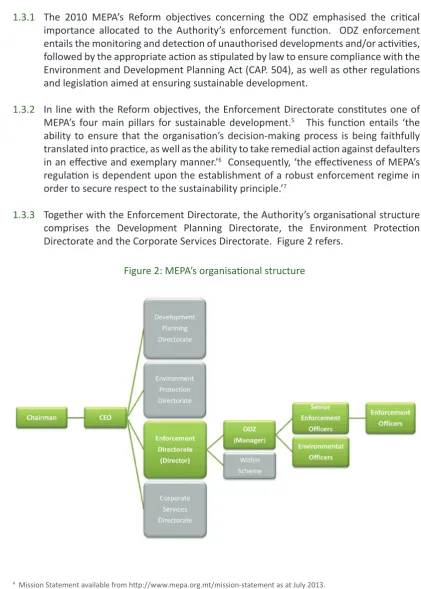
1.3.3 Together with the Enforcement Directorate, the Authority’s organisaional structure
comprises the Development Planning Directorate, the Environment Protecion Directorate and the Corporate Services Directorate. Figure 2 refers.
4 Mission Statement available from htp://www.mepa.org.mt/mission-statement as at July 2013.
5 htps://opm.gov.mt/mepa_pillars?l=1 as at November 2012.
6 A Blueprint for MEPA’s Reform (9 July 2009) available from htps://opm.gov.mt//mepa as at November 2012. 7 Ibid.
1.3
MEPA’s
2010 Reform
objecives sought
to enforce
ODZ through a
zero tolerance
approach
16
Naional Audit Oice Malta Enforcement Acion by MEPA within the Outside Development Zone 17
1.3.4 As at April 2013, the Enforcement Directorate was composed of 54 employees, 23 of whom were enforcement oicers, the equivalent of nine being assigned to the ODZ. The remaining 31 employees were divided between management, administraive, operaions and support staf. The Directorate is mainly divided into two major units. One unit is responsible for enforcement relaing to development Within Scheme.
1.3.5 The other unit is responsible for enforcement of any development and/or acivity
within the ODZ. The current organizaion structure of the ODZ Unit comprises a unit manager, who is assisted by a senior enforcement oicer. The Unit manager, who was appointed in 2012, reports to the Director of Enforcement. The ODZ Unit employs the equivalent of nine enforcement oicers, who are generally assigned to speciic localiies in Malta and Gozo.
1.3.6 In accordance with pracices adopted in 2010, whenever possible, on-site ODZ ieldwork is carried out in groups of two enforcement oicers. The main aim of this pracice is to improve the efeciveness and internal controls associated with enforcement work.
1.3.7 The ODZ Unit allocates a signiicant proporion of its available resources to ascertain the integrity of Planning Applicaions as well as to verify and act on Complaints related to alleged irregulariies lodged through various sources. Enforcement oicers are also expected to invesigate any other irregulariies noted during enforcement work undertaken within ODZ. Surveillance of districts consitutes a criical element of enforcement work since it has the potenial to address irregulariies at the earliest possible stage, thus minimising the ensuing environmental impact.
1.3.8 In addiion to the enforcement work outlined in the preceding paragraph, this Unit is also responsible to other enforcement related iniiaives. These include aciviies related to quarries, producer responsibiliies with respect to packaging waste, the Convenion on Internaional Trade in Endangered Species of Wild Fauna and Flora, and major projects. Furthermore, the Unit also paricipates in other enforcement iniiaives in collaboraion with Governmental Departments. These include the collecion of scrap material and abandoned vehicles throughout the Maltese Islands, as was the case in 2008 and 2009.
1.3.9 Notwithstanding the eforts to broaden its enforcement funcion, in line with the zero
tolerance approach adopted through MEPA’s 2010 Reform, answers to Parliamentary Quesions and a number of media reports highlight that a signiicant number of ENs have remained outstanding for a number of years. Moreover, on an annual basis, the number of new ENs issued outnumbers concluded enforcement cases. Furthermore, various aricles and media reports coninue to highlight irregulariies within ODZ. Such circumstances imply that signiicant threats to the protecion and conservaion of this zone prevail.
1.4.1 Against this backdrop, this study sought to determine whether the enforcement role within MEPA is appropriately implemented. Within this context, the term appropriate relates to the extent to which the Authority is capable of detecing irregulariies as well as taking rapid and decisive enforcement acion to safeguard the ODZ.
1.4
1.4.2 In view of the foregoing, the objecives of this performance audit include determining the degree to which MEPA’s Enforcement Directorate:
i. is equipped with the appropriate resources to enable efecive enforcement;
ii. has developed policies and Standard Operaing Procedures to ascertain eicient,
consistent and efecive execuion of the enforcement funcion;
iii. detects irregulariies and, issues and processes ENs expediently as well as
efecively; and
iv. appropriately implements enforcement decisions, in terms of the relevant Direct Acion (DA) when necessary, the restoraion of the site in quesion and the recovery of the relaive enforcement costs from the contravener.
1.5.1 The undertaking of this study entailed interviewing key personnel at MEPA, namely
the Enforcement Directorate’s senior management and oicials responsible for enforcement related duies, especially the processing of ENs. The NAO also reviewed data and other informaion maintained in manual and electronic Enforcement Case Files. In order to obtain a beter understanding of the enforcement processes involved, the NAO also accompanied MEPA oicials during their on-site monitoring of some enforcement cases.
1.6.1 Following this introductory Chapter, the Report is structured around these key areas:
• Chapter 2 provides an overview of the current state of afairs within the ODZ. This
overview discusses the iniiaives undertaken by the Enforcement Directorate within a context on naional, European Union and internaional environmental targets and obligaions.
• Chapter 3 discusses the mechanisms employed by the Authority to detect illegal
development and aciviies within the ODZ. Such mechanisms include the Authority’s inspecion targeing and policies.
• Chapter 4 focuses on the processing of ENs. Towards this end the discussion relates
to the categorisaion of irregulariies and processing eiciency issues.
• Chapter 5 evaluates the extent to which the Authority is able to implement its own
enforcement decisions. The discussion considers the issues which impinge on the imely implementaion of enforcement. These factors include the lack of inancial and human resources to enable DA to be carried out, the Appeals process as well as the recently introduced iniiaives such as the imposiion of Daily Fines.
1.6.2 The overall conclusions and recommendaions emanaing from this study are included in the Report’s Execuive Summary on page 6 to 12.
1.5
Audit methodology
18
Naional Audit Oice Malta
Chapter 2 - Current state of afairs
2.1.1 Land is a scarce resource and, as a result, it is subject to signiicant pressures in terms
of demand and use. The small size of the Maltese Islands allocates a greater economic and intrinsic value to land. Subsequently, unless appropriately regulated, land scarcity places unsustainable strains on natural resources and processes in Malta.8
Various environmental indicators suggest that there are potenial risks relaing to the protecion and conservaion of land falling within the Outside Development Zone (ODZ).
2.1.2 This Chapter provides an overview of the current state of afairs within the ODZ.
Following a discussion on what consitutes the ODZ, the Chapter also outlines the current social and environmental threats to this area, such as the direct and indirect losses with regards to the respecive local lora and fauna. The discussion then proceeds to introduce the iniiaives undertaken by the Enforcement Directorate: within the naional, European Union (EU) and internaional level context; with respect to environmental targets; and obligaions, in line with Malta Environment and Planning Authority’s (MEPA) Reform of 2010.
2.2.1 The ODZ is of signiicant social and ecological importance. By deiniion, development
in this zone is to be limited only to excepional circumstances. In fact, as deined in Legal Noice 276 of 2012, all illegal developments ideniied within the ODZ are subject to substanially higher ines than would be the case for a similar infringement within the Development Zone (vide Appendix III). These provisions are intended to channel future development in exising development zones in order to miigate the over exploitaion of land.
2.2.2 As at end 2012, MEPA esimated that around 21 per cent of the Maltese Islands
consisted of built-up development. The total ODZ area consitutes 248.95 square kilometers out of the total area of 315.36 square kilometers of the Maltese Islands. Moreover, within the ODZ, the Authority has increased the number of sites designated as Special Areas of Conservaion and Natura 2000, whereby speciic policies guide the type of development that can take place in these areas.
2.1
Introducion
2.2
Illegal
development and
aciviies within
the ODZ threaten
the quality of life
of the Maltese
ciizens
20
Naional Audit Oice Malta Enforcement Acion by MEPA within the Outside Development Zone 21
2.2.3 A criical objecive of the ODZ relates to the conservaion of the countryside and the
associated rural resources including the natural environment, the built heritage and the rural landscape. In this context, the ODZ is an important factor, which contributes to the quality of life of the Maltese ciizens.
2.2.4 The ODZ also aims to conserve a variety of habitat types, fauna and lora in the Maltese Islands. Some elements have a wider regional importance or are of evoluionary and bio-geographical interest. A number of the island’s habitats such as woodlands, saline marshlands, coastal wetlands, sand dunes, permanent springs and caves, are rare and threatened. Similarly, a number of species are threatened with exincion, whilst a number of species have already become exinct. Human acivity is the primary factor afecing habitats and wildlife in Malta. The main impacts are associated with the destrucion of habitats and uncontrolled exploitaion.9
2.2.5 As a scarce resource, a signiicant threat to land arises through the changing
demography of the Maltese Islands. Towards this end, demography inluences the demand for housing, transport, minerals, energy and water producion. The nature and naional importance of some of these projects necessitate that planning permission is granted within the ODZ. Such circumstances materialise, since the aciviies associated with the provision of these public goods either occupy a considerable amount of space and/or the nature of the works undertaken result in negaive externaliies, such as noise or harmful emissions. Consequently, such aciviies must be located as far as possible from built-up areas.
2.2.6 The ODZ is also subject to other threats, mainly from individuals who idenify potenial proitable business opportuniies within these rural areas. Various Non-Governmental Organisaions (NGOs) and other stakeholders highlighted the fact that the degradaion of land through the haphazard dumping of inert material on virgin garigue is nowadays a major concern. Such land degradaion would certainly increase the chances for approval of any development planning applicaion submited to the MEPA.
2.2.7 In addiion, other individuals make use of agricultural related developments, for example water reservoirs and pump rooms, as an antecedent for addiional structures, such as residenial units. The later would not have been otherwise approved by the Authority within this protected zone.
2.2.8 The illegal dumping of inert material for land degradaion and the use of agricultural related developments as a precursor for further illegal developments, were also noiceable through the Enforcement Case Files randomly sampled and reviewed by the Naional Audit Oice during this study and discussed in this Report.
2.3.1 In Malta, ODZ plays a criical role in safeguarding the local environment. Towards this
end, the 2010 MEPA Reform aimed to adopt a zero tolerance approach in cases of illegal developments and/or aciviies. Malta also has EU obligaions to protect and conserve biodiversity, which is more predominant within the ODZ.
2.3.2 EU Member States, including Malta, have agreed on a 2050 EU vision and also a 2020
EU headline target, that is “to halt the loss of biodiversity and the degradaion of ecosystem services in the EU by 2020, and restore them in so far as feasible, while
2.3
9 Naional Commission for Sustainable Development (2006). A Sustainable Development Strategy for the Maltese Islandsstepping up the EU contribuion to avering global biodiversity loss”.10 According
to economists, it is esimated that each year, on average, EU Member States lose around three per cent of their respecive Gross Domesic Product due to the loss of biodiversity.
2.3.3 In order to assist the atainment of local biodiversity related EU obligaions, the
Naional Biodiversity Strategy and Acion Plan (NBSAP) for Malta was drawn up. This document was published jointly by the Ministry for Tourism, Culture and the Environment, and the MEPA during February 2012.11 The drat acion plan was
developed to serve as a naional policy driver to further integrate biodiversity issues into the policies and programmes of all those sectors that may afect Malta’s biological and natural resources.12 The plan outlines the iniiaives scheduled for 2012 to 2020,
which are intended to enable Malta to meet its biodiversity and other environmental objecives and Internaional commitments by 2020.
2.3.4 Such a plan is required to align with the Convenion on Biological Diversity’s Biodiversity Strategic Plan 2011 to 2020, as well as conform to the EU Biodiversity Strategy to 2020 and their respecive targets. These include the drasic minimisaion of the rate of loss of natural habitats, the establishment of further terrestrial, coastal and marine conservaion areas and the restoraion of degraded sites.
2.3.5 To achieve these targets, it is important to frequently measure those indicators, which
gauge the state of the environment, such as the quality of the air and water, the use of resources, the generaion of waste, climate change and biodiversity.
2.4.1 A key pillar of MEPA’s 2010 Reform focused on the seing up of an Enforcement Directorate, in lieu of the previous arrangement whereby the enforcement funcion pertained to the Planning Directorate. The role of the Enforcement Directorate entails securing respect to the sustainability and polluter pays principles. The atainment of such objecives, in part, entails safeguarding the ODZ.
2.4.2 Consequently, the key funcions of MEPA’s Enforcement Directorate are to ensure that all development takes place with prior authorisaion by the Authority. Development is to follow the plans and condiions sipulated in the approved permit.
2.4.3 In cases of planning and/or environmental irregulariies, the Enforcement Directorate is authorised by law, to issue a Stop Order and Enforcement Noice (EN).13 This noice
must contain a detailed descripion of the alleged infringements detected within the ODZ and include, where applicable, a site plan indicaing the land in quesion.
2.4.4 The Reform and its corresponding legislaive changes aimed to introduce or to strengthen various mechanisms to protect and safeguard land use, including areas within the ODZ through the following:14
• Certain illegal development typologies in more sensiive areas will not be
sancionable, hence signifying that such illegal development must irst be removed by the contravener.
11 Unil March 2013, MEPA was within the responsibility of the Ministry for Tourism, Culture and the Environment. 12 MEPA (2012). NBSAP Malta, Working Hand-In-Hand With Nature, Malta’s Naional Biodiversity Strategy and Acion Plan
2012-2020, p. 3.
13 Throughout this Report, Stop and Enforcement Noices are referred to as Enforcement Noices (ENs).
Naional Audit Oice Malta Enforcement Acion by MEPA within the Outside Development Zone 23
• Enforcement of these cases would immediately come into efect, therefore Appeals
against ENs would no longer be guaranteed.
• A signiicant increase in penalies imposed by MEPA, in cases where illegal development
was sancioned.
• The imposiion of Daily Fines through Legal Noice 276 of 2012, to moivate more
expedient remedial acion by contraveners in order to self-regulate their own posiion.
• Direct Acion (DA) by the Authority, which includes the removal of illegal development
and/or aciviies in cases where the above measures prove insuicient to restore sites to, as much as possible, their original state.
• The prevenion of illegal development by the Enforcement Directorate’s monitoring
of approved and refused development planning applicaions.
• Whenever possible the Enforcement Directorate will strive to encourage contraveners
to address irregulariies themselves, as this will prove beneicial to all paries.
2.4.5 The objecives and scope of MEPA’s enforcement, as outlined in the preceding secion, is to varying degrees relected in the operaional pracices of the Enforcement Directorate. Enforcement acion is partly triggered through monitoring iniiaives of development Planning Applicaions (PAs). This monitoring, which is undertaken through various on-site inspecions by enforcement oicers, aims to ascertain compliance with planning and environmental regulaions. Towards this end, the Enforcement Directorate seeks to inspect sites during the processing of the applicaion submited as well as throughout the various phases of development.
2.4.6 Addiionally, enforcement acion may be iniiated through Complaints submited by the public or other stakeholders, such as NGOs. In most cases, dealing with Complaints also necessitates a number of on-site inspecions. This Report, deines Complaints as reports of alleged planning and environmental irregulariies, which are referred to the Authority from various sources.
2.4.7 The ieldwork undertaken provides the Enforcement Directorate the opportunity to detect other illegaliies. This is of paricular relevance to ODZ enforcement since such areas are less accessible and visited by the public and consequently, irregulariies may remain undetected for longer periods or not ideniied at all. For a list of the diferent types of illegaliies ideniied by MEPA refer to Appendix II.
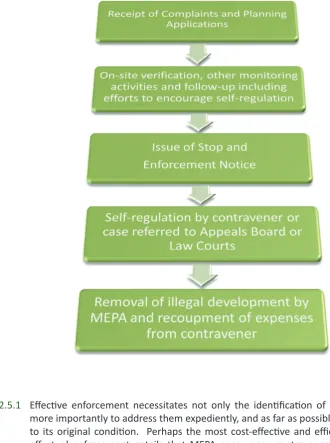
2.4.8 Figure 3 illustrates the major phases of the enforcement process.
2.5.1 Efecive enforcement necessitates not only the ideniicaion of irregulariies but
more importantly to address them expediently, and as far as possible restore the site to its original condiion. Perhaps the most cost-efecive and eicient manner for efectual enforcement entails that MEPA encourages contraveners to self-regulate their own posiion. Moreover, efecive enforcement entails that unless irregulariies are appropriately reciied, the contravener is obliged to assume responsibility for the illegal acions. Towards this end, accountability is invoked through the imposiion of ines or the implementaion of the Board of Appeals or Court decisions.
2.5.2 The efeciveness of MEPA’s enforcement is to varying degrees weakened since the
Authority has not been able to process ENs in a imely manner. The Enforcement Directorate is sill to address cases that were iniiated prior to MEPA’s Reform in 2010. Moreover, the Directorate is sill not managing to cope with an increasing number of enforcement cases. This is illustrated by the substanial number of acive cases, esimated at over 3,500 by June 2012, and which increased marginally by end March 2013. Figure 4 refers.
2.5.3 These acive ENs are at the various stages within the enforcement process. The key
stages, namely relate to ENs that are:
Figure 3: Enforcement Process
2.5
Enforcement
efeciveness is
diluted due to
the high volume
and prolonged
outstanding cases
24
Naional Audit Oice Malta Enforcement Acion by MEPA within the Outside Development Zone 25
• being processed and reviewed by enforcement oicers ater the issue of the respecive
EN;
• awaiing the outcome of an Applicaion to Sancion, whereby the contravener seeks
MEPA’s approval through a PA to endorse structures erected without the necessary permits;
• pending at Appeals or Law Courts;
• declared as Executable, which implies that enforcement cases have been reviewed by
the Enforcement Directorate, and all other mechanisms such as the Appeals system have been exhausted.
2.5.4 The Directorate may then consider the removal of the illegal developments and/ or curtailment of the aciviies in quesion through a DA. In cases where a DA is imminently planned, the Enforcement Directorate contacts contraveners, either through a Direct Acion Noiicaion Leter (DANL) and/or through a telephone call, as a means of inal noiicaion. The DANL states that MEPA may enter the relaive site at any ime in order to remove the illegal developments noiied through the ENs, and that all the expenses involved shall be incurred by the contraveners themselves. The Authority then aims to recoup these expenses from the contraveners.
2.5.5 A substanial number of acive ENs are within the inal stage of the enforcement
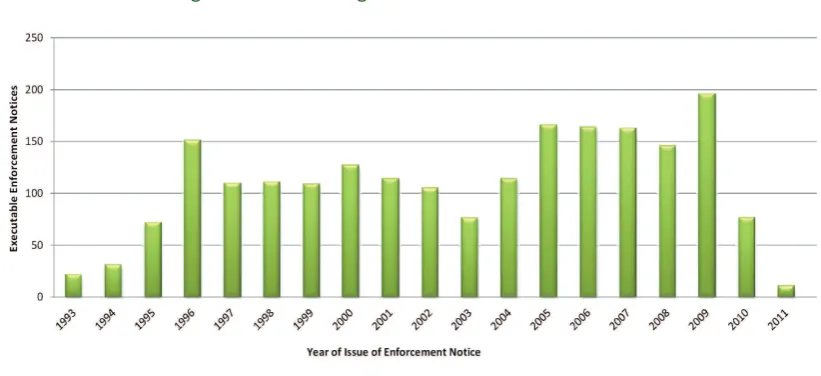
process, that is designated as Executable. Some of these cases relate to ENs issued in 1993. MEPA’s electronic system used to log ENs is not capable of generaing backdated reports. Consequently, this audit was constrained to analyse mainly the outstanding 2,065 Executable ENs as at year-end 2011. Figure 5 provides a breakdown of these outstanding ENs in accordance to the year of issue.
2.5.6 The number of outstanding Executable ENs implies that MEPA’s organisaional infrastructure did not cope with the number of irregulariies under invesigaion by the Authority. MEPA management contended that due to historical concerns relaing to its administraive capacity, it was unable to deal with these outstanding ENs in a imely manner.
Figure 4: Total Acive ENs (2007 to March 2013)
2.5.7 In this context, MEPA Management highlighted that the organisaional structure at the ime lacked managerial posiions to enable improved supervision of the relaive enforcement processes. MEPA contends that the Enforcement Secion was generally not awarded high priority in terms of resource allocaion. An example in this regard relates to enforcement oicials with a teriary level of educaion being deployed to other funcions within the Authority. It was only in late 2011 that the irst professional enforcement job descripion was created within the Authority, thus enabling the Directorate to employ professional staf.
2.5.8 In view of the administraive capacity limitaions, it was deemed more appropriate to address the increasing caseload by dealing with the more recent cases. While this approach addressed the more recent cases, MEPA was not in a posiion to allocate priority to the processing of these 2,065 outstanding Executable ENs. The issues dealing with such circumstances will be discussed in detail in Chapter 4.
2.5.9 Unless MEPA manages to moivate contraveners to comply with the provisions
sipulated in the EN, then the Authority will iniiate acion to stop the illegal acivity through various mechanisms or, where appropriate, to remove the illegal development, as per Aricle 90(1) of the Environment and Development Planning Act (CAP. 504). Moreover, since 24 November 2012, contraveners have been subject to a Daily Fine unil their posiion is regularised.
2.5.10 The outstanding 2,065 Executable cases relate to ENs issued between 1993 and 2011. These cases have been pending for an average period of 9.2 years. Various issues contribute to this number of outstanding Executable enforcement cases and the lengthy processing ime. The following refers:
• The demand for MEPA enforcement has been increasing steadily over the years as
environmental awareness increased. Such awareness has resulted in the Authority’s receiving a signiicant number of Complaints relaing to irregular developments and/or aciviies. The Authority uilises Complaints received as one of the major enforcement triggering mechanisms. However, due to a lack of resources at the Enforcement Directorate, the opportunity cost of allocaing priority to Complaints received is the prolonged processing of enforcement cases.
Figure 5: Outstanding Executable ENs as at end 2011
Source: MEPA
26
Naional Audit Oice Malta Enforcement Acion by MEPA within the Outside Development Zone 27
• Since its establishment, the Authority has increasingly focused in idenifying
irregulariies, which led to the immediate issue of ENs, thus shortening the negoiaion period between the Authority and the respecive contravener. Such a scenario resulted into a situaion whereby the Authority was not able to process the signiicant number of ENs issued, and as a consequence a backlog of cases accumulated.
• The number of outstanding cases also showed an increasing trend since some
contraveners prolonged enforcement acion through various means, such as frivolously invoking the Appeals process or by submiing an Applicaion to Sancion.
2.5.11 A detailed analysis focusing on the issues impinging on the processing of ENs is
discussed in Chapter 4.
2.6.1 The limited availability of land renders the protecion and conservaion of ODZ as criical to sustainable development. This Chapter, however, has noted that the lack of imely acion weakens the Authority’s enforcement funcion. These circumstances raise the risk that irregular development and/or aciviies within ODZ threaten the local environment and quality of life of Maltese ciizens.
2.6.2 The MEPA 2010 Reform strategy and subsequent legislaive developments recognised that the Authority’s enforcement funcion needed strengthening. Towards this end an Enforcement Directorate was created in 2011. However, in view of the volume of cases and administraive capacity constraints, the Enforcement Directorate is sill not in a posiion to fully atain the objecives outlined in the Reform strategy.
2.6.3 There are various reasons leading to the state of afairs discussed in the preceding paragraph. These mainly relate to MEPA’s organisaional capacity to detect, process and implement enforcement acion in the manner envisaged by the Reform strategy. These issues will be discussed in detail in subsequent Chapters.
2.6.4 The next Chapter discusses the irst stage of the enforcement funcion, namely the detecion of irregulariies within ODZ.
2.6
28
Naional Audit Oice Malta
Chapter 3 - Detecing irregulariies within
the Outside Development Zone
3.1.1 The Malta Environment and Planning Authority (MEPA) uilises various approaches
to detect non-conformiies with planning and environmental legislaion. This audit found that the detecion of irregulariies is dependent on the Complaints received by the Authority, the monitoring of Planning Applicaions (PAs) as well as surveillance undertaken by MEPA’s enforcement oicers. The audit concluded that MEPA could further enhance its funcion of detecing irregulariies through increasingly adoping a risk-based approach. This will enable the Authority to opimise the resources available, as well as, beter prioriise its caseload and surveillance pracices.
3.1.2 This Chapter aims to discuss the extent to which the methods employed by MEPA to
detect irregulariies within the Outside Development Zone (ODZ) are eicient and efecive. The discussion focuses on the various iniiaives adopted by the Authority to issue Enforcement Noices (ENs) in cases of non-compliance. The ensuing secions in this Chapter address the following issues:
• PA related work carried out by the Enforcement Directorate; • MEPA’s ability to conirm or otherwise alleged irregulariies; • ODZ rouine surveillance by MEPA;
• the Authority’s interface with contraveners; and • the reports generated by enforcement oicers.
3.2.1 The Enforcement Directorate may be requested to validate the integrity of PAs
submited by developers. Moreover, this Directorate aims to ascertain that actual development proceeds in accordance to the permits issued. The objecive of such monitoring is mainly to enable the Authority to issue a compliance ceriicate, cerifying that the development complies with all condiions noted in the approved permit.15
3.1
Introducion
3.2
Validaion
of PAs inluences
enforcement work
prioriizaion and
raises potenial
conlict of interests
30
Naional Audit Oice Malta Enforcement Acion by MEPA within the Outside Development Zone 31
3.2.2 The validation work related to PAs entails that enforcement officers perform
on-site inspections as deemed necessary. Inspections are generally carried out before the commencement of works, during the actual development and especially at completion stage. The Enforcement Directorate also aims to ensure that no development takes place on sites where the relative PA was refused by the Authority.
3.2.3 The Directorate does not maintain comprehensive staisics relaing to the number
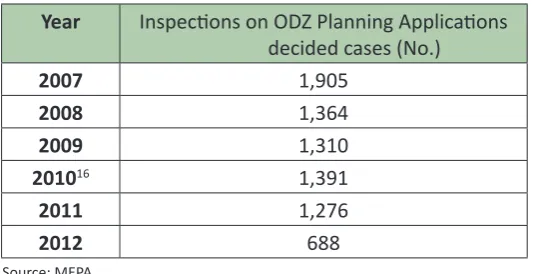
of PA inspecions carried out by enforcement oicers. Whilst the relaive assessment is noted in the respecive case-ile, this does not enable the Directorate to accurately determine the number of PA inspecions undertaken in a speciied period. The Directorate could only generate informaion relaing to the amount of PA related inspecions with respect to decided applicaions. As a result, the Naional Audit Oice (NAO) was constrained to evaluate PAs on the basis of the limited informaion available up to December 2012. Table 1 refers.
Table 1: Number of Inspecions on ODZ PAs decided cases (2007 to 2012)
Year Inspecions on ODZ Planning Applicaions
decided cases (No.) Reform policies, the Authority has set strict processing deadlines with respect to the issuing of development permits. In order to, as far as possible, respect these deadlines, the Enforcement Directorate allocates priority to PA related inspections.
3.2.5 The enforcement officers’ involvement in the validation of PAs mainly materialised
to ease caseload pressure from the Development Planning and Environment Protection Directorates. While such circumstances contributed towards considerably reducing the number of outstanding PAs17, it had the opposite
effect on MEPA’s enforcement function as is shown by the increasing trend of outstanding cases at the Enforcement Directorate over recent years (Figure 5 on page 26 refers). This matter is discussed in further detail in the next Chapter of this Report. Moreover, PA related work diminished the Directorate’s capabilities to extend its enforcement coverage to other ODZ areas and issues, which pose higher environmental risks.
Source: MEPA
16 The Enforcement Directorate in its present format assumed responsibility for PA inspecions in 2010. Prior this date, this
funcion sill related to the Enforcement Unit, which pertained to the Planning Directorate.
17 According to MEPA’s website (htp://www.mepa.org.mt/outlook34-aricle7 as at July 2013) the number of outstanding PAs
decreased by around 70 per cent, from 4,620 to 1,441 during the period 2008 to 2012.
3.2.6 The Enforcement Directorate, through various validaion and monitoring oriented on-site inspecions, is acively involved in the processes leading to the issue of development permits and compliance ceriicates. As referred to in paragraph 3.2.4, enforcement oicers, on the request of the Development Planning Directorate, MEPA Board and/or Environment and Planning Commissions, validate the correctness of PAs submited by developers.
3.2.7 The same area enforcement oicers then ascertain that development is proceeding according to the condiions sipulated in the development permit. Moreover, on conclusion of the development in quesion, the same oicials decide whether to issue or otherwise the Compliance Ceriicate.
3.2.8 The potenial conlict of interest arises since the appropriate level of segregaion of duies, are not in place. Consequently, the adequate levels of internal checks and balances are not present to minimise the processing risks involved in the validaion, monitoring and issue of compliance ceriicates regarding PAs.
3.2.9 In order to miigate the above menioned conlict of interests, the Authority is
considering segregaing duies related to the PAs and rouine ODZ Surveillance through the seing up of another unit to speciically deal with the former. However, such iniiaive is highly dependent on the engagement of addiional resources within the Enforcement Directorate.
3.3.1 Another triggering mechanism employed by MEPA’s Enforcement Directorate to
idenify potenial irregulariies within the ODZ is the follow-up of Complaints. The majority of the Complaints (86 per cent) received between January and June 2012, were generated by the general public. A further seven per cent of these Complaints were raised through MEPA oicials, who are employed within the diferent secions of the Authority, including the Enforcement Directorate. The remaining Complaints emanated from media reports as well as concerns raised by Non-Governmental Organisaions and Local Councils. Table 2 outlines the total number of Complaints received during the period 2007 to June 2012.
Table 2: Total number of Complaints received (2007 to June 2012)
Year Total Complaints received (No.)
3.3.2 An oicial within the Directorate of Corporate Services is in charge of managing the
Naional Audit Oice Malta Enforcement Acion by MEPA within the Outside Development Zone 33
3.3.3 The MEPA website also provides the opportunity for complainants to atach photos
related to the alleged irregularity reported. Such informaion enables the Enforcement Directorate to carry out its preliminary assessment more eiciently.
3.3.4 Up to the ime of drating of this Report, the Authority had not carried out in-depth studies relaing to the issues raised through Complaints. Consequently, MEPA do not have accurate informaion based on the categorisaion of alleged irregulariies indicated in the Complaints received. It is felt that such limitaions hinder the Authority from idenifying the major areas of concern through a risk-based approach, enabling the improved uilisaion of its resources.
3.3.5 In order to obtain an indicaion of the type of alleged irregulariies noted in Complaints
received, the NAO analysed the 211 Complaints received between January and June 2012. In 11 instances, Complaints related to muliple irregulariies. In these cases, the analysis considered only what was deemed the most pressing issue raised. Such an approach was adopted since the number of muliple alleged irregulariies was not considered material, all related to the same site, and most were integral to what was considered to be the main issue of concern.
3.3.6 The NAO classiied the 211 alleged irregulariies received through Complaints under broad categorisaions. These categorisaions were mainly based on deiniions outlined in the Environment and Development Planning Act (EDPA). Appendix II classiies potenial environmental and planning irregulariies under the categorisaion headings adopted for the purpose of this audit.
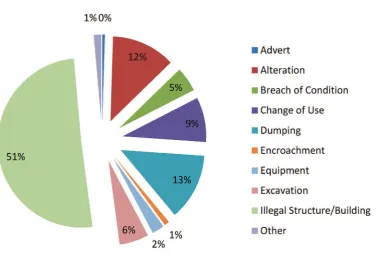
3.3.7 This analysis showed that the most common type of illegality reported (around 51 per cent) related to Illegal Structure/Building. These irregulariies namely consisted of rooms, boundary walls and other structures, which were built without MEPA’s prior authorisaion. The second most complained about irregularity related to Dumping. Figure 6 refers.
3.3.8 All of the categories of alleged irregulariies indicated in Figure 6 may have serious environmental repercussions within the ODZ. Consequently, the Enforcement Directorate aims to prioriise the validaion of the alleged irregulariies noted in Complaints received. The Directorate’s allocaion of case priority generally considers the relaive risks and whether the alleged abuse is sill ongoing.
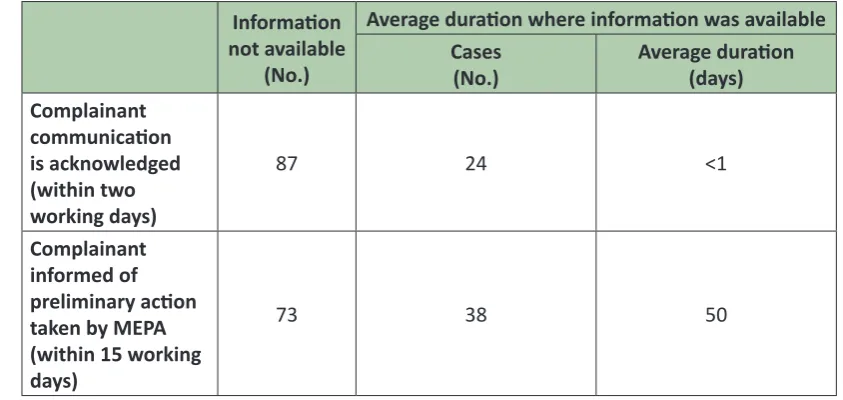
3.3.9 In its website, the Authority has commited itself to acknowledge a writen
Complaint within two working days of its receipt. Upon preliminary evaluaion by the Complaints oicer, Complaints are forwarded to the Enforcement Directorate for further invesigaion. The Directorate then updates the Complaints Oicer regarding the progress of the invesigaion in quesion, who will in turn inform the complainant. This formal feedback is to reach the later within 15 working days of receipt of the complaint in wriing.18
3.3.10 The NAO analysed the 211 ODZ Complaints received during the period January to June 2012 against the above criteria. In order to allow for suicient processing ime to elapse, the cut-of date for this evaluaion was set at December 2012. This approach would ensure that a period of at least six months would have elapsed from the receipt of the Complaint and that such duraion provides an appropriate processing benchmark. This analysis excluded the 100 anonymous complaints since, in these cases, feedback to complainants would not be applicable. Consequently, this evaluaion is based on the 111 remaining Complaints. This exercise was, however, constrained through the substanial number of instances where the necessary supporing case documentaion was neither maintained nor updated by the Authority. Table 3 refers.
Table 3: Feedback to complainants with respect to ODZ Complaints (January to June 2012)
Informaion
18 htp://www.mepa.org.mt/complaints-oice#comp04 as at July 2013.