GRAMMATICAL PATTERN OF AFRICAN AMERICAN VERNACULAR
ENGLISH (AAVE) IN RICHARD WRIGHT SHORT STORY,
THE MAN
WHO ALMOST A MAN
A THESIS
Submitted as Partial Fulfillment of the Requirements for the Sarjana Degree
of English Department, Faculty of Adab and Humanities,
State Islamic University Sunan Ampel Surabaya
By:
Yulika Harnum Aulia Basandi
NIM A83211203
ENGLISH DEPARTMENT
FACULTY OF ADAB AND HUMANITIES
STATE ISLAMIC UNIVERSITY SUNAN AMPEL
ABSTRACT
Basandi, Y. H. B. 2015. Grammatical Pattern of African American Vernacular English (AAVE) in Richard Wright Short Story, The Man Who Almost A Man. English Departement, Faculty of Adab and Humanities. The State Islamic University of Sunan Ampel Surabaya.
The Advisor : Raudlotul Jannah, M.App.Ling
Key words : Grammatical Pattern, African American Vernacular English
(AAVE), Standard American English (SAE), Non-Standard English The Man Who Almost A Man
INTISARI
Basandi, Y. H. B. 2015. Grammatical Pattern of African American Vernacular English (AAVE) in Richard Wright Short Story, The Man Who Almost A Man. English Departement, Faculty of Adab and Humanities. The State Islamic University of Sunan Ampel Surabaya.
Dosen Pembimbing : Raudlotul Jannah, M.App.Ling
Kata Kunci : Grammatical Pattern, African American Vernacular English (AAVE), Standard Amerikan English (SAE), Non-Standard English, The Man Who Almost A Man
x
TABLE OF CONTENT
Inside Cover ... i
Inside Title ... ii
Declaration ... iii
Advisor’s Approval
... iv
Examiner’s
Sheet ... v
Motto ... vi
Dedication ... vii
Acknowledgment ... viii
Table of Content ... x
Abstract ... xiii
Intisari ... xiv
CHAPTER I INTRODUCTION ... 1
1.1
Background of the Study ... 1
1.2
Statements of the Problems ... 6
1.3
Objectives of the Study ... 6
1.4
Significance of the Study ... 6
1.5
Scope and Limitation ... 7
1.6
Definition of the Key Terms ... 8
CHAPTER II REVIEW OF RELATED LITERATURE ... 11
2.1 Theoretical Framework ... 11
2.1.1 Language Variation ... 11
2.1.1.1 Language and Identity ... 13
2.1.1.2 Language and Social Interaction ... 14
2.1.2 African American Vernacular English (AAVE) ... 15
2.1.2.1 Linguistics Features of AAVE ... 17
A. Phonological ... 18
1. Final Consonant Sound ... 18
2. Devoicing ... 18
4.
r
and
l:
Liquid Vocalization ... 19
5. Reduction Phonological Patterns ... 19
B. Lexical and Semantic ... 20
C. Morphological and Syntactic ... 21
2.1.3 Grammatical Pattern of AAVE ... 22
2.1.3.1 Syntactical Features ... 22
1. The Absence of Auxiliary or Conjugated Form ... 22
2. The Use of Ain’t
... 23
3. Inverting Auxiliary in Question ... 24
4. Omitting Auxiliary in Question ... 24
5. Auxiliary in Question Tag ... 25
6. Verb Phrase Ellipsis ... 26
7. Invariant be ... 26
8. Invariant BIN ... 27
9. Invariant
Dәn
... 27
10. Multiple Negation ... 28
11. Existential
it
and
dey
... 29
12. Relative Clause ... 30
13. Preterit
had
... 30
2.1.3.2 Morphological Features ... 31
1. Past Morphology ... 31
2. Verbal
–
s ... 32
3. The Absence of Possessive
–
s ... 33
2.2 Review of Related Studies ... 33
CHAPTER III RESEARCH METHOD
3.1 Research Design ... 37
3.2 Research Instrument ... 38
3.3 Research Subject ... 38
3.4 Data and Data Source ... 38
3.5 Data Collection ... 39
3.6 Data Analysis ... 40
CHAPTER IV FINDINGS AND DISCUSSION
4.1 Findings ... 42
4.1.1 Grammatical Pattern of AAVE ... 42
4.1.1.1 The Use of Ain’t
... 45
4.1.1.2 Invariant be ... 46
4.1.1.3 Invariant BIN ... 47
4.1.1.4 Invariant
D
ə
n
... 48
4.1.1.5 Multiple Negation ... 48
4.1.1.6 Omitting Auxiliary in Question ... 49
4.1.1.7 Relative Clause ... 50
4.1.1.8 Past Morphology ... 51
xii
4.1.2.1 To Show the Identity of African American Ethnic Group
... 53
4.1.2.1 To Show the Solidarity among Black American and White
American ... 54
4.2 Discussion ... 56
CHAPTER V CONCLUSION ... 61
REFERENCES ... 63
CHAPTER I
INTRODUCTION
This chapter consists of background of the study, statement of the problems,
objectives of the study, significance of the study, scope and limitation, and
definition of the key terms.
1.1 Background of the Study
As an international language, English has been used around the
world and widespread in different countries such as Australia, Britain and
the USA (Yule, 2006). People can use variation of English, there are Indian
English, Australian English, New York English, West Country English,
African American Vernacular English, Non-Standard English, BBC
English, and so on (Wardaugh, 2006). Because of that, largely people have
accepted the fact that every language has a lot of variation.
Language variation is influenced by the factors such as age, sex,
social class, and ethnic background. Those factors make them speak
differently. It is not only lies on the words meaning (lexical) but also on the
sound (phonological) and the words construction (grammatical). The
uniqueness language ethnicity in a single region refers to dialect. Every
region has a differentiation in dialect. People in a social group have different
dialect which associated with specific colloquial language, known as
2
Vernacular is a topic to start. Vernacular is the language variation
which refers to non-standard language. Holmes (1995, p.80) says that it is
usually the first language learned by people in multilingual community for
informal situation. Vernacular generally refers to a language which has not
been standardized and has not an official status. Furthermore, Meyerhoff
(2006, p.37) states that amount kinds of vernacular used as a local language
such as, Vernacular Variety of German, Standard German (Hochdeutsch),
White American Vernacular English (WAVE), Vernacular Varieties of
Arabic and Haitian, African American Vernacular English (AAVE).
In United States, African American Vernacular English (AAVE) is
a kind of another variation of American English. Green (2002, p.6) defines
that AAVE has a list of labels, they are: Negro Dialect, Nonstandard Negro
English, Negro English, American Negro Speech, Black Communications,
Black Dialect, Black Folk Speech, Black Street Speech, Black English,
Black English Vernacular, Black Vernacular English, Afro American
English, African American English, African American Language, African
American Vernacular English (AAVE). The last four are more commonly
used today. However, people more often heard those beginning with
“Black”.
AAVE was born by the history of tobacco and cotton plantations in
United States where the slaves of African were a closely contact with the
White American. Many White American use Standard American English
3
those languages influenced one another until today and they share certain
features (Sladkova, 2013).
Studies about AAVE have been done with different focuses.
Pullum (1999) describes several features of AAVE uttered by African
American in California school board. In conclusion, they talk about
vernacular forms which mostly occurs systematic differences from SAE in
the domain of words, structures, and sound. Deak (2007) observes the status
of using AAVE in California school board educational practice. Ezgeta
(2012) studies grammatical variations of selected AAVE, those are the third
person singular –s absence, the plural –s absence and generalization is and
was to plural and second pronouns in ten African American public figures. Ningrum (2014) focuses on grammatical pattern, phonological pattern in
AAVE, and 4 types of slang word process in the Huckleberry Finn by Mark
Twain.
AAVE is not only used in daily conversation such as in a movie,
television and radio but also in a novel, short story and drama script. Since
the writer’s experience as an English department’s student, it is not easy to
understand non-standard American English in literary works given by the
lecturer. Sometimes, the authors like Mark Twain, Thomas Dixon, Margaret
Mitchell, William Faulkner, and Richard Wright use uncommon English in
some literatures.
Richard Wright was born in Mississippi where many African
4
novels, short stories, poems and non-fiction. Much of his literature concern
of the racial themes, especially involving the plight of African American
during the late 19th to mid-20th centuries. His literary works consist a lot of
non-standard American English.
The writer chooses short story The Man Who Almost A Man. The short story tells about Dave, a young African American who works in the
American’s field. He lives with his parent, both are African American.
Nigger Characters in this short story represent non-standard American
English in conversations.
Unlike the previous studies, systematic grammatical pattern of
AAVE in written form is unique to be analyzed. The writer support the
newest previous study that has successfully shows AAVE pattern. For the
present study, the writer tries to deep dig about grammatical pattern in
Richard Wright short story, The Man Who Almost A Man.
The most language in The Man Who Almost A Man is mostly different from Standard American English. For example, Ah tol yuh t git outta here! Yuh ain gonna toucha penny of tha money fer no gun! Thas how come Ah has Mistah Hawkins t pay yo wages t me, cause Ah knows yuh ain got no sense, the language in those sentences little bit difficult to understand for linguist and non-linguists. Therefore, the writer wants to study AAVE
in the work by Richard Wright. Since object of this study taken from written
form, the writer only focus on grammatical pattern, then phonological
5
The AAVE grammatical pattern is arrangement of non-standard
American English words in sentence construction usually used by African
American community. In AAVE, negation such as don’t, no and nothing
can be used multiple in a single negative sentence. For instance I didn’t see nothing. Based on AAVE, two negators didn’t and nothing in one sentence is grammatical correct. On contrary, a perspective rule from SAE states that
double negation in one sentence are ungrammatical correct, because they
make a positive one (Green, 2002). The correct sentence for SAE should I didn’t see anything. The writer focuses on AAVE grammatical pattern, in addition, the writer also provides SAE forms which correspond to the
utterances that containing AAVE grammatical pattern.
The explanations above make the writer not only curious, but also
inspired to focus more on grammatical pattern of AAVE. Furthermore, the
data are taken from utterances of Nigger characters in the short story. The
unique one, there still no study deeper about grammatical pattern of AAVE.
The writer focuses on nine types of AAVE grammatical pattern by Green
(2002). In order to answer statement of the problems, the writer uses theory
of language variation by Meyerhoff (2006), Wardaugh (2006), and Yule
(2006), language and identity, language and social interaction by Edward
6
1.2 Statement of the Problems
1. What are the grammatical pattern of African American Vernacular
English (AAVE) found in the Richard Wright short story, The Man Who Almost A Man?
2. What are the reasons of African American characters using AAVE
in this short story?
1.3 Objectives of the Study
1. To classify the grammatical pattern of African American
Vernacular English (AAVE) found in the Richard Wright short
story, The Man Who Almost A Man.
2. To describe the reasons of African American characters using
AAVE in this short story.
1.4 Significance of the Study
This study are supposed to give a valuable contribution
theoretically and practically. To the theoretically, this study is expected to
be one of the sources in sociolinguistics studies and gives more knowledge
about African American Vernacular English (AAVE) variation by Green
(2002) in Richard Wright work. Moreover, the writer hopes that this study
useful for other linguistics researchers whom interested in studying AAVE.
To the practically, this study gives some information about AAVE
and help the reader to define what the AAVE is. Especially for linguist and
7
in our environment is not only Standard English but also non-standard
English.
1.5 Scope and Limitation
There are many patterns in African American Vernacular English,
according to Green (2002, p.1) AAVE is a variety that has set phonological
(system of sounds), morphological (systems of the structure of words and
relationships among words), syntactic (system of sentence structure),
semantic (system of meaning) and lexical (structural organization of
vocabulary items and other information) patterns.
This study focuses on grammatical pattern used by Nigger
characters which covered syntactic and morphological pattern. The writer
chooses her analysis in Richard Wright short story, The Man Who Almost A Man published in 1960. The short story consist of some standard and non-standard American English in the narration and conversation. As a
conclusion, the writer limits her study to the utterances in conversations
uttered by the chosen characters.
Actually, the research about African American Vernacular English
is suitable for spoken text which contains of voice and sound. Moreover, the
writer using written text because the data for supporting this analysis are
8
1.6 Definitions of the Key Terms
In order to avoid misinterpretation about the use of the terms. It is
important for the writer to give the suitable meaning of the key terms. Some
terms are defined as follows:
1. English language variation is varieties of a language which used by
particular social group in particular social context. It provides
different specific human speech patterns such as sounds, words and
grammatical pattern. English language variation includes dialect,
jargon, register, slang, standard and non-standard English language.
2. Standard American English (SAE) is an international language that
recognized as the correct language by the majority of people in
America. This language has written in a grammar book,
pronunciation and used in spelling conventions. SAE also used by
media and other public linguistics such as the education system
(Radford, Atkinson, Britain, Clahsen and Spencer, 2003).
3. Non-standard English is a language which often considered to be
lazy, ungrammatical forms which betray a lack of both educational
training and discipline in learning. Finch (2000, p. 217) claims that
non-standard English are restricted in function and have no fixed
orthographic form. It is usually used as daily communication with
family, friends and non-formal activity.
4. Grammatical pattern of AAVE is arrangement of non-standard
9
States. For example, negation such as don’t, no and nothing can be used double in a single negative sentence. For instance I didn’t see nothing. Based on AAVE, double negation didn’t and nothing in one sentence is grammatical correct. On contrary, a perspective rule
from SAE states that double negation in one sentence are
ungrammatical correct, because they make a positive sentence
(Green, 2002).
5. Vernacular is the first language learned by people in multilingual
communities and they often used for relatively narrow range of
informal situation. Jackson (2007, p. ) defines, vernacular refers to
a local, non-standardized language, and be learnt first by a child. It
is also used in a wider sense to refer any language that is not
designated as an official language. More widely, it refers to any
colloquial variety used by a speaker, as against the standard
language.
6. African American Vernacular English (AAVE) is a kind of another
variation of American English spoken by almost majority of
African American in a certain community. AAVE has certain
differences from the Standard American English. Many Niggers in
America regions use AAVE (Yule, 2010).
7. Nigger refers to the black people. Known in America as African
10
8. Richard Wright was an African American author of controversial
novels, short stories, poems and non-fiction. Much of his literature
concern racial themes, especially those involving the plight of
African American during the late 19th to mid-20th centuries. His
literary works consist a lot of AAVE.
9. The Man Who Almost A Man is the one of Richard Wright short
CHAPTER II
REVIEW OF RELATED LITERATURE
This chapter consists of many important aspects concerning the theoretical
framework and related studies.
2.1 Theoretical Framework
2.1.1 Language Variation
Not everyone in a single geographical area speaks in the same way
in every situation (Yule, 2010). For instance, a director may speak to his
wife using Javanese but he may change Bahasa when he asks information
to the hotel receptionist. He may also change the language to English when
he speaks in the meeting abroad. This shift of language are based on
individual language choice. Meyerhoff (2006, p.28) states that people pay
more or less attention to their speech when they are engaged in different
kinds of situations, so they design their speech to suit with their audiences.
People have some reasons why they choose a variation of a
language. The reason is just not stand to reach successful in communication
only. Meyerhoff (2006, p.24) states that there are a lot of reasons why people
use the language variation. First, desire to speak the language which is
different from others, but fit in with some people, people do that in order to
differentiate themselves from others. Second, desire to utter the language
that has value or consider has the most positive effect in society. Third is
12
lecturer or the president more selective in communication and eliminate the
language which has a negative value, indeed they use the variation language
to avoid that it may look down in the society. The last is desire to train how
people appreciate themselves.
Yule and Wardaugh find that the language variation are divided into
regional variation and social variation. Regional variation and social
variation develop when people are separated from geographically and
socially.
Regional variation covers accent and dialect in a certain areas.
Dialect is a language which claim as the language of the people in a certain
region. Wardaugh (2006, p.135) states that a regional variation is the
regional dialect which marks off the residents in one region from other
regions. It has aspects of the grammar, vocabulary and pronunciation of a
variety of the language.
Moreover, people that come from different social groups use
different linguistic variation. Social variation is analysis of the language
from social perspective. It will require us to be able to find linguistic
features which are associated with differences in classes or groups and to
define what we mean by these latter terms (Meyerhoff, 2006). The
language variation based on social variation is more interesting to be
analyzed because it directly engaged with the society. It includes registers,
styles, or any other sociolinguistic variation including standard &
13
Although, people can use standard or non-standard English
variation, the majority of people consider that Standard English is the
correct way to speak. Standard English has written in grammar books,
pronunciation and uses in spelling conventions. It is used by the media and
other public linguistics such as the education system (Radford, Atkinson,
Britain, Clahsen and Spencer, 2003).
Otherwise, non-standard English variation is a language which
often considered to be lazy, ungrammatical forms which betray a lack of
both educational training and discipline in learning. Finch (2000, p. 217)
claims that non-standard English are restricted in function and have no
fixed orthographic form. It is usually used as daily communication with
family, friends and non-formal activity.
2.1.1.1Language and Identity
The language that we use shows who we are, which refers to our
identity. Edward (2009, p.20) states that identity is central to all human and
concerned with the ways in which human beings understand themselves and
others. Identity are divided into two, there are social identity and personal
identity. In general, each individual or social group will reflect its identity.
Edward also says that individual identity cannot be separated from
individual action. It is based on level of education, social status and social
class. The example in the level of education, a teacher more using
appropriate words than a member of Gang Street. Then social status, for
14
Social class, the language used by personal may show that he or she is
upper-class person or upper-class person.
Social identity shows the speech in communities, national groups,
and ethnic group. The language of pilots, criminals, financiers are the
example of language in specific communities. Yet, each communities has
different language from others. Second example, Indonesia has kinds of
regional dialect, when two Indonesian meet in some places in America then
they have a conversation, indirectly they use Bahasa Indonesia than using
English. It because they are as national group of Indonesia.
Ethnic group sometimes boundaries with a region. The language
variation in the ethnic group could happen when people want to show their
ethnic’s identity. In an ethnic group, a majority language in a region as the
signal of the identity. For example, when Sundanese men move to the other
region in Madura Island, then they speak using Bahasa Indonesia although
the accent and dialect of Sundanese and Madurese are different. It shows
that Sundanese applying the identity of the ethnic group. In this cases, the
way people using language of ethnic group is to make them differentiate
with the others. Yet, it is because he proudly using his ethnic group
language.
2.1.1.2 Language and Social Interaction
Interaction with a society will be taking place as long as we are alive.
It is impossible if we use language without any purposes for social
15
switching have relationship between social situation and language variation.
Sometimes, people are using a language based on the situation. For instance,
Chinese students at the Hong-Kong University often switch his language of
Cantonese and English. If they spoke only Cantonese, they might be
regarded as being loyal to their community.
Within the context of an English-language university, Cantonese as
uneducated and unsophisticated language. When Chinese students meet in
their community then they spoke Cantonese, it makes the conversation
more intimate and may be viewed as being solidary to their community.
Therefore, not all surprising that code-switching is a very widespread
phenomenon.
2.1.2 African American Vernacular English (AAVE)
Vernacular is the first language learned by people in multilingual
communities and they often used for relatively narrow range of informal
situation. Vernacular… generally refers to a language which has not been
in standardized form and which not have an official status (Holmes, 1995).
Therefore, vernacular is a general expression of a kind of social dialect,
typically spoken by a lower status group which is treated as non-standard
because of the marked differences from the standard language. It has
aspects of the grammar, vocabulary and pronunciation of a variety of a
language (Yule, 2010).
The most widespread and most familiar vernacular of African
16
p.6) said that it is a kind of another variation of American English. AAVE
has a list of labels, they are: Negro Dialect, Nonstandard Negro English,
Negro English, American Negro Speech, Black Communications, Black
Dialect, Black Folk Speech, Black Street Speech, Black English, Black
English Vernacular, Black Vernacular English, Afro American English,
African American English, African American Language, African
American Vernacular English (AAVE). The last four are more commonly
used today. However, people more often heard those beginning with
‘Black’.
Black American English or AAVE came from the historical of
slavery. Koh in the Taylor (2000) says that African separated from their
African family and friends in childhood. They herded into the wretched
and stinking hold a slave ship, and sold at auction to a Waccamaw rice
planter. The slave found himself among various other enslaved Africans
whose speech could not understand with strange customs and they was
unfamiliar.
Masters in this environment commands at them, which they
struggled to comprehend. Little by little they effort to communicate with
one another, they discovered common grammatical patterns in their diverse
African languages. While they lacked a common linguistic heritage,
through trial and error in their effort to communicate with one another,
African increasingly became aware of common elements in their diverse
17
languages. Out of the opposing tendencies to learn English and to retain
African speech patterns, they created a new language.
African American reveals the link between oral and written
expression. Ball (1996, p.28) states that the oral style or structures of
expression in AAVE are less easily translatable into the standard academic
forms of expository written than those of some other cultural groups in our
society. Some AAVE speakers who have been adept at integrating their
everyday language into their writing, their syntactic features that appeared
in their texts as errors. She (1996, p. 29) adds that traditionally, AAVE
speakers also use rhythmic language, patterns of repetition and variation,
expressive sound, and phenomena encouraging participative
sense-making, like using dialogue, tropes, hyperbole, and call and response
patterns in their traditional ways of expressing their ideas.
Not all African are fluent speakers of AAVE. Like other social
groups, speakers of AAVE also share characteristic ways of interacting. It
has characteristic phonological, morphological, syntactic features and
vocabulary (Finegan, 2004).
2.1.2.1 Linguistics Features of AAVE
Linguistics features in African American Vernacular English is a
language variation which has a number of characteristics which a bit
different from Standard American English. Green (2002, p.1) argued that
AAVE is a variety that has set phonological (system of sounds),
18
words), syntactic (system of sentence structure), semantic (system of
meaning) and lexical (structural organization of vocabulary items and other
information) patterns. So when speakers know AAVE, they know the
system of sounds, word and sentence structure, meaning and structural
organization of vocabulary items and other information.
A. Phonological
Phonological pattern of AAVE shows the different sound that
reflected in the combination of sounds. Words in AAVE and in SAE
that have the same meanings may have different pronunciations due to
constraints on sounds. For examples:
1. Final Consonant Sound
Analyses of final consonant groups is a process in which the
final consonant group composed of two consonant sounds such as
tes (test), des (desk) and han (hand). The sound tes, des and han is reduced to a single consonant sound. In contrary, the
pronunciations when the speakers produce minimal two words, first
word ending with the two consonants and the following word
beginning with a vowel, for instance I will test out of math. They add the final consonant to the first word.
2. Devoicing
The process of consonant devoicing is make a voiced
19
pronounced in p, t and k.. For examples cab (for SAE cap), d feed
(for SAE feet) and g pig (for SAE pick).
3. Sound Patterns and th
The other pattern in the sound system of AAVE is the
production of t/d and f/v in the words which the th sound occurs in SAE. For instances, the words such as that, bath, with and these in SAE will be sound dat, baf, wit and dese in AAVE.
4. r and l: Liquid Vocalization
This section focus in the pattern that associated on the
consonant with r and l which is them will disappear in AAVE.
AAVE Phonethic transcription SAE
Cout [kot] ‘court’
Brotha [br∧də] ‘brother’
Toe [to] ‘tore’
Bea [bεə] ‘bell’
Coo [ko:] ‘cold’
5. Reduction Phonological Patterns
The pattern is omitted in the suffix–ing when the words with more one than one syllable such as walking, running, spending,
thinking, and listening that included the property of –ing (ɪŋ) will be pronounced as –in (Iŋ) walkin, runnin, spenin, thinkin and listenin
20
B. Lexical and Semantic
Lexical and semantics of AAVE reveal the information about
the type of meaning that is associated with lexical items (words and
phrases) and also reveal the information about the unique meanings of
AAVE. Speakers who know AAVE, they know the lexical of these
words. It is usually used by African American adolescence, teenagers,
and young adult. This variation generally not accepted in the
marketplace in America. The lexical of AAVE may be used in different
linguistic environments, but they have different meanings
The example below provide gloss or sentence in SAE for
corresponding sentences with terms from AAVE lexical. Example:
1. Some [s∧m] Adv,—{Adj, Adv}, very; to a great extent
(meaning in SAE)
Note: The adverb some is generally pronounced with stress.
a. I really want some candy.
The sentence above has an acceptable in SAE but different in
some occurs in the sentences below. b. Kareem Abdul Jabar is some tall. c. She can cook some good.
Gloss: She can cook very well.
21
C. Morphological and Syntactic
The morphological and syntactical features of AAVE are
covered by grammatical pattern. Syntactical is the rules of grammar for
the arrangements of words into phrase and of phrases into sentence.
Word classes are the basic elements of syntactic. Traditionally, word
classes are known as part of speech. Part of speech includes; nouns,
verbs, adjectives, adverbs, pronouns, preposition, conjunction, and
articles. The example sentences of syntactic pattern of AAVE such as
omitting auxiliary be form in She here, She running. While, the perspective from SAE that auxiliary be form should occur both in nominal sentence or verbal sentence, such as I am here and I am running. Other part of grammatical pattern of AAVE is morphological.
Morphological is a system that deals with the function of
smaller unit of words, it has relation with the internal economy of
words. The example of morphological pattern of AAVE such as verbal
–s, verb base may occurs with third person singular in the present tense.
As the result, the verb base for present tense that occurs with the third
person singular subject is not marked with an –s, speakers who using AAVE often produce sentences in She come, He go, so on. In contrary, the speakers intentionally leave out –s in verb base for the third person and add it where it does not belong to SAE form. The distinction
22
characteristics of grammatical pattern of AAVE against the SAE
norms.
2.1.3 Grammatical Pattern of AAVE
The grammatical pattern of AAVE includes syntactical and
morphological pattern. In syntactical features, there are absence of
copula/aux be, the use of ain’t, inverting auxiliary in question, omitting auxiliary in question, auxiliary in question tag, VP-ellipsis, invariant be, invariant BIN, invariant dәn, multiple negation, existential it and dey functions as there, relative clause, and preterit had. Then in the morphological features, there are past morphology, verbal –s, and the absence of possessive -‘s
2.1.3.1 Syntactical Features
1. The Absence of Auxiliary or Conjugated Forms
Examples:
a. They ø walking too fast
b. He ø be there in a minute
c. The teacher ø got all the papers
The auxiliary is, am, are, was, were or conjugated forms to be, do, have and modals in AAVE can be characterized by a set of properties that usually reduced. It makes the sentence cannot be
indicated as present tense, present progressive tense, and perfect
23
The sentence point (a) shows the example of zero auxiliary
be form, there is no to be form before verb progressive walking. The sentence for SAE can be they is walking too fast or they were walking too fast. Now, for sentence point (b), there is a reduced form of will for the future tense or would for past tense. The sentence in SAE can be He will be there in a minute or He would be there in a minute. The last for the sentence point (1c), there is an absence of the auxiliary preceding verb got for perfect tense. The absence form is have which corresponds to SAE as the perfect tense. The sentence should be The teacher have got all the papers for SAE.
2. The Use of Ain’t
Examples:
a. Bruce ain’t talking calculus this semester
b. Bruce ain’t finish his homework las night
Green stated that the ain’t features in AAVE has classified as negation. Usually, all negative sentences in AAVE using negation
ain’t. In contrary, the negation form for SAE occurs in the forms
isn’t for to be is and contracted not, then didn’t, can’t, hasn’t, haven’t and so on.
The example point (a) presents the negative progressive
sentence, because the negation ain’t preceded by the verb
24
should be Bruce isn’t taking calculus this semester. For example point (b) which ain’t preceding by the verb base finish and the adverb of time last night which indicates an event in the past. The SAE for point (b) should be Bruce didn’t finish his homework last night. All the use of ain’t based on the examples above has the function as a negation.
3. Inverting Auxiliary in Question
Example:
a. Cook Bruce can?
An analysis for interrogative sentence in AAVE helps to
reveal another property of auxiliaries in question. The auxiliary in
question formation of AAVE is a unique feature.
For example in point (a), the main verb cook has inverted preceding the subject Bruce. The rule in SAE which an auxiliary (but not main verb) can be placed in the position preceding subject like
in Can Bruce cook? for yes-no question. It is contrary with the question uttered by AAVE speakers. Yet, the important thing form
them, they can understand that the sentences is question seen by the
intonations.
4. Omitting Auxiliaries in Question
Auxiliary verb to be, have, do, does, did or modal auxiliary
25
subject is described as questions. However, you may find some
yes-no questions in AAVE that are formed without overt auxiliaries in
the sentence initial position, the following may also be used in this
examples:
a. You know her name?
b. He sleeping in the car?
c. Bob left?
There are no auxiliaries do and is in the initial position of the for sentences (a,b), but the intonation pattern marks them as
questions. The SAE sentence for (a) should Do you know her name?, and for point (b) Is he sleeping in the car? Or was he sleeping in the car?, it means the point (b) has two interpretations same as the next point. The identical question in point (c) has 2 interpretations in SAE, it can be Have Bob left? or Did Bob leave?, point (c) can be distinguished by the context in which they occur.
5. Auxiliary in Question Tag
Examples:
a. Bruce ø eating, ø not he?
b. Bruce ø eating, ain’t he?
Tag questions are formed by copying the auxiliary in a
declarative sentence in the position at the end of the sentence,
making it negative it its original occurrence positive and positive if
26
subject of declarative sentence is copied in the position following
the copied auxiliary.
The AAVE sentences in (a) and (b) show that the tag
questions which cannot be formed without placing an auxiliary in
the tagged part of the sentence even if there is no overt auxiliary in
the declarative. For SAE point (a) should be in Bruce is eating, is not he?. But, the example point (b) has provided the negative auxiliary form whether it using ain’t.
6. Verb Phrase Ellipsis
Examples:
a. Bruce ø dancing, and Dee is, too
The term VP-elipsis is used to refer the structures which an
auxiliary is substituted for deleted material. The showing of ø is used
to indicate that an auxiliary does not occur in that position. In verb
phrase ellipsis, the auxiliary is in example (a) substitutes for dancing
and the verb dancing is omitted in the second clause of the sentence.
7. Invariant be
Invariant be in this point has the meaning as the sequence of verbs. It shows the meaning of sentence based on the construction.
27
Examples:
a. Bruce be running
Aspectual be of AAVE in the example point (a) receive
ambiguous interpretation. Be form in here can be replaced by auxiliary was or is. Otherwise, be form will appear in SAE such as
Bruce is running to be which occur on the surface will make the emphatic context. It indicates that running is already in progress and
shows the use of present progressive tense.
8. Invariant BIN
Examples:
a. She bin running
b. I been knowing he died
BIN (been) which occurs in AAVE has the function as present perfect progressive tense, this should add has/have before
BIN. The correct sentences for point (a) should be in “She has been
running”, and “I have known for a long time that he died”. For point
number (b), the verb forms in BIN constructions that are interpreted as meaning ‘for a long time’ or ‘a long time ago’.
9. Invariant Dәn
Examples:
a. She dən been to church.
28
The verbal maker dәn denotes that an event has ended. Sometimes, dәn has the function as the replacement of the verb has
or have. For example in the point number (a), dәn indicates the person has had the experience of attending the church. In (b)
indicates the recent past, an example of the person who has just lost
his wallet or just realize that his wallet lost. The correct sentences
for those examples should be “She has been to church before” and
“I have just lost my wallet!”.
10. Multiple Negation
The multiple negation is a sentence which consists of more
than one negator, it can be double negator, triple, or more. In AAVE,
the multiple negation can be used in a single negative sentence. The
multiple negation can be marked in the auxiliaries don’t, isn’t,
aren’t, won’t and indefinite nouns such as anybody (nobody) and
anything (nothing). Examples:
a. Sometimes it didn’t have no chalk, no books, no
teacher
b. Ain’t nothing you can do
For instance in point (a), there are negation did’t and no in one sentence. On one hand, double negation in one sentence is
grammatical correct for AAVE rule. On the other hand, a
29
grammatical correct because they make a positive one. The
sentences above, should be Sometimes it has no chalk, no books, no teacher and nothing you can do in SAE rule.
11. Existential it and dey
It and dey occur in AAVE construction to indicate that something exists. The existential sentences in AAVE can be
constructed with an existential element it and dey and following obligatory form of to be, have or got. The use of it and dey here have the functions as existential there in the same sentence for SAE. Examples:
a. It be too many cars in that parking lot
b. It was seventy in the family that went down to Israel
c. Dey got a fly messing with me
d. Dee gat anoao leedi laas tu
The sentences point (a and b) should be in There are always too many cars in that parking lot, and There were seventy in the family that went to Israel for SAE rule. Same as the function of it,
30
12. Relative Clause
Examples:
a. There are many mothers [ø don’t know where their
children are]
b. It’s a whole lot of people [ø don’ wanna go to hell]
These clauses (enclosed brackets) may be introduced by an
overt relative pronoun, that or who. The symbol ø to indicate that nothing in the specific position.
The example point (a) should There are many mothers who don’t know where their children are for SAE forms and point (b) should be It’s a whole lot of people who don’t want to go to hell.
13. Preterit had
The use of preterit or past tense form had appear appears in certain environments which is had in AAVE is used to mark past tense. In contrary, the use of had + pluperfect in SAE is used to mark the past activity before the past or indicates as past perfect tense.
Examples:
a. My mother had cooked fish last night when I had got
my clothes together
The example above shows that the use of had followed by pluperfect cooked and got is not used to indicate the events that took
place in the past before the past or past perfect tense. Yet, the AAVE
31
in that sentence, the cooking fish event and the getting clothes event
which taken place simultaneously, or the time of one has overlapped
the time of the other. My mother was cooking fish last night when I was getting my clothes is the correct sentence based on SAE.
2.1.3.2 Morphological Features
1. Past Morphology
The past morphology in AAVE usually has no distinction
verb form for the simple past and the past participles sentence. The
same form for simple past and past participle are same. In the
terminology, participle forms are used with helping verbs, as in I eat,
I ate, I have eaten. The participle or -en form is eaten.
Examples:
a. The mirror BIN broke
b. Did you walked?
The perfect tense form such as in example point (a) which
using verb base broke, then there is BIN which has the function as replacement has been should be followed by pluperfect. The correct sentence for SAE rule should in the mirror has been broken.
The second example indicates of the activity has been
completed. There is did in the first construction, which indicates the past tense interrogative sentence. The interrogative sentence in the
32
the point (b) is past simple. The correct interrogative past tense in
SAE should Did you walk?.
2. Verbal –s
Examples:
a. When he come down here, I be dən talked to him
b. When I think about Palm Sunday, I gets excited
In verbal –s feature, verb base may occurs in the subject third person singular. As the result, the base form for the present tense
sentence with the third person singular subject is not marked with an
–s. AAVE speakers often produce sentences like She come, He go, so on. In contrary, the speakers intentionally leave out the third
person –s and add it where it does not belong to SAE form, the distinction between singular and plural verb is neutralized.
In the example point (a), which the subject he refers to the 3rd singular subject, then the verb which followed should adding –s.
The SAE rule for the present tense should be when he comes down here, I have usually talked to him. Moreover, the subject of the second example is 1st person singular I, but the verb ends in –s for
33
3. The Absence of Possessive -‘s
Examples:
a. Sometimes Rolanda bed don’t be made up
b. That’s the church responsibility
In AAVE, the possessive –s may also be deleted. As in the
sentences point (a and b) Rolanda bed and church responsibility.
There are no possessive -’s marker is used. A possession may also be indicated by of, however, the loss of possessive –s can be happened in AAVE. The correct sentence based on SAE should be
Sometimes Rolanda’s bed don’t be made up and that’s the church’s responsibility.
2.2 Review of Related Studies
The writer inspired to study African American vernacular English
(AAVE) from the previous studies that have successfully research about
AAVE. On December 1996, Pullum (1999) reported about the Oakland
school district school board that allow to use AAVE in school that primarily
language of Niggers. He also describes several features of AAVE which
usually occur in environment. He concludes that AAVE speakers use
different grammar that clearly distinguishes from Standard American
English (SAE) though it massively similar to SAE overall. Americans
concludes that Niggers are bad and stupid. Yet, this study provides an
argument that a linguistic study of AAVE makes quite clear that AAVE is
34
language. It just another variation of English American because it has
systematic rules.
In relation to the above issues, Deak (2007) observed the status
AAVE in educational practice in the famous 1996 school board of Black
speech sounds. The result of the study clarifies that the educators in Los
Angeles have brought AAVE into the schools as a tool for learning, an
object of study, and a complement to cultural instruction in other aspects of
the curriculum.
Different from the study before, since the emergence of urban areas
became the contemporary norm of AAVE, Wolfram (2000) classifies the
grammar of urban AAVE in rural south 14 different kinds of language
grammar of urban AAVE. Those are verb phrase, copula/auxiliary absence,
invariant be, completive done, sequential be done, remote been, simple past
had + verb, specialized auxiliaries, irregular verbs, subject-verb agreement,
other verb phrase structures, negation, nominals, question formation. The
factors influenced Nigger to use AAVE are the social class, speech
community, identity, and language ideology. The studies above summarize
the status of grammatical structure in tables (innovate and intensifying
features of urban AAVE, receding features, summarize stable features. But
she also compare urban AAVE with earlier AAVE (the nineteenth century),
Southern European American vernacular English, and Northern European
American vernacular varieties. It concludes that young African Americans
35
Ezgetta (2012) study AAVE and her object is ten African-American
public figures, they are Redman, Chuck D, Oprah Winfrey, Prodigy, Queen
Latifah, Colin Powell, Whoopi Goldberg, B.B. King, MC Lyte and Michelle
Obama. She examines grammatical variation of the selected AAVE features
include the third person singular –s absence, the possessive –s absence, the
plural –s absence, and the generalization of is and was to plural and second
person pronouns in interviews. And the result of her study the use of AAVE
features contribute to a better understanding and wider acknowledgement of
the fact that AAVE is a regular and systematic form of vernacular language.
Ningrum (2014) studied entitle African American English (AAVE)
and slang used by Jim and Huck Finn in the Adventures of Huckleberry Finn
Novel by Mark Twain. She was analyze AAVE used theory by Trudgill.
She found ten types AAVE features and four types of slang word formation
in that novel. Her study use qualitative method.
After exploring some related studies, the writer found the similarity
between Ningrum (2014) and this study. Both of those studies are taken
from the written form. Moreover, (Pullum, 1999) Wolfram (2000), (Deak,
2007) and Ezgeta (2012) analyzed AAVE grammatical features in the urban
area and the school board. Yet, the object of those studies is different from
this study. After share similarities of the object study, the writer concludes
the differences of from the previous studies. Ningrum (2014) focuses on
36
grammatical pattern by Green (2002) as the focus for this study while the
CHAPTER III
RESEARCH METHOD
This chapter discussed the method for this study. The writer explained the
general process of collected and analyzed the data. It consist of research design,
research instrument, research subject, data and data sources, data collection, and
data analysis.
3.1 Research Design
In conducting this study, the writer used qualitative approach
because the data came in the form of text to be analyzed. Based on Guest,
Namey, and Mitchell (2012) typology of qualitative research divides the
qualitative data into its three main forms—text, images, and sounds.
Besides, Bogdan and Biklen (1992) stated that qualitative data collected
the data in the form of words or pictures rather than number. So, this study
didn’t use a formula at all.
This study classified and described the grammatical pattern of
African American Vernacular English (AAVE) used by Nigger characters
in the short story, The Man Who Almost A Man. Often, the next logical step in qualitative research is to describe these items in as much depth as
possible (Guest, Namey, and Mitchell, 2012). Moreover, the qualitative
approach is used to describe each type of grammatical pattern of AAVE
produced by chosen characters. So, the writer not only stop in finding the
38
3.2 Research Instrument
Due to the fact that this study used qualitative approach, the main
instrument was the writer herself. It means that the writer herself who
collected, interpreted, organized and analyzed the data and drawn the
conclusion for this study. In collecting the data, the writer also need
printed out of short story, note, pen as the supporting instrument to assist
her, also internet connection for looked deeper information about Richard
Wright’s short story, The Man Who Almost A Man.
3.3 Research Subject
The subject of this study is all African American’s characters in
The Man Who Almost A Man. They are Dave, Dave’s Father, Dave’s Mother and Mr. Joe as the store owner. The writer used those characters
because they represented grammatical pattern of AAVE.
3.4 Data and Data Source
The data of this study found the utterances in conversation of
Nigger characters in short story, it could be form of words, phrases or
sentences. There were two different utterances used by Niggers, Standard
and Non-Standard American English. Nevertheless, the writer only took
AAVE as the Non-Standard American English. Whereas, the data source
39
3.5 Data Collection
The writer collecting the data by doing the following steps:
1. Accessing then downloading the online short story The Man Who Almost A Man from http://xroads.virginia.edu/~DRBR2/wright.htm. 2. Printing out the short story.
3. Reading to understand plot of the short story. To understand the
whole content of the short story, the writer read three times or
more. For going deeper, the writer looks everything about the
author of the short story in the internet.
4. Choosing the characters who represent the use of AAVE in short
story.
5. Identifying each utterance by bold each word in the conversation
uttered by Niggers as many words as possible containing
[image:48.612.148.483.117.666.2]grammatical pattern of AAVE.
40
3.6 Data Analysis
After collected the data, the writer began to analyze the data. In
analyzing the data, there are several steps as follows:
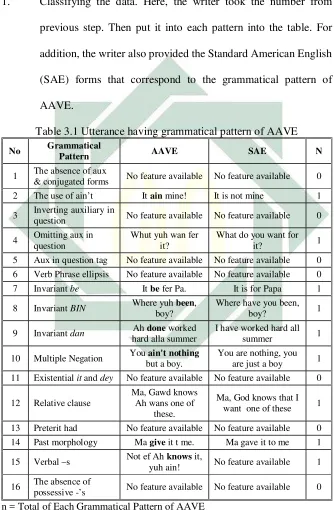
1. Classifying the data. Here, the writer took the number from
previous step. Then put it into each pattern into the table. For
addition, the writer also provided the Standard American English
(SAE) forms that correspond to the grammatical pattern of
[image:49.612.147.481.163.673.2]AAVE.
Table 3.1 Utterance having grammatical pattern of AAVE
No Grammatical
Pattern AAVE SAE N
1 The absence of aux
& conjugated forms No feature available No feature available 0 2 The use of ain’t It ain mine! It is not mine 1
3 Inverting auxiliary in
question No feature available No feature available 0
4 Omitting aux in question
Whut yuh wan fer it?
What do you want for
it? 1
5 Aux in question tag No feature available No feature available 0 6 Verb Phrase ellipsis No feature available No feature available 0
7 Invariant be It be fer Pa. It is for Papa 1
8 Invariant BIN Where yuh been,
boy?
Where have you been,
boy? 1
9 Invariant dan Ah done worked
hard alla summer
I have worked hard all summer 1
10 Multiple Negation You ain'tnothing but a boy.
You are nothing, you are just a boy 1 11 Existential it and dey No feature available No feature available 0
12 Relative clause
Ma, Gawd knows Ah wans one of
these.
Ma, God knows that I want one of these 1
13 Preterit had No feature available No feature available 0 14 Past morphology Ma give it t me. Ma gave it to me 1
15 Verbal –s Not ef Ah knows it,
yuh ain! No feature available 1
16 The absence of
possessive -’s No feature available No feature available 0
41
2. From the findings, the writer interpreted each type of
grammatical pattern based on the related theory.
3. Then, the writer also described the reasons of African American
characters using AAVE in short story, The Man Who Almost A Man.
4. Finally, the writer made a conclusion for this study and gave
42 CHAPTER IV
FINDINGS AND DISCUSSION
The aims of this chapter is concerned with the analysis of the data in order
to answer the research problems presented in chapter I. In the first part, the writer
focuses on the grammatical patterns of African American Vernacular English
(AAVE) in Richard Wright short story,The Man Who Almost A Man. In the second
part, the writer describes the reasons of African American characters using AAVE
in this short story.
4.1 Findings
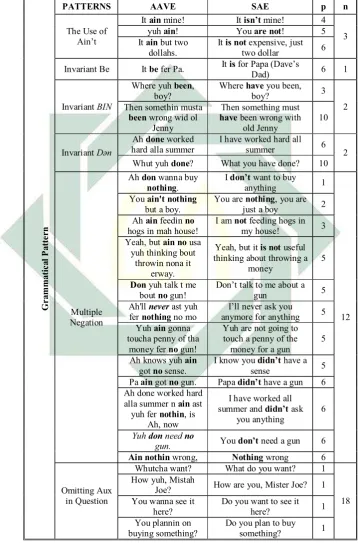
In this study, the writer found 47 AAVE grammatical patterns. The
writer also provided the Standard American English (SAE) forms that
correspond to the grammatical patterns of AAVE.
4.1.1 Grammatical Pattern of AAVE
In the finding, the writer found nine grammatical patterns of AAVE
uttered by African American characters in short storyThe Man Who Almost
A Man. Grammatical pattern of AAVE includes syntactic and
morphological pattern. The syntactical patterns consist of the use ofain’t,
invariant be, invariant BIN, invariant dΩQ, multiple negation, omitting
auxiliaries in question, and relative clause. While, the morphological
43
Table 4.1 Each AAVE Grammatical Pattern
G r a m m a tic a l P a tte rn
PATTERNS AAVE SAE p n
The Use of Ain’t
Itainmine! Itisn’tmine! 4
3
yuhain! Youare not! 5
Itainbut two
dollahs. Itis nottwo dollarexpensive, just 6
Invariant Be Itbefer Pa. Itisfor Papa (Dave’sDad) 6 1
InvariantBIN
Where yuhbeen,
boy? Wherehaveboy?you been, 3 2 Then somethin musta
beenwrong wid ol Jenny
Then something must havebeen wrong with
old Jenny 10
InvariantDΩQ
Ahdoneworked hard alla summer
I have worked hard all
summer 6 2
Whut yuhdone? What you have done? 10
Multiple Negation
Ahdonwanna buy nothing.
Idon’twant to buy
anything 1
12 Youain't nothing
but a boy.
You arenothing, you are just a boy 2 Ahainfeedinno
hogs in mah house! I am
notfeeding hogs in
my house! 3
Yeah, butain nousa yuh thinking bout
throwin nona it erway.
Yeah, but itis notuseful thinking about throwing a
money
5
Donyuh talk t me boutnogun!
Don’t talk to me about a
gun 5
Ah'llneverast yuh fernothingno mo
I’ll never ask you
anymore for anything 5 Yuhaingonna
toucha penny of tha money fernogun!
Yuh are not going to touch a penny of the money for a gun
5
Ah knows yuhain gotnosense.
I know youdidn’thave a
sense 5
Paaingotnogun. Papadidn’thave a gun 6 Ah done worked hard
alla summer nainast yuh fernothin, is
Ah, now
I have worked all summer anddidn’task
you anything
6
Yuhdonneedno
gun. Youdon’tneed a gun 6
Ain nothinwrong, Nothingwrong 6
Omitting Aux in Question
Whutcha want? What do you want? 1
18 How yuh, Mistah
Joe? How are you, Mister Joe? 1 You wanna see it
here?
Do you want to see it
here? 1
You plannin on buying something?
44
Your ma lettin you have your own
money now?
Do your Mother let you to have your own money
now? 1
Whut you plannin on
buyin? What is your planning tobuy? 2 Whut you want with
a gun?
What do you want with the gun, Dave? 2 Whut yu wan fer it? What do you want for it? 2 Whut this? What is this? 3 Yuh crazy? Are you crazy? 3 yuh hear? What did you hear? 6 Know whut this is,
Jenny? Do you know what isthis, Jenny? 8 Whut yuh do wid the
gun?
What have you do with the gun? 10 Whut yuh do wid it? What did you do with it? 12 Where Dave? Where is Dave? 10 Where yuh git the
money?
Where did you get the
money? 11
Whut yuh wan fer yo mule, Mistah
Hawkins?
What do you want for your mule, Mister
Hawkind?
12
Whut yuh do wid it? What will you do? 12 Relative
Clause
Ma, Gawd knows Ah wans one of these.
Ma, God knowsthatI
want one of these 5 1 Past
Morphology Magiveit t me. Magaveit to me 11 1
Verbal -s
Ahwanst take it home wid me
I wantto take it home
with me 1
8 Ah plowsmo Ian
than anybody over there.
I plowmore than
somebody over there 4
Ma,Gawd knows Ah wans one of
these.
Ma, God know thatI wantone of these 5 Not efAh knowsit Not if I know it 5
Ah knowsyuh ain got no sense.
I knowyou didn’t have a
sense 5
But Ma,Ah wansa
gun But Ma,I wanta gun 6
Ah wansa gun I wanta gun 6
Please, Ma!Ah loves
yuh, Ma. Please, Ma!MaI loveyou, 6
Total 47
The list of grammatical pattern of AAVE shown in the Table 4.1
45
study are taken from Green (2002), Edward (2009), and other supporting
materials.
4.1.1.1 The Use of Ain’t
Green states thatain’tis classified as the negation. It is different
from other negation auxiliaries in SAE. In SAE, the negation is formed from
any particular auxiliary or conjugated form of be, do, have, modals +
contractednot(n’t). Althoughain’tmay occur in environments which have
function asisn’t,didn’tandhaven’t, can’t. As shown in table 4.1, the use of
ain’t occurs 3 times. The utterance that uses this feature is found in the
following conversation:
Conversation 1
Dave : "Naw, Ma, Gimme ma catlog, Ma."
Dave’s Mam : "Quit hollerin at me! Whut's wrong wid yuh? Yuh crazy?" Dave : "But Ma, please.It ain mine!It's Joe's! He tol me t bring
it back t im termorrow. "
This conversation happened when Dave grabbed the catalogue and
Dave’s Mam asked him to stop holler at her. Dave might look weird until
his mam said that he was crazy. Dave grabbed the catalogue because that
was not belong to him. It was belong to Mr. Joe, the store owner. Dave
would brought back the catalogue to Mr. Joe tomorrow.
The use ofain’tmostly happens when Dave speaks with his family.
Mostlyain’tin this short story are withoutt.Dave usesain’tinit ain mine
to utter the negative sentence about the thing which is not belong to Dave.
46
not form preceding auxiliary for nominal sentence. So, this family prefer
use ain’t in their conversation for negative sentence to simplify their
utterances.
4.1.1.2 Invariantbe
Invariantbewhich may also be in the form ofbesin some instances
indicates habitual meaning. Whereas the auxiliary/copula be and other
auxiliaries in AAVE can be absent or do not have to occur obligatorily. The
aspectual markerbecannot be left out of the sentence. If it is omitted, some
sentences may receive ambiguous interpretations, or they may not receive
the intended interpretation. In AAVE, the use ofbe replaces to beis, am,
are in SAE. It occurs just once, the utterance that uses invariant be is
presented in the following conversation:
Conversation 2
Dave’s Mam : "Yuh bring it straight back t me, yuh hear?It be fer Pa." Dave : "Yessum! Lernme go now, Ma."
The conversation above happened when Dave’s Mam gave Dave
money to buy a gun but he should promise to her. Dave should give the gun
to his father. After he promised to his mam, he left the home to buy a gun
as soon as possible.
Invariant be occurs just once in the story. For the conversation
above, Dave’s Mam did not do habitual activity, but here she changes
47
form in her utterance. The