Unlocking resilience through
autonomous innovation
Aditya Bahadur and Julian Doczi
Working Paper
Overseas Development Institute 203 Blackfriars Road
London SE1 8NJ
Tel. +44 (0) 20 7922 0300 Fax. +44 (0) 20 7922 0399 E-mail: [email protected]
www.odi.org www.odi.org/facebook www.odi.org/twitter
© Overseas Development Institute 2016. This work is licensed under a Creative Commons Attribution-NonCommercial Licence (CC BY-NC 4.0). Readers are encouraged to reproduce material from ODI Working Papers for their own publications, as long as they are not being sold commercially. As copyright holder, ODI requests due acknowledgement and a copy of the publication. For online use, we ask readers to link to the original resource on the ODI website. The views presented in this paper are those of the author(s) and do not necessarily represent the views of ODI.
ISSN (online): 1759-2917 ISSN (print): 1759-2909
Contents
List of acronyms
5
Executive summary
6
1. Introduction
7
2. Innovation and Autonomous Innovation
7
3. Resilience thinking
14
4. Unlocking resilience through Autonomous Innovation
16
5. Implications for development organisations
21
6. Conclusions
24
List of igures and boxes
Figures
Figure 1: Relationships between different approaches to innovation, according to their degree of external inluence and
their relative resource requirements
13
Tables
Box 1: 10 types of innovation
9
Box 2: An example of an autonomous innovation
12
Box 3: Five characteristics of resilience
15
Box 4: Responding to adversity through Autonomous Innovation in the absence of government intervention
17
Box 5: Dealing with residual and compound risk through the matir unoon
18
Box 6: Fighting the freeze with native potatoes
19
Box 7: Iteration and experimentation by ‘the menstrual man’
20
Box 8: Self-regulation for resilience to heat waves
21
List of acronyms
BRACED Building Resilience and Adaptation to Climate Extremes and Disasters
DFID Department for International Development
ICT Information and Communication Technology
ICT4D ICT for development
IFRC International Federation of Red Cross and Red Crescent Societies
IPCC Intergovernmental Panel on Climate Change
ISET Institute for Social and Environmental Transition
MRC Mekong River Commission
NGO Non-governmental organisation
NIF National Innovation Foundation
NRC National Research Council
ODI Overseas Development Institute
R&D Research and development
UK United Kingdom
UN United Nations
UNISDR UN International Strategy for Disaster Risk Reduction
US United States
USAID US Agency for International Development
Acknowledgements
We gratefully acknowledge funding support from the Rockefeller Foundation to carry out this work as part of its Resilience Scan project, led by ODI. Further information and quarterly scans of resilience articles, debates and social media can be found at www.odi.org/resilience-scan.
We gratefully acknowledge contributions and reviews made to this report by Mark Strong (DFID), Thomas Tanner (ODI), Kevin O’Neil, Chukwudi Onike and Hunter Goldman (Rockefeller Foundation), and Kathy Peach (BOND).
Key messages
• Communities that are most vulnerable to the impacts of the growing number of interacting shocks and stresses often lack the resources needed reducing risk and enhancing resilience.
• Approaches to innovation that are inclusive, bottom-up and frugal or draw on the philosophy of jugaad (a Hindi term for frugal and simple solutions) can help ill this gap.
• Private sector actors such as 3M, Huawei and the Tata group employ principles from concepts such as jugaad
to innovate and improve business practice, yet the majority of development actors engaged in building resilience seem unaware of these novel and potent ideas.
• Using examples, this paper examines the characteristics and conditions for ‘Autonomous Innovation’ and how it can help poor and vulnerable people enhance their resilience.
Executive summary
The world is facing a growing number of natural, technological, economic, social and political shocks and stresses. These evolve and come together in varied conigurations to cause damage that can undermine development outcomes.
Yet the countries, places and people that are most vulnerable to the impacts of these shocks and stresses often lack the resources needed for structured processes of innovation to deliver scientiically robust solutions for reducing risk and enhancing resilience. This is where approaches to innovation that are inclusive, bottom-up and frugal or draw on the philosophy of jugaad (a Hindi term for frugal and simple solutions) are highly relevant. Private sector actors such as 3M, Huawei and the Tata group already employ principles from concepts such as jugaad
to innovate and improve business practice, yet these novel ideas are rarely employed by development actors engaged in building resilience.
This paper draws on these alternative approaches to innovation to present the concept of Autonomous Innovation as an important approach/process for enhancing resilience to range of shocks and stresses, including climate change. Autonomous innovations have ive key characteristics: they are inductive (bottom-up); indigenous and suited to local cultural norms; inexpensive and frugal; developed through subjective processes that rely on the innovator’s intuition; and entail a high degree of iteration through trial and error. This is in contrast with innovations arising from more structured, expert-led and resource-intensive research and development processes and standardised business procedures.
A wide range of examples demonstrate what
Autonomous Innovations look like in practice. This may result in power generators made from motorcycle batteries,
a bicycle that gains power with every bump in the road or potatoes that can survive extreme temperatures to save remote mountain communities from starvation. There is increasing attention on factors that motivate and enable Autonomous Innovation. Emerging insights highlight how communities with strong social networks, a culture that favours/celebrates creativity and experimentation, the existence of aspiration despite resource scarcity and a conducive political-economic environment are key to enabling Autonomous Innovation.
Autonomous Innovation can support resilience in a number of ways:
First, in resource-scarce settings across the developing world, communities are usually the irst responders to shocks and stresses. Therefore, they must be able to innovate autonomously to deal with needs – this can make the crucial difference between life and death, between resilience and vulnerability.
Second, despite our best scientiic efforts, signiicant uncertainty remains on how the climate is changing and how its impacts will occur. This uncertainty means a certain degree of ‘residual risk’ will remain, regardless of the actions governments in any context take to build resilience. Supporting the ability of communities to innovate autonomously helps tackle this uncertainty and the remaining residual risk.
Third, ‘resilience thinking’ and related initiatives may not resonate with the contexts of local politics and culture in low-income countries, not least as the concept of resilience was developed primarily in the richer nations of the ‘Global ‘North’. Using an endogenous approach such as promoting autonomous innovations to reduce risk can help determine pathways of resilience that are rooted in local cultural norms.
Fourth, resilience thinking has contributed to the development of adaptive management as an important tool for managing change in dynamic systems. Yet adaptive management, which is based on a high degree of rapid experimentation and iteration, has been criticised for being an approach for managing change in large systems rather than one that helps overcome particular problems. Autonomous innovations encapsulate the principle of iteration and are inherently adaptive in their approach to problem solving. As such, the concept carries the promise of operationalising adaptive management at smaller scales for tackling particular problems.
Development organisations can also promote
autonomous innovations by providing inance. This could take the form of grants to support programmes that create an enabling environment for Autonomous Innovation, or investment to scale up autonomous innovations directly. Furthermore, organisations running resilience programmes can have a lexible pot of resources to support or scale up autonomous innovations that project staff may uncover while going about their regular tasks.
Autonomous Innovation can be supported programmatically either through a ‘mainstreaming’ approach, where programme staff recognise contexts or individuals with a conducive enabling environment for Autonomous Innovation and work to encourage this, or through bespoke programmes. An example of the latter would include ‘challenge funds’ – which are not a new idea in international development but have not yet been used to promote autonomous innovations for resilience.
The value of Autonomous Innovation for enhancing resilience is clear, but it is vital to understand that it can only complement structured processes of risk reduction and resilience. Comprehensively reducing risk and building resilience will require a variety of measures, including large-scale policy interventions and the generation and use of scientiic information. Autonomous Innovation can accompany these structural interventions to provide an added boost in enhancing resilience.
1. Introduction
The term ‘resilience’ appears in a large number of disciplines, but no deinition is common to all. All deinitions emphasise different elements or attributes of resilience but they speak in a general way to the ‘continued ability of a person, group, or system to adapt to stress— such as any sort of disturbance—so that it may continue to function, or quickly recover its ability to function, during and after stress’ (National Research Council, 2011: 13). ‘Resilience thinking’ has evolved from a concept used in the study of natural systems (e.g., ecosystems) to a dominant approach for analysing changes in coupled socio-ecological systems and guiding large development programmes aimed at reducing risk and vulnerability across the world (Bahadur et al., 2015; Holling, 1973). Research and practice now engages signiicantly with the concept to understand how to tackle the impacts of a wide range of shocks and stresses (Bahadur et al., 2013).
Vulnerable populations need to innovate to enhance their resilience, because different kinds of shocks and stresses (e.g., climatic and demographic) will combine to bring new problems or exacerbate existing problems in unforeseen ways. Yet the countries, regions or communities that are most vulnerable to such problems often lack the resources needed for structured processes of innovation
to deliver scientiically robust solutions for reducing risk and enhancing resilience (Radjou et al., 2012). In its place, concepts such as improvisation, ‘frugal’ or jugaad
innovation are highly relevant. Jugaad is a Hindi term derived from the common Indian experience of producing frugal and simple innovations as solutions to everyday challenges. Our increasingly uncertain and resource-constrained world demands ‘autonomous innovations’ that are lexible, frugal and instinct-driven, to function through a variety of disturbances in these challenging circumstances. This is in contrast with innovations that big research and development (R&D) processes and standardised business procedures generate. Private sector actors such as 3M, Huawei and the Tata group have been employing some of these principles for decades, yet many development actors engaged in building resilience seem unaware of these novel and potent ideas.
This working paper explores the value of encouraging Autonomous Innovation as one outcome for enhancing resilience to a variety of shocks and stresses, including those induced by climate change, in resource-constrained settings of the global south. Section 2 explains traditional innovation and consolidates a set of principles that distinguish Autonomous Innovation for development. Section 3 goes into detail on resilience thinking. Section 4 presents arguments as to why agencies working to enhance resilience should consider Autonomous Innovation seriously. Section 5 then explores ways for development agencies to operationalise Autonomous Innovation in their resilience programming. Section 6 presents concluding arguments and ways forward.
This paper touches on themes that research on technology for development, appropriate technology and technology justice have also explored (e.g., Practical Action, 2014a; Bascavusoglu, 2006). It also aligns with work on ‘Autonomous Adaptation’, which demonstrates the importance of ensuring adaptation processes are informed – and where possible set – by those who must adapt (Christoplos et al., 2009). Additionally, the paper is aligned with the history of work on participatory development, which argues for seeing communities not merely as recipients but also as agents of change (Chambers, 1983).
2. Innovation and Autonomous Innovation
This section examines different forms of innovation and uses them to deine the concept of Autonomous Innovation. The term ‘innovation’ is used widely around the world and has many different deinitions. For the purposes of this paper, we use the deinition by Keeley et al. (2013: 6-7) of innovation being ‘the creation of a viable new offering, [which] requires identifying the problems that matter and moving through them systematically to deliver elegant solutions’. Within this, Keeley et al. deine 10 types of innovation, distinguishing them based on their position within the value chain of product/process development and marketing. Box 1 discusses these.
Innovation is important because resource constraints from climatic and environmental degradation are increasingly becoming the norm around the world, including in advanced economies (Radjou et al., 2012). In this context of increasing competition for scarce resources, ‘innovation will be the key differentiator between the winners and the also-rans’ (ibid: 36).
However, our rapidly changing world demands changes to the processes and products of innovation. An increasing number of experts are highlighting that the traditional forms of innovating that drove the rise of western economies are themselves insuficient to respond to the needs of a world facing environmental, demographic and socioeconomic stress. They argue for innovation processes and products becoming more frugal with scarce resources, affordable and accessible to the poorest citizens and environmentally sustainable (Bound and Thornton, 2012; Radjou et al., 2012).
The idea of innovation in lower-income contexts also demands greater attention. The majority of the academic literature on the processes and products of innovation has to date focused on ‘advanced’ innovation – measured in terms of R&D budgets, numbers of patents and aspects of international trade and technology transfer (Radjou et al., 2012; Gupta, 2009). This is also relected in recent international frameworks like the UN Sustainable Development Goals and the outcome document of the ‘Financing for Development’ conference in Addis Ababa, both of which make frequent reference to innovation, but mostly in the context of R&D investment and technology transfer. Far less analysed have been the inventions and innovations arising out of communities and individuals themselves, especially in lower-income contexts.
Interest is growing, though, and this is in parallel with a broader shift in the development and private sector discourse towards more localised and problem-driven activities/products that recognise and work with local contexts. The recent Doing Development Differently initiative is a relevant example that emphasises this issue and provides case study examples of better development practice (its ‘manifesto’ is available from Harvard University and ODI (2014); case studies are available at ODI (2015)). Initiatives such as these are arguing that
development programmes should treat people as a source of ideas, innovations and institutional arrangements, rather than as a sink of aid, assistance and advice (Gupta, 2013). People who live with and experience a problem irst-hand are more likely to see where the possibilities for innovation lie (Howmatters, 2013).
Other narratives from different sectors are making similar arguments. The information and communication technologies for development (ICT4D) movement highlights the importance of ensuring the design and use of ICTs are inclusive and can beneit human development (e.g., Harris, 2004). The appropriate technology movement emphasises the importance of choosing and using
technology that is small in scale, decentralised, labour-intensive, energy-eficient, environmentally sound and locally owned, and is usually applied in the development context to focus on promoting local solutions instead of importing expensive and unworkable ones from the global north (e.g., Schumacher, 1973). Similarly, the technology justice movement argues that too much of the world’s innovation effort is focused on improving the lifestyles of the rich world and more should be spent on helping the poor access existing technology and promoting innovation to meet basic needs (Practical Action, 2014a). These parallel similar discourses in the private sector on social entrepreneurship and on Prahalad’s (2004) seminal idea for large corporations on the ‘fortune at the bottom of the pyramid’. These have since evolved to realise there is no ‘fortune’ waiting to be discovered from marketing to the poor; rather, companies need to learn how to create a fortune with the poor (iBoP Asia, 2012).
‘Traditional’ innovation
In 1934, Joseph Schumpeter was among the irst to articulate the importance of innovation for the industrial economy. He theorised that the processes and products of innovation could give irms an advantage over their competitors, especially when aided with a temporary monopoly on their ideas through patent protections (Cozzens and Sutz, 2012). He deined ive types of innovation: new product, new method of production, new source of supply, exploitation of a new market and new way to organise a business (Schumpeter, 1934). Authors such as Drucker (2002) have since argued that ‘the very foundation of entrepreneurship is the practice of systematic innovation’. Firms began to seek out ways of generating more innovations to keep ahead of their competitors, but did so in the absence of any uniied theory of how innovation occurs.
requires three key ingredients: (1) a recognised need, (2) competent people with relevant technology and (3) favourable economics and inancial support. Drucker (2002) – a famous management consultant – proposed a different set of ingredients, arguing that principled, systematic innovation is ‘work rather than genius’, requiring knowledge, ingenuity and focus. Hollander (1965) and Katz and Shapiro (1987) echoed a similar idea that most innovation is a continuous, iterative and gradual process of incremental problem solving, rather than one of grandiose ‘breakthroughs’. From the policy perspective, Spielman (2005) added the importance of institutions to the list, arguing that institutions condition the sets of incentives available to agents that may otherwise have the same objectives. Differences in these sets of incentives can result in different decisions and outcomes of an otherwise similar innovation process.
A lesson emerging from this different research is that there is no one ‘best’ process for producing innovations. Organisations and individuals have interpreted and operationalised these different recommendations in different ways, resulting in the diversity of managerial and entrepreneurial approaches to promoting innovation that exists today. Our paper does not aim to detail all of them, but rather to highlight one of the historically dominant ones and then to compare it with a few newer
ones through the lens of resilience and better international development programming.
Chief among these has been an overarching corporate approach that Radjou et al. (2012) termed as producing ‘structured’ innovation. They and others, like Chataway et al. (2013), argue the model of producing structured innovation drove much of the developed world’s corporate and economic growth in the 20th century. The idea of R&D encapsulates the model, often visualised in the media as an insular group of intelligent researchers working within a modern and high-security laboratory. By differentiating the ‘R&D process’ from their other business activities, Radjou et al. (2012) argue irms have aimed to ‘manage’ innovation through dedicated budgets, standardised business processes and controlled access to knowledge.
A prominent technique that underlies this approach is Six Sigma. Invented by an engineer at Motorola in 1986 (Motorola Inc., 2005), the technique aims to minimise variability in manufacturing and production processes. Its goal is to standardise each of the various stages of these processes such that 99.99966% of outputs are free of defects. The technique has grown rapidly in popularity since the 1990s, with companies like GE and Motorola claiming that using it has saved them billions of dollars (Motorola Inc., 2005; Dusharme, 2001). There are now various standard methods and certiication programmes to
Box 1: 10 types of innovation
Innovation experts Keeley et al. wrote a book in 2013 that deined ten types of innovation based on their position within the value chain of product/process development and marketing. One of their aims in doing this was to draw attention to the fact that innovation involves more activities along the value chain than its common deinition of ‘developing new products and processes’ suggests. Their typology uses terminology relevant to private enterprises, but the concepts are equally relevant for governments, individuals and non-proit organisations. These are:
Coniguration – innovations that focus on the innermost workings of an organisation and its business system: 1. proit model: how an organisation makes money
2. network: how an organisation connects with others to create value
3. structure: how an organisation organises and aligns its talent and assets
4. process: how an organisation uses signature or superior methods to do its work
Offering – innovations that focus on an organisation’s core product or service, or a collection of its products and services:
5. product performance: how an organisation develops distinguishing features and functionality
6. product system: how an organisation creates complementary products and services
Experience – innovations that focus on more public-facing elements of an organisation and its business system:
7. service: how an organisation supports and ampliies the value of its offerings
8. channel: how an organisation delivers its offerings to customers and users
9. brand: how an organisation represents its offerings and business
10. customer engagement: how an organisation fosters compelling interactions
train irms to ‘design for Six Sigma’ (e.g., the International Association for Six Sigma Certiication).
This approach to producing structured innovation and the techniques like Six Sigma that underlie it have been successful at helping large companies in rich countries innovate in a consistent and predictable way. However, it has also been criticised as being too expensive and resource consuming, lacking lexibility and being elitist and insular (Radjou et al., 2012). It has not always worked either. For example, in China, a low-cost ($20,000) X-ray machine produced by Zhongxing Medical captured 50% of the country’s market and forced multinationals like GE and Philips (whose machines cost around $150,000) to cut prices or exit the market altogether (ibid).
Chataway et al. (2013) further argue that the nature of this type of innovation – capital-intensive, depending on high-quality networked infrastructure, relying on skilled labour, producing products that meet the needs of the rich – disadvantages and excludes the poor, both as consumers and as producers. Both Radjou et al. and Chataway et al. argue that different approaches to producing innovation are needed in lower-income contexts that can empower and include the poor, and thus promote more inclusive economic development.
Autonomous Innovation
In response to these arguments, a number of different approaches to producing innovation in the context of the poor have arisen recently. The outcome of Autonomous Innovation that we present through this paper is an amalgam of several of these competing approaches, which have a number of overlapping tenets. These include ‘frugal’, ‘grassroots’, ‘jugaad’, ‘inclusive’, ‘bottom-up’ and ‘user-led’ innovation, along with elements of ‘human-centred design’, ICT4D, appropriate technology, technology justice, ‘agile methodology’ and ‘design thinking’, among others. Most of these approaches have been codiied within the past decade or so and have many similarities, yet, for the most part, they appear to have been developed in separate academic and sectoral silos. The diversity of terms is confusing and motivates our work in this paper to amalgamate many of their tenets into a single term.
First among these is the effort to produce ‘frugal innovation’. Two different deinitions of this term have been put forward. Basu et al. (2013) deine it as an effort to consider the needs and contexts of citizens in lower-income countries and to develop appropriate, adaptable, affordable and accessible products and services for them. Their focus is on the idea of inclusive design that still relies on external designers. As an example, experts from the non-governmental organisation (NGO) Evidence in Action designed a simple, low-cost chlorine dispenser that could be installed in low-income areas with community water services where the use of chlorine for treatment was low (Vogelstein, 2015).
Bound and Thornton (2012) deine the term instead as a response to limited resources, using different methods to turn these constraints into an advantage. They posit that successful frugal innovations are low in cost, outperform the alternatives, can be made available at a large scale and often have an explicitly social mission. Although low-cost by nature, both deinitions agree that frugal innovations relect the making of better things, not just cheaper things, and need not only refer to ‘low-technology’ solutions.
One concept of innovating frugally that is attracting attention in the private sector is ‘jugaad innovation’.
Jugaad is a colloquial Punjabi-Dogri word that can mean a homemade ix or a simple work-around used for solutions that respond to the problems of everyday life in India and bend the rules of traditional innovation. A book by Radjou et al. (2012) popularised the term and concept for the business community, though the idea is not unique to India. Similar concepts are described in terms like
gambiarra in Brazil, zizhu chuangxin in China and jua kali
in parts of Africa (Pansera and Owen, 2014).
Radjou et al. and Pansera and Owen (2014) deine several principles for producing jugaad innovation, differentiating it from traditional innovation as, ‘if structured innovation is a classical orchestra, jugaad is the jazz band.’ These include:
• reframing challenges as opportunities (e.g., developing energy-eficient appliances to deal with poor availability of electricity)
• making maximum use of scarce inancial resources
• adapting to changing circumstances quickly (which could include cycles of failing and restarting)
• keeping outputs simple by focusing on ‘good enough’ solutions
• ensuring the socially and economically marginalised beneit from the innovation process
• following intuition, culture and subjective values
• ensuring outputs are robust to deal with infrastructure shortcomings (such as electrical voltage luctuation), are fault-resistant to cope with users with low levels of literacy and are affordable to larger sections of society
For example, in India, GE has applied the principles of jugaad to advance a ‘just-in-time’ supply chain model for the production and delivery of radioisotopes to local hospitals (Radjou et al., 2012). This has dramatically lowered its costs for use in PET/CT scanners.
(Creativityatgrassroots, 2014). Facing high transaction costs and few external materials, most of the innovations these individuals develop inevitably happen to be frugal.
The latter conception of grassroots innovation also overlaps with the idea of producing ‘bottom-up innovation’. This describes innovation that is generated or led by citizens or community groups, rather than government, business or industry (Bergman et al., 2010; Bloom, 2015). ‘Bottom-up’ thus relates to the source of the innovation.
As an example of an endogenous and unaided innovation, Jorge Odon, a car mechanic from Argentina, invented a simple device to ease cases of obstructed/complicated human births. He developed his initial ‘Odon device’ without any external support or expert knowledge on health care, inspired instead by watching a YouTube video on how to extract a loose cork from inside an empty wine bottle (McNeil Jr., 2013). His device has since gained global acclaim, including from the World Health Organization, and is currently being reined through medical trials.
Another concept is ‘inclusive innovation’, which again carries more than one deinition and overlaps with the concepts of ‘user-led’ innovation and ‘human-centred design’. The World Bank (2010) conceives of inclusive innovations as those with a focus on involving the poor in identifying their own development priorities and on providing incentives for external actors to serve their needs more effectively. This contrasts with iBoP Asia’s (2012) deinition, which contends that it aims to deliver high-performance products, processes and services at an ultra-low price for resource-poor people by harnessing science and technology. This latter thinking is closer to Basu et al.’s (2013) conception of frugal innovation. Similarly, user-led innovations are those that have been designed with the users’ needs always at the centre, but could have been led by an external party (Ornetzeder and Rohracher, 2006; von Hippel, 1988). The process of human-centred design can be considered a method of achieving these inclusive or user-led innovations, which generally involves phases of experts learning from the people for whom they are designing, identifying design opportunities and working with these users to develop the opportunities into innovations (Design Kit, 2015).
Cozzens and Sutz (2012) provide an example of the World Bank’s deinition through community water systems in Costa Rica. Here, a national programme describes an organisational structure for local water management efforts and provides technical expertise if requested. However, a community must enrol itself in this programme voluntarily and must develop its own solutions to local water management problems if it hopes to make progress.
Other techniques have arisen from the private sector that relate to producing more user-led innovation. This includes the structured approach to commercial creativity known as ‘design thinking’ (Brown, 2008) and a non-linear project management approach for software design known as ‘agile methodology’ (Agile Methodology, 2008). These techniques
do not prescribe their favoured type of innovation, though they generally seem to favour expert involvement and relatively signiicant amounts of resource investment.
Lastly, other concepts, like ICT4D, ‘appropriate technology’ and ‘technology justice’ promote innovations of the type that these different terms encompass, and often refer to them directly. In our understanding, however, these movements do not deine and prescribe their favoured type of innovation in this regard. They focus more on the underlying development principles, rather than on the innovation’s resource requirements and on whether it is locally led or externally supported.
The ive ‘Is’ of Autonomous Innovation
We aim to distil these various concepts to a single term that captures their best elements, while focusing on our idea of how to empower communities to innovate to deal with a variety of shocks and stresses. We envision the term as ‘Autonomous Innovation’ and propose that autonomous innovations and the processes that produce them demonstrate some or all of the following ive ‘Is’:
1. Inductive: Autonomous Innovation encapsulates innovations that arise from ‘non-experts’, organically, endogenously and without direct external support. This, in essence, is an inductive process of innovating. It distinguishes the idea from some of the other approaches – like Basu et al.’s version of frugal
innovation or iBoP Asia’s version of inclusive innovation – where communities innovate alongside an ‘expert’ developer or an external innovator learns from a community and develops solutions for them. Our use of these ‘non-expert’ and ‘expert’ connotations in this type of situation is somewhat of a misnomer though. This principle posits that local innovators are the ‘real’ experts of their particular needs, which non-locals with expertise in a particular domain or sector cannot fully understand. Note, though, that this does not preclude development agencies from working to create an enabling environment for this type of unaided work to take place, as we discuss in Section 5.
3. Inexpensive: Autonomous Innovation encapsulates low-cost innovations, both for the producer and for the consumer. Given the resource constraints and poverty in the low-income communities we are focusing on, many of their innovations will be frugal and simple by nature, since they do not have access to new and high-value resources and technologies. These cost constraints apply to the facilities for innovating, the level of skill required, the nature of raw materials needed and the price of the inal solution on offer. The concept of Autonomous Innovation hinges on the idea that these innovations should be accessible and affordable to a large number of people engaging with a variety of problems and opportunities. In addition, the fact that these innovations are inexpensive means innovators can make multiple different attempts (sometimes simultaneously) towards an ideal outcome.
4. Intuitive: Autonomous Innovation encapsulates subjectively ‘good enough’ innovations – that is, a ‘minimum viable product’ – rather than objectively advanced ones. This differentiates Autonomous Innovation from traditional forms of structured innovation. Traditional approaches use techniques like Six Sigma to design rigorously standardised, functionally lawless products. Autonomous innovations, by contrast, rely on the individual views of the innovator – a
subjective appraisal of when an output is good enough, rather than an objective, statistical one. This advocates an alternative epistemological tradition that recognises the value of one’s own ‘blue sky thinking’ via their local, traditional and indigenous knowledge. This is not to say the results of autonomous innovations arrived at intuitively do not need to be improved on through iteration/experimentation (see next point). Rather, it means that Autonomous Innovation provides more
room for subjective experiences shaping processes of innovation to deliver products that are good enough.
5. Iterative: Autonomous Innovation encapsulates innovations that arise from iteration – ‘failing cheap, fast and often’ – towards a solution (Radjou et al., 2012). Iteration arises naturally from Autonomous Innovation’s other principles, such as intuitive and inexpensive. As autonomous innovations do not rely on extensive and expensive testing and trialling processes as Six Sigma does, their outputs will often fail to deliver the impact they are meant to – at least in their early forms. It is also possible that these outputs will ill a ‘temporary’ demand but will need to be amended to accommodate any change in circumstances or context. The fact that autonomous innovations are inexpensive means these necessary iterations towards the desired impact are not overly burdensome on the innovator. This principle relates to the broader design concept of ‘rapid prototyping’, which traditional innovations can also rely on (at higher cost and with more expert input) (efunda, 2015).
We can conclude with a deinition of Autonomous Innovation that encapsulates these ive principles, as below. Box 2 then provides an example that does the same.
Autonomous Innovation refers to ‘good enough’, unaided innovations developed by people in low-income communities, producing solutions that iteratively respond to the challenges or opportunities facing their local situation and their interests and values. These innovations are often frugal, simple and based on indigenous/traditional knowledge by nature.
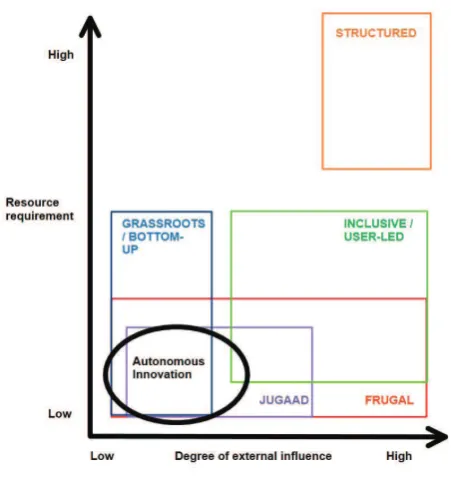
Noting this, Figure 1 summarises how Autonomous Innovation relates to the other concepts of innovation we
Box 2: An example of an autonomous innovation
In our view, a good example of an autonomous innovation comes from a low-income mechanic named Alfredo Moser of Brazil. Pansera and Owen (2014) describe Moser’s life in 2002 in a small town that was subject to frequent and lengthy power cuts. To solve the problem of indoor lighting, he began experimenting with prototypes and eventually arrived at a model that involved installing a clean, plastic bottle illed with water and a small amount of bleach (to prevent the growth of algae) in the roof of a house. During daylight hours, even a single bottle like this could provide 40-60 watts worth of light into a dark room. In the years since, his simple and affordable invention has gained global acclaim. It has been especially popular in the Philippines – where local entrepreneurs aided by an NGO were aiming to install these ‘Moser lamps’ in a million homes by the end of 2015 (MyShelter Foundation, 2015).
discussed earlier. It does so by comparing the concepts in terms of the degree of ‘external inluence’ they involve (i.e., ‘top-down’ innovating by non-local ‘experts’ versus ‘bottom-up’ innovating by local people) and the relative amount of resources (inancial, human, physical, etc.) their innovations typically require. Their boundaries are estimates based on what we understand of these terms. As visible, our vision of Autonomous Innovation is most similar to the characteristics of jugaad and grassroots/ bottom-up innovations, in terms of its focus on innovating without external inluence and in highly resource-poor contexts (e.g., post-disaster environments).
Conditions that motivate Autonomous Innovation
The previous section described ive characteristics of autonomous innovations, but in what circumstances have innovations with these characteristics occurred? Drawing on literature from the related concepts that Autonomous Innovation encapsulates, we postulate four conditions here that could help create an enabling environment for it.
Autonomous Innovation can occur …
1. .… when communities have strong social networks:
Inventing and innovating are social processes. Authors like Hall et al. (2001) have argued that social capital – the quality and frequency of human interactions – is a key ingredient for all types of successful invention and innovation. For a locally led autonomous innovation, this implies the need for good social capital between the
potential innovator and their community. A community where people regularly interact with each other and self-organise to perform daily tasks is more likely to present a favourable environment for innovating than one where people rarely do so – because of, for example, physical barriers, strong social divides or ongoing conlict between groups.
2. .… within cultures that favour creativity and
experimentation: Another social element to innovating relates to whether a potential innovator feels their new ideas will be welcomed or derided. This could involve interactions between the culture and beliefs of both the innovator’s community itself and those of the wider country or region. For example, authors like Radjou et al. (2012) and Bound and Thornton (2012) have recognised that India’s cultural and socio-political context presents a generally favourable environment for innovating. The idea of jugaad is seen as a part of life, and innovations with elements of jugaad that scale up are celebrated – such as the Tata Nano (e.g., Sorabjee, 2009). That said, within a large country like India, there are surely communities that may be more or less accepting of new inventions and ideas than the national average. These competing cultural norms between nation and community will ultimately determine whether a potential innovator pursues their ideas or not. 3. .… when communities are frugal, yet aspirational: Local
citizens will be inspired to develop their ideas when they know there is an unserved market of interested customers seeking simple and affordable products of good quality. A good example is that of the Mitticool fridge and its innovator, Mansukh Prajapati. Prajapati developed a clay fridge that used the evaporation of water, rather than electricity, to cool its contents, after being inspired by a photo from a large earthquake in India in 2001 (Mitticool, 2011). He envisioned a fridge that could be used by the masses of aspirational poor in India who lacked electricity in their homes but who would otherwise buy a fridge. His product successfully responded to this latent demand and he has since scaled it up into a successful company that in 2012 employed about 20 potters, received orders from 41 countries and had a turnover of around $450,000 (Sharma, 2012). Bound and Thornton (2012) suggest the emerging middle classes in lower-income countries like India, Kenya, the Philippines, etc. are among the best customers for stimulating Autonomous Innovation. They are still relatively poor, but they have achieved a disposable income that makes them aspirational. By contrast, the richest people in a community will usually be able to get whatever they want, whenever they want it, and will not be a major source of demand. The poorest people in a community might beneit just as much as the middle classes might. However, with effectively no disposable income, they may be focused on attempting to satisfy their basic needs, rather than
Figure 1: Relationships between different approaches to innovation, according to their degree of external inluence and their relative resource requirements
on demanding new products and services from local innovators.
4. .… with a conducive political-economic environment: Local innovators will autonomously innovate if their political-economic environment incentivises them to do so. As authors like Spielman (2005) and Berdegue (2005) argue, innovation is incentivised in environments where innovators have a reasonable assurance that they will be able to beneit from their efforts and not be preyed on or disadvantaged. Local and national institutions play a key role in this. At the very least, they should not be actively repressing new ideas. Environments that are more favourable may also include local equivalents of patent protection, intellectual property rights and other types of inancial or social incentives, such as inancial assistance or the awarding of prizes to local innovators with good ideas. For example, the Government of India’s Department of Science and Technology hosts the National
Innovation Foundation (NIF). This autonomous body provides support to local innovators, in partnership with other, major, civil society organisations in the country that play a similar role, such as the Honey Bee Network (NIF, 2014). High-level institutional support like this for Autonomous Innovation has probably contributed to India’s fame as a hotbed for this type of innovation.
Challenges and critiques of Autonomous Innovation
Low-cost, unaided innovations like autonomous innovations are not without their challenges and critiques. As a irst example, some authors highlight the potential of the idea and its outputs to be ‘merely’ coping strategies – that is, innovating to ‘make do’ or ‘get by’ (Bound and Thornton, 2012; DeanMoull, 2013). The concern is that the use of autonomous innovations in a community might reduce its demand for more structured innovation products, leading to its members subsisting on ‘bare minimum’ innovations instead of innovations that are more impactful. Although this risk could materialise, we view it as uncommon. We advocate for Autonomous Innovation in contexts precisely where structured innovation products have been inappropriate or which they have been unable to reach. For example, if Filipino slum dwellers were able to source a better form of electricity, they would not have embraced the ‘Moser lamp’ in such numbers. This means autonomous innovations should be seen as those best suited to their environment, rather than as a bare minimum.
A more powerful challenge to autonomous innovations relates to their inability to transform the systems within which they occur. Smith et al. (2012) argue that these types of innovations could fail to have a positive inluence on existing social or economic imbalances. Autonomous innovations and their innovators may aim to improve the
sustainability or social justice of their local context, but by their nature of being resource-constrained may lack the ability to have a systematic inluence.
Similarly, Gupta (2013) highlights that the nature of a system’s rules and incentives may result in autonomous innovations that are undesirable – that is, which actively perpetuate inequality or are unsustainable. Dynamite ishing is a good example. This is an autonomous innovation by all measures – locally led, inexpensive and intuitive – but is something most people would judge as unjust and unsustainable.
Reframed more broadly, these critiques posit that the unaided, local nature of autonomous innovations means they do not consider possibilities outside the scope of what local populations know. As such, they might bring unexpected side effects or ineficiencies that could have been mitigated if external actors had participated in their design (consider again the dynamite ishing example, above, or the external availability of new technology like 3D printing, whose outputs could solve a local challenge but which a local innovator might not be aware of). Likewise, their outputs might not consider future trends like climate change, unless local innovators are versed in climate science. Autonomous innovations might therefore tend to arise as response mechanisms to a recent calamity, rather than as preparatory measures in anticipation of a future threat.
We concur that autonomous innovations pose the risks these critiques highlight, but think these risks can be managed. The challenges are not unique to autonomous innovations but serve to underscore the fact that autonomous innovations are not perfect and all-encompassing solutions. Efforts to encourage Autonomous Innovation should not occur in the absence of other efforts by development partners to work with communities and to build political-economic systems that are more socially, economically and environmentally sustainable. We discuss the synergies that arise from doing this more in Section 5.
3. Resilience thinking
Resilience is emerging as the dominant paradigm for risk management and has been embraced by multilateral, bilateral and philanthropic donors, all of which are now supporting large resilience-building initiatives.
stress resilience in ecological systems and those that see the two as highly interconnected.
The ‘socio-ecological system’ has emerged as a conceptual entity that can give social and ecological systems the same weight in their analysis (Folke, 2006). These are ‘linked systems of people and nature. The term emphasises that humans must be seen as a part of, not apart from, nature – that the delineation between social and ecological systems is artiicial and arbitrary’ (Simonsen, 2007). Mayunga (2007) acknowledges the interconnection of human and ecological systems by stating that both natural capital (air, soil, etc.) and social capital (trust, norms, networks) have a role in determining the resilience of a system. This is in contrast with Folke (2006), who does not isolate human/social and natural/ecological factors, seeing them instead as a highly integrated, systemic ‘whole’.
This understanding of resilience has led to a substantial amount of interest in the social sciences, ‘where it is applied to describe the behavioural response of communities, institutions and economies’ (Klein et al., 2003: 39). Central to resilience thinking in socio-ecological systems is the adaptive cycle through which all complex systems go through four phases – ‘growth, conservation, collapse and renewal’ (Resilience Alliance, 2002). Closely associated with this is the notion of ‘panarchy’, which explains how adaptive cycles are simultaneously taking place within system components at different scales (more on this later).
Tenets of resilience thinking
As resilience has moved from being an academic concept to one that informs development programming operationally, many different development actors have attempted to distil key ‘qualities’ and ‘characteristics’ of the term. These include the International Federation of Red Cross and Red Crescent Societies’ (IFRC’s) six characteristics of resilience (Arup International Development, 2011), 10 characteristics
of resilience from the UK Department for International Development’s (DFID’s) Strengthening Climate Resilience Initiative (Bahadur et al., 2010), seven principles of resilience from the Stockholm Resilience Centre (Simonsen et al., 2012), 10 characteristics of resilient systems, institutions and agents from the Institute for Social and Environmental Transition (ISET) (Tyler and Moench, 2012) and 167 characteristics of a disaster-resilient community offered by an interagency group of NGOs in the UK (Twigg, 2009), among many others. The assumption behind these qualities is that those systems or sub-systems that exhibit them are more likely to be resilient.
The key insights from these various frameworks have been previously distilled into ive overarching characteristics of resilience, used by the Rockefeller Foundation to guide its resilience programmes and policies (see Box 3) (Rockefeller Foundation, 2015).
Deploying resilience thinking to deal with shocks
and stresses
There are a number of advantages to using resilience thinking for engaging with a variety of shocks and stresses. Walker and Salt (2006: 31) note that ‘resilience thinking is systems thinking’. Integral to resilience is the heuristic of the ‘adaptive cycle’. As the preceding section discussed, this views systems as highly dynamic entities that are constantly in lux. The notion of ‘panarchy’ then takes this idea forward to argue that such cycles of creative destruction happen at different scales within a system and at different time scales, as not all elements of a complex system have synchronised cycles of change (ibid).
Using systems thinking as a lens provides unique tools to engage with a wide variety of shocks and stresses, including those climate extremes and disasters induce. This underlines the importance of breaking out of narrow sectoral
compartments to analyse the relationships, feedbacks and
Box 3: Five characteristics of resilience
Aware: Being aware means having the ability to constantly assess, learn and take in new information on strengths, weaknesses and other factors through sensing, information gathering and robust feedback loops.
Diverse: Diversity implies a person or system has a surplus of capacity such that he/she/it can operate successfully under a diverse set of circumstances, beyond what is needed for everyday functioning or relying on only one element for a given purpose.
Self-regulating: This implies a system can deal with anomalous situations and interferences without signiicant malfunction, collapse or cascading disruption. This is sometimes called ‘islanding’ or ‘de-networking’ – a kind of ‘safe failure’ that ensures any failure is discrete and contained.
Integrated: Being integrated means individuals, groups, organisations and other entities have the ability to bring together disparate thoughts and elements into cohesive solutions and actions. Again, this requires the presence of feedback loops.
interconnections between different sectors. It also implies that those running resilience programmes must understand the interrelationship between multiple scales of governance and that the resilience of a community is contingent on higher scales of governance, such as the provincial or national levels. The ideas of panarchy and the adaptive cycle that are integral to resilience thinking underline the fact that we inhabit a dynamic environment. This highlights the need to engage with multiple and evolving risks
simultaneously, instead of predicting and tackling speciic risks. This is important, as there is mounting evidence of how climate change is increasing the uncertainty with which extreme events occur and is rendering historical records less effective in predicting the future.
Resilience highlights the need to think systemically when dealing with uncertainty and provides models of engaging with multiple evolving risks. One such model is ‘adaptive management’. This is an approach to managing change that considers plausible hypotheses about future changes in the system, weighs possible strategies against this set of potential futures and then favours actions likely to be robust in the face of uncertainties (Wilby and Dessai, 2010). Adaptive management expands the range of possibilities in decision-making processes and encourages the deployment of responses that can be reduced as their usefulness/eficacy becomes apparent in the context of the changes that do occur. It aims to tackle uncertainty through learning by doing, synthesising different knowledge systems, collaborating and power sharing among local, regional and national levels – doing so with a high degree of lexibility. These features stem from an understanding of how socio-ecological systems function as incorporated within resilience thinking. That said, operationalising adaptive management in the context of programmes aimed at helping communities deal with shocks and stresses remains dificult. One of the reasons for this is the tendency of programming approaches to privilege monetary concerns, by specifying that outputs be delivered at speciic periods in time. This can curtail the lexibility needed to deal with multiple evolving risks.
The potential of resilience as a concept for dealing with risk has been recognised at the highest levels of global governance. The concept is now part of the Sustainable Development Goals and the Sendai Framework for Action on Disaster Risk Reduction. It is used in manifestos such as ‘Build Back Better’, which highlight the importance of empowering communities, entrepreneurship and building long-term resilience, among other issues, during recovery processes that follow disasters (Clinton, 2006).
Using resilience thinking brings advantages, although there are a few important challenges as well. The idea of resilience has arisen mainly from natural scientiic research conducted by researchers in rich countries, with comparatively little research conducted in lower-income countries. For example, review papers by Bahadur et al. (2010, 2013) found that none of the ways in which
resilience had been conceptualised were speciic to lower-income countries. This has led some to claim that resilience in its current form may not be adequate for engaging with the problems of lower-income countries (Cannon and Müller-Mahn, 2010). People have also criticised resilience thinking for its lack of emphasis to date on how issues of politics and power mediate responses to disturbances (ibid). It focuses on changing practices and policies without adequately acknowledging the inherent political complexity in issues of managing risk (Kuhlicke, 2010). Likewise, some argue resilience foregrounds the technical and rational while paying inadequate attention to the human and social (Leach, 2008). In short, resilience as a technical concept remains dificult to communicate and operationalise, even though it has a pragmatic appeal as an intuitive term with the potential for integrating different actors and narratives (Béné et al., 2012; Brown et al., 2012; Tylor and Moench, 2012; Wardekker et al., 2010). There is therefore a need for tools that help integrate resilience analyses into the realms of planning, economics and policy (Chelleri, 2012).
4. Unlocking resilience through
Autonomous Innovation
This section presents ive arguments for why Autonomous Innovation can help unlock resilience for dealing with shocks and stresses, considering the tenets, advantages and challenges for each concept presented in earlier sections.
Autonomous Innovation is vital as communities are
the primary responders to shocks and stresses
Low-income countries are inherently resource-constrained. Resource-constrained governments are often barely able to provide basic services for their population, let alone prepare for contingencies or develop resilience to multiple, evolving shocks and stresses. For example, research by Bahadur and Tanner (2013) in India highlighted the manner in which preparing for an unforeseen event is perceived as a ‘luxury’ outside the reach of government departments.
prepare adequately for shocks and stresses, communities will bear the primary burden of response (ibid). Therefore, empowering communities to deal with exigencies is an important route to resilience.
There is a greater political appetite for responding to disasters. This is for a number of reasons, including the high media visibility extended to those providing disaster relief or the fact that local governments often receive funds from provincial and central governments for disaster response (Bahadur and Thornton, 2015). Even though governments may have the will to respond to disasters, without adequate preparedness it is often dificult to reach affected communities and provide goods, because of disrupted supply chains. In this circumstance, the ability of communities to innovate autonomously to deal with exigencies can help them function until help arrives.
In Section 2, we argued that Autonomous Innovation is an ‘inductive’ concept, where innovations develop from the ground up rather than through the involvement of those with scientiic or technical expertise. We developed this from principles within the ‘inclusive innovation’ and ‘grassroots innovation’ ideas, which highlight innovation generated by civil society and argue communities need to be empowered to ind their own solutions to the problems that they face. Therefore, creating an environment that
enables Autonomous Innovation is an important strategy for enhancing resilience, especially in the absence of effective ‘top-down’ mechanisms to help communities deal with shocks and stresses. See Box 4 for an example.
Autonomous Innovation helps tackle residual and
compound risks
Despite our best science, signiicant uncertainty remains on how the climate is changing and how its impacts will occur. This uncertainty stems from our limited scientiic knowledge of the climate system and of how future greenhouse gas emissions will change (Willows and Connell, 2003). There is also uncertainty about the impact of a future climate on society, the economy and the environment, as this knowledge is mainly experiential and based on past impacts that may not necessarily predict future ones. This uncertainty means a certain degree of ‘residual risk’ will remain, regardless of the actions governments in any context take to build resilience. The UN International Strategy for Disaster Risk Reduction (UNISDR) (2009) deines this residual risk as the risk that remains despite structural interventions to mitigate the adverse impact of shocks and stresses.
Uncertainty and residual risk have two implications for this discussion on Autonomous Innovation. First, the fact that no structured intervention can ever reduce all risks means communities must retain the ability to respond when these formal systems are overwhelmed (IPCC, 2012). They must have the skills and resources to assess the risks they face and to deploy their capabilities and technical resources to deal with them. They should also be able to retain their functionality if broader networks providing basic services fail and to collaborate with one another to develop solutions to adjust to changing circumstances.
Autonomous innovations are uniquely placed to facilitate these processes, since they demonstrate innovation that is based on resource scarcity (Basu et al., 2013). By their nature, autonomous innovations arise
Box 4: Responding to adversity through Autonomous Innovation in the absence of government intervention
Kanak Das, a low-income villager in India, grew tired of struggling with his bicycle over bumpy, potholed roads. His area lacked any ‘top-down’ government intervention to improve the roads, leaving communities to suffer the consequences. Das developed his own solution to the challenge bad roads presented to his cycling. Although he had purchased shock absorbers for his bike, he was not satisied with the results. He realised the energy these shock absorbers captured while riding over bumps was just being wasted. He began modifying his bicycle in a way that could gain energy from riding over the bumps, instead of slowing down. After several prototypes, he arrived at an idea that worked by using the energy the shock absorbers captured to supplement the pedal function, thus converting it into horizontal thrust. An Indian university has since helped him patent the invention and engineers at the Massachusetts Institute of Technology are hoping to apply his innovation to motor vehicles. This invention does not excuse the Government of India for its failure to provide adequate roads to its citizens and does not itself make the roads better. However, it does show autonomous innovations can provide workable alternatives in cases where communities are naturally the irst responders, such as after a disaster.
Sources: Radjou et al. (2012); NIF (2002).
from a process of developing solutions to problems when large amounts of inancial and technical support are not available. This will be the case with marginalised and vulnerable populations suffering the impacts of climate change that formal interventions have been unable to anticipate. Second, uncertainty means that it is impossible to pinpoint or outline the nature of shocks and stresses residual risk will bring. These risks may also evolve into more compound risks, where, for instance, a lood may trigger a cholera outbreak. See Box 5 for an example.
Again, autonomous innovations are uniquely placed to deal with the evolving and emergent nature of residual risks. Autonomous Innovation relies on making progress by experimenting with several inexpensive solutions simultaneously. Those doing the experiments are often the same people suffering from the problems they are trying to ix and, as such, they are best placed to review the eficacy of their results. This is in contrast with more structured innovations, which rely on ixed and rigorous cycles of testing/optimising and the input of ‘experts’. The underlying idea of jugaad innovation most clearly relects these tenets, since it encapsulates rapid adaptation to changing circumstances (which could include cycles of failing and restarting). Both Autonomous Innovation and
jugaad emphasise that the dynamic nature of residual risks needs to be dealt with through nimble innovation processes that are in touch with the rapidly changing context.
Autonomous Innovation supports the
operationalisa-tion of resilience thinking
Section 3 highlighted some critiques of the tenets of resilience thinking, including that they were developed in contexts far removed from the places that will suffer the worst shocks and stresses. Pairing Autonomous Innovation with initiatives to enhance resilience can help overcome this.
Autonomous innovations are an outcome of inductive innovation. This means they are evidenced on innovations that arise from ‘non-experts’, organically, endogenously and without direct external support. This notion is central to many of the concepts Autonomous Innovation encompasses. For instance, the idea of ‘grassroots innovation’ focuses on generating novel, bottom-up solutions for sustainable development that respond to the local situation and to the values of the communities involved. Similarly, the concept of bottom-up innovation argues for innovation being led by individual citizens and community groups, rather than external actors like donors, governments or businesses. Innovating autonomously inherently involves drawing on one’s own culture and subjective values. The Autonomous Innovation process places high value on individual intuition in the innovation process. This, in turn, makes room for innovation to align with local cultural norms and political systems. As such, Autonomous Innovation aims to ensure innovation outputs are aligned with both the tangible (e.g., topography, climate) and intangible (e.g., values and socioeconomic characteristics) aspects of the context for which they are meant. As such, encouraging Autonomous Innovation as a tool in processes to enhance resilience can ensure the concept is applied in a way that is best suited to the realities of different local contexts. See Box 6 for an example.
Box 5: Dealing with residual and compound risk through the matir unoon
Every year, seasonal loods inundate the village of Satiantoli and surrounding low-lying areas in Bangladesh, a devastating pattern exacerbated by climate change. As the loods disrupt lives and livelihoods directly, the village has received a number of structured interventions that aim to reduce lood risk. These include the construction of a bridge to connect the village to the highway (to facilitate evacuation), programmes to teach swimming to the children of the village (to save lives in cases of sudden inundation) and tree plantation (to reduce soil erosion and crop losses and to stabilise riverbanks). Yet the loods are becoming increasingly erratic and there is no clarity on whether these measures will continue to keep the residents of Satiantoli safe. In response, the community has started to prepare for uncertainty by innovating autonomously. After surviving an initial onslaught of loodwaters, their major concern is the outbreak of waterborne disease. To help deal with this compound risk, the community has developed the matir unoon, or mud stove. This portable stove (weighing roughly 5 kg) is moulded from the clay widely available in the local area and runs on locally available fuel (wood scraps, grass, hay, cow patties, etc.). It is virtually free to manufacture, as it needs to no expert intervention or exogenous technology. Should the community ind itself stranded with no access to potable water, people can use the stove to boil and drink the available water. This device lends itself to other uses including cooking and disinfecting diapers and clothes.
Source: Bahadur and Winston (2007).
Autonomous Innovation is inherently about adaptive
management
Section 3 explained how resilience thinking focuses on systems thinking and complexity as tools for risk reduction, which extend into the model of adaptive management. The idea of adaptive management is to expand the range of possibilities that decision-making processes consider and to encourage the deployment of a variety of different responses (Wilby and Dessai, 2010). These responses can then be reduced as their usefulness (or lack thereof) becomes apparent in the context of the changes that occur.
Adaptive management is an extension of resilience thinking and has been widely recognised as an approach to helping systems function through shocks and stresses, even though it has been dificult to operationalise. Decision-makers struggle to embrace it because it has yet to demonstrate its applicability in overcoming speciic problems, although it has the potential to engage with the management of broader change (Scarlett, 2013; Jiggins and Röling, 2006). This is partly because much of the thinking on adaptive management to date has focused on very large
systems (e.g. the Everglades or the Baltic Sea), which has led to a lack of clarity on how individual actions can result in systemic change (Jiggins and Röling, 2006).
Autonomous innovations hold the potential to give adaptive management a shape and form and to help operationalise its principles in a way that makes its beneits felt tangibly. Essentially, an adaptive management approach to inding pathways of resilience can be operationalised through the deployment of Autonomous Innovation, as there is a high degree of conceptual alignment between the two concepts. Adaptive management advocates an ‘experimental approach to learning and decision-making, which involves all relevant stakeholders in the process and should be able to accommodate the pluriform interests of these stakeholders’ (Jiggins and Röling, 2006: 7). Similarly, autonomous innovations are an outcome of an approach to innovation that is based on testing a number of experimental solutions, to be able to hone in on those that work best in particular contexts to deal with particular problems.
Additionally, adaptive management lays ‘special emphasis on iterative decision making in the face of uncertainty’, which is congruent with the focus on iteration evident across all concepts that underpin Autonomous Innovation (Williams, 2011: 1347).As the preceding sections discussed, concepts like jugaad relect iteration because they are reliant on intuition, culture and subjective values, which makes it entirely likely that Autonomous Innovation outputs will fail to deliver the impact they are meant to the irst time around. The fact that these forms of innovation are inexpensive ensures cycles of iteration are inancially viable.
Adaptive management is ideally suited to situations where there is incomplete knowledge on dynamic variables in a system and attempts to manage this uncertainty are made through short feedback loops and repeated cycles of learning (Doremus et al., 2011). Similarly, Autonomous Innovation too thrives in complex contexts that are dificult to understand, such as resource-scarce, informal
Box 6: Fighting the freeze with native potatoes
The indigenous communities living high in the Andes (4,000-4,500m above sea level) are some of the poorest and most vulnerable people in Peru. These isolated rural communities receive little or no government help. There is practically no vegetation and communities are highly susceptible to adverse weather. Their vulnerabilities are compounded by a growing trend of intense cold spells that have never been experienced before, where temperatures can drop to -35°C. This extreme weather disrupts supply routes and makes many kinds of agriculture impossible, leading to the risk of food shortages and starvation. Practical Action is organising these communities to enable them to innovate autonomously to tackle this problem. As potatoes have been the staple diet of this region for centuries, one key endogenous solution includes expanding the cultivation of native potato varieties that can survive this harsh weather. Over the years, knowledge of these varieties has diminished but a team of 40 farmers familiar with these types of potatoes is experimenting to improve the technical aspects of production, and training others to do the same. A revolving community fund has been set up with the singular purpose of providing access to seeds for these hardy, native potatoes. In this way, communities are innovatively expanding an indigenous solution that is aligned with local cultural norms and diets to survive extreme weather.
Source: Practical Action (2014b).