Lucrări Ştiinţifice - vol. 55, Seria Zootehnie
DETECTION OF ANTIBIOTIC RESIDUES AND
CONCENTRATIONS IN COWS MILK TAKEN
FROM LOCAL DAIRY FARMERS
IN LEMBANG SUB DISTRICT
Roostita L. B.
1, Ellin H.
1, Vivi, V.
11 Faculty of Animal Husbandry, University of Padjadjaran, Bandung, West Java-Indonesia [email protected]
Abstract
Antibiotics used on cattle medicine practices in local dairy farmers were unavoidable. These practices allow the antibiotic residues still left on milk. Even the concentrations were low, antibiotic residue consumed can cause health problems such as allergy, intoxication and antibioresistance. Besides that, milk with antibiotic residues cannot be treated with using microorganisms’ starter. Antibiotic residues-free milk would increase consumer safety and competitiveness on international trade.Eighteen local dairy farmers from three milk reception places that were members of South Bandung Dairy Farmers Cooperative were selected purposively. Milk samples were taken shortly after milking and qualitatively tested using Beta Star 25. When positives sample found, the test was continued for three days with Frontier Post Test (FPT), using Bacillus subtilis The results were analyzed descriptively and showed that 5 from 18 samples (27.78%) were antibiotic residue positives and Frontier Post Test result shown the decrease of antibiotic residue concentrations from day 1 until day 3. The average of antibiotic residue concentration from day 1 until day 3 on the pH of 6.0 was 19.60 4.62 mm; 9.80 5.22 mm and 7.00 5.20 mm, while on the pH of 8.0 was 10.40
4.34 mm; 9.00 3.81 mm and 1.40 0.55 mm.
Key words: antibiotic concentrations, antibiotic residues, cows milk
INTRODUCTION
Along with the Indonesian government's policy planning about self-sufficiency and dairy milk productivity improvement, mastitis control would be need to improved dairy milk productivity so that self-sufficiency can be accomplished. However, there were so many mastitis infections found in Indonesians dairy farm. Mastitis infections almost found in every dairy farm in West Java, Central Java and East Java which is the region that contribute milk production in Indonesia and one of the largest milk producing regions in West Java were Lembang.
High number of mastitis infections causes high number of antibiotics uses among Lembang farmers. Antibiotic were used to medicate dairy cow’s that infected by mastitis bacteria. One of the largest uses of antibiotics in dairy production may be for “dry cow” treatment. In the dairy farm practices, the most common infectious diseases in heifers and cows for which antibiotic therapy can be indicated include mastitis,
respiratory illness, lameness, and enteric diseases (Andrews, 2000; Dodd and Booth, 2000; Weaver, 2000). Antibiotic use in dairy farm practices can not be avoided due to maximum production that must be achieved.
Although the concentrations were very low, the presence of antibiotics in milk can cause health problems, primarily at consumers who were antibiotics sensitive. Beside that, milk containing antibiotic can not be used for the manufacture of dairy products like yogurt and cheese. A number of studies were also demonstrated an association between antibiotic use and the occurrence of resistant enteric bacteria in cattle (Alcaine et al., 2005; Berge et al., 2005; Sato et al., 2005).
To avoid the occurrence of residues in produced milk, it would need a close supervision on antibiotic use in dairy farm practices. Withdrawal time and restrictions of drugs types should get more attention in dairy farm practices. Supervision of antibiotic residues on milk can be done with using microbiology methods by using
-Universitatea de Ştiinţe Agricole şi Medicină Veterinară Iaşi
one of microorganisms species that grown in suitable media. Microorganism grown well in an appropriate medium, but the presence of an antibiotic will inhibit the growth of microorganisms. Inhibition of microorganisms’ growth can be shown by halo formation on a sample (Murdiati, 1997).
MATERIAL AND METHOD
Milk was taken from eighteen local dairy farmers from three milk reception places that were members of South Bandung Dairy Farmers Cooperative were selected purposively. Samples were taken shortly after milking and qualitatively tested using Beta Star 25. When positives sample found, the test was continued for three days with Frontier Post Test (FPT) using Bacillus subtilis that incubated 24 hours at 37°C on acid condition (pH of 6.0) to determine the antibiotic residue of Penicillin and Tetracycline groups while alkaline conditions
tests (pH of 8.0) were also done to determine the antibiotic residue of Streptomycin groups (Oka, 1995). Frontier Post Test result was measured and compared with control
(Penicillin, Oxytetracycline and Cloaxillin)
.
RESULTS AND DISCUSSIONS
Milk was taken from eighteen local dairy farmers from three milk reception places that were members of South Bandung Dairy Farmers Cooperative and then tested with using Beta Star 25. As shown in table 1, the result showed that 5 samples (27.78%) were positive containing antibiotic residue.
The positives sample found were continued tested for three days with Frontier Post Test (FPT) using Bacillus subtilis. Tests were done in acid condition (pH of 6.0) to determine the antibiotic residue of Penicillin and Tetracycline groups while alkaline conditions tests (pH of 8.0) were also done to determine the antibiotic residue of Streptomycin groups (Oka, 1995).
Table 1 . The result of antibiotic residue test of eighteen local dairy farmers
Samples Code Beta Star 25 Result Samples Code Beta Star 25 Result 1
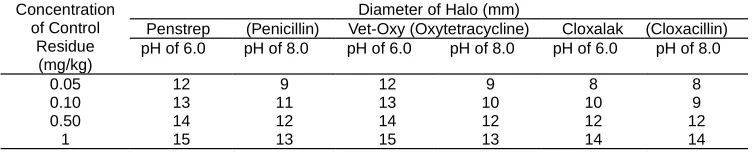
Frontier Post Test result on Table 3 showed that diameter of halo on the first day was 14-26 mm on the pH of 6.0 and 4-16 on the pH of 8.0. If we compared it with the control (Table 2) on acid conditions, all the samples had an antibiotic residue more than 1 mg/kg except B samples with diameter of halo of 14 mm. If the antibiotic that used were Penstrep, allegedly the antibiotic residue concentration was 0.5 mg/kg. But if the used antibiotic were Vet-Oxy or Cloxalak, allegedly the concentration of antibiotic residue was 1 mg/kg.
Meanwhile alkaline conditions test results showed that all the samples had an antibiotic residue less than 1 mg/kg except A samples with halo diameter of 16 mm. On the pH of 8.0, B
samples shown halo diameter of 4 mm which was Indonesian National Standard qualified. The average of halo diameter on the first day was 19.60 ± 4.62 mm on acid condition and 10.40 ± 4.34 mm on alkaline conditions.
The results on the second and third day had shown decreasing of antibiotic residue concentrations. On the second day, the average of halo diameter was decrease until 6-18 mm on acid condition and 3-13 mm on alkaline conditions. On acid conditions, the lowest halo diameter of 6 mm was shown by A and E samples and 7 mm of halo diameter were also shown by D samples. The result was indicating that the antibiotic residue concentrations on second day were less than 0.05 mg/kg and
-Lucrări Ştiinţifice - vol. 55, Seria Zootehnie
Indonesian National Standard qualified. As well as alkaline conditions tests, the result shown decrease in the second day and the lowest halo diameter of 3 mm (less than 0.05 mg/kg) was shown by B sample which was qualified for
Indonesian National Standard, while other samples were still varied on 8-13 mm (0.05-1 mg/kg). Given the results was still varied, milk on the second day should not be consumed.
.
Table 2. Control of antibiotic residue tests
Concentration of Control
Residue (mg/kg)
Diameter of Halo (mm)
Penstrep (Penicillin) Vet-Oxy (Oxytetracycline) Cloxalak (Cloxacillin) pH of 6.0 pH of 8.0 pH of 6.0 pH of 8.0 pH of 6.0 pH of 8.0
Table 3. The result of Frontier Post Test (FPT)
Samples Code
Diameter of Halo (mm)
Day 1 Day 2 Day 3
Third day result showed that diameter of the halo were decrease until 3-16 mm on acid conditions and 1-2 mm on alkaline conditions. On the pH of 6.0, all the samples except C samples gives halo diameter of 3-6 mm which mean the antibiotic residues concentrations were less than 0.05 mg/kg that Indonesians National Standard qualified. The C samples shown 16 mm diameter of halo that mean the antibiotic residues concentrations was more than 1 mg/kg. Different
with acid conditions, alkaline condition tests has shown a great decrease trend on the halo diameter until 1-2 mm. That mean, antibiotic residues concentrations of all samples were less than 0.05 mg/kg that Indonesians National Standard qualified. But if we combined the result between acid and alkaline conditions tests, it shown the milk that taken from cow with antibiotics treatment were not safe to consumed until 3 days.
CONCLUSIONS
Qualitative test of antibiotics residue with using Beta Star 25 showed that 5 from 18 samples (27.78%) were positives containing antibiotic residues and Frontier Post Test result shown the average of antibiotic residue concentration from day 1 until day 3 on the
pH of 6.0 was 19.60 4.62 mm; 9.80 5.22
mm and 7.00 5.20 mm, while on the pH of
8.0 was 10.40 4.34 mm; 9.00 3.81 mm
and 1.40 0.55 mm. The results shown that
milk from treated cows should not be consumed until more than three days.
ACKNOWLEDGEMENTS
The author would like to thank Gemilang Lara Utama, for his help in writing this paper.
REFERENCES
Alcaine, S. D., S. S. Sukhnanand, L. D. Warnick, W. L. Su, P. McGann, P. McDonough, and M. Wiedmann. 2005. Ceftiofur-Resistant Salmonella Strains Isolated from Dairy Farms Represent Multiple Widely Distributed Subtypes that Evolved
by Independent Horizontal Gene Transfer.
Antimicrob. Agents Chemother. 49:4061–4067.
Andrews, A. H. 2000. Calf Health. in The Health of Dairy Cattle. A. H. Andrews, ed. Blackwell Science, Oxford, UK. 1–14.
-Universitatea de Ştiinţe Agricole şi Medicină Veterinară Iaşi
Berge, A. C. B., E. R. Atwill, and W. M. Sischo. 2005. Animal and Farm Influences on the Dynamics of Antibiotic Resistance in Faecal
Escherichia Coli in Young Calves. Prev. Vet. Med.
69:25–38.
Dodd, F. H., and J. M. Booth. 2000. Mastitis and
Milk Production. in The Health of Dairy Cattle. A.
H. Andrews, ed. Blackwell Science, Oxford, UK. 213–255.
Mudiarti, T. B., 1997. Teknik Deteksi Residu
Antimikroba dalam Produk Peternakan, in
Seminar Nasional Peternakan dan Veteriner. 1997. Veterinary Research Center, Bogor .
Oka, H. 1995. Regulation and Current Residue Detection Methods of Antibiotics Used in the
European Union. Chemical Analysis for
Antibiotics Used in Agriculture. Edited by Oka, H.,
Nazakawa. H., Harada, K. and Macneil, J. D. AOAC International.
Sato, K., P. C. Bartlett, and M. A. Saaed. 2005. Antimicrobial Susceptibility of E. Coli Isolates from Dairy Farms Using Organic vs.
Conventional Methods. J. Am. Vet. Med. Assoc.
226:589–594.
Weaver, A. D. 2000. Lameness