* corresponding author: [email protected]
The risk factors of urinary tract infection
among elementary school students in
Sleman District, Yogyakarta Special
Region
Arya Agustino Purba1*, Pungky Ardhani2, Suryana Yudha Patria2, Tonny Sadjimin2
1Imanuel Hospital, Bandar Lampung, Lampung Province, 2Department of Pediatrics,
Dr. Sardjito General Hospital/Faculty of Medicine, Gadjah Mada University, Yogyakarta, Indonesia
ABSTRACT
Urinary tract infection (UTI) is the second commonest bacterial infection in Indonesian children after respiratory tract infection. In order to establish early diagnosis of UTI, it is important to recognize the risk factors of UTI in children. The aim of this study was to evaluate the association between circumcision, personal hygiene, environmental sanitation, nutritional status, parents’ educational level, socioeconomic status, constipation, and class attendance with incident of UTI and to determine its prevalence in elementary school students in Depok and Ngaglik Sub Districts, Sleman District, Yogyakarta Special Region. It was a case-control study using stratified random sampling. Controls were matched with case groups based on school grade and gender. An early screening of UTI using dipstick was conducted, and continued with urine culture to confirm microorganims infection. The association between the risk factors and the incident of UTI was evaluated using a questionnaire for the students or their parents. Prevalence of UTI in elementary school students in Sleman District was 9.96% with pathogenic microorganisms namely Klebsiella (44.1%),Echerichia coli (31.2%), and Pseudomonas (24.7%). Circumcision (OR=8.00; 95%CI=2.115-193.91; p=0.039) was statistically significant as protective factor of UTI. Furthermore, poor personal hygiene (aOR = 4.314; 95% CI = 2.202-8.451; p = 0.000) and poor environmental sanitation (aOR = 2.481; 95% CI = 1.264-4.872; p = 0.008) were the high risk factors of UTI, whereas lower socioeconomic status and lower educational level of the parents were not significant risk factors of UTI. Other factors i.e. poor/fair nutritional status, constipation and class attendance were not risk factors of UTI. In conclusion, the prevalence of UTI in elementary school students in Sleman District is 9.96%. Circumcision is a protective factor of UTI, whereas poor personal hygiene and poor environmental sanitation are proven as risk factors of UTI.
ABSTRAK
Infeksi saluran kemih (ISK) merupakan infeksi bakteri paling umum kedua pada anak di Indonesia setelah infeksi saluran pernapasan. Untuk menegakkan diagnosis dini ISK, penting untuk mengetahui faktor risiko ISK pada anak. Penelitian ini bertujuan untuk mengkaji hubungan antara sirkumsisi, kebersihan individu, sanitasi lingkungan, status gizi, tingkat pendidikan orang tua, tingkat status sosialekonomi, konstipasi, kehadiran di kelas dengan kejadian ISK dan menentukan prevalensinya pada pelajar sekolah dasar di Kecamatan Depok dan Sayegan, Kabupaten Sleman, Daerah Istimewa Yogyakarta. Penelitian ini merupakan penelitian potong lintang menggunakan
kejadian ISK dikaji dengan mengajukan daftar pertanyaan pada anak atau orang tuanya. Prevalensi ISK pada pelajar sekolah dasar di Kecamatan Depok dan Sayegan, Kabupaten Sleman adalah 9,96% dengan mikroorganisme patogen Klebsiella (44,1%), Echerichia coli (31,2%) dan Pseudomonas (24,7%). Sirkumsisi (OR=8,00; 95%CI=2,115-193,91; p=0,039) merupakan faktor pelindung nyata terjadinya ISK. Selain itu, kebersihan individu yang buruk (aOR = 4,314; 95% CI = 2,202-8,451; p = 0,000) dan kebersihan lingkungan yang buruk (aOR = 2,481; 95% CI = 1,264-4,872; p = 0,008) merupakan risiko tinggi terjadinya ISK. Sedangkan, derajad sosialekonomi dan pendidikan orang tua yang rendah bukan merupakan faktor risiko nyata terjadinya ISK. Faktor lain seperti status gizi buruk, konstipasi, kehadiran di kelas bukan merupakan faktor risiko terjadinya ISK. Dari hasil penelitian ini dapat disimpulkan, prevalensi ISK pada pelajar di sekoleh dasar di Kabupaten Sleman adalah 9,96%. Sirkumsisi merupakan faktor pelindung terjadinya ISK, sedangkan kebersihan individu dan lingkungan yang buruk terbukti merupakan faktor risiko terjadinya ISK.
Keywords: urinary tract infection - risk factors - protective factor - elementary school students - pathogenic microorganism
INTRODUCTION
Urinary tract infection (UTI) remains a health problem in developing countries including Indonesia. Urinary tract infection is one of the commonest bacterial infection in children, placing as the second most prevalent among infectious diseases after respiratory tract infection.1-3Urinary tract infection is commoner
in male neonates and younger babies compared to the female ones in the first 6-12 months of life. The male to female ratio in UTI varies with age, as it is found as 5:1 in babies and shifts to 1:10 after the second year of life or preschool and school children.4-6
The diagnosis of UTI remains a difficult task probably because its symptoms is non-specific particularly in younger patients. Moreover, the symptoms may be similar to other common diseases. This makes it easy to miss children with UTI.2,7 In babies, the common
symptoms are fever, agitation, dehydration, diarrhea, constipation, vomiting, or lethargy. In preschool children who are just learning to walk, common symptoms are fever, abdominal discomfort, anorexia, a change in urination pattern, and enuresis after toilet training. In school children and adolescents, the symptoms are similar with those in adults, namely
polakisuria, urgency, dysuria, pelvic dis-comfort, fever, hematuria, and suprapubic pain.8
Despite the signs and symptoms and physical examination findings, urinary examination is needed to confirm the diagnosis of UTI.
Urinary tract infection results from invasion of pathogenic microorganisms such as bacteria, viruses, or fungi to the urinary tract system through the urethra.9,10Gram negative enteric
bacteria are the most common etiologic microorganisms in UTI.Echerichia coli is the commonest microorganism isolated from 80% cases of uncomplicated UTI in children. Other microorganisms commonly found areProteus mirabilis, Klebsiella pneumonia, Pseudomo-nas aeruginosa, Enterobacteriaceae, Strepto-coccus viridans, andCandida albicans.6,9,10
Treatment of UTI is generally aimed to eradicate the infection, prevent and treat recurrent infection, as well as find and correct the anatomical abnormality. Children with symptomatic UTI have to be given antibiotics immediately. The choice of antibiotics is based on resistance pattern of pathogenic bacteria in the area.10Besides pharmacological
emptying urinary bladder thoroughly in each urination should be informed to the patients. Girls need to be taught how to clean perineum from the front to back direction.10,11
Risk factors for UTI in children include age, gender, abnormality in urinary tract structure, circumcision, personal hygiene, environmental sanitation related to socioeconomic status, parents’s education, and concomitant diseases.12-15Babies and younger children have
higher risk for UTI compared to older children due to higher risk to have renal damage. Prevalence of UTI in girls compared to boys varies with age. In neonates and babies up to 12 months, boys have higher risk from UTI compared to girls. However, in preschool and school children, a shift is observed where UTI is more commonly found in girls compared to boys.12Abnormality in urinary tract structure
including vesicoureteral, urinary statis, urinary tract stones, and trauma are other important risk factors for UTI.13 Circumcision is a protective
factor of UTI. Odds ratio of UTI in circumcized children compared to the uncircumcized children is 0.13. Uncircumcized children are susceptable to UTI due to bacterial colonization and attachment. Urethral meatus and periurethral area in uncircumcized children are more possible to contain uropathogenic organisms as indicated with higher bacterial count in this organ. Moreover, reputium also facilitates the bacterial attachment.14Personal hygiene,
environ-ental sanitation related to socio-economic status and parents’ education level may influence the incidence of UTI in children. However, the role of these risk factors is still
co ntrov ersi al .12,13,15 Some diseases such as
diabetes mellitus, malnutrition and immune system dysfunction decrease individual immunity leading to increased risk of UTI, whereas constipation in children is often related to UTI. The distended rectum would push the wall of urinary bladder and cause obstruction of the urinary orifice causing instability of detrusor muscle.16
This study was conducted to evaluate the risk factors of UTI among elementary school students in Sleman District, Yogyakarta Special Region. The findings of this study are important to help healthcare practitioners in this area in managing UTI in children.
MATERIALS AND METHODS
This was an observational study using a case-control study design conducted in several elementary schools in rural areas of Sleman District, Yogyakarta Special Region, in November-December 2008, simultaneous with school children immunization month (Bulan Imunisasi Anak Sekolah = BIAS). Target population was school children in rural areas of Sleman District, who were registered in the National Education Board (Dinas Pendidikan Nasional) Yogyakarta Special Region in the school year 2007-2008.
Subjects were school children in Depok and Ngaglik Sub Districts, Sleman District who fulfilled the inclusion and exclusion criteria. The inclusion criteria were students ofSekolah Dasar Negeri(Public Elementary School=PES) who were willing to participate in this study by signing the informed consent. The exclusion criteria were subjects who were not present at the time of the study and took antibiotics in the month before the study started.
Stratified random sampling based on clusters was conducted in this study.17 To
represent school children in each Sub District, PES in Puskesmas (Primary Health Centres/ PHCs) Depok-1 area and PHCs Ngaglik-1 area were randomized. Elementary schools were chosen based on BIAS program in PHCs Depok-1 and PHCs Ngaglik-Depok-1. Urine samples were taken with the cooperation of PHCs Depok-1 and PHCs Ngaglik-1. Stratification was conducted based on class.
case-control. Control was matched based on school grade and gender. Ninety one cases, and a minimum of 90 controls were enrolled in this study. The case group consisted of children who were diagnosed to have UTI based on urine culture, with bacterial count e”105, while the
control group consisted of children who were not proven to have UTI (dipstick result was negative or bacterial count <105).
The study subjects were urinary samples of elementary school students obtained as clean-catch midstream urine. Early screening was conducted through urinary examination using dipstick. Dipstick with positive urinary samples were then further examined using bacterial count and urine culture to confirm the incidence of UTI. The study was continued by evaluating the relation between variables of risk factors including uncircumcized boys, personal hygiene, environmental sanitation, nutritional status, educational level of the parents, socio-economic status, constipation, class attendance and the incidence of UTI by using a questionnai-re for the students or their paquestionnai-rents. The questionnaire had been tested previously for its reliability with test-retest method using r-product moment formula.18
Children diagnosed with UTI were then given antibiotic of choices for UTI (sulfa-methoxazole trimethoprim). After 7 days of treatment, urinary examination with dipstick was performed again. If the clinical features and urinary examination result were in the normal range, the children were considered as cured.
If clinical features and urinary examination result showed signs of UTI, urine culture was reperformed and treatment was adjusted according to antibiotic sensitivity. Besides pharmacological intervention, education was also given to the children and their parents or baby sitters.
Data obtained from case and control groups were compared and analyzed by Chi square and nonparametric test (Mann-Whitney test) using SPSS software, with p value <0.05 considered as significant. The study has been approved by the Health Research Ethics Committee of the Faculty of Medicine, Universitas Gadjah Mada, Yogyakarta. All parents were given clear explanations regarding the methodology of the research. The children were included in the study if their parents agreed and signed the inform consent.
RESULTS
TABLE 1. Characteristics of subjects based on PES in Depok and Ngaglik Sub Districts
Characteristics of subjects based on school grade and gender of students of PES in Depok and Ngaglik Sub Districts, Sleman District are presented in TABLE 2. The prevalence of UTI based on the school grade and gender varied, but not significantly different. The highest prevalence of UTI was observed in students in
the 1stgrade (11.4%), followed by students in
2ndgrade (10.4%), 3rdgrade (10.37%), 6thgrade
(8.82%), 4th grade (8.63%), and the lowest
prevalence of UTI was observed in students in 5th grade (5.98%). The prevalenve of UTI in
male students (8.55%) was lower than in female students (11.54%).
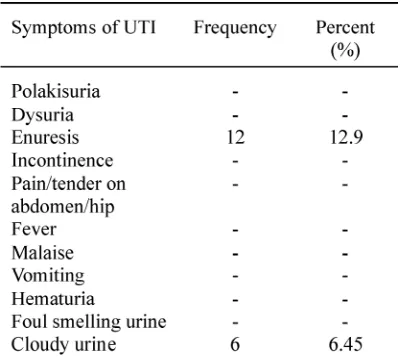
Signs and symptoms of UTI observed on students of PES in Depok and Ngaglik Sub Districts, Sleman District are presented in TABLE 3. Most of students (80.6%) with UTI in PES in Sleman District were asymptomatic. Among 93 students with UTI, there were only 18 students (19.4%) who had symptoms of UTI consisting enuresis 12.9% (12 students) and cloudy urine 6.5% (6 students).
TABLE 3. The common presenting signs and
symptoms of UTI on students of PES in Depok and Ngaglik Sub Districts, Sleman District
Risk factors of UTI in the students of PES in Depok and Ngaglik Sub Districts, Sleman District are presented in TABLE 5. All risk factors observed in this study were found to be associated with UTI in the students enrolled in this study. Circumcision (OR=8; p=0.39) was statistically significant as protective factor of UTI in the students, whereas socioeconomic status (OR=3.3; p=0.001), educational level of parents (OR=2.83; p=0.035), personal hygiene (OR=3.43; p=0.000) and environmental sanitation (OR:3.163; p=0.000) were found to be associated with UTI in the students.
Further analysis using logistic regression and multivariate analysis was performed to evaluate risk factors of UTI among the students of PES in Depok and Ngaglik Sub Districts, Sleman District. The results of analysis are presented in TABLE 6. The results showed that poor personal hygiene was the highest risk factor of UTI in students of PES in Depok and Ngaglik Sub Districts, Sleman District (aOR = 4.314; 95% CI = 2.202-8.451; p = 0.000) followed by poor environmental sanitation (aOR = 2.481; 95% CI = 1.264-4.872; p = 0.008). Meanwhile, lower socioeconomic status (aOR = 1.901; 95% CI = 0.933-3.873; p = 0.077) and lower educational level of the parents (aOR = 1.276; 95% CI = 0.542-3.002; p = 0.577) were not significant as risk factors of UTI of the students.
The microorganisms cultured from the urine of the students of PES in Depok and Ngaglik Sub Districts, Sleman District are presented in TABLE 4. The commonest microorganims cultured in this study was Klebsiella (44.1%) followed byE. coli(31.2%) and Pseudomonas (24.7%).
TABLE 5. Risk factors of UTI in the students of PES in Depok and Ngaglik Sub Districts, Sleman District
DISCUSSION
The prevalence of UTI obtained in this study was 9.96% varying from 5.08% to 11.4% depending on the school grade of the students. The highest prevalence of UTI was observed in students in the 1st grade (11.4%), whereas
the lowest prevalence of UTI was observed in students in 5thgrade (5.98%). The result of this
study is almost similar with the result obtained from other study conducted by Rochmanadji and Kosnadi19in students of an elementary school
in Semarang, Central Java. It was reported that the prevalence of UTI was 10.1% with the highest prevalence was 16.0% and the lowest prevalence was 7.0%.19A study conducted in
Tuntungan District, North Sumatra reported that
the prevalence of UTI in student of elementary school was lower i.e. 8.0%.20
The prevalence of UTI in girls of the elementary school (11.54%) was higher than in boys (8.55%) in this study, although it was not significantly different. This result is similar with the result reported by Lumbanbatu et al.20 in
which the prevalence of UTI in girls (7.0%) was higher than in boys (1.0%) in school children in Tuntungan District, North Sumatra. It has been reported in many studies that the prevalence of UTI in girls compared to boys varies depending on age. In neonates and babies up to 12 months, prevalence of UTI in boys was higher compared to girls. However, in preschool and school children, the prevalence of UTI shifts, where UTI is more commonly found in girls TABLE 6. Multivariate analysis of risk factors of UTI among the students of
compared to boys.12The higher prevalence of
UTI in girls compared to boys is related to the anatomy of female urinary tract system. The girls have shorter urethras than boys which makes it easy to get bacterial invasion from perineoim to urinary bladder. In addition, microorganism may also be introduced into a girl’s bladder by wiping from back to front after a bowel movement, which can contaminate the urethral opening. It may also increase the risk of getting a UTI.6
Most of students (80.6%) with UTI in this study were asymptomatic. Among 93 students with UTI, there were only 18 students (19.4%) who had symptoms of UTI. Asymptomatic UTI is the presence of bacteria in urine in the absence of clinical signs or symptoms of UTI in the host. The microbiologic definition is usually e”105
colony-forming units per mL of the same microorganism or microorganims in two consecutive urine specimens.21The frequency
of asymptomatic UTI in children varies for different populations. However, asymptomatic UTI is commoner than symptomatic UTI in children.22,23
The predominant presenting signs and symptoms of UTI on students reported in this study were enuresis 12.9% (12 students) and cloudy urine 6.5% (6 students). Different from other studies, fever was the predominat presenting symptom of UTI in children.7,20Other common
symptoms include vomiting, diarrhea, abdominal pains, dyuria, urgency, urinary frequency and costovertebral angle tenderness.7,20,22
There were no other signs or symptoms observed in this study as reported in previous study because the students were selected from the community or their schools. Students who have more severe signs or symptoms would be brought by their parents to the doctor or other health service providers.
The commonest microorganism cultured in this study was Klebsiella(44.1%%) followed
byE. coli(31.2%) and Pseudomonas (24.7%). It was similar to other study conducted by Muoneke et al.7 in Abakaliki, Nigeria who
reported that Klebsiella (24.5%) was the commonest microorganism followed by S. aureus (21.8%). However, many other studies reported that E. coli was the most frequent microorganism isolated from children with UTI.19-23 The difference of pathogensis of
microorganism of UTI in this study compared to other previous study may be influenced by the bacterial pattern in the areas. It was reported that epidemiology and bacterial pathogens in children with UTI showed large inter-regional and rates of bacterial resistance variability.24
Some factors have been reported to be associated with UTI in children namely age, gender, abnornality in urinary tract structure, circumcision, personal hygiene and environ-mental sanitation related to socioeconomic status, parents’s education, and concomitant diseases.12-15It was reported in this study that
Other factors i.e. poor/fair nutritional status, constipation, and class attendance were reported not to be risk factors of UTI in this study. Nutritional status could not be assessed, because all children in case and control groups had good nutritional status. Constipation could not be evaluated because children with constipation in case and control groups were not observed. Class attendance also could not be analyzed because there were no children who had high class absence.
A study of risk factors of a disease using a case control design has a limitation concerning the occurence of recall bias. Data of risk factor exposure in the subjects were obtained by relying on the memory of the children and their parents. The occurrence of recall bias may be caused by subjects’ failure of remembering, as subjects who had UTI tended to remember the exposure of risk factor compared with subjects who did not have UTI.17To minimalize the
occurrence of recall bias in this study, the answers to the questionnaire items had been cross-checked between the children and their parents.
CONCLUSION
It can be concluded that the prevalence of UTI in elementary school students in Ngaglik Sub District and Depok Sub District, Sleman District is 9.96%. Furthermore, circumcision is a protective factor of UTI, whereas poor personal hygiene and poor environmental sanitation are proven as risk factors of UTI.
ACKNOWLEDGEMENTS
The authors would like to thank Head of the Department of Pediatrics, Dr. Sardjito General Hospital/Faculty of Medicine, Universitas Gadjah Mada, Yogyakarta and Head of the National Education Board, Sleman District for their permission to conduct this
study. Moreover, we would also like to thank teachers from elementary schools in rural of Sleman District for their valuable assistance during the gathering of data in this field, as well as all students and their parents who have participated in this study.
REFERENCES
1. Rusdidjas, Ramayati R. Infeksi Saluran Kemih, Dalam: Alatas H, Tambunan T, Trihono PP, eds, Nefrologi anak, jilid 1. Jakarta: Badan Penerbit Fakultas Kedokteran Universitas Indonesia 1993: 109-31.
2. Damanik MP, Soenarto, Ismangoen H. Tinjauan kasus-kasus infeksi saluran kemih pada anak di UPA RSUP Dr. Sardjito, KONIKA VI; Denpasar: IDAI, 1984.
3. Adedoyin OT, Oyeyemi BO, Aiyedehin OV. Screening of febrile children on hospital admission for urinary tract infections (UTI). Afr J Clin Exp Microbiol 2003; 4:1–2.
4. Barnett BJ, Stephens DS. Urinary tract infection: an overview. Am J Med Sci 1997;314(4): 245-9.
5. Lipsky BA. Urinary tract infection in men: Epidemiology, pathophysiology, diagnosis, and treatment. Ann Intern Med 1989 (2);110:138-50.
6. Rushton HG. Urinary tract infections in children: epidemiology, evaluation, and management. Pediatr Clin North Am 1997; 44(5): 1133-69.
7. Muoneke VU, Ibekwe MU, Ibekwe RC. Childhood urinary tract infection in Abakaliki: etiological organisms and antibiotic sensitivity pattern. Ann Med Health Sci 2012; 2(1):29-32.
8. Gearhart JP, Herzberg GZ, Jeffs, RD. Childhood urolithiasis: experiences and advances. Pediatrics 1991; 87(4):445-50.
9. Elder JS. Urinary tract infections. In: Kliegman RM, Behrman RE, Jenson HB, Stanton BF editors. Nelson textbook of pediatrics, 18th
ed. Philadelphia: Saunders, 2007: 2223-8.
10. Hansson S and Jodal U. Urinary tract infection In: Avner ED, Harman WE, Niavdet P editors. Pediatric nephrology, 5th
11. Hooton TM. Clinical practice. Uncomplicated urinary tract infection. N. Engl J Med 2012; 366(11): 1028-37.
12. Schaeffer AJ. Infeksi saluran kemih: sistitis dan pielonefritis. Dalam: Samik AW, penerjemah dari Schulman ST, Phair JP, Sommers HM, editor. Dasar biologi dan klinis penyakit infeksi, edisi 4. Yogyakarta: Gadjah Mada University Press, 1995: 244-59.
13. Rink CR, Adams MC, Mitchell ME. Ureteral abnormalities. In Aschraft KW, editor. Pediatric urology. Philadelphia: WB Saunders Co 1990; 125-50.
14. Singh-Grewal D, Macdessi J, Craig J. Circumcision for the prevention of urinary tract infection in boys: a systematic review of randomised trials and observational studies. Arch Dis Child 2005; 90(8): 853-8.
15. Hoi LV, Sarol Jr JN, Uriarte RD, Tadoy SA. The association between selected hygiene behavior and urinary tract infection (UTI) in children. SEA J Tropical Med Pub Health 2000; 31(Suppl 1):162-6.
16. Loening-Baucke V. Urinary incontinence, urinary tract infections and their resolution with treatment of chronic constipation of childhood. Pediatrics 1997; 100 (2 pt 1):228-32.
17. Sastroasmoro S, Ismael S. Dasar-dasar metodo-logi penelitian klinis. Edisi 3, Jakarta: CV Sagung Seto, 2008.
18. Machfoedz I. Teknik membuat alat ukur penelitian bidang kesehatan, kedokteran, keperawatan, dan kebidanan. Yogyakarta: Fitramaya, 2008.
19. Rochmanadji W dan Lydia K. Bakteriuria asimptomatik pada siswi Sekolah Dasar kelas I-VI di Mijen. [Laporan Penelitian]. Semarang: Universitas Diponegoro, 1989.
20. Lumbanbatu SM, Rusdidjas, Ramayati R, Tobing R. Bakteriuria asimtomatik pada anak Sekolah Dasar laki-laki dan perempuan usia 9-12 tahun. Sari Pediatri 2001; 3(2): 67 – 71.
21. Rubin RH, Shapiro ED, Andriole VT, Davis RJ, Stamm WE. Evaluation of new anti-infective drugs for the treatment of urinary tract infection. Clin Infect Dis 1992; 15(suppl 1):S216–27.
22. Chang SL, Shortliffe LD. Pediatric urinary tract infections. Pediatr Clin N Am 2006; 53(3): 379– 400.
23. Cheng CH, Tsai MH, Huang YC, Su LH, Tsau YK, Lin CJ, et al. Antibiotic resistance patterns of community-acquired urinary tract infections in children with vesicoureteral reflux receiving prophylactic antibiotic therapy. Pediatrics 2008; 122(6):1212-7.