Designer: Charles Rice Editing: Eric Rountree. Cover Art: Jeremy Simmons Interior Art: Chris Martinez Layout: Chris Davis
Creative Director: Chris Davis
Playtesting and Editing: Carrie Baize, Charles Baize, Corey Hodges, Ryan Kelly, Edward Lennon, Paula Rice, Josh Roehm
Requires the use of a Roleplaying Game Core Book published by Wizards of the Coast, Inc.
The ‘d20 System’ and the ‘d20 System’ logo are Trademarks owned by Wizards of the Coast and are used according to the terms of the d20 System License version 1.0a. A copy of this License can be found at www.wizards.com. Portions of this work are derived from the d20 System Reference Document.
Visit our Website:
www.RPGObjects.com
Table of Contents
Introduction
2
Classes
3
Bad-Ass Barroom Brawler
3
Contemplative Master
4
Martial Arts Master
6
Skills
8
Feats
9
General Feats
9
Martial Arts Styles
10
Martial Arts Maneuvers
21
Signature Maneuvers
27
Ki Feats
33
Martial Arts Mastery
35
Mastery Definitions
40
Martial Arts Weapons
42
The Hanmei
50
Epilogue
56
Appendix 1: Feats
58
Open Game License
61
d20 Modern(tm) is a trademark of Wizards of the Coast, Inc., a subsidiary of Hasbro, Inc., and is used with permission. Dungeons & Dragons(R) and Wizards of the Coast(R) are registered trademarks of Wizards of the Coast, Inc., a subsidiary of Hasbro, Inc., and are used with permission.
Blood and Fists
by Charles Rice
2
“Look, sweetness, you want no part of this. This isn’t daddy’s dojo in Fresno. Got it?”
Brianna brought her knees up to her chest one at a time, then, while each knee was still against her chest that leg went straight up into the air. Both feet on the ground, she doubled over backward, placing her hands flat on the ground. After holding this position for a few seconds, during which time her back popped—out of shape, too much time over a typewriter at the paper—she brought her legs up, held the handstand for a few seconds, then went over the rest of the way. She moved her head from side to side, momentarily resting an ear on each shoulder—and causing her neck to pop both times—then tied her long chestnut hair back into a ponytail and stepped out of her shoes.
The men were no longer laughing.
“Look, is this a date, or what? I made all the right ‘contributions’ to the old folks’ home. I thought you boys liked to party.”
The men formed a circle around her.
One stepped forward, his sadistic grin showing the teeth he had lost in previous streetfighting. “All right, Cutie. I promise to be gentle.”
Brianna smiled. “That doesn’t work for me, sugar.” The punk never saw the snap-kick—or the circle kick that robbed his smile of another tooth—but he managed to throw himself out of the way of the jump kick that would have snapped his head back into oblivion. The men surrounding them starting screaming as if on cue, with the men in the back—the hard-looking Japanese men with the bulges in their jackets, the men she was actually here to meet—taking bets.
“What the fuck was that?!?”
Brianna smiled again, her sweet southern drawl mocking the man on the ground. “That’s Hapkido, darlin’. Did you miss the lecture on Korean history at the museum last week?” She moved in a slow circle around him, keeping her eyes on the throng surrounding her to make sure no one wanted to join the “party.”
The man sprang to his feet, spitting out a mouthful of blood, which caught one of the spectators right in the face. The man growled and surged forward, but a voice in the back hissed something, and he froze in his tracks.
Good. This might be the Hanmei after all. Five hours later, back in her hotel room, Brianna slipped into a long-overdue hot bath, working out strain in muscles long left unused. Before surrendering altogether to the hot water, she picked up her cell phone and hit the speed dial. “Constitution. Do you know the extension of the party you’re trying to reach?”
Brianna’s mind was already fogging over, but she managed to mumble “868.”
“Hello, this is Foreign Affairs Editor Jim Philby. I’m not at my desk right now, but leave me a message, and I’ll return your call as soon as time permits.”
“Jim. Bri. I’m in.”
Hanging up the phone, Brianna sank down into the tub, letting the water cover her completely.
The d20 Modern Roleplaying Game handles martial arts well enough for games that focus on gunplay, driving, criminal shenanigans, getting your brain eaten by zombies, and all that other fun stuff, but in these games, combat with weapons is a preference, and a skill in unarmed combat is developed as a fallback position in case you are disarmed. Many people, however, enjoy watching movies with Bruce Lee, Jackie Chan, Jean-Claude van Damme, and others that feature a decided focus on unarmed combat. Blood and Fists allows you to bring these kinds of combat situations into your d20 Modern game. In addition to two-fisted, two-footed action scenes, Blood and Fists also gives you new rules for the more mystical side of the martial arts, abilities like Ki and Zen.
Blood and Fists begins with three advanced classes to round out the selection offered in the d20 Modern Roleplaying. Two of these, the Martial Arts Master and the Contemplative Master, are offered as alternatives to the d20 Modern Martial Artist advanced class. Following these classes, a section with three new skills, plus one or two new uses for existing skills, is offered.
Next is the heart of Blood and Fists: the new feats. Blood and Fists presents over one-hundred new feats to augment the martial arts rules presented in the d20 Modern Roleplaying Game. These feats are broken down into several categories, including: Martial Arts Styles, representing over thirty real styles to replace the generic martial arts feats in the d20 Modern Roleplaying Game; Martial Arts Maneuvers, representing the specialized and advanced moves learned by the dedicated martial artist; Signature Maneuvers, representing the exotic moves and stances found in some styles; and lastly, the Power of Ki, which brings Ki into the game as a new form of FX.
The next section presents new weapons and weapon rules from nations around the world, broken down culturally and geographically.
Following this, Blood and Fists presents a section on the Martial Arts Campaign, which presents Martial Arts Campaign Themes. A Theme is somewhat like the Campaign Models presented in the d20 Modern Roleplaying Game, except that Themes may come and go through the course of the campaign.
2
Blood AND fists
Chapter 1:
Classes
3
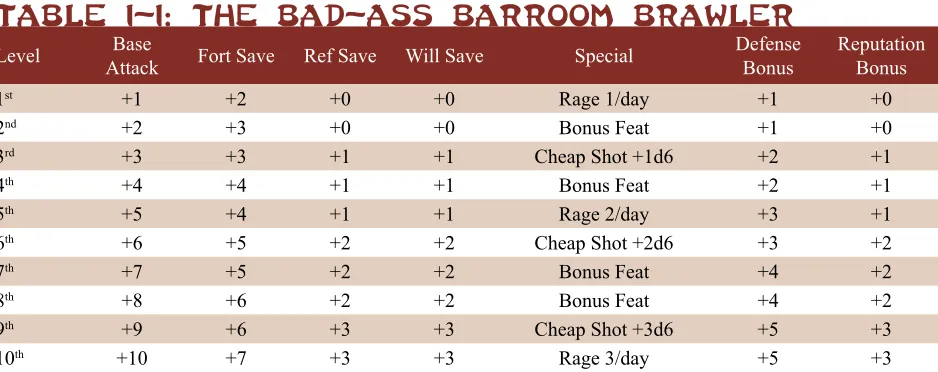
Table 1-1: The Bad-Ass Barroom Brawler
Level AttackBase Fort Save Ref Save Will Save Special Defense Bonus ReputationBonus
1st +1 +2 +0 +0 Rage 1/day +1 +0
2nd +2 +3 +0 +0 Bonus Feat +1 +0
3rd +3 +3 +1 +1 Cheap Shot +1d6 +2 +1
4th +4 +4 +1 +1 Bonus Feat +2 +1
5th +5 +4 +1 +1 Rage 2/day +3 +1
6th +6 +5 +2 +2 Cheap Shot +2d6 +3 +2
7th +7 +5 +2 +2 Bonus Feat +4 +2
8th +8 +6 +2 +2 Bonus Feat +4 +2
9th +9 +6 +3 +3 Cheap Shot +3d6 +5 +3
10th +10 +7 +3 +3 Rage 3/day +5 +3
Chapter 1:
Classes
This section presents three new advanced classes for d20 Modern games. The Bad-Ass Barroom Brawler is a wild, undisciplined fighter who relies on anger, brute strength, and dirty tricks to win his battles. The Contemplative Master explores the mystical side of the martial arts, learning the subtle yet powerful mysteries of Ki and pressure points. The Martial Arts Master is the living embodiment of his style, learning its maneuvers and mastering them to a degree few characters can match.
Bad-Ass Barroom
Brawler
Max watched the two fighting men, then turned away in disgust. As he walked over to his beat-up truck, he glanced at the little Japanese twerps that ran these “qualifiers.” He could feel their eyes on him as he reached in through the passenger window and pulled out a beer. Grinning at the closest one, Max stared right into his eyes as he opened the bottle with his teeth.
“Mr. Riggs, that might not be the best idea. You only get one attempt to qualify.”
Max spit out the cap and took a long swig of his beer. “What, you think I need to be sober to beat those guys?”
Suddenly the crowd split open, and one of the two men was on the ground. The other, the big bald asshole with the Nazi tattoos all over his chest, was glaring at Max. “Don’t ever talk about me, hick.”
Max growled, the veins of his thick neck bulging as he surged forward. The Japanese handlers were yelling. Max smashed the huge man right across the face with the bottle, ignoring the spray of beer and blood that showered him as he grabbed the biker’s crotch with one hand and his goatee with the other, upending him and pile-driving him right into the pavement.
As the toughs who enforced the rules tried to drag him
away, Max kicked the downed biker with his steel toe. “You listening, you ignorant fuck?!? Good. Don’t ever call me a hick!”
Max spit on the man and walked back toward his truck. The head handler ran over. “No weapons! No Weapons! That one doesn’t count!”
Max laughed, then frowned, seeing that the biker had made him waste his last beer. Taking out his pack of unfiltereds, he watched as the other toughs tried, without success, to get the biker to stand.
He was about to light a smoke, but he suddenly changed his mind. He tossed the cigarette pack into the truck and barreled towards the action again, grabbing two of the onlookers and smashing their heads together. “All right then, who else’s sorry ass do I have to kick? Huh?”
One of the spectators had gone down, and Max drew back to kick him like he had the biker, when the handlers grabbed him again. “All right! All right! You win! You win!”
Max shrugged his shoulders, simultaneously dislodging the thugs.
“Whatever. Look, is there a secret handshake or something? I’m thirsty.”
One of the Japanese men, the one who spoke English, stepped forward and handed him a card. It had two numbers on it.
“What the hell is this, your phone number? I don’t want a date, Hop Sing.”
“It is a time and a flight number. The next stage of the Hanmei takes place in Hong Kong.
The Bad-Ass Barroom Brawler character is a baaaaaaaaad man. He’s the kind of guy who rides the subway at night because it’s soothing. He has usually not been formally trained in any fighting style, but not too many people are willing to tell him that.
Requirements
To qualify to become a Bad-Ass Barroom Brawler, a character must fulfill the following criteria.
4
Chapter 1:
Classes
Chapter 1:
Classes
5
Class Information
The following information pertains to the Bad-Ass Barroom Brawler advanced class.
Hit Die: 1d12.
Action Points: 6 plus one-half the character’s level, rounded down.
Class Skills: The Bad-Ass Barroom Brawler class skills are as follows: Bluff, Drive, Gamble, Gather Information, Intimidate, Knowledge (streetwise), Repair.
Skill Points per Level: 2 + Intelligence modifier.
Class Features
The following features pertain to the Bad-Ass Barroom Brawler advanced class.
Rage: Bad-Ass Barroom Brawler temporarily gains +4 to Strength, +4 to Constitution, and a +2 morale bonus on Will saves, but suffers a –2 penalty to AC.
The Constitution bonus increases the Bad-Ass Barroom Brawler’s hit points by 2 points per level, but these hit points go away at the end of the rage, at which time the Constitution score drops back to normal. While raging, a Bad-Ass Barroom Brawler cannot use skills or abilities that require patience and concentration (the only class skill he can use while raging is Intimidate).
A fit of rage lasts for a number of rounds equal to 3 plus the character’s (newly improved) Constitution modifier, but the Bad-Ass Barroom Brawler may voluntarily end the rage before that time has elapsed. At the end of the rage, the Bad-Ass Barroom Brawler is fatigued (–2 to Strength, –2 to Dexterity, can’t charge
or run) for the duration of that encounter. The Bad-Ass Barroom Brawler can only fly into a rage once per encounter, and only a certain number of times per day (determined by level). Entering a rage takes no time itself, but the Bad-Ass Barroom Brawler can only do it during his action.
Bonus Feat: The Bad-Ass Barroom Brawler gains a bonus feat at 2nd, 4th, 7th, and 8th level. The feat must
be selected from the following list, and the character must meet the feat’s prerequisites to select it : Box Ears, Cleave, Elbow Slam, Endurance, Frightful Presence, Great Fortitude, Haymaker, Head Butt, Improved Brawl, Improved Bull Rush, Improved Damage Threshold, Improvised Weapon Proficiency, Kidney Punch, Power Attack, Simple Weapon Proficiency, Toughness.
Cheap Shot: Once per combat, the Bad-Ass Barroom Brawler can do something really nasty, dirty, underhanded, and generally in violation of barroom combat etiquette. If the attack hits, the Brawler inflicts the listed amount of bonus damage. Hit or miss, the Brawler’s opponent is on his guard for the rest of the fight and will no longer be vulnerable to the attack. This attack will not work on targets that are not subject to critical hits or have no discernable anatomy.
Contemplative
Master
The spectators whispered, wondering what the two men were saying. Usually these little affairs were fun, like something out of a movie. Instead, the old man was talking to the handlers in Japanese, and—unusual for them—they appeared to be showing him a great deal of deference. Finally, however, the head handler, with apparent reluctance, shook his head in a firm “No.”
The ring of onlookers rippled and parted as a young man in Air Force fatigues pushed through. “Look, old man,” he said in disgust, “some of us have business to attend to here, you know?”
The old man turned, looking up at the much larger American. “I am not here to fight. I am looking for my daughter. I heard she was here.”
The young soldier coughed, grinning. “I know a lot of Japanese girls. Maybe I know her.”
The old man turned his back on the soldier, again speaking to the handlers in low tones, their Japanese unintelligible. The men again began shaking their heads, almost sadly.
“Hey, old man, don’t turn your back on me.” The soldier grabbed the old man by the shoulder, intending to spin him around, but the old man reached up and grabbed his hand, in the center, with only two fingers. Suddenly the soldier was on his knees, writhing in agony. The old man twisted his arm behind his back, placed one foot on it, and casually pinned the large man to the ground. Penetrating gray eyes raked the crowd as the first hint of impatience entered the old man’s voice.
4
Chapter 1:
Classes
Chapter 1:
Classes
5
This is not the place for her.”
The handler stepped forward, handing the old man a card. “This is where your daughter is, Sensei.”
The old man took his foot off the soldier’s arm. The soldier gasped, trying to move it, but it just hung limp, numb, and useless from his shoulder.
Katsumoto fixed the handler with his gaze, and his voice was steel. “You gave one of these to my daughter.”
The young handler nodded, unable to speak. The old man turned and walked away.
The Contemplative Master has devoted his life to the mastery of the physical and mental discipline of one style of the martial arts. However, this character also seeks to master the inner spirit, or Ki.
Requirements
To qualify to become a Contemplative Master, a character must fulfill the following criteria.
Base Attack Bonus: +2. Skill: Meditation 3 Ranks.
Feats: Combat Martial Arts or Defensive Martial Arts, plus any one Style feat
Class Information
The following information pertains to the Contemplative Master advanced class.
Hit Die: 1d6.
Action Points: 6 plus one-half the character’s level, rounded down.
Class Skills: The Contemplative Master class skills are as follows: Bluff, Climb, Concentration, Diplomacy, Intimidate, Jump, Knowledge (current events, history, popular culture, tactics, theology, philosophy), Listen, Meditation, Pressure Points, Sense Motive, Swim, Zen Mastery (Note that most styles will grant the character additional class skills beyond these).
Skill Points per Level: 5 + Intelligence modifier.
Class Features
The following features pertain to the Contemplative Master advanced class.
Table 1-2: The Contemplative Master
Level AttackBase SaveFort SaveRef SaveWill Special Defense Bonus Reputation Bonus
1st +0 +0 +2 +2 Mastery +1 +0
2nd +1 +0 +3 +3 Bonus Feat +2 +0
3rd +2 +1 +3 +3 Mastery +2 +1
4th +3 +1 +4 +4 Bonus Feat +3 +1
5th +3 +1 +4 +4 Mastery (Level 2) +4 +1
6th +4 +2 +5 +5 Bonus Feat +4 +2
7th +5 +2 +5 +5 Mastery +5 +2
8th +6 +2 +6 +6 Bonus Feat +6 +2
9th +6 +3 +6 +6 Mastery (Level 3) +6 +3
10th +7 +3 +7 +7 Bonus Feat +7 +3
Mastery: At 1st, 3rd, 5th, 7th, and 9th levels, the
Contemplative Master may choose a Mastery ability either from his Style list or from the Contemplative list. Level 2 Masteries may only be learned by characters of 5th level and above. Level 3 Masteries may only be
learned by characters of 9th Level.
Bonus Feats: At 2nd, 4th, 6th, 8th, and 10th levels, the
6
Chapter 1:
Classes
Chapter 1:
Classes
7
Martial Arts
Master
“New Contest.”
Kimmy stepped into the center of the ring, ignoring the snickers. Stretching, she watched her opponent shrug off his jacket to go bare-chested in the cool night air. He squatted low several times, swinging his arms back and forth, military tattoos rippling on his wiry frame. He was watching her, too, his eyes never wandering from her, and his gaze made the hairs on the back of Kimmy’s neck stand up.
Stop being a Daddy’s girl.
She walked over to the man, extending her hand. “Kimmy.”
He just nodded at her proffered hand, still not taking his eyes off her. “Marcel Bontecou.” His French accent was so think she could barely understand him. It was almost funny, in a way, like something you’d hear in a bad movie.
Then he stood up, smiling at her. She was barely five feet, and he wasn’t much bigger. He was bald with bushy eyebrows and some sort of scar on his chin.
“Begin.”
Suddenly the smile was gone. The man began bouncing on his toes, dancing around her. He looked wired. Manic. Suddenly, his leg snaked out. Kimmy darted back with the agility of a cat, but he still grazed her.
Right on the inside of her knee.
The pain exploded through her leg, and the wind was sucked out of her lungs. She made the mistake of giving into her reflex and reaching down for her leg, balancing on one foot.
Marcel dropped down like a dancer, planting his hands on the ground and swinging both legs around to knock Kimmy’s one good leg out from under her. Before she even hit the ground, he was up and dancing around her again, smiling as she tried in vain to locate him. He loved this. Kimmy could tell. He missed it, even. Too much, perhaps.
“Are you crying? So delicate. Like a butterfly. Marcel loves to hunt butterflies.”
Don’t cry. You cry too easily, Kimmy.
Kimmy could hear her father’s voice in her head. God, she hated that voice. She wanted to yell at him when he got like that. He’d wanted a son. She wished he could have admitted it, just once. But no. He had other ways of showing his disapproval.
A shadow. A glimpse out of the corner of her eye. Kimmy rolled, and the Frenchman’s foot landed beside her head. Right where her neck had been.
He’s going to kill me.
Kimmy moved on instinct. Stop looking for him. You can feel where he is, anyway.
A scuff of a sneaker. In her world, so contracted, the sound was like a car skidding on a rain-slick road. No crowd. Just her and the maniac. Her hand snaked out and caught a pant leg.
Kimmy pulled like her life depended on it. Another thud. This one much louder. Kimmy rolled away from it, onto her feet.
She went down again just as quickly, grimacing in pain as her knee gave out.
Marcel was up again immediately. “Butterfly has some spark, hmm?” He licked his lips at her failed attempt to get up again.
Can’t fly on a broken wing.
Kimmy saw him coming toward her again. Straight toward her. No dancing this time. She tested her ankle— the one he’d knocked from under her—as she crouched on the pavement. Still works.
She drove herself forward on one leg right into Marcel’s midsection. She felt the air rushing out of him, but he rolled with her movement, pitching her away as he went down.
She punched him in the groin as she hit the ground, and she heard him cry out in pain and surprise.
Reflexively, he kicked her, the point of his shoe hitting her right in the temple. The streetlights seemed to stretch and swirl. Why was Daddy practicing her so hard, anyway? She hated the dojo. Hated the history. Especially hated him.
Wait. Maybe this was her rape prevention class. That was it. Kick to the groin. What’s wrong with my leg? Eye gouge. Ridgehand to the throat.
6
Chapter 1:
Classes
Chapter 1:
Classes
7
The Martial Arts Master has devoted his life to mastery of the physical and mental disciplines of one style of martial arts. Characters who take this class will generally refer to themselves by their Style name (Aikido Master, Karate Master, etc.).
Requirements
To qualify to become a Martial Arts Master, a character must fulfill the following criteria.
Base Attack Bonus: +3. Skill: Concentration 3 Ranks.
Feats: Combat Martial Arts or Defensive Martial Arts or Brawling, plus any one Style feat.
Class Information
The following information pertains to the Martial Arts Master advanced class.
Hit Die: 1d8.
Action Points: 6 plus one-half the character’s level, rounded down.
Class Skills: The Martial Arts Master class skills are as follows: Bluff, Climb, Concentration, Intimidate, Jump, Knowledge (current events, history, popular culture, tactics, theology, philosophy), Listen,
Meditation, Sense Motive, Swim (Note that most styles will grant the character additional class skills beyond these).
Skill Points per Level: 4 + Intelligence modifier.
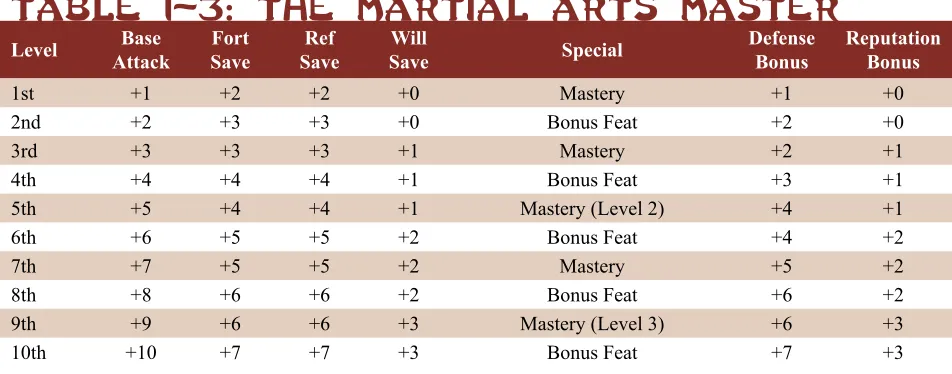
Table 1-3: The Martial Arts Master
Level AttackBase SaveFort SaveRef SaveWill Special Defense Bonus Reputation Bonus
1st +1 +2 +2 +0 Mastery +1 +0
2nd +2 +3 +3 +0 Bonus Feat +2 +0
3rd +3 +3 +3 +1 Mastery +2 +1
4th +4 +4 +4 +1 Bonus Feat +3 +1
5th +5 +4 +4 +1 Mastery (Level 2) +4 +1
6th +6 +5 +5 +2 Bonus Feat +4 +2
7th +7 +5 +5 +2 Mastery +5 +2
8th +8 +6 +6 +2 Bonus Feat +6 +2
9th +9 +6 +6 +3 Mastery (Level 3) +6 +3
10th +10 +7 +7 +3 Bonus Feat +7 +3
Class Features
The following features pertain to the Martial Arts Master advanced class
Mastery: At 1st, 3rd, 5th, 7th, and 9th levels, the character
gets to pick an ability from the Mastery list for the Martial Arts style he is mastering. See Martial Arts Mastery for more information on Mastery abilities. Level 2 Masteries may only be learned by characters of 5th
level and above. Level 3 Masteries may only be learned by characters of 9th Level.
Bonus Feats: At 2nd, 4th, 6th, 8th, and 10th levels, the
8
Chapter 2:
Skills
Chapter 3:
Feats
9
Chapter
2: Skills
Kimmy was staring at the ceiling. Suddenly, she surged up.
Where was she? How did she get here?
“Stay still. You have a concussion.” “Where…?”
“Shh! It’s a good thing I was there, young lady. The ‘etiquette’ of these street brawls is to call an ambulance and scatter. I am Ishinomori Katsumoto. What is your name, girl.”
“Kimmy. Did I… owwwwwww!”
“Do not move! And what kind of name is ‘Kimmy’?” “K-Kimiko, Sensei.” God, I hate Japanese men. “Now listen to me, Kimiko. The men consider your match to be a tie, but you should go home. No doubt there are people who are worried about you, and this episode should have acquainted you with the barbarism of…”
Kimmy smiled, slipping back into welcome oblivion. “I won…”
Katsumoto looked down at her, frowning. Where are you, Bri?
Balance (Dex)
Armor Penalty
New Use – Resist Trip Attacks: You can use Balance to avoid being tripped or thrown in the same fashion as characters in the d20 Modern Roleplaying Game can use Escape Artist to avoid being grappled. You make a Balance skill check, opposed by your attacker’s attack roll. Using Balance for this purpose is an attack action (but see the Immovable Stance feat for more information).
Meditation (Wis)
Trained Only
Check: By succeeding at a skill check (DC 15), you are able to enter a self-induced trance, almost a form of autohypnosis. This allows you to ignore fatigue or exhaustion for one hour, after which time you must either rest or check again. A successful skill check (DC 20) also allows you to reroll any failed Will save or Concentration skill check at +2.
Try Again?: For ignoring fatigue or exhaustion, you may try again in one hour. For rerolling a Will save or Concentration check, no.
Special: You can take 10 when making a Meditation check, but you can’t take 20. The amount of time it takes to enter a meditative state is one minute (10 rounds), minus one round for each Meditation rank you possess (1 round minimum at 10 or more Ranks).
Pressure Points
(Wis)
Trained Only
Check: A successful skill check (higher than the target’s Defense) will add +1d6 to the damage from any unarmed or melee weapon attack. This ability may be used once per combat, unless the target of the attack is flanked, in which case it may be used at will. This ability will only inflict extra damage on a target vulnerable to critical hits or with a discernable anatomy.
Try Again?: No.
Special: You can take 10 when making a Pressure Points skill check, but you cannot take 20. Making a Pressure Points check is a move-equivalent action. This skill also includes knowledge of acupuncture and acupressure techniques. Any character with 5 or more ranks in this skill gains a +2 Synergy bonus to Treat Injury checks.
Sense Motive
New Use – Predict Attack: This use of Sense Motive may not be used untrained. By reading your opponent’s body language, you can predict when and where an attack will strike and be better prepared to intercept or prevent it. On a successful skill check (you may choose either DC 10 plus your attacker’s BAB or skill vs. skill against your attacker’s Bluff) you gain a +2 to any Block or Disarm opposed check. If you have Improved Combat Throw, you may take a +2 bonus on an opposed Trip check through your attack of opportunity.
Zen Mastery (Wis)
Trained Only
Check: Zen Masters are renowned for their ability to fight effectively while blinded, and they often practice and perform exhibitions of combat while blindfolded. This skill reduces the miss chance in melee combat due to concealment by 2% for each skill rank. So, if you have 10 Ranks in Zen Mastery, you would only suffer a 30% miss chance while blinded.
8
Chapter 2:
Skills
Chapter 3:
Feats
9
Chapter
3: Feats
No one is going to believe this. They were in a Hong Kong warehouse for “Stage Two,” as the handlers had called it. Brianna watched the match in progress. Classical Shao-Lin Dragon against… ROSS? Krav Maga? It was hard to say. Definitely Special Forces, though.
Jim will think I took a vacation and made this up. She looked pensively at her gym bag. If anyone found out she was taping this, she wouldn’t have to wonder about being believed. These guys were serious. And she still wasn’t even sure who they were. Yakuza? Tong? Private businessmen just looking for a cheap thrill?
Again, it was hard to say. “Hello, sweet cheeks.”
Brianna froze. She knew that voice… Oh, hell. “What are you doing here, Max?”
“I’m here to fight, darlin’. The thrill of victory, the agony of defeat. That’s me.”
Brianna turned and looked up at him. God, I hate this redneck. Why did I ever…?
“Actually, it was your father’s idea. He asked me to help him find you. I figure once we get this little business settled, and you and me get married, I’ll call him ‘Dad’ too.”
“My father is…”
“No, he isn’t here. Okinawa. Seems like they got these little parties goin’ all over the place. Gives me and you a chance to get reacquainted, though.”
Max just laughed as she stomped away. She loves me.
This chapter presents new feats for the Martial Arts styles of the modern world. The information is broken down into the following sections: General Feats (those that didn’t fit anywhere else), Martial Arts Styles (the history, basic training, and philosophy of the various types of martial arts), Martial Arts Maneuvers (the specific attack and defense maneuvers of the practitioners of the different styles), Martial Arts Signature Moves (an optional set of feats for those who want a little more variety and color in their martial arts combat), and Ki Feats (optional feats for those who wish to bring the power of the Ki, or spirit, as FX into their campaigns).
General Feats
The feats in this section do not fit into any of the other categories presented in this chapter. Some of these feats represent a general knowledge of the martial arts. Some characters will study the strengths and weaknesses of a certain style in order to gain an advantage when fighting practitioners of that style. Other characters will immerse
themselves in the history and lore of the style they prefer, thereby gaining bonuses when using that style. In this section you will also find many new weapon feats, grouped by geographical region or specialized purpose.
Archaic Weapons -
Chinese
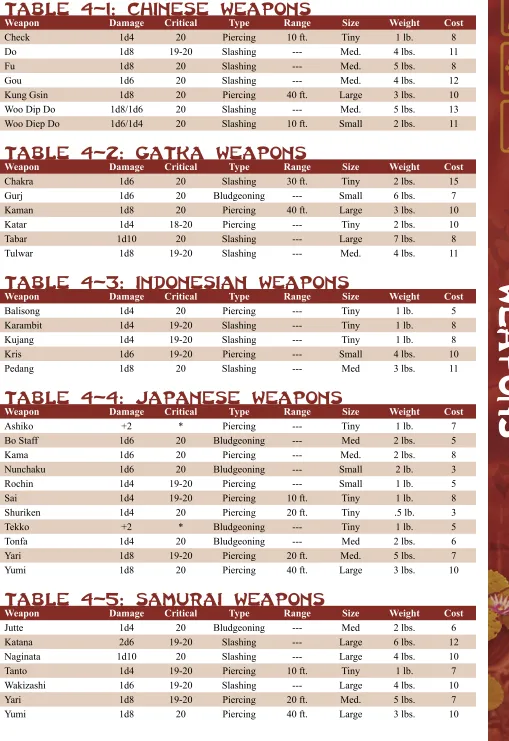
You are proficient with the weapons of medieval China. Effect: You are proficient with the following weapons: Check, Do, Fu, Gou, Kung Gsin, Woo Dip Do, Woo Diep Do.
Archaic Weapons -
Indian
You are proficient with the weapons of classical India. The Gatka fighting style of the Sikh warrior teaches the student to master all the weapons in this group.
Effect: You are proficient with the following weapons: Chakra, Gurj, Kaman, Katar, Tabar, and Tulwar.
Information on these weapons can be found in the Martial Arts Weapons chapter.
Archaic Weapons -
Indonesian
You are proficient with the weapons of classical Indonesia.
Effect: You are proficient with the following weapons: Balisong, Karambit, Kujang, Kris, Pedang.
Archaic Weapons -
Japanese
You are proficient with the “peasant” weapons of feudal Japan. Many martial arts styles incorporate weapon maneuvers: Kobujutsu, which teaches the student to master almost all the weapons below; Kyudo, which teaches mastery of the Yumi; and Sojitsu, which teaches mastery of the Yari.
Effect: You are proficient with the following weapons: Ashiko, Bo Staff, Kama, Nunchaku, Rochin, Sai, Shuriken, Tekko, Tonfa, Yari and Yumi. Information on these weapons can be found in the Martial Arts Weapons chapter.
Archaic Weapons -
Samurai
You are proficient with the “noble” weapons of feudal Japan. Kendo teaches the student to master the Katana, Kyudo the Yumi, Naginata-do the Naginata, and Sojitsu the Yari.
Effect: You are proficient with the following weapons: Jutte, Katana, Naginata, Tanto, Wakizashi, Yari, and Yumi.
10
Chapter 3:
Feats
Chapter 3:
Feats
11
Banter
You have mastered the art of “witty” (read: annoying) repartee in combat. This serves to both annoy and distract your opponents.
Prerequisite: Cha 13+, Bluff 5 ranks.
Effect: You gain a Competence bonus to your Defense against melee attacks equal to your Charisma modifier. Any circumstances which cause you to lose your Dexterity modifier to defense also causes you to lose this bonus.
Improvised Weapons
You are a walking disaster area. Anything you touch is likely to be used in a fight.
Prerequisite: Brawl.
Effect: You may use any improvised weapon with no penalty to hit. You must still learn how to use items designed as weapons in the normal way.
Kata
Kata is a ritualized practice technique for the martial arts, in which moves are practiced again and again until they become instinctive.
Prerequisite: One martial arts style.
Effect: You gain a +1 to hit with Maneuvers from one martial arts style.
Special: This feat may not be applied to adaptable or weapon martial arts styles (see Martial Arts Styles for more information).
Kata Lore
You have studied the history and philosophy of a martial arts style.
Prerequisite: Kata, Knowledge (history) 1 Rank, Knowledge (philosophy) 1 Rank.
Effect: You gain a +2 bonus to your style skills (the skills granted as class skills by the Style feat for your chosen martial arts style). You may only take this feat in a Style for which you have the Style Focus feat.
Special: This feat may not be applied to adaptable or weapon martial arts styles (see Martial Arts Styles for more information).
Kata Mastery
You are a greatly feared Master of one martial arts style. Prerequisite: Kata Specialist.
Effect: You gain a +1 bonus to the threat range of Maneuvers from one martial arts style. You may only take this feat in a style for which you have the Style Specialist feat.
Special: This feat may not be applied to adaptable or weapon martial arts styles (see Martial Arts Styles for more information).
Kata Specialist
You have spent hours practicing the Kata of a style, learning the intricacies of its movements.
Prerequisite: Kata.
Effect: You gain a +2 damage bonus with Maneuvers from one martial arts style. You may only take this feat in a Style for which you have the Style Focus feat.
Special: This feat may not be applied to adaptable or weapon martial arts styles (see Martial Arts Styles for more information).
Know Your Enemy
By studying a certain fighting style, you are better able to combat it.
Prerequisite: Knowledge (history) 2 Ranks, Knowledge (tactics) 2 Ranks.
Effect: When you take this feat, choose a specific martial arts style. When fighting a practitioner of that style, you gain a +2 Competence bonus to attack, damage, or defense. Only one of these categories gains the bonus, but it may be changed from round to round.
Knowledge is Power
Prerequisite: Know Your Enemy, BAB 9+
Effect: When you take this feat, you must apply it to the same Style as the Know Your Enemy feat used as the prerequisite. When a practitioner of that style attacks you and misses, you gain an Attack of Opportunity against him.
Poise
Your composure and indomitable will make you a formidable opponent.
Prerequisite: Wisdom 13+, Concentration 5 Ranks. Effect: You gain a Competence bonus to your Defense against melee attacks equal to your Wisdom modifier. Note that the bonuses from Banter and Poise do not stack, as they are both Competence bonuses.
Special: Poise cannot be learned by characters whose only martial arts style is a non-aesthetic style.
Martial
Arts
Styles
“Oto… Oto…”
Katsumoto frowned. The match ended suddenly, when “OtoOto,” actually Otomo Otojiro, a somewhat famous Sumo Wrestler as he recalled, grabbed his opponent and slammed him down onto the mat.
The chanting got even louder, and Oto ran a victory lap around the mat, even signing some autographs as the cheers washed over him.
“You disapprove, Sensei?”
Katsumoto stiffened. He recognized that voice. “I thought I told you to go home, Kimiko.”
10
Chapter 3:
Feats
Chapter 3:
Feats
11
should you?”
“I’ll bet he misses you quite a bit, little one. You seek to prove yourself to your father, prove that you are as much a warrior as any son he could have had. This is not the place for that. This is not the way of the warrior.”
Kimmy’s face was red as she pushed past him onto the mat. “You don’t know a thing about me, old man.”
Lucky guess.
Martial Arts Styles
The majority of the feats in this chapter are divided into two sub-groups, Styles and Maneuvers. Martial Arts Styles represent training in the basics, while Maneuvers represent the abilities of the advanced student. Before we go on to the feats themselves, a word is warranted about the way these styles were created, both to address any balance issues the GM may feel he finds below and to assist in the creation of new styles from the GM’s own experience and imagination.
The Balance of Styles
The first thing the GM will likely notice is that the feats below grant a much wider range of abilities than those in the d20 Modern Roleplaying Game. Although these rules are 100% compatible with the d20 Modern Roleplaying Game system, and most of the feats from that book are used in these rules, the d20 Modern rules set was not kind to the Martial Artist. This is not a weakness in the d20 Modern rules, just an assumed emphasis (and a realistic one) on guns as the top dog in the modern battlefield. The feats below grant characters more “bang for the buck,” precisely to allow martial arts to have the same place in d20 Modern games that it has in cinema where Martial Arts plays a big role. Which is to say, a wholly unrealistic one.
Creating New Styles
Style feats have many common elements, and an explanation of these elements will aid players and game masters in designing their own styles. Since there are tens of thousands of martial arts styles around the world, not all can be represented in this book, and characters should be encouraged to bring their favorite styles into the game.
Basic Moves
The first element discussed in any martial arts style is the set of moves taught to the beginning student. All martial arts damage can be lethal or non-lethal. Is the practitioner of the
style considered armed with punching, kicking, elbow, knee, or head attacks? Is the student proficient in all those attacks? Does the style allow the character to make Trip, Disarm, or Grapple attacks without provoking attacks of opportunity? The answers to these questions will determine how the student of a given style fights.
Style Skills
All Martial Arts styles grant a character new class skills. For any style that involves extensive throws, Balance and Tumble will be included among these skills. The first thing a student in these styles must learn is how to fall without injury, so that throws may be practiced safely. Many fighting styles concentrate on “psyching out” your opponent. Professional boxers and Samurai both spend time learning this, and styles that focus on such matters will grant Intimidation as a class skill. Styles that teach extensive feinting techniques will grant Bluff as a class skill. Some styles, such as those taught to Ninja and military commandos, will grant the character Hide and
Move Silently, as these styles follow the axiom “invisibility equals invincibility.” When
bringing new styles into the game, the GM will find that these skills are the most commonly granted, but whatever best represents the philosophy of the style, without harming game balance, is the best choice.
Attack Modifiers
One of the key differences between a trained martial artist and an untrained fighter
is the emphasis on qualities other than brute strength. One of the main reasons students take up the martial arts is to defend themselves
without resorting to brute strength alone. For this reason, most martial arts attacks are modified
by an ability other than Strength. If a style focuses on speed, Dexterity will modify attack rolls. If a style has extensive
philosophical underpinnings, as do many animal styles that focus on a connection with nature, then attacks will be modified by Wisdom. If a style focuses on deception (allowing you, for example, to make an opponent think you are weak and then strike when least
12
All of the styles below were created using a system, so that they could be balanced against one another. Presented here, to aid the GM in creating his own styles and balancing them with those presented below is the method that was used to create all the styles in this handbook. To begin, start with six “points,” then pick from each of the categories below until you are out of points.
Zones of Attack
Combat Martial Arts from the d20 Modern Roleplaying Game grants proficiency with “unarmed attacks.” This is defined as “striking for damage with punches, kicks, or head butts.”
In Blood and Fists, these distinctions are broken down further and clarified with the following categories, or “zones”: punching (which includes elbow and open hand strikes), kicking (which includes knee and heel strikes), and head butts. To represent combat beyond what can be accomplished through punching and kicking, these zones are further expanded to include Disarm, Trip, Grapple, and Feint attacks.
Each of the styles described below grants a character skill in one or more of these zones. If a character has no proficiency in that zone (because he entered the art through Defensive Martial Arts or Brawling), he is considered armed when making attacks in that zone, he provokes no attacks of opportunity for acting in that zone (for Grapple or Trip attacks), and he may use that zone as a move action rather than an attack action (for feinting). If a character is already proficient in a zone of attack taught by a Style he takes (usually because he used Combat Martial Arts, Improved Unarmed Strike, Improved Trip or Improved Feint as the prerequisite for the Style), then he gains a +1 Competence bonus when attacking in that zone. Remember that Competence bonuses (like most kinds of bonuses other than Dodge bonuses) do not stack, so a character can only receive a +1 bonus to hit no matter how many styles he takes that grant proficiency in a particular zone.
Each zone granted by a style costs the style one point.
Class Skills
The serious student of the Martial Arts has the chance to learn about much more than just punching and kicking, attacking and defending. In Kyudo, students are taught “one shot, one life.” This type of philosophical and spiritual training is as important to many students of the martial arts as the self-defense capabilities taught by the style.
When a student takes a martial arts style, he will add the style’s class skills to his permanent list of class skills. If a skill taught by the style is already a class skill, then the character receives a +1 competence bonus on checks using that skill.
Each class skill the style adds to the character’s list of class skills cost it one point.
External Styles
These styles are concerned with affecting the outer world, and tend to be more focused on combat. External styles have their attack rolls modified most often by Strength. However, some of these styles focus more on speed to generate attack power. These styles have their attacks modified by Dexterity. If a style’s attacks are modified by Dexterity, this costs the style one point. If the practitioner of the style has the ability to choose whether to focus on power or speed (choosing between Strength and Dexterity when the style is taken), this costs the style two points.
Internal Styles
These styles are concerned with the inner spirit of the student. Master yourself, and mastering the world will come easily, say the practitioners of internal martial arts. Internal styles have their attacks modified by Wisdom. This costs the style one point.
Adaptable Styles
Three of the styles detailed below (Commando Training, Jeet Kune Do, and Ninjutsu) are listed as adaptable styles. An adaptable style sees no point in adhering to any specific creed or philosophy and is capable of borrowing moves from every style. Several factors balance this huge advantage: being adaptable costs a style one point in its design, making the basic style itself less attractive; adaptable styles have only one Level 3 Mastery ability; and lastly, adaptable styles gain no more bonus feats than any other style, and fewer maneuvers as bonus feats than many styles. What these three strictures combine to do is make adaptable styles a little less attractive for Martial Arts Masters, especially if the style is non-aesthetic Mastery refers to the Master Advanced Classes. Since non-aesthetic styles have no access to Ki, fewer level 3 Masteries, and fewer maneuvers as bonus feats, they are less attractive to those in the advanced classes (see below). This is wholly intentional. Most characters with Commando Training are likely to be soldiers, and most Jeet Kune Do practitioners come to the style already experienced in another Martial Art. Only Ninjutsu, which is an aesthetic style, makes a strong case for true Mastery, but it is still likely to be chosen by members of a broad range of professions.
Aesthetic and Non-Aesthetic Styles
12
Chapter 3:
Feats
Chapter 3:
Feats
13
A Note about Animal Styles
Martial Arts systems from around the world have been formulated around the idea of imitating the way certain animals fight. Bando, a style from Burma, has many animal forms, as do numerous African, Chinese, and Japanese martial arts styles. Rather than make a separate style for each of these national animal forms, Blood and Fists simply gives you a style based on the animal itself. These styles will be very close to any national version, and will provide enough detail for most campaigns. GMs wishing to incorporate a closer match to, say, White Crane Kung-Fu are encouraged to do so.
Aikido
History: Aikido’s founder, Morihei Ueshiba (1883-1969), was affectionately called O Sensei (Great Teacher) by the teachers and students who follow his teachings. Ueshiba trained extensively in martial arts as a youth, mastering Jujutsu, Kendo (Sword Fighting), and Sojitsu (Spear Fighting), and was an instructor at Japanese military academies. Ueshiba claimed Aikido came to him in a vision in 1925 when he was 42 years old. Using this new style, Ueshiba defeated a military officer in a duel, without hurting him, by evading his blows until he dropped unconscious from exhaustion.
Aikido means Blending (Ai) Energy (Ki) Way (Do), thus, Aikido means The Way of Blending Force. Instead of resisting blows and possibly taking injury, the defender blends with the force of an attack, allowing it to harmlessly pass him by. Others translate Aikido as The Way of Harmony.
“Those who seek competition are making a grave mistake. To smash, injure or destroy is the worst sin a human being can commit. The real way of a warrior is to prevent slaughter— it is the art of peace, the power of love.” –Morihei Ueshiba, 1942.
Prerequisite: Defensive Martial Arts, Improved Disarm or Improved Trip.
Effect: You provoke no attacks of opportunity for making Trip or Grapple attacks. This feat adds Balance, Meditation, and Tumble to your list of class skills. Aikido is an internal style whose attacks are modified by the character’s Wisdom.
Arnis (Escrima or
Kali)
History: Arnis was developed by the settlers of the Philippine Islands, many of them from China, India, Indonesia, and Southwest Asia. When the Spanish invaded the islands, they dubbed the fierce stick-fighting style of the natives “Escrima,” which means “skirmish.” After conquering the island, the Spanish outlawed the style, and it was forced underground. The style was preserved through dances and mock battles, in which the natives played the role of Spaniards, wearing the “arnes,” or medieval armor. These plays used the same footwork as Escrima and kept the techniques alive.
Remy Amador Presas, who incorporated empty-hand techniques, such as kicks and throws, into the style to make it more rounded, and who blended more than 7,000 regional styles into one national style, is considered the founder of Modern Arnis. This updated style also has a mystical side—dubbed “The Flow” by Presas himself— which encourages each student to tailor the style to his body and natural movements rather than conform himself to the style. Arnis stylists refer to their greatest practitioners as “Grand Masters.”
Prerequisite: Simple Weapon Proficiency.
Effect: You are proficient in punch attacks and are considered armed when making such attacks. You also provoke no attacks of opportunity when making Trip attacks. This feat functions as the two-weapon-fighting feat when you use a Short Sword and Baton (“espada y daga”) or two Batons (“Sinwali”). This feat adds Meditation and Pressure Points to you list of class skills. Arnis is an external style whose attacks are modified by Dexterity.
Boar
You have trained to imitate the deadly, charging, close-in fighting style of the Boar.
Prerequisite: Combat Martial Arts.
Effect: You are proficient in head attacks and are considered armed while making such attacks. You suffer no attacks of opportunity when making Grapple or Bull Rush attacks. This feat adds Bluff and Intimidate to your list of class skills. Boar is an external style whose attacks are modified by Strength.
Boxing
History: Boxing can be definitively traced to the Ancient Olympic games as far back as 688 BCE, although its origins are doubtless much older. As with wrestling, boxing appears to be an almost universal activity in the ancient world for both combat and sport. Modern competition boxing bears little resemblance to these ancient matches, in which no protective gear was worn, no time limit was imposed, no score was kept, and matches sometimes lasted over twelve hours, continuing until one combatant could no longer stand or fight. Boxing, in its modern form, dates back to the 1904 Olympic Games in St. Louis. Some Boxers refer to themselves as “sluggers,” “dancers,” or “pugilists” and many affectionately refer to their sport as “the sweet science.”
14
Chapter 3:
Feats
Chapter 3:
Feats
15
Capoeira
History: Escaped Brazilian slaves developed Capoeira as a means of self-defense. These slaves developed their fighting techniques right under the noses of their Portuguese masters, disguising their training as a ritualistic dance in which the dancers (called capoeiristas) threw spinning kicks and head butts at opponents who performed acrobatics evasions, causing the kicks to narrowly miss. All the while, their fellow slaves played drums and sang songs about freedom. When the Dutch invaded Brazil in the seventeenth century, the slaves used the confusion created by these attacks to escape. As the Portuguese expelled the Dutch and set about attempting to recapture their erstwhile laborers, they learned what their slaves had been practicing. The authorities subsequently outlawed Capoeira, and it remained illegal in Brazil until the mid-twentieth century. Capoeira stylists refer to themselves as Capoeiristas and to their Masters as “Mestres.”
Prerequisite: Combat Martial Arts or Defensive Martial Arts.
Effect: You are proficient in kick and head attacks and are considered armed while making kick attacks. You may feint as a Move action. This feat adds Bluff, Perform (dance), and Tumble to your list of class skills. Capoeira is an external style whose attacks are modified by Dexterity.
Cat
You imitate the sleek grace of the cat when fighting. Prerequisites: Combat Martial Arts or Defensive Martial Arts.
Effect: You are proficient in kick attacks and are considered armed while making these attacks. This feat adds Balance, Hide, Move Silently, and Tumble to your list of class skills. Cat is an external style whose attacks are modified by Dexterity.
Cobra
You imitate the deadly serpent when attacking. This style is also one of the five animal styles associated with the Shao-Lin temple: Crane, Dragon, Leopard, Cobra, and Tiger. If you wish to simulate one of these Shao-Lin animal styles, you should take both the Shao-Shao-Lin Kung Fu and Dragon Style feats and then take a mix of maneuvers from each style.
Prerequisite: Combat Martial Arts or Defensive Martial Arts.
Effect: You are proficient in punch attacks and are considered armed while making such attacks. You may feint as a Move action. This feat adds Bluff, Intimidate, and Pressure Points to your list of class skills. Cobra is an external style whose attacks are modified by Dexterity.
Commando Training
History: This fighting style represents the advanced combat training given to Special Forces personnel
around the world. There are as many variations of this style as there are military organizations to teach it.
Prerequisite: Combat Martial Arts.
Effect: Commando Training adheres to no fixed style or philosophy, except for the creed of putting your man down as quickly, efficiently, and silently as possible. You are proficient in head, elbow, and kick attacks and are considered armed while making such attacks. This feat adds Hide and Move Silently to your list of class skills. Commando Training is an external style whose attacks are modified by either Strength or Dexterity (chosen when you first take this feat). Commando Training is an adaptable, non-aesthetic style.
Dragon
History: Many cultures revere the legendary power and majesty of the Dragon and attempt to emulate it when fighting. Dragon is a difficult style to master, because it requires power and grace in equal measure. This style is also one of the five animal styles associated with the Shao-Lin temple: Crane, Dragon, Leopard, Cobra, and Tiger. If you wish to simulate one of these Shao-Lin animal styles, you should take both the Shao-Shao-Lin Kung Fu and Dragon Style feats and then take a mix of maneuvers from each style.
Prerequisite: Combat Martial Arts or Defensive Martial Arts.
Effect: You are proficient in kick attacks and are considered armed while making such attacks. You provoke no attacks of opportunity when making Grapple attacks. This feat adds Balance, Escape Artist, and Intimidate to the character’s list of class skills. Dragon is an External Style whose attacks are modified by Strength.
Drunken Master
History: Like many ancient martial arts, the exact origin of Drunken Master is hard to determine. There are many legends that give possible origins for the style. The tale of the Eight Drunken Immortals, who fought with their fellow gods while drunk, and the tale of an intemperate Monk who defeated thirty of his fellows while drunk, then ripped the doors off the monastery, are only two of the mythological “origin stories” for this martial art. Monkey, Eagle, and Shao-Lin Kung Fu all have Drunken variants. If you wish to play a Drunken Monkey,
Drunken Eagle, or Drunken Shao-Lin martial artist, simply take both styles. There is also a dedicated style, Shu-ju-chuan, which is the style presented here.
Prerequisite: Combat Martial Arts or Defensive Martial Arts.
14
You imitate the fierce eagle when fighting.
Prerequisite: Combat Martial Arts or Defensive Martial Arts.
Effect: You are proficient in punch attacks and are considered armed when making such attacks. You do not suffer attacks of opportunity when attempting to Disarm an opponent. This feat adds Balance and Pressure Points to your list of class skills. Eagle is an external style whose attacks are modified by Strength.
Fencing
History: The sword has been a staple of combat since ancient Egyptian times. Fencing, however, might properly be seen as rising from the death of the sword as a military weapon rather than the ultimate expression of its use as a military weapon. In the fourteenth century, the heyday of the sword as a military weapon was brought to an end by the emergence of two technologies: heavy plate armor and gunpowder. However, the sword remained alive in the imaginations of the people of Europe (and remains so to this day, as a required part of many military dress uniforms and military ceremonies), and the wearing of a light sword, typically a rapier or épée, became a fashion-statement for gentlemen. Unfortunately, this practice led to dueling as method of settling disputes. It was out of an attempt to systematize the training of young gentlemen in dueling that the first fencing manuals were produced. Two schools of fencing have been widely acknowledged since the sixteenth century, with French fencing relying on speed, and Italian fencing relying on power.
Prerequisite: Archaic Weapons Proficiency. Effect: You provoke no attacks of opportunity for Disarm attempts, and you may feint as a move action. This feat adds Bluff to your list of class skills. Fencing is an external style whose attacks are modified by either Strength or Dexterity (chosen when you first select this feat).
Gatka
History: Gatka is a Sikh weapon-oriented martial art with origins in the Punjab region of India. Gatka has been used to great effect on a number of occasions in recent history, from the streets of Shanghai in the 1930’s (where Sikh Gatka warriors were used as riot police) to Sikh regiments in World War II, which were almost exclusively composed of Gatka warriors. Gatka fighting techniques are based on movements called “Panthra,” which are initially practiced without weapons to perfect the footwork and balance needed to function effectively on the battlefield. This practice technique is analogous to the Kata of the eastern martial arts. Gatka uses a number of traditional weapons, such as the Khanda (an Indian Saber), the Kirpan (a dagger), and the Kaman (a bow). However, this style also teaches the use of exotic weapons such as the Katar (Indian punch-dagger) and the Chakra (or Chakram), a circular weapon with a razor sharp edge which is thrown at the enemy. This weapon
has recently become a part of popular culture and is known by millions of television viewers as the favorite throwing implement of Xena: Warrior Princess.
Prerequisite: Archaic Weapons – Indian.
Effect: When you take this style, choose one weapon from the Archaic Weapons – Indian weapon group as your favored weapon. Your damage with that weapon is increased by one die size (e.g. from 2d6 to 2d8). This feat adds Balance, Intimidate, and Meditation to your list of class skills. Gatka is an External Style whose attacks are modified by Strength.
Hapkido
History: Hapkido was created by Yong Shul Choi. In 1909, Korea was conquered by Japan, and Choi, at the age of seven, was sent to mainland Japan to serve as a laborer. Choi came to serve Sokaku Takeda, who was an instructor of Daito Ryu Aikijutsu, a more combative form of the art that became Aikido. Yong Shul Choi spent thirty years of servitude in Japan, under the influence of Aikijutsu. Upon his master’s death, he returned to the country of his birth and soon took on his first students and opened a school to teach Aikijutsu. In 1956, Ji Han Jae opened a school in Seoul, where he began to teach his own style, mixing elements of Aikijutsu he had learned from Yong Shul Choi, elements of Taoist mysticism, and the offensive kicks of TaeKwonDo, which he called Hapkido.
Prerequisite: Combat Martial Arts or Defensive Martial Arts.
Effect: You are proficient in kick attacks and are considered armed while making such attacks. You provoke no attacks of opportunity when making Trip attacks. This feat adds Jump and Tumble to your list of class skills. Hapkido is an external style whose attacks are modified by Dexterity.
Jeet Kune Do
History: “The way of the intercepting fist” is perhaps best known for its creator, the legendary “little dragon,” Bruce Lee. Lee rejected all aesthetics, stances, and other “mumbo jumbo” (as he called it), instead focusing on the reality of combat. Jeet Kune Do focuses on fluidity and attempts to emulate the indestructibility of water. In the words of Bruce Lee, “Try to find a nicely-tied package of water.” Water will sometimes flow around you unimpeded, but it can destroy boulders.
“When you fight with a specific style, you are expressing that style. You are not expressing yourself.”
–Bruce Lee.
Prerequisites: Combat Martial Arts or Defensive Martial Arts.
16
History: Jujutsu, which means “gentle art,” is anything but in practice. Originally, this style was the preferred unarmed style of the Samurai (one of the three major combat schools of the Samurai, in conjunction with Kenjitsu and Sojitsu), complimenting the swordsmanship learned through Kenjitsu (known today as Kendo) and concentrating on simple, brutal, yet effective kicks and bone-breaking locks. Classical Jujutsu is the parent style of modern Aikido, Judo, and Karate. In modern times, the philosophy of this art has changed from its violent beginnings, and it now concentrates on a measured response to an attack, applying enough force to discourage an attacker. Obviously, however, this philosophy still includes the possibility of killing a determined opponent. Jujutsu practitioners call their most accomplished warriors “Shihan.” A student who has mastered all the moves of the style, to the point that he is considered fit to teach Jujutsu to other students, is called “Kaiden.”
Prerequisite: Combat Martial Arts or Defensive Martial Arts.
Effect: You are proficient in kick attacks and are considered armed while making these attacks. You provoke no attacks of opportunity when making Grapple attacks. This feat adds Meditation, Pressure Points, and Tumble to your list of class skills. Jujutsu is an external style whose attacks are modified by Dexterity.
Karate
History: Like Kung Fu, Karate’s history is complicated, because there are in fact hundreds of varieties. Karate originated in Okinawa but has seen its greatest advancement and growth in mainland Japan. The five major styles are (in no particular order): Shotokan, Ishin Ryu, Goju Ryu, Wado Ryu, and Shito Ryu. The style listed here is a “middle of the road” form of Karate, most closely related to Goju Ryu (Goju literally means “hard-soft”).
Prerequisite: Combat Martial Arts.
Effect: You are proficient in punch and kick attacks, and are considered armed while making these attacks. This feat adds Balance, Meditation, and Tumble to your list of class skills. Karate is an external style whose attacks are modified by Strength.
Kendo
(also known as Wae Gum in Korea)
History: Kendo literally means “way of the sword” and is the traditional sword-fighting technique of the legendary Samurai warriors of Japan. Training also concentrates on “Reigi,” the Samurai code of etiquette and conduct, roughly equivalent to the code of chivalry practiced by the medieval knights of Europe. In modern Japan, Kendo is as much a part of Japanese culture as it ever has been, and it is one of the nation’s most popular sports (though the sport version uses wooden swords). Kendo techniques are taught in police academies, schools, and universities across Japan.
The Korean style of swordfighting, known as Wae Gum, was adopted by the Koreans in the sixteenth century. Korean King Sukjong, recognizing the superiority of the Samurai to his country’s own swordsmen, ordered the acquisition of Japanese books on swordsmanship.
Prerequisite: Archaic Weapons Proficiency – Samurai or Exotic Weapon Proficiency – Katana.
Effect: When you wield a Katana, you increase your damage with that weapon by one die size (e.g. from 2d6 to 2d8). This alone makes you a deadly Swordsman. You are not able to wield the Katana one-handed (something not granted by Archaic Weapons – Samurai) unless you also takes Exotic Weapon Proficiency – Katana. True masters of Kendo sometimes wield the Katana and Wakizashi simultaneously (as Musashi did), thus Two-Weapon Fighting is one of the bonus feats this style grants the Kendo master. This feat adds Intimidate, Meditation, and Zen Mastery to your list of class skills. Kendo is an external style whose attacks are modified by either Strength or Dexterity (chosen when you first select this style).
Kobujutsu
History: When Japan conquered Okinawa in the sixteenth century, the use of weapons was forbidden. In response to this, the Okinawans developed two fighting styles: Toshu-jutsu (way of the empty hand) and Emono-jutsu (the way of weapons). Toshu-Emono-jutsu is the precursor to modern Karate, and Emono-jutsu is the precursor of modern Kobujutsu. Since swords were forbidden, many farm implements, such as rice threshers (Nunchaku) and harvesting sickles (Kama), were adapted to serve as weapons. Kobujutsu training begins with the Bo-staff, then the Sai (which are used in pairs, although advanced practitioners carry a third for throwing), then the Tonfa, the Kama, the Tekko, the Nunchaku, and finally Tinbe-Rochin. More information on all these weapons can be found in the Martial Arts Weapons section.
Prerequisite: Archaic Weapons – Japanese.
Effect: You are proficient in punch and kick attacks, and are considered armed when making such attacks. Kobujutsu weapon training involves extensive training in the use of two weapons at once (Sai, Tonfa, Kama, and Nunchaku are all used in pairs). When using a weapon from the Archaic Weapons – Japanese list, you act as if you had the Two-Weapon Fighting feat (and this feat can substitute as the prerequisite for any feat that has the Two-Weapon Fighting feat as a prerequisite). This feat adds Balance and Tumble to your list of class skills. Kobujutsu is an external style whose attacks are modified by Strength.