[email protected]
Achieving more Inclusive European Social Dialogue through
Networking Technologies
Task 3: Review study and international survey on
online communications
Panos Panagiotopoulos
Document and task history
Literature review and feedback from kick-off
meeting September 2011
Consolidation of survey design January 2012
Survey analysis and first version of the report May 2012
Feedback from Communicators Forum and
interim project meeting July 2012
Final report September 2012
About the author
Dr Panagiotis Panagiotopoulos (Panos) is a part-time lecturer and research fellow in Information Systems at Brunel University in London. His interests are in the use of information and communication technologies in political and administrative processes (eGovernment and eParticipation). His work has covered a wide range of case studies with public, private and non-profit organisations, as well as surveys and online research studies.
Panos has been an advisor with the Greek Federation of Bank Employee Unions (OTOE) since 2009 on issues of online communications and the use of social media. He was also involved as a research associate in DialogoS+, the project that preceded [email protected].
He can be contacted at: [email protected]
Forefro t a d a k o ledge e ts
Online communications are becoming a momentous part of the trade union agenda, therefore creating the need to systematically assess progress. The potential of Information and Communication Technologies (ICTs) to improve union communications has been associated with benefits such as reaching new audiences, connecting with younger workers and p o oti g u io s’ positio s i so iet .
For the scope of [email protected], the objective of our work was twofold:
To review and compare current practices in Europe and at an international level. To set the agenda in the field by identifying main challenges and recommendations
for future practice.
The current report for task 3 is centred on presenting the findings of an international survey completed by 151 UNI Global affiliates that represent workers in all six continents. The survey findings confirm the high global interest in online communications across different countries and systems of representation in the workplace. Many of those unions have been using a great variety of tools to realise online communications strategies. They anticipate strong benefits from online communications, but also perceive noteworthy risks. Leadership, resource availability and expertise are important factors that drive such decisions. Social media are particularly associated with demands from members and societies to promote union modernisation and transparency.
Overall, online means are recognised as key enablers of improved union communications, but the critical factor remains the recognition of tools, activities a d people’s apa ities to engage. This conclusion was further reinforced by the open comments received through the survey and the fruitful discussions of the study outcome during the UNI Communicators Forum at Nyon, Switzerland, June 2012.
Furthermore, I thankfully recognise the essential support of the European Trade Union Confederation, Alex White and all those who helped to disseminate the questionnaire and study findings.
Finally, my gratitude goes to Aristoteles Lakkas, the project manager of [email protected], and to Ntinos Bakoulas and Manos Sofianopoulos for their general support throughout the course of the project.
Contents
Forefront and acknowledgements 3
1. Scope and motivation of this report 5
2. Survey design and administration 6
3. Survey findings 8
3.1. Demographics 8
3.2. Adoption of tools 10
3.3. Websites and online audience 12
3.4. Resources, skills and leadership 14
3.5. Union environment and strategic orientation 15
3.6. Additional comments 17
4. Reflection and practical recommendations 18
4.1. Summary of important findings 18
4.2. Unions as networks of professionals 19
4.3. Selecting and monitoring tools 20
4.4. The online audience 21
4.5. Rethinking Unions 2.0 22
5. Lessons for European Social Dialogue 23
References 25
1.
S ope a d oti atio of this report
Trade unions have been advised to to embrace a Unions 2.0 way of operating by responding to the cultural and social transformation represented by Web 2.0 ha ges (Bibby 2008). This recommendation followed the historical virtual trade union demonstration on Second Life against IBM Italy in September 2007, which was organised with the involvement of UNI Global Union (Blodgett, Tapia 2010).
Since 2007, the impact of social media has become even more apparent in every aspect of
people’s p ofessio al a d pe so al li es, hence changing our perspective of networking, political representation and information sharing. Some trade unions have been making considerable progress with online communications that help them reach new audiences and spread their message further and faster. Others are focusing their efforts on understanding what the social media concept actually involves and how this can be realised within union communications. Many others are having difficulty to operationalise such plans due to limitations by existing communication channel, lack of resources or expertise.
Given the international interest to examine how trade unions are experiencing the Union 2.0 transformation, this report presents and discusses the findings of a global survey conducted with organisations representing workers in all six continents. The survey results are based on 151 usable responses that originated mainly from communication departments and international officers. The motivation for the survey was not only to outline which tools are being used and how, but also to understand the factors that affect decisions about online communications. Those factors are related to broader beliefs about the benefits and risks of social media, support from leadership, resource availability and influences from members and fellow unions. Also, there was an interest to position the social media in a global perspective and examine whether their effects across different geographical regions and contexts of representation.
The findings of study were extensively discussed during the UNI Communicators Forum in June 2011 and further enhanced by comments from the [email protected] project partners. By reflecting on the findings, forum participants and project partners were able to offer important insights and further develop the conclusions described in this report. Valuable comments were also gathered from the Twitter conversation at #unicommunicators and through further contacts with the author.
methodology and findings, the report discusses the evolving nature of online union communications and provides recommendations. The main message is that trade unions have to actively seek knowledge of their online engagement audience so as to develop informed communication st ategies. If u io s do ’t atte pt to oade the spe t u of their activities on the web, it is likely that discussions of their immediate interest will occur in spaces outside their attention. In other words, the traditional role of trade unions as networks of professionals and official bodies of representation in the workplace cannot be taken for granted on the web.
This study specifically seeks to promote a spirit of pro-activeness in union communications and highlight the urgency for developing online channels that will effectively complement existing ones. The implications of this message for European Social Dialogue are very timely since trade unions in Europe are at the crossroads of new socio-economic conditions which challenge their traditional role. Finally, beyond its findings for labour organisations, this study seeks to contribute to our broader understanding of the use of information technology by non-profit organisations (e.g. Zhang et al. 2010, Lovejoy, Saxton 2012).
2.
Sur ey desig a d ad i istratio
The academic part of this study was motivated by literature in information technology adoption and an adaptation of the Technology – Organisation – Environment model in particular. This model originates from the seminar work of Tornatzky and Fleisher (1990) and relates the adoption of technologies with technological, organisational and environmental variables. A wide variety of studies have built upon this model to examine the adoption of information systems by public and private organisations (e.g. Furneaux, Wade 2011) Along the three odel’s dimensions, the following key variables were selected:
Technology: the perceived benefits and risks of online communication tools. Organisation: availability of resources and support from leadership.
Environment: influences from members, fellow unions and from participation in networks that promote the use of online tools.
The online questionnaire was hosted in the Survey Monkey system. Its first version was
In February 2012, an email invitation was sent to all UNI Global affiliates, followed by a reminder a few weeks later. Further to this invitation, the survey was circulated in international lists relevant to union communications (ETUC working group and AlexWhite.org). The survey remained open for completion for a period of 7 weeks. The link to the questionnaire is available at:
http://www.surveymonkey.com/s/social-media-and-unions (accessed 01/10/2012)
At the introductory page of the survey, visitors were informed about the scope of the study and were asked to indicate how they were invited to participate. Then, they were asked to complete a series of background questions (see section 3.1). Next, they were asked to complete a group of descriptive questions about the use of tools in their union and their website experience (sections 3.2 and 3.3). The rest of the questions followed the structure of the model described above (sections 3.4-3.6).
In March 2012, the questionnaire was closed for completion and responses were downloaded and analysed. The analysis reported here was carried out with the help of Microsoft Excel and SPSS statistics. Apart from the descriptive statistics and frequencies, relationships between variables were examined using either Pearson two-tailed correlations or linear regressions. The relationships that are mentioned in the findings were found to be statistically significant for at least p<0.05.
The questionnaire was started by a total of 210 visitors which led to 151 full responses which were eventually used for the analysis. The rest of those responses were either incomplete or duplicates from the same union. Incomplete responses also came from visitors who scanned the questionnaire and then decided to pass it on to a colleague for completion. Therefore, it is difficult to specify the exact reasons for incomplete responses. The overall response rate is within the 15-20% range, which is typical for online surveys.
3.
Sur ey fi di gs
3.1.
De og aphi s
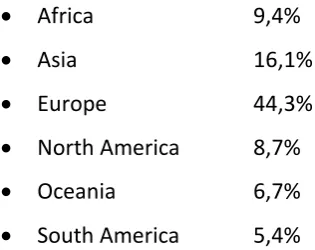
The first section of the questionnaire contained background questions about unions represented, as well as information about the person responding from each union. Respondents came from all the different continents and represented multiple countries. Unions from Europe were the majority. Most frequent countries were Australia (7) Sweden (7), Malaysia (6), Switzerland (6), USA (6), Canada (5) and Finland (5), while 13 respondents did not indicate their country of origin. Distribution across continents was as follows:
Africa 9,4%
Asia 16,1%
Europe 44,3%
North America 8,7%
Oceania 6,7%
South America 5,4%
As shown in table 1, respondents were asked to indicate in which sector(s) they represent workers, with Finance and Commerce being the most represented.
In which sector(s) does your union represent workers?
Cleaning/Security 20.8% Media, Entertainment & Arts 18.1%
Commerce 23.5% Post & Logistics 22.8%
Finance 34.9% Social Insurance 10.1%
Gaming 11.4% Sport 8.0%
Graphical & Packaging 12.7% Telecom 24.2%
Hair & Beauty 8.7% Tourism 12.7%
IT & Services 19.5% Other 25.5%
Table 1: Sectors in which respondents represent
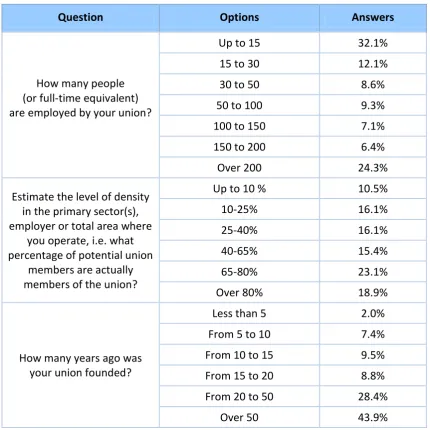
Table 2 shows the answers to additional demographic questions. In terms of how many
people a e e plo ed the u io s, the e a e ast diffe e es ith up to a d o e ei g the ost f e ue t hoi es. Respo ses a out de sit o the pe e tage of
-80% being the most popular answer. Most unions tend to be quite established since over 72% combined has been into existence for more than 20 years.
Question Options Answers
Similar issues arose when participants were to specify how many people their unions represent. On an average of 243,000 workers, the following responses were provided:
About 11% less than 1,000 workers 20% between 1,000 and 5,000 workers 16% between 5,000 and 20,000 workers 13% between 20,000 and 50,000 workers 11% between 50,000 and 100,000 workers 18% between 100,000 and 1,000,000 workers 9% over 1,000,000 workers
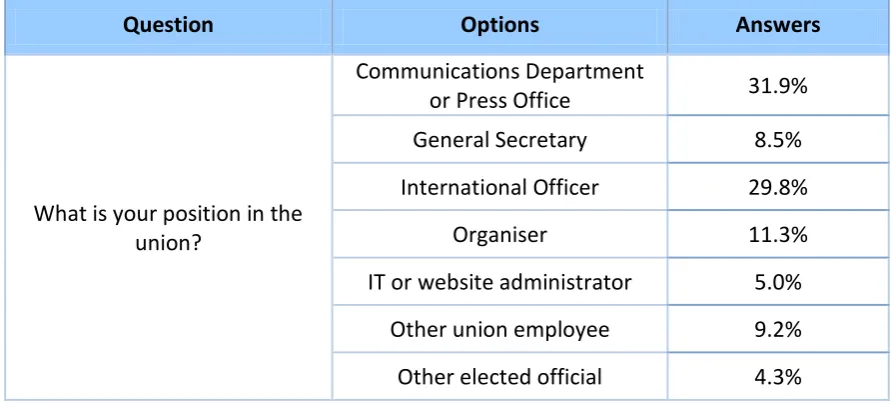
The final question asked participants to indicate their position in the union. Most of them came from Communications departments or Press Offices, followed by international officers. The invitation to the survey emphasised that only one response from each union was needed, preferably from the most appropriate person.
Question Options Answers
What is your position in the union?
Communications Department
or Press Office 31.9%
General Secretary 8.5%
International Officer 29.8%
Organiser 11.3%
IT or website administrator 5.0%
Other union employee 9.2%
Other elected official 4.3%
Table 3: Position of respondents in their union
3.2.
Adoptio of tools
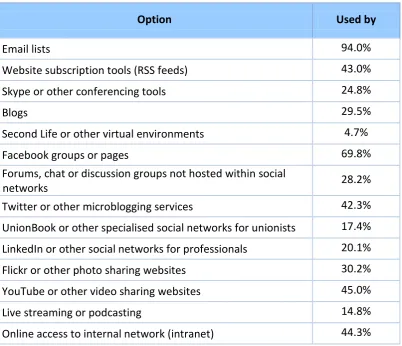
Facebook groups. All other options were used by less than half of the respondents. With the exceptions of virtual environments and streaming/podcasting, an important mass of users can be noted for all the other options.
About 11% of respondents indicated that they have adopted additional tools, which included online survey hosting systems, wikis, digital magazines, text messaging services, content management systems, website analytics, online collaboration platforms, the enterprise social network Yammer, social media management dashboards such as Hootsuite, online campaigning tools and general purpose social networks in local countries and languages. Mobile applications were hardly mentioned, but they are likely to become an important aspect in the future.
Option Used by
Email lists 94.0%
Website subscription tools (RSS feeds) 43.0%
Skype or other conferencing tools 24.8%
Blogs 29.5%
Second Life or other virtual environments 4.7%
Facebook groups or pages 69.8%
Forums, chat or discussion groups not hosted within social
networks 28.2%
Twitter or other microblogging services 42.3%
UnionBook or other specialised social networks for unionists 17.4%
LinkedIn or other social networks for professionals 20.1%
Flickr or other photo sharing websites 30.2%
YouTube or other video sharing websites 45.0%
Live streaming or podcasting 14.8%
Online access to internal network (intranet) 44.3%
Table 4: Adoption of online engagement tools
3.3.
We sites a d o li e audie e
Union members were the most popular group in the intended main audiences of unions’ online engagement strategies (table 5). Potential union members, union staff, media, employers and other unions follow. Table 6 shows the responses to three questions regarding websites. Most union websites seem to be quite established, since about two thirds of them exist for at least 5 years. Yet, it is suspiring that almost 12% do not have a dedicated website and another 10% developed a website during the last 3 years. Those websites have information mostly in one language (about 60%) or in two languages (about 28%). The rest have information in three languages or more, while several respondents specified Google translation as an alternative to manual translation that provides basic information to visitors beyond main local languages.
Which of the following groups do you think form the main audience of your union's online engagement strategy?
Union members 91.3% Allies in the NGO 16.1%
Media 44.3% Union staff 51.0%
Employers 43.0% Government 20.1%
General public 36.9% Other unions 45.6%
Potential union members 54.4% Other 6.0%
Table 5: Audience of online engagement strategy
Relationships between the variables show that unions with more staff have developed their websites before the others (early adopters), but density, age and number of workers represented do not have an effect. Those who consider their website not to be the main
sou e of i fo atio te d to o e f o ou ge u io s. Those ho ha e o e g oups
specified as their main audience tend to use a wider variety of online tools.
Question Options Answers
How long has your organisation had a website?
(in years)
Less than 1 years 3.5%
1 to 3 years 6.9%
3 to 5 years 11.1%
7 to 9 years 8.3%
Table 6: Questions about unions’ websites
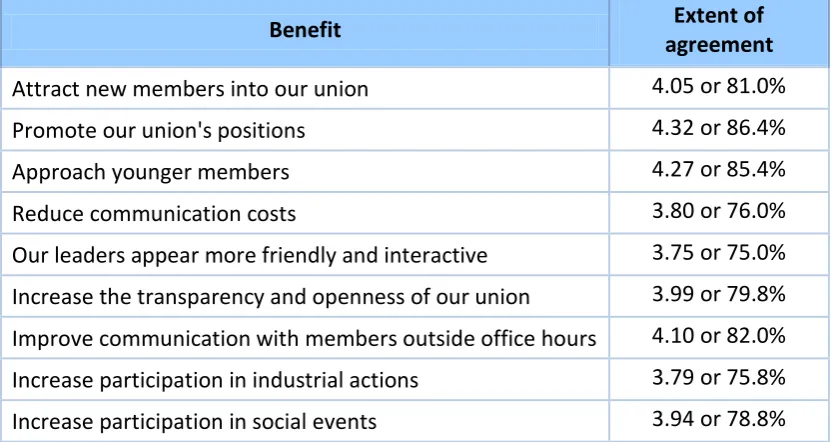
Two sets of nine and four questions were used respectively to indicate perceived benefits
a d isks f o usi g so ial edia ta les a d . P o oti g the u io ’s positio s,
approaching younger members and improving communications outside office hours were the three strongest benefits. Sentiment to all those potential benefits was quite positive. Sentiment to the fours risks in table 8 was more neutral, especially in terms of social media threatening the traditional profile of unions.
Benefit Extent of
agreement
Attract new members into our union 4.05 or 81.0%
Promote our union's positions 4.32 or 86.4%
Approach younger members 4.27 or 85.4%
Reduce communication costs 3.80 or 76.0%
Our leaders appear more friendly and interactive 3.75 or 75.0% Increase the transparency and openness of our union 3.99 or 79.8%
Improve communication with members outside office hours 4.10 or 82.0% Increase participation in industrial actions 3.79 or 75.8% Increase participation in social events 3.94 or 78.8%
Negative relationship was found between union age and benefits: more established unions perceive less benefit from social media on average. In terms of risks, there is positive relationship with union staff, but negative relationship between density and the threat of negative publicity. Unions with higher densities are more concerned about the possibility of attracting negative publicity on social media. This is possibly due to the fact that, since they are quite established in their main area or sector, exposure to risk has to be minimised.
Risk Extent of
agreement Can bring negative publicity to our union 3.11 or 62.2%
Can be dangerous for our members in terms of
exposing their identity and union beliefs to employers 3.11 or 62.2% Can help employers monitor and even block union
activities 3.22 or 64.4%
Can threaten the traditional profile of our union 2.61 or 52.2%
Table 8: Perceived risks from the use of social media
3.4.
Resou es, skills a d leade ship
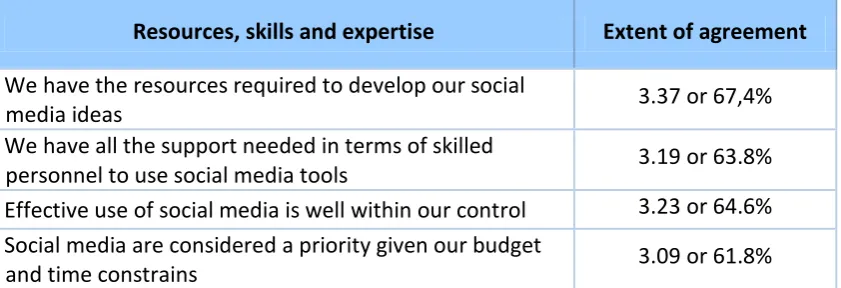
Unions seem moderately confident about their ability to develop social media initiatives. From table 9, we can observe that lack of resources is not identified as a potential barrier, even in terms of prioritising those efforts given budget and time constrains. Unions also seem to consider effective use of social media within their control.
Resources, skills and expertise Extent of agreement We have the resources required to develop our social
media ideas 3.37 or 67,4%
We have all the support needed in terms of skilled
personnel to use social media tools 3.19 or 63.8%
Effective use of social media is well within our control 3.23 or 64.6% Social media are considered a priority given our budget
and time constrains 3.09 or 61.8%
Table 9: Availability of resources, skills and expertise
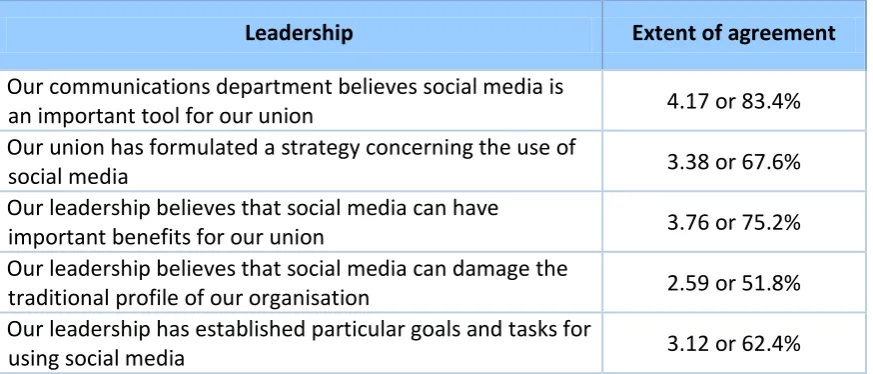
important tools and this is even reinforced if we isolate the answers of those who do come from communication departments or press offices. Overall, the effect of leadership on social media overall is positive, but there is less confidence that leadership has established particular tasks and roles. Agai , espo de ts a e eut al to possi le leade ship’s eliefs that social media can damage the traditional profile of unions. Leadership is highly correlated with the adoption of particular tools: stronger leadership directly leads to the use of more online tools. As expected, availability of resources affects the number of different tools that unions are using and also has a positive relationship with union age.
Leadership Extent of agreement
Our communications department believes social media is
an important tool for our union 4.17 or 83.4%
Our union has formulated a strategy concerning the use of
social media 3.38 or 67.6%
Our leadership believes that social media can have
important benefits for our union 3.76 or 75.2%
Our leadership believes that social media can damage the
traditional profile of our organisation 2.59 or 51.8% Our leadership has established particular goals and tasks for
using social media 3.12 or 62.4%
Table 10: Social media leadership
3.5.
U io e i o
e t a d st ategi o ie tatio
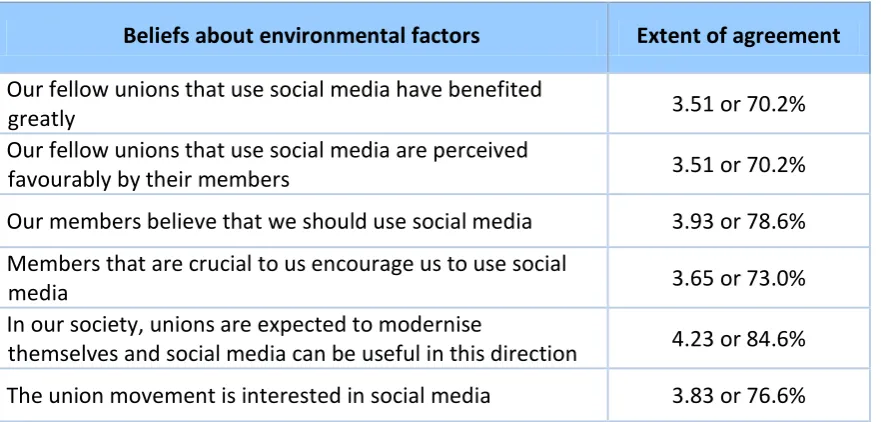
Beliefs about environmental factors Extent of agreement Our fellow unions that use social media have benefited
greatly 3.51 or 70.2%
Our fellow unions that use social media are perceived
favourably by their members 3.51 or 70.2%
Our members believe that we should use social media 3.93 or 78.6%
Members that are crucial to us encourage us to use social
media 3.65 or 73.0%
In our society, unions are expected to modernise
themselves and social media can be useful in this direction 4.23 or 84.6%
The union movement is interested in social media 3.83 or 76.6%
Table 11: Influences from members and fellow unions
Another important type of influence is participation in initiatives and events that promote the use of social media. Only one third indicated their participation in such initiatives, with the UNI Global Communicators Forum being the most frequent one. Other initiatives or events included the following: ACTU Media and Communications Network, CGIL seminar on the use of social media, Labour New Media BootCamp, AFLCIO Young Workers Summit, TUC Communicators Network, ETUC Press and Communication working group, Netroots Nation, Uni-online Africa future, Canadian Association of Labour Media, The Central Organisation of Finnish Trade Unions, Caribbean Domestic Workers Network, Labour Start Global Solidarity conference, Public Relations Society of America and national meetings.
The final set of questions asked participants to indicate their agreement with three statements that reflect the strategic orientation of unions towards social media. Those
state e ts efe to the o ept of ei g so ial edia a ti e i a ea ’s ti e. E en though there is no explicit definition of being social media active, it is interesting to see which unions consider themselves more active. Table 12 shows that respondents tend to be moderately positive towards those statements.
participate in international events that promote social media the more they experiment with different available tools.
Strategic orientation Extent of agreement We are considering to become a social media
active union in a year's time
3.50 or 70.0%
We are likely to become a social media active
union in a year's time 3.43 or 68.6%
We expect to become a social media active union in a year's time
3.64 or 72.8%
Table 12: Strategic orientation to social media
There is no relationship between the variety of tools that unions use and their strategic orientation. In other words, unions that consider themselves very social media active might use fewer forms of online engagement than others who might appeared not be equally optimistic about their strategic orientation.
3.6.
Additio al o
e ts
At the end of the questionnaire, there was space for respondents to add comments or provide feedback about specific questions or the questionnaire design. A total of 40 additional comments were received with major themes outlining the following:
1. Lack of IT literacy, skills, resources and capacity to use social media. More support is required to understand the relevance and usefulness of social media in different activities. One respondent expressed concerns that social media might be time consuming since people will expect answers from the union on a 24/7 basis.
2. Generational aspects seem to have a prominent effect both within unions and among members. Younger people are much more enthusiastic about online forms of communication, while older people do not understand social media.
many unions, personal contact in the workplace appears to be historically established and therefore cannot be substituted.
4. Online tools have a substantial impact on reducing geographical fragmentation and accelerating mobilisation efforts.
5. It is difficult to ignore the great potential of social media as a tool of union modernisation. One respondent described sceptical attitudes to social media as
ha i g dou ts a out the telepho e .
Other comments addressed privacy issues and the need to have a careful attitude when using social media for any activity. Another comme t stated that the u io ’s e site should serve as the point of information for the general public, while deeper relationships are being established on social networking groups. Finally, one respondent proposed to conduct the survey at regular intervals as a means to raise awareness.
Two potentially important issues not mentioned in comments concern the implications of using social media in the workplace and how unions understand the difference between traditional and online audiences (apart from approaching the young online).
4.
Refle tio a d pra ti al re o
e datio s
4.1.
“u
a of i po ta t fi di gs
The survey findings show that becoming a social media active organisation is a complicated process that requires very good understanding of tools, activities and the capacity of audience to engage. The findings can be summarised as follows:
Union websites remain the central point of online presence where most of the information is addressed to current and potential members. Experience and expertise with websites varies.
Emailing lists are by far the principal forms of online communication. Facebook groups and pages follow. All other tools are used by less than about 45% of respondents.
Diverse opinions exist within unions about the relevance and usefulness of online communications. Even if communication officers are eager to promote social media, some union leaders might not be equally enthusiastic.
Being an active union on social media is a concept difficult to specify or operationalise. Unions that characterise themselves as social media active do not systematically use more tools to engage than others.
Only about a third of respondents had attended social media promotion events such as the UNI Communicators Forum. Those who did attend appeared to be using a broader range of online tools.
Union density, age, number of staff and workers represented have an effect in online communication that does not appear to be major. Lack of expertise and resources appear to be more hindering factors.
Using social media is strongly linked with wider perceptions about union modernisation and expectations from members. Hence, social media are not by any means a technical problem or a simple issue of adding communication channels.
The difficult to evaluate what a social media active union actually implies is not surprising. The change compared to traditional communications can be considerable and requires time and experimentation. The survey also shows that the shift towards online communications
o es alo g i te al de ate a out the u io ’s p ofile a d the a it seeks to defi e itself
on the web. This is now discussed in more detail.
4.2.
U io s as et o ks of p ofessio als
Since the Second Life demonstration in 2007 and the emergence of online union organising, a lot have changed in the traditions of social media themselves. The most important change is that barriers to online professional networking have been significantly lowered. Sites such as LinkedIn and Facebook act as networks of professionals. Blogging and microblogging applications provide the opportunity for immediate real-time content around the whole range of personal and professional issues. In many professions, even not IT-related ones, a great proportion of the significant activity is now happening on the web.
union networks (17.4%), blogs (29.5%) and microblogging services (42.3%) can be alarming. The higher use of Facebook groups and pages (69.8%) shows that unions have embarked more on the social aspects of networking or are finding that this is what their audience is willing to support.
The dominance of mailing lists might point to the fact that unions are more used to pushing content to their audience than engaging in more interactive forms and building professional relationships. Emails should certainly remain a central communication tool given their speed, ease-of-use and low cost. Yet, posting email updates should not be treated as the activity of sending as much information about union issues as possible to a massive uniform audience. Writing emails, organising lists and grouping the audience according to geographic or other criteria are parameters that should not be overlooked. More detailed advice about email campaigns can be found in (White 2012).
Another important aspect of this discussion concerns the ability of unions to borrow from the success of social networking websites themselves. Many of those sites have managed to gather remarkable number of members in very short times by acting as membership organisations. As Bryson et al. (2010) explain, the messages for a new model of unionism that incorporates some of the characteristics of social networks can be important. Indeed, the survey shows that attracting new members and particularly younger workers is the one of the strongest benefits that unions see in online networking.
4.3.
“ele ti g a d o ito i g tools
The survey shows that unions recognise considerable influences from their environment and members to promote the image of a modern organisation that is active on social media. Those influences and the social media fashion itself might push part of the online communications activity, but the ability to look beyond those influences in union communication strategies is critical. Two important dimensions should be considered here along the broader suggestion to transfer part of union activities on the web.
traditional communication structures on the web can be problematic and appealing for members who are familiar with online tools in a much more different way.
Second, making informed choices in communication channels is necessary. While using as many options as possible contributes to plurality, it also presumes an appropriate level of commitment, responsiveness, monitoring and consistency (see White (2010) for the importance of consistency). While regular, but not necessarily constant, update of content is of apparent importance, monitoring should not be overlooked; this can be quite a major change compared to traditional communications. It is difficult to specify how many people read a leaflet, but website analytics can provide valuable information about visitors and the way they interact with union information. Similarly, much of the u io o u i ato s’ attention has to be devoted in monitoring what is happening online beyond the places
ithi the u io ’s o t ol or immediate visibility. For example, Twitter hashtags and content aggregator tools such as RSS feeds can be helpful without the need to dedicate staff on continuous basis.
4.4.
The o li e audie e
The survey shows that it is usually assumed that younger people are more likely to participate online in union activities because they are familiar with how the Internet works. This is to some extent true but requires a broader perspective about the audience of online communications and its relationship with the traditional audience.
Studies with Internet users have shown that people who participate in online political activities might not be traditionally motivated or willing to participate. This is because trust in online means gains a self-reinforcing nature: the more people become familiar with online places the more they trust them and keep using them for different activities. The message for unions can be as si ple as fi d he e ou e e s a e a d eet the
the e , but there is more to that. If Internet experiences and skills drive online participation, unions can target savvy Internet users to promote their ideas and even find new members. It is important to consider that this audience is not necessarily limited to the young but includes all experienced Internet users who might be traditionally disengaged. In January 2011, a study with the members of the Greek union in the banking sector confirmed that
e e less e gaged e e s e e suppo ti e of the u io ’s o li e p ese e if the e e
This practically means that an important dimension in online communication strategies is to understand the new audience and adapt to its particular characteristics. The more unions can tailor their message to a specific audience they more chances they have to be successful (also see the previous comment about emails). Then, it can be possible to organise an online strategy using an appropriate combination of tools around a website which acts as the central point of information. Hence, it is important that unions become proactive in seeking such knowledge about the audience and able to collect feedback about their online communications.
4.5.
Rethi ki g U io s .
It is important to consider how the Unions 2.0 way of working can be updated in the light of the survey findings. The initial approach to the term had already recognised the social and cultural aspects of transformation that go beyond the practical challenges of adding communication channels. Those aspects remain equally essential at the present day, even though the nature of engagement, interactivity and information sharing on the web is radically changing. The author of this report believes that, in principle, a social media active union or Union 2.0 should have a critical attitude towards online communications acquired through a combination of experience and planning. This seems to involve the ability to:
Act as a social and professional network on the web in addition to being an information provider.
Actively seek and apply knowledge about the new engagement audience, including a plan to disseminate targeted information.
Monitor online places of interest and make sense of them in the context of the
u io ’s a ti ities.
Make informed choices about the combination of online tools in a way that ensures commitment, responsiveness and consistency.
Following this discussion and bearing in mind the survey findings, there are certain issues that have to be taken into account concerning the course of European Social Dialogue and the strategy of unions to organise and communicate their influence.
5.
Lesso s for Europea So ial Dialogue
Social Dialogue is a fundamental element of European Union institutions and a source of social cohesion and justice. No matter where and how Social Dialogue is happening, trade union members have a legitimate right to participate and influence its outcome. This study draws the attention of European policy makers and trade union leaders into certain guidelines that their organisations could adopt when developing online communications.
While networking tools have the potential to achieve multiple contributions in Social Dialogue, trade unions have to conceptualise their use as part of their main challenge: how to develop the central narratives that will support and communication their causes. Trade unions have the ethical and practical responsibility to develop the European narratives of growth and fairness centred on stable labour conditions and respect to employees all around Europe. In the current socio-political conditions, these key messages can even be more powerful in turning anger into meaningful action.
Through networking tools, the narratives can become viral, more easily understood and
sha ed the ge e al pu li . A e elle t e a ple of su h essages is the I am not a
u e the UK Prospect (2012). This campaign promoted stories of actual people whose personal and working lives are negatively influenced by cuts in public sector budgets. This message can help the public realise that austerity measures, being implemented all over Europe, have a direct impact on workers and form the difficult reality behind financial measures and political agendas.
The balanced sample of the survey between European and non-European trade unions allows for certain interesting comparisons. First of all, it seems that trade unions in Europe might be lacking the urgency to foster innovation compared to their fellow organisations from countries such as Brazil or Australia. Certain unions in these countries appear to be rapidly advancing their online communication practices even beyond providing a website and updates about the union life through email lists or newsletters. As a result, they have been able to experience online communications more creatively.
concerns. As discussed in section 4.3, the mediating role of trade unions as facilitators of Social Dialogue can be undermined if citizens, disappointed by current institutions, use technical means to bypass their authority. Many of these citizen movements directly evolve around the European solidarity narrative, which can be the central space for trade unions to mobilise their members.
Can trade unions in Europe function as citizen movements and mobilise people around thematic campaigns with equal effectiveness? Pursuing this objective means that unions have to find new ways of working that will enable them to switch between online and offline actions so that they keep a large audience engaged. Such tactics have proven very effective with advocacy political movements such as Moveon.org and SumOfUs.org in the USA. These movements have online engagement at the centre of their communication models, which allows them to manage costs and mobilise global and regional networks of volunteers and supporters.
The ability of European trade unions to adopt such flexible modes of communication is in most cases limited. Even though European trade unions are usually well resourced and with solid membership bases, their response to change cannot match the rapid advancement of Internet tools and their adoption in societies. Additionally, European trade unions tend to organise around centralised forms of leadership, which might not always be compatible with social media cultures where members expect to engage in a more bottom-up way. The survey findings strongly point to the fact that active leadership results in a greater variety of participation and networking opportunities offered to the members.
Refere es
Bibby, A. 2008, "Industrial Relations and Social Dialogue in the Web 2.0 World". Available: http://www.andrewbibby.com/pdf/Bibby_PMS-3-2009-0112_en.pdf
[accessed 2010, 10/02].
Blodgett, B.M. & Tapia, A.H. 2010, "When Protests go Virtual: How Organizing Social Protest in Virtual Worlds Changes the Nature of Organizing", Proceedings of the 16th Americas Conference on Information Systems, Association for Information Systems.
Bryson, A., Gomez, R. & Willman, P. 2010, "Online Social Networking and Trade Union Membership: What the Facebook Phenomenon Truly Means for Labor Organizers", Labor History, vol. 51, no. 1, pp. 41-53.
Furneaux, B. & Wade, M. 2011, "An Exploration of Organizational Level Information Systems Discontinuance Intentions", MIS Quarterly, vol. 35, no. 3 pp. 573-598.
Lovejoy, K. & Saxton, G.D. 2012, "Information, Community, and Action: How Nonprofit Organizations Use Social Media", Journal of Computer-Mediated Communication, vol. 17, no. 3, pp. 337-353.
Panagiotopoulos, P. (in press) Towards Unions 2.0: Rethinking the Audience of Social Media Engagement, New Technology, Work and Employment, pp. 1-15.
Prospect 2012, "Public Servants are not just Pen-Pushers" Available:
http://www.prospect.org.uk/campaigns_and_events/national_campaigns/cutstop/nota number [accessed 2012, 06/10].
Tornatzky, L.G. & Fleischer, M. The Processes of Technological Innovation. Lexington Books, Lexington, Massachusetts, 1990.
White, A. 2012, "Improve you U io ’s E ail Campaigns". Available:
http://alexwhite.org/2012/05/improve-your-unions-email-campaigns-part-1/ [accessed 2012, 10/06].
White, A. 2010, Social Media for Unions, Aleithia media and communications.
Zhang, W., Gutierrez, O. & Mathieson, K. 2010, "Information Systems Research in the Nonprofit Context: Challenges and Opportunities", Communications of the Association for Information Systems, vol. 27, no. 1, pp. 1-12.
Supporti g i liography
Chadwick, A. 2007, "Digital Network Repertoires and Organizational Hybridity", Political Communication, vol. 24, no. 3, pp. 283-301.
Davies, W. 2004, Trade Union Membership and the Internet: Lessons from Civil Society, IPPR Digital Society and Media Programme.
Diamond, W.J. & Freeman, R.B. 2002, "Will Unionism Prosper in Cyberspace? The Promise of the Internet for Employee Organization", British Journal of Industrial Relations, vol. 40, no. 3, pp. 569-596.
Frege, C.M. & Kelly, J. 2003, "Union Revitalization Strategies in Comparative Perspective", European Journal of Industrial Relations, vol. 9, no. 1, pp. 7-24.
Greene, A., Hogan, J. & Grieco, M. 2003, "Commentary: E-collectivism and Distributed Discourse: New Opportunities for Trade Union Democracy ", Industrial Relations Journal, vol. 34, no. 4, pp. 282-289.
Hogan, J., Nolan, P. & Grieco, M. 2010, "Unions, Technologies of Coordination, and the Changing Contours of Globally Distributed Power", Labor History, vol. 51, no. 1, pp. 29-40.
Hyman, R. 2007, "How Can Trade Unions Act Strategically?", Transfer: European Review of Labour and Research, vol. 13, no. 2, pp. 193-210.
INE-OTOE 2009, A Collection of Reports from the DialogoS+ European Project, INE-OTOE, Athens, Greece.
Ka pf, D. , "O li e Politi al Mo ilizatio f o the Ad o a G oup’s Pe spe ti e:
Looking Beyond Clicktivism", Policy & Internet, vol. 2, no. 4, pp. 7-41.
Lévesque, C. & Murray, G. 2010, "Local Union Strategies in Cross-Border Alliances", Labor Studies Journal, vol. 35, no. 2, pp. 222-245.
Lévesque, C. & Murray, G. 2010, "Understanding Union Power: Resources and Capabilities for Renewing Union Capacity", Transfer: European Review of Labour and Research, vol. 16, no. 3, pp. 333-350.
Levi, M., Olson, D., Agnone, J. & Kelly, D. 2009, "Union Democracy Reexamined", Politics & Society, vol. 37, no. 2, pp. 203-228.
Lucio, M.M. 2003, "New Communication Systems and Trade Union Politics: a Case Study of Spanish Trade Unions and the Role of the Internet", Industrial Relations Journal, vol. 34, no. 4, pp. 334-347.
Lucio, M.M. & Walker, S. 2005, "The Networked Union? The Internet as a Challenge to Trade Union Identity and Roles", Critical Perspectives on International Business, vol. 1, no. 2/3, pp. 137-154.
Internet and Networking", New Technology, Work and Employment, vol. 24, no. 2, pp. 115-130.
Maste s, M.F., Gi e , R., )age k, T.J. & “he huk, I. , "U io Me e s’ Usage of IT",
Industrial Relations, vol. 49, no. 1, pp. 83-90.
McGrath, K., Elbanna, A., Hercheui, M., Panagiotopoulos, P. and Saad, E. (2012), Exploring the Democratic Potential of Online Social Networking: the Scope and Limitations of E-Participation, Communications of the Association for Information Systems, vol. 30, 16.
Metochi, M. 2002, "The Influence of Leadership and Member Attitudes in Understanding the Nature of Union Participation", British Journal of Industrial Relations, vol. 40, no. 1, pp. 87-111.
Panagiotopoulos, P., Brooks, L., Elliman, T. & Dasuki, S.I. 2011, "Social Networking for Membership Engagement in Nonprofit Organisations: a Trade Union Study",
Proceedings of the 17th Americas Conference on Information Systems, Association for Information Systems.
Pulignano, V. 2009, "International Cooperation, Transnational Restructuring and Virtual Networking in Europe", European Journal of Industrial Relations, vol. 15, no. 2, pp. 187-205.
Scruggs, L. & Lange, P. 2002, "Where Have All the Members Gone? Globalization, Institutions, and Union Density", The Journal of Politics, vol. 64, no. 1, pp. 126-153.
Whittall, M., Knudsen, H. & Huijgen, F. 2009, "European Works Councils: Identity and the Role of Information and Communication Technology", European Journal of Industrial Relations, vol. 15, no. 2, pp. 167-185.
Yates, C.A.B. 2005, "Segmented Labour, United Unions? How Unions in Canada Cope with Increased Diversity", Transfer: European Review of Labour and Research, vol. 11, no. 4, pp. 617-628.