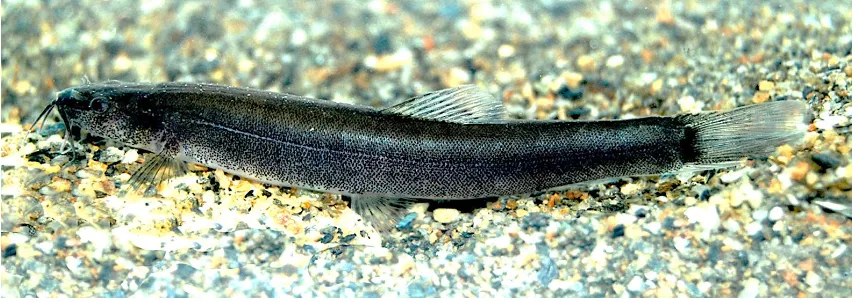
The loaches of the genus
Nemacheilus
(Teleostei: Nemacheilidae)
in Sunda Islands, with an identification key
[Ikan genus
Nemacheilus
(Teleostei: Nemacheilidae) di Kepulauan Sunda,
berikut kunci identifikasinya]
Renny Kurnia Hadiaty
1,, Kazunori Yamahira
2 1Ichthyology Laboratory, Museum Zoologicum Bogoriense (MZB),Zoology Division of Research Center for Biology, Indonesian Institute of Sciences (LIPI) Jln. Raya Bogor Km 46, Cibinong 16911, Indonesia.
2Tropical Biosphere Research Center, University of the Ryukyus, Okinawa, Japan. Senbaru 1, Nishihara, Okinawa 903-0213, Japan.
Received: March 9, 2014; Accepted: April 22, 2014
Abstract
Loaches of the genus Nemacheilus are distributed in Southeast Asia from the mainland of Asia to Sunda Islands (Su -matra, Java, and Borneo). In this paper, the status of Nemacheilus in Sunda Islands is discussed base on the results of field trips in Indonesian waters, the fish collections in Museum Zoologicum Bogoriense, and published papers. There are 18 species in Sunda Islands, 8 species inhabit in Sumatra and 10 species in Kalimantan, and only 2 species inhabit in Java. An idetification key of the 18 species is also included.
Key words: Identification keys, Nemacheilus, Sunda Islands, Indonesia
Abstrak
Ikan genus Nemacheilus tersebar meliputi wilayah Asia Tenggara, dari daratan Asia sampai ke Kepulauan Sunda (Su -matra, Jawa, dan Kalimantan). Dalam tulisan ini dikemukakan status Nemacheilus di pulau-pulau tersebut berdasarkan hasil kegiatan lapangan di perairan Indonesia, koleksi di Museum Zoologicum Bogoriense (MZB), dan tulisan yang te -lah dipublikasi. Di Kepulauan Sunda dijumpai 18 species Nemacheilus, delapan spesies dijumpai di Sumatra, 10 spesies di Kalimantan dan hanya dua spesies di Jawa. Kunci identifikasi 18 spesies Nemacheilus disertakan.
Kata penting: Kepulauan Sunda, kunci identifikasi, Nemacheilus, Indonesia
Introduction
How many freshwater fish species live in Southeast Asia? Kottelat (2013) reported the bio -diversity of freshwater fishes in Southeast Asia as follows: 3107 valid native species, in 707 va -lid genera and 137 families. In addition, there are about 300 species to be named or already on mu -seum shelves, a fair number of synonyms to be revalidated, and about 500 species still awaiting discovery in the wild (Kottelat 2013).
One of the most diverse freshwater fish group in Southeast Asia is loaches, the suborder Cobitoidei. Indeed, the fishes reported from the highest altitude in Asia (at 5200 m above sea le -vel) are loaches, and those reported from the
lowest altitude (about 50 m below sea level) are also loaches. In a catalogue of Cobitoidei, Kottelat (2012) reviewed all 1499 recorded spe -cies-group names and 185 genus-group names and corrected spelling and types, based on about 1010 titles of bibliographies. He finally recog -nised 1043 valid species in 111 valid genera.
Nemacheilidae is a family of loaches, which live in the rivers of Eurasia and Ethiopia (Kottelat & Freyhof 2007 and Kottelat 2012). Nemacheilinae was a subfamily of Balitoridae for a long time, but since it was recognized to be a monophyletic lineage (Bohlen & Šlechtová 2009), Kottelat (2012) retain Nemacheilidae as a valid family. Based on his review, Nemacheil -idae consists of 575 species in 46 genera.
Corresponding author
The type genus of Nemacheilidae is Nemacheilus. The type species of the genus is Nemacheilus fasciatus, which was described as Cobitis fasciata by Valenciennes (in Cuvier & Valenciennes 1846). Bleeker in 1853 described the genus Nemacheilus. He reviewed the C. fasciata and put it in Nemacheilus.
The genus Nemacheilus comprise of 33 species, 6% of the total number of nemacheilid species (Kottelat 2012). All of the Nemacheilus
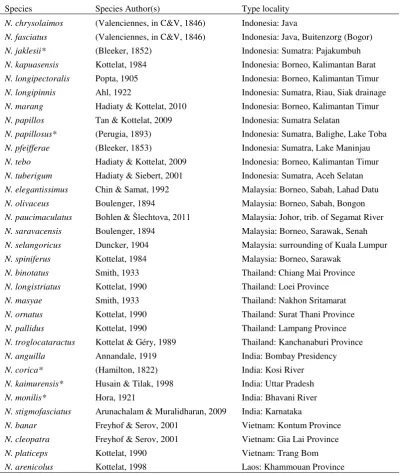
species are endemic to Southeast Asia (the valid species, authors and type localities presented in Table 1). Among the 33 species, 16 species, about a half of them, have been described from Sunda Islands: Borneo (8 species), Sumatra (6 species), and Java (2 species). However, the di -versity of this genus in Sunda Islands is still un -clear, because of the lack of comprehensive field collections and taxonomic examinations of this group throughout the area.
Table 1. Valid species of Nemacheilus, their authors and type locality (from Kottelat 2012)
Species Species Author(s) Type locality
N. chrysolaimos (Valenciennes, in C&V, 1846) Indonesia: Java
N. fasciatus (Valenciennes, in C&V, 1846) Indonesia: Java, Buitenzorg (Bogor)
N. jaklesii* (Bleeker, 1852) Indonesia: Sumatra: Pajakumbuh
N. kapuasensis Kottelat, 1984 Indonesia: Borneo, Kalimantan Barat
N. longipectoralis Popta, 1905 Indonesia: Borneo, Kalimantan Timur N. longipinnis Ahl, 1922 Indonesia: Sumatra, Riau, Siak drainage
N. marang Hadiaty & Kottelat, 2010 Indonesia: Borneo, Kalimantan Timur
N. papillos Tan & Kottelat, 2009 Indonesia: Sumatra Selatan
N. papillosus* (Perugia, 1893) Indonesia: Sumatra, Balighe, Lake Toba
N. pfeifferae (Bleeker, 1853) Indonesia: Sumatra, Lake Maninjau
N. tebo Hadiaty & Kottelat, 2009 Indonesia: Borneo, Kalimantan Timur
N. tuberigum Hadiaty & Siebert, 2001 Indonesia: Sumatra, Aceh Selatan N. elegantissimus Chin & Samat, 1992 Malaysia: Borneo, Sabah, Lahad Datu
N. olivaceus Boulenger, 1894 Malaysia: Borneo, Sabah, Bongon
N. paucimaculatus Bohlen & Ṧlechtova, 2011 Malaysia: Johor, trib. of Segamat River
N. saravacensis Boulenger, 1894 Malaysia: Borneo, Sarawak, Senah
N. selangoricus Duncker, 1904 Malaysia: surrounding of Kuala Lumpur
N. spiniferus Kottelat, 1984 Malaysia: Borneo, Sarawak
N. binotatus Smith, 1933 Thailand: Chiang Mai Province N. longistriatus Kottelat, 1990 Thailand: Loei Province
N. masyae Smith, 1933 Thailand: Nakhon Sritamarat
N. ornatus Kottelat, 1990 Thailand: Surat Thani Province
N. pallidus Kottelat, 1990 Thailand: Lampang Province
N. troglocataractus Kottelat & Géry, 1989 Thailand: Kanchanaburi Province
N. anguilla Annandale, 1919 India: Bombay Presidency
N. corica* (Hamilton, 1822) India: Kosi River N. kaimurensis* Husain & Tilak, 1998 India: Uttar Pradesh
N. monilis* Hora, 1921 India: Bhavani River
N. stigmofasciatus Arunachalam & Muralidharan, 2009 India: Karnataka
N. banar Freyhof & Serov, 2001 Vietnam: Kontum Province
N. cleopatra Freyhof & Serov, 2001 Vietnam: Gia Lai Province
The aim of this study is to provide the sta -tus of the Nemacheilus species that inhabit Sun -da Islands, i.e., Sumatra, Java, and Borneo (the four Indonesian provinces [Kalimantan Barat, Kalimantan Selatan, Kalimantan Tengah, Kali -mantan Timur], the two Malaysian provinces [Sabah, Sarawak], and Brunei) and construct an identification key. Since we did not have the op -portunity to collect fish in Malaysian Borneo, the information for species in that area are extracted from the literature (Kottelat 1984, 1990, 2012, 2013, and Chin & Samat 1992). This study will add to the data on fish biodiversity in Sunda Island, especially in Indonesian waters, and should help to recognise and identify these loaches.
Material and methods Field collections
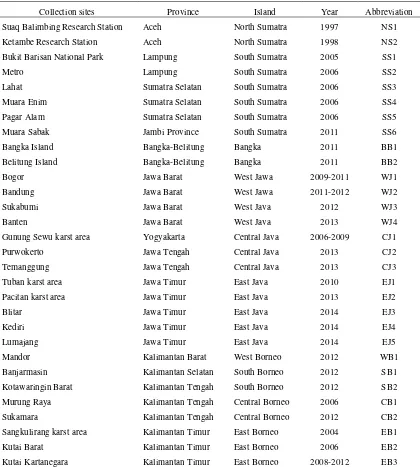
This study is based on the specimens col -lected by the first author during field trips in Su -matra, Java, and Kalimantan between 1997 and 2014. Collection sites were summarized in Table 2. Fish samples were collected with electricity, tray nets, and/or seines. Notes on habitats and surrounding environments were recorded. The live specimens of almost all species collected were photographed immediately after capture or later at the base camp. The fish were preserved in 10% formalin (4% formaldehyde).
The identifications were based on Alfred (1961), Chin & Samat (1992), Hadiaty & Siebert (2001), Hadiaty & Kottelat (2009, 2010), Kottelat (1984, 1990, 2012, 2013), Kottelat et al. (1993), Kottelat & Widjanarti (2005), Kottelat & Whitten (1996), Kottelat & Freyhof (2007), Martin-Smith & Tan (1998), Roberts (1989), and Tan & Kottelat (2009). All samples were regis -tered at Museum Zoologicum Bogoriense (MZB), the Ichthyology Laboratory, Division of
Zoology, Research Center for Biology, Indone -sian Institutes of Sciences, Indonesia.
Some type specimens of Nemacheilus spp. were examined in five European museums: The Rijksmuseum van Natuurlijke Historie (RMNH), Leiden; The Natural History Museum (NHM), London; The National Museum of Natural History (MNHN), Paris; The Zoological Museum Amsterdam (ZMA), Amsterdam; Collections of Maurice Kottelat (CMK), Switzerland; and The Raffless Museum of Biodiversity Research (RMBR), Singapore. Some specimens were examined with scanning electron microscope in National Museum of Natural History (NMNH), Smithsonian Institution, Washington DC. In ad -dition to the specimens collected during the field trips above, the Nemacheilus spp. collections of Museum Zoologicum Bogoriense (MZB), the Ichthyology Laboratory, Division of Zoology, Research Center for Biology, Indonesian Insti -tutes of Sciences, were also examined.
Morphometry and meristics were exam -ined for species which had not been described. Methods for morphometry and meristics follow Kottelat (1984; 1990) and Kottelat & Freyhof (2007). Measurements were taken using a digital caliper, from point to point; exceptions are expli -citly signified.
Results
Table 2. Collection sites of Nemacheilus species and years of field trips
Collection sites Province Island Year Abbreviation
Suaq Balimbing Research Station Aceh North Sumatra 1997 NS1
Ketambe Research Station Aceh North Sumatra 1998 NS2
Bukit Barisan National Park Lampung South Sumatra 2005 SS1
Metro Lampung South Sumatra 2006 SS2
Lahat Sumatra Selatan South Sumatra 2006 SS3
Muara Enim Sumatra Selatan South Sumatra 2006 SS4
Pagar Alam Sumatra Selatan South Sumatra 2006 SS5
Muara Sabak Jambi Province South Sumatra 2011 SS6
Bangka Island Bangka-Belitung Bangka 2011 BB1
Belitung Island Bangka-Belitung Bangka 2011 BB2
Bogor Jawa Barat West Jawa 2009-2011 WJ1
Bandung Jawa Barat West Jawa 2011-2012 WJ2
Sukabumi Jawa Barat West Java 2012 WJ3
Banten Jawa Barat West Java 2013 WJ4
Gunung Sewu karst area Yogyakarta Central Java 2006-2009 CJ1
Purwokerto Jawa Tengah Central Java 2013 CJ2
Temanggung Jawa Tengah Central Java 2013 CJ3
Tuban karst area Jawa Timur East Java 2010 EJ1
Pacitan karst area Jawa Timur East Java 2013 EJ2
Blitar Jawa Timur East Java 2014 EJ3
Kediri Jawa Timur East Java 2014 EJ4
Lumajang Jawa Timur East Java 2014 EJ5
Mandor Kalimantan Barat West Borneo 2012 WB1
Banjarmasin Kalimantan Selatan South Borneo 2012 SB1
Kotawaringin Barat Kalimantan Tengah South Borneo 2012 SB2
Murung Raya Kalimantan Tengah Central Borneo 2006 CB1
Sukamara Kalimantan Tengah Central Borneo 2012 CB2
Sangkulirang karst area Kalimantan Timur East Borneo 2004 EB1
Kutai Barat Kalimantan Timur East Borneo 2006 EB2
Kutai Kartanegara Kalimantan Timur East Borneo 2008-2012 EB3
pfeifferae, N. papillosa, and N. saravacensis which had been described from Indonesian waterswere not collected during the trips.
From those 10 species, three were design -ated as new species and described as N. tuberi -gum Hadiaty & Siebert 2001, N. tebo Hadiaty & Kottelat 2009, and N. marang Hadiaty & Kottelat 2010. One species from Kalimantan Tengah Province was also a new species but has not been described. These four species were examined as follows.
Nemacheilus tuberigum Hadiaty & Siebert, 2001
Nemacheilus tuberigum is known from
the area of Gunung Leuser National Park, Nang -roe Aceh Darussalam Province, Indonesia.
Table 3. Nemacheilus species collected during the course of field trips. See Table 2 for abbreviations of collection sites
No. Species Collection sites
1. N. tuberigum NS1, NS2
2. N. fasciatus SS1-SS4, WJ1, WJ3, CJ1-CJ3, EJ1-EJ5
3. N. selangoricus BB1, BB2, WB1, SB1, SB2
4. N. chrysolaimos WJ1, WJ2
5. N. kapuasensis EB1
6. N. longipectoralis EB3
7. N. marang EB1
8. N. spiniferus CB1, EB1-EB3
9. N. tebo EB1
10. Nemacheilus nsp. SB2
Notes: NS= North Sumatra, SS=South Sumatra, WJ=West Java, CJ=Central Java, EJ=East Java, BB= Bangka-Belitung, WB=West Borneo, SB=South Borneo, EB= East Borneo, CB= Central Borneo
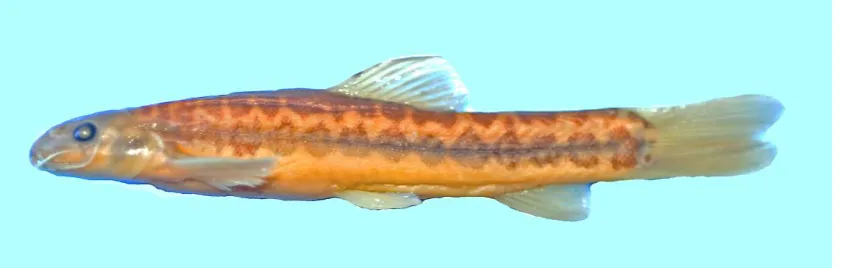
Figure 1. Nemacheilus tuberigum, MZB 14383, 48.7 mm SL; Nangroe Aceh Darussalam Province: Gunung Leuser National Park, Sumatra, Indonesia.
peduncle; colour pattern consisting of 11-15 dor -sal saddles, a series of 8-13 lateral blotches cen -tred along the lateral line and without a dark spot at anterior base of dorsal fin (Figure 1).
Sexual dimorphism.Male with suborbital flap and much more tubercles on flank than fe -male.
Nemacheilus tebo Hadiaty & Kottelat, 2009 Nemacheilus tebo is known from Danau Tebo area, an isolated hilly part of Sangkulirang Peninsula karstic area in Kalimantan Timur Pro -vince, Indonesia. This specieswas collected at 6 sites in the Danau Tebo drainage. The southern part of Tebo was burned once during the 1997
fires, but the area is so remote that other impacts (illegal logging and hunting) are minimal; it currently retains large patches of primary forest (Salas et al.2005).
a
b
rows of elongated scales on the caudal peduncle, each scale with a tubercle at posterior extremity. It is distinguished from the other species of the N. selangoricus group (sensu Hadiaty & Kottelat 2009) by having smaller tubercles, and by the presence of rows of tubercles on the lower half of the flank. Further, it is distinguished from N. selangoricus and N. spiniferus in missing the
long, acuminate posterior projection on the cau -dal peduncle and by the absence of the black spot at the base of the anterior dorsal-fin rays and of the rows of black spot on the rays.
Sexual dimorphism. Male with suborbital flap and much more tubercles on flank than fe -male. The flap is smaller in the largest specimen.
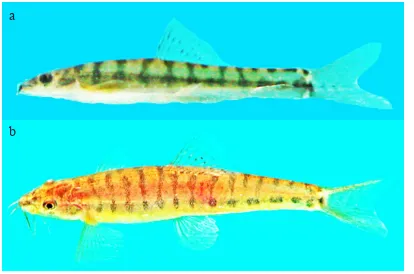
Figure 2. Nemacheilus tebo, MZB 13367, holotype, 56.1 mm SL; Lake Tebo, Sangkulirang karst area, Kalimantan Timur Province, Indonesia.
Nemacheilus marang Hadiaty & Kottelat, 2010
Nemacheilus marang is known from Su -ngai Marang, Bengalon drainage, Tepian Langsat Village, Kecamatan Kelai, Kabupaten Kutai Ti -mur, Kalimantan Ti-mur, Indonesia.
Diagnosis. Nemacheilus marang is distin -guished from all other species of the genus in Sunda Islands by its colour pattern made of 10 -18 dark brown bars on flank, extending from dorsal midline to just below lateral line, conti -nous across back, not or only slightly wider on back and where crossing midlateral stripe; bars usually regular, straight, and width less than half that of interspaces (Figure 3).
Other diagnostic characters but not unique to the species are: scales of rows above and below lateral line row on caudal peduncle not elongate and without a tubercle at their posterior extremity; pectoral fin reaching only slightly beyond half of distance to pelvic-fin base; caudal fin forked, upper lobe 1.0-1.5 times longer than median rays; anus located behind middle of distance between pelvic-fin base and anal-fin origin; anterior nostril at the front side of a pointed flap; 17 branched caudal-fin rays: 8½
branched dorsal-fin rays; and 84-92 lateral line pores.
Sexual dimorphism.Male with suborbital flap.
Nemacheilus nsp.
Nemacheilus nsp. were collected from Sei
Samai drainage, Antakalang, Kotawaringin Ba -rat, Kalimantan Tengah, Indonesia.
Diagnosis. Nemacheilus nsp. is distin -guished from all other species of the genus in Sunda Islands by its colour pattern, all of the bo -dy colour is black, especially when alive, imme -diately after capture (Figure 4).
Sexual dimorphism.Male with suborbital flap.
Discussions
Diversity of the genus Nemacheilus in Indonesia Throughout the field trips in Sunda Is -lands, three new Nemacheilus species have been described, and one more is waiting to be named. Considering that there are still many unexplored waters, it is very possible that there are more un -described species of Nemacheilus in this area.
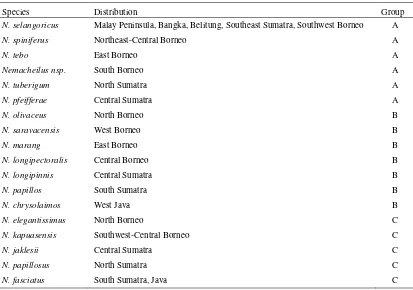
Table 4. The 18 Nemacheilus species in Sunda Islands and their distributions. Group indicates the groups estimated from the identification keys (see text for details).
Species Distribution Group
N. selangoricus Malay Peninsula, Bangka, Belitung, Southeast Sumatra, Southwest Borneo A
N. spiniferus Northeast-Central Borneo A
N. tebo East Borneo A
Nemacheilus nsp. South Borneo A
N. tuberigum North Sumatra A
N. pfeifferae Central Sumatra A
N. olivaceus North Borneo B
N. saravacensis West Borneo B
N. marang East Borneo B
N. longipectoralis Central Borneo B
N. longipinnis Central Sumatra B
N. papillos South Sumatra B
N. chrysolaimos West Java B
N. elegantissimus North Borneo C
N. kapuasensis Southwest-Central Borneo C
N. jaklesii Central Sumatra C
N. papillosus North Sumatra C
N. fasciatus South Sumatra, Java C
Including the undescribed species, in to -tal, 18 species of Nemacheilus, more than half of the species of this genus, are found on Sunda Is -lands (Table 4). Especially, Borneo has 10 spe -cies, and Sumatra has 8 spe-cies, respectively, in -dicating that these two islands are the most di -verse area of the genus. Among the 18 species, only N. selangorius inhabits both the Sunda (Su -matra, Bangka, Belitung, and Borneo) and the Asian mainland sides (Malay Peninsula). Be -sides, among the 18 species, N. elegantissimus and N. olivaceus inhabits only in Malaysian Borneo (Sabah) and has not been found from Indonesian waters. We provide identification keys for the 18 Nemacheilus species in Sunda Islands below.
Identification keys
This key is modified mainly from Kottelat (1984, 1990), with the additional information from Roberts (1989), Chin & Samat (1992),
Kottelat et al. (1993), Hadiaty & Siebert (2001), Hadiaty & Kottelat (2009, 2010), Tan & Kottelat (2009), and van Oijen & Loots (2012).
1a. Acuminate or enlarged scales on rows above and below lateral line on caudal peduncle. ... 2 1b. No acuminate or enlarged scales on caudal
peduncle ... 7 2a. 4-10 acuminate scales above and below la
-teral line on caudal peduncle ... 3 2b. Enlarged scales above andbelow lateral line
on caudal peduncle ... 4 3a. Process of acuminate scales as long as rest
-ween; dorsal head length 21-23% SL; N.-C. the bars being often lighter brown than the margin or as light as the background, the bar then being vertically split into two thin bars, these bars are very regular; dorsal head length 18-22% SL; Malay Peninsula, Bangka, Belitung, S.E. Sumatra, W. Borneo ... N. selangoricus 4a. Colour pattern consisting of 10-18 dorsal
saddles with 8-15 blotches along lateral line ... 5 4b. Body with dark brown bars in some part
fused forming a large elongate dark brown or body totally black ... 6 5a. Colour pattern consisting of 11-15 dorsal
saddles, wider than interspaces, a series of 8-13 blotches along lateral line; dorsal head length 16.8-20.9 % SL; N. Sumatra
... N. tuberigum 5b. Colour pattern consisting of 10-18 saddles
on the back and 10-15 dark blotches along lateral line, alternating with the saddles, often fused to dorm a longitudinal stripe; C. Sumatra ... N. pfeifferae 6a. Colour pattern consisting of 11-16 dark
brown bars, those in front of dorsal fin short, close together or fused, forming a kind of large elongate dark brown bars, be -low and behind dorsal fin continuous across dorsum, irregularly shaped, wider along the dorsal midline and along lateral line, narrower in between; dorsal head length 17.1-21.1% SL; E. Borneo (Lake Tebo) ... N. tebo
6b. Colour pattern consisting of all over of the body black, no bars, saddles or blotch; S. 8a. Anterior naris ending in a modified project
-tion ... 9 8b. Anterior naris valve pierced at the tip of a
tube ... 11 9a. Anterior naris ending in a filament at least
as long as rest of valve; caudal fin rounded, truncate or forked, if forked, caudal lobes subequal, upper lobe less than 1.3 times of median caudal-fin rays; N. Borneo
... N. olivaceus 9b. Anterior naris ending in a short projection;
caudal fin forked, upper lobe 1.0-1.5 times longer than median caudal-fin rays .. 10 10a. 16 (17 in the Kapuas material) branched
caudal-fin rays; 9-10 branched dorsal-fin rays; colour pattern consisting of 13-17 ir -regular dark blotches along lateral line; W. Borneo ... N. saravacensis 10b. 17 branched caudal-fin rays; 8-9 branched
dorsal-fin rays; colour pattern consisting of 10-18 dark brown bars, extending from the dorsal midline to just below lateral line, bars usually similarly shaped, straight, and narrower than interspaces; E. Borneo (Sangkulirang Karst area)
... N. marang 11a. Long pectoral fins, pectoral fins reach
farther than the base of pelvic fins; C. Borneo ... N. longipectoralis 11b. Pectoral fins do not reach the base of pelvic
fins ... 12 12a. Lips strongly papillated; colour pattern
dorsal profile with 10-11 bars, much wider than interspaces, no sexual dimorphism; S. Sumatra ... N. papillos 12b. Lips not papillated; colour pattern irregular
... 13 13a. Big eyes, eye diameter 7% SL; a dark spot
at the base of the anterior part of the dorsal fin; C. Sumatra (Siak River)
... N. longipinnis 13b. Eye diameter 4-6% SL; body light brown
with 9-18 dark bars of irregular shape, bars wider than interspaces; W. Java
... N. chrysolaimos 14a. Colour pattern consisting of dark brown
blotches and dorsal saddles ... 15 14b. Colour pattern consisting of dark bars
... 16 15a. Colour pattern consisting of 17-21 dark
blotches which is some diamonds pattern along lateral line, dark saddles alternating with the blotches; N. Borneo (Danum Valley) ... N. elegantissimus 15b. Colour pattern consisting of 14-18 dark blotches along lateral line with 11-12 dark saddles across the back; S. Sumatra, Java ... N. fasciatus 17a. Colour pattern consisting of 10 narrow dark
bars, much narrower than interspaces; C. Sumatra (Payakumbuh) ... N. jaklesii 17b. Colour pattern consisting of narrow dark
bars with dorsal saddles; N. Sumatra (Bali -ge) ... N. papillosus
Biogeography
The distribution of Nemacheilus species
on the Great Sunda Islands is restricted to Suma -tra, Java, Borneo, Bangka, and Belitung. They are not present in Sulawesi and Lesser Sunda Islands. The islands of Sumatra, Java, and Bor -neo, and mainland South-East Asia are on a shal -low marine shelf, the Sunda shelf. Pleistocene glaciations caused sea level variation, exposing vast areas of the Sunda shelf and creating land bridges among the islands and mainlands (Voris 2000). Probably, the common ancestor of Nema -cheilus in Sunda Island expand their geographic range from the mainland Asia to the islands du -ring the Pleistocene glacial, when the shelf was exposed and drained by large river systems which connected many of today's rivers (Voris 2000). The striking faunal similarities between countries bordering the Sunda shelf have been attributed to faunal exchanges across the shelf (McConnel 2004).
resultant allopatric speciation may have con -tributed to the diversification of this group. The fact that most of Nemacheilus species in Sunda Islands live in mountainous areas and have low dispersal ability may have facilitated physical isolations.
The other group is further divided into two subgroups by the shape of the anterior naris, one group having a tube-like naris, Group B, and the other having a non tube-like naris, Group C. We found that like Group A the species members of each of Group B and C also do not overlap their geographic distributions with each other or overlap only a little if any (Table 4). This sug -gests that allopatric speciations may have con -tributed to the diversifications also in Group B and Group C. It is presently unclear how the three groups (Group A-C) had diverged from a common ancestor in the first place, but it is like -ly that physical isolations are the primary condi -tions for the diversifica-tions of this genus, consi -dering their low dispersal ability.
Conservation status
According to the IUCN Red list of threat -ened fish species version 2013 (http: //www. iucnredlist/org/serch?page=2), Nemacheilus sela -ngoricus is the only Nemacheilus in Sunda Islands included in the list. This species is listed as ‘data deficient’. Nemacheilus species in Sunda Islands generally live in stream environments in the hilly part or mountainous area, with the clear water, stone or gravel substrate, and moderate to strong current. The water pollution, habitat deg -radation, and invasion by exotic species may easily affect the sustainability of the Nemacheilus species, and the freshwater stream biodiversity as well in general. It has been suggested that sus -tainable conservation strategies for freshwater biodiversity can be most effective, if they inte
-grate multiple levels of biological organization (Geist 2011). However, their conservation in stream habitats are still poorly understood (Geist 2011), and thus may offer a great perspective for future researches.
Conclusions
Eighteen species of the genus Nema -cheilus inhabit Sunda Islands, including one un -described species. Among the 18 species, 11 and 9 species live in Borneo and Sumatra, respect -ively, indicating that these two islands are the most diverse area of the genus. Only one spe -cies, N. selangoricus, is distributed both on Sun -da Islands and the mainland Asia. Identification keys suggest that the 18 species in Sunda Islands are classified into three subgroups.
Materials examined
Nemacheilus chrysolaimos: MNHN 3961,
lec-totype, 1 ex., 46.7 mm SL; Java, Indonesia; Kuhl & van Hasselt, no date. MNHN B 2972, paralectotype, 1, 46.7 mm SL; Java, Indonesia; Kuhl & van Hasselt, no date. MZB 1374b, 10 ex., 43.0-47.3 mm SL; Ci-sarua, Bogor, Java, Indonesia; Yachya, 5 April 1970. MZB 1366, 9 ex., 27.9-41.6 mm SL; Ciapus, Gadog, Bogor, Java, Indo-nesia; Minin, 25 December 1969.MZB 6, 3 ex., 48.8-67.7 mm SL; Sungai Cigundul, West Java, Indonesia; Hardenberg, 15 Au -gust 1930.
Nemacheilus elegantissimus: CMK 7937,
Nemacheilus fasciatus: MNHN B 2798, holo-mm SL; Cikaniki, Cipaku, Bogor, Java, In-donesia; S. Wargasasmita, 25 March 1970. MZB 2010, 7 ex., 56.3-68.6 mm SL, Sang-harus, Airnaningan, Pulau Panggung, Lam-pung Selatan, Sumatra, Indonesia; D. Hardjono & F. Sabar, 26 February 1975. ZMA 109.262, 2 ex., 41.9 mm SL, 1 specimen without head; stream in Gremeng cave, Gunung Sewu, Yogya, Java, Indo-nesia; E. Jacobson, Feburary 1911.
Nemacheilus jaklesii: BMNH 1866.5.2.60,
para-lectotype, 1 ex., 49.1 mm SL, male; Paya Kumbuh, Sumatra, Indonesia; no collector and date.
Nemacheilus kapuasensis: ZRC 44047, 1 ex., 60
mm SL; Bau area, Sarawak, Malaysia; H. H. Tan, 24 April 2004. ZRC 38823, 2 ex., 51.4–52.9 mm SL, Sungai Lanjak in Lan-jak and Sungai LanLan-jak Deras, 1 km east of Lanjak, Kapuas drainage, Kalimantan Ba-rat, Borneo, Indonesia; M. Kottelat, 11 June 1995. CMK 3187, 3 ex., 41.2-54.0 mm SL; Sungai Pinoh at Nangu Saian, 45 km S of Nangapinoh, Kapuas drainage, Kalimantan Barat, Borneo, Indonesia; T.R. Roberts, 26 July 1976.
Nemacheilus longipectoralis: RMNH 7641,
lectotype, 1 ex., 34.4 mm SL; upper Ma-hakam, Kalimantan Timur, Borneo, Indo-nesia; A.W. Nieuwenhuis, November 1898. RMNH 27350, paralectotypes, 2 ex., 28.9-36.7 mm SL, Mahakam, Borneo, Indonesia; A.W. Nieuwenhuis, November 1898. MZB 16479, 1 ex., 39.4 mm SL; Sungai Pleo,
Sungai Senget Kiri, Mahakam drainage, Kalimantan Timur, Borneo, Indonesia; R.. Hadiaty et al., 6 June 2008. ZRC 40383, 3 ex., 33.7–38.3 mm SL; Sungai Lonpodas, Danum Valley, Lahad Datu District, Sabah, Malaysia; H.H. Tan & Y.Y. Goh, 3 October 1996.
Nemacheilus longipinnis: ZMB 20547, holotype,
1 ex, broken tail; upper & middle sections of Rokan Kanan, Rokan Kiri and Siak drainages, Riau, Sumatra, Indonesia.
Nemacheilus marang: MZB 13301, holotype, 1
41.7–45.8 mm SL; Mouth of Sungai Ma-rang, Indonesia: Kalimantan Timur: Kabu-paten Kutai Timur: Kecamatan Kelai: Te-pian Langsat village; R. K. Hadiaty, Oman & Sugeng, 24 August 2004. MZB 13306, 10 ex., 37.5-54.7 mm SL; Mouth of Sungai Marang, Indonesia: Kalimantan Timur: Kabupaten Kutai Timur: Kecamatan Kelai: Tepian Langsat village; R. K. Hadiaty, Oman & Sugeng, 25 August 2004.
Nemacheilus olivaceus: ZRC 43986, 1 ex, 49.8
mm SL; small tributary to Sungai Bole, ca. 500 m into coupe 93, Danum Valley, Sa-bah, Borneo, Malaysia; H.H. Tan & Y.Y. Goh, 2 October 1996. ZRC 45411, 1 ex., 43.9 mm SL; Danum Valley, Sabah, Bor-neo, Malaysia; H.H. Tan & Y.Y. Goh, 1 October 1996. ZRC 45453, 5 of 7 ex., 36.3-50.9 mm SL; Danum, Lahad Datu, Sabah, Borneo, Malaysia; H.H. Tan & Y.Y. Goh, 2 October 1996. ZRC 45485, 5 ex., 40.6-48.5 mm SL; a tributary of Segama, Sabah, Borneo, Malaysia; Y.Y. Goh, 23 September 1998.
Nemacheilus papillos: MZB 10994, holotype, 1
ex., 55.3 mm SL; Sumatra: Sumatera Se-latan: Sungai Sentang near Desa Sukajaya, about 5 km from road (turn-off at about 12 km on road from Bayung Lencir to Jambi; tra, Indonesia; no collector and date.
Nemacheilus pfeifferae: MZB 4710, 2 ex.,
37.1-40.9 mm SL; Sungai Batang Kalu, Kayu Tanam, Padang, Sumatra Barat, Indone-sia; I. Rachmatika & F. Sabar; 2 October 1982. MZB 4968, 22 ex., 33.3-63.3 mm SL, Su-Sumatra Barat, Indonesia; M. Siluba & M. Toha, 22 December 1983.
Nemacheilus saravacensis: BMNH 1893.3.2.277,
lectotype, 42.1 mm SL; Senah, Sarawak, mainstream, Sungai Kapuas basin, Kali-mantan Barat, Indonesia; T.R. Roberts, 10 August 1976. MZB 2395b, 3 ex., 29.3-41.4 mm SL; Tanah merah, Lempake, Kaliman-tan, Indonesia; M. Siluba, 27 February 1978. RMNH 28879, 5 ex., 41.1–44.1 mm SL; Sungai Mandai Kecil, 18 km south west of Putussibau, Borneo, Indonesia; T.R. Roberts, 11 August 1975. RMNH 24995, 1, 47.1 mm SL; north of Seletar reservoir, Sungei Seletar, Singapore; E.R. Alfred, 4 April 1963.
Nemacheilus spiniferus: MZB 6807, 6 ex.,
Indonesia; D.J. Siebert, A. H. Tjakrawidjaja & O. Crimmen, 7 July 1992. MZB 6928, 2 ex., 38.7-40.0 mm SL; Sungai Laung, a tri-butary of Sungai Barito, Laung Tuhup, Barito Utara, Kalimantan Tengah, Borneo, Indonesia; D.J. Siebert, A.H. Tjakrawidjaja & O. Crimmen, 15-18 July 1992. MZB 6948, 2 ex., 34.1-34.5 mm SL; Sungai Mata, a tributary of Sungai Barito below Muara Laung, Laung Tuhup, Barito Utara, Kalimantan Tengah, Borneo, Indonesia; D.J. Siebert, A.H. Tjakrawidjaja & O. Crimmen, 8 July 1992.
Nemacheilus tebo: MZB 13367, holotype, 1 ex.,
56.1 mm SL; Indonesia: Kalimantan Timur:
Berau Regency, Kelai District, Merapun
Village, Lake Tebo area, a pond at mouth of
west cave, site 2; coll. R. Hadiaty, Sokir &
Cai, 31 Aug.2004. Paratypes: All from
In-donesia: Kalimantan Timur: Berau
Re-gency, Kelai District, Merapun Village,
Lake Tebo area; BMNH 2007.11.30.1, 1
13359, 3 ex., 36.-40.7 mm SL; cave behind
camp, site 3; coll. R. Hadiaty, Sokir & Cai,
30 Aug. 2004. - MZB 13360, 4 ex., 37.1–
44.9 mm SL; ZRC 50728, 1 ex., 40.6 mm
SL; entrance of cave northwest of camp,
site 1; coll. R. Hadiaty, Sokir & Cai, 31
Aug. 2004. Additional material (non types):
MZB 13341, 43 ex., 18.8–48.2 mm SL:
Lake Tebo; coll. R. Hadiaty, 28 Aug. 2004.
Nemacheilus tuberigum: MZB 9356, holotype,
behind the camp at Ketambe Research Sta-tion, Aceh, Sumatra, Indonesia; R.K. Hadiaty & A. Mun'im: 21 June 1998. MZB 10567, 3 ex., (38.6-52.9 mm SL); unnamed tributary of S. Alas, Ketambe Research Sta-tion, Aceh, Sumatra, Indonesia; R.K. Hadiaty & A. Mun'im; 20 June 1998. MZB
10568, 5 ex., (41.2-52.8 mm SL); unnamed tributary of S. Alas, in front of the National
Park camp ground, Ketambe, Aceh,
Su-matra, Indonesia; R.K. Hadiaty & A.
Mun'im; 23 June 1998. MZB 10569, 2 ex., (39.8^4.9 mm SL); mouth of S. Sukarimbun, Ketambe, Aceh, Sumatra, Indonesia; R.K. Hadiaty & A. Mun'im; 20 June 1998. MZB 10570, 15 ex., (28.2-59.6 mm SL), unnamed tributary of S. Alas, behind the camp of the Ketambe Research Station, Sumatra, Indonesia; R.K. Hadiaty & A. Mun'im; 21 June 1998. MZB 14383, 8 ex., 46.9-54.9 mm SL; a tributary of Sungai Alas, Ketambe Research Center, Gunung Leuser National Park, Ketambe, Aceh, Sumatra, Indonesia; R.K. Hadiaty & A. Mun’im, 21 June 1998. ZMA 112.875, 1, 49.1 mm SL; ZMA 113.744, 4, 34.3–48.7 mm SL; Pageralem; P.A. Ouwens, 22 November 1918. ZMA 116.645, 1, 46.7 mm SL; no collector and date.
Nemacheilus nsp. MZB 21450, 1, 49.8 mm SL, Sungai Mawai, a tributary of Sungai Sa -mai, Antakalang, Kalimantan Tengah, Indo -nesia; R.K. Hadiaty, X. Giam, & D. Wowor, 25 June 2012. MZB 2145, 1, 38.2 mm SL, Sungai Tangoi, a tributary of Sungai Samai, Antakalang, Kalimantan Tengah, Indonesia; R.K. Hadiaty, X. Giam, & D. Wowor, 25 June 2012. MZB 21449, 4, 35.9-45.9 mm SL, Sungai Batu Nyambil, a tributary of Sungai Samai, Antakalang, Kalimantan
Tengah, Indonesia; R.K. Hadiaty, X. Giam, & D. Wowor, 15 June 2012. MZB 21452, 2, 43.6-45.6 mm SL; Sungai Batu Nyambil, a tributary of Sungai Samai, Antakalang, Kalimantan Tengah, Indonesia; R.K. Hadiaty, X. Giam, & D. Wowor, 15 June 2012. MZB 21121, 6 ex., 43.3-52.4 mm SL, Sungai Batu Nyambil, a tributary of Sungai Samai, Antakalang, Kalimantan Tengah, Indonesia; R.K. Hadiaty, X. Giam, & D. Wowor, 26 June 2012.
Acknowledgements
Singapore. Martien van Oijen and Ronald de Ruiter from Naturalis Museum, Leiden provided references and the pictures of N. jaklesii and N papillosus. Last but not least, it is a great plea -sure to thank Pak Abdul Mun’im and Sopian Sauri, technicians at the MZB Ichthyology Labo -ratory who accompanied and help during the field trips, and to Yayat who for help in the fish collections. Thanks are also to my colleague, Daisy Wowor who coordinated the field trips to Kalimantan Timur. We thank to Seiji Arakaki and Maurice Kottelat for giving useful comments on the manuscript. All photos took by RKH.
Literature cited
Ahl E. 1922. Einige neue Süsswasserfische des Indo-Malayischen Archipels. Sitzungsber-ichte der Gesellschaft Naturforschender Freunde zu Berlin, 1922 (1–2): 30–36. Alfred ER. 1961. Notes on a reexamination of
some Bleeker type specimens of Indo -Malayan freshwater fishes. Part 1, Cobiti -dae and Homalopteri-dae. Raffless Bulletin of Zoology, 30(1): 32-37.
Annandale N. 1919. The fauna of certain small streams in the Bombay Presidency. Records
of the Indian Museum, 16: 109-138, pls.
1-7.
Arunachalam M & Muralidharam M. 2009.
Ne-macheilus stigmofasciatus, a new species of
nemacheiline loach (Cypriniformes:Bali-toridae) from the Western Ghats, India.
Journal of Threatened Taxa, 1(3): 147-150.
Bleeker P. 1852. Diagnostische beschrijvingen van nieuwe of weinig bekende visch-soorten van Sumatra. Tiental I-IV. Na-tuurkundig Tijdschrift voor Nederlandsch Indië, 3: 569-608, 1 pl.
Bleeker P. 1853. Diagnostische beschrijvingen van nieu- we of weinig bekende vischsoorten van Sumatra. Tiental V–X. Natuurkundig Tijdschrift voor Neder-landsch Indië, 4: 243-302.
Bohlen J, Šlechtová V. 2009. Phylogenetic posi -tion of the fish genus Ellopostoma (Tele-ostei: Cypriniformes) using molecular genetic data. Ichthyological Exploration of
Freshwaters, 20(2): 157–162.
Bohlen J, Šlechtová V. 2011. A new genus and two new species of loaches (Teleostei: Nemacheilidae) from Myanmar.
Ichthyo-logical Exploration of Freshwaters, 22(1):
1–10.
Boulenger GA. 1894. Description of a new li-zard and a new fish obtained in Formosa by Mr. Holst. Annals and Magazine of Natural
History, Ser. 6, 14 (84): 462–463.
Chin PK, Samat A. 1992. A new species of loach, Nemacheilus elegantissimus, (family Bali -toridae, subfamily Nemacheilinae), from Danum Valley, Sabah, Malaysia. Malayan Nature Journal, 46: 25-33.
Cuvier G & A Valenciennes. 1846. Histoire
naturelle des poissons. Tome dixhuitième.
Bertrand, Paris. xix+505 pp., pls. 520–553.
Duncker G. 1904. Die Fische der malayischen Halbinsel. Jahrbuch der Hamburgischen Wissenschaftlichen An- stalten, 2. Beiheft, Mitteilungen aus dem Naturhis- torischen Museum in Hamburg, 21: 133–207, 2 pls. Freyhof J, Serov DV. 2001. Nemacheiline
loaches from Central Vietnam with de -scription of a new genus and 14 new spe -cies (Cypriniformes: Balitoridae). Ichthy -ological Exploration of Freshwaters, 12(2): 133-191.
Geist J. 2011. Review: Integrative freshwater ecology and biodiversity conservation. Eco -logical Indicators, 11: 1507-1516.
Hadiaty RK, Siebert DJ. 2001. A new species of loach, genus Nemacheilus (Osteichthyes, Balitoridae) from Aceh, Sumatra, Indone -sia. Bulletin of the Natural History Muse -um, Zoology Series, 67: 183-189.
Hadiaty RK, M Kottelat M. 2009. Nemacheilus tebo, a new nemacheiline loach from Sang -kulirang Karst, East Kalimantan, Indonesia (Teleostei: Nemacheilidae). Raffles Bulletin of Zoology, 57: 119-125.
Hadiaty RK, Kottelat M. 2010. Nemacheilus marang, a new loach (Teleostei: Nema -cheilidae) from Sangkulirang karst, Eastern Borneo. Zootaxa, 2557: 39-48.
Hamilton F. 1822. An account of the fishes found
in the river Ganges and its branches.
Hora SL. 1921. Notes on fishes in the Indian Museum. II. On a new species of
Nema-chilus from the Nilgiri Hills. Records of the
Indian Museum, 22: 19-21.
Inger R, Chin PK. 1962. The Fresh-Water Fishes of North Borneo. Fieldiana Zoology, 45: 1 -268.
Kottelat M. 1984. Revision of the Indonesian and Malaysian loaches of the subfamily Noema -cheilinae. Japanese Journal of Ichthyology, 31: 225-260.
Kottelat M. 1990. Indochinese nemacheilines. A revision of nemacheiline loaches (Pisces: Cypriniformes) of Thailand, Burma, Laos, Cambodia and southern Viet Nam. Verlag Dr. Friedrich Pfeil, München. 262 p.
Kottelat M. 1998. Fishes of the Nam Theun and Xe Bangfai basins, Laos, with diagnoses of twenty-two new species (Teleostei: Cypr-inidae, Balitoridae, Cobitidae, Coidae and Odontobutidae). Ichthyological Exploration
of Freshwaters, 9(1): 1–128.
Kottelat M. 2012. Conspectus cobitidum*: An inventory of the loaches of the world (Teleostei: Cypriniformes: Cobitoidei). The
Raffless Bulletin of Zoology, 26: 1-199.
Kottelat M. 2013. The fishes of the inland wa-ters of Southeast Asia: A catalogue and core bibliography of the fishes known to occur in freshwaters, mangroves and estuaries. The
Raffless Bulletin of Zoology, 27: 1-663.
Kottelat M, Géry J. 1989. Nemacheilus
troglo-cataractus, a new blind cavefish from
Thailand. Spixiana, 11(3): 273-277. Kottelat M, Whitten AJ, Kartikasari SN, Wirjoat
-modjo S. 1993. Freshwater fishes of Western Indonesia and Sulawesi. Periplus, Hong Kong. 259 p.
Kottelat M, Whitten AJ. 1996. Freshwater fishes of Western Indonesia and Sulawesi: addi -tions and correc-tions. Periplus, Hong Kong. 8 pp. European freshwater fishes. Publications Kottelat, Switzerland. 646 pp.
Kottelat M. 2012. Conspectus cobitidum: An in -ventory of the loaches of the world (Tele -ostei: Cypriniformes: Cobitoidei). The
Raffless Bulletion of Zoology, Supplement 26: 1-199.
Kottelat M. 2013. The fishes of the inland waters of Southeast Asia: A catalogue and core bibliography of the fishes known to occur in freshwaters, mangroves and estuaries. The Raffless Bulletin of Zoology, Supplement 27: 1-663.
Kreemer J. 1922. Atjeh. Algemeen samenvaltend overzicht van land en volk van Atjeh en onder hoorigheden. E.J. Brill, Leiden. (Fide Wirjoatmodjo, 1987).
Martin-Smith KM, Tan HH. 1998. Diversity of freshwater fishes from Eastern Sabah: Annotated checklist for Danum Valley and a consideration of inter- and intra-catchment variability. Raffless Bulletin of Zoology, 46(2): 573-604.
McConnell SKJ. 2004. Mapping aquatic faunal exchanges across the Sunda shelf, South -East Asia, using distributional and genetic data sets from the cyprinid fish Barbodes gonionotus (Bleeker, 1850). Journal of Na -tural History, 38: 651-670.
Perugia A. 1893. Di alcuni pesci raccolti in Su -matra dal Dott. Elio Modigliani. Annali del Museo Civico di Storia Naturale di Genova (Serie 2), 13: 241-247.
Popta, CML. 1905. Suite des descriptions pré-liminaires des nouvelles espèces de pois-sons recueillies au Bornéo central par M. le Dr. A. W. Nieuwenhuis en 1898 et en 1900.
Salas LA, Bedos A, Deharveng L, Fryer S, Hadi -aty RK, Heryanto, Munandar, Nardiyono, Noerdjito M, Rahmadi C, Riyanto, A Ro -fik, Ruskandi A, Struebig MJ, Suhardjo -no,J, Suyanto,A, Vermeulen JJ, Walck C, Wiriadinata H, Meijaard E, Stanley S. 2005. Biodiversity, endemism and the conservation of limestone karst in the Sangkulirang Peninsula, Borneo. Biodi -versity, 6: 12–23.
Smith HM. 1933. Contributions to the Ichthyo -logy of Siam. II. New Species of Loaches of the Genus Nemacheilus. Journal of the Natural History Society of Siam Supple -ment 9: 53-62.
-gical Exploration of Freshwaters, 20(1): 13-69.
van Oijen MJP, Loots GMP. 2012. An illustrated translation of Bleeker’s Fishes of the In -dian Archipelago. Part II. Cyprini Zoolo -gisch Mededelingen, 86: 1-469.