KEY INGREDIENTS TO DEVELOP AN APPROPRIATE INNOVATION
Ariyadi Wijaya
Department of Mathematics Education, the Faculty of Mathematics and Natural Science Yogyakarta State University
Abstract
Improving educational achievement of a particular country cannot be simply done by applying other countries system. This paper describes how improving educational performance should be done on the basis of the specific needs and the existing educational practice of a particular country. For this purpose, two aspects are discussed: error analysis and opportunity-to-learn. Examples from a so called CoMTI (Context-based Mathematics Tasks Indonesia) Project were provided to show how these two aspects
serve as important bases to develop ways to improve )ndonesian students performance
on context-based mathematics tasks.
Keywords: educational achievement; error analysis; opportunity-to-learn
INTRODUCTION
The result of international comparative tests – such as the Programme for International Student Assessment (PISA) and the Trends in International Mathematics and Science Studies (TIMSS) – is considered as an important educational benchmark. This situation has led many countries to improve their educational achievement, for which various ways have been applied in different countries. For example, Finland attributes its success in education to teacher quality, whereas Singapore and the Netherlands point to their curriculum (Stacey, 2011). Another way is used by Japan that refers its success in education to carefully constructed lessons and its culture of lesson study. Reflecting upon
these different ways for improving educational achievement, we might question: what is
the best way to improve educational achievement? )t is not easy to answer this question because, according to Pearson (2014) and Stacey (2011), what works in one particular country will not necessarily give the same result in other countries. A new question, then,
arises: how can we develop an appropriate way to improve educational achievement of a
particular country?
The educational achievement of a country could be improved through an innovation.
performance of a particular country should be done on the basis of the needs and the existing educational practice of that country. This is what it means to be an appropriate innovation. For this purpose, error analysis and opportunity-to-learn are considered as the key aspects. As illustrative examples, some results of CoMTI (Context-based Mathematics Tasks Indonesia) Project2 (Wijaya, 2015) are provided.
Error Analysis: A Preliminary Step to Improve Students Performance
Scores resulted from a particular test (e.g. PISA and TIMSS) indeed give an indication of
students performance. (owever, scores do not provide enough information to improve students performance. )n order to develop appropriate way s to improve students
performance, we need detailed information on specific difficulties encountered by
students. )nvestigating students difficulties is a crucial step in the process of improving
student performance because it sheds light on specific aspects or competences that need
to be developed. Students difficulties can be investigated through an error analysis
because students errors are considered as a powerful source to diagnose learning
difficulties Brodie, ; Radatz, . Students errors illustrate the difficulties
experienced by students, provide access to students reasoning, and provide information
on students understanding of certain concepts or procedures. Such information cannot be obtained if we rely only on students scores. According to Radatz, error analysis has a
crucial role both in academic practice and in research. In academic practice error analysis
is an important means to diagnose students learning difficulties, to develop criteria for differentiated learning, and to create support for students performance and
understanding. In terms of research, error analysis is a remarkable starting point for research on mathematical teaching and learning because it can clarify fundamental questions of mathematics learning.
A key aspect of error analysis is developing analysis framework as a direction to identify
students errors, which, later, leads to an investigation of students difficulties. An analysis
framework can be derived from a theoretical perspective, developed on the basis of
students actual work for which we can refer to a so called grounded theory, or a
combination of both ways. An example of framework that uses the combination of both ways is the framework analysis that was developed by Wijaya, Van den
Heuvel-Panhuizen, Doorman, and Robitzsch to identify students errors in solving
context-based mathematics tasks. The four error types – comprehension, transformation, mathematical processing, and encoding – in this framework were derived from
theoretical perspective by considering Blum s modeling process and P)SA s
(OECD, 2003) mathematization, whereas the sub-types of each error type were
developed on the basis of students work.
2 CoMTI project is a PhD research of Ariyadi Wijaya under the supervision of Marja van den
Heuvel-Panhuizen and Michiel Doorman from Freudenthal Institute, Utrecht University, the Netherlands. The
Opportunity-to-learn: A bridge between students learning difficulties and appropriate innovation at classrooms
McKinsey (2010) points out that the best approach or resource to improve an educational practice depends greatly on the existing condition of that practice. In relation to
improving students performance, we need to investigate the existing educational
practice and connect it to the needs and/or the learning difficulties of students. For this
purpose, we can consider a so called opportunity-to-learn that is often used to find an
explanation for students mathematics performance. )n the First )nternational
Mathematics Study opportunity-to-learn was defined as whether or not […] students have had the opportunity to study a particular topic or learn how to solve a particular
type of problem (usén, , p. -163). Opportunity-to-learn, according to Brewer
and Stasz (1996), can be measured from three interrelated dimensions. The first dimension is curriculum content that refers to the scope of the topics offered to students. The second dimension is instructional resources, such as textbooks, which are used to teach students. The third dimension is instructional strategies, i.e. teaching strategies that are used by teachers to present the topics and to engage students.
In terms of research at school level, we can focus on the second and the third dimension: instructional resources and instructional strategies. Research has shown that textbooks
have a strong influence on students learning. The degree of exposure to particular content included in a textbook can influence students performance. Tornroos
found a relation between student achievement on a test and the amount of textbook content related to the test items. The characteristics of tasks in textbooks can also
determine students opportunity to learn. A task that emphasizes on routine procedure
might only develop students procedural knowledge and skills, but, on the other hand, a
task with implicit procedure might develop students ability to make a mathematical
model. With respect to the dimension of instructional strategies, several studies (e.g. Hiebert & Grouws, 2007) revealed that students mathematical performance is largely
influenced by teachers teaching practices. The strategies used by teachers to teach
particular topics, the kind of tasks provided by teachers, and the nature of the discussions they organized in class are important factors influencing students opportunity-to-learn. Therefore, investigating the current teaching practices is important to identify whether that practice fit the targeted goals or competences.
An Example from CoMTI project
As an illustrative example how error analysis and an investigation into students opportunity-to-learn can be used as the basis for developing way s to improve students performance, I provide some results of CoMTI project.
As their first attempt to improve )ndonesian students performance on context-based
tasks, Wijaya et al. investigated students difficulties when solving such tasks
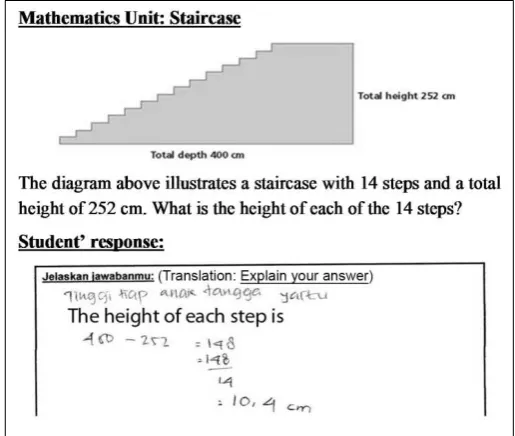
mathematical problem), process skills (error in performing mathematical procedures), and encoding (error in interpreting the mathematical solution). Among these error types, comprehension and transformation errors were found to be the most dominant errors made by the students, i.e. 38% and 42%, respectively. These results indicate that
improving )ndonesian students performance on context-based tasks can be done by
enhancing students ability to comprehend a context-based task and to transform it into
a mathematical problem. A closer examination into students errors revealed that a half
of the comprehension errors were errors in selecting relevant information. This finding suggests that improving the task comprehension of Indonesian students requires a focus
not only on students language competence, but also on the ability to select relevant
information.
Figure 1. An example of comprehension error, in particular error in selecting information
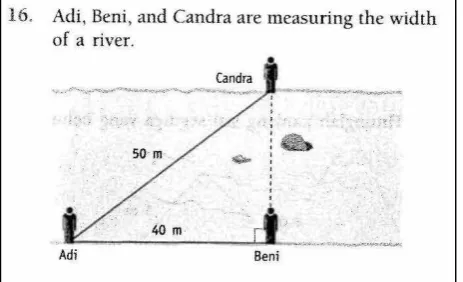
Figure 2. An example of transformation error
As a further endeavor to improve students performance, the CoMT) project focused on
identifying possible reasons for students errors. For this purpose, opportunity-to-learn
Mathematics Unit: Exchange Rate (question 2)
On returning to Singapore after 3 months, Mei-Ling had 3900 ZAR (South African rand) left. She changed this back to Singapore dollars, noting that the exchange rate had changed to:
1 SGD = 4.0 ZAR
How much money in Singapore dollars did Mei_Ling get?
Student’ response: Student’ response:
was considered as the key concept. Students opportunity-to-learn to solve context-based
tasks were investigated from two aspects: textbooks and teachers teaching practices.
Wijaya, Van den Heuvel-Panhuizen, and Doorman (2015) analyzed Indonesian mathematics textbooks and, in general, found a low quantity of context-based tasks in the textbooks. This result give an early indication about insufficient opportunity-to-learn to solve context-based tasks offered in Indonesian textbooks. To get a better understanding
of the relation between students errors and the textbooks, Wijaya et al. conducted a further investigation into the characteristics of context-based tasks in the textbooks in which they found correspondences between these two aspects. The substantial number
of students comprehension errors corresponds to the high number, i.e. 5%, of
context-based tasks that provide only relevant information and, therefore, do not require students to select information. The high number of transformation errors made by students relates to a low number of context-based tasks with relevant and essential contexts. Furthermore, all context-based tasks are located after the explanation sections in which a particular mathematics topic is discussed. It means students do not get enough opportunity to identify the procedures required to solve the tasks. These results indicate
that one of strategies that can be used to improve students performance on context
-based tasks is by developing textbooks, i.e. providing more context--based tasks which: (i) use essential and relevant context, (ii) include irrelevant information, and (ii) do not provide the required procedure(s) explicitly.
Figure 3. A task in Indonesian mathematics textbook that provides only the relevant
information and clearly indicates the required procedure
Students opportunity-to-learn was also investigated from teachers teaching practices
for which Wijaya, Van den Heuvel-Panhuizen and Doorman (submitted) examined
teachers teaching approach and the types of context-based tasks offered by teachers in
their classroom practices. Wijaya et al. found that the teachers teaching practices did not offer enough opportunity for students to learn to solve context-based tasks. The teachers mainly used directive teaching approach in which they tended to directly explain and give instruction. Such practice was in contrast to the practice recommended by experts in modeling (e.g. Blum, 2011) that context-based tasks should be taught through a student-centered and investigative teaching approach in which students are actively involved and
of tasks offered by the teachers in their teaching practices, the teachers mainly give tasks that provide only the relevant information and have explicit procedure. Such tasks do not support students to learn to select relevant information and to identify required procedure. These results provide important basis for developing ways to improve
students performance on context-based tasks, i.e. by improving teachers teaching
practices from two aspects: using consultative teaching and providing more context-based tasks which include irrelevant information and has missing information.
The final phase of CoMTI was developing an intervention program based on the results of the error analysis and the investigation into opportunity-to-learn (Wijaya, Van den Heuvel-Panhuizen, & Doorman, submitted). This intervention program comprised two components: consultative teaching approach and a set of context-based tasks that include irrelevant information and do not provide the required procedures explicitly. A closer
examination of the effect of the intervention on students errors revealed a significant
difference between the experimental group and the control group for the decrease in the total number of errors χ² , n = 4127) = 4.149, p = .042). This finding reflects a positive
influence of intervention program on reducing students errors. )n particular for
transformation errors a positive influence was found only for context-based tasks addressing graphs, i.e. the topic taught during the intervention period. Reflecting upon
this finding, it can be learned that to improve students ability to identify the required
procedure it is essential to provide mixed context-based tasks, i.e. tasks that are related
to the topic being taught and also other topics. Final Remarks
The aforementioned discussion and the example from CoMTI project show the importance of error analysis and an investigation into opportunity-to-learn as preliminary steps to develop an appropriate innovation, i.e. an innovation that fits the
needs and the characteristics of a particular country. By connecting students errors or
difficulties with opportunity-to-learn, we could identify what competences to be developed and what is missing in the existing educational process. However, we still have to consider iterative analysis and redesign aspects of design research (see Wang &
(annafin, . For example, a reflection upon the Wijaya et al. s submitted finding
that their intervention program has a better effect, in terms of transformation errors, for tasks addressing the taught topic indicates a room for improvement, such as providing context-based tasks addressing various topics.
Note:
The appendix shows a summary how an intervention program was developed on the basis of error analysis and an investigation into opportunity-to-learn.
References
Brewer, D. J., & Stasz, C. (1996). Enhancing opportunity to learn measures in NCES data. Santa Monica, CA: RAND.
Brodie, K. (2014). Learning about learner errors in professional learning communities. Educational Studies in Mathematics, 85(2), 221–239.
Hiebert, J., & Grouws, D. A. (2007). The effects of classroom mathematics teaching on
students learning. )n F. Lester Ed. , Second handbook of research on mathematics
teaching and learning (pp. 371–404). Charlotte: Information Age Publishing.
Husén, T. (Ed). (1967). International study of achievement in mathematics: A comparison of twelve countries (Vol. II). New York: John Wiley & Sons.
Pearson. (2014). The Learning Curve 2014: Education and skills for life. Retrieved from http://thelearningcurve.pearson.com/reports/the-learning-curve-report-2014 on June 24, 2014.
Radatz, H. (1980). Students' Errors in the Mathematical Learning Process: A Survey. For the Learning of Mathematics, 1(1), 16–20.
Stacey, K. (2011). The PISA view of mathematical literacy in Indonesia. IndoMS Journal on Mathematics Education, 2(2), 95–126.
Tornroos, J. (2005). Mathematics textbooks, opportunity to learn and student achievement. Studies in Educational Evaluation, 31(4), 315-327.
Wang, F., & Hannafin, M. (2005). Design-based research and technology-enhanced learning environments. Educational Technology Research & Development, 53(4), 5– 23.
Wijaya, A., Van den Heuvel-Panhuizen, M., Doorman, M., & Robitzsch, A. (2014). Difficulties in solving context-based P)SA mathematics tasks: An analysis of students errors. The Mathematics Enthusiast, 11(3), 555 – 584.
Wijaya, A. (2015). Context-based mathematics tasks in Indonesia: Toward better practice and achievement. Doctoral thesis. Utrecht University
Wijaya, A., Van den Heuvel-Panhuizen, M., & Doorman, M. (2015). Opportunity-to-learn context-based tasks provided by mathematics textbooks. Educational Studies in Mathematics, 89(1), 41 – 65.
Appendix
An investigation into Indonesian mathematics teachers’ teaching practices
Teachers’ report about the characteristics of context-based tasks offered to students: - most of the teachers frequently give tasks with explicit procedures
- most of the teachers frequently give tasks with matching information - a half of the teachers never or rarely give tasks with superfluous information - a half of the teachers never or rarely tasks with missing information.
Teachers’ teaching approach:
Over all stages of solving context-based tasks:
- No instruction was given in 42% of all questions discussed in the lessons. - Directive teaching was applied in 47% of all questions discussed in the lessons. - Consultative teaching was applied in only 12% of all questions discussed in the lessons.
Specified for the stages of solving context-based tasks:
- Directive teaching was most frequently applied in the comprehension and the transformation stages. - Consultative teaching was mostly applied in the mathematical processing stage.
- Almost no attention was paid to the encoding stage. Analysis of Indonesian mathematics textbooks
Exposure of the context-based tasks:
- Only about 10% of all tasks were context-based. Characteristics of the context-based tasks:
- most of the tasks used camouflage contexts and provide explicit indications about the required mathematical procedures. - most of the tasks provide matching information, i.e. only the
information that is needed to solve the tasks.
- almost no reflection tasks, i.e. tasks with highest cognitive demands which require constructing original mathematical
) Analysis of Indonesian students’ errors when solving context-based tasks
The most dominant error types:
- comprehension errors; in particular, errors in selecting relevant information.
- transformation errors; in particular, errors identifying the required mathematical procedures.
A positive effect of the OTL on students’ task comprehension was found:
- Students could understand better the instruction of the task - Students’ ability to select relevant information improved
- In general no effect of the OTL on students’ ability to transform a real-world problem into a mathematical problem. However, a positive effect was found for tasks addressing an interpretation of a graph, which in fact was related to the topic taught during the intervention. - This finding leads to a recommendation to offer students ‘mixed exercises’, i.e. a set of
context-based tasks that address various topics.
Consultative teaching approach with metacognitive prompts:
- Paraphrasing: asking students to formulate a task in their own words. - Underlining all information and circling
only the relevant information
- Context-based tasks with missing or superfluous information.
- Context-based tasks with a relevant context that requires modeling - Context-based tasks with
non-explicit procedure