Abstrak
Telah diutarakan secara singkat data-data klinis, Iaboratoris dan uii kulit anak dengan asma yang diperoleh
dari hasil
beberapapenelitian yang telah dilakukan
di
beberapa tempat di Indonesia. Data tersebut menunjukkan boi*o-paàa anak prevalensi penyakit atopi berkisar antara 3,8% sarnpai 25,5% dan penyakit asma antara 3,7% dan 16,4%. Tampaknya prevalensi penyakit alergi cli daerah pedesaan lebih rendah dibanding daerah urban danyang lertinggi adnlah di daerah perkotàan. ienyakit alergi yang terbanyak terdapatadalah penyakit alergi
ialan
napas. Perbandingan as,na pada anak laki-Iaki lebih tinggi dibaniing anak peretipuor,ion
sebagian besar umur pennulaan timbulnya asna adalah kurang dari 5 tahun. Sebagian besor asrià poda onatr mrnunjukkan riwayat atopijada
keluarga danjuga sering disertai adanya nanifestasi alergi lainnya. Jutnlah hitung eosinifil darah pada anak dengan
^,ro
urnu,nnyoneningkat, tetapi kenaikanjumlah eosinofil hipodens sanpai lebih dari 20% Iebih sering ditenukai. Kadar IgE serwnjuga urnumny' meningkat. Sebagian besar anak dengan asma menuniukkan tes kulit yang positip dan 3 alergen terbanyak
jenyebabieikulit
positipadalah debu rutnah, epitel binatang dan tungau debu runnh. Tes kulit positif terhadap tungaulebu
,r,nih
biororya juga nenunjukkantes FIST
yangpositip
dan teskulit
yang negatip nenunjukkantes
P7.ST yang negatip dengankorelasi
sebesar 77%. Tanpamemperhitungkan adanya pemberianfonnula atau nnkanan patlat dan tnakanan tantbahàn tainnya,
tilak
terlihat adanya korelasi yang bennakna antara larnanya penberianair
susu ibu dan unur perntulaat, tinùulnya osu,o po4o oirok.Abstract
A brief review on clinical, laboratory and skin test data of children with asthtna obtained front several studies done in certain places oflndonesia has been presented. The data revealed that the prevalence ofatopy rangedfrotn 3,8 %
to 25.5
% anàthe prevalence of asthtna rangedfrorn 3.7 % to 16.4 %. It seemed that the prevolence of allergic disiases-isii
the ciity. Respiratory allergy is the tnostco'nnon allergic disease in children. The proportion of asthnta in nnles is greater than infettnlesân4 the oge of onset'were rnostly under 5 years old. Asthnn in children,nostly showed positivefanùly history ofatopy and
iifrequently
associateà with other allergicdiseases- Eosinophil count is usually increased in asthtnatic children, but increased eosinophiT hypndrire to a percentage rnore than 20
% was nore frequent. seru,n IgE level is frequently increased in children with asthma.
ine
rtàjority of children with asthnn showed positive skin test and the three leading positive prick test were against house dust, aninal epithelioàni
hous" dust rnite. positive prick test against house dust mite was correlated with positive P#,ST and negativeprick
test with ,tegative MST overall to a level of 77 %. Without considering the presence offonnula or solidfood, there was no signifcant correlation between durationof
breastfeeiing
andage ofonset ofasthma.
Keywords : Asthtna, Prevalence, Atopy, serutn IgE, Eosinophil count, pricktest, Breastfeeding
Vol 3, No 1,
Jonuory
March 1994Asthma
in Children
:
View point
from
Indonesia
Corry
S.Matondang
INTRODUCTION
Asthma is
oneof
the diseaseswhich
isusually
seenin
our private practice.
It
is
oneof
the leading
causesof
school
absencesin
children.
The prevalenceof
asthma seems to be increased inthis
last decade and thefactors
responsible
for this
increase areprobably changing
of
Asthtna in Children 25
life
style,
industrialisation
and theincreasing
numbersof
new
chemicals.Atlhough childhood
and
adult
asthma
share thesame
pathophysiologic
mechanisms,
there are
some featuresthat
aredistinctive in infants
andchildren.
It
is
saidthat
themajority of
asthmain children
were of
allergic origin,
had family
history
of allergic
26
Matondangeases,l'2 age
of
onsetunder
five
years3'a and showedpositive skin test
with
the three leading
percentageagainst house
dust, animal epithelia
and house
dustmite.
Asthma
in children
alsoshowed
increasedlevel
of serum
IgE
and increased peripheral eosinophil
count.5'6
It
is
also
suggested
that
breast
feeding
canprevent, postpone
or
modify_the onset
of
atopic
dis-easesin
infants
andchildren.
/'ËIn
this connection
theauthor tried
to
illustrate
the clinical, laboratory
andskin
test data
of
children
with
asthmaobtained
from
several studies done
in
certain
placesof
Indonesia.
Prevalence
of asthma in children
From our
previous
community
study
in
certain
urbanareas around
central
Jakarta,
it
revealed that
the prevalenceof
atopy in
childre
25.5 %
and
6.9 %
among th
Konthen,lo in
his
community
6
to
20 years
old
in
acertain
rural
areain Bali
found
that the
prevalence
of
atopy was 13.8
%
and3.7
%among them was
asthma.Djayanto,ll in his
study
in
school
children
5.6
to
L3.4 yearsold in
South
Jakarta(city
area)
found that the
prevalence
of asthma
was16.4
%
(table 1).
It
seemed
that the
prevalence
of
asthmais
lower in
therural
area thanin
the urban area andthe highest
is in
thecity.
Whether this difference
was due to thedifferent environment
(pollution
andlife
style), further investigation
should be done.
This
dif-ferent findings
support
the opinion
that environment
beside geneticplay
arole in
themanifestation of
aller-cv'
Table
l.
Prevalenceof
asthmain
childrenin
Jakarta and Banyuatis Village BaliAuthor
Med
J
Uttiv IndonFrom
a
retrospective studyl2
conducted
in
theoutpatient
clinic,
Subdivision
ofAllergy
andImmunol-ogy, Department
of Child
Health,
Dr
Cipto
Mangun-kusumo
Hospital,
Jakarta
it
revealed that most
of
theoutpatient visitors were
asthmatic
children, the
next
most
were
urticaria followed by allergic rhinitis
andatopic
dermatitis (figure
1).But from
the community
studye
it
revealed that allergic
rhinitis
is
the
most
common
allergic
manifestation
in children
(9,0%).
Sodid Konthen,lU
h.
found
that the prevalenceof
allergic
rhinitis
was6.6
%.The different figure
obtainedin
the outpatientsclinic
may be due to that some patientswith
allergic rhinitis
visit
the outpatient
clinic of
the
Ear, Nose andThroat
department.But
as awhole it
revealedthat respiratory allergy
is the most common allergic
disease
in
children.
I
Male T--l Female oo d
t
E o ù
î
FAbFc Dêrnslitb Albçlc
Ffihlis
Place
of
study (age)Prevalence of asthma
N%
Konthenlo
Siregar et al9
Djayantoll
Banyuatis Bali rural area
(6 - 20 years)
East Iakarta (under 14 years)
South Iakarta city area
(5,6 - 13,4 years)
22159O
t71243
r92ltt7
|
37
Figure
I. Total percentage of ttllergic
disease in the outpatientclinic
Sub
Division of,Allergyfltntnunology Cipto Mangun-kusuttto Hospital, I 984."Sex
and
ageofonset
Table 2
showed
that the proportion
of
children with
asthma
in
males was greater thaninfemales.
69
Wtl 3, No
l,
Jartuurv - Mrtr<lr 1994Table 2. Sex ratio of children with asthma
Asrhtna in
Children
2i
Author
Place of study(ag")
in
agreementwith
the''
The high
percentage.
asthma supports the
Table 4. Family history of atopy in asthmatic children Sex ratio
Damanik et al
Konthenlo
Matondangl2
Siregar et al9
Djayantol I
Pangeran Hospital Yogyakarta (under 14 years)
Banyuatis Bali (6 - 20 years)
Cipto Mangunkusumo Hospital, Iakarta (8 months - 14 years)
Urban area East Jakarta (under 14 years)
South Jakarta (5,6
-
13,4 years)1.55 : I
l:l
1.36 : I
1.42 : I
1.4:
I
Family history of atopy N %
Presence
Absence 995
95.2 4.8
Total 104 100.0
This
is
in
agreementwith
thefindings of
other
inves-tigators.""*
The
cause
of
this sex variation
is
still
unknown, although humoral factors
have been empli-cated.Table 3. Age of onset of asthma in children
* Patient's siblings, parents and their siblings, grand father
and grand mother and their siblings. rô
Presence
other allergic
diseasesTable 5 showed that other
allergic
manifestations
arefrequently
associated
with
childhood
asthma.
This
finding is
also
seenby
other investigators.l'2
It
is not
known whether
the presenceof
otherallergic
manifes_tation
in
asthmais
anindication
that
the asthma tendsto
become chronic.
But
according
to
Kuzemko,l5
asthma
with
persistent dermatitis tends
to
becomechronic.
Table
5.
Other allergic manifestations in asthmatic childrenl6Other allergic manifestations Author Place of study Age of onset
under 5 years
Matondangl2
Djayantol I
Cipto Mangunkusumo Hospital outpatient clinic sub division of allergy/immunology
School children South Jakarta
70.2 %
46.4 %
t7.3 t3.4 6.7 62.5 %
Urticaria Allergic rhinitis Atopic dermatitis No other allergic diseases
l8
t4
7
6-5
Total 104 100.0
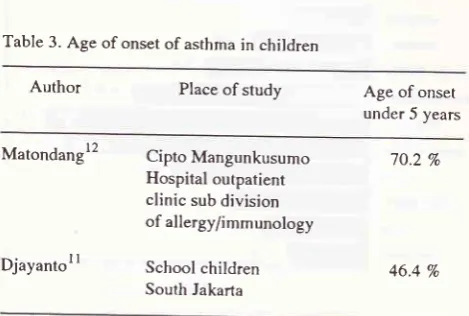
Table
3showed that most
of
thechildren
with
asthmahad the
age
of
onset
under
5
years.
This
is
also in
agreement
wi
rs.3,4This may
be
tions
which
may
pr
al.Family history of atopy
Table
4showed that most
of
thechildren
with
asthmavisiting
the outpatient
clinic
of
Subdivision of
Aller-gy/Immunology
showed a
positive family history of
atopy
(including
asthma,allergic
rhinitis,
urticaria
andSerum IgE
level
Henderson et al,s noted
that 75
% patientswith
extrin-sic
asthma showed increased serum
IgE
levels.
Our
studyr6 showed that 52 out of 97
children
1S:.0 To)with
asthma
without
considering
the presenceof
ascariasisor
other
allergic
manifestations showed
increased [image:3.595.57.294.102.354.2] [image:3.595.315.551.383.599.2] [image:3.595.56.291.413.571.2]7
28
Matondangof specific IgE
was
not
necessaryincreased the total
serum
IgE. They found that high
house dust IgE
specific can be
detected
in
normal total serum IgE
lêvel. Our studyl6
showed that 64 out
of
69
(92.8
%)children
with
asthma showedpositive skin
test against house dust. So thelower
percentage of increased serumIgE levels we
had,
may
be due
to what other
inves-tigators had noted.
It
seemedthat normal IgE
serumlevel did not rule
out the
presenceof allergic
asthma' [image:4.595.313.553.90.213.2]Other
factor
that may
influence
the
lower
percentage was thedifferent
technique we
used.Table 6. Serum
IgE
level and eosinophil countin
asthmatic childrenMed
J
Univ IndonTable 7. Result of prick test in asthmatic childrenl6
Prick test
Positive
Negative
92.8
7.2
Total 69 100.0
lncreased serum IgE levell6
Increased eosinophil countl6
:r:ï1"d'HlltPodense
greater
s2le1
3619r
17 lL8
39.5
94.4
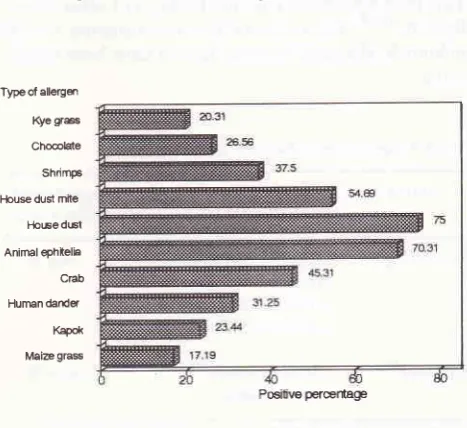
The three leading percentage of
positive
pricktest
were
against house
dust, animal ephitelia
and
house dustmite (figure
2). Thelîme
findings
were alsonoted
by
other investigators .22'23Wealso
noted thatpositive
skin
test against house dustmite
correlated
with
posi-tive
RAST
andnegative skin
testwith
negative
RAST
overall
to
a level
of
77
7o.24This
good
correlation
betweenpositive skin
test against house dustmite
andmite RAST
was also seen by other investig"tors,lT'18'23 Hsieh23found that
90
%of
serafrom individuals with
skin
testpositive to
mite
also
gavepositive
RAST.
Eosinophil count
McNicol
and
Williams6 found that peripheral
blood
eosinophil count
washigher
in
asthma comparedwith
controi group. Our
study16showed
that
36
out
of
9l
(39.5
%)children
with
asthmawithout
considering
the presenceof
ascariasisor other
allergic
manifestations
showed increase
eosinophil count
(table
6).
It
is
saidthat counting the
percentageof
eosinophil
hypodense is moresignificant
than thetotal eosinophil.re
lswari2ufound
that
17out
of
18(94,4
%)children
with
asthmavisiting
the outpatient
clinic of subdivision of
Pulmo-nology,
Department
of
Child
Health
Dr.
Cipto
Mangunkusumo
Hospital,
Jakarta, showed
apositive
eosinophil
hypodense greaterthan20
%.Allergy
skin testing
Table
7
showed that the majority
of
children with
[image:4.595.55.291.273.436.2]asthma showed
positive
skin
prick
tests., Suchfinding
were
also notedby
other investi
gators.'""
This
find-ing
supports the
opinion
that most
of
asthmachildren
were allergic.
Figure 2. Positive prick tests against various type of allergenl6
Breast feeding and
ageof
onset
of asthma
Saarinen et al,8
found that exclusive
breastfeeding
upto 6
months and even
up to 4
weeksTcan prevent or
postpone the onset
of
asthmain
achild
whosemother
is
anatopic
individual.
However
in
our studyl6
itt
104children
with
asthma, showed
that
there was
no
sig-nificant
correlation
betweenduration of
breastfeeding
and age
of
onsetof
asthma.This
different finding
may
Typeotellergs
Kye græ
Ch@lâte
Shrimps
Flouæ dusl mite
l-b6e dGl Animl ephfelie
CEb Humn dânds
KePok
MâiægEs
[image:4.595.318.552.363.577.2]ktl
-1, No l, Jurtuur\, - March 1994be due
to that
in this
study
the presenceof formula
or
solid food
besides breastfeeding
werenot
considered.SUMMARY
The prevalence of atopy in
children
rangedfrom
I3.8%
to25.5
%
andthe prevalence
of
asthma rangedfrom
3.7
%
to
16.4 %.
It
seemedthat the
prevalence
of
allergic
diseasesis lower in
the
rural
areathan
in
theurban
area and thehighest is
in
thecity.
Respiratory
allergy is
the most common
allergic
disease
in
children.
The
proportion
of
asthmain
males is greater thanin
females
and themajority of
thechildren
had an ageof
onset
under 5
years
old. Asthma children
mostly
showed
family
history
of
atopy and are
frequently
associated
with
other
allergic
manifestations.
The
presence
of specific
serumIgE to
housedust
wasnot
necessary increased thetotal
serumIgE.
Counting
the precentage ofeosinophil
hypodense is moresignificant
than the
total
eosinophil.
The
majority of
asthmain children
showedposi-tive prick test
and the three leading
percentage wereagainst house
dust, animal epithelia
and house
dustmite.
Positive
skin
test
against housedust
mite
corre-lated
with positive RAST
andnegative
skin
test
with
negative RAST.
There was
no
significant
correlation
betweenduration
of
breastfeeding
and ageof
onsetof
asthmawithout
considering the
presenceof formula or solid
food
besides breastfeeding.
REFERENCES
1. Sibbald B, Hom EC, Brain AE, Gregg I. Genetic factors in childhood asthma. Thorax 1988; 35 :671 - 4.
2. Zimmennan B, Feanny S, Reisman J et al. Allergy in asthma.
L The dose relationship of allergy to severity of childhood
asthma.
I
Allergy clin Immunol 1988;8l
: 63 - 77.3.
Blair H.
Natural historyof
childhood asthma. Archs Dis Child. 1977; 52:613 - 9.4. Godfrey S. Childhood asthma; in clark, Godfrey, Asthma; 2nd ed, pp 415 - 56 (Chapman arrd Hall, London 1983).
5. Henderson L, Swedlund HA, Van Dellen RG et al.
Evalua-tion of IgE tests
in
an allergy practice.I
Allergy clin Im-munol 1971;48 : 361 - 5.6. McNicol KN, Willaims HE. Spectrum of asthma in children.
BrmedJL9T3;IV:7-16.
Asthna in
Children
297. Chandra RK. Prospective studies of the effect of
breastfeed-ing on incidence ofinfection and allergy. Acta paediat scan
1979; 68 :691 - 4.
8. Saarinen
MV,
BackmanA,
KajosaariM,
Siimes MA.Prolonged breast-feeding as prophylaxis for atopic disease.
Lancet
l
:1979;163-6.9. Siregar PS, Suyoko D, Akib A, Munasir Z, Matondang CS.
Prevalensi penyakit atopi pada anak
di
Kelurahan Utan Kayu, dalam Simposium Kualitas hidup di Perkotaan, Aspek penyakit alergi. Pokja Immunologi FKUI, Iakarta, 1990. 10. Konthen PG. Prevalensi status atopi pada suatu populasiMajalah Ilmu Penyakit Dalam Surabaya
I
Int Med 1988; 14: 173 - 90.
ll.
DjayantoB.
Prevalensi asma pada anakdi
sekolah dasarYayasan Pendidikan Islam Al-Azhar, Jl. Sisingamangaraja Iakarta Selatan. Tesis 1991.
12. Matondang CS. Asma pada anak (Gambaran
klinik
sertahasil
uji
kulit).
Symposium advancesin
the treatment ofhouse dust mite allergy, Jakarta, 1991.
13. Smith
MJ.
Prevalence and natural historyof
asthma inschool-children. Br med
I
196l; I
:7ll
- 3.14. Balfour-Lynn L. Childhood asthma and puberty. Archs Dis. Childh 1985;60:231 - 5.
15. Kuzemko
IA.
Natural history of childhood asthmaI
Pediat1980;
9l
: 886 - 92.16. Matondang CS. Spectrum of asthma in children visiting the
outpatient clinic of the subdivision of Allergy and
Immunol-ogy Paediatr. Indones
l99l; 3l
: 150 - 64.17. Nagaya H. Relationship between antigen specitif IgE
an-tibody (RAST) and total serum
IgE
levels. Ann Allergy 1979;43 :267.18. Kuno-Sakai H. Total serum IgE and specific IgE antibodies
in children with bronchial asthma. Ann Allergy 1986; 56 :
488 - 91.
19. Shult PA, Lega
M,
Jadidi S, Vritrs R, Wamer T, GrazianoFM, Busse WW. The presence of hypodense eosinophils and
diminished chemilumirescence response in asthma. J.
Aller-gy clin. Immunol 1988;
8l
: 42O - 37.20. Iswari S. Hubungan eosinofil hipodens dengan
hiperreak-tivitas bronkus pada asma anak. Penelitian pendahuluan Fakultas Pasca Sarjana Universitas Indonesia, Program Studi Ilmu Kesehatan Anak, Iakarta, 1990.
21. Rackemann FM, Edwards MC.
A
follow up study of 688patients after an interval of twenty years. New Engl
I
Medt952;246:858
- 63.22.Wood, CBS, Oliver
J.
SerumIgE
in
asthmatic children. Relation to age, sex, eczema and skin sensitivity test. Arch Dis Childh 1972;47 : 890 - 6.23. Hsieh KH.
A
study of intracutaneous skin tests and RadioAllergo
Sorbent Teston
1.000 Asthmatic Children in Taiwan. Asian Pasific J Allerg Immun 1984;2: 56 - 60.24. Tumer KJ, Sumarmo, Matondang CS. Precipitating factors
in
respiratory allergic diseasein
Indonesia children Clin.