INTERPERSONAL METAPHOR IN POLITICAL
DEBATE
A Thesis
Submitted to English Applied Linguistics Study Program in
Partial Fulfillment of the Requirements for the Degree of
Magister Humaniora
By:
HESTIKA GINTING Registration Number. 8106112010
ENGLISH APPLIED LINGUISTICS STUDY PROGRAM
POSTGRADUATE SCHOOL
ACKNOWLEDGEMENTS
First and foremost, I praise God, the almighty for providing me this opportunity and granting me the capability to finish this thesis. This thesis appears in its current form also due to the assistance and guidance of several people. I would like to offer my sincere thanks to all of them who made this thesis possible and an unforgettable experience to me.
I would like to express my sincerest gratitude to my advisors Prof. Amrin Saragih, M.A., Ph.D. and Prof. Dr. Busmin Gurning, M.Pd. who have supported me during my thesis completion with their patience, motivation, enthusiasm, and immense knowledge. Besides my advisor, I would like to express my deep thanks to the my thesis examiners Prof. Dr. Berlin Sibarani, M.Pd, Dr. Didik Santoso, M.Pd, and Dr.Tyrhaya Zein, M.Pd., for their encouragement, insightful comments, and questions.
I acknowledge my gratitude to Dr. Rahmad Husein, M.Ed and Prof. Dr. Sri Minda Murni, M.S., Head and Secretary of English Applied Linguistics Study Program for assistance in completing the administrative procedures as well as Farid Ma’ruf as an administrator of LTBI who has given assistance in completing the official administration to fulfill this thesis. I am also indebted to all lectures at LTBI UNIMED who have given immense knowledge to all of the students during my study there.
fun and memorable time we had. I am thankful to my best friends Eka, Julia, Luhetri and Resty who were always beside me during the happy and sad moments to push me and motivate me whenever I was in need. My gratitude is also to Emma, Febrika and Meilinda for their support and precious friendship. I am thankful to Rona, Jessy, Calvin, Lylies, Tini and all friends from Nanyang and Bina Insan Mandiri School for the time with laughter, and support. Thank you doesn’t seem sufficient but it is said with appreciation and respect to all of you for your support and encouragement, understanding, and precious friendship.
Lastly, I would like to express the profound gratitude from my deep heart to my beloved family; my parents, my brothers for their love, support they provide me through my entire life. I attribute my master degree to my parents’ encouragement and effort and without them this thesis, too, would not have been completed.
Medan, September 2015
ABSTRACT
Ginting, Hestika. Interpersonal metaphor in political debate. A Thesis. English Applied Linguistics Study Program, Postgraduate School, State University of Medan, 2015.
ABSTRAK
Ginting, Hestika. Interpersonal Metaphor dalam Debat Politik. Thesis. Program Studi Linguistik Terapan Bahasa Inggris, Sekolah Pasca Sarjana, Universitas Negeri Medan (UNIMED) 2015.
v 1.1The Background of The Study………1
1.2The Problems of The Study…..………..7
1.3The Objectives of The Study…..………7
1.4The Scope of The Study………..8
1.5The Significance of The Study…..………..8
CHAPTER II: REVIEW OF RELATED LITERATURE 2.1 Interpersonal Metaphor ……….……….9
2.1.1 Metaphor of Mood...………..………...14
2.1.2 Metaphor of Modality ...………..……… 15
vi
CHAPTER IV: DATA ANALYSIS, FINDINGS AND DISCUSSION
4.1Data Analysis……… 32
4.1.1 The Way Interpersonal Metaphors With Reference to Mood and Modality Metaphor Used by Debaters in the Political Debate……….38
4.1.1.1 Command in declarative mood……… 39
4.1.1.2 Statement in interrogative mood………. 41
4.1.1.3 Question in declarative mood……….. 43
4.1.1.4 Statement in imperative mood………. 45
4.1.2.5 Metaphorical realizations of probability………. 45
4.1.2.6 Metaphorical realizations of usuality……….. 47
4.1.2.7Metaphorical realizations of obligation……….. 47
4.2 The Circumstances of Interpersonal Metaphors With Reference to Mood and Modality Metaphor Used by Debaters in the Political Debate …...……….... 49
4.3 Findings………...……….. 52
4.4 Discussion………... 54
CHAPTER V: CONCLUSIONS AND SUGGESTION 5.1 Conclusions……….. 57
5.2 Suggestions……….. 58
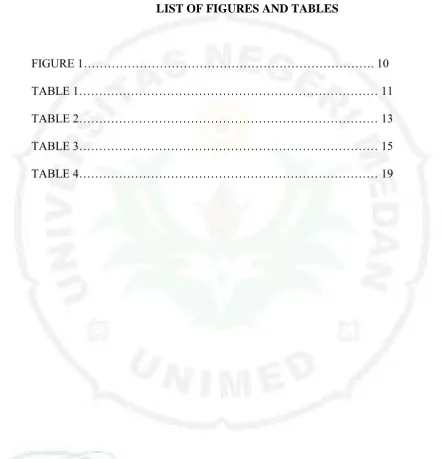
LIST OF FIGURES AND TABLES
FIGURE 1………. 10
TABLE 1……… 11
TABLE 2……… 13
TABLE 3……… 15
CHAPTER 1
INTRODUCTION
1.1The Background of the Study
In September 2012 Jakarta governor Fauzi Bowo and Surakarta mayor Joko
Widodo faced off during the Jakarta gubernatorial debate. In this debate both Jakarta
governor Fauzi Bowo and Surakarta mayor Joko Widodo argued what they believe
will bring security, welfare and peace to Jakarta citizens. Each of them convincingly
tried to show their desire to lead the capital city into a better one. However, Joko
Widodo was the candidate who could convince the voters to elect him to be the next
Jakarta mayor. The voters were amazed and inspired by the rich language expressions,
impassioned statements and wholehearted attitudes he applied in his speech in order
to win more voters. Jokowi as a newcomer in Jakarta and less experienced than Fauzi
succeed to win the voters’ heart. This study analyzed how the candidates
communicate their message to achieve their goals. To address this aim, the study used
the theory of systemic functional grammar with reference to Interpersonal metaphor.
Interpersonal metaphor is important, especially in political discourse. As a part
of grammatical metaphor, it deals with meaning about relations and attitudes between
participants, their status and their feelings about what is said. The use of interpersonal
metaphor creates special interpersonal and discourse effects, helping the speaker to
persuade and dominate others. As we know, politicians always use language to
vividly convey their ideas and make their point clear to people. Politicians also need
aims and ideas. The more vividly and convincingly politicians present their argument,
the more likely they can influence people.
When language is used effectively, it benefits the speaker. As in the politics if
the politicians can influence people with what they say and do, they can ensure people
to support them. Thus, more analyses about political especially in debate are needed.
This study was going to explore the language use with systemic functional approach
in the political debate.
The Jakarta gubernatorial election was chosen because it had been the
headline not only in local media but also in United States. New York Times showed
its interest in its article entitled "Outsider Breathing New Ideas into Jakarta Election"
which was later on changed into, "Joko Widodo, Breathing New Ideas Into Jakarta
Election". The article stated that Jokowi representing the new generation of
Indonesian political figure. Even though Joko Widodo had just involved himself in
Indonesian politic but his dedication made him chosen by the Tempo magazine as
one of the 'Top 10 Indonesian Mayors of 2008'. In addition, in 2012 he received 3rd
place of the 2012 World Mayor Prize for "transforming a crime-ridden city into a
regional center for art and culture and an attractive city to tourists. Meanwhile the
incumbent Fauzi Wibowo was the governor of Jakarta for the 2007–2012 terms. He
previously served as deputy governor. He had worked for the Jakarta administration
since 1987.
Revyanto (Tempo 2012) stated that the second and final round of the Jakarta
gubernatorial election was a stunning victory for democracy. The power in politics is
usually dominated by the elite and their wealth. However, governor elect Joko
configuration. The two candidates overcome assaults reeking of racism and religious
prejudice that would surely endanger democracy in this country.
Language use in politics has been always of the writer’s personal interest and
it is apparent to the writer that language use in politics is complicated and needs
studying. Although some studies have investigated political discourse, political debate
may present dissimilar characteristics. The main function of using interpersonal
metaphor is to accurately reflect the speaker's point of view of a proposition,
expresses related emotion, and play the role of judgment. The interpersonal
grammatical metaphor constitutes indispensable expression styles in the political
debate and so it plays an essential role of expression.
Interpersonal metaphor comprises the expression of mood and modality. Mood
expresses the speech function; and modality expresses the speaker’s judgment or
evaluation. Zhixiang (2012) in his exploration of metaphors of modality and mood in
the presidential debate of First Bush and John Kerry found out that metaphor of
modality’s main function is to highlight the firmness of one’s attitude or belief,
disguise the subjective nature of one’s arguments, express relevant connotative
meanings, and help to optimize one’s presentations for one’s goals. Meanwhile
metaphor of mood is mainly used to persuade the audience implicitly into accepting
the debater’s arguments, shorten the social and psychological distance between the
debater and the audience, induce the audience’s participation in the intended dialogue,
make one’s views sound more authoritative and make one’s tone more emphatic or
more euphemistic.
Therefore, the interpersonal metaphor plays essential part in the political
understand and analyze the function of grammatical metaphor theory in the political
discourse.
Grammatical Metaphor is proposed first by Halliday, who treated it as an
important component of system language functions theory and made significant
contribution to the metaphor study. At first, research on metaphor was done from the
perspective of rhetoric, which is the traditional metaphor. After that, Halliday (1985)
asserts that metaphors can also be looked into from the perspective of Functional
Grammar. Systematic functional linguistics studies the metaphor from the point of
view of meaning expression. Grammatical metaphor considers that the metaphor is
not limited in the vocabulary level, but is often seen in the syntax level. According to
the theory of grammatical metaphor, grammatical metaphor includes three types –
ideational metaphor, interpersonal metaphor, and textual metaphor.
Halliday’s approach to metaphor is based on the fact that there are two choices
of grammatical structures namely congruent and incongruent. According to Halliday
grammatical metaphor is perceived as an incongruent realization of a given semantic
configuration in the lexicogrammar. In other word a semantic configuration that
would be represented congruently (i.e., non-metaphorically) by one type of clause is
represented metaphorically by another.
Selecting process type, transitivity functions, choices in mood and modality
and further structuring them the way the speaker wants it are the reason for the choice
of the metaphorical form. Moreover, grammatically metaphorical forms are never
totally synonymous with their non-metaphorical configuration; there will always be
Metaphorical meaning is the result of a special process for construing a certain
meaning. The purpose of using a metaphor is to get the lexis and the grammar the way
the speaker wants it in order to produce a certain effect. Moreover, since the use of the
metaphor presents an alternative way of constructing a picture of reality, we may even
find an ideologically charged representation in the choice of metaphor. In other
words, the incongruent form always has an effect which can go from the aesthetic to
the ideological. Among the three systems of grammar in metaphor; ideational
metaphor, interpersonal metaphor and textual metaphor, this study employed the
theory of interpersonal metaphor and debate is chosen as the source of data.
Research on political candidate images has long supported the argument that
voters make voting decisions based on the perceived image of the candidate from the
political advertising and televised debate. Debates serve an important function for
candidates since it represents the source of mass communication in which the message
of each candidate can be directly delivered to the audience. Candidates can also
improve their image in a short time as well as reach the voters with convincing
arguments.
Debates are commonly used in democratic societies to explore and resolve
issues and problems. Debate as one of the campaign media enables presidential,
governor, mayor candidates to show their political savvy, especially in presenting
their positions and solutions dealing with the recent issues. During the debate
language plays a crucial role for every political action. Political debates are indeed
important parts of the political communication.
In politics two or more parties have to struggle for power in order to put
communication can help them to win people’s heart. One way to express the
politicians’ political positions or ideas in order to win people’s heart is by having a
debate with their opponents. Debate is a formal, discussion or structured contest about
an issue or a resolution that enable the politicians convincingly present their views. In
debate, two individuals or teams presenting arguments to support or oppose a
question. To state their positions, liberate their ideas or attacking their opponent’s
views, participants must follow a set of rules that have been agreed on in debate.
Lasch (1996: 162–3) stated that democracy requires not only information but
also vigorous public debate. Debate can generate the kind of information that
democracy needs. Moreover he said that we do not know what we need to know until
we ask the right questions, and we can identify the right questions only by subjecting
our own ideas about the world to the test of public controversy. Information, usually
seen as the precondition of debate, is better understood as its by-product. When we
get into arguments that focus and fully engage our attention, we become avid seekers
of information. Otherwise we take in information passively – if we take it in at all. In
addition, many cite the debate as the quintessential example of the power of television
images. Televised debates have become a crucial part of campaigning.
From the perspective of systemic functional grammar, this study took the
2012 Jakarta gubernatorial debate as the source of data and identified the
interpersonal metaphor with reference to metaphor of mood and modality in debate,
and analyzed the function and the use. By conducting the analysis in the political
discourse, we would be able to reveal how the politicians initiate their discourse with
the audiences or voters, establish the relationships and convince the voters via
The functional analysis of interpersonal metaphor with reference to mood
metaphor and modality metaphor could enable us to understand the interpersonal
meaning of the political debate from a new perspective, which elaborates the
subtleties of language use in political discourse and help us have a better
understanding of it. A large number of studies have shown before that the use of
grammatical metaphor theory can successfully deconstruct the science, technology,
political and news discourse. Due to its functionality, this study aimed to explore the
function and application of interpersonal in Jakarta gubernatorial political debate in
2012.
1.2 The Problems of The Study
Based on the background stated above, the problems of study are formulated
as the following.
1. How are the interpersonal metaphors with reference to mood metaphor and
modality metaphor used in political debate?
2. In what circumstances are the interpersonal metaphor with reference to
mood metaphor and modality metaphor used?
1.3 The Objectives of The Study
In relation to the problems, the objectives of study are
1. to elaborate interpersonal metaphor with reference to mood metaphor and
2. to reason for why the debaters use the interpersonal metaphor with
reference to mood metaphor and modality metaphor to communicate their
message(s) in light of their communicative goals in political debate.
1.4 The Scopes of The Study
This study applied the concept of the systemic functional linguistics (SFL)
proposed by Halliday. This analysis was aimed at investigating Interpersonal
Metaphor with reference to mood metaphor and modality metaphor realized in
political debate used in 2012 Jakarta gubernatorial election political debate between
Jokowi and Fauzi Bowo which was aired on Metro TV
1.5 The Significances of The Study
Findings of the study are expected to be useful theoretically and practically.
1. Theoretically, the findings is expected to be useful for the readers, especially
for the students of English department to understand the metaphor of mood
and modality used in political debate and to improve English learners’
speaking and writing so that they can develop their communicative
competence effectively.
2. Practically, the findings are expected to be useful for other researchers to
conduct research on the basis of SFL, in which the finding can give significant
CHAPTER V
CONCLUSION AND SUGGESTIONS
5.1 Conclusions
After analyzing interpersonal metaphors in political debate of Jakarta’s
governor election, conclusions are drawn as the following.
(1) Both types of Interpersonal Metaphor namely Mood Metaphor expressing command, statement as well as question and Modality Metaphor comprising
probability, usuality and obligation in high, medium, low values and
subjective and objective orientation are used by the debaters in delivering
their ideas in the political debate. The mood metaphor is used to persuade
the audience implicitly into accepting the debater’s argument, shorten the
social and psychological distance between debaters and audience, induce the
audience’s participation in the intended dialogue and to make other debaters’
views sound authoritative. Modality metaphor is used to highlight the
firmness of their belief and to disguise the subjectivity nature of their
arguments.
(2) All debaters use mood metaphor and modality metaphor which is closely to social context. The field, mode and tenor significantly affect the candidates
5.2 Suggestions
In the relation to the conclusion, suggestions are offered as the following.
(1) It is suggested that other researchers conduct detail analyses of interpersonal metaphors and any other grammatical metaphors in different
phenomena to find out specifically the functions and effect they make.
(2) More researches on political discourse such as presidential acceptance speeches, political interview, etc., are needed in order to give better
REFERENCES
Barbaros, A.C. 2007. Exploring Televised Political Debstes: Strategies and Issues. University of IASI. Romania
Bogdan, R., and Biklen, S.K. 1992. Qualitative Research for Education. Boston: Allyn and Bacon
Butler, Christopher S. & Miriam Taverniers. 2008. Layering in structural-functional grammars. Linguistics 46(4): 689-956.
Bybee, J. & S. Fleischman, 1995. Modality in Grammar and Discourse. Amsterdam:
Benjamins.
Cai-yan, Feng. 2011. Functions of Metaphor of Modality in President’s Radio Addresses. Journal. University of Mingbo Dahomngying. China
Cohen , L. et al. 2007. Research Methods in Education. Milton Park: Routledge
Dong, Jiezhen. 2013. Interpersonal Metaphor in Legal Discourse:Modality in Cross Examinations. Journal. Guangdong Pharmaceutical University. China
Eggins, S. 2004. An Introduction to Systemic Functional Linguistics. Continuum. New York.
Fadda, Sandra. The Use Of Metaphors In Political Discourse:The Speeches Of George W. Bush. 2006. Argentina: 33rd ISFC (International Systemic Functional Congress.
Halliday, M.A.K. 1985. An Introduction to Functional Grammar. London: Edward Arnold
Halliday, M.A.K. 1994. AnIntroduction to Functional Grammar. London: Arnold Halliday, M. A. K., & Mathiessen, C. M. I. M. (2004). An Introduction to Functional
Grammar. London: Arnold.
Hu, Z. 1988. A Course of Linguistics. Peking: Peking University Press.
Huang, Guowen. 2001. Theory and Practice of Discourse Analysis: A Research on
Advertising Discourse. Shanghai: Shanghai Foreign Language Education
Press.
Kaid, L. L. 2004. Political advertising. In L. L. Kaid, (Ed.), Handbook of political
communication research, (pp. 155-202). Mahwah, NJ: Lawrence Erlbaum
Lasch, C. 1996 The Revolt of the Elites and the Betrayal of Democracy, New York and London: W.W. Norton & Co.
Martin, J.R. 1992. System and Structure. London:Routledge
Martin J. & Rose D. 2003, Working with Discourse: Meaning beyond the Clause, Continuum, London & New York.
McKinney, M.S. & Carlin, D. B. 2004. Political Campaign Debates, in L.L. Kaid (Ed.) Handbook of Political Communication Research, (pp. 203-234). Mahwah: Lawrence Erlbaum.
Miles, M., & Huberman, A.M. 1994. Qualitative Data Analysis. Thousand Oaks, CA: Sage Publications.
Pfau, M., Cho, J., & Chong, K. 2001. Communication forms in U.S. Presidential campaigns: Influences on candidate perceptions and the democratic process. Press/Politics, 6, 88-105.
Quirk,R. et al. 1985. A comprehensive Grammar of the English Language. London: Longman.
Revyanto. Goodbye Solo,, Hello Jakarta. TEMPO. September 24th 2012. Saragih, Amrin. 2002. Bahasa dalam Konteks Sosial. Medan: FBS Unimed. Thompson, G. 2004. Introducing Functional Grammar. London: Arnold.
Wang, X. 2010. Grammatical Concepts and Their Application in Foreign Language. Univerity of Tasmania.
Wu, J., & Tang, L. 2010. Grammatical Metaphor in News English Discourse. Journal. Qingdao University.
Xu, J. 2009. Interpreting Metaphor of Modality in Advertising English. Journal. Zhenjiang: Jingsu University.