ISSN 1682-8356
© Asian Network for Scientific Information, 2013
Corresponding Author: Niken Ulupi, Faculty of Animal Sciences, Bogor Agricultural University, Jl Agatis IPB Campus, Darmaga, Bogor,
Association of TLR4 Gene Genotype and Resistance Against
Salmonella
enteritidis
Natural Infection in Kampung Chicken
Niken Ulupi , Muladno , Cece Sumantri and I. Wayan Teguh Wibawan1 1 1 2 Faculty of Animal Sciences Faculty of Veterinary Medicine,
1 2
Bogor Agricultural University, Jl Agatis IPB Campus, Darmaga, Bogor, West Java-16680, Indonesia
Abstract: Eggs of kampung chicken play an important role as substance in ‘jamu preparation’ in Indonesia, mostly provided and consumed without cooking. Salmonella free eggs become significant in producing the safe ‘jamu preparation’ and such eggs might be produced by chickens which have high resistancy to this bacteria. One of excellent markers showing resistance of chicken against Salmonella is an active Toll-like Receptor 4 (TLR4) gene. TLR4 is a phagocytes cell surface receptor that plays a role to recognize lipopolysaccaride (LPS) of gram negative bacteria including Salmonella enteritidis. It is transcribed by TLR4 gene and conserved in the activation of the non-specific immune system. The aim of the research was to prove how kampung chicken resistant against natural infection of S. enteritidis, using TLR4 gene as marker. TLR4 gene was genotyped in 50 kampung chickens with PCR-RFLP. Then biological assays of resistance indicator were measured. The genotyping result on exon 2 (220 bp in size) identified 3 genotypes of TLR4 gene in kampung chicken: AA, AG and GG. Concentration of leucocytes and their differentiation were not significantly different in AG and GG genotype. The value of it from AA genotype was similar to them. There was no S. enteritidis finding in blood and eggs produced by AA, AG, GG chickens. Specific IgY to S. enteritidis was positively found in kampung chickens serum and egg yolk. Concentration of specific IgY in kampung chicken egg yolk was found very high. The study postulated that most likely kampung chicken resistant to S. enteritidis natural infection.
Key words: Kampung chicken,TLR4 gene, genotyping, non-specific immune INTRODUCTION
Salmonella is one of the emerging pathogen in food borne disease which is often found in contaminated chicken eggs (Bhunia, 2008). The isolation incidence of salmonellosis in humans due to consumed of chicken eggs was mostly caused by S. enteritidis (Velge et al., 2005). Eggs can be contaminated with S. enteritidis from the beginning of the formation process inside parent body that infected by these bacteria. Eggs also can be contaminated by these bacteria from the environment in which eggs were stored until to consument (Gantois et al., 2009).
Nugroho (2005) stated that 1.4% of egg samples from 35 farms of commercial chicken in Sleman positively contaminated by Salmonella sp. The similar experiment has been conducted in Bogor. It has been found out that the eggs positively contaminated by S. enteritidis by 3.12% (Ulupi et al., 2009).
Kampung chicken eggs mostly used by Indonesian people as ‘jamu’ (a potion) or as an ingredient of potion that it was directly consumed without cooking. Kampung chicken is a kind of Indonesian local chicken that do not have special characteristic and spread out in various regions of Indonesia (Nataamijaya, 2010). Most of the kampung chickens were traditionally reared by people in a state of less hygiene. This condition allow exposure of
some disease agents including from S. enteritidis bacteria. Thus the chance of people who consumed kampung chicken eggs exposed to salmonellosis was very large. Nevertheless, there never has been found any report of salmonellosis cases due to consume of raw kampung chicken eggs.
Some researches on the isolation of S. enteritidis on kampung chicken eggs in a various of conditions, from different regions (Semarang, Bogor and Bali), did not find these bacteria (Budi, 1993; Alvina, 2007; Aditya et al., 2012). This fact raised the question of whether genetically kampung chicken has greater resistance against the infection of Salmonella compared to commercial chicken, just like their resistance to the infection of Avian Influenza (Maeda, 2005).
In general, the immune system consists of genetic component, molecular component and cellular component that interact with each other and forming a complex communication networks (Subowo, 1993). As a genetic component, the immune system was controlled by many genes. One of them was the TLR4 (Toll-like receptor 4) gene, which was part of the TLRs genes (Calenge et al., 2010).
ij i ij
Y = µ +P + ε
innate immunity. In bacteria, the components were for 30 seconds (annealing) and 60 C for 30 seconds lipopolysaccharide (LPS), peptidoglycan, lipoprotein (extension). The final extension was for 5 minutes (72 C) (lipopeptide), and bacterial DNA (Emertcan et al., 2011). (Muladno, 2010). RFLP method was used to determine Each of these components bound to a particular part of the genotype TLR4 gene. PCR result of the TLR4 gene the TLRs (Kabelitz, 2007). Bacterial component which is fragments was cut by MscI restriction enzymes. PCR bound to receptor TLR4 was LPS from gram-negative products that have been cut with enzyme were bacteria, including Salmonella (Akira and Takeda, 2004). electrophoresed using 2% agarose gel.
The result research showed that occurrence of The genotyping resultcalculated frequency of genotype mutations of the TLR4 gene on humans and mice TLR4 gene. The calculation was based on Nei (1987). impacted on the decreasing of the individuals ability to
recognize LPS from Salmonella. These individuals Biological assays: On the second week of the kampung became sensitive, and easily infected by Salmonella sp. chicken rearing, biological assays were done. There (Lorenz et al., 2002). Occurrence of mutations in the were including some indicators of body resistance TLR4 gene caused the formation of some genotypes. against S. enteritidis natural infection.
The aim of the research was to prove resistance of Concentration of leukocytes and differentiation of kampung chicken against natural infection of S. leucocytes were assayed with Giemsa method enteritidis, using TLR4 gene as marker. The evidence (Djokowoerjo et al., 1989). Concentration of specific IgY was done by analyzing the association between in egg yolk was measured by Indirect ELISA protocol genotype of TLR4 gene with the factors that indicate the (Abcam, 2013). The presence of specific IgY in serum resistance to these bacteria that was obtained from was identified by AGPT method and the assay of S. biological assays. enteritidis concentration was refers to SNI 01-2897-2008 MATERIALS AND METHODS
The research was conducted during five month (April to August 2013), at Laboratory of Poultry Production, Molecular of Animal Breeding and Genetics Laboratory, Faculty of Animal Science and Laboratory of Physiology, Laboratory of Medical Microbiology, Faculty of Veterinary Medicine, Bogor Agricultural University, Bogor.
Animal experiments and rearing: Fifty kampung chicken TLR4 gene genotype In kampung chickens: TLR4 gene female (8 month aged) were reared during four weeks in chickens was on chromosome 17. Based on the data (2-29 April 2013). The feed was commercial feed for from GenBank (A Y064697.1), the size of TLR4 gene laying hens that contain 14-17% crude protein and 2850 was 11698 bp. Structure of this gene was begun by a kcal/kg metabolizable energy. Feed and water were promoter region (2743 bp), exon 1, 2 and 3 (105, 167 given ad libitum. and 3260 bp), intron 1 and 2 (934 and 984 bp), and the The kampung chickens were randomly placed at cages. end was the flanking region (3505 bp). TLR4 gene was The cage size was 35x45x50 cm . All of the cages were3 genotyped on exon 2 (from base to 3898-4117), with a placed in a pen (7x10 m ). The feed and water were2 220 bp PCR product. Result of this study was presented placed in the front of cages. This pen was equipped with in Fig. 1.
2 light bulbs. Figure 1 was the result of PCR of TLR4 gene fragment
TLR4 gene genotyping: At the beginning of the first week exon 2 site 3924 (TGG|CCA). In this figure, N was the of kampung chicken rearing, TLR4 gene was genotyped TLR4 gene PCR amplification product in exon 2 by using from all of the kampung chickens. Blood sample was primer (F) : 5’-GCTCAAATATTTTCATCAGTggCC-3’ and taken from the brachial vein in the wing area. (R) : 5’-ATCTGG ACTGAAAGCTGCAC-3’. The cutting by This test consists of 3 phases: DNA extraction, PCR restriction enzyme resulted allele A (with size 196 bp and amplification and RFLP (Restriction Fragment Length 24 bp), and allele G (with size 220 bp). AA, AG and GG Polymorphism). Genomic DNA extraction used phenol- were TLR4 gene genotypes of kampung chicken which chloroform method (Sambrook et al., 1989). PCR was identified.
reactions was using primers designed (F): 5’- A presence of mutation was detected on site 3924. This GCTCAAATTATTTTTCATCAGTggCC-3’ and primer (R): mutation caused bases change from guanine (G) to 5’-ATCTGGACTAAAGCTGCAC-3’. PCR reaction was adenine (A). Changing of nucleotide changed the amino started with an initial denaturation at 95 C (5 minute).o acid from glutamic acid (GAA) to lysine (AAA). This result Then it was performed for 35 cycles of amplification, was similar to those reported by Beaumont et al. (2003), respectively at 95 C for 30 seconds (denaturation), 60 Co o on the commercial brown laying hens.
o
o
(BSN, 2008).
Data analysis: Data were analyzed with ANOVA using completely randomized design. TLR4 gene genotype was as treatment and biological assays data were as response. Statistical model was used
(Mattjik and Sumertajaya, 2002). RESULTS AND DISCUSSION
From 50 blood samples of kampung chicken that was genotyped, has been produced AA genotype (1), AG genotype (18) and GG genotype (31). Genotype frequency of TLR4 gene of the kampung chicken was presented in Table 1.
Table 1: Genotype frequency of the TLR4 gene in kampung chickens
Genotype Frequency
AA 0.02
AG 0.36
GG 0.62
The frequency of GG genotype dominated the kampung chicken samples in this study. The presence of AA genotype in kampung chicken was caused by a cross between the chickens that TLR4 gene mutated (AG). In kampung chicken, a cross between individuals still occurred randomly and openly (Sulandari et al., 2007), thus it will add diversity of heterozygous genotype TLR4 gene.
Association of TLR4 gene genotype and resistance against S. enteritidis natural infection in kampung
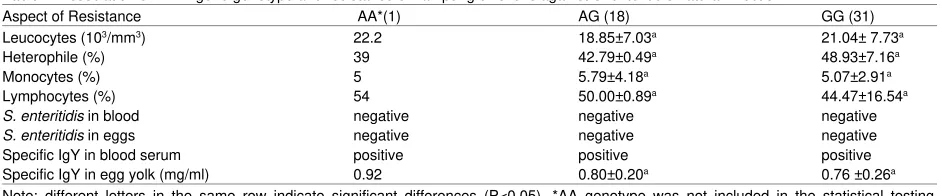
chicken: Association of TLR4 gene genotype and resistance of kampung chickens against S. enteritidis natural infection was presented in Table 2.
Leucocytes and differentiation of leucocytes concentration: Leucocytes concentration of kampung chicken that had TLR4 gene with AG and GG genotype were not statistically different. Kampung chicken leukocytes concentration (AA, AG and GG genotype), included in normal category (12-30x 10 cells/mm ) (Jain,3 3
1993). The percentage of leukocytes differentiation (heterophile, monocytes and lymphocytes), were almost equal to the research result of Yusriani (2012), who reported that in 10 weeks aged of the kampung chicken had percentage of heterophile, monocytes, and lymphocytes, respectively 38.20%, 5.67%, and 56.80%. Ratio of heterophile and lymphocyte percentage (H/L) was an indicator of stress levels for chicken. According to Swenson (1984), in chicken, ideal H/L ratio was 0.45-0.50. Outside of this range, chicken was in stress conditions. In this study, ratio of H/L in kampung chicken was 0.72 (AA genotype), 0.86 (AG genotype) and 1.10 (GG genotype). These result showed that kampung chicken in stress state. This stress caused due to the high ambient temperature of chicken rearing. The observations during this study was showed that in every day, just about 5 hours (24.00-05.00) kampung chickens were on the thermal environment in accordance with the thermoneutral zone (20-23 C) (Bell and Weaver, 2002).o
During the next 19 hours, the kampung chickens were at an environment temperature that far from comfortable conditions (29 - 34.6 C). The high of environmento
Fig. 1: PCR-RFLP amplification product of TLR4 gene at exon 2 that was cut by the MscI.
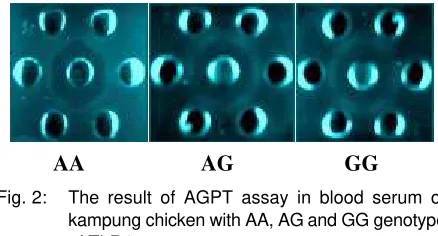
Fig. 2: The result of AGPT assay in blood serum of kampung chicken with AA, AG and GG genotype of TLR4 gene.
temperature during rearing was one of the factors causing stress. The effect of it was very significant (Yousef, 1985).
The presence of s. Enteritidis in blood and eggs:
Although based on H/L ratio, kampung chickens were under stressful conditions, but in assay of the presence of S. enteritidis in blood, these bacteria were not found in all genotype of TLR4 gene. Similar assay on eggs produced by kampung chicken, also not found any Salmonella.
It meant that the phagocytes cells can be function very well, and it can eliminate (clearance) these bacteria. The high phagocytic activity was positively correlated with TLR4 gene activity. The high activity of TLR4 gene was negatively correlated with the concentration of S. enteritidis in the blood (Zhongyong et al., 2012). Thus it can be said that all the TLR4 gene genotypes (AA, AG and GG) in this study had a high activity.
The high activity of TLR4 gene, will transcribe receptor protein that was also high. Abundant TLR4 receptor protein on the surface of phagocytes cells will facilitate of the macrophages to capture S. enteritidis, because these receptors were able to recognize LPS from these bacteria. The impact of it was negative result on S. enteritidis assay in blood and eggs that produced by kampung chicken.
M N AA AG GG
Table 2: Association of TLR4 gene genotype and resistance of kampung chickens against S. enteritidis natural infection
Aspect of Resistance AA*(1) AG (18) GG (31)
Leucocytes (10 /mm )3 3 22.2 18.85±7.03a 21.04± 7.73a
Heterophile (%) 39 42.79±0.49a 48.93±7.16a
Monocytes (%) 5 5.79±4.18a 5.07±2.91a
Lymphocytes (%) 54 50.00±0.89a 44.47±16.54a
S. enteritidis in blood negative negative negative
S. enteritidis in eggs negative negative negative
Specific IgY in blood serum positive positive positive
Specific IgY in egg yolk (mg/ml) 0.92 0.80±0.20a 0.76 ±0.26a
Note: different letters in the same row indicate significant differences (P<0.05). *AA genotype was not included in the statistical testing.
This fact can be explained that the daily rearing of the the production period amounted to 1.60 bacteria/ kampung chickens by people were in a state of poor macrophage. After incubated with IgY in egg yolk, sanitation. So naturally of kampung chicken often got increased to 5.18 bacteria/macrophage.
exposure of disease agents including from S. enteritidis. Assay of specific IgY concentration to S. enteritidis that The exposure will induce enhancement of expression was contained in egg yolk was done by using indirect TLR4 gene. Enhancement of expression TLR4 gene will ELISA method. The average concentration of specific IgY increase the phagocytic activity. It resulted an increase in against S. enteritidis of kampung chicken on AG and GG non-specific immune response. Indirectly enhancement genotype was not statistically different. Concentration of of the non-specific immune response can increase the specific IgY S. enteritidis on AA genotype (0.92 mg/ml), at specific immune response through the role of least not lower than the average specific IgY from AG macrophages as Antigen Presenting Cell (APC). Every and GG genotype (0.80 and 0.76 mg/ml).
epitope that was presented by APC will induce the According to Schade and Hlinak (1996), eggs of the formation of a specific antibody which was mediated by commercial laying hen on average have a volume of egg T helper cell and B cell. yolk 15 ml, and contains about 5-100 mg of IgY, of which Thus the expression of AA, AG and GG genotype TLR4 2 to 10 % are specific antibodies. Based on this value, gene was also influenced by the interaction between it can be stated that the total content of antibodies egg genetic factors (genotype of gene) and the environment yolk were amounted to 3.33-6.67 mg/ml, with specific continuously. It was consistent with Li et al. (2013), antibodies content were ranged from 0.07-0.67 mg/ml which stated that the expression of genotype variation of egg yolk.
TLR4 gene in Chinese local chicken was influenced by The average of concentrations specific antibodies the interaction between genetic factors and the other against S. enteritidis from kampung chicken egg yolk in
factors. this study were ranged from 0.76-0.92 mg/ml. There
The presence of specific IgY S. enteritidis in Serum antibodies from eggs yolk that produced by the
and Egg Yolk: Assay of presence specific IgY of S. commercial laying hens. Thus the kampung chicken enteritidis in blood serum was done qualitatively by eggs had high protection against bacterial infection of S. AGPT method. The result of assay was presented in Fig. enteritidis. The above analysis was the answer, why the
2. kampung chicken eggs with various conditions (fresh
This picture showed that blood serum of kampung from cage, circulating in the market, or which were at the chicken (AA, AG and GG genotype of TLR4 gene) after consumer level) that came from different regions in challenged in vitro with S. enteritidis produced previous studies never found the presence of these precipitates lines. It indicated that in blood serum of the bacteria in kampung chicken eggs (Budi 1993; Alvina kampung chicken contained antibodies specific to S. 2007; Aditya et al. 2012).
enteritidis. This result showed that the kampung chickens were used in this study, although they were not vaccinated or challenged with S. enteritidis, but in their blood serum contained specific antibodies of these bacteria. Forming of this specific antibody, was caused by induced from natural exposure of S. enteritidis, which was came from the rearing environment.
The presence of specific antibodies in the serum can increase the phagocytic activity of phagocytes cells. One of the functions of antibodies was as opsonin. It has been proved by Okti et al. (2008), who stated that the macrophages capacity of the commercial laying hen in
were much higher than concentration of specific
Conclusion: Based on the association of the result of TLR4 gene genotyping at exon 2 and biological assay results in this study, it can be proven that kampung chicken is resistant against natural infection S. enteritidis in all genotypes. Eggs were produced by kampung chicken contains high specific antibodies against S. enteritidis.
ACKNOWLEDGEMENTS
Culture of Republic Indonesia for the financial support Jain, N.C., 1993. Essential of Veterinary Hematology. through BPPS Scholarship. Author thanks to Erik
Andreas SPt. MSi. for the facilitation in the molecular laboratory.
REFERENCES
Abcam, 2013. Indirect ELISA protocol. http://www.abcam. com/ps/pdf/protocols/Indirect%20ELISA%20proto col.pdf. 14 September 2013.
Aditya, N., I.B.N. Swacita and T.P.G. Ketut, 2012. Deteksi bakteri Salmonella spp dan pengujian kualitas telur ayam buras. Indonesia Medicus Veterinus, 3: 320-329.
Akira, S., K. Takeda, 2004. TLR signaling pathways. Nature Reviews Immunol., 4: 499-511.
Alvina, A., 2007. Deteksi antibodi bakteri gram negatif (Escherichia coli dan Salmonella sp.) pada telur ayam kampung dengan AGPT. Skripsi. Fakultas Kedokteran Hewan IPB, Bogor.
Beaumont, C., J. Protais, F. Pitel, G. Leveque, D. Malo, F. Lantier, F. Plisson-Petit, P. Colin, M. Protais, P.L. Roy, J.M. Elsen, D. Milan, I. Lantier, A. Neau, G. Salvat and A. Vignal, 2003. Effect of two candidate genes on Salmonella carier state in fowl. Poult. Sci., 82: 721-726.
Bell, D.D. and W.D. Weaver, 2002. Commercial Chicken Meat and Egg Production. 5th Ed. New York. USA. Springer Science and Business Media Inc.
Bhunia, A.K., 2008. Foodborne Microbial Pathogen : Mechanisms And Pathogenesis. New York, Springer.
BSN, 2008. SNI 01-2897-2008: Metode pengujian cemaran mikroba dalam daging, telur dan susu, serta hasil olahannya. Badan Standardisasi Nasional, Jakarta.
Budi, S., 1993. Pemeriksaan kuman Salmonella pada telur ayam kampung (Studi mikrobiologi telur ayam kampung pada penjual jamu di kecamatan Semarang Selatan). Skripsi. Fakultas MIPA IPB, Bogor.
Calenge, F., P. Kaiser, A. Vignal and C. Beaumont, 2010. Genetic control of resistance to salmonellosis and to Salmonella carrier-state in fowl: a review. Genetics Selection Evolution, 42: 1-11.
Djokowoerjo, S., S.S. Sri Hartini, W. Reviany, U. Tonny, M. Achmad, N. Hamdani, S. Regina and H. Razak, 1989. Penuntun Praktikum Fisiologi Veteriner. Pusat Antar Universitas Ilmu Hayat IPB, Bogor.
Emertcan, A., F. Ozturk and K. Gunduz, 2011. Toll-like receptors and skin. Journal of the European Academy of Dermatology and Venereology, 11: 1-7. Gantois, I., R. Ducatelle, F. Pasmans, Haesebrouck, R. Gast, T.J. Humpre and V. Immerseel, 2009. Mechanisms of egg contamination by Salmonella enteritidis: in Federation of European Microbiological Societies. Belgium, Blackwell Publishing.
Lea & Febiger, Philadelphia.
Kabelitz, D., 2007. Expression and function of Toll-like receptors in T lymphocytes. Curr. Opin. Immunol., 19: 39-45.
Li, H.F., Y. Hu, H. Hu, C. Song, J.T. Shu, C.H. Zhu, S.J. Zhang, J.H. Fan, W.W. Chen, 2013. Genetic differ in TLR4 gene polymorphisms and expression involved in Salmonella natural and artificial infection respectively in Chinese native chicken breeds. Mol. Biol. Rep., DOI: 10.1007/s11033-013-2601-8. Lorenz, E., J.P. Mira, K.L. Frees and D.A. Schwartz, 2002.
Relevance of mutations in the TLR4 receptor in patients with gram-negative septic shock. Arch Intern. Med., 162: 1028-1032.
Maeda, 2005. Polymorphism of Mx gene in Asia indigenous chicken population. Makalah dipresentasikan pada Seminar Nasional Tentang Unggas Lokal III, Universitas Diponegoro, 25 Agustus 2005.
Mattjik, A.A. and M. Sumertajaya, 2002. Perancangan Percobaan dengan Aplikasi SAS dan Minitab. Ed ke-2, Bogor, IPB Press.
Muladno, 2010. Teknologi Rekayasa Genetika. Ed 2, Bogor, IPB Press.
Nataamijaya, A.G., 2010. Pengembangan potensi ayam lokal untuk menunjang peningkatan kesejahteraan petani. J. Litbang Pertanian, 29: 131-138.
Nei, M., 1987. Molecular Evolutionary Geneticcs. New York, Columbia University Press.
Nugroho, W.S., 2005. Tingkat cemaran Salmonella sp. pada telur ayam ras di tinngkat peternakan kabupaten Sleman Yogyakarta. Prosiding Lokakarya Nasional Keamanan Pangan Produk Peternakan, Puslitbang Peternakan, Bogor.
Okti, N.P., D.S. Retno, I. Agustin and I.W.T. Wibawan, 2008. Peran antibodi kuning telur (IgY) sebagai opsonion untuk pencegahan serangan mutan Streptococcus serotipe D (Streptococcus sobrinus). Berkala Penelitian Hayati, 13: 129-134.
Sambrook, J., E.F. Fritsch and T. Maniatis, 1989. Molecular Cloning : a Laboratory Manual. United State of America, CSH Lab Pr.
Schade, R. and A. Hlinak, 1996. Egg yolk antibodies, state of the art and future prospects. ALTEX. 13: 5-9. Subowo, 1993. Imunobiologi. Bandung, Penerbit
Angkasa.
Swenson, M.J., 1984. Physiological Properties and Yousef, M.K., 1985. Stress Physiology in Livestoock. Vol. Cellular and Chemical Constituents of Blood. In III, 1st Ed. Florida.USA. CRC Press. Inc.
Swenson, M.J. (Editior). Dukes Physiology of Yusriani, Y., 2012. Pemanfaatan bungkil biji jarak pagar Domestic Animals. 10th. Edition, London, Cornell sebagai sumber protein pada ayam kampung dan
University Press. kajian senyawa aktifnya terhadap infeksi
Ulupi, N., S.T. Anita and B. Bram, 2009. Paket teknologi Salmonella thypimurium. Disertasi, Sekolah probiotik sebagai agen biokontrol dalam upaya Pascasarjana IPB, Bogor.
pencegahan infeksi Salmonella enteritidis Zhongyong, G., L. Ranran, Z. Guiping, Z. Maiqing, L. transovarian pada ayam petelur. Seminar hasil- Peng, W. Huihua, Z. Yun, C. Jilan and W. Jie, 2012. hasil penelitian LPPM IPB, Bogor. Epigenrtic modification of TLRs in leukocytes is Velge, P., A. Cloeckaert and P. Barrow, 2005. associated with increased susceptibility to Emergence of Salmonella epidemics : the Salmonella enteritidis in chickens. PLoS ONE 7: problems related to Salmonella enterica serotype e33627.