UNIVERSITI TEKNIKAL MALAYSIA MELAKA
FACULTY OF ELECTRICAL ENGINEERING
BEKU 4894
FINAL YEAR PROJECT II
AUTONOMOUS WHEELCHAIR (MOBILE ROBOT) VIA EOG SIGNAL
RECOGNITION
Wong Chui Yee
B011010026
Bachelor of Electrical Engineering
(Control, Instrumentation and Automation)
“I hereby declare that I have read through this report entitle “Autonomous Wheelchair (Mobile Robot) Via EOG Signal Recognition” and found that it has comply the partial fulfillment for awarding the degree of Bachelor of Electrical Engineering (Control, Instrumentation and Automation)”
Signature : ……….
Supervisor’s Name : ……….
AUTONOMOUS WHEELCHAIR (MOBILE ROBOT) VIA EOG SIGNAL RECOGNITION
WONG CHUI YEE
A report submitted in partial fulfilment of requirements for the degree
of Bachelor in Electrical Engineering (Control, Instrumentation And Automation) with
Honors
Faculty of Electrical Engineering
UNIVERSITI TEKNIKAL MALAYSIA MELAKA
iii
I declare that this report “Autonomous Wheelchair (Mobile Robot) Via EOG Signal Recognition” is the result of my own research except as cite in the reference. The report has not been accepted for any degree and is not concurrently submitted in candidature of any other degree.
Signature : ………..
Name : ………...
iv
v
ACKNOWLEDGEMENT
Firstly, I would like to express my deepest gratitude to lecturers in Faculty of Electrical Engineering (FKE), University Technical Malaysia Melaka who give a lot of guidance, encouragement and advices throughout the process of completing this progress report on time and fulfilled the requirement of the subject BEKU 4792.
Besides that, I would also like to express my sincere appreciation to my family members who give moral support, financial support and encouragement throughout the completion of this technical report.
In addition, I would like to take this opportunity to express my gratitude to my supervisor, Mr Wan Mohd Bukhari Bin Wan Daud for his guidance in writing this progress report. He is willing to spend his precious time to guide me throughout my final year and provide me with useful information.
Last of all, I would like to thank all my coursemates and friends who have given their opinion, motivation and cooperation in accomplishing this progress report. They had given their suggestions and comments in helping me to finish this report.
vi
ABSTRACT
vii
ABSTRAK
Tujuan kajian ini adalah menggunakan electrooculography (EOG) sebagai teknik alternatif untuk mengawal pergerakan kerusi roda. Dapatan kajian utama untuk projek ini adalah potensi kornea-retina yang diperolehi dari elektrod. Potensi kornea-retina (CRP) adalah hasil daripada hyperpolarization dan depolarization antara retina dan kornea. Amplitud CRP untuk projek ini telah diambil dari 5 peserta. CRP itu telah diperoleh dari elektrod pakai buang dan isyarat itu kemudian dipindahkan ke perisian Matlab. Tiga elektrod akan ditampal di muka untuk mendapatkan EOG signal. Dalam Matlab, analisis isyarat telah dijalankan untuk mencapai beberapa maklumat mengenai isyarat seperti nilai maksimum dan minimum ampiltud potensi kornea-retina (CRP). “Threshold level” ditentukan berdasarkan ciri-ciri isyarat. “Threshold
ix
4 RESULTS AND DISCUSSIONS 33
4.1 Results Obtained for Separately Signal 33
4.1.1 Right Signal 33
4.1.2 Left Signal 34
4.1.3 Upward Signal 35
4.1.4 Downward Signal 37
4.2 Result Obtained for Combination of Signal 38
4.2.1 Horizontal Signal 38
4.2.2 Vertical Signal 39
4.3 Process in Determining Threshold Level 40
4.3.1 Threshold Level for Horizontal Direction (Left or Right)
40 4.3.2 Threshold Level for Vertical Direction (Forward or
Reverse)
41
4.4 Blinking Effect 42
4.5 Effect of Low Pass Filter 43
4.6 Results Obtained for 5 Volunteers 44
4.7 Simulink Block Diagram 48
4.8 Connection between Arduino Mega and PIC Microcontroller 51
4.9 Wheelchair Prototype 52
4.10 Summary for Results and Discussions 53
5 CONCLUSIONS AND RECOMMENDATIONS 56
5.1 Conclusion 56
5.2 Recommendations 56
5.3 Future Work 57
REFERENCES 58
x
LIST OF TABLES
TABLE TITLE PAGE
2.1 Function of each electrode 11
2.2 Comparison of advantages and disadvantages of EEG signal 15 2.3 Comparison of methodology used for EEG signal wheelchair
control
15
2.4 Advantages and disadvantages of voice controlled wheelchair 16 2.5 Comparison of methodology used in voice controlled wheelchair 17 2.6 Limitations of voice controlled wheelchair, EEG signal wheelchair
control and EOG signal controlled wheelchair
19
3.1 Gain and frequency used 22
3.2 Funtion of the muscles 24
3.3 Requirements for volunteer 25
3.4 Indicator for flowchart 29
3.5 Processes in determining threshold level 32
4.1 Features extracted from right signal 34
4.2 Features extracted from left signal 35
4.3 Features extracted from upward signal 36
4.4 Features extracted from downward signal 37
4.5 Features obtained for combination of horizontal signals 39 4.6 Features obtained for combination of vertical signals 40 4.7 Features extracted from right signal after 5 times of experimental
xi
testing
4.11 Features extracted from downward signal after 5 times of experimental testing
42
4.12 Threshold level setting for moving forward and backward 42 4.13 Results of the four directions obtained for 5 volunteers 45 4.14 Threshold level set for 4 directions for 5 volunteers 48
4.15 Truth table for “AND” gate 49
xii
LIST OF FIGURES
FIGURE TITLE PAGE
1.1 Joystick controller 2
1.2 Electrical powered wheelchair using joystick controller 2
2.1 Hyperpolarisation process 8
2.2 Depolarization process 9
2.3 Electrodes placement 11
3.1 Disposable electrodes 20
3.2 Top layout of the shield board 21
3.3 Bottom layout of the shield board 21
3.4 Main parts on the board 22
3.5 Eyes muscles 24
3.6 (a) Electrodes placement in experiment (for horizontal signal) 24 3.6 (b) Electrodes placement in experiment (for vertical signal) 24
3.6 (c) Grounding at non-muscles area 24
3.7 Obtaining left signal 25
3.8 Obtaining right signal 26
3.9 Obtaining upward signal 26
3.10 Obtaining downward signal 26
3.11 (a) Flow chart for signal detection 30
3.11 (b) Flow chart for directing wheelchair prototype 31
3.12 Summary of the process 32
4.1 Waveform obtained for right signal 34
4.2 Waveform obtained for left signal 35
4.3 Waveform obtained for upward signal 36
4.4 Waveform obtained for downward signal 37
xiii
4.6 Waveform obtained for combination of vertical signals 39
4.7 Blinking effect to EOG signal 43
4.8 Effect of low pass filter to EOG signal 44
4.9 Threshold determination 47
4.10 Simulink block diagram in obtaining signal 48
4.11 Simulink block diagram for controlling horizontal direction 50 4.12 Simulink block diagram for controlling vertical direction 50 4.13 Connection between Arduino Mega and PIC microcontroller 51
4.14 Wire shielded with aluminium foil 51
4.15 PIC microcontroller with LCD display 52
4.16 Wheelchair prototype 53
4.17 Horizontal signal obtained for 5 volunteers 55
xv
LIST OF APPENDICES
APPENDIX TITLE PAGE
A Physical dimension of the shield board 62
B Schematic diagram of Shield-EKG-EMG board 63
C Top layout of Arduino Mega 2560 64
D Bottom layout of Arduino Mega 2560 64
E Technical specifications for Arduino Mega 2560 65
F Function of each part on Arduino Mega 2560 66
G Certificate of Bronze price for I-ENVEX 2014 67
H Certificate of Bronze price for UTeMEX 2013 68
I Paper publication for The 2nd Power and Energy Conversion Symposium (PECS 2014)
CHAPTER 1
INTRODUCTION
1.1 Overview
The Person with Disabilities Act (2008, art. 2) defines people with disabilities are person who have long term physical, mental, intellectual or sensory impairments which prevent them from participating the social activities effectively.
Wheelchair is an important communication tool for those who are handicapped and suffered from diseases such as paralysis, Parkinson’s disease and Lou Gehrig’s disease. With the wheelchair, patients are able to move around and interact with other people. Wheelchairs help people with moving disabilities to help them in sustainable into environment. There are many types of techniques have been applied to the wheelchair in order to ease the patients. The most commonly used technique is controlling the wheelchair by using joysticks or tactile screen. However this technique (using joystick or tactile) cannot satisfy the demands of elderly or patients who have restricted limb movement [1].
2
1.2 Project Motivation
Patients who suffer from paralysis, Parkinson’s disease and Lou Gehrig’s disease make them facing difficulties in mobility issues. According to Social Welfare Department (JKM) statistics in August 2010, showed that there are 313685 people with disabilities (PWD) are registered. According to Malaysian Parkinson’s Disease Association, it is approximated that about 15000 to 20000 patients suffer from Parkinson’s disease in Malaysia. All these patients rely on wheelchair to enable them to interact with environment [1].
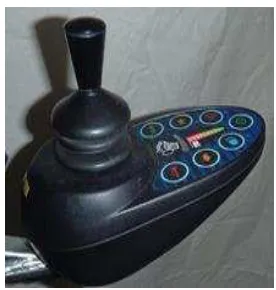
The number of people with disabilities (PWD) has an increasing trend in Malaysia, demands for wheelchairs is also increasing. The common type controlled wheelchair is electrical powered wheelchair (EPW). This electrical powered wheelchair (EPW) is controlled by using a joystick. Joystick is the common instrument in controlling electrical powered wheelchair (EPW). User can move to the targeted location by controlling the joystick as shown in Figure 1.1. However, controlling technique using joystick as shown in Figure 1.2 is not convenient for other disabled people such as those who suffer from paralysis, Parkinson’s disease and Lou Gehrig’s disease. They have difficulties in controlling the joystick because they do not have good motor functionality of hand muscle.
Figure 1.1: Joystick controller [21] Figure 1.2: Electrical powered wheelchair using joystick controller
3
developed in a low cost method. Implementation of EOG signal recognition in navigating the wheelchair can help to reduce the cost of the wheelchair and thus it is affordable by many disabled people.
1.3 Hypotheses
Hypothesis is used to determine reason on method selection. Two hypotheses have been made for this project. The first hypothesis for this project is majority of people who suffer muscular and neurological disorders still have the ability to move their eyes. The second hypothesis is shifting of gaze will result a potential and negative potential voltage respectively. Based on these two hypotheses, electrooculography (EOG) signal recognition is proposed.
1.4 Problem Statements
Wheelchair is the common tool for disabled people. The conventional wheelchair (hands-rim controlled wheelchair) and electrical powered wheelchair (EPW) which is controlled by a joystick are not suitable for all types of disabilities for example people who suffer Parkinson’s disease because they do not able to control their hand coordination well thus cannot control the wheelchair using joystick. People with muscular and neurological disorder still have the ability to move their eyes. Therefore, EOG signal recognition technique is developed to help those disabled people with Parkinson’s disease.
When eyes are moving, they will generate a potential difference, known as corneal-retinal potential (CRP). The polarity for this voltage potential obtained is different for different directions. The polarity is positive for right and upward eyes movement while the polarity is negative for left and downward eyes movement.
4
if the selected threshold level is too low, then it will be very sensitive. Any eyes movement will lead to changing in motor direction. Thus, threshold level has to be determined precisely and accurately.
1.5 Objectives
Following are the objectives for this project:
1.) To classify features of electrooculography (EOG) signal.
2.) To develop a controlled wheelchair prototype using electrooculography (EOG) technique.
In order to achieve the first objectives, experiments have to be conducted to obtain EOG signal and analysis has be done to classify the features of EOG signal. A motor based with PIC microcontroller is used to develop a wheelchair prototype. The features extracted from EOG signal is used to control the wheelchair prototype.
1.6 Scope
5
in indoor. Place such as laboratory and lecture room to avoid disturbance to the signal. The experiment should be conducted in a silent situation. For volunteers who take part in the testing cannot be colour blindness and night blindness and their age is in the range from 20 to 24 years old.
1.7 Report Outline
CHAPTER 2
LITERATURE REVIEW
2.1 Basic Topologies
In this section, simple concept about electrooculography (EOG) will be introduced such as the EOG background, types of EOG signal, and basic components used in obtaining EOG signal will be explained.
2.1.1 Electrooculography (EOG) Background
Electrooculography is a bio-signal which is produced by eye-movements. It is a test to measure the electrical response of the light-sensitive cells (rods and cones) and motor nerve components of the eyes [3]. It is the simplest and the weakest bio-signal that can be obtained from human body. The signal pattern is not quite complex [4]. EOG is the most effective test for the study of the functioning of the vestibular system [5].
7
Corneal-retinal potential (CRP) is a result from depolarization and hyperpolarisation existing between the retina and cornea [7].
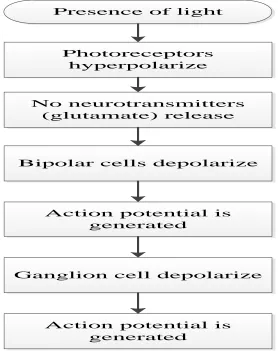
EOG potential is the resting potential of the retina. The potential is varied proportionally to the displacement of the eyeballs inside the conductive environment of the skull [6]. Depolarization and hyperpolarisation of between retina and corneal produce potential difference across the eyes, which is known as corneal-retinal potential (CRP). In dark condition, photoreceptors are depolarized and continuously active and releasing glutamate to bipolar and horizontal cells. When light arrives, photoreceptors hyperpolarise and amount of glutamate released decreases. Photoreceptors contain light-absorbing pigment molecules. On-centre bipolar cells and off-On-centre bipolar cells have their own glutamate receptors [17].
i.) Hyperpolarisation