240 Typhoid Fever and other Salmonelosis Med
J
IndonesChromatographically purifTed
Vi-capsular
P-3
polysaccharide antigen
for
vaccination
against
Tlphoid
fever
I.v.
Ankudinov,
M.E. Golovina,
v.L.
L vov, N.P. vaneeva, I.c. verner, S.I.
Yolkina,
p.G.
Aparin
Abstrak
Kami telnh mendapatkan antigen-V dengan tingkat kualitas kromatografi dalam bentuk tidak terdenaturasi yang memberikan pro-tel<si efektif terhndap infelcsi demam tifuid. Antigen-Vi yang kemurniannya tinggi diisolasi denganfiItrasi-gel dan menggunakan metode pengolahnn paling ringan dengan mengurangi sejumlah prosedur yang menggwtakan bahan kimia. Struktur molekul antigen-V termasuk yang paling aktif secara imunologik, group O-Ac- dan COO-- ridak berubah pada pengolahan yang ditnkukan dan telah dibuktiknn
dengan data Spektroskop NMR. Berat molekul maksimun tertinggi dan fralcsi imunogenik antigen
V
tersebut digunakan dalam vaksin (Kd<0,25 pada kromatografi dengan sepharose 4B-CL). Antigen Vi sejenis digunaknn sebagai komponen utarna vaksin tifuid VIANVAê .Dalam tes laboratorium antigen Vi memberiknn protel<si efektif yang tinggi pada mencit terhadap infel<si galur virulen S. qphi Ty2, menurut prosedur WHO, FDA untuk challenge test demam tifuid. Imunisasi beberapa kelompok manusia pada percobaan klinik terkon-trol menginduksi respon imun anti V yang kuat terdeteksi dengan Indirect heamagglutination atau tes ELISA. Pada kelompokyang di-imunisasi dapat dideteksi IgG, IgM dan bahkan IgA antibodi spesifik V. Kekebalan aktif pada manusin terbentuk 2 - 3 minggu setelah vaksinasi, bersamaan dengan pembentukan respon imwt humoral. Percobaan preklinik dan klinik memastilan tingkat keamanan yang tinggi vaksin ini. Hanya tercatat efek samping rasa sakit bkal, dan efek samping sistemik jarang terjadi. Data vaksinasi yang terbaru dengan valcsin antigenW yang dimurnikan dengan kromatografi pada kejadinn luar biasa demam tifoid di Tajikistan akan dipresentasi-kan.
Abstract
We have obtained chromalography grade quality V-antigen in non-denatured form which provide effective protection against ty-phoid fever infection. Highly purified V-antigen is isolnted by gel-fiItration with use of most mild methods of treatment and lowered nwnber of procedures with chemical agents involved. V-antigen molecule structure including most immunologically active O-Ac- and COO - groups doesn! chnnge under such treatment and hnve been verified by NMR-spectroscopy data. Maximal high rùolècular weight and funmunogenicfractions ofVi-antig^en are used invaccine (Kd<0.25 under chromatography on Sepharose 4B-CL). SuchVi-antigen is used as main component of VIANVAP Qphoid vaccine. In laboratory îests Vi-antigen provid.es highly effective protucrton of mice against infection by virulent straln S. typhi Ty2 according WHO, FDA regulations
for
typhoid fever challenge test. Immunisation of human con-tingents under the controlled clinical trials induced powerful anti-V immune response which was detected in ind.irect heamagglutination or ELISA tests. .lgG, IgM and even detectable quantity of IgA V-specific antibodies are registered in immunized persons. Active immunity in humans forms in 2-3 weeks afîer the vaccination simultaneously with the development of humoral immune response. preclinical and clinical trials confi.rm high safety ofpreparation.lncal
side reactions were registered as only painfulness, common side reaction are rare. The recent vaccinationdan
by chromatographically purified V-antigen vaccine under typhoid fever outbreak in Tajikistan wiII be pre-sehted.INTRODUCTION
Typhoid fever is
still
a common disease,causing
sig-nificant morbidity and
morlality in countries that
have not yet
achieved satisfactory
control of drinking
water, food and sewage
disposal.
Control of typhoid fever may be aided by
immuniza-tion, but
widespread protection
by this
method
hasnot been achieved
for
various reasons, including the
limitation
and insufficient use
of
available vaccines.
CHEMICAL
COMPOSITION
Chromatographically
purified
capsular
polysaccha-ride
from Salmonella
typhi (CP-Yi-antigen)
is
the
main
polysaccharide
typhoid
VIANVAC@
vaccine
component. CP-Vi-antigen
is
isolated
by
gel-filtra-tion with
use of mostmild
methods
of treatment and
lowered number of procedures
with chemical agents
involved. CP-Vi-antigen is being
highly purified
dur-ing manufacturdur-ing process.
Protein and nucleic
acidsadmixtures
contaminating
the main substance
arestrictly controlled (protein contamination
<
l%o,
nu-cleic
acids
contamination
< 2Vo).
As a result vaccine
final
form contains
chromatographically purified
clear
sharp peaks
on the chromatograms
of
vaccine
series
(Figure
1).At
least
5OVoof
the Vi-polysaccharide eluted from
the column
Sepharose
CL-48
before a distribution
constant
Kn
-
0.25.
L
CP-Vi-antigen molecule structure
(including
most
immunologically active
O-Ac-
and
COO--
groups)
have
been
verified
by NMR
-
spectroscopy
(Figure
2).
Peak corresponded
to
immunodominant
O-Ac
group
is
determined under the 21 ppm.
'We
permanently
control O-acetyl group content in
preparation by
NMR
-spectroscopy
or Hestrin
tech-nique.
O-Acetyl
group content
for
different
lots
of
CP-Vi-antigen
were
no
less than
2.O
pmoUmg
andconsist
of
2.8 pmoUmg, 3.0
pmol/mg,2.9
StmoUmgcorrespondingly for
Lot
I25,
127,
I30.
IMMUNOCHEMISTRY
Nativity, functional activity of CP-Vi-antigenic
deter-minants
have been
investigated by immunochemical
methods.Immunochemical identification of CP-Vi-antigen lots
[image:2.595.51.286.85.362.2]have
beenperformed by Ouchterlony technique with
Vi
and
O:9 monovalent
serum
(Figure
3).Figure 1. GelfiltrationprofiIe of CP-Vi-Antigenvaccine
(lot
130) passing through Sepharose 4B-CL.tive
substance
which
can
be
chemically identified
and analyzed.
CP-Vi-antigen
is
a
non-toxic polysaccharide which
represent
linear polymer
built of
a(1-4)-linked
N,O-Ac
galactouronic acid
residues.Native CP-Vi-antigen
molecules reach significant size. That's why during
its production
it
is important to avoid its
depolymeri-zation
i.e.
its
decay
to
small chains. Maximal high
molecular
andimmunogenic fractions of
CP-Vi-anti-gen
areused
in
vaccine preparation. They
appear
as6
5
6
5
o2
o3
-170 100 80 60 40 20 0
ppmFigure 2.13C-NMR-rp"ctrum of CP-Vi-antigen from vaccine
(lot
130)1
o
o
o
4
[image:2.595.307.544.493.627.2]a)4b)
Figure
j.
Identification of the main component of the CP-V-vac-cine antigen by the Ouchterlony lechnique. Central weII was in-oculated by a) mono-Vi serum 25 1tl. b) mono-O:9 serum 25 1tI. welll-2
Lot 125242 Typhoid Fever and other Salmonelosis
- irt
.
Ç -r
+t
[image:3.595.309.538.83.271.2]I
Figure 4. Determination of CP-Vi-antigen content in vaccine
fi-nal form.
I
- Lot 125 (50 1tg/ml) 2 - Lot 125 (251tg/ml) 3 - Lot 125 (12.5 1ts/ml)CP-Vi-antigen content
in
VIANVAC@
final form
have been studied
by Rocket
immunoelectrophoresis
technique (Figure
4).
Serological
activity
of
CP-Vi-antigen
preparations
were
analyzed
by
inhibition specific
haemagglutina-tion reachaemagglutina-tion
(IHA).
CP-Vi-Antigen
adsorbed
eryth-rocytes and
monospecific Vi-antiserum in
concentra-tion
4
SU (Diagnostic Pasteur,
France) were
used.In-hibition
concentration varied
from
0.1
to
5.0
pglml
ispresented
in
the
Table
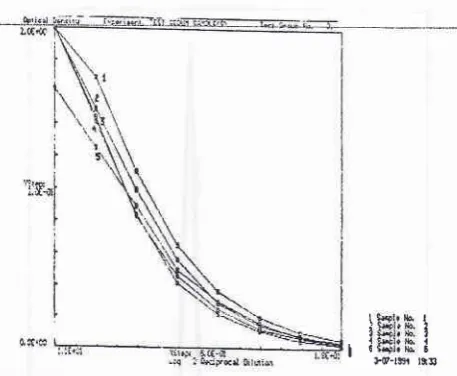
1.Binding curves
of
Vi
antibodies
by
solid
phase
ad-sorbedCP-Vi-antigen
Lot's
I25,127 differ slightly in
ELISA
tests (Figure
5).
The presenr data
suggeststhat CP-Vi-antigen
lots
used
in vaccine show
high
and
nearly
equal
serological activity.
Thble 1. Inhibition point concentration
for CP-Vi-antigen
andVi-antigen (Typhim-Vi vaccine)
Sample
Concentration in direct
haemag-glutination inbibition reaction (pglml)
Figure 5, Binding curves
ofV antibodies in ELISA
test.Microtitration ELISA plates were coated with 25 1tg/ml of
CP-V-antigen in carbonate buffer (50 mM, pH 9.6). Monospecific
anti-14 rabbit serum was added in serial dilutions. Peroxidase-labeled goat anti-rabbit
Ig
antibodies (Calbiochem, USA) was used assecond antibodies.
The absorbance was measured at 492 nm
in
Dynatech ELISA reade6 binding curves analyzed by using Cyclop analyzingpro-8ram.
Sample I-2 Lot 125 Sample 3, 4, 5
lnt
127PROTECTIVE
&
IMMUNOGENIC
PROPER-TIES
Vi-Antigen
(an antigen
of virulence) is a very
impor-tant protective antigen
for
typhoid fever.
It
protects
animals against
typhoid fever infection
in
model
ex-periments, induces
anti-Vi
antibody
response in
hu-mans and
animals, triggers
off
the complement
sys-tem
and macrophages.Vi-Antigen
plays
an importantrole in
pathogenesis
oftyphoid
fever especially in
se-vere forms
course.
High immunogenic properties
of
CP-Vl-antigen
vaccine
are
stipulated
by
modern
technology
of
its production:
it
allows
to
obtain
Cp-Vi-antigen
in
non-denatured
form.
a)
Experimental
data
CP-Vl-antigen provides high effective protection
of
laboratory
animals against
infection by virulent
strain
according
to WHO, FDA regulations
for
typhoid
fe-ver
vaccines challenge
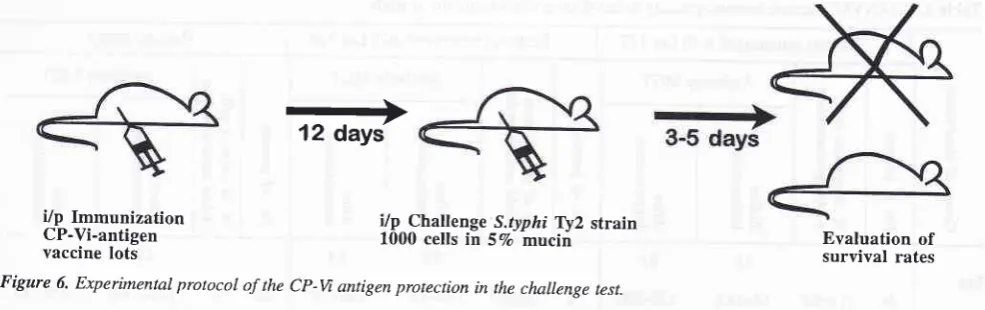
test.Mice
were challenged
by
highly-virulent S.typhi Ty2 strain (LDso < 20 cells)
(Figure 6).
Single
immunization by
vaccine lots
with
dose25
pg
as
with
gradually
decreased doses
provide
effectiie
l00Vo protection
against
typhoid fever infection
ac-cording to
vaccine
testing protocol
(TabIe
2).Med
J
Indoneslr
it
1i
i
t-o-ls9t cl3
CP-Vi antigen Lot 125
CP-M antigen
Lot
127CP-Vi antigen
Lot
129CP-Vi antigen Lot 130
CP-Vi antigen
Lot
131Typhim Vi Lot 1003
Typhim Vi Lot 1004
0.19 6.25 1.56 0.39
0.30 r.56
[image:3.595.47.284.87.253.2]i/p
Immunization CP-Vi-antigen vaccine lots-+>
12 days
[image:4.595.31.537.88.456.2]Evaluation of
survival
rates Figure 6. Experimental protocol of thecp-v antigen protection in
the challenge test.Tabel
2. Protection
rates after single immunization of mice with CP-vi antigen (VIANVAC@ Lot#125,12g, 130) and Wyeth whole cell vaccine and challenge with S.typhi'1y2.i/p
Challenge S.typhi Ty2 strain 1000 cellsin 57o
mucinImmuniza-tion dose for vaccine
(pc)
Part
of
human doseSurvival of mtce per group immunized
with VI-vaccine VIANVAC@, Lot 125
Survival of mlce per group immunized
with VI-vaccine VIANVAC@,
Lot 128
Survival of mice per group immunized
with VI-vaccine VIANVAC@,
Lot 130
Immuniza-tion dose for vaccine
(protective units USP)
Part of human
dose
Survival
of
mlce per groupimmunized with Typhoid vaccine USP Wyeth Whole cell vaccine Lot 4928282 25
2.5 0.5 0.02 0.004 Control
t/10 1/50 r/250 tl1250 l/6250
10/10 10/10 10/10 l0/10 8/10 0/r0
10/10 l0/10 10/10 r0/10 r0/10 0/10
l0/10 10/10 l0/10 10/10 7/10 0/10
2u 1u 0.5u 0.25u 0.125u
U4
l/8
1/16 lt32 t/6410/10 l0/10 10/10
7lr0
5/to 0/10Protective
activity
was
compared
with
USp typhoid
vaccine standard and
showed that
protective potential
of
CP-Vi-antigen vaccine may
be
evaluated
in
ty-phoid protective units USp. primary Vi-specific
im-mune response on
mice
was registered
after
immuni_
zation
(CBAxC5TBL/6)F| mice
with
lots
of
Cp-Vi-antigen
(Figure
7).High levels
of
anti-Vi
antibodies were detected after
immunization of with 25
tt1 (human
dose),5 pg
(1/5
F.igure
7.
Primary V-speciJic immune response after immuniza_ rion with CP-Vi antigenInt's 129 and l3(j.
human dose),
I
1tg(l/25
human dose).
Two
most
im-portant
in
view
of
typhoid
bacteria neutralization
classesof
anti-Vi antibodies -IgG
and
-IgM
are pre-sentedin
serum
after
vaccination.
Induction
of
delayed-type
hypersensitivity
(DTH)
in
foodpad-swelling
test was
registered
aftei
immuniza-tion with
CP-Vi-antigen.
DTH
induction
by
Vi-anti-gen
depends
on
immunization dose. Therefore
the
data
obtained
indicated activation of humoral
aswell
ascell
part
of
immunity.
b)
Clinical
data
Double-blind randomized
study
Similar
to
analogous preparations
Cp-Vi-antigen
in-duced strong
humoral immune
responseand
serocon-verslon.
Under the double-blind randomized volunteer
study
seroconversion was evaluated
by traditional indirect
haemagglutination test
(IHA).
ondayll
[image:4.595.35.528.91.246.2]Table
3. VIAI\I/AC
vaccine immunogenicity under double-btind randomized studyd
L
o !c
È
o
Persons immunized
withLot
127 Persons immunized with t ot 128 Placebo groupo
L
o
Ê
z
t9
oé
Éo
8t
Lh g1 otsE
-ù
B\+
Antibody MGT
,
o
À
o
z
t9
qÉ
cê
;5
KL oo Àa
tsE
_ù
6\+
Antibody MGT
E
,
o
a
j
z
É'E'
aé
êo
??
oo
ùq
ts=
-q:
È\+
Antibody MGT
o
cÉ N
e,=
€E
oÉd N
li=
<.E
o
c! N
EA
ùÈ
oÉd
N
ôiÊ 2Ê
N oÉ
N
ôiÊ iÉ
Tohl
2.6
5.1
74
71.6fi.2
1:8+1:4.6
1:39+1:302.5
5.476
78.5!4.7
1:7.5+1:4.3 1:56-1:322.5
2.768
1:7.5+1:4.3 1:8.6-1:4.9Sero-negalive persons
5.1 1:52+1:22.6
14 1000
04.8
l:42+1:18.4
18 1000
0 13 00.3
(0)
Sero-positive persons
3.2
5.160
65.016.2
1:10.6+1:8
1:39+1:303.2
5.758
72.4!5.9
1:10.6+1:8
1:69+1:393.
t
3,255
1:9.8+1:7.5
l:10.6+1 :8*
anti-V-antibodies were determined by IHA-testwith
Vi-antigen coated erythrocytes.244 Typhoid Fever and other Salmonelosis
According to
data presented
in
the Table
3,four-fold
seroconversion was observed
to
occur
in
1007oof all
seronegative
persons immunized
with
VIANVAC
vaccine
onemonth after vaccination;
whereasthis
in-Med
J
Indonesdex was somewhat
lower
in
seropositive persons.
So,this
index value
was 65Voin
personsimmunized
with
VIANVAC, lot
127and72.4
Voinpersons
immunized
with
lot
128,
but the difference
between these value
was
found to
be
statistically unreliable (p>0.05).
Summary
index value
of
four-fold seroconversions
(independent upon initial immune
background) in
thegroups
of
persons
immunized
with VIANVAC,
lot
I27
and lot128
was7l.6Vo
and78.9Vo respectively,
and the
difference
between these
value was
also
sta-tistically unreliable
(p>0.05).
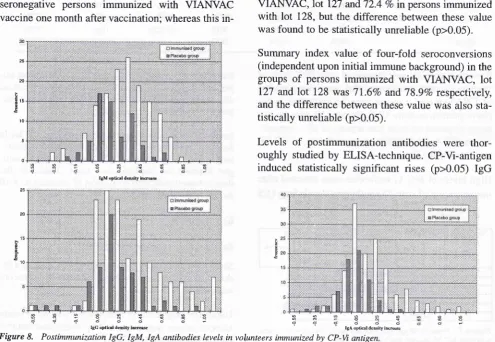
Levels
of
postimmunization antibodies
were
thor-oughly studied
by EllSA{echnique.
CP-Viantigen
induced statistically significant rises (p>0.05) IgG
dddddd
IgA opticsl dcnsity incHsc
25
m
!ru
t
10
5
0
25
N
B20 15 15
ù'
c 10
+?gddddd;
tsM optic.l dcNity inqe$
È6ôô ççdddddr
[image:5.595.53.545.98.358.2]IgC optlcd dcNlty incrusc
[image:5.595.50.546.392.734.2]and
IgM
and even
IgA
Vi-specific antibody
levels
(Figure
8).Mean of optical density
OD+sz increasefor IgG
anti-Vi
antibodies
in
immunized
persons
was
0.33+0.11versus placebo group persons 0.1410.06;
for
IgM
anti-Vi
antibodies was 0.2810.06
versus
0.161il.05;
for IgA anti-Vi
antibodies 0.1510.06 versus 0.0310.02.
It
should be
stressedthat
IgA
specific antibodies
iswell-known
mechanism
of
mucosal
immunity
induc-tron.
Immunization
under typhoid
fever
epidemy
in
Ta-jikistan
Organized contingent
of
frontier
service
RF
in
Re-public
Tajikistan have been immunized
by
VIAN-VAC@
vaccine based
on
CP-Vi-antigen
in
March
1997 (18362
persons).Immunization
caused
significant
decreaseof typhoid
fever morbiditl,
according
to
7-month
supervision
data
(Figure
9).months 1997
Figure
9.
Incidence of typhoidfever after VIANVACimmuniza-lion under Tajik epidemic.
Incidence
rate
of
infection
is
greatly
decreased to
2.J7
casesper
1000 among
immunized person. In
contrast incidence rate among
non-immunized
organ-ized contingents varied
from
10to
12 casesper
1000.SAFETY
VIANVAC@ is the vaccine
with
high
safety
profile.
Chromatography
grade
of
Vi-antigen and
detailed
control ofthe
preparation provides its good
tolerance.
a)
Experimental
data
Occasionally
some redness
and
swelling may
occur
at the site
of
injection. Pain
sensation
registered in
30-35Vo
of
vaccinated
persons.Examination
of
the
CP-Vi-antigen
general
toxicity
in
rodents:
(CBAxC57BV6)F1 mice, Vistar
rats, guinea
pigs
and
Shinshilla rabbits allows
us
to make
acon-clusion that CP-Vi-Antigen has an extremely wide
therapeutical index. The
dose
of
35 mg/kg which
is
100,000
times more than the equivalent vaccinating
dose
of
0.35 pg/kg
(
25 tte
per
70
kg
human body
weight) very well
tolerated
by
animals after
theinjec-tion,
and does
not
cause
any
changes
in
behavior,
water
andfood
consumption,
increaseof
body
andin-ner organs weight. The further investigation
of
thepreparation
in
order
to
determine CP-Vi-Antigen
LD56 was
unreasonable due to the absence
of
any
no-ticeable
toxic
effect after
such
a
considerable
(100,000
times)
overdose
of
the vaccine.
To evaluate chronic
toxicity
CP-Vi-antigen was
in-jected to
rabbits repeatedly (10
times) during
the day
in
a
8 times
overdose.
Any
structural
or
functional
changes
proved
by
haematological, biochemical,
ophtalmological,
and
pathomorphological
investiga-tions
were
not
found
except
for
hyperemia
at
the
place
of injections in
some rabbits.
CP-Vi-antigen Lots
met
WHO
requirements
for
pyro-genicity
of
polysaccharide
typhoid
vaccine.
Thres-hold
apyrogenic
dosefor
vaccine
Lots is significantly
higher
than
WHO
approved parameter (Table 4).
Table
4.
CP-Vi antigen pyrogenicity.Vi-Vaccine
Thresholdapyro
Dose of HumanLots
genic dose(pg/ml) apyrogenic
doseper J kg rabbit
immunization'*
(pg)body
weight
(pg/ml)LOT t25
LOT 127
WHO control
parameter
0.550
0.720
0.025
l 100
1440
50
25
2
*
ttnder dil.ution coefficientl:2000
Presence
of
the bacterial endotoxins was
evaluated
additionally by
deaths ratesof (CBAxC5TBl/6)Fl
fe-male mice
which
were administered
by dactinomycin
in
a doseof
15pg
permice
with
the bodyweight 20
g.Lipopolysaccharide
from
E
coli
0III:
B 4
(Sigma)
[image:6.595.47.279.368.564.2]246 Typhoid Fever and other Salmonelosis
Thble
5.
CP-V antigen andV
antigen (Typhim-Vi vaccine) endotoxicity under dactinomycin test.Med
J
IndonesNN
Groups of PreparationsNumber
of
Animals
Dactinomycin
'
Doses doselLg/C
pg/miceDeaths Peicentage pclkc
1
2
3
4
5
6 7
8
9 r0
0-75 0.75 0.75 0.75 0.75 0.75 0.75 0.75 0.75 0.75
0 0 r00 80 40 100 100 40 20 0 Dactinomycin
Dactinomycin + solvent
Dactinomycin + CP-M-VACCINE Dactinomycin + CP-Vi-VACCINE Dactinomyci n + CP-Vi-VACCINE Dactinomycin + Typhim-Vi Dactinomycin + Typhim-Vi Dactinomycin +Vi-Typhim Pactinimicint Lipopolysaccharide Dactinomyci n +Lipopolysaccharide
20 20 20 20 20 20 20 20 20 20
0.2 (ml) 2.5 2.0 1.5 2.5 2.0
1.5
0.004 0.002
125 100 75 125 r00 75 0.2
0.1
was used as a
positive control, while
thePBS-phenol-containing solvent
for
CP-Viantigen
was used
asnegative
control.
CP-Vi-antigen
toxicity
considering
the
degreeof
pu-rification from
bacterial endotoxins does not differ
from Typhim-Vi vaccine
(Table
5).The
possibility of
theimmediate allergic
reactions
in-duction attended
by
appearance
of
the
homocyto-tropic antibodies in
responseto CP-Vi
antigen
injec-tion
was evaluated
in
guinea-pigs
in
systemic
ana-phylactic reaction
.Sensitization of
the
guinea-pigs with
230-250
gbody
weight
wascarried out according to the
optimal
aller-gization determination
scheme and
estimation of
thereaction was made according
to
accepted
-grade
system
registering
(Table
6).In
conducted experiments
with
oneor
two
sensitizing
doses
of
the preparation the anaphylactic
properties
of CP-Vi
antigen were
not
discovered.
b) Clinical
data
Experimental and
clinical
data provide
direct
evi-dence
that Vi-vaccine
based
on CP-Vi antigen
is
awell-tolerated
preparation.
Low-level
of
adverse reactions
under double-blind
control
clinical trials
were registered. Systemic
reac-tions: myalgias, allergic complications were
absent.This
complications
are typical after immunization
with whole-cell typhoid vaccine.
Such general
reac-tions
asheadache, moderate temperature
rise 37.6'C
-
<38.5"C
areregistered
conespondingly in3-4Vo
andL37o
of
cases.Tâble
6.
Sensitization of the guinea-pigs by V-VACCINE. Sensitization ChallengeAnaphyl-
Numberactic
of
Index
Animals I. Vi-VACCINE,5pgx3
M-VACCINE, 25
ltgx
3PBS*, x 3
Vi-ag 75 pg
Vi-ag 75 pg
Vi-ag 75 pg
*
PBS - phosphate-brffired salineCONCLUSION
Effectivity
of
vaccine application
is
determined
by
risk/benefit ratio
for
each concrete preparation.
In-creased
risk factor
due
to toxicity, pyrogenicity
andother
sidereactions
-
main disadvantage
of traditional
whole-cell
typhoid
vaccines.
Benefit from
such
vac-cine
usagemay
benot significant,
dueto prophylaxis
by
suchvaccines is
limited
(age,health
condition
fac-tors)
andcarried out
in
desperateepidemic
situations.
VIANVAC - new formulation
of Vi-antigen typhoid
vaccine seriously
differs
from
predecessors.This
Vi-antigen vaccine
has
fully
controlled chemical
struc-ture
and
immunogenic
characteristics
basedon
chro-matography grade
quality
reliable. Factor
risk
de-creasing removes
risk/benefit ratio
in
favor
of
thelast.
It
make
justify
to
use
VIANVAC
for
mass
im-munization adults
and children over
5
years
e.a.widespread
prophylaxis of typhoid
fever.
8
2 0
0 2