THE 12TH MALAYSIAINDONESIA INTERNATIONAL CONFERENCE ON
ECONOMICS, MANAGEMENT, AND ACCOUNTING 2011
MIICEMA
Copyright 2011
Fakultas Ekonomi, Universitas Bengkulu
All rights reserved. No part of this publication may be reproduced or
transmitted in any form or by any means, electronics or mechanical including photocopy, recording or any information storage and retrieval system, without permission in writing from Fakultas Ekonomi, Universitas Bengkulu
Published in Bengkulu by
Fakultas Ekonomi, Universitas Bengkulu
Jl. WR.Supratman, Kandang Limun Bengkulu 38371 A
Printed in Bengkulu By Unib Press
Universitas Bengkulu
Jl. WR.Supratman, Kandang Limun Bengkulu 38371 A
Proceedings of the 12thMalaysia Indonesia International Conference on
Economics, Management, and Accounting: Borderless Economy: Opportunities and Challenges for Businesses in Southeast Asia/ Edited By Lizar Alfansi, Paulus Sulluk Kananlua, Sugeng Susetyo, Effed Darta Hadi, Siti Aisyah, Ferry Tema Atmaja
TABLE OF CONTENT
The Conference (istory………... ixx
Greeting from the Conference Chair……… xiii
Conference Program……….. xiv
Concurrent Session Program………... xvxxix
Keynote Speaker Papers………. xxxlv
List of M))CEMA Organizing Committee………. lvi
List of M))CEMA Reviewers………. Lvii
ACCOUNTING TRACK
M))CEMA Unib‐ Perceptions Of Accountants, Users, Organizers, And Students On
Indonesian Education Standard For Professional Accountants……… ‐
M))CEMA Unib‐ Budgetary Participation and Managerial Performance: A Study in Ministry
of (ome Affairs MO(A , Malaysia……… ‐
M))CEMA Unib‐ Malaysian Code of Corporate Governance:The Impact on Quality of
Reported Earnings of Kuala Lumpur Composite )ndex KLC) Components………- ‐
M))CEMA Unib‐ The Effect Of Capital Structure On Profitability: The Extended Analysis Of
Biotechnology Companies Listed On The Bursa Malaysia……… ‐
M))CEMA Unib‐ The )nfluence Of Capital Structure And Growth Of Company To Firm Value At
Company )n )ndonesian Stock Exchange………... ‐
M))CEMA Unib‐ What Makes People Pay Taxes )n Self Assessment System?.... ‐
1232
NON‐ Managerial Performance And Performance Measurement System----
MANAGERIAL PERFORMANCE AND PERFORMANCE MEASUREMENT SYSTEM
Lukluk Fuadah
Universitas Sriwijaya
ABSTRACT
This paper is based on theoretical. The aim of this paper is to explain about theory and research results related to Managerial Performance. The paper will explore the variables that can influence them. In conclusion, Burney and Widener (2007) conclude that performance is the link to the evaluative process, complexity, and managerial experiences moderate the relations between an SPMS and Job Relevant Information, Role Ambiguity, and Role Conflict. Furthermore, the research results from Hall (2008) indicate that comprehensive PMS is indirectly associated with managerial performance through dimensions of role clarity and psychological empowerment, Burney et al (2009) also provide evidence that heightened levels of organizational justice are the mechanism though which the perceived characteristics of the SPMS are associated with employee performance.
Keywords: managerial performance, performance measurement system.
1. Introduction
There is growing recognition of the importance of understanding in how and why performance measurement systems (PMS) in management accounting literature relate to individual and / or organizational performance. Furthermore, especially psychological theories indicate that performance measurement systems affect individual performance through cognitive and motivational mechanisms. Performance measurement systems have evolved from systems with a few measures focused on financial outcomes to systems with multiple non financial and financial related to strategy (Kaplan and Norton 1996, 2001).
The remainder of the paper contains three sections: the nest section develops the literature review. This is follow by presentation of the result in findings and discussion. The final section conclude the paper.
2. Literature Review Definition of SPMS
Firms are implementing strategic performance measurement systems (SPMS) defined as systems that
―translate business strategies into deliverable results. Strategic performance measurement systems
combine financial, strategic and operating business measures to gauge how well a company meets its
targets‖ (Gates, 1999, 4).
Burney and Widener (2007, 43-44) defined an SPMS as ―a performance measurement system that
contains at least two measures and is linked to a firm‘s strategy. SPMSs can vary in their reflection of
strategic objectives; an SPMS that is closely linked to strategy better reflects a strategic objective than
does on that is loosely linked‖.
Definition of CPMS
Prior research indicates that more comprehensive PMS include a more diverse set of performance measures, and performance measures that are linked to the strategy of the firm and provide information about parts of the value chain (Chenhall, 2005; Malina & Selto, 2001; Nanni, Dixon, & Vollman, 1992; Neely, Gregory, & Platts, 1995). Comprehensive PMS have been popularized in techniques such as the balanced scorecard (Kaplan & Norton, 1996), tableau de board (Epstein & Manzoni, 1998) and performance hierarchies (Lynch & Cross, 1992). A comprehensive PMS is one that provides performance measures that describe important parts of the SBU‘s operations and integrates measures with strategy and across the value chain.
Theories Underlie the Researches Agency Theory
reduced role ambiguity. Agency theory posits that incentives serve to align the manager‘s interest with those of the principal.
Expectancy Theory
Higher levels of performance are achieved because incentives provide extrinsic motivation, which lead to greater effort (Jenkins, Gupta, Mitra, & Shaw, 1998). Expectancy theory holds that managers will not put forth effort unless that effort is rewarded (Hilton et al. 2000).
Reinforcement Theory
Higher levels of performance are reinforcing the performance goals that are linked to incentives (Jenkins, Gupta, Mitra, & Shaw, 1998).
Goal Setting Theory
Goal-setting theory predicts that having specific goals ‗‗makes it clear to the worker what it is he is
expected to do‘‘—that is, the worker‘s role should be clear (Latham and Locke 1979, 72). Higher
levels of performance are motivating employees to expend effort to achieve difficult goals (Jenkins, Gupta, Mitra, & Shaw, 1998).
Equity Theory
Distributive justice is rooted in equity theory which holds that employees calculate their outputs as a
function of their inputs, compare that ratio to other employees‘ input–output ratios, and make a
judgment regarding the fairness of their outcome (Adams, 1965).
3. Findings and Discussion
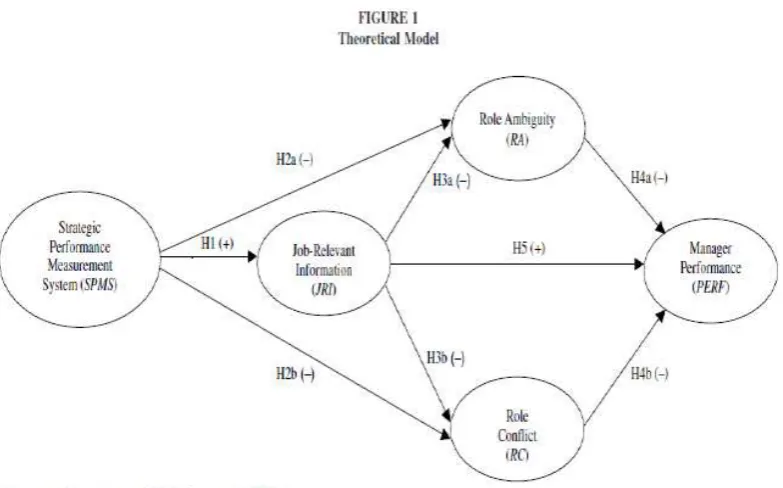
Hypotheses from Burney and Widener (2007)
H1 : Job-relevant information (JRI) is positively associated with the extent to which the
organization‘s performance measurement system is linked to its strategy (SPMS).
H2a : Role ambiguity (RA) is negatively associated with the extent to which the organization‘s
performance measurement system is linked to its strategy (SPMS).
H2b : Role conflict (RC) is negatively associated with the extent to which the organization‘s performance measurement system is linked to its strategy (SPMS).
H3a : Role ambiguity (RA) is negatively associated with job-relevant information (JRI). H3b : Role conflict (RC) is negatively associated with job-relevant information (JRI). H4a : Performance (PERF) is negatively associated with role ambiguity (RA). H4b : Performance (PERF) is negatively associated with role conflict (RC).
Result
Burney and Widener (2007) used a survey of Institute of Management Accountants (IMA) members. The survey was returned 763 respondents, with a response rate about 50,07 %. They use AMOS for test the hypotheses.
Table Result of Hyphoteses Hypothesis
Hypothesized Direction
Result
H1 + Supported
H2a - Supported
H2b - Supported
H3a - Supported
H3b - Supported
H4a - Supported
H4b - Supported
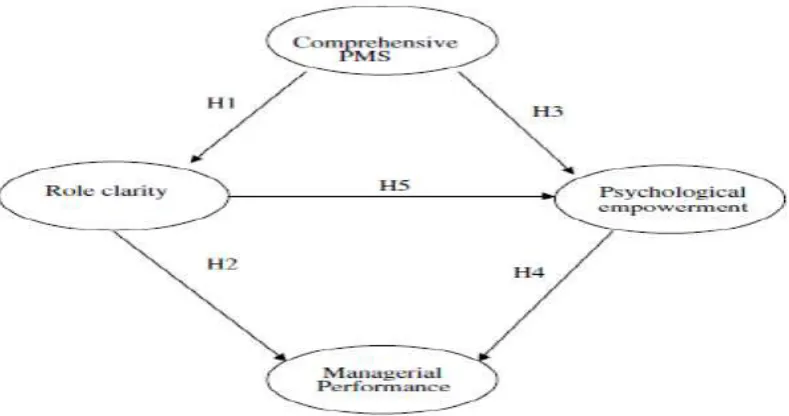
Hypotheses based on Hall (2008):
H1 : There is a positive relation between comprehensive PMS and role clarity. H2 : There is a positive relation between role clarity and managerial performance.
H3 : There is a positive relation between comprehensive PMS and the four dimensions of psychological empowerment.
H4 : There is a positive relation between the four dimensions of psychological
H5 : There is a positive relation between role clarity and the four dimensions of psychological empowerment.
The result
Hall (2008) collected data using a questionnaire administered to SBU managers within Australian manufacturing organizations and distributed 369 questionnaires, 83 were received, which provided a response rate of 22.5%. He used PLS regression analysis to test the hypotheses in this study.
Table Result of Hypotheses Hypothesis
Result
H1 Consistent, weak for process clarity
H2 Consistent, no association for process clarity H3 Consistent, weak for self-determination H4 Only the meaning dimension of psychological
empowerment is positively associated with managerial performance
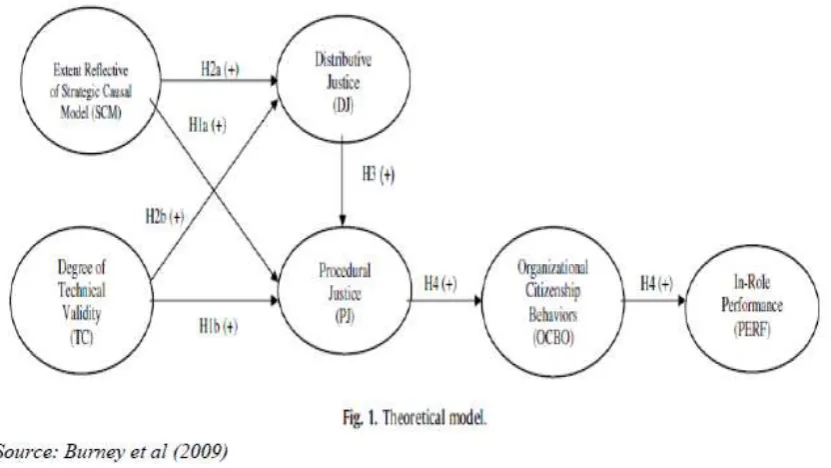
Hypotheses of Burney et al (2009)
H1a : The extent to which employees perceive the SPMS reflects a strategic causal model is positively associated with procedural justice.
H1b : The degree to which employees perceive the SPMS is technically valid is positively associated with procedural justice.
H2a : The extent to which employees perceive the SPMS reflects a strategic causal model is positively associated with distributive justice.
H2b : The degree to which employees perceive the SPMS is technically valid is positively associated with distributive justice.
H3 : Distributive justice is positively associated with procedural justice.
H4 : Procedural justice is positively associated with employee performance through organizational
citizenship behaviors.
Result
Burney et al (2009) conducted a survey within one region of the Branch Banking division. 333 employees returned surveys for a response rate of about 60%. They use AMOS to estimate the structural equation model. There are two important things from the result. First, the extent to which employees perceive that the SPMS reflects a strategic causal model and the degree to which it is technically valid are positively associated with their perceptions of organizational justice. Second, the heightened levels of organizational justice are mechanism though which the perceived characteristics of the SPMS are associated with employee performance.
Table Result of Hypotheses Hypothesis Result
H1a, H2a Supported (p< 0,05 and p < 0,01) H1b, H2b Supported (p < 0,01 and p < 0,05)
H3 Supported (p< 0,01)
Conclusion and Implications Conclusion
Burney and Widener (2007) conclude that performance is the link to the evaluative process, complexity, and managerial experiences moderate the relations between an SPMS and Job Relevant Information, Role Ambiguity, and Role Conflict. Furthermore, the research results from Hall (2008) indicate that comprehensive PMS is indirectly associated with managerial performance through dimensions of role clarity and psychological empowerment; Burney et al (2009) also provide evidence that heightened levels of organizational justice are the mechanism though which the perceived characteristics of the SPMS are associated with employee performance. It can be said that based on Burney and Widener (2007), Hall (2008) and Burney et al (2009) are investigating the role of learning processes at managerial (individual) level. They have examined how cognitive and motivational mechanism help to explain links between PMS and managerial performance.
Implications
Burney and Widener (2007) states that their implications such as the linkage of an SPMS with
evaluative processes, the complexity of an SPMS, and manager‘s experience are important, at least in
terms of improving managerial performance. Companies also need to be aware of the experience
levels of employees that use SPMS. SPMS is more beneficial for inexperienced and experienced
managers that it is for those managers with moderate experience. In addition, the result indicates that
comprehensive PMS (CPMS) influences manager‘s cognition and motivation, which, in turn,
influence managerial performance (Hall, 2008). Furthermore, Burney et al (2009) states that the
implication is that the firms do not necessarily need to introduce subjectivity into the incentive
contracting system, but can enhance performance by linking incentive contracts to their SPMS if the
system contains characteristics that enhance employees‘ perception of justice.
5. References.
Adams, J. S. (1965). Inequity in social exchange. In L. Berkowitz (Ed.). Advances in experimental social psychology (Vol. 2, pp. 267–299). San Diego, CA: Academic Press.
Burney, L.L., Widener, S.K., 2007. Strategic performance measurement systems job relevant information, and managerial behavioral responses –– role stress and performance. Behavioral Research in Accounting 19, 43–69.
Burney, L.L., Henle, C.A., Widener, S.K., 2009. A path model examining the relations among strategic performance measurement system charac- teristics, organizational justice, and extra- and in-role performance. Accounting, Organizations and Society 34 (3–4), 305–321.
Epstein, M., & Manzoni, J. (1998). Implementing corporate strategy: from tableaux de bord to balanced scorecards. European Management Journal, 16, 190–203.
Feltham, G., and J. Xie. 1994. Performance measure congruity and diversity in multi-task principal / agent relations. The Accounting Review 69: 429–453.
Gates, S. 1999. Aligning Strategic Performance Measures and Results. No. 1261-99-RR. New York, NY: The Conference Board.
Hall, M., 2008. The effect of comprehensive performance measurement systems on role clarity, psychological empowerment and manage- rial performance. Accounting, Organizations and Society 33 (2–3), 141–163.
Hilton, R. W., M. W. Maher, and F. H. Selto. 2000. Cost Management: Strategies for Business Decisions. New York, NY: McGraw-Hill.
Jenkins, G. D., Jr., Gupta, N., Mitra, A., & Shaw, J. D. (1998). Are financial incentives related to performance? A meta-analytic review of empirical research. Journal of Applied Psychology, 83, 777– 787.
Kaplan, R. S., and D. P. Norton. 1996. The Balanced Scorecard. Boston, MA: Harvard Business School Press.
———, and ———. 2001. The Strategy-Focused Organization: How Balanced Scorecard Companies Thrive in the New Business Environment. Boston, MA: Harvard Business School Press.
Latham, G. P., and E. A. Locke. 1979. Goal setting—A motivational technique that works.
Organizational Dynamics: 68–80.
Lynch, R. L., & Cross, K. F. (1992). Measure up – Yardsticks for continuous improvement. Cambridge, MA: Basil Blackwell.
Malina, M. A., & Selto, F. H. (2001). Communicating and controlling strategy: an empirical study of
the effectiveness of the balanced scorecard. Journal of Management Accounting Research, 13, 47–90.
Nanni, A. J., Dixon, J. R., & Vollman, T. E. (1992). Integrated performance measurement: management accounting to support new manufacturing realities. Journal of Management Accounting Research, 4, 1–19.
Neely, A., Gregory, M., & Platts, K. (1995). Performance measurement system design: a literature review and research agenda. International Journal of Operations and Production Management, 15, 80– 116.
Sprinkle, G. B. (2003). Perspectives on experimental research in managerial accounting. Accounting,