Revolutionizing farm
management
As a result of an increased awareness of environmental degrada-tion, in recent years consumers have begun to prefer products that generate the least ecological impact and the greatest positive so-cial impact.
This has led to the implementation of sustainable processes based on new forms of production, which enable us to continue using nat-ural resources more efficiently in activities such as agriculture.
Traditionally, the lack of appropriate techniques and information among rural producers, together with their need to generate credits in the short term, has led to practices that caused problems rang-ing from inequitable labor relations to deforestation, soil erosion and water pollution.
Mission of the Rainforest Alliance
Sustainable Agriculture Program
Integrate agricultural production,
biodiversity conservation and
community development
Today, with the support of the Rainforest Alliance, a nonprofit inter-national organization, there has been an upsurge in what is termed “sustainable agriculture,” which integrates improving production with adopting solutions that are profitable and environmentally and socially responsible. Sustainable agriculture also aims to encourage an ethical economy by opening new market niches.
Rainforest Alliance administers a sustainable farm certification pro-gram and acts as the Secretariat of the Sustainable Agriculture Net-work (SAN), a coalition of NGOs that links responsible farmers with conscientious consumers through the development of the Sustain-able Agriculture standards and the use of the Rainforest Alliance Cer-tified™ seal of approval.
Sustainable farms leave a minimal
environmental footprint.
Maintaining productivity and conserving
natural resources and are among
the goals of sustainable agricultural
certification.
In addition to conserving ecosystems, sustainable farms can sup-ply healthier foods at reasonable prices, provide respectable living conditions for workers and are profitable enough to compete with conventional agriculture.
Rainforest Alliance offers incentives to
farmers to comply with the sustainable
agriculture standards and encourages
businesses and consumers to support
farmers who improve their farms.
A paradigm
for commitment and action:
Farmers win with
certiication
Products from Rainforest Alliance Certified farms are harvested
based on a responsible farm management model.
Globally, crops take up one-quarter of the world’s land. Agriculture has already destroyed millions of hectares of forest, and the pres-sure on the planet’s limited resources continues to grow, as farm-ers depend on crops for their subsistence and also due to consumer demand.
As a solution, the Sustainable Agriculture Network promotes the im-plementation of best sustainable practices and certification. It also promotes changes in consumer behavior, changes in land uses in order to conserve wildlife and ecosystems and protects the rights of workers and neighboring communities.
Beneits
Certified farms have succeeded in:
1. Reducing water contamination by controlling sources of
con-taminants such as pesticides and fertilizers, se diments, waste-waters, solid wastes and fuels.
2. Reducing erosion through practices such as contour crop
plant-ing on slopes and maintainplant-ing ground cover.
3. Eliminating the use of the most toxic pesticides, with direct
im-pacts on improving human and ecosystem health.
4. Often increasing farm efficiency by reducing production costs
and improving farm or agribusiness administration.
Cofee with a taste of the forest
Coffee farmers in South America, Central America, Mexico, Africa and Asia have dis-tinguished themselves by increasing client satisfaction and maximizing the value of their golden bean. The concept of sterile monocultures devoid of biological diversity has been left behind, and farms are self-sus-taining agroforestry systems that can pro-vide refuges to scores of wildlife species.
5. Setting an example of environmental stewardship by halting
de-forestation, protecting riverbanks with buffer zones, conserving fragile ecosystems like wetlands and preserving forest patches within the farms.
6. Reducing waste, since organic by-products such as banana
stems, coffee pulp, orange peels and foliage are composted and returned to the fields as fertilizer.
7. Recycling plastic, glass and metals.
8. Motivating their workers with just wages, decent housing,
po-table water, sanitation and safe, wholesome work areas. Workers and their families have access to education, medical assistance, transportation and training.
9. Optimizing the use of water through conservation and recycling
programs and through improvements to systems for irrigation, washing and packing plants and housing.
10. Differentiating products and improving competitiveness, helping
farmers to remain in markets and open new consumer niches.
11. Increasing publicity and technical assistance opportunities.
12. Better relations with neighbors and surrounding communities.
Reasons to choose farm certiication:
• Client preference.
• Recognition of the seal in destination markets. • Quality and punctuality of the services. • Greater and better production.
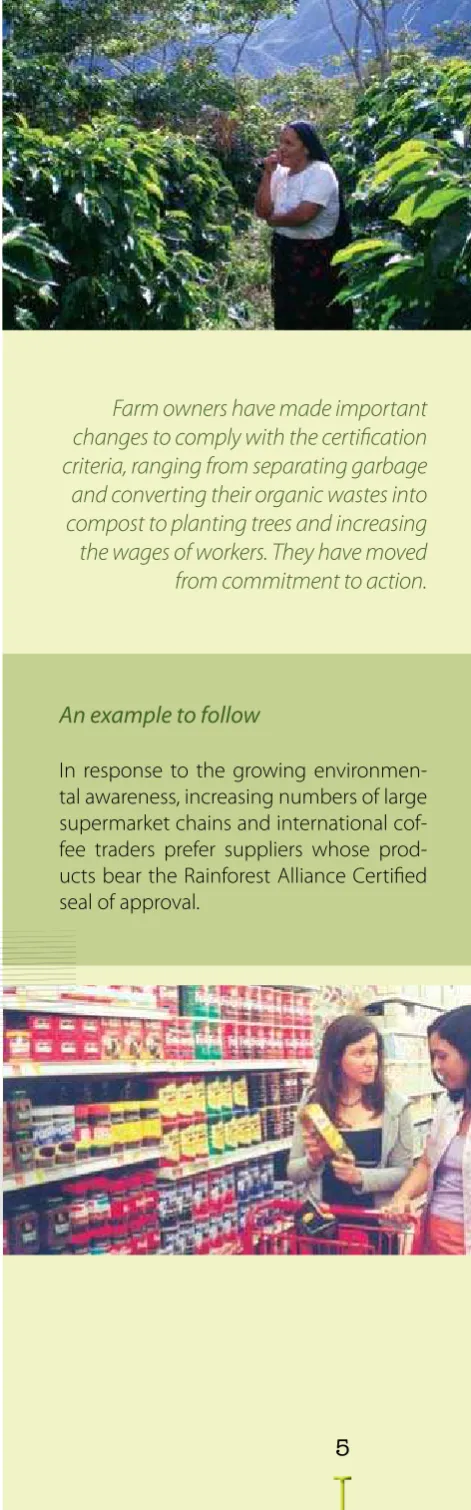
An example to follow
In response to the growing environmen-tal awareness, increasing numbers of large supermarket chains and international cof-fee traders prefer suppliers whose prod-ucts bear the Rainforest Alliance Certified seal of approval.
Sustainable agriculture is a business
that benefits everyone.
People,
resources and money:
A process in which
everyone wins
Rainforest Alliance certification guarantees that natural resources on certified farms are conserved, that those who practice responsible farm management are well compensated for their efforts and that consumers and business owners are rewarded for their purchases.
Certification standards show farmers
how to manage their crops sustainably.
These are the three pillars on which the certification
program and the standards for sustainable
agriculture were based.
Eicient farming
Biodiversity Community
development
The Rainforest Alliance Certified seal is not awarded to products or companies, but rather to production units or farms - from small fam-ily farms to plantations owned by large international corporations.
Certification focuses on the management of a farm or farms and cov-ers the social and environmental aspects specified in the standards. The scope of the certification process is the farm and the areas of in-fluence outside the farm that are affected by its production systems.
Rainforest Alliance certification is voluntary. The process begins with the preparation of the farm to comply with the standards and culmi-nates when the Rainforest Alliance Certified seal is awarded.
The certification contract is granted for three years. Farms remain certified as long as they comply with the SAN standard as demon-strated during annual audits. The certification contract is renewed at the end of the three-year period, after a full audit.
All farmers are welcome
to participate – all that is required
is a serious commitment
to comply with the requirements.
Towards certiication
Before beginning the formal process of Rainforest Alliance certifica-tion, the farmer should ensure that his farm complies with the sus-tainable agriculture standards. A certification audit can be requested from the local authorized entity.
Request for service. When a farm
or a group of farms is ready for the certification audit, a completed application is sent to the local en-tity. The application contains all the necessary information to con-tact the farm or the group admin-istrator and to plan the audit.
Planning the service. Based on information contained in the ap-plication, the local entity prepares a budget and proposes dates for the field audit. Once the budget has been approved, the client re-ceives the audit plan, and the au-dit team prepares.
If you are interested in becoming certified
or in receiving further information, please
refer to the local entities authorized for
these services at this address:
Costs
Direct certification costs include the audit fee, which will depend on the farm’s location, size and access, plus an annual quota based on the size of the farm. The indirect costs include all the changes that must be implemented to comply with the certification requirements.
The costs incurred during Rainforest Alliance certification are an investment in the farm’s sustainability and in future generations of farmers and local residents. It is important to obtain an information packet and submit an application to receive an official estimate of the audit costs.
Preparation and review of the report. The audit
team prepares a report based on its observations and findings. Part of this process involves an as-sessment of the farm’s performance, based on the standards. In the report, the team indicates whether or not the farm complies with the certi-fication requirements. Audit teams do not recom-mend or make decisions on certification. The cli-ent subsequcli-ently receives a preliminary version of the report in order to provide further informa-tion or correct any inaccurate informainforma-tion.
Certiication decision. Sustainable Farm Certification International (SFC), an independent organiza-tion, reviews the certification re-port prepared by the audit team and decides whether or not to award certification. The client has the opportunity to appeal the de-cision, which the SFC would con-sider on the basis of the evidence and justifications submitted.
Monitoring and annual audits. The
lo-cal entity returns to the farm each year to check on its general performance and on the progress made in correct-ing any non-conformities with respect to the standards.
www.sustainablefarmcert.com
Purchase and sale of certiied products
Being a member of the produce market that uses the Rainforest Alli-ance Certified seal offers major advantages:
• Your farm or group will be listed in the official directory of certi-fied product sources published at:
http://www.rainforest-alliance.org/farmproducts
• You will be able to locate producers and buyers throughout the agricultural production chain.
• You will be able to use the Rainforest Alliance Certified seal on your products or packaging.
• You will have access to high-quality promotional materials to increase your sales.
• You will receive regular information on products, tools and services.
• You will receive the Farm to Market bulletin that contains up-to-date information on certified products.
Ten Principles
of Sustainable Agriculture
1
2
5
7
8
1. Management System 2. Ecosystem Conservation 3. Wildlife Protection
4. Water Conservation
5. Fair Worker Treatment
6. Occupational Health and Safety 7. Community Relations
8. Integrated Crop Management
9. Soil Conservation
10. Waste Management
4
9
Sustainable Agriculture
Standards
The ten principles of sustainable agriculture underpin the sustain-able agriculture standards of the Sustainsustain-able Agriculture Network, laying out a path to sustainable agriculture through a set of good social and environmental practices.
These standards show producers how to manage their farms sustain-ably and how to minimize or eliminate long-term negative impacts on natural resources.
The original standards were developed between 1991 and 1993 as a result of a concerted technical effort by the members of the SAN, and they benefitted from extensive public consultation with contri-butions from farmers, academic institutions and governments.
They synthesize more than 15 years of experience in sustainable ag-riculture auditing and research in several Latin American countries. The standards are revised periodically.
The standards’ development and review process complies with the “Code of Best Practices for Setting Social and Environmental Stan-dards” of the International Social and Environmental Accreditation and Labeling Alliance (ISEAL). The Rainforest Alliance is the Secretari-at of the SAN and is a full member of ISEAL.
Social and environmental performance is evaluated by auditors based on the guidelines contained in the sustainable agriculture standards.
Standards Structure
Each one of the ten principles of the sustainable agriculture stan-dards consists of criteria that describe the best practices for social and environmental management. Some of the criteria are critical and must be complied with fully.
The criteria describe the means for evaluating compliance. There are local indicators that orient the farm in its efforts to comply with the standards, which can be changed according to conditions found in different countries, regions or cultures.
Growers of certified crops maintain
their productivity and are able to sell to
discerning consumers who are concerned
with healthy and ethical production, for
which they often are willing to pay higher
prices.
Requirements
To obtain Rainforest Alliance certification, each farm or group of farms must:
1. Be audited.
2. Achieve overall compliance with at least 80% of all the
appli-cable criteria of the sustainable agriculture standards.
3. At least 50% compliance with the applicable criteria for each
principle of the standards.
4. Comply with all the critical criteria.
5. Sign and comply with the certification agreement.
1
Critical criteria: The farm must have a sys-tem to avoid mixing certified and non-cer-tified products in its facilities and during harvesting, packaging and transportation. Products leaving the farm must be duly identified and accompanied by documen-tation indicating their origin.
Social and Environmental
Management System
This includes policies, programs and procedures necessary to imple-ment best practices, in accordance with respective national legisla-tion. The system evolves according to the results of the evaluations, and its scale and complexity depends on the type of crop, the size and complexity of the agricultural operations and on the farm’s inter-nal and exterinter-nal environmental and social factors.
Farms with good management systems maintain their infrastructures, offer training programs in occupational health and environmental education, monitor and carry out analyses of potable and waste wa-ters and control erosion and fertilization and waste management.
The programs stipulated in this principle must include work plans carried out by trained personnel, timetables and a description of the resources necessary to implement each action. Farm documents, such as maps and records of corrective actions implemented, should be accessible and well organized.
2
Ecosystem Conservation
Carbon sequestration, crop pollination and pest control are some of the services provided by natural ecosystems on farms. Rainforest Al-liance certification requires farms to protect ecosystems or carry out activities to restore them.
Production areas must not be located in places where they might have negative impacts on parks, wildlife ref-uges, biological corridors or other conservation areas.
The standards prohibit the extraction of threatened or en-dangered plants or animals. There are exceptions for tree felling and the extraction of plants, seeds and other non-timber forest products, but only if the farm has a plan for sustainable management approved by the appropriate authorities.
A buffer zone, where the use of agrochemicals is prohibit-ed, must be established to separate production areas from
natural ecosystems. A vegetated buffer zone created by planting or natural regeneration must separate different crop areas.
Natural water channels must be protected by establish-ing protected zones on the banks of rivers, streams, creeks and lakes. Farms must not alter natural water channels to create new drainage or irrigation canals.
Areas of vegetation must be maintained along roadsides and around areas of human activity, such as schools, dining areas, clinics, recreation areas, homes, storage areas, packing stations, warehouses, workshops and processing plants.
MAGGIE’S FARM
ON THIS FARM WE PROTECT
NATURE
Some measures to protect ecosystems vital for feeding, reproduction and breeding are:
Identify and keep an inventory of the wildlife found on the farm and its habitat.
Keep an up-to-date inventory of animals held in captivity or in workers’ homes, and demonstrate that these are kept in appropriate conditions, in line with national legislation.
Farms may breed wild animals, provided that the national legislation is followed.
3
Wildlife Protection
Certified farms provide a refuge for all types of wildlife, including endangered species, both resident and migratory. Hunting is pro-hibited on certified farms and the capture of wild animals must be reduced and eventually eliminated, even though this traditional for many cultures.
4
Water Conservation
Clean water is vital for agriculture. Certified farms must prevent the contamination of surface and ground water sources by treating and monitoring wastewater.
Other measures to consider are:
• All water sources exploited must have the re-spective concessions or permits from the corre-sponding environmental authorities.
• Irrigation systems must be designed based on climate, humidity and other characteristics to prevent waste or leakage.
• Responsible personnel should be designated for each operation and areas set aside exclusively for washing contaminated equipment.
• Farms that discharge wastewater into the envi-ronment must undergo an analysis and sampling program conducted by an accredited laboratory. • The use of septic tanks must be restricted to
do-mestic waste water.
Critical criteria. Farms must not discharge industrial or domestic wastewater into natural bodies of water, unless these dis-charges comply with the parameters es-tablished to prevent the degradation of clean water. Domestic or industrial waste, such as rubble, may not be deposited.
5
Just Treatment and Good
Working Conditions for Workers
All employees benefit from the working conditions established by international organizations such as the United Nations (UN) and the International Labour Organization (ILO), including the right to orga-nize and associate freely.
Workers must be informed of their rights and of the farm’s policies and should enjoy fair working hours, rest periods, vacations, bonuses and all the benefits stipulated in national legislation. They should also be familiar with the farm’s policies and procedures related to payments and deductions.
If housing is provided, it must be in good condition, with potable water, sanitation facilities and domestic waste collection. Families liv-ing on certified farms must have access to medical services and the children must have access to education.
HEALTH
POST
WORKER RIGHTS AND RESPONSIBILITIES
Other measures:
• The farm must have a written policy covering workers’ rights and benefits, which is approved by the farm’s management or owner and that is disseminated and made available to the workers. • The workforce should be hired directly, not through
intermediaries.
• Overtime work must be voluntary and must be paid at a higher rate than the standard wage. When national laws permit, work-ers may exceed the maximum of 60 hours per week during sea-sonal production peaks or due to unforeseen circumstances. • All forms of sexual, verbal, physical and psychological abuse are
prohibited and the farm must have established procedures for receiving and dealing with complaints.
• An environmental education program should be implement-ed for employees and their families, with an emphasis on
Critical criteria. The farm must not discrim-inate in its labor and hiring policies and procedures along the lines of race, color, gender, age, religion, social class, political affiliation, nationality, medical condition, sexual orientation or marital status.
The basic wage should be equal to or greater than the legal minimum for the re-gion. The costs of housing, food and other services may not be considered as part of the salary, unless permitted by the nation-al legislation.
6
Critical criterion. All workers who apply, handle or have contact with agrochemi-cals, including those who launder cloth-ing, should use protection equipment
Occupational Health and Safety
In order to comply with the requirements for health, order and clean-liness, and especially to reduce and prevent the risk of accidents, all workers must receive training on how to do their work safely, espe-cially with regard to the use of machinery, heavy equipment and agrochemicals.
This must form part of a program in which the required services, re-sources and working conditions must be identified and the employ-ees’ suggestions included in the analysis.
Farm administrators should provide the necessary equipment to protect workers and ensure that the farm’s infrastructure, machinery and tools are in good condition and do not pose a danger to human health or the environment.
Other measures:
• Workers who carry heavy loads, handle dangerous machinery or use agrochemicals should receive an annual medical checkup.
• Farms should keep an up-to-date inventory of chemical sub-stances and store only the necessary quantities. Personal protection equipment must not be stored next to chemical kept on the floor or in contact with absorbent materials.
• Specific procedures must be adopted to reduce the risk of ac-cidents and spillage of chemical substances during transporta-tion to and within the farm.
• Workers, local residents and visitors must be continuously pro-tected from the effects of agrochemical applications and bio-logical and organic inputs.
• Showers and changing rooms must be provided for all person-nel who apply or have contact with agrochemicals.
7
Community Relations
Certified farms are good neighbors. Farm owners and managers communicate, consult with and respect surrounding communities and local interest groups. Farm activities must not affect activities of social, cultural, biological, environmental and religious importance.
Farms must follow procedures to consider the interests of local populations regarding new construction, pro duction areas or operational changes that could have a negative impact on their quality of life.
Priority must be given to hiring and training local workers and to contracting and acquiring local services and products.
Farms should also contribute to the conservation of the community’s natural resources, collaborate with the local
economic development and contribute to the costs of lo-cal infrastructure, such as schools, roads and aqueducts.
Certified farms must also support environmental educa-tion efforts in local schools, when possible. For example, a large farm might be expected to contribute materials, courses or lectures or to organize events, while a small farm could provide access to its facilities for lectures, field days or other similar activities.
Put trash here
8
Integrated Crop Management
To reduce the risks and effects of pest infestations, preference should be given to biological, physical and mechanical methods to control harmful insects, plants, animals and microbes. Certified farms should reduce and eventually eliminate agrochemical use through integrat-ed crop management.
Farms must keep records to determine the types and quantities of agrochemicals purchased and to demonstrate gradual reduction. Any increase in their use must be short-term, for a specific type of pest, and must be justified in technical and economic terms.
To reduce waste and excessive agrochemical application, farms must have procedures and equipment for mixing chemical products and for maintaining and calibrating application equipment. Trained per-sonnel must perform these tasks.
Critical criteria. Use of chemical or bio-logical substances that are not legally reg-istered in the country or that are banned by the Environmental Protection Agency (EPA) of the United States and by the Euro-pean Union is prohibited.
Also prohibited are substances identified as Persistent Organic Pollutants (POP) in the Stockholm Convention, those prohibited or restricted by the Rotterdam Convention and the UN Environmental Program’s Prior Informed Consent Program (PIC). Other prohibited pesticides are those on the Pes-ticide Action Network’s Dirty Dozen list.
Farms must take steps to avoid introduc-ing, cultivating or processing transgenic crops, i.e. organisms modified using mod-ern biotechnology techniques to have genetic material from more than one spe-cies. If the presence of such material is de-tected on nearby farms, measures must be adopted to prevent their accidental introduction.
For more information, request the
updated list on banned pesticides from:
9
Soil Management and Conservation
Soils must support long-term agricultural production, so certified farms must work to improve them. Farms must have a program to prevent and control erosion, with practices such as using windbreaks, vegetative ground cover and run-off channels to reduce soil loss and the negative impacts on bodies of water.
Farms must implement a fertilization program based on the needs of different crops and soils, giving priority to organic fertilization using residues generated by the farm.
Using ground cover in planted and fallow areas helps restore soils’ natural fertility and reduces dependence on agrochemicals to control pests and weeds. Burning to prepare land for crops is not permitted.
10
Integrated Waste Management
Certified farms are clean and orderly thanks to waste management programs that include waste reduction, reuse and recycling. The ad-ministration, the workers and the families that live on the farms must be made aware of and comply with these objectives.
Open dumping and open-air burning of wastes are not permitted. Burning waste products is only allowed in an incinerator especially designed for that purpose. Certified farms must have legal permits for building and operating the incinerator.
Final or semi-permanent waste disposal areas on the farm must be designed to reduce contam-ination risks. Their location must be based on a site analysis, on the volume and type of waste, in accordance with current legislation regarding distances from houses and other areas of human activity and from water channels and sources.
Farms must not transfer waste without checking that its treatment or final use complies with legal requirements and those of the standards. Waste products or materials that have been in contact with agrochemicals must not be released without ensuring that their use will not be dangerous.
Farms must be clean and free of accumulations of all types of waste products in order to main-tain a positive image and contribute to the workers’ well-being.
RECYCLING CENTER
ORGANIC
WASTE PLASTIC METAL GLASS
AGROCHEMICAL CONTAINERS
DANGER
TOXIC WASTE PLEASE
The Seal
Differentiated products
Recognized by buyers
Farmers and groups of producers whose farms are Rainforest Alliance Certified, as well as buyers who obtain products from a certified farm or from certified groups, may use the Rainforest Alliance Certified seal of approval. All become part of a community committed to pro-tecting biodiversity and natural resources and to the just treatment of farm workers and their families.
The seal offers many advantages in international markets that demand a high level of social and environmental responsibility, since more and more consumers, mainly in Europe and the United States, wish to know where the coffee that they drink comes from, or where the chocolate, bananas, pineapple, passion fruit or ferns that they buy are produced.
The Rainforest Alliance authorizes the use of the seal to certified farms or groups of farms. It also allows the buyers of Rainforest Al-liance Certified products to use the seal once these are registered in the organization’s marketplace data system, found here: www. rainforest-alliance.org/farmproducts
Following
the product trail
To ensure that the products bearing the Rainforest Alliance Certi-fied seal of approval have not been mixed with other non-certiCerti-fied products, the facilities that process, pack, distribute or in some way intervene in the handling of the certified products must be assessed to determine chain-of-custody or traceability systems.
Chain-of-custody
is a system that allows for an effective
follow-up of the final processed product, beginning with
the raw material on the certified farms. The reception,
handling, storage, processing, dispatch and
delivery of certified products is controlled
from the farm to the end buyer.
If you have any questions about the
registration process for using the seal, or
regarding its correct use in promotional
items or other corporate identification
and marketing material, you can email
the Rainforest Alliance at:
[email protected]
Elements of the Chain of Custody
• Policies and procedures to control the mixing of products throughout the processing, handling, storage and distribution process.
• Documents demonstrating the separation of certified from non-certified products, as well as compliance with the appli-cable environmental and social legislation.
• Records of purchases and sales of certified products.
• Processes and spaces for physically separating certified from non-certified products or for processing these at different times.
• A training program for the key people involved in handling cer-tified products.
The chain-of-custody system prevents the unintentional mixing of Rainforest Alliance Certified products with uncertified products; it also verifies the intentional mixing of products in order to calculate the specific contents of the final certified product.
Small farmers
join together
The specific requirements for group
certification may be requested from
members of the SAN or by writing:
[email protected]
Small farmers face many challenges in obtaining certification, such as a lack of economic resources or limited access to technical know-how in order to comply with the standards. Some do not produce the necessary volume to attract international buyers.
The Sustainable Agriculture Network has standards for group certifi-cation in order to make the process more accessible to small farmers. Under this system, an organized group of farmers has responsibility for ensuring compliance with the standards. Instead of auditing each farm individually, the group management system and a sample of farms are audited with advantages for the entire group,
This certification option is available to farmers organized in groups that are managed by a “group administrator.” Examples include coopera-tives, producers’ associations and even farms that supply an exporter.
Advantages
• Lower audit costs, compared with individual farm audits.
• Farms in the group can develop and share policies, programs and systems, such as biodiversity conservation and chain- of-custody.
• Easier farmer training through an extension and inspection program.
• The internal control system is a platform both for quality con-trol and product traceability purposes and for other types of certification.
Requirements:
• A group administrator, the entity in charge of im plementing the produc-er management system.
• Developing and implementing an in-ternal control system to ensure that farmers comply with the standards and the selection or ex clusion of farms for certification.
• The group administrator should en-sure that internal audits are made on all farms and also maintain records on certified production data and the number and location of farms includ-ed in the group.