GROWTH AND YIELD STABILITY OF SWEET POTATO CLONES ACROSS FOUR
LOCATIONS IN EAST NUSA TENGGARA
Yosep S. Mau*), Antonius S. S. Ndiwa, I G. B. Adwita Arsa and Shirly S. Oematan Faculty of Agriculture, Nusa Cendana University
Jl. Adicucipto Penfui-Kupang, West Nusa Tenggara Indonesia
*) Corresponding author Phone: +62-380-881085 Email: [email protected]
Received: October 12, 2010/ Accepted: June 6, 2013
ABSTRACT
A number of promising sweet potato clones from East Nusa Tenggara and a checked cultivar were evaluated in several locations for the following objectives: 1) to elucidate genotype by environment effect on growth and yield of the sweet potato clones, and 2) to determine growth and yield stability of the clones across diverse locations in East Nusa Tenggara province. The study was carried out in four locations and was laid out in a Randomized Block Design consisting of 10 sweet potato genotypes as treatments and two replicates. Obtained data were subjected to combined analysis of variance to determine GxE interaction, followed by stability analysis based on joint regression model of Eberhart and Russell. Research results revealed that genotypes, locations and genotype by location interaction posed significant effect on the observed variables. Most of the evaluated clones were unstable for vegetative growth characters but were stable for tuber yield and yield components. The local clone LB-01 produced the highest mean tuber yield over all locations, averaging at 4.15 kg.plant-1 (~ 46.11 t.ha-1). Two local clones, i.e. ON-06 and LB-01, and the check cultivar Kidal were the most stable clones for tuber yield and yield components across diverse environments. Keywords: growth, yield, stability, sweet potato,
location
INTRODUCTION
Sweet potato [Ipomoea batatas L. (Lam)] is the second most important food crop in Indonesia after cassava. Due to its high carbo-hydrate content, sweet potato has been so far an important staple food crop besides rice and
corn (Cahyono and Juanda, 2000). In addition to carbohydrate content, sweet potato is also rich in vitamins and nutrients essential for human diets such as β -carotene, anthocyanins, total phenolics, dietary fiber, ascorbic acid, folic acid and minerals (Bovell-Benjamin, 2007; Rabah et al., 2004). Compared to other major staple food crops, sweet potato possesses additional positive attributes such as wide production geography, adaptability to marginal condition, short production cycle, high nutritional value and sensory versatility in terms of flesh colors, taste and texture (Truong and Avula, 2010). However, the potency of sweet potato in Indonesia has not been optimally exploited as with other staple food crops such as rice and corn. This is indicated by the continued decrease of harvest area and production of sweet potato during the last decade.
East Nusa Tenggara Province is one of sweet production centers in Indonesia. Sweet potato has been cultivated by farmers in this region over generations, and is utilized as staple food source to substitute rice and corn, mainly during famine period. Nevertheless, this crop can not be solely relied on as the main staple food crop due to its low tuber yield and quality in the farmer level. The low yield and quality is caused by, among others, low yield potential of the cultivars grown. In fact, numerous sweet potato germplasm are available in this region with enormous genetic diversity (Ndiwa et al., 2007). These local germplasm are invaluable genetic resources that can be exploited for sweet potato cultivar development.
Information on yield potential of sweet potato germplasm from East Nusa Tenggara province is lacking. This information is vital for development of the existing local germplasm into superior varieties with good adaptation to East Nusa Tenggara agroclimatic condition as Accredited SK No.: 81/DIKTI/Kep/2011
Yosep S. Mau et al.: Growth and Yield Stability of Sweet Potato………... 96
well as parental sources for sweet potato breeding programs. Several sweet potato clones from East Nusa Tenggara have been evaluated for drought tolerance (Mau, 2011) but the clones have not been tested over many locations that cover diverse agro-ecological conditions of this region. Multilocational trial will provide information on whether genotype by environment interaction poses significant effect on growth and yield of these clones. The presence of genotype by environment interaction usually causes serious problem in selecting the best performing and most stable genotypes due to the need to select for multiple environments (Ngeve, 1993; You, 1995). Environmental conditions that influence crop adaptation include soil type, altitude, latitude,temperature, climate and season. Large genotype by environment interaction effect, frequently, still does exist although the environ-mental conditions have been stratified. This would slow down the selection process and makes genotypes recommendations difficult (Caliskan et al., 2011; Yusuf et al., 2008). The stability analysis is, therefore, required to pinpoint the genotype performance across diverse environments, which will be very useful for breeders to select for the most stable genotypes.
In this study, a number of local sweet potato clones from East Nusa Tenggara province were evaluated over four locations for the following objectives: 1) to elucidate genotype by environment interaction effect on growth and yield of the sweet potato clones, and 2) to determine growth and yield stability of the sweet potato clones across diverse locations in East Nusa Tenggara province.
MATERIALS AND METHODS
Location and Time of the Research
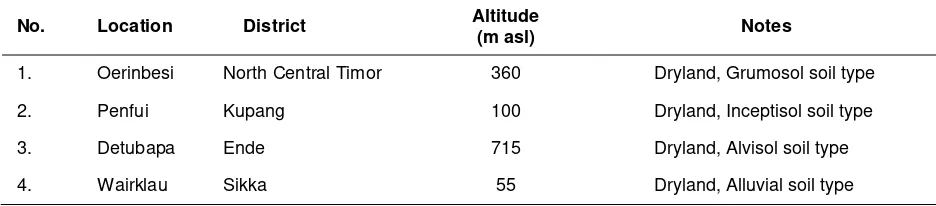
This study was carried out in four locations that covered low to medium altitude of sweet potato growing areas in East Nusa Tenggara Province from May to November 2009. The four research locations were distributed in four districts in the province, i.e. Oerinbesi (North Central Timor District), Penfui (Kupang District), Detubapa (Ende District), and Wairklau (Sikka District). A laboratory work was also carried out in Soil Chemistry and Soil Physics Laboratory of Faculty of Agriculture, Nusa Cendana University, to analyze both chemical and physical properties of soil samples taken from the four research locations. General features of research locations are presented in Table 1.
Altitude of the research locations ranged from 55 – 700 m asl., representing low to medium altitude. Soil types of the locations were Grumosol, Inceptisol, Alvisol and Alluvial. Soil texture of research location in Oerinbesi was sandy loam, and that in Penfui, Detubapa and Wairklau were, respectively, clay loam, sandy loam, and clay sandy loam. Soil acidity (soil pH) in Oerinbesi, Penfui, Detubapa dan Wairklau were, respectively, 6.69, 8.30, 6.81 and 6.70. Soil mineral fertility of the four locations also varied with N content (%), P content (ppm) and K content (me/100) were, respectively, 0.14%; 138.05 ppm and 0.54 me/100 in Oerinbesi; 0.12%, 116.55 ppm and 0.5% in Penfui; 0.25%, 141.48 ppm and 1.36% in Detubapa; and 0.13%, 132.36 ppm and 1.57% in Wairklau.
Table 1. General physical setings of experimental sites in four locations
No. Location District Altitude
(m asl) Notes
1. Oerinbesi North Central Timor 360 Dryland, Grumosol soil type
2. Penfui Kupang 100 Dryland, Inceptisol soil type
3. Detubapa Ende 715 Dryland, Alvisol soil type
Experimental Design and Research Procedures Research units at each location were laid out in a Randomized Block Design with two replicates (blocks). The treatment consisted of 8 local clones of East Nusa Tenggara (ON-07, ON-06, EBS-01, ORM-02, SEO-01, LB-01, PSU-03, NBN-01), one checked variety (Kidal) and one clone introduced from Papua (Lapembe). Planting materials were taken from shoots of 25-30 cm long or about 3-4 nodes each. The planting materials were sown in a single row plot of 1 m x 3 m, with a planting space of 50 cm between plants and 100 cm between plots. Fertilizers were applied at time of sowing with a rate of 150 kg.ha-1 of Urea, 100 kg.ha-1 of SP-36 and 100 kg.ha-1 of KCl. Soil moisture was maintained around field capacity level during the growing period.
The main variable observed was market-able tuber yield (fresh tuber weight per plant), which was then converted to fresh tuber yield per ha. Besides, vegetative growth and yield component characters were also observed. The vegetative growth characters observed included number of leaves per plant, number of secondary branch per plant and plant length, while that of yield components included number of tuber per plant, tuber diameter, and tuber length.
Data Analysis
Collected data were subjected to analysis of variance (Anova) using a single factor (genotype) component for each location. Data from all locations were then checked for their homogeneity of variance using Bartlett test and were subjected to combined analysis of variance to elucidate the effect of Genotype by Environment (GxE) interaction on the observed variables. Variables with significant GxE interaction were further analyzed to estimate stability parameters of the tested clones.
Yield stability parameters were determined following the model proposed by Eberhart and Russell (1966). A genotype was considered stable when the genotype exhibited an insignificant regression coefficient from unity (bi = 1.0) and an
insignificant deviation from regression (S2di = 0.0.).
Analysis of variance was performed using a Minitab Statistical Program Version 16.0.
RESULTS AND DISCUSSION
Vegetative Growth Components
Vegetative growth data over four locations were subjected to combined analysis of variance to determine the effect of genotype by environment interaction. Results of the analysis demonstrated that genotype, location and genotype by location caused significant effect (P<0.05) on the observed variables. This implies that vegetative growth parameters, i.e. number of leaves per plant, number of secondary branches per plant and plant length of the sweet potato clones did change following the change of planting environments. In other words, different locations posed different effect on genetic expression of vegetative growth of the tested sweet potato clones.
Means of growth component parameters over four locations at 3 months after sowing are presented in Table 2. Research results showed that SEO-01 possessed the highest number of leaves (127.25 leaves per plant), which was significantly higher than the other clones except Kidal (118.94 leaves per plant) and LB-01(113.13 leaves per plant). Number of secondary branches per plant did not differ among the tested clones with a range between 5 to 6 branches per plant. As with number of leaves per plant, plant length also varied significantly among the tested clones. The longest plant length was obtained from the introduced clone, Lapembe (216.44 cm) which differed significantly from ON-07 (115.9 cm) but not from the rest of the clones.
Yosep S. Mau et al.: Growth and Yield Stability of Sweet Potato………... 98
Similar results were also recently reported by Moussa et al. (2011) for plant length and number of branches per plant of six sweet potato cultivars evaluated under different environments.
The joint regression method of Eberhart and Russell (1966) was employed to estimate stability parameters of the observed variables which already exhibited significant genotype by location interaction effect. According to this method, the stable and desirable genotype would have the following criteria: 1) Non significant regression coefficient from one (bi =
1.0), 2) Non significant deviation from regression (S2di = 0.0), and 3) A high mean value. The
regression coefficient measures the response of a genotype to a given environment, and deviation from regression measures the stability of performance (Moussa et al., 2011). Mean performance and stability parameters of the tested clones for vegetative growth characters are presented in Table 2.
Data presented in Table 2 demonstrate that for number of leaves per plant, values of regression coefficient (bi) ranged from 0.15 up to
2.0 with insignificant different from unity for all evaluated clones; however, their values of deviation from regression (S2di) deviated
significantly from zero indicating instability of the clones for the trait. According to Eberhart and Russell (1966), the most important parameters of stability appeared to be the deviation from regression, and clones with the lowest deviation were considered the most stable. Of the 10 clones tested, SEO-01, Kidal, LB-01 and ON-07 exhibited average number of leaves above the grand mean. For secondary branch number per plant, bi values did not significantly differ from unity for the tested clones, except EBS-01 and LB-01. SEO-01, ON-07, Kidal and ORM-02 exhibited high mean values, and insignificant bi and S2di values for secondary branch number
per plant suggesting that these clones were stable across diverse environments for the trait. The local clone LB-01 exhibited a high branch number per plant (5.73) but its bi value was
significantly lower than unity (bi = 0.13) and its
S2di value was also significantly deviated from
zero (S2di = 1.34), suggesting that this clone was
unstable for the trait. As with number of leaves per plant, bi values of all evaluated clones did not significantly differ from unity but their S2di
values significantly differed from zero for plant length trait. This implies that the evaluated clones were unstable for plant length character. Keeping in view with the three criteria of stable and desirable genotypes proposed by Eberhart and Russell, i.e. mean value, regression coefficient and deviation from regression, the results of the present study demonstrated that all evaluated clones were unstable for vegetative growth characters under study. Similar results were reported by Moussa et al. (2011) for branch number per plant and plant length characters of six sweet potato cultivars grown under two locations during two consecutive years.
Yield Components
2 AGRIVITA VOLUME 35 No. 1 FEBRUARY - 2013 ISSN : 0126-0537
Table 2. Mean performance and stability parameters of vegetative growth characters of sweet potato clones evaluated in four locations
Remarks: Means followed by a common letter(s) within each column do not significantly differ using DMRT at 0.05 level of significance. *) Significant and ns) Not significant at t-test 0.05 level. *) Significant and ns) not significant using t-test at 0.05 level of significance
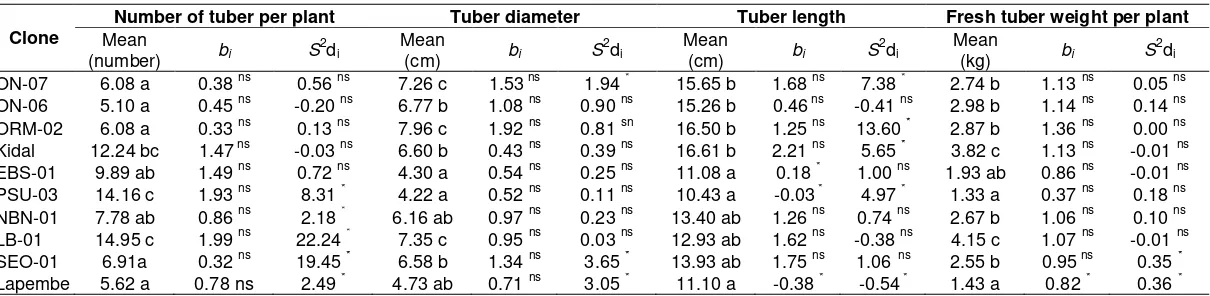
Table 3. Mean performances and stability parameters of yield components of sweet potato clones evaluated over four locations
Clone
Number of tuber per plant Tuber diameter Tuber length Fresh tuber weight per plant
Mean
(number) bi S
2
di Mean (cm) bi S2di Mean (cm) bi S2di Mean (kg) bi S2di
ON-07 6.08 a 0.38 ns 0.56 ns 7.26 c 1.53 ns 1.94 * 15.65 b 1.68 ns 7.38 * 2.74 b 1.13 ns 0.05 ns ON-06 5.10 a 0.45 ns -0.20 ns 6.77 b 1.08 ns 0.90 ns 15.26 b 0.46 ns -0.41 ns 2.98 b 1.14 ns 0.14 ns ORM-02 6.08 a 0.33 ns 0.13 ns 7.96 c 1.92 ns 0.81 sn 16.50 b 1.25 ns 13.60 * 2.87 b 1.36 ns 0.00 ns Kidal 12.24 bc 1.47 ns -0.03 ns 6.60 b 0.43 ns 0.39 ns 16.61 b 2.21 ns 5.65 * 3.82 c 1.13 ns -0.01 ns EBS-01 9.89 ab 1.49 ns 0.72 ns 4.30 a 0.54 ns 0.25 ns 11.08 a 0.18 * 1.00 ns 1.93 ab 0.86 ns -0.01 ns PSU-03 14.16 c 1.93 ns 8.31 * 4.22 a 0.52 ns 0.11 ns 10.43 a -0.03 * 4.97 * 1.33 a 0.37 ns 0.18 ns NBN-01 7.78 ab 0.86 ns 2.18 * 6.16 ab 0.97 ns 0.23 ns 13.40 ab 1.26 ns 0.74 ns 2.67 b 1.06 ns 0.10 ns LB-01 14.95 c 1.99 ns 22.24 * 7.35 c 0.95 ns 0.03 ns 12.93 ab 1.62 ns -0.38 ns 4.15 c 1.07 ns -0.01 ns SEO-01 6.91a 0.32 ns 19.45 * 6.58 b 1.34 ns 3.65 * 13.93 ab 1.75 ns 1.06 ns 2.55 b 0.95 ns 0.35 * Lapembe 5.62 a 0.78 ns 2.49 * 4.73 ab 0.71 ns 3.05 * 11.10 a -0.38 * -0.54 * 1.43 a 0.82 * 0.36 *
Remarks: Means followed by a common letter(s) within each column do not significantly differ using DMRT at 0.05 level of significance. *)Significant and ns) Not significant using t-test at 0.05 level of significance.
Clone
No. of leaves per plant No. of secondary branches per plant Plant length
Mean
(Number bi S
2
di Mean
(number bi S
2
di Mean
(cm) bi S
2
di
ON-07 101.75 bc 1.55ns 26.53* 5.88 1.90ns 0.89ns 115.99 a 0.77ns 2477.32*
ON-06 50.75 a 0.15ns 134.87* 5.19 1.57ns 0.65ns 138.31 ab 0.78ns 2448.60*
ORM-02 66.67 ab 0.61ns -9.99* 5.71 0.81ns 1.04ns 151.11 ab 1.59ns 553.28*
Kidal 118.94 de 1.37ns 213.41* 5.81 0.34ns 0.47ns 167.16 ab 1.47ns 1238.33*
EBS-01 83.44 ab 0.85ns 114.82* 5.19 0.23* 0.31ns 180.38 ab 0.40ns 150.04*
PSU-03 90.01 abc 1.08ns 415.93* 5.10 0.60ns 4.57* 154.04 ab 1.30ns 1562.85*
NBN-01 73.63 ab 0.84ns 110.88* 4.81 2.64ns 17.11* 142.44 ab 1.29ns 2953.39*
LB-01 113.13 cd 0.80ns 1331.15* 5.73 0.13* 1.34* 200.25 ab 1.80ns 2465.58*
SEO-01 127.25 de 2.00ns 1431.82* 6.19 1.20ns -0.02ns 143.81 ab 1.06ns 1268.59*
Lapembe 81.94 ab 0.84ns 6059.02* 5.81 0.83ns 19.50* 216.44 bc -0.46ns 8272.82*
99
Yo
s
e
p
S
.
M
a
u
e
t a
l.:
G
ro
wth
a
n
d
Yi
e
ld
St
a
b
ility
o
f
Swe
e
t
Po
ta
to
………
…..
100
Yosep S. Mau et al.: Growth and Yield Stability of Sweet Potato………...
Means of yield components and tuber yield of tested sweet potato clones are presented in Table 3. Over four locations, data presented in Table 3 demonstrate that the highest number of marketable tuber per plant, the biggest tuber diameter, and the longest tuber were, respectively, possessed by LB-01 (14.95 tuber.plant-1), ORM-02 (7.96 cm), and Kidal (16.61 cm). The existence of significant GxE interaction on tuber number per plant, tuber diameter, and tuber length demonstrates that expression of these yield component characters were determined by interaction between genetic factor (genetic potential) and environmental factor. Previous work by Rahayuningsih and Hartojo (1999) demonstrated that environmental factor such as soil humidity strongly influenced number of tuber produced per plant, where number of tuber per plant tended to decrease on water deficit condition. Furthermore, Ashari et al. (1997) found sweet potato clones that produced varying number of tuber per plant when grown in different environments. Tuber diameter and tuber length, according to Adriyaswar et al. (1994), were influenced by tuber shape (genetic factor) as well as by soil chemical fertility, soil texture, and climate (environmental factor). Soil with permeable texture and rich in nutrients is mostly favorable for tuber development, both tuber number and tuber size (diameter and length). Furthermore, Rahayuningsih and Hartojo (1999) found that tuber size was determined by drought stress, where water deficit increased number of small size tuber but on the other hand reduced number of large size tuber.
Research results (Table 3) showed that the highest mean tuber yield over four locations was possessed by LB-01 (4.15 kg.plant-1), followed by Kidal (3.82 kg.plant-1) and ON-06 (2.90 kg.plant-1) at the second and the third places, respectively. The presence of significant GxE interaction effect on fresh tuber yield may have been due to varying environmental conditions where the plants were grown. Environmental conditions that may influence tuber production include soil fertility, temperature, humidity, altitude, etc. Soil fertility influences various aspects of plant growth through availability of essential nutrients required for plant and tuber growth and development (Cahyono and Juanda, 2000). There was a considerable variability of soil fertility, soil type and altitude among the four research locations (Table 1). These differences, through
their interaction with genetic makeup of the tested clones, may have caused significant effect on tuber yield of the sweet potato clones. Results of the present study are similar to findings of previous workers where genotype by environment interaction posed significant effect on tuber yield of sweet potato (Moussa et al., 2011; Osiru et al., 2009; Yusuf et al. 2008; Ashari, 1997; Mbwaga, et al., 2007). These findings suggest that tuber yield is a quantitative trait that is controlled by many genes, where expressions of these genes are strongly influenced by environmental factor. Sweet potato genotype grown in changing environments will result in changing tuber yields.
Stability parameters of evaluated clones are presented in Table 3. Values of regression coefficient for tuber number per plant did not significantly differ from unity indicating their general adaptability. Number of tuber per plant of LB-01 (14.95 tuber. plant-1) and PSU-01 (14.16 tuber. plant-1) were the highest and were above the grand mean (8.88 tuber. plant-1) but their S2di values deviated significantly from zero
suggesting their instability for the trait. Tuber diameter of LB-01 (7.35 cm) and ORM-2 (7.96 cm) were the highest and above the grand mean with insignificant bi and S2di values suggesting
their stability for tuber diameter across environments and, hence, the most desirable clones for this yield component character. Regression coefficient values of tuber length did not significantly differ from unity for evaluated clones except Lapembe, EBS-01 and PSU-01. Five clones (Kidal, ORM-02, ON-06, ON-07, and LB-01) possessed tuber length above the grand mean (13.69 cm) but only ON-06 and LB-01 possessed insignificant S2di values. This suggests
that ON-06 and LB-01 were the most desirable clones for tuber length trait.
For fresh tuber weight, bi values did not significantly differ from unity for the evaluated clones, except Lapembe. Deviation from regression values of the tested clones also did not significantly deviate from zero, except Lapembe and SEO-01. These findings suggest that the majority of evaluated clones were stable for fresh tuber yield under different environmental conditions.
the grand mean (2.65 kg.ha-1). However, only three of these clones, i.e. ON-06, LB-01 and Kidal possessed high and stable tuber yield and also were stable for at least two yield component characters observed in the present study. ON-06 was the only clone with insignificant bi and S2di
values for all measured yield component characters, i. e. number of tuber per plant, tuber diameter, and tuber length indicating its stability for these characters. In addition, LB-01 was also stable for tuber diameter and tuber length, and Kidal was stable for the number of tuber per plant and tuber diameter traits (Table 3). Sweet potato genotypes with high and stable tuber yield across diverse environments have been reported by previous workers (Moussa et al., 2011, Haldavanekar et al., 2011; Mwololo, 2009; Yusuf et al., 2008; Mbwaga et al., 2007). As comparison, previous work by Caliskan et al. (2011) could identify sweet potato genotypes with considerably high tuber yield but no stable genotype was found among the evaluated genotypes.
The findings of the present study revealed two local clones i.e. LB-01 and ON-06 and the checked cultivar Kidal as the most desirable clones due to their high mean values and stability for tuber yield and yield component characters. LB-01 and ON-06 are then, potential clones to be proposed as promising varieties with high and stable yield across diverse agro-ecological conditions of East Nusa Tenggara Province.
CONCLUSIONS
Growth and yield parameters of the tested sweet potato clones were strongly influenced by genotype, location, and genotypes by location interaction. Most of the tested clones were unstable for vegetative growth characters but were stable for yield and most of yield component characters.
Two local clones, i.e. ON-06 and LB-01, and the checked cultivar, Kidal, were the most desirable genotypes due to their high mean values and stability for tuber yield and yield component characters.
The local clones, ON-06 and LB-01, and the checked cultivar Kidal are recommended for cultivation in sweet potato growing areas in East Nusa Tenggara Province. ON-06 and LB-01 can also be proposed as new superior varieties for
agro climatic condition of East Nusa Tenggara Province after more detailed and further testing.
AKCNOWLEDGEMENTS
This work was funded by the University of Nusa Cendana, through Regional Development and Empowerment Research Grant 2009 program. Therefore, the authors would like to thank the Rector of the University of Nusa Cendana for the grant provided to the research team.
REFERENCES
Adriyaswar, Mulyadi, and M. Jusuf, 1994. Evaluation of yield potential of several sweet potato clones and varieties on Gadut Andosol Soil, Bukittinggi. Summary of National Seminar, Research Institute of Food Crops, Sukarami, 4: 139-144. ( in Indonesia)
Ashari, S., N. Basuki and N.R. Ardiarini. 1997. Growth and yield characters of several sweet potato clones in two locations. Agrivita. 19 (1): 1-5. ( in Indonesia) Bovell-Benjamin, A.C. 2007. Sweet Potato: A
review of its past, present, and future role in human nutrition. Advances in Food and Nutrition Research. 52:1-48.(http://www. ncbi.nlm.nih.gov/pubmed/17425943). Cahyono, B. and D. Juanda, 2000. Cultivation
and Agribusiness Analysis of Sweet Potato. Kanisius Publishing Inc. Yogyakarta. pp.92. ( in Indonesia) Caliskan, M.E., E. Erturk, T. Sogut, E. Boydak
and H. Arioglu. 2007. Genotype × environment interaction and stability analysis of sweetpotato (Ipomoea batatas) genotypes. New Zealand Journal of Crop and Horticultural Science, 35 (1): 87-99. (http://dx.doi.org /10.1080/01140670709510172).
Eberhart, S.A. and W.A. Russell, 1966. Stability parameters for comparing varieties. Crop Science Journal, 6: 36-40.
Haldavanekar, P.C., S.G. Bhave, R.G. Kahandekar, S.G. Kadam and S.S. Sawant.2011. Stability analysis in sweet potato (Ipomea
batatas L.). Karnataka J. Agric. Sci., 24 (3):
Yosep S. Mau et al.: Growth and Yield Stability of Sweet Potato………... 102
Manrique, K. and M. Hermann, 2000. Effect of GxE interaction on root yield and beta-carotene content of selected sweetpotato (Ipomoea batatas (L) Lam.) varieties and breeding clones. CIP Program Report, 281-287.
Mau, Y. S. 2011. Evaluation of drought tolerance level of sweet potato (Ipomoea batatas L.) germplasm from NTT Province. in Nurbaity, A., E. Subroto, E.Y. Setyowati, F. Stanica, I.N. Bari, K. Wimmers, N. Carsono, O. Mulyani, P. Lehmousloto, P.S. Teng, S.Y. Siswanto, S. Aleksic (Eds.). Proceeding of International Conference on Sustainable Agriculture and Food Security: Challenges and Opportunities. p.370-376.
Mbwaga, Z., M. Mataa, A. Msabaha, 2007. Quality and yield stability of orange flesh sweet potato (Ipomoea batatas) varieties grown in different agro-ecologies. African Crop Sciences Conference Proceedings, 8: 339 - 345. (http://www. acss.ws/Upload/XML/Research/223.pdf) Moussa, S.A.M., H.A.A. Aal and N.I.A. El-Fadl, 2011. Stability study of sweet potato yield and its component characters under different environments by joint regression analysis. Journal of Horticulture Sciences and Ornamental Plants. 3(1): 43-54. (http://idosi.org/ jhsop/3(1)11/6.pdf). Mwololo, J.K., P.W. Muturi1, M.W.K. Mburu,
R.W. Njeru, N. Kiarie, J.K. Munyua, E.M. Ateka, R.W. Muinga, R.E. Kapinga and B. Lema. 2009. Additive main effects and multiplicative interaction analysis of genotype x environmental interaction among sweetpotato genotypes. Journal of Animal and Plant Sciences, 2(3): 148 - 155. (http://www.m.elewa.org/JAPS/). Ndiwa, A.S.S., I.G.B.A. Arsa, M. Kasim, A.S.J.
Adutae and Z. Abidin. 2007. Inventarisation and Identication of local sweet potato clones of East Nusa
Tenggara Province in an attemp to development and promotion of its production potential as an ideal staple food alternative. Researh Report. Pulses and Tuber Crops Research Center, Universitas Nusa Cendana, Kupang. pp.32. ( in Inonesia)
Ngeve, J.M.1993. Regression analysis of genotype x environment interaction in sweet potato. Euphytica, 71: 231-238. Osiru M.O., O.M. Olanya, E. Adipala, R. Kapinga
and B. Lemaga, 2009. Yield stability analysis of Ipomoea batatus L. cultivars in diverse environments. Australian Journal of Crop Science. 3 (4): 213-220. (http://www.cropj.com/).
Rabah, I.O., D.X. Hou, S.I. Komine and M. Fuji, 2004. Potential chemopreventive pro-perties of extracts from baked sweet potato (Ipomoea batatas Lam. Cv. Koganesengan). Journal of Agricultural and Food Chemistry. 23: 7152-7157. Rahayuningsih, S.A. and K. Hartojo, 1999 In
Krisdiana, R., Trustinah, A. Taufiq, A. Winarto (Eds.). Performance of promising sweet potato clones in restricted irrigated area in Blitar. Special Edition of Balitkabi, 13: 334-346. ( in Indonesia)
Truong, V.D. and R.Y. Avula, 2010. Sweet potato purees and dehydrated powders for functional food ingredients. In: Ray, R.C. and K.I. Tomlins (Ed.). Sweet potato: post harvest aspects in food, feed and industry. Nova Science Publishers, Inc. p.117-162.
You, S.K., 1995. Regression and AMMI analyses of genotype x environment interactions: An empirical comparison. Agronomy Journal, 87: 121-126.