Harr y Samuels
BA H R A I N
20th-Century Humanism
and 21st-Century Technology:
A Match Made in Cyberspace
L
earning a foreign language is a
challenging task—and
teach-ing a foreign language can be
just as daunting. Though as
teach-ers we may experience only minimal
changes in our curricula from year
to year, we are constantly looking for
new and creative ways to motivate
our students to learn. Once upon a
time, back in the days of peace, love,
revolution, and bell-bottomed blue
jeans (that is, the 1960s), a
philoso-phy gained popularity among
edu-cators in a variety of disciplines and
was adopted by teachers of foreign
languages. That method was based
on the premise that if our students
feel better about themselves, they
will achieve greater results as learners.
Additionally, the philosophy said, the
more inclined students are to share
their feelings, interests, values, hopes,
and dreams, the stronger and more
self-confident they will be. That
phi-losophy appealed to foreign language
teachers because it also meant that
our students would have the
con-fidence to speak more in the target
language and move closer to full
lin-guistic competence. This innovation
in teaching was known as the
human-istic approach to education, and
exer-cises developed for the classroom were
referred to as humanistic activities.
you will be in your endeavors, including for-eign language learning.
In certain respects, then, twentieth-centu-ry humanism and twenty-first-centutwentieth-centu-ry social media are a logical match; the more you interact with others in cyberspace, the more self-assured you can become, and with the increasing availability of social media, nowa-days you can reach out to a vast number of people online. This article will explore the background and principles of humanism, then present ideas for humanistic activities updated for the twenty-first century.
Origins of humanistic methodology in education
Sixty years ago, the United States was emerging from a period during which the country’s population had suffered economic hardship in the Great Depression and sacrificed lives and wealth during World War II. A time of peace and prosperity in the 1950s resulted in a spike in the nation’s birthrate, produc-ing a generation of youngsters who came to be known as the Baby Boomers. Upheaval in the nation’s economic, political, and social structures occurred during the middle of the twentieth century, and education was not immune from the changes. During this period, the theories of psychologists Abraham Maslow and Carl Rogers influenced educators who recognized the value of introducing humanism in the classroom. By the late 1960s, the Baby Boomers were college students and were call-ing for greater reform in education and society, their demands expressed in lyrics to songs such as “Aquarius” (Rado, Ragni, and MacDermot 1969), which proclaimed it was a time for “har-mony and understanding, sympathy and trust abounding … .” Educators realized that more attention needed to be paid to students’ emo-tional needs, and that also had to be reflected in the way teachers performed their duties.
One result was that greater attention was paid to the personal as compared with the intellectual dimension of the student. Gertrude Moskowitz, a guru for those who tuned in and turned on to humanism in education, describes the mood of the period: “There seems to be a shift in our society’s focus from one of aca-demic achievement to one of self-actualization. Developing fulfilling relationships, recogniz-ing interdependence, expressrecogniz-ing one’s feelrecogniz-ings,
achieving one’s potential, sharing oneself, and giving and receiving support are all parts of this new area of emphasis” (Moskowitz 1978, 10). Simon, Howe, and Kirschenbaum (1972) also wrote of the estrangement of students who were put off by the status quo in education: “So often, what goes on in the classroom is irrelevant and remote from the real things that are going on in students’ lives—their daily encounters with friends, with strangers, with peers, with authority figures” (13).
In this environment of alienation and rebel-lion, attention to humanism and self-actualiza-tion—achieving one’s full potential—gained momentum in society and in the classroom. According to Moskowitz (1978, 13), “Such an approach will help increase the esteem and understanding students have for themselves and others, thus facilitating growth in the direction of being more self-actualized” (italics added). In other words, learners will be more confident not only in their ability to learn Eng-lish—but to succeed at almost any task.
Critics of this shift of emphasis from the cognitive to the personal insist that the goal of education is to teach academic content accord-ing to the requirements of the curriculum, and that by devoting time to activities that address the feelings of students, we are simply creating a distraction from the main task at hand. Gadd (1998) argues that some teachers substitute affective learning for more formal learning, to the detriment of the student’s academic prog-ress. In a rebuttal, Arnold (1998) makes the point that the vast majority of foreign-language teachers use these exercises to supplement what students are expected to learn in class. She cites Moskowitz as someone who recommended “not total abandonment of what teachers are expect-ed to teach, but supplementing these materials where appropriate” (Moskowitz 1978, 1). In Arnold’s words, “Humanistic language teach-ers see that they can teach English at least as effectively as those who take another approach, and at the same time provide their students with added benefits” (Arnold 1998, 237).
If we consider the basic principles that pro-vide a justification for humanism in education, its benefits become clear. Referring to those principles, Moskowitz has written,
them-selves and their classmates and find out more about what they are really like. Such an approach will help increase the esteem and understand-ing students have for themselves and others … . They will then become more motivated to learn to use the foreign language and, as a result, will be more likely to learn. (Moskowitz 1978, 13)
Today, with the increasing popularity of social media, students have new forums where they can share their feelings with others. This is an important development for English-language teachers and learners; if we apply the principles of humanism to social media, it means that as the number of English-language-speaking peers in one’s social media network grows, it will be easier for a student to move along the path to self-actualization and that student will have greater potential for success in learning the target language.
Humanistic activities
Traditionally, humanistic activities designed for the classroom have not been dependent on advanced technology, so they serve as realistic possibilities for teachers in nearly every context. But because an increasing number of teachers and students have access to the Internet, the exercises described in this article are also Inter-net-adaptable, and they include instructions for using web platforms such as chat rooms (also known as message boards or online forums) or more recent innovations such as the web-cam chat and a social network. Additionally, the activ-ities presented here are relatively easy to carry out in the classroom. The first is based on the well-known icebreaker Find Someone Who …, while the others focus on self-expression, intel-lect, and perception.
Some of the activities featured in this article are inspired by ones that appeared in Mos-kowitz (1978) and by her enthusiasm for using humanistic techniques to teach foreign languages. She offers three important pieces of advice. The first is to always accentuate the positive. Humanism is all about feeling good about yourself, so tell your students that whenever they are tempted to say something negative about someone, they shouldn’t do it! The second piece of advice is to give your students the option to not participate in any
activity; feeling overly pressured to participate can discourage any language learner. Third, bear in mind that these activities are meant to supplement what you are required to cover with your students according to your syllabus and curriculum.
The activities presented here have been adapted to social media platforms in order to increase their appeal as well as their effectiveness.
Four humanistic activities 1. Find Someone Who …
Many teachers have had experience with Find Someone Who …, but in a humanistic exercise, the questions that students usually ask each other about hobbies, experiences, and skills can be supplemented with others that address a student’s feelings, values, and personal qualities.
Establishing a level of rapport with your students at the beginning of a course can help facilitate a humanistic adaptation of Find Someone Who … . One strategy is to share personal information, as suggested by Mole (2011): “Something that I think helps establish a rapport is to tell the class a few details about yourself, your family, and your background … . So I talk about various members of my family and some of my friends as well as drawing on my experiences in other countries.” Such an approach, if you feel comfortable with it, can help put students at ease and at the same time provide them with an example of the type of information you would like them to share with their classmates. By engaging the students, you may also discover which topics are of interest to them. That will help you draft your own prompts for the activity.
must turn the prompt into a question and ask a classmate, “Do you have a younger brother?” If the response is “No,” the student moves to another classmate and repeats the question. If the response is “Yes,” the student asks for the respondent’s name and writes it after the prompt. Ideally, the student will write a different student’s name for each of the prompts.
The activity gives students practice with forming questions using “Do you …,” “Are you …,” and “Can you …,” along with other structures, if you expand the prompts to include tenses besides present simple. The activity also allows for practice using vocabu-lary related to things students do, think, and feel, inside and outside the classroom.
As such, the activity offers an excellent opportunity to incorporate prompts with a humanistic orientation and the qualities associ-ated with it. Following are examples of prompts (and a quality that each relates to):
Find someone who …
• is a volunteer. (civic responsibility) • can tell funny jokes. (humor) • can keep a secret. (trust)
• thinks it is better to give a gift than receive one. (generosity)
• is a member of a club. (sociability) • cleans his or her room every day.
(neat-ness/self-discipline)
• is always on time for school. (punctual-ity/self-discipline)
• likes helping other people with tasks. (consideration of others)
• would offer his or her seat to an elderly person. (consideration of others) • always follows rules. (obedience) • helps with chores at home. (cooperation) • is saving money to buy something.
(thrift)
• wants to read a new book. (curiosity/ self-improvement/personal growth) • wants to learn a new language.
(curios-ity/self-improvement/personal growth) • exercises every day. (health and fitness) • eats healthful foods. (health and fitness) • has a part-time job. (industriousness) • likes to work with others. (cooperation/
teamwork)
• wants to be a leader. (leadership)
Give students enough time to find people who say “Yes” to most or all of the prompts.
The classroom usually becomes quieter as students near completion of the task. Have the students sit down again and then ask if anyone has written the name of a student for each item. Or you can ask students to talk about some of the interesting things they’ve learned about their classmates. Use follow-up questions to elicit more details during the discussion phase.
Using a chat room for Find Someone Who …
An Internet connection can make it pos-sible for a class to participate in chat rooms. Such platforms make it possible for students or instructors to post messages that others can read and respond to almost instantaneously. Find Someone Who … can be adapted to an online chat room format, but instead of the teacher providing the prompts, the students anony-mously post their own sentences. Then, in class, these sentences become the prompts that students turn into questions as they try to dis-cover who wrote them in the chat room. Here are a few examples of online postings, followed by the in-class questions they would prompt:
1. Post: I volunteer to tutor students who study English at my school.
Question: Do you volunteer to tutor students who study English at our school?
2. Post: Many of my friends tell me their secrets.
Question: Do many of your friends tell you their secrets?
3. Post: I taught my brother how to swim last weekend.
Question: Did you teach your brother how to swim (last weekend)?
the questioner something important about the student. You can ask students if they were able to identify the authors of all the postings and conclude with a discussion about the interest-ing thinterest-ings they learned about their classmates. Find Someone Who … can be adapted to a humanistic context. It will give students a forum, either in the classroom or online, where they can share information about their values, feelings, and personal qualities. As they do, stronger bonds will be formed, confidence to speak in the target language will increase, and they will make progress toward reaching their full potential as language learners and human beings.
2. Self-Collage
Collage is an art form that offers students an excellent venue for self-expression. Even stu-dents who do not consider themselves accom-plished artists can derive pleasure from creating their own collage. In this exercise, each student combines meaningful images with words in the target language to create a collage about himself or herself. Many examples of collages can be found on the Internet; you can find images of some by doing a search for “self-collage” under the www.google.com Images tab. A typical self-collage includes pictures of people, places, and other items that are important to the creator of the piece. Those images may be cut from maga-zines or newspapers, or students can draw their own sketches. Because this is a language proj-ect, English should be prominently featured in the collage. Words and phrases in the target language that describe personal qualities, inter-ests, hobbies, and emotions are interspersed among the images.
When you introduce the assignment, tell students not to put their names or pictures of themselves on the collage in order to ensure anonymity, an important element of the proj-ect. This is an assignment that should be completed at home and will require one to two weeks for preparation. On the due date, stu-dents hand in their collages, and you can hang them on the walls of the classroom. A sheet of lined paper should be attached to the bottom of each collage where other students can post their comments. Encourage your students to write extended comments rather than snippets like “It’s good” or “I like it”—urge them to try to figure out and explain why it’s good or
why they like it. You can also encourage the following:
• positive remarks about the collage • comments about what the viewer
learned about the interests of the cre-ator of the collage
• reflections on personal qualities and interests shared by the creator and the student who is commenting
Some examples of thoughtful comments: “You and I have visited the same waterfall.” “I can tell that you are a generous person.” “It’s great that you like to exercise so much. You must be very healthy.” The activity can conclude with each student presenting his or her collage to the class and reflecting on the comments made by classmates.
Using a Ning for the self-collage
This project can also be carried out on the online platform called a Ning (www.ning. com). A Ning is an online social network with membership limited to individuals who are invited to join and participate. Members create blogs, upload photos, participate in forums, and do much more. Students can upload pho-tographs of their collages, and comments can be posted by other members of the Ning—that is, other students in the class. Each student will be able to read how the collage is perceived by classmates, and creators can compare those perceptions with how they perceive themselves. Their own reactions to comments can also be posted on their Ning blog.
One goal of the collage project is to promote friendship and trust, and you should emphasize that goal when you introduce the assignment. Remind students of the importance of making positive comments on their classmates’ collages: such comments can help students feel better about themselves and about their classmates. In addition, being positive about an aspect of a collage that may be different from their own also helps students appreciate individual differ-ences in taste, interests, and experidiffer-ences.
basic principles of humanism to social media suggests that the more a student’s social media network expands, the better the student will feel about himself or herself.
3. Express Yourself with Art
During this activity, students listen to a musical arrangement and—using pencils, mark-ers, watercolors, or whatever sketching tools are available—draw images that capture their emotions. The selection they listen to should allow enough time for students to complete their drawings; ten to fifteen minutes should be sufficient. An instrumental piece such as a symphony, a jazz composition, or a selection from an indigenous or traditional musical genre would be suitable. I’ve always done this activity or seen other teachers do it with an instrumen-tal piece; lyrics might become a distraction, or the students might sketch according to words they hear in the song. After the students have put the finishing touches on their artwork, have each one stand up and present it to a small group or to the entire class. It should be held high enough so that everyone can see the image as students describe what they’ve drawn and how they were affected by the music.
If you want to be explicit about the lan-guage your students practice, instruct them to use a structure being targeted or vocabulary being reviewed. Examples might be “This is a picture of a sunset” (demonstratives) or “The music made me feel _________” (adjec-tives that describe emotions). The activity can become more interactive if other students ask the artists about their artwork (“What is the small blue object in the corner?”) and compare drawings among themselves. In a humanistic context, questions could address the following:
• motivation (e.g., “What did the music make you think of?”)
• emotion (e.g., “How did you feel when you were drawing the picture?”) • reflection (e.g., “What do you like best
about your picture?”)
As most teachers know, using a visual aid can help elicit feedback. Images are interpreted in different ways, and interpretations can be compared in a lively discussion. To one stu-dent, the drawing might look like a shimmer-ing stream flowshimmer-ing through a tropical jungle, while to another it may appear to be an alien from a distant world.
You can also use a graphic organizer to illustrate how the same image can affect dif-ferent people in many ways. To do this, attach the picture to the center of the blackboard and draw lines that connect it to ovals containing words or phrases you elicit from your students. As with any graphic organizer, the first set of ovals can radiate to others containing related words and phrases. The choice of prompts you use is up to you; here are three suggestions:
• What do you see in this picture? • How does this picture make you feel? • What similarities do you see in this
picture and your own picture?
Artwork and social media
Photographs of the artwork can be upload-ed to a Ning, and members can use their blogs to post comments that describe how they were influenced by the recordings; classmates can also post impressions and interpretations of the artwork created by others. The presentation of artwork can be fun and, regardless of the level of sophistication, a source of pride and achievement. That pride can be channeled in a direction that will give your students more confidence to communicate through speech and writing in the target language.
Additionally, groups of students in more than one location can take part in a web chat, where students use a video connection to pres-ent their artwork to studpres-ents in a classroom in another school, city, or even country. The students who are viewing the artwork post their feedback as chat—text that appears in a “chat box” on the same screen. There are several web-sites where this application can be downloaded, but currently Skype (www.skype.com) is the most popular; it’s free if the users communicate computer-to-computer. The students who are presenting can also respond to the comments of others on camera or with text.
about music and art with learners from places your students would like to visit will also give them a feeling of satisfaction at having been able to make themselves understood through both art and language.
4. Jeopardy!
For years, teachers of all subjects have debat-ed the value of playing games in the classroom; many teachers and even some students consider such activities frivolous. On the other side of the argument are teachers like Adam John Simpson, who writes, “Despite my many years of trepidation, there has always been pedagogic evidence out there to endorse the use of games in the language classroom” (Simpson 2011). He cites Lengeling and Malarcher (1997), who point out that games offer affective and cogni-tive benefits, strengthen classroom dynamics, and foster adaptability.
In a humanistic context, games will help language learners develop greater confidence as they perform tasks that give an indication of their level of knowledge in a specific area of language or culture. In games that are played by teams, learners build teamworking skills, and when students perform well, not only do their teammates benefit, but all of their classmates observe their accomplishments. The affective benefits identified by Lengeling and Malarch-er (1997)—e.g., lowMalarch-ering the affective filtMalarch-er, encouraging the creative and spontaneous use of language, and promoting communicative competence—are well known to those of us who use humanistic techniques. When a stu-dent performs successfully in front of a group or in front of the class, those affective benefits are multiplied.
How has the Internet affected the quality and availability of games we can use in the classroom? Games for teaching English as a for-eign language can be found on many websites, but a more important decision for the teacher is which game to choose. Television may provide us with an answer.
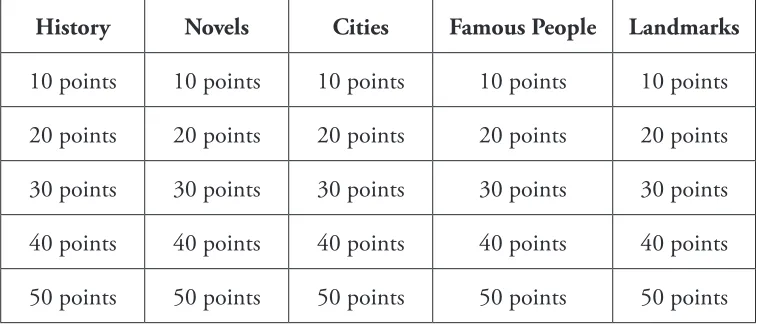
One of the most popular American televi-sion game shows of all time, Jeopardy!, tests a contestant’s knowledge on a variety of topics. There are various commercial websites where templates for games such as Jeopardy! can be downloaded for a fee. However, it’s not dif-ficult for your students to create their own
Jeopardy! game board. The board has categories across the top, with the rest of the board made
up of cells where answers can be deposited. (See Figure 1 for an example, but you can play the game with fewer categories or fewer items in each category.) Use stiff poster-sized paper and make pouches for each cell.
Note that each cell contains the answer to a question about an item in the category. To play the game, a contestant must choose a cell (e.g., “Cities for 10 points”), and a moderator—you or a student who is not in the game—reads the answer in the cell. The contestant must then
ask a question that would produce that answer. For example, the “Cities for 10 points” cell might have the answer, “Washington, D.C.” The contestant is expected to provide a ques-tion such as, “What is the capital of the United States?” On the other hand, the cell worth 50 points should contain an answer to a more challenging question. If the answer “Mother Teresa” appears in a cell under “Famous Peo-ple,” a correct question would be, “Who helped poor people living in Kolkata, India?”
The Jeopardy! game is played by teams of students (teams of three work well), with one student representing each team in each round. If necessary, the player is allowed to ask his or her teammates for help. Players have the right to choose answers from any of the cells, but most begin with ones that have lower values (easier items) and then move on to more challenging, higher-value cells. If a student produces the correct question, he or she is awarded the corresponding number of points. If the student is incorrect, the points are sub-tracted from the team’s total, and the other team is allowed to try. After an equal number of students from each team has played the game, scores are totaled and the winning team is announced.
Jeopardy! also provides the opportunity for collaboration during at least two stages. First, students working in groups of three can collab-orate to create “answers” for games that will be played by other groups. Students have a sense of the kinds of categories their classmates may be interested in as well as the specific questions that are easy or difficult to answer. Students can derive as much satisfaction and sense of achievement from creating a game that is fair and fun for their classmates to play as they might from playing a game themselves.
her team, allow the team members to consult one another about which category they want to try and then again about what their ques-tion will be. And, of course, they can also col-laborate to determine the correct form of the question they would like to ask.
There is almost no limit to the categories that can be used in this game—choices will depend on your students’ background knowl-edge and topics they are currently studying. Humanistic qualities can be worked into the answers and questions. For example, a broad category called “Vocabulary” might incorpo-rate humanistic values with answers like these (possible correct questions are in parentheses):
• 10 points: The opposite of war (What is
peace?)
• 20 points: A group of people who work together to accomplish a goal (What is a team?)
• 30 points: A person who offers to do work without receiving payment (What is a volunteer?)
• 40 points: A person who gives money to help other people (What is a donor?) • 50 points: A word describing a
per-son who is always on time (What is
punctual?)
Humanistic values could also be incorpo-rated in categories that focus on, for example, “Nobel Peace Prize Winners” (e.g., Barack Obama; Mother Teresa; Martin Luther King, Jr.; Kofi Annan; Aung San Suu Kyi). A pre-game assignment might involve students doing research on individuals or topics that will be used, with the game serving as a tool to
reinforce students’ knowledge. You could also follow up with a post-game focus on people or qualities that were used in the game.
When I observed Jeopardy! played among three groups of students in the city of Taraz, Kazakhstan, the game produced the heightened level of interest, enthusiasm, and excitement that teachers aim for in a foreign-language classroom. The students had been enrolled in a beginners’ level group for slightly less than a semester. Yet the progress they had made in that brief period was impres-sive. The affection the teachers had for the students was palpable, and the camaraderie displayed among students was also clearly evident. The Jeopardy! game was an indication of what had been taking place in the program for the entire semester. The combination of effective instruction, appropriate materials and activities, and sincere caring produced the kind of results teachers strive for: happy, confident students whose progress exceeded expectations due at least in part to the human-istic approach implemented by the teaching staff. My observations—and the work of those teachers—support the belief of Arnold (1998): “Basic humanism—not a set of tech-niques nor a specific method, but rather an approach to life reflected in one’s attitudes towards all of one’s activities—has much to offer to English language teaching” (241).
Adapting Jeopardy! for social media
Teachers have both structured or nonstruc-tured options for using the Jeopardy! concept of providing an answer and having students write a corresponding question. In a structured
History
Novels
Cities
Famous People
Landmarks
10 points
10 points
10 points
10 points
10 points
20 points
20 points
20 points
20 points
20 points
30 points
30 points
30 points
30 points
30 points
40 points
40 points
40 points
40 points
40 points
50 points
50 points
50 points
50 points
50 points
Figure 1. Example of a Jeopardy! game board
approach, you can provide an answer on the class blog and assign students to write questions that would produce that answer. The answers should be people or things that students are already familiar with, such as the name of the school, a nearby landmark, or—in keeping with the humanistic approach—the name of a well-known person who has demonstrated humanistic values. You might want to assign students to come up with more than one ques-tion, both to give practice in forming different question types and to provide opportunities for students to think about the answer in a variety of ways. (It also prevents students from asking only the most obvious question, such as “What is the name of our school?”)
Nonstructured options include asking stu-dents to come up with their own answers, then sending or posting the answer by what-ever means they prefer—email, text, Facebook, etc.—to one or more classmates, who provide a question for that answer—and then send back a new answer of their own. In this way, a back-and-forth series of answers and questions could develop, with students using their imaginations to come up with challenging answers and cre-ative questions.
There could also be competitions to see which student or group of students could come up with the most questions for a given answer in a given time period. In any case, no matter how you incorporate the Jeopardy! concept, from a humanistic viewpoint the keys are that all students would be participating, using Eng-lish in a nonthreatening situation, and likely having fun doing so.
Conclusion
The humanistic approach in education first attracted attention a half century ago. Much more recent developments in social media and information technology are taking foreign-lan-guage education in new directions. This article has featured humanistic exercises that have been adapted for this new era in global com-munication. These exercises are examples of ways that humanistic teaching can add to our classrooms what Arnold (1998) calls “a further dimension: the capacity to use our thinking in a positive and useful manner” (240).
Whether we teach English in the classroom or in cyberspace, we must continually encour-age our students to use the languencour-age they learn with enthusiasm and in a meaningful way. According to proponents of humanism in education, as students travel along the path toward self-actualization, they will become bet-ter language learners if they possess the right amount of self-esteem and have the confidence to speak up and speak out when given the opportunity to do so. As Simon (1993) writes, “From knowing yourself, your behaviors and your patterns—a new confidence, an internal security, and a sense of potency will emerge that is life-giving” (101–102). The confidence and security that emerge from allowing others to know them as well as they know themselves will make your students more effective learners of any foreign language, including English.
References
Arnold, J. 1998. Towards more humanistic English teaching. ELT Journal 52 (3), 235–242. Gadd, N. 1998. Towards less humanistic English
teaching. ELT Journal 52 (3), 223–234. Lengeling, M. M., and C. Malarcher. 1997. Index
cards: A natural resource for teachers. English Teaching Forum 35 (4): 42–44.
Mole, I. 2011. Establishing rapport with your students. Humanising Language Teaching 13 (April). www.hltmag.co.uk/apr11/index.htm Moskowitz, G. 1978. Caring and sharing in the
foreign language class. Rowley, MA: Newbury House.
Rado, J., G. Ragni, and G. MacDermot. 1969. “Aquarius/Let the Sunshine In.” The Age of Aquarius by The Fifth Dimension. Soul City Records.
Simon, S. B. 1993. In search of values: 31 strategies for finding out what really matters most to you. New York: Warner Books.
Simon, S. B., L. W. Howe, and H. Kirschenbaum. 1972. Values clarification: A handbook of practi-cal strategies for teachers and students. New York: Hart.
Simpson, A. J. 2011. Why use games in the lan-guage classroom? Humanising Language Teach-ing 13 (April). www.hltmag.co.uk/apr11/index. htm
HARRY SAMUELS is a Regional English
Language Officer and will begin working at the U.S. Embassy in Manama, Bahrain, later this year.