2018
9
·
Planar (Rolling) Shear Strength of Structural Panels Using 5-point Bending Test
Sei Chang Oh ����������������������������������������������������������������������������������������������������������������������������
Physical Characteristics of Korean Red Pines According to Provinces (Goseong, Hongcheon
and Bonghwa-gun)
Min-Ji Kim·Byung-Ro Kim ��������������������������������������������������������������������������������������������������������
Current Researches on the Protection of Exterior Wood from Weathering
Yeong-Suk Kim �������������������������������������������������������������������������������������������������������������������������
Dimensional Stabilization through Heat Treatment of Thermally Compressed Wood of
Korean Pine
Jeong Min Lee·Won Hee Lee �����������������������������������������������������������������������������������������������������
Change of Bending Properties of 2
×
4 Larch Lumber According to Span Length in the Four
Point Bending Test
Chul-Ki Kim·Kwang-Mo Kim·Sang-Joon Lee·Moon-Jae Park ����������������������������������������������������
Evaluation of Deterioration of
Larix kaempferi Wood Heat-treated by Superheated Steam
through Field Decay Test for 12 Months
Yonggun Park·Yeonjung Han·Jun-Ho Park·Hyunwoo Chung·Hyunbin Kim·
Sang-Yun Yang·Yoon-Seong Chang·Hwanmyeong Yeo �������������������������������������������������������������
Effects of Heat Treatment on the Characteristics of Royal Paulownia (Paulownia tomentosa
(Thunb.) Steud.) Wood Grown in Korea
Yun Ki, Kim·Gu Joong Kwon·Ah Ran Kim·Hee Soo Lee·Byantaradarsan Purusatama· Seung Hwan Lee·Chun Won Kang·Nam Hun Kim ��������������������������������������������������������������������
Characteristics of White Charcoal Produced from the Charcoal Kiln for Thermotherapy
Gu Joong Kwon·Ah Ran Kim·Hee Soo Lee·Seung Hwan Lee·Wahyu Hidayat·Fauzi Febrianto·Nam Hun Kim �������������������������������������������������������������������������������������������������
Preliminary Survey for Setting Evaluation Standards of Wood Pellet Safety
In Yang·Sung-Mo Kang·Young Hun Kim·Gyu-Seong Han ��������������������������������������������������������
Comparison of Domestic and Overseas Allowable Standards Related to Emissions from
Wood Pellet Combustion
In Yang·Gyu-Seong Han �����������������������������������������������������������������������������������������������������������
Preparation and Characteristics of Cellulose Acetate Based Nanocomposites Reinforced with
Cellulose Nanocrystals (CNCs)
Jae-Gyoung Gwon·Dan-Bee Lee·Hye-Jung Cho·Sun-Young Lee ������������������������������������������������
Biofuel Utilization and Implications in ASEAN Based on Case Analysis of Developed Countries
Su Jung Heo·Joon Weon Choi ���������������������������������������������������������������������������������������������������Analysis of Emission Characteristics and Emission Factors of Carbon Monoxide and Nitrogen
Oxide Emitted from Wood Pellet Combustion in Industrial Wood Pellet Boilers Supplied
According to the Subsidy Program of Korea Forest Service
Sea Byul Kang·Kyu Sung Choi·Hyun Hee Lee·Gyu-Seong Han �������������������������������������������������
A Study on the Optical Characteristics According to the Lacquer Drying Conditions for the
Conservation of Lacquerwares
In Sun Hwang·Jung Hae Park·Soo-Chul Kim ����������������������������������������������������������������������������
September 2018
Vol. 46 No. 5
Vol. 46 No. 5
September 2018
Journal of the Korean Wood Science and Technology
Journal of the Korean Wood Science and Technology
The Korean Society of Wood Science & Technology
The Korean Society of Wood Science & Technology
c/o Department of Forest Products, National Institute of Forest Science (NIFoS)
- II
- I
Jour
nal of the Kor
ean W
ood Science and T
echnology
Vol. 46 No. 5
The Kor
ean Society of W
ood Science & T
Volume 46, Number 5, Printed on September 25, 2018
Published by and Subscription Order to:
The Korean Society of Wood Science and Technology
c/o Department of Forest Products
National Institute of Forest Science (NIFoS)
nd Floor, Namu Byungwon-dong
Hoegi-ro, Dongdaemun-Gu
Seoul
, Republic of Korea
E-mail : [email protected]
There is a charge for the subscription.
Printed by:
Korean Studies Information Co., Ltd.
Aims and Scope
The
Journal of the Korean Wood
Science and Technology
( JKWST ) launched in 1973 as an
official publication of the Korean Society of Wood Science and Technology has been served
as a core of knowledges on wood science and technology. The Journal acts as a medium for
the exchange of research in the area of science and technology related to wood, and publishes
results on the biology, chemistry, physics and technology of wood and wood-based products.
Research results about applied sciences of wood-based materials are also welcome. The Journal
is published bimonthly, and printing six issues per year. Supplemental or special issues are
published occasionally.
The abbreviated and official title of the journal is ‘
J. Korean Wood Sci. Technol.
’. All submitted
manuscripts written in English or Korean are peer-reviewed by more than two reviewers. The title,
abstract, acknowledgement, references, and captions of figures and tables should be provided in
English for all submitted manuscripts. All articles are indexed in SCOPUS and Korea Citation Index
(KCI).
All manuscripts should be submitted to the editorial office via the on-line system at
https://jwst.jams.or.kr. The website of the Journal is either https://jwst.jams.or.kr/ or http://www.jwst.or.kr
where full text is available. The website of the Society is http://www.kswst.or.kr/. This journal was
supported by the Korean Federation of Science and Technology Societies (KOFST) Grant funded by
the Korean Government.
All rights are reserved for the Korean Society of Wood Science and Technology.
J. Korean Wood Sci. Technol. 2018, 46(5): 527~540 pISSN: 1017-0715 eISSN: 2233-7180 https://doi.org/10.5658/WOOD.2018.46.5.527
Original Article
Characteristics of White Charcoal Produced from the
Charcoal Kiln for Thermotherapy
1
KORAPP
Gu Joong Kwon
2
Ah Ran Kim
2
Hee Soo Lee
2
Seung Hwan Lee
2
Wahyu Hidayat
3
Fauzi Febrianto
4
Nam Hun Kim
2,†ABSTRACT
1)In this study, the characteristics of the white charcoal from charcoal kilns made for both charcoal production and thermotherapy and from the traditional charcoal kiln were compared and examined. A charcoal kiln for thermotherapy as a secondary purpose was made to minimize environmental problems such as fine dust and harmful gas generated from sealed charcoal kiln in consideration of comfort and safety. White Charcoal produced from the charcoal kiln for both charcoal production and thermotherapy had higher ash and volatile matter and lower fixed carbon than that from the traditional charcoal kiln. The density of the white charcoal produced from the charcoal kiln for both charcoal production and thermotherapy was slightly higher than that of the traditional one, but the equilibrium moisture content and pH were not significantly different. The calorific value, refinement degree, hardness and anatomical structure were not different between the two. It was concluded that the white charcoal produced from the advanced charcoal kiln for thermotherapy as a secondary purpose meets the quality certification standards of Korea Forest Research Institute.
Keywords: charcoal kiln, charcoal quality, proximate analysis, thermotherapy, white charcoal
1. INTRODUCTION
Domestic charcoal production in 2016 is 9,156 tons,
accounting for 10% of domestic demand (Korea Forest
Service, 2018). Although the production of charcoal
is thought to have increased due in part to recent
environmental problems and increased use of fuel, it
is experiencing many difficulties because of the
thoughtless distribution of charcoal from Southeast Asia,
lack of utilization of charcoal byproducts, excessive
environmental regulations, and lack of workforce.
It is time to solve the difficulties that the charcoal
manufacturers are experiencing and to find new ways
to revitalize the charcoal manufacturing industry.
Revitalizing the charcoal thermotherapy that Korean
people have traditionally enjoyed is one of solutions.
Traditionally, charcoal kilns used in producing charcoal
are made of loess and stone, and in recent years, loess
1Date Received July 30, 2018, Date Accepted September 8, 2018
2College of Forest and Environmental Sciences, Kangwon National University, Chuncheon 24341, Republic of Korea 3Faculty of Agriculture, University of Lampung, Bandar Lampung, Indonesia
4Faculty of Forestry, Bogor Agricultural University, Bogor, Indonesia
bricks and red bricks have become the main materials
for producing charcoal kilns. Thermotherapy is enjoyed
at a temperature of around 100°C during the process
2018b). Therefore, thermotherapy using residual heat
from the charcoal kiln after the production of charcoal
structure suitable for the production of charcoal.
Therefore, there is a need to solve environmental issues
such as purification of air contaminated by fine dust
inside charcoal kilns and inflow of harmful gas
generated in the adjacent charcoal kilns for a safe and
comfortable thermotherapy. Therefore, it is necessary
to improve the structure of charcoal kilns suitable for
thermotherapy, that is, a structure which can provide
a pleasant indoor air quality without any inconvenience
to thermotherapy users, and a safe structure without
adversely affecting the quality of charcoal produced.
In order to revitalize the traditional charcoal industry,
the authors developed a charcoal kiln enabling
thermotherapy, using ceramic materials that emit many
far-infrared rays (Kim, 2015).
The authors (Kim et al., 2006; Kim and Hanna, 2006;
Kwon et al., 2012; Kwon et al., 2013) have analyzed
the quality and properties of charcoal that is produced
at various temperature in many ways. The superior
quality of charcoal made from traditional charcoal kilns
(Hwang et al., 2002; Kwon et al., 2011) was also
reported.
In this study, we compared the quality of white
charcoal produced from a kiln developed to be suitable
for both charcoal production and thermotherapy by
improving traditional kilns with that of white charcoal
produced from a traditional kiln.
.
T RI
T OD
lightweight ceramic bricks and cement bricks for
semi-permanent use. The walls were doubled, using
ceramics and loess materials such as MnO, Mullite,
SiC etc. that can secure stability and maximize the
far-infrared radiation efficiency, and the ceiling of the
charcoal kiln was built as a domed type for the
improvement of the yield of charcoal and beautiful
appearance. Unlike traditional charcoal kilns, two
entrances were built, one for charcoal production and
the other one for thermotherapy, and they are separately
installed on the front and back side of the charcoal
kiln to minimize the environmental issues such as fine
dust generated by the poor charcoal working
Characteristics of White Charcoal Produced from the Charcoal Kiln for Thermotherapy
Fig. 1. Overview of a modified charcoal kiln for thermotheraphy.
2.2. Testing materials
In this study, white charcoal produced in the charcoal
kiln for both charcoal production and thermotherapy
which is installed in Paekgok-myeon, Jincheon-gun,
Chungcheongbuk-do as shown in Fig. 1 and white
charcoal produced in the charcoal kiln only for charcoal
production built by the same company were used as
testing materials.
2.3. Experimental method
2.3.1. Technical analysis
With Moisture (KS E ISO 589 anthracite-measurement
of total moisture), ash (KS E ISO 1171 solid mineral
fuel-measurement of ash content) and volatile matter
(KS E ISO 562 anthracite and coke-crystals of volatile
matter) and fixed carbons were calculated using the
following equation.
2.3.2. Density
The surface of the charcoal samples was covered
with paraffin and then the volume was measured using
a measuring cylinder containing water, and the density
was calculated as follows.
×
2.3.3. Hygroscopicity
To measure the hygroscopicity of charcoal, charcoal
powder pulverized to 60 mesh or less was dried in
a dryer (105±2°C) for 24 hours. Then, it was allowed
to stand in a desiccator maintained at a relative humidity
of 80% at room temperature for 24 hours to calculate
the moisture absorption amount. Then, the relative
humidity was adjusted using a mixture of distilled water
and KCl (distilled water: 993.6 g, KCl: 356.4 g).
Moisture content Ash Volatile matter Fixed carbon
To observe the anatomical characteristics of charcoal,
charcoal samples were observed under an accelerating
voltage of 15kV with a scanning electron microscope
(JEOL, JSM-5000).
. R
U T
DI CU
ION
3.1. Technical analysis
Generally, charcoal consists of water, volatile matter
that is volatilized by heat, inorganic matter (ash) that
thermotherapy. The moisture content of white charcoal
produced from the traditional charcoal kiln was 9.60%
and that of white charcoal produced from the charcoal
kiln for both charcoal production and thermotherapy
was 9.15%. Therefore, the difference between the two
charcoal production and thermotherapy was 6~8%, and
therefore charcoal used in this study showed a slightly
higher moisture content. The ash was 1.14% of white
charcoal produced from the traditional charcoal kiln
Characteristics of White Charcoal Produced from the Charcoal Kiln for Thermotherapy
traditional kiln 8,095±13 01 12 Table 3. Calorific value, refining degree, and hardness of the charcoal samples
kiln for both charcoal production and thermotherapy.
Kwon et al. (2011) estimated the ash content to be
kiln for both charcoal production and thermotherapy
was 9.10%, which is a little higher. The content of
not significantly different from that of general charcoal.
The charcoal used in this study showed excellent
properties that meet the quality certification standards
(National Institute of Forest Science, 2017) of wood
products (No. 2017-9) notified by the Korea Forest
Research Institute.
3.2. Density, pH, hygroscopicity
Table 2 shows the density, pH, and hygroscopicity
of the charcoal produced from the charcoal kiln only
for charcoal production and the white charcoal produced
from the charcoal kiln for both charcoal production
thermotherapy. In general, charcoal properties are
strongly influenced by carbonization temperature, and
pH is inclined to be alkaline with the carbonization
(2012, 2013) reported that using an oriental oak, the
pH of charcoal increased with increasing carbonization
temperature, showing strong alkalinity. Recently,
Hidayat et al. (2017) reported an increase in pH with
increasing carbonization temperature in the study of
carbonization using core wood of tropical wood.
Charcoal produced at such a high temperature has a
high pH. This is because of the difference in the types
and amounts of the acidic or alkaline functional groups
generated depending on the carbonization temperature.
Another reason is believed to be that the acidic
functional groups in the low-temperature carbides and
the basic functional groups in the high-temperature
carbides become richer (Jo et al., 2006). After analyzing
kiln for both charcoal production and thermotherapy
was 9.88%, so both the figures are similar. Modern
charcoal is highly recommendable because people are
greatly interested in humidity control and deodorization
using environmentally friendly materials (Lee and Kim,
2010a; Lee and Kim, 2010b).
thermotherapy. The calorific value of white charcoal
from the traditional charcoal kiln was 8,139 kcal/kg,
while that of white charcoal from the charcoal kiln
for both charcoal production and thermotherapy was
8,095 kcal/kg. The calorific values of the charcoal
produced in the two charcoal kilns is grade A meaning
an excellent product based on the quality certification
standards (National Institute of Forest Science, 2017)
of wood products notified by the Korea Forest Research
Institute (No. 2017-9). Refining is a high-temperature
treatment process that is finally performed while burning
charcoal, and the quality of charcoal changes during
this process. The refinement degree refers to the degree
of carbonization of charcoal by measuring the electrical
resistance of the surface of charcoal. It is measured
in 10 steps from 0 to 9, and the closer to 0, the better
the quality of charcoal. Also, the hardness of charcoal
indicates that of the charcoal surface, and the higher
the number, the harder it is. The refinement degree
and hardness showed the same excellent characteristics
for both the charcoals from the charcoal kiln only for
charcoal production and from the charcoal kiln for both
charcoal production and thermotherapy.
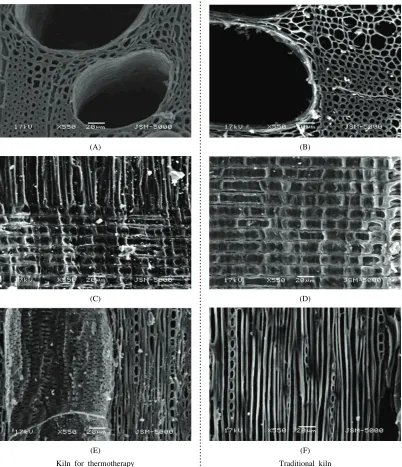
3.4. Anatomical characteristics
Fig. 2 shows photographs of three sections of
charcoals produced from a traditional charcoal kiln and
a charcoal kiln for both charcoal production and
thermotherapy, and these photographs were observed
by a scanning electron microscope. Generally, the
Characteristics of White Charcoal Produced from the Charcoal Kiln for Thermotherapy
(A) (B)
(C) (D)
(E) (F)
Kiln for thermotherapy Traditional kiln
Fig. 2. SEM images on cross sections(A,B), radial sections(C,D), and tangential sections(E,F) of white charcoal from the thermotherapy and traditional kilns.
Elder et al., 1979; Cutter et al., 1980; Kim and Hanna,
2006; Kwon et al., 2009 ), and archaeological aspects
have also been studied in relation to the identification
of species (Prior and Alvin, 1983, 1986; Prior and
Gasson, 1993; Angeles, 2001; Eom and Xu, 2010). The
in the anatomical characteristics based on the
manufacturing temperature from the results of the
scanning electron microscope analysis of charcoal
which was produced at various temperatures. In other
words, charcoal produced at 1000°C, which is almost
the same temperature used for white charcoal in this
study, made ducts and parenchymatous cells greatly
destroyed and deformed and cell walls much thinner
production and thermotherapy are as follows.
1. According to the technical analysis of the white
charcoal produced from the traditional charcoal
kiln and the one from the charcoal kiln for both
charcoal production and thermotherapy, the
moisture content was less than 10%, the ash
was little difference between the white charcoals
of the two kilns.
charcoal production and thermotherapy has the
characteristics similar to those of white charcoal
produced from the traditional charcoal kiln.
C NO
D
NT
This study was supported by the Forestry Science
and Technology Research and Development Project
(Project No: 2016008A00-1719-AB01) provided by
the Korea Forest Service.
following pyrolysis. Wood Science and Technology
14: 115-130.
Elder, T.J., Murphey, W.K., Blankenhorn, P.R. 1979.
A note on the thermally induced changes of
intervessel pits in black cherry (Prunus serotina
EHRH.). Wood Fiber 11(3): 179-183.
Eom, Y.G., Xu, G.Z. 2010. Wood identification of
neolithic charcoal excavated at giheung nongseori
ruins. Journal of the Korean Wood Sciences and
Technology 38(4): 275-281.
Fuse, T., Taki, M. 1987. Nonthermogenic effect of
far-infrared radiation with a wavelength of 100 gm
on biological organisms. Sekigaisen Gijutsu 12:
27-34.
Characteristics of White Charcoal Produced from the Charcoal Kiln for Thermotherapy
Chae, H.M., Kondo, T., Kimn N.H. 2017.
Carbonization characteristics of juvenile woods
from some tropical trees planted in indonesia.
Journal of the Faculty of Agriculture Kyushu
University 62 (1): 145-152.
Honda, K., Inoue, S. 1988. Sleep-enhancing effects of
far-infrared radiation in rats. International Journal
of Biometeorology 32: 92-94.
Hwang, W.J., Kwon, G.J., Lee, S.J., Park, H.S., Kim,
N.H. 2002. Anatomical characteristics of charcoals
carbonized in a Korean traditional kiln. Journal of
the Korean Forest Bioenergy Society 21(1): 49-55.
Jo, T.S., Lee, O.K., Ahn, B.J., Choi, J.W. 2006. Some
physical properties and adsorptive behaviors of
wood charcoal carbonized with domestic wood.
Journal of the Korean Forest Bioenergy Society
characteristics of Qurecus variabilis charcoal
prepared at different temperatures. Wood Science
and Technology 40: 392-401.
Kim, N.H., Hwang, W.J., Kwon, S.M., Kwon, G.J.,
Lee, S.J. 2006. Anatomy of Quercus variabilis
charcoal manufactured at various temperature.
Journal of the Korean Wood Sciences and
Technology 34(4): 1-8.
Korea Forest Service. 2018. 2016 Wood utilization
survey.
Kwon, G.J., Kwon, S.M., Jang, J.H., Hwang, W.J., Kim,
N.H. 2011. Charcoal properties and temperature
change of a kiln’s inner and outer walls in
carbonization process using an improved kiln.
Journal of the Korean Wood Sciences and
Technology 39(3): 230-237.
Kwon, S.M., Jang, J.H., Lee, S.H., Park, S.B., Kim,
N.H. 2013. change of heating value, pH and FT-IR
spectra of charcoal at different carbonization
temperatures. Journal of the Korean Wood Sciences
and Technology 41(5): 440-446.
Kwon, S.M., Kim, N.H., Cha, D.S. 2009. An
investigation on the transition characteristics of the
wood cell walls during carbonization. Wood Science
and Technology 43: 487-498.
Kwon, S.M., Kwon, G.J., Jang, J.H., Kim, N.H. 2012.
Characteristics of charcoal in different carbonization
temperatures. Journal of Forest Science 28(4):
263-267.
characteristics of the commercial wood charcoal
in Korea. Journal of the Korean Wood Sciences
and Technology 38(6): 480-489.
Mai, H.N., Sharma, N., Shin, E.J., Nguyen, B.T., Jeong,
J.H., Jang, C.H., Cho, E.H., Nah, S.Y., Kim, N.H.,
Nabeshima, T., Kim, H.C. 2018a. Exposure to far
infrared ray protects methamphetamine-induced
behavioral sensitization in glutathione peroxidase-1
knockout mice via attenuating mitochondrial
burdens and dopamine D1 receptor activation.
Neurochemical Research 43: 1118-1135.
Mai, H.N., Sharma, N., Shin, E.J., Nguyen, B.T.,
Nguyen, P.T., Jeong, J.H., Cho, E.H., Lee, Y.J.,
Kim, N.H., Jang, C.G., Nabeshima, T., Kim, H.C.
2018b. Exposure to far-infrared ray attenuates
methamphetamine-induced impairment in
kinase C inmale mice: Comparison with the
antipsychotic clozapine. Journal of Neuroscience
Research 96: 1294-1310.
McGinnes, E.A., Jr, Kandeel, S.A., Szopa, P.S. 1971.
Some structural changes observed in the
transformation of wood into charcoal. Wood Fiber
3(2): 77-83
National Institute of Forest Science. 2017. Standard and
specification of wood products. Notification No.
2017-9 of the National Institute of Forest Science.
Prior, J., Alvin, K.L. 1983. Structural changes on
charring woods of dichrostachys and salix from
southern Africa. International Association of Wood
Anatomists Bulletin 4(4): 197-206.
Prior, J., Alvin, K.L. 1986. Structural changes on
charring woods of dichrostachys and salix from
southern Africa: the effect of moisture content.
International Association of Wood Anatomists
Bulletin 7(3): 243-250.
Prior, J., Gasson, P. 1993. Anatomical changes on
charring six African hardwoods. International
Association of Wood Anatomists Journal 14(1):
77-86.
Tran T.H., Mai, H.N., Shin, E.J., Nam, Y.S., Nguyen,
B.T., Lee, Y.J., Jeong, J. H., Tran H.Y., Cho, E.H.,
Nah, S.Y., Lei, X.G., Nabeshima, T., Kim, N.H.,
Kim, H.C. 2016. Repeated exposure to far infrared
ray attenuates acute restraint stress in mice via
inhibition of JAK2/STAT3 signaling pathway by
induction of glutathione peroxidase-1. Neurochemistry