PERCEIVED INFLUENCE OF SOCIAL NETWORKING SITE ON THE ACADEMIC PERFORMANCE OF THE GRADE 10 STUDENTS
OF EVSU SLS AY 2016-2017
An Undergraduate Thesis Proposal Presented to the Faculty of the College of Education
Eastern Visayas State University
In Partial Fulfillment of the Requirements for the Degree Bachelor of Science in Industrial Education
and BT- HELE
CLAUDELYN P. LACABA AMIEL N. DUMPANG
ESEL O. LICARDO
Chapter 4
PRESENTATION, ANALYSIS AND INTERPRETATION OF DATA
The profile of the respondents, their personal answer to each question and the perception of the respondents about the impact of social networking are presented in this chapterThe student-respondents participated as illustrated in Table 1, the personal profile; Table 2 showed the data gathered as a result of respondents’ response confirming their
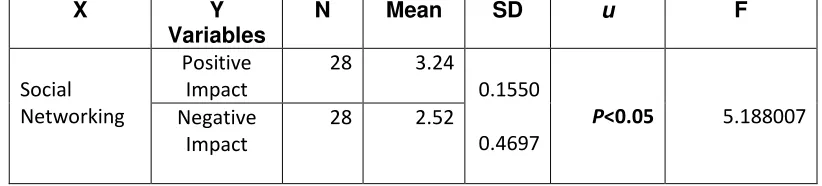
preferred choice of social network content; Table 3 are the data processed about the Perceived Effect of Social Networking to their academic achievements; and Table 4 showed the ANOVA Coefficient f as a result of testing the overall MEANS which suggested the significant difference between the academic achievements affected by Social Networking activities.
Table 1 Personal Profile
PROFILE FREQUENCY PERCENTAGE
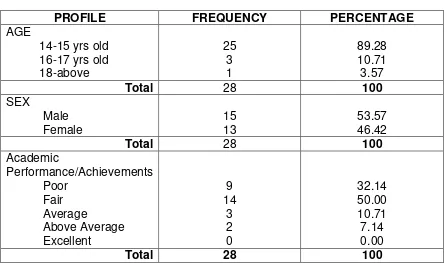
Table 1 in the preceding page showed that out of twenty eight respondents, twenty five (25) or 89.28% are 14-15 yrs old,16-17 yrs old respondents posted three (3) participants or 10.71%; and 18-above one (1) or 3.57% respondent.
The twenty eight respondents are participated by fifteen (15) Males or 53.57% of the total respondents; and thirteen (13) or 46.42% of the respondents are Females.
Academic Performance/Achievements of the respondents, nine (9) or 32.14% students are Poor performer/achievers; fourteen (14) or 50% are Fair; three (3) or 10.71% are Average; and two (2) or 7.14% are Above Average performer/achievers.
Table 2 showed the student-respondents’ Preferred Choice of Social Network Contents and Interaction. Most of the students, thirteen (13) or 46.42% of the total twenty eight (28) respondents spent at least or less than one hour in social networking; ten (10) or 35.71% among them spent 3-4 hours of their free time in studying.
Nineteen (19) students or 67.85% preferred “Sports” content; three (3) or 10.71% of the students spent hours in “Lifestyle” and two (2) each or 7.41% for “Celebrity,” “Religious.” “Articles“ and “News”.
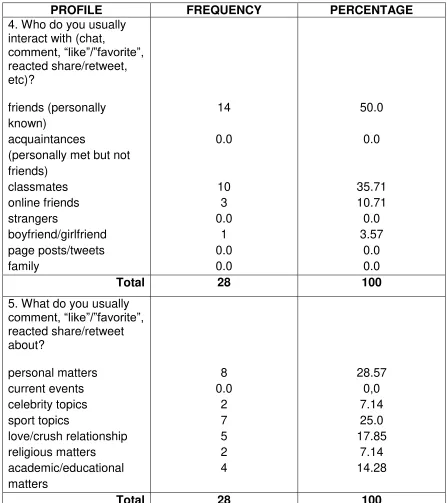
“Friends (personally knowns” are the most people whom the students interacted
with, followed by “Classmates” with fourteen (14) or 50% and ten (10) or 35.71%, respectively.
There is only One (1) student or 3.57% of the total respondents who interacted with “boyfriend/girlfriend.”
Table 2
Respondents’ Preferred Choice of Social Network Contents and Interaction
PROFILE FREQUENCY PERCENTAGE
1. Time spent in using social networking site per day (accumulated hours)
Table 2 cont’d.
PROFILE FREQUENCY PERCENTAGE
4. Who do you usually
The most “like”/”favorite” and or commented/replied by the students are “personal matters“ and “sports topic” with eight (8) or 28.57% and seven (7) or 25%,
respectively.
The students’ level of performances/achievements in relation to social networking activities can be analysed as with less significant effect as the “choice” of pages and
interaction are mostly non-academic related contents.
However, “Sports topic” topped over any other contents and discussions, and this
may affected the students in sports or P.E. knowledge. This further suggested that interests of the students are less likely inclined to core and and academic tracks which is reflected in their “poor” and “fair” performances which both are not satisfactory
outcome.
While interactions suggested that students spent more time with “friends” and “classmates” talking with “personal matters” and followed by second highest “Sport topic” which is a confirmation of truthfulness of students’ interests.
Why the students spent more time in social networking with “friends” and “classmates” despite of their frequent and regular meeting and togetherness?
Students’ behaviors suggested their comfort zones, learning style and personality are more effective in “private” group and comfortable company.
The comprehension and expressive thoughts and ideas of the students can be attributed to “kind” of company, “kind” of environment and “kind” of topic which part of
These analyses are supported by the information provided by the student-respondents who participated in this study. They learned “somethings” and accomplished some academic tasks in social networking with “friends.”
Table 3
Perceived Effect of Social Networking to Student-Respondents’ Academic Performances/Achievements
ITEMS Mean Interpretation
A. Academic Impact of Social Networking 1. I learned some academic matters from social
networking
3.29 Agree 2. I am aided in my assignments through friends in
social network
3.04 Agree 3. I learned about my academic concerns through
friends in social network
3.14 Agree 4. I learned things in social network which are not
discussed in school
3.25 Agree 5. I am challenged to study harder by what I see
and read about success stories in social network
3.5 Agree
Overall Mean 3.24 Agree
B. Academic Lags due to Social Networking 1. I am addicted to social networking and neglect
my school responsibilities
2.75 Not Sure 2. I prefer to read from friends posts/tweets than
my books
2.86 Not Sure 3. I am happy doing social networking (chat,
post/tweet, etc) than attending to my classes
2.29 Not Sure 4. I enjoy social networking much to the extent of
forgetting my school assignments
1.68 Disagree 5. I am excited in following social networking
posts/tweets than following my class subject topics
2.0 Disagree
6. My time for study is spent in social networking 2.14 Disagree 7. Social networking is more appealing for studying
due to graphics and animation than studying by the book in the library
2.39 Not Sure
8. Social networking is helpful in my studies and assignments
3.11 Disagree 9. My topic assignments are mostly found in social
networking
3.14 Disagree 10. I can effectively discuss with my
classmates/groupmates our class assignments or projects in social networking than in
classroom interface
2.86 Agree
Table 3 further confirmed that “Somethings” are learned by the students in social networking which are not discussed in classroom lecture and dynamics with a Mean of 3.25 which means “Agree”.
The question items in Part B of Table 3 confirmed that the students’ “Poor” and “Fair” performances/achievements are not related to social networking, mostly with “Disagree” responses.
Table 4
ANOVA Coefficient f Test Result of the MEANS which shows Significant Difference between the Academic Performances/Achievements affected by
Social Networking Activities.
X Y
Variables
N Mean SD u F
Social Networking
Positive Impact
28 3.24
0.1550 0.4697
P<0.05 5.188007 Negative
Impact
28 2.52
The obtained value of F is 5.188007 larger than the critical F-value of 0.05, thus the test result is significant at that level of probability. This is expressed as “there is a significant difference between the Academic performances/achievements influenced or
Chapter 5
CONCLUSION AND RECOMMENDATIONS
The study investigated a segment of students due to the continuous change in cultural and social aspects of people with the accordance of technological revolution, particularly the social networking essence in the face of the internet and web is still in question for the purpose of this research paper we have purposely focused on the perceived effects of social networking site on the study of the grade 10 students of Eastern Visayas State University.
The use of social networking has been wide spread that they have not only caught the attention of academic and industry researches worldwide but also us, in particular, social network are now being investigated by numerous social science researchers and or increasing member of academic commentators are becoming more and more interested in studying Facebook, Twitter, and other social networking service because of their probable impact on academic performance.
This research investigated some information about the perceived influence of social network by Grade 10 students of Eastern Visayas State University -SLS in relation to their academic performance. The study sought answers the following questions:
1. What is personal profiles of the respondents in term of the following: 1.1. Age
1.2. Gender
1.3. Academic Performance
1.5. Time allotted for studying
2. What are the perceived influences of social networking site? 3. What is the academic performance of the students?
4. Is there a significant difference between the personal profile of the Grade 10 students and social networking, and their academic performances?
The study found out that most students spent more time in social networking with “friends” and “classmates” despite of their frequent and regular meeting and
togetherness.
The findings are analysed and Students’ behaviors suggested their comfort zones, learning style and personality are more effective in “private” group and comfortable
company.
The comprehension and expressive thoughts and ideas of the students can be attributed to “kind” of company, “kind” of environment and “kind” of topic which part of
their interests that can stimulate their cognitive brain functions.
These analyses are supported by the information provided by the student-respondents who participated in this study. They learned “somethings” and accomplished some academic tasks in social networking with “friends.”
The question items in Part B of Table 3 confirmed that the students’ “Poor” and “Fair” performances/achievements are not related to social networking, mostly with “Disagree” responses.
In conclusion, the Null Hypothesis which is stated as ”There is no significant difference between the academic performances/achievement of the Grade 10 students
caused by social networking” is rejected.
The obtained value of F is 5.188007 larger than the critical F-value of 0.05, thus the test result is significant at that level of probability. This is expressed as “there is a
significant difference between the Academic performances/achievements influenced or
affected by Social Networking activities.”This is, however, limited to positive impacts to students’ learning outcome.
Recommendations
The researchers highly recommend the following based on the data gathered, processed and analyzed which concluded coherently and scientifically:
1. The Time Allotment by the students for social networking is quite fair. This must
be observed with consistency and reminders to make it a habit to have an average of 1-houror less social networking daily.
2. The students must be consistently reminded to do Social networking balanced with academic responsibilities, and mature priorities.
3. Further studies must be conducted for diagnosis of “poor” and “fair”
4. Development and implementation of Teachers’ training program for teaching skills advancement with psychological approaches to students’ interests, learning
styles and personality. Universality of approach and learning methods and materials left some students below the expected level of cognitive and behavioral knowledge and skills and performances.