25
Characteristics of nesting habitat
of sea turtle
Lepidochelys olivacea in
Lhoknga Beach, Aceh Besar District, Indonesia
Hindar Hindar1*, Zainal A. Muchlisin2, Faisal Abdullah3
1Magister Program of Integrated Coastal Management, Syiah Kuala University, Banda Aceh, Indonesia;
2Department of Aquaculture, Faculty of Marine and Fisheries, Syiah Kuala University, Banda Aceh,
Indonesia; 3 Department of Physics, Faculty of Sciences, Syiah Kuala University, Banda Aceh, Indonesia. Email: [email protected]
ABSTRACT
The purpose of this study was to determine the characteristics of nesting habitat of sea turtle in Lhoknga beach. The observation was conducted at three locations from January to March 2016. The study showed that the coastal slope average ranges 1.03 ° - 1.38 °. The average of nest temperature was 28.05 °C to 29.47 °C (inside the nest) and from 28.77 ° C to 29.95 ° C (at the surface of the nest). The width beach at high tide ranges from 20.17 m to 21.83 m and 31 m to 33.83 m at low tide. The nest humidity ranges from 20.5% -24.15%. There were six species of coastal vegetation recorded during the study, where station 1 has higher of density and diversity of the coastal vegetation. In general, Lhoknga Beach is suitable for nesting of the sea turtle. A total of 13 sea turtles (Lepidochelys olivacea) were nesting during the study, where station 1 had higher of nesting frequency.
Keywords: Lepidochelys olivacea; Habitat characteristics; Beach slope; Coastal vegetation.
INTRODUCTION
A total of 7 species sea turtles are recorded worldwide; of these, six species are found in Indonesia waters, namely, Chelonia mydas, Eremochelys imbricate, Lepidochelys olivacea), Caretta caretta, and
Natatorepresus (Juwana et al., 1999; Zamani, 1996). According to International Union for the Conservation of Nature (IUCN) all species of sea turtles have been listed as threatened and near-threatened species (Eckert et al., 1999; Hays, 2004; Broderick et al.,2006; McMahon et al., 2007). The hunting of brood and turtle eggs are the main factors causing the threat of turtle population (Setywatiningsih et al., 2011). In addition, the development in coastal areas such as port, coastal tourism infrastructure, and coastal embankment developments are also contributed to the disruption and decline of turtle nesting habitats (Nuitja, 1992; Setywatiningsih et al., 2011). In addition, the increasing of turtle mortality is also caused by marine pollution (Setywatiningsih et al., 2011), and bycatch of the tuna longline (Nugraha et al., 2017); Therefore, turtle conservation is crucially needed. One of the efforts to prevent the decline of the turtle population is by managing or conserve nesting site (Setywatiningsih et al., 2011).
Aceh Besar is one of the areas in Indonesia that has the potential of sea turtles. The local community supported by government agency and NGO has initiated the center for sea turtle conservation in this area (Muchlisin et al., 2012). According to Sari and Rahmad (2013), several species of turtles were recorded landed on the coastal area of Aceh Besar, namely hawksbill turtle
Eremochelys imbricate, the leatherback turtle Dermochelys coriacea, the green turtle Chelonia mydas, and the
Lepidochelys olivacea. One of the nesting locations is Lhoknga Beach (Personal communication with local fishermen). However, the number of sea turtle landed in Lhoknga Beach is decreasing over last 20 years (interviews with turtle breeding communities).
The frequency of the landed of turtles to lay their eggs is strongly influenced by the characteristics of the beach, such as beach slope, and sand type (Nuitja, 1992). The steeper the coast the greater the energy the turtles need to spawn, other than that the wide beach is well correlated with the area available for the nesting turtles (Sani, 2000; Setywatiningsih et al. 2011). Presently, there was no information on the characteristics of the Lhoknga Beach as a nesting area for the sea turtle
L. olivacea. This information is very useful to develop a conservation strategy of this species. Hence,
26
the objective of the present study was to explore and record the characteristics of Lhoknga Beach as a nesting habitat of the L. olivacea.
MATERIALS AND METHODS Site and time
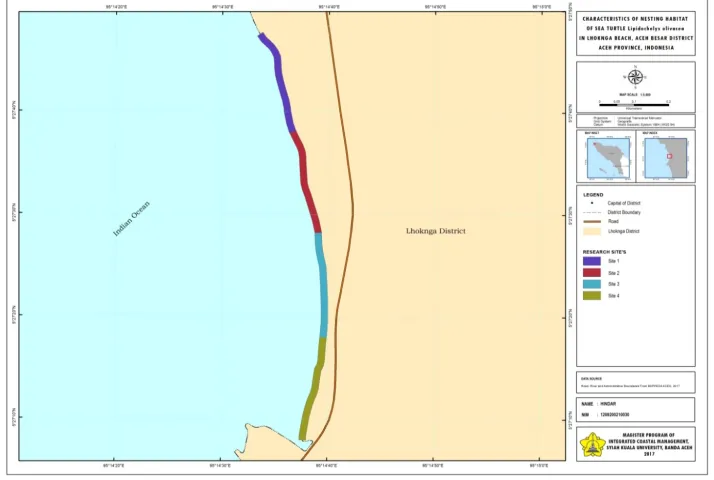
The study was conducted in Lhoknga Beach, Aceh Besar District, Indonesia from January to March 2016. The location of the research to be surveyed along the Lhoknga coastal area is approximately 1 km, it was divided into 4 stations and every station had the area about 250 m length x 20 m width (Figure 1). The beach width was perpendicular to the shoreline towards the land and the length was parallel to the shoreline.
Figure 1. The map of the study site at Lhoknga Beach, Aceh Besar
Measurement of the width and slope of the beach
The width and slope of the shore were measured at each station. The width of the beach was measured from the boundary of the vegetation with a line transect perpendicular to the highest and at lower tides marks. The coastal slope was measured using a theodolite digital. Theodolite was setting up parallel to the coastline at the highest tide limit. Then the theodolite was directed perpendicular to the ruler's board which was placed on the outer shelf of coastal vegetation (Sani, 2000) (Figure 2).
Coastal vegetation observation
27
Figure 2. Measurement of coastal slope (Sani, 2000)
Characteristic of the nest
The nest characteristic includes of temperature, sand size and texture, and humidity. The nest temperature was measured at the surface and inside of the nest using a mercury thermometer. A total of 500 gram of sand were taken using a hand Auger from the surface into 10 cm depth (surface) and at 30 cm to 40 cm (inside nest). The sand samples were put into a plastic jar the sealed properly. The samples were transported to Soil Laboratory of Faculty of Agriculture, Syiah Kuala University for further analysis of sand size, composition, texture, and humidity (Hermawan, 1992)
Monitoring of the turtle presence
Monitoring of turtle presence was conducted from January to March 2016. Monitoring was done at night. At the time of monitoring, the date, time, number of sea turtle presence, the species of sea turtle, the number of eggs, the length, and width of the carapaces were recorded (interviews with turtle breeding communities).
Data Analysis
The physics and biology data were presented in the tables of graphs then analyzed descriptively by comparing to the theories and others relevant references. The correlation between characteristics of the nest and turtle presence were performed using Pearson-correlation analysis at 95% confidence level. The one-way analysis of variant (one-way ANOVA) was used to test the effect of the habitat characteristic to the number of the turtle presence, if the p< 0.05 the data were subjected to multiple range test to find out the most preferred habitat types by the sea turtle (Table 3).
RESULTS Characteristic of the nest
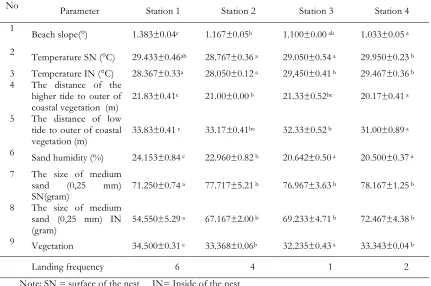
The study showed that average slope of the Lhoknga Beach ranged 1.03o to 1.38o. The higher slope was found at station 1 and the lower slope was recorded at station 4 (Table 1). The average of surface temperature of the nest ranges from 28.8 oC to 30.0 oC with the higher temperature was recorded at station 4 and the lower temperature was at station 2. While the average of the temperature inside the nest rages 28.1 oC to 29.5 oC where the higher inside nest temperature was recorded at 4 and the lower was at station 2 (Table 1).
The distance from outer of coastal vegetation to the high tide mark was 21.83 m at station 1, and the lower distance from recorded at station 4 (20.17 m), while at low tide, the higher distance to outer of coastal vegetation was also recorded at station 1 (33.83 m) and the narrow distance was
Highest Tide Limit
28
found at station 4 (31.0 m). The sand sizes of nest surface range from 7.13 gram to 7.82 gram, while the sand size inside of the nest ranges 5.46 gram to 7.25 gram, indicate that the sand size inside of the nest was smaller compared to the surface. In addition, the humidity ranges from 20.5% to 24.15 % where the higher humidity was recorded at station 1 (Table 1).
Vegetation and nesting frequency
There were six species of coastal vegetation was recorded during the study, namely; Ipomoea pes-caprae, Launaeasarmentosa, Pandanus tectorius, Terminalia catappa, Casuarinas equisetifolia, and Spinifex littoreus (Table 2). Based on Important Value Index showed that I. pe-caprae is predominant vegetation in all sampling sites followed by L. sarmentosa, where P. tectorius, T. catappa, and S. littoreusare only found at station 1 indicate station 1 has the higher diversity of vegetation compared to other sampling locations. The study revealed that a total of 13 sea turtles were landed for nesting during the study, further identification showed that only one species of the sea turtle was landed for nesting,
Lepidochelysolivacea. The sea turtle was frequently nesting in station 1 compared to other locations (Figure 3).
Table1. Characteristic of the nesting habitat of sea turtle Lepidochelys olivacea in the Lhoknga Beach, Aceh Besar, Indonesia
29
Table 2. Coastal vegetation in the study area of Lhoknga Beach, Aceh Besar, Indonesia
Figure 3. Nesting frequency of the sea turtle in Lhoknga Beach based on monthly observation
DISCUSSION
The study showed that Lhoknga Beach is categorized as a low slop with the moderate size of sand. The observation showed that sea turtle L. olivacea was frequently landed at station 1. This station has higher of the diversity of coastal vegetation and width of the sandbar. According to Sani (2004) and Setyawatiningsih et al. (2011) slope are strongly correlated with nesting frequency of the sea turtle; However, in general, the slope of the Lhoknga Beach is categorized as low sloping and there were no significant differences of sloping between the sites (Table 3).
30
Table 3. Result of correlation analysis between characteristics with turtle presence at each station
No
Parameter Station 1 Station 2 Station 3 Station 4
1
Beach slope(°) 1.383±0.04c 1.167±0.05b 1.100±0.00 ab 1.033±0.05 a
2
Temperature SN (°C) 29.433±0.46ab 28.767±0.36 a 29.050±0.54 a 29.950±0.23 b 3 Temperature IN (°C) 28.367±0.33a 28.050±0.12 a 29,450±0.41 b 29.467±0.36 b 4 The distance of the
higher tide to outer of coastal vegetation (m)
21.83±0.41c 21.00±0.00 b 21.33±0.52bc 20.17±0.41 a
5 The distance of low tide to outer of coastal vegetation (m)
33.83±0.41 c 33.17±0.41bc 32.33±0.52 b 31.00±0.89 a
6 Sand humidity (%) 24.153±0.84 c 22.960±0.82 b 20.642±0.50 a 20.500±0.37 a
7 The size of medium sand (0,25 mm) SN(gram)
71.250±0.74 a 77.717±5.21 b 76.967±3.63 b 78.167±1.25 b
8 The size of medium sand (0,25 mm) IN (gram)
54.550±5.29 a 67.167±2.00 b 69.233±4.71 b 72.467±4.38 b
9 Vegetation 34.500±0.31 c 33.368±0.06b 32.235±0.43 a 33.343±0.04 b
Landing frequency 6 4 1 2
Note: SN = surface of the nest IN= Inside of the nest
There were no significant differences in the temperature at the surface and inside of the nest(Table 3). The nest temperature is influencing the embryonic development and hatching rate (Kaska et al., 2006), where the optimum temperature was between 29°C to 33°C (Bustard, 1972 and Kaska et al., 2006). Besides, the nest temperature is also influencing the sex ration of the hatchling (larvae) of the sea turtle (Bustard, 1972; Booth and Freeman, 2006; Yusuf, 2000; Kaska et al., 2006). According to Khaisu (2013) and Crews et al. (2001) the high environmental temperature (>30 °C) the hatchlings to be a female and the low temperatures <30 °C to be the male.
31
CONCLUSION
Lhoknga Beach had the suitable characteristics for turtle nesting and the turtles sitting on the beach of Lhoknga was Lepidochelys olivacea. A total of 13 turtles were detected nesting on the beach of Lhoknga during the study, where the sea turtle was nesting frequently in the location 1 which has higher density and varied coastal vegetation.
REFERENCES
Booth, D., T., E. C. Freeman. 2006. Sand and nest temperatures and an estimate of hatchling sex ratio from the Heron Island green turtle (Chelonia mydas) rookery, Southern Great Barrier Reef. Coral Reefs, 25: 629-633.
Broderick, A., C.R. Frauenstein, F. Glen, A.I. Jackson, T. Pelembe. 2006. Are green turtles globally endangered ?. Global Ecology and Biogeography, 15: 21-26.
Bustard, R. 1972. Sea turtle, natural history, and conservation. Collins, London.
Crews, D., A. Fleming, E. Willingham, R. Baldwin, J.K. Skipper. 2001. Role of steroidogenic factor I and aromatase in temperature-dependent sex determination in the red-eared slider turtle. Journal of Experimental Zoology, 290(6): 597-606.
Eckert, K.L., K.A. Bjorndal, F. A. Abreu-Grobois, M. Donnely. 1999. Research and management techniques for conservation of sea turtles. IUCN/SSC Marine Turtle Specialist Group. Washington USA.
Ewert, M.A., D.R. Jackson, C.E. Nelson. 1994. The pattern of temperature-dependent sex determination turtles. The Journal of Experimental Zoology, 270: 3-15
Hays, G.C. 2004. Conservation of turtles. Trends in Ecology and Evolution, 19(10): 512-513. Hermawan, D. 1992. Study of hawksbill turtle nesting habitat (Eretmochelys Imbricata) on the
eastern and western islands of eastern islands Seribu National Park Jakarta. Faculty of Fisheries Department of Aquatic Resources Management. Institut Pertanian Bogor, Bogor.
Juwana, S., K. Romimohtarto. 1999. Marine biology research and development center for oceanography. Indonesia Institute of Sciences (LIPI), Jakarta.
Kaska, Y., C. Ilgaz, A., Ozdemir, M. Stachowitsch, I. Baran. 2006. Sex ratio estimations of loggerhead sea turtle hatchlings by histological examination and nest temperatures at Fethiye Beach, Turkey. Naturwissenschaften, 93: 338–343
Khaisu, MS. 2013. Turtle conservation efforts (Lepidochelys olivacea)in TWA Air Hitam Kab. Muko muko Provinsi Bengkulu. Report PKL Institute Pertanian Bogor, Bogor.
Kusmana, C. 1997. Method of vegetation survey. PT. Agriculture Institute Bogor, Bogor.
McMahon, C.R., C.J. Bradshaw, G.C. Hays. 2007. Satellite tracking reveals unusual diving characteristics for a marine reptile, the Olive ridley turtle Lepidochelys olivacea. Marine Ecology Progress Series, 329: 239-252.
Muchlisin, Z.A., M. Nazir, M. Musman. 2012. Pemetaan potensi daerah untuk pengembangan kawasan minapolitan di beberapa lokasi dalam Provinsi Aceh: suatu kajian awal. Depik, 1(1): 68-77.
Nugraha, B., I. Jatmiko, H. Hartaty. 2017. Penanganan penyu yang tertangkap rawai tuna di Samudera Hindia. Depik, 6(1): 60-71.
32
Riandi, F., W. Sari, M. Muhammadar. 2017. Pengaruh naungan terhadap pertumbuhan embrio penyu lekang (Lepidochelysolivacea) di Lhok Pante Tibang Syiah Kuala, Banda Aceh. Jurnal Ilmiah Mahasiswa Kelautan dan Perikanan Unsyiah, 2(1): 119-129.
Rofiah, A., R. Hartati, E. Wibowo. 2012. The effect of shade on the percentage of turtle egg hatchery (Lepidochelys olivacea) in Samas Bantul Beach, Yogyakarta. Journal of Marine Research, 1(2): 103-108.
Sani, A., A. 2000. Biophysical characteristics of spawning habitat and association with nesting nest of the green turtle (Chelonia mydas) in Sindang Kerta Beach, Cipatujah, Tasikmalaya, West Java. Thesis, Institute Pertanian Bogor, Bogor.
Sari, W., Rahmad. 2013. The Utilization of sea turtles by the coastal communities in the City of Banda Aceh. Faculty of Sciences, Syiah Kuala University, Banda Aceh.
Setyawatiningsih, S. C., D. Marniasih, Wijayanto. 2011. Biophysical characteristics of hawksbill breeding sites (Eretmochelys imbricata) on island Anak Ileuh Kecil Riau. Jurnal Teknologi Biologi, 2(1): 17-22.
Zamani, N.P. 1996. Sea turtle, reptiles approaching extinction. Water Science Journals and Fisheries Indonesia, 4(2): 91-97.